
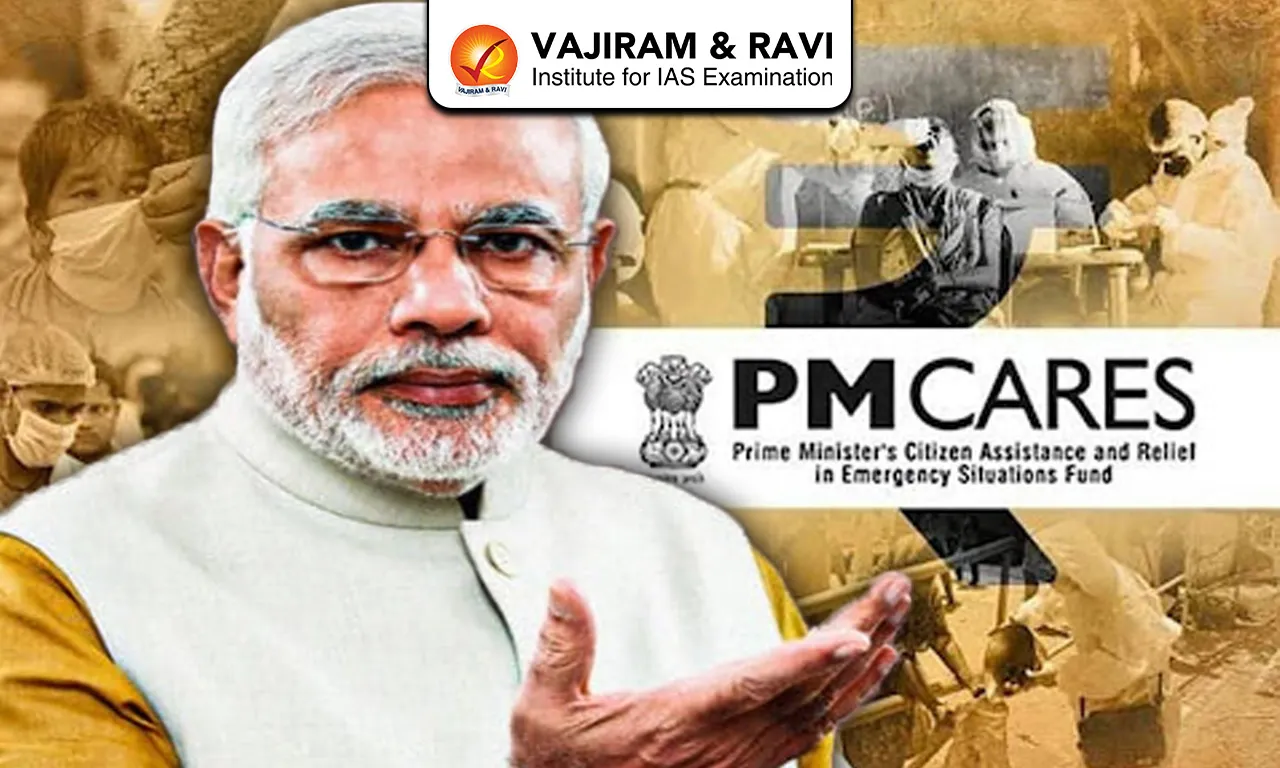
PM CARES Latest News
- The Prime Minister’s Office (PMO) has informed the Lok Sabha Secretariat that questions or matters related to the PM CARES Fund, the Prime Minister’s National Relief Fund (PMNRF), and the National Defence Fund (NDF) are not admissible under Lok Sabha rules.
- The PMO cited Rule 41(2)(viii) and Rule 41(2)(xvii) of the Rules of Procedure and Conduct of Business in Lok Sabha to state that such questions and discussions cannot be taken up in Parliament.
PM CARES Fund, PMNRF and NDF: What Are These Funds
- The PM CARES Fund was set up on March 27, 2020, in the wake of the Covid-19 pandemic.
- It was created to deal with emergency and distress situations and to provide relief during crises such as public health emergencies.
- Full name: Prime Minister’s Citizen Assistance and Relief in Emergency Situations Fund
- Legal status: Public Charitable Trust
- Registered under the Registration Act, 1908, in New Delhi
- Fund balance (March 2023): ₹6,283.7 crore (as per latest available report)
Prime Minister’s National Relief Fund (PMNRF)
- The Prime Minister’s National Relief Fund was established in January 1948, originally to assist refugees displaced from Pakistan after Partition.
- Over time, its scope expanded and it is now primarily used to:
- Provide immediate relief to families affected by natural calamities such as floods, cyclones, and earthquakes
- Assist victims of major accidents and riots
- The fund is financed through public contributions and is controlled by the Prime Minister’s Office.
National Defence Fund (NDF)
- The National Defence Fund is dedicated to the welfare of Armed Forces personnel, including paramilitary forces, and their dependents.
- It is
- Used for financial assistance and welfare measures
- Administered by an Executive Committee
- Chaired by the Prime Minister, with the Defence, Finance, and Home Ministers as members
Common Feature
- All three funds:
- Are controlled or administered by the Prime Minister’s Office
- Receive voluntary public contributions
- Operate outside the Consolidated Fund of India, which has implications for parliamentary scrutiny
Government’s Stand on PM CARES Fund: Past Position Explained
- Public Charitable Trust, Not a Statutory Body - In January 2023, the Union government told the Delhi High Court that the PM CARES Fund is a public charitable trust, not created under the Constitution or by any law enacted by Parliament or a State legislature.
- Not ‘State’ Under Article 12 - The submission came in response to a plea seeking to declare PM CARES a “State” under Article 12 to ensure transparency.
- The Centre argued that the trust is neither owned nor controlled by the government, and that trustees holding public office do so for administrative convenience, not governmental control.
- RTI Act Not Applicable - The government’s affidavit further stated that since PM CARES is not constituted under law or the Constitution, it does not qualify as a public authority under the Right to Information Act, and therefore is outside the RTI framework.
Supreme Court’s Ruling on the PM CARES Fund
- In August 2020, the Supreme Court of India refused to direct the transfer of money from the PM CARES Fund to the National Disaster Response Fund (NDRF).
- The Court held that the two are “entirely different funds” with distinct objectives and purposes, leaving “no occasion” for such a direction.
- The Court noted that:
- The NDRF is audited by the Comptroller and Auditor General of India (CAG) under specific guidelines
- The PM CARES Fund, being a public charitable trust, does not fall under those guidelines, and therefore no CAG audit can be mandated
Why Lok Sabha Questions on PM CARES, PMNRF and NDF Are Not Admissible
- The PMO has directed the Lok Sabha Secretariat not to admit questions or matters related to the PM CARES Fund, PMNRF, and the National Defence Fund on the ground that these funds are entirely financed through voluntary public contributions.
- Since they do not receive any allocation from the Consolidated Fund of India, they fall outside the scope of parliamentary scrutiny under Lok Sabha rules.
- This reasoning aligns with the Centre’s earlier position before courts that these funds are non-statutory, trust-based entities, not government funds subject to legislative oversight.
Rules Cited to Bar Lok Sabha Questions on PM CARES, PMNRF and NDF
- The PMO informed the Lok Sabha Secretariat that questions or matters related to PM CARES Fund, PMNRF and the National Defence Fund are not admissible under specific provisions of the Rules of Procedure and Conduct of Business in Lok Sabha.
Rule 41(2)(viii): Not a Government Concern
- This rule bars questions that do not relate primarily to the concern of the Government of India.
- The PMO argued that since the three funds are financed through voluntary public contributions and are not part of the Consolidated Fund of India, they do not fall under the government’s primary administrative domain.
Rule 41(2)(xvii): Outside Government Control
- This provision states that questions cannot raise matters under the control of bodies or persons not primarily responsible to the Government of India.
- The PMO maintained that these funds operate as independent trusts, and hence are not directly accountable to the government in a manner that would permit parliamentary questioning.
PM CARES FAQs
Q1: What do the PMO directives on PM CARES state?
Ans: PMO directives on PM CARES clarify that Lok Sabha questions on PM CARES, PMNRF and NDF are not admissible under Rules of Procedure governing parliamentary business.
Q2: Why are PMO directives on PM CARES linked to parliamentary rules?
Ans: PMO directives on PM CARES rely on Rule 41(2)(viii) and 41(2)(xvii), which bar questions not primarily concerning the Government of India or bodies not accountable to it.
Q3: How does funding structure justify PMO directives on PM CARES?
Ans: PMO directives on PM CARES argue these funds rely entirely on voluntary public contributions and receive no money from the Consolidated Fund of India.
Q4: What has been the government’s legal position supporting PMO directives on PM CARES?
Ans: PMO directives on PM CARES align with the Centre’s stand that PM CARES is a non-statutory public charitable trust, not a “State” under Article 12.
Q5: What is the constitutional implication of PMO directives on PM CARES?
Ans: PMO directives on PM CARES effectively limit parliamentary oversight by classifying PM CARES, PMNRF and NDF as trust-based entities beyond routine legislative questioning.

