India’s Heritage Reclaimed Latest News
- Earlier this month, the Smithsonian’s National Museum of Asian Art (NMAA) announced it will return three historic bronze sculptures to the Government of India, acknowledging they were illegally removed from temple settings.
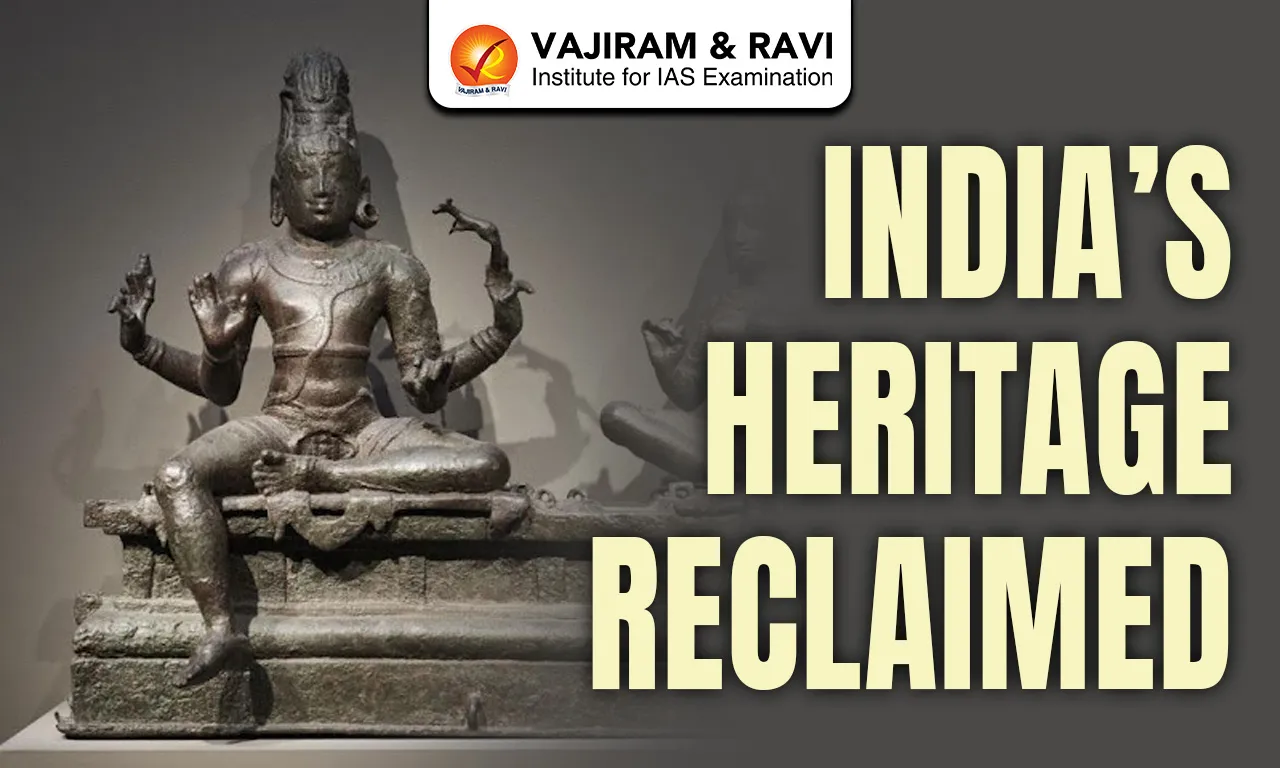
- The artefacts include: Shiva Nataraja (Chola period, ca. 990); Somaskanda (Chola period, 12th century); Saint Sundarar with Paravai (Vijayanagar period, 16th century).
- The decision aligns with a global push for restitution of looted or illicitly trafficked cultural property to Asian countries such as Cambodia, Indonesia, Sri Lanka, and Thailand.
- As part of this broader effort, the United States returned 297 Indian antiquities in 2024 alone.
- Of the three bronzes, two will be physically repatriated to India, while the Shiva Nataraja will remain at the Smithsonian on a long-term loan.
- The return follows detailed provenance research that traced their unlawful removal, underscoring growing institutional accountability in global museum practices.
The Three Bronzes: Sacred Origins and Iconography
- All three sculptures were sacred processional bronzes, traditionally carried during temple rituals, reflecting the refined bronze-casting traditions of South India.
- These were not decorative objects but living icons central to worship and ceremonial life.
Shiva Nataraja: Lord of the Dance
- The Shiva Nataraja bronze originated from the Sri Bhava Aushadesvara Temple in Tamil Nadu’s undivided Thanjavur district.
- It portrays Shiva as “Lord of the Dance”, performing the ananda tandava (dance of bliss), symbolising cosmic creation, preservation, and destruction.
Somaskanda: The Divine Family
- The Somaskanda bronze traces its provenance to the Visvanatha Temple in Mannargudi, Tamil Nadu.
- It depicts:
- Shiva seated with Parvati (Uma)
- Their son Skanda, who may sit between or dance around them
- Notably, the NMAA sculpture is missing Skanda.
- According to experts, Skanda was often cast separately and was typically the first figure to be lost or separated.
- Archival photographs show Skanda was already missing by 1959.
- Crucially, provenance research revealed that buried or damaged bronzes could later be reinstalled in temples, challenging earlier scholarly assumptions that burial meant permanent removal from ritual use.
Saint Sundarar with Paravai: Devotion in Bronze
- The third sculpture depicts Saint Sundarar and his wife Paravai, originally from a Shiva temple in Veerasolapuram village, Tamil Nadu.
- The couple were influential Shaivite saints, credited with spreading Shiva worship in eighth-century southern India, and are deeply revered in Tamil religious tradition.
Living Icons, Not Museum Objects
- According to the NMAA, such images were:
- Housed in dedicated shrines for most of the year
- Once annually subjected to elaborate ritual bathing (abhisheka) using water, milk, yogurt, honey, sandalwood paste, and sacred ash
- Then dressed in ceremonial robes
How the Three Bronzes Entered the Smithsonian’s Collection
- The three bronzes had been part of the Smithsonian’s National Museum of Asian Art (NMAA) collections for decades.
- They came under scrutiny during a systematic provenance review, which revealed gaps and inconsistencies in their documentation, according to the museum’s provenance team.
- The bronzes were acquired during a period when museum collecting standards were less stringent.
- Today, NMAA requires documentary proof of legal export, assessed against the UNESCO 1970 Convention, alongside export permits, seller consent, and a complete ownership trail, factoring in colonial and geopolitical contexts.
- A 2023 collaboration with the French Institute of Pondicherry photo archives confirmed that the bronzes were photographed in situ in Tamil Nadu temples between 1956 and 1959.
- The Archaeological Survey of India subsequently reviewed the findings and confirmed the sculptures were removed in violation of Indian law.
- While the exact circumstances of removal remain unclear, the museum established that the bronzes appeared in US markets or collections after the 1950s and passed through dealers linked to illicit antiquities.
- There is no evidence of lawful export from India.
Why the Smithsonian Is Returning the Bronzes
- The Smithsonian’s National Museum of Asian Art (NMAA) stated that the decision reflects its commitment to responsible stewardship of cultural heritage and greater transparency.
- NMAA began its restitution efforts in 2002, making it one of the earlier US museums to address issues of illicitly acquired cultural property.
- The institution acknowledges that many artefacts were transferred over the past two centuries without the consent of local communities.
What Restitution Means for India
- Restoring Legal and Cultural Ownership - Restitution ensures that India regains legal title over artefacts that rightfully belong to it. While ownership returns to the Government of India, objects may remain on long-term loan, allowing them to be displayed internationally while acknowledging their true origin.
- Ethics and International Goodwill - The provenance research and return process reflect ethical museum practice and foster diplomatic goodwill. Restitution signals recognition of historical wrongs and builds trust between source nations and global institutions.
- Opportunities for Cultural Collaboration - Repatriation can open doors to long-term cultural partnerships.
- For example, after returning three sculptures to Cambodia—one remaining on loan—the museum collaborated on a five-year exhibition project in 2023.
- Such arrangements allow source countries to showcase their heritage globally through structured cooperation.
- Expanding Global Cultural Presence
- For India, restitution does not necessarily mean withdrawal from global spaces. Instead, it can:
- Strengthen India’s cultural diplomacy
- Promote curated international exhibitions
- Ensure wider global engagement with Indian heritage
- For India, restitution does not necessarily mean withdrawal from global spaces. Instead, it can:
India’s Heritage Reclaimed FAQs
Q1: Why is India’s Heritage Reclaimed in the news?
Ans: India’s Heritage Reclaimed is in the news after the Smithsonian’s National Museum of Asian Art decided to return three sacred South Indian bronzes removed illegally from temples.
Q2: Which artefacts are part of India’s Heritage Reclaimed?
Ans: India’s Heritage Reclaimed includes Shiva Nataraja, Somaskanda, and Saint Sundarar with Paravai—Chola and Vijayanagar period bronzes originally worshipped in Tamil Nadu temples.
Q3: How did provenance research support India’s Heritage Reclaimed?
Ans: India’s Heritage Reclaimed followed archival evidence, temple photographs, and verification by the Archaeological Survey of India confirming unlawful removal and lack of legal export documentation.
Q4: Why is India’s Heritage Reclaimed significant globally?
Ans: India’s Heritage Reclaimed reflects a wider global restitution movement where museums reassess colonial-era acquisitions and return looted cultural property to rightful nations.
Q5: What does India’s Heritage Reclaimed mean for cultural diplomacy?
Ans: India’s Heritage Reclaimed strengthens cultural sovereignty while enabling long-term loans and collaborative exhibitions, enhancing India’s global cultural presence and ethical museum partnerships.

