
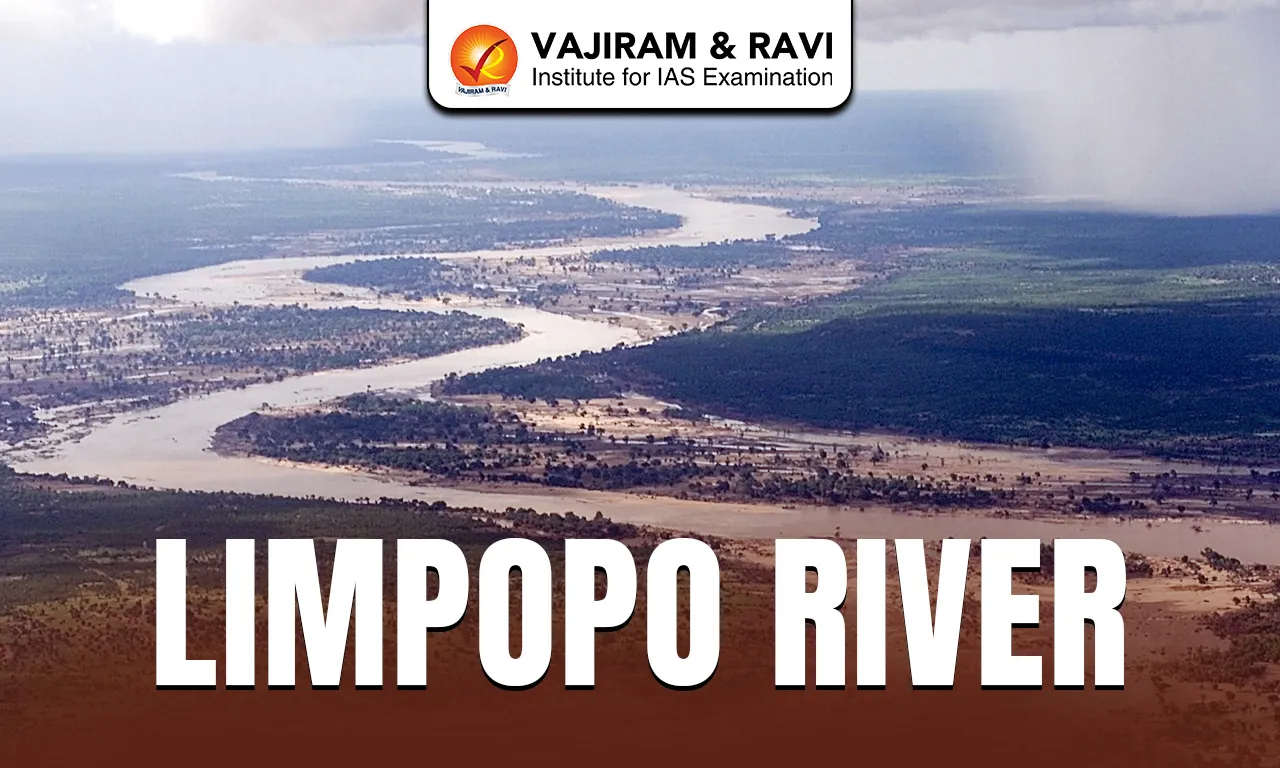
The Limpopo River is one of the major rivers of Southern Africa. It flows across four countries and forms an important transboundary river system.It is often referred to as the “Crocodile River” because of the large population of crocodiles found along its course.
Limpopo River Source and Origin
- The Limpopo River originates from the confluence of the Marico and Crocodile rivers near the South Africa-Botswana border.
- The crocodile river originates near the Witwatersrand region located within Highveld Plateau.
Read about: Darling river
Limpopo River Course
- Along its course, the Limpopo river initially flows northward and forms parts of the international boundaries between South Africa and Botswana and later between South Africa and Zimbabwe.
- The river then turns eastward, enters Mozambique, where it flows across a relatively flat coastal plain. In Mozambique, the river becomes broader and slower, increasing flood risk during periods of heavy rainfall.
- Finally, the Limpopo drains into the Indian Ocean, completing a course of about 1,750 km.
- Along its course, it crosses the Tropic of Capricorn twice.
Limpopo River Tributaries
Most tributaries are ephemeral or seasonal, reflecting the semi-arid climate of the basin. Major tributaries are:
- The Olifants River is the largest and most significant tributary of the Limpopo.
- The Shashe River flows from Zimbabwe and Botswana and joins the Limpopo near the tri-junction of South Africa, Botswana, and Zimbabwe.
- The Mwenezi River, originating in Zimbabwe, contributes seasonal flows and is prone to drought-related drying.
- The Notwane River, flowing through Botswana.
Limpopo River Drainage Basin
- The Limpopo River basin covers approximately 415,000 square kilometres, making it one of the major river basins of Southern Africa.
- The basin spans four countries: South Africa (largest share), Botswana, Zimbabwe and Mozambique.
- Large parts of the basin lie in semi-arid to arid climatic zones, receiving low and irregular rainfall.
Limpopo River Dams and Reservoirs
The Limpopo basin contains several dams and reservoirs, primarily constructed for irrigation, water supply, flood control, and limited hydropower. Major Dams are :
- Massingir Dam (Mozambique)
- Loskop Dam (South Africa)
- Flag Boshielo Dam (South Africa)
- Notwane Dam (Botswana)
Ecologically, the Limpopo Basin supports savannah grasslands and diverse wildlife typical of southern Africa. Parts of the famous Kruger National Park lie within the basin
Limpopo River FAQs
Q1: Limpopo river through which countries?
Ans: The Limpopo River flows through South Africa, Botswana, Zimbabwe, and Mozambique.
Q2: Where does the Limpopo River originate?
Ans: The Limpopo River originates from the confluence of the Marico River and the Crocodile River near the South Africa–Botswana border.
Q3: Limpopo River drains into which ocean?
Ans: The Limpopo River drains into the Indian Ocean in Mozambique.
Q4: Which is the largest tributary of the Limpopo River?
Ans: The Olifants River is the largest and most significant tributary of the Limpopo.
Q5: What is the approximate size of the Limpopo River basin?
Ans: The basin covers about 415,000 square kilometres across four southern African countries.

