
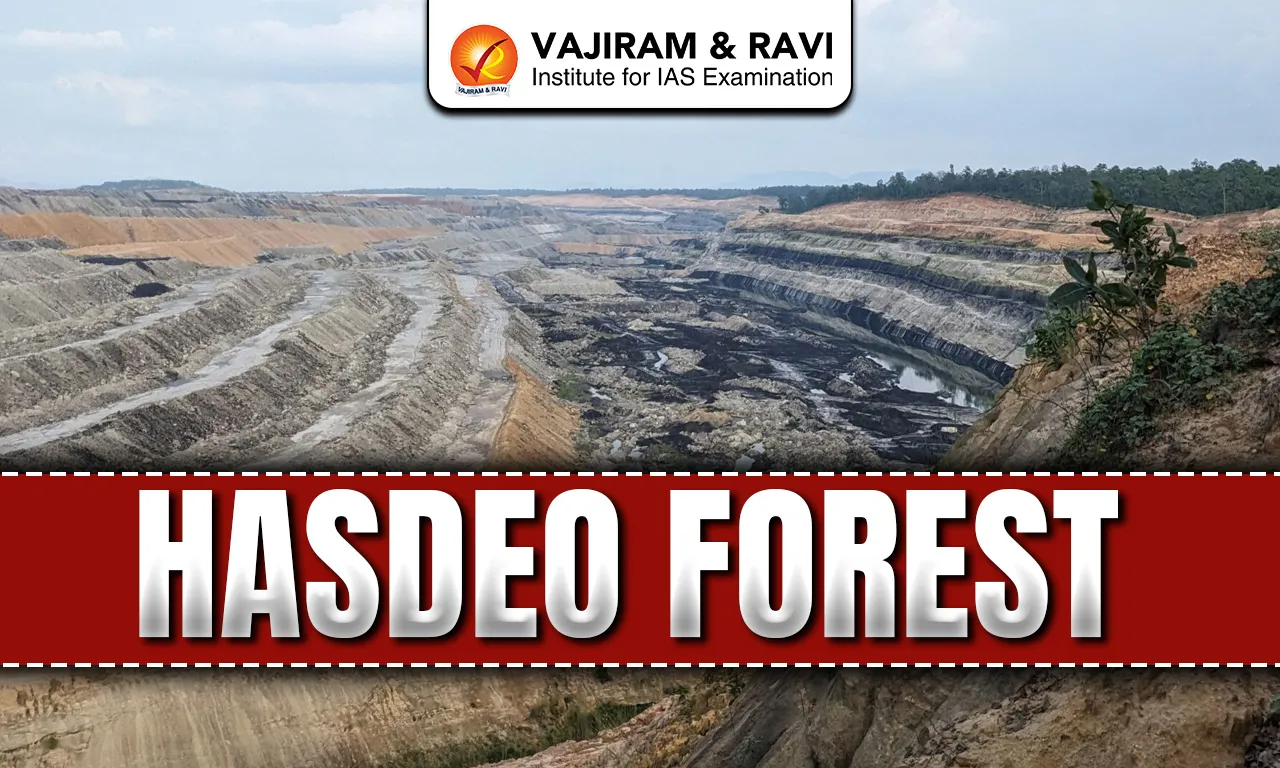
Hasdeo Forest, also known as Hasdeo Arand, is a vast forest region located in northern Chhattisgarh across Korba, Surajpur and Surguja districts. It is spread over nearly 1,70,000 hectares of area and is considered the largest unfragmented forest landscape in Central India. Beneath this dense forest lies the Hasdeo Arand Coalfield, one of India’s significant coal bearing areas, making the region ecologically valuable as well as economically sensitive.
Hasdeo Forest
Hasdeo Forest is often called the “Lungs of Chhattisgarh” because of its dense Sal and teak cover and high biodiversity. The forest forms a crucial water catchment for the Hasdeo River and supports thousands of tribal people. It is also an important elephant habitat and wildlife corridor that links central Indian forest landscapes and maintains ecological continuity.
Hasdeo Forest Features
The major features of the Hasdeo Forest has been listed below:
- Location: Hasdeo Forest is situated in northern Chhattisgarh across Korba, Surajpur and Surguja districts.
- Climate: The region experiences a tropical climate with distinct summer, monsoon and winter seasons. Dense forest cover helps regulate local temperature, maintain humidity levels and support perennial water flow in the Hasdeo River basin.
- Human Settlement: Around 10,000 people reside within and around the forest area.
- Tribes: Major tribal communities include Gond and Oraon groups, who have traditionally lived in forest villages for generations.
- Hasdeo Arand Coalfield: The region has significant coal reserves beneath its surface, with 23 identified coal blocks containing 1.369 billion tonnes of proven and 5.179 billion tonnes of estimated coal reserves.
- River System: The Hasdeo River flows through the forest and is a major tributary of the Mahanadi.
- Hasdeo Bango Dam: The forest acts as a catchment area and supports the dam, which irrigates nearly 3,00,000 hectares to six lakh acres of farmland.
- Vegetation: The forest is dominated by dense Sal (Shorea robusta) and teak trees. It supports around 640 plant species, including medicinal plants, timber yielding species and several threatened vegetation types.
- Wildlife Habitat: The region supports bird species, mammal species and snake species.
- Elephant and Tiger Corridor: The region forms a major migratory pathway for elephants and provides habitat continuity for large mammals, preventing genetic isolation and maintaining central Indian wildlife connectivity.
Also Read: Temperate Rainforest
Hasdeo Forest Mining Issue
Coal extraction proposals have triggered ecological, legal and social controversy over forest diversion and tribal rights.
- Coal was discovered under Hasdeo Forest and in 2010 the area was first marked as a “no-go” zone for mining because of its dense forest and wildlife value. However, within a year this decision was changed and permission was given to start coal mining in one part of the forest.
- The mining project was planned in two phases by clearing large areas of forest land. Thousands of hectares were marked for diversion and lakhs of trees were proposed to be cut. This created fear among local villagers that their forests and farmland would be permanently damaged.
- Many tribal communities living in the forest depend on it for farming, forest produce, water and daily income. They argued that mining would destroy their livelihoods and force them to leave their homes. They also claimed that proper consent of village councils was not taken honestly. Hasdeo Bachao Sangharsh Samiti was established to protect forests.
- The issue reached environmental courts, where mining was temporarily stopped at one stage due to ecological concerns. Later, higher courts allowed work to continue while the case remained pending. Meanwhile, coal extraction increased rapidly and a large portion of reserves was already used.
- In recent years, when expansion of mining and fresh tree cutting began, strong protests started again. Villagers demanded cancellation of new mining blocks and protection of the forest. The state government announced that some new areas would not be mined, but tension over ongoing mining activities still continues.
Also Read: Types of Forests in India
Way Forward
Balanced ecological protection and energy planning are essential to safeguard forest integrity and livelihoods.
- Protection of Lemru Reserve Forest: Activists demand safeguarding nearly 1,995 sq km Lemru Reserve area to secure elephant corridors and prevent further fragmentation.
- Sustainable Energy Transition: Improved utilisation of existing coal blocks, efficient blending strategies and gradual shift to renewable sources can reduce pressure on untouched forest tracts.
- Independent Ecological Monitoring: Wildlife Institute of India and independent scientific bodies should conduct periodic biodiversity audits and cumulative impact assessments before expansion approvals.
- Integrated River Basin Management: Protecting catchment forests of the Hasdeo River will secure irrigation for lakhs of hectares and maintain water flow into the Mahanadi basin.
Hasdeo Forest Biodiversity
Hasdeo Forest supports rich biological diversity with dense Sal forests, diverse plant species and protected wildlife populations as highlighted below:
Flora
- Sal and Teak Dominance: The forest is primarily composed of pristine Sal (Shorea robusta) and teak forests, forming one of the largest continuous natural forest stretches in Central India with dense canopy cover and minimal fragmentation.
- Plant Species: Around 640 plant species are recorded in the region, reflecting high ecological variety across forest layers including trees, shrubs, herbs and climbers adapted to central Indian climatic conditions.
- Medicinal Plants: Nearly 128 plant species have medicinal value and are traditionally used by Gond and Oraon tribal communities for primary healthcare and herbal treatments.
- Timber: Approximately 40 species provide commercially valuable timber, contributing to regulated forest based economic activities while maintaining structural stability of the ecosystem.
- Threatened Vegetation: Earlier ecological surveys identified 167 vegetation varieties, out of which 18 are categorised as threatened, indicating conservation urgency in specific microhabitats within the forest.
- Catchment Vegetation: The dense root systems of forest vegetation help maintain soil stability, regulate groundwater recharge and sustain perennial flow of the Hasdeo River basin.
Fauna
- Mammals: The forest supports 25 species of mammals, including large carnivores and herbivores, forming an important wildlife assemblage within Central India’s forest landscape.
- Schedule I Protected Species: Nine species receive highest protection under the Wildlife Protection Act, 1972, including elephant, leopard, sloth bear, Indian grey wolf, pangolin and four horned antelope.
- Elephants: Hasdeo functions as a major migratory corridor for elephants, ensuring seasonal movement and genetic exchange between forest divisions in Chhattisgarh and adjoining regions.
- Tigers: Confirmed tiger sightings highlight its role as a secondary tiger habitat and an extension of broader central Indian carnivore landscapes.
- Avifauna: Around 92 bird species are documented, including forest dependent and migratory birds, indicating strong ecosystem health and layered habitat structure.
- Reptiles: At least 16 snake species inhabit the region, reflecting ecological balance across trophic levels and availability of prey species.
- Butterflies: The forest also harbours endangered butterfly species, which act as ecological indicators of habitat quality and climatic stability.
Hasdeo Forest FAQs
Q1: Where is Hasdeo Forest located?
Ans: Hasdeo Forest, also known as Hasdeo Arand, is located in northern Chhattisgarh across Korba, Surajpur and Surguja districts. It spreads over nearly 1,70,000 hectares and forms part of the Hasdeo River basin.
Q2: Why is Hasdeo Forest called the “Lungs of Chhattisgarh”?
Ans: It is called the “Lungs of Chhattisgarh” because of its dense Sal and teak forests, rich biodiversity and its role in maintaining ecological balance and water security in the region.
Q3: What is Hasdeo Arand Coalfield?
Ans: The Hasdeo Arand coalfield covers about 1,879.6 sq km and contains 23 coal blocks with over 1.369 billion tonnes of proven coal reserves and 5.179 billion tonnes of estimated reserves.
Q4: Which tribal communities live in Hasdeo Forest?
Ans: Around 10,000 tribal people, mainly from the Gond and Oraon communities, live in the forest. Nearly 60-70% of their annual income depends on forest based resources.
Q5: Why are there protests against mining in Hasdeo Forest?
Ans: Protests for Hasdeo Forest have emerged due to concerns about large scale tree cutting, biodiversity loss, displacement of tribal communities and alleged irregularities in Gram Sabha consent for coal mining projects.

