
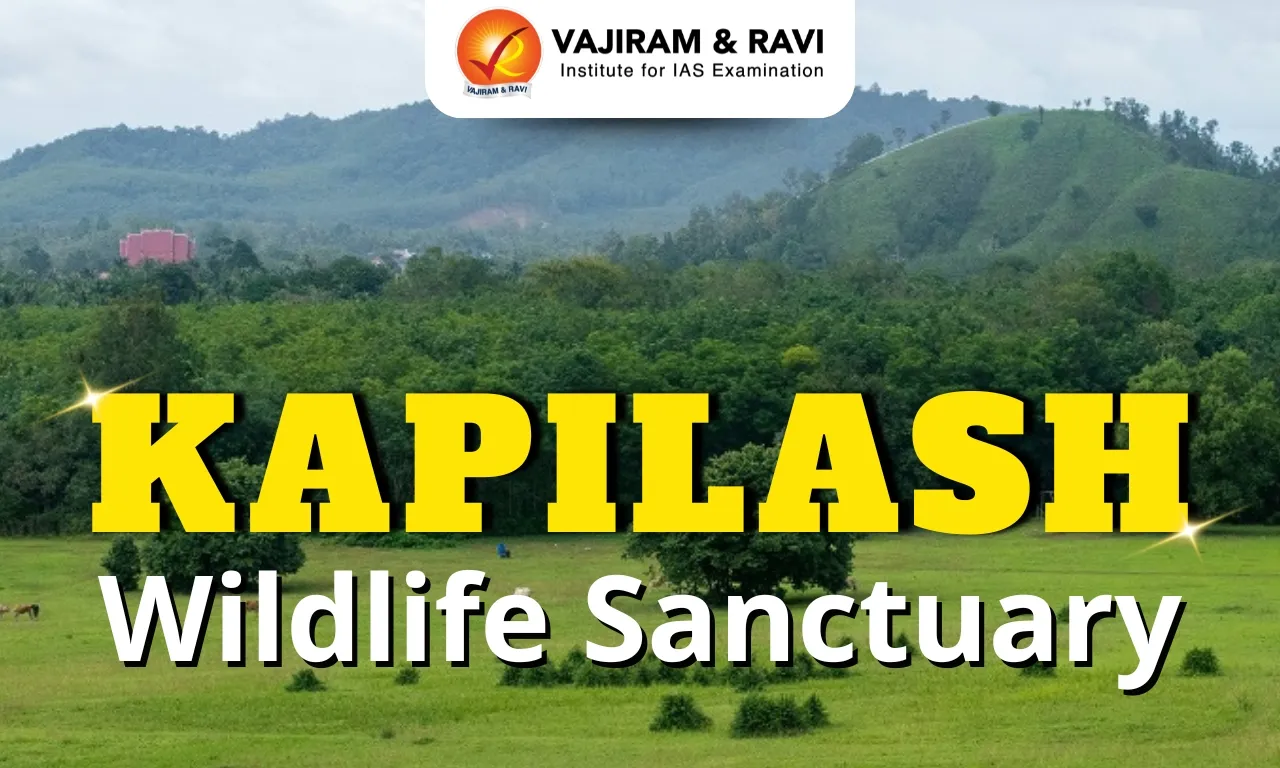
Kapilash Wildlife Sanctuary Latest News
The standing committee of the National Board for Wildlife (NBWL) recently gave its nod for the use of 4.68 hectares of forest land from the Kapilash wildlife sanctuary for the much-awaited 111 km six-lane capital region ring road (CRRR) project to pass.
About Kapilash Wildlife Sanctuary
- It is located in the Dhenkanal district of Odisha.
- It covers an area of about 125.5 sq.km. and lies in the Chota Nagpur Plateau region.
- It has a picturesque landscape with hills, forests, and caves and includes the Kapilasa Temple atop a hill.
- The temple is believed to have been constructed by King Kapilendra Deb, who ruled over Odisha from 1435 to 1467 AD.
- Vegetation: It is classified as an Eastern Highlands moist deciduous forest ecoregion.
- Flora: It is dominated by sal trees and a rich variety of flora like amla, teak, and kadamba.
- Fauna:
- It is home to diverse wildlife, including elephants, jungle cats, sloth bears, spotted deer, jackals, and various species of birds such as peacocks, junglefowl, and kingfishers.
- It also supports several reptiles and unique species like pangolins and porcupines.
Source: MSN
Kapilash Wildlife Sanctuary FAQs
Q1: Where is Kapilash Wildlife Sanctuary located?
Ans: It is located in the Dhenkanal district of Odisha.
Q2: In which physiographic region does Kapilash Wildlife Sanctuary lie?
Ans: It lies in the Chota Nagpur Plateau region.
Q3: Which famous temple is located within Kapilash Wildlife Sanctuary?
Ans: The Kapilasa Temple is located atop a hill within the sanctuary.
Q4: Under which forest ecoregion is Kapilash Wildlife Sanctuary classified?
Ans: It is classified as an Eastern Highlands moist deciduous forest ecoregion.

