
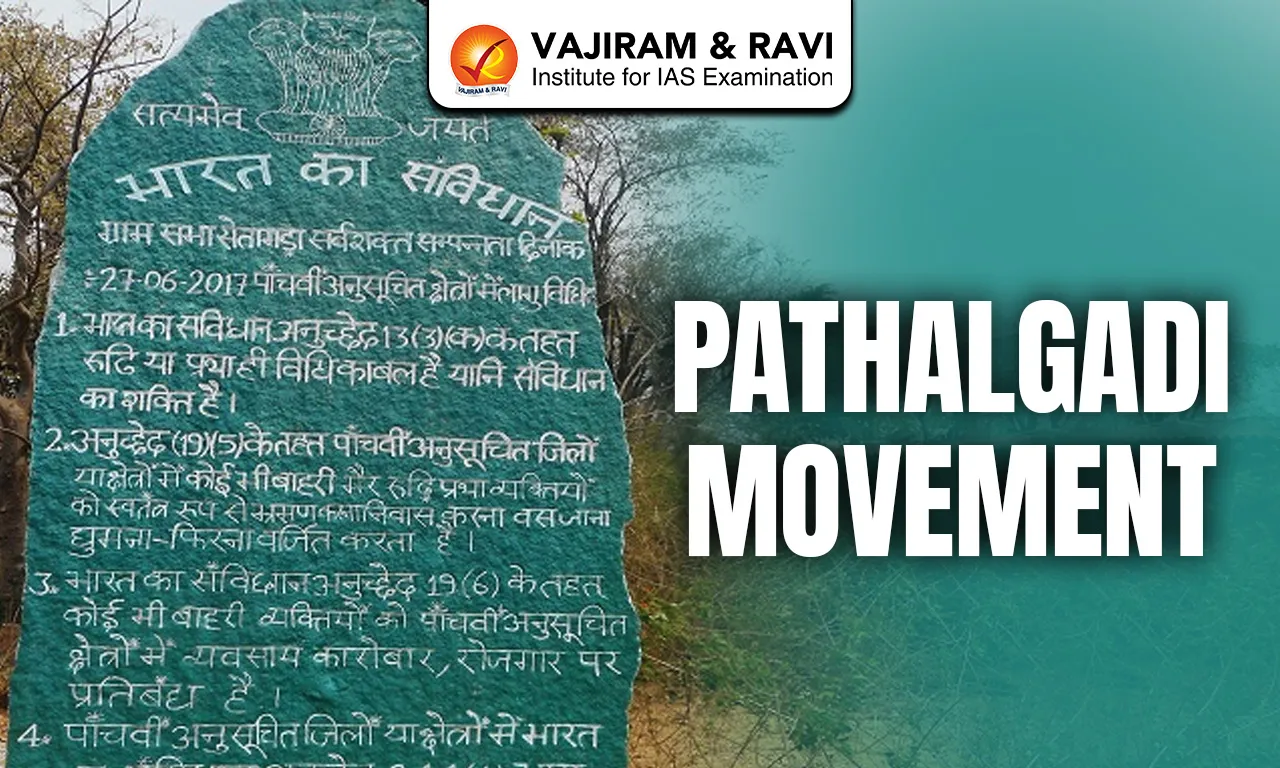
The Pathalgadi Movement was a tribal assertion movement that emerged mainly in Jharkhand and in some parts of Chhattisgarh and Odisha. The movement is rooted in Pathalgadi Tradition - an adivasi tradition of erecting stones to commemorate ancestors, mark village boundaries, or record important events.
Munda Adivasis erected carved stone slabs containing excerpts from constitutional provisions and PESA to assert self-rule, protect land rights, and reject state/central government authority in favor of the Gram Sabha.
Many villages declared themselves self-governing units, insisting that government officials required the permission of the Gram Sabha to enter. In some areas, villagers boycotted elections, rejected Aadhaar and voter ID cards, refused to celebrate national holidays, and set up alternative schools that focused on tribal history and culture. Some leaders even declared that the authority of the Indian state did not apply within their villages.
Pathalgadi Movement Causes
Main causes of the Pathalgadi Movement were:
- Fear of Land Alienation:
- The immediate trigger for the movement was the proposed amendments to the Chotanagpur Tenancy (CNT) Act, 1908, and the Santhal Pargana Tenancy (SPT) Act by the Jharkhand government in 2016.
- These Acts were designed to prevent the transfer of tribal land to non-tribals and to protect community ownership.
- The proposed amendments aimed to allow the use of tribal land for development and infrastructure projects, which led to widespread fear among tribal communities of land acquisition and corporate exploitation
- Poor Implementation of PESA Act, 1996:
- PESA Act provisions were not properly implemented. Decisions regarding land and resources were often taken without tribal consent.
- Historical Exploitation and Displacement: Tribal communities had long experienced land dispossession, mining-related displacement, and inadequate rehabilitation, which created deep resentment against state policies.
- Distrust of Government and Police: In Maoist-affected areas, tribals often faced police action and suspicion, leading to mistrust of state authorities and a push for local self-rule.
- Socio-economic Backwardness: Despite resource-rich regions, tribal areas suffered from poverty, illiteracy, poor infrastructure, and lack of employment, contributing to dissatisfaction.
- Lack of Participation in Development Decisions: Development and land acquisition decisions were often taken without consultation with Gram Sabhas, leading to demands for consent-based governance.
Pathalgadi Movement Demands
Major demands of the Pathalgadi Movement were:
- Full Implementation of the Fifth Schedule: Tribal communities demanded proper enforcement of Fifth Schedule provisions to ensure autonomy and protection of their land, culture, and governance systems in Scheduled Areas.
- Effective Implementation of PESA Act, 1996: The movement demanded recognition of the Gram Sabha as the supreme authority and mandatory consent of the Gram Sabha for land acquisition, mining, and development projects.
- Protection of CNT and SPT Acts: Tribals demanded that the Chotanagpur Tenancy (CNT) Act and Santhal Pargana Tenancy (SPT) Act should not be amended, and that tribal land must remain protected from transfer to non-tribals.
- Control over Natural Resources: The movement sought ownership and management rights over forests, water, and land, in line with PESA and the Forest Rights Act.
- Withdrawal of Police Cases and Security Camps: Tribals demanded the withdrawal of criminal cases against activists and the removal of police and paramilitary camps from Scheduled Areas.
- Direct Transfer of Tribal Development Funds: The movement demanded that Tribal Sub-Plan funds should be transferred directly to Gram Sabhas for local development.
- Development with Gram Sabha Consent: All development schemes, welfare programmes, and infrastructure projects should be implemented only after approval of the Gram Sabha.
After 2018, the movement declined in intensity due to police operations and the withdrawal of controversial land amendments, but the underlying issues of tribal autonomy, land rights, and governance in Scheduled Areas remain unresolved.
Pathalgadi Movement FAQs
Q1: What is the Pathalgadi Movement?
Ans: The Pathalgadi Movement was a tribal assertion movement that emerged mainly in Jharkhand around 2016–18, especially in Khunti district. It involved erecting large stone slabs inscribed with provisions of the Fifth Schedule and PESA Act, 1996 to assert the authority of the Gram Sabha, protect tribal land rights, and demand self-governance.
Q2: What is the traditional meaning of Pathalgadi?
Ans: Traditionally, Pathalgadi refers to the practice of erecting stones among Adivasi communities, particularly the Munda tribe, to commemorate ancestors, mark village boundaries, record important community decisions or events.
Q3: What triggered the Pathalgadi movement?
Ans: The immediate trigger was the proposed amendments to the CNT and SPT Acts in 2016, which aimed to allow the use of tribal land for development projects. Tribal communities feared land alienation, displacement, and corporate exploitation.
Q4: What were the main demands of the movement?
Ans: Key demands included: Full implementation of the Fifth Schedule, Effective enforcement of the PESA Act, Protection of CNT and SPT land laws, Control over natural resources, Withdrawal of police cases and camps, Development only with Gram Sabha consent.
Q5: What was the government’s response to the movement?
Ans: The Jharkhand government treated parts of the movement as anti-state and Maoist-influenced, leading to police action and arrests. At the same time, the government withdrew the controversial land amendments and announced development initiatives to address tribal concerns.

