
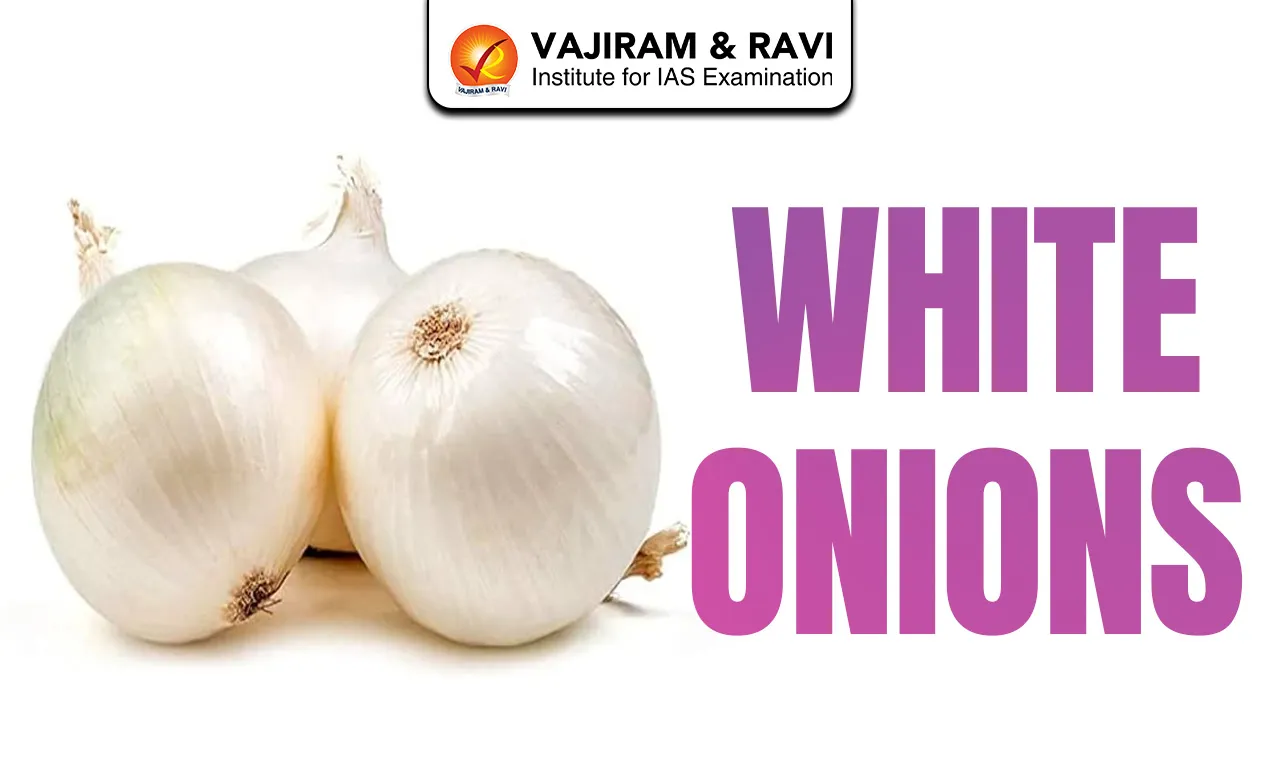
White Onions are a variety of onions that have white outer skin and white flesh. They are known for their mild, slightly sweet flavour and comparatively lower pungency than red onions. They are commonly used in cooking, food processing, and export markets.
White Onions Key Facts
- Allium Cepa is the scientific name of White Onions
- Compared to red onions, they contain higher moisture and have thinner skin.
- They have a shorter shelf life than red onions.
- They are rich in Vitamin C, potassium, fiber, and antioxidants, including flavonoids.
- White Onions are generally grown as a cool-season crop but can adapt to different climatic conditions with proper management. They require well-drained loamy soil with good organic content. The ideal temperature for growth ranges between 13°C and 25°C.
White Onions Major Producing Areas in India
White Onions are generally grown as a cool-season crop but can adapt to different climatic conditions with proper management. They require well-drained loamy soil with good organic content. The ideal temperature for growth ranges between 13°C and 25°C.
- India is the second-largest producer of onions in the world after China.
- White onions are cultivated mainly in Maharashtra, Gujarat, Madhya Pradesh and Karnataka.
- The Mahuva region of Gujarat is particularly known for onion dehydration industries that depend heavily on white onion varieties.
White Onions Economic Importance
- White Onions are widely used in the dehydration and processing industries.
- White onions are particularly suitable for dehydration because of their uniform size and mild taste.
- The dehydration industry converts them into Onion flakes, Onion powder, Onion granules, Paste and processed food ingredients. These products are widely used in packaged foods, soups, sauces, fast food chains, and international cuisines.
- India is one of the largest exporters of dehydrated onion products. The export of dehydrated onion products provides foreign exchange earnings and supports thousands of small and medium enterprises.
However White onions have a shorter shelf life compared to red onions because they contain higher moisture and thinner outer layers. They are more prone to fungal infections and spoilage during storage.
White Onions FAQs
Q1: What are white onions?
Ans: White onions are a variety of onions with white outer skin and white flesh. They have a mild, slightly sweet taste and are less pungent than red onions.
Q2: What is the scientific name of white onion?
Ans: The scientific name of white onion is Allium cepa.
Q3: Why do white onions have a shorter shelf life than red onions?
Ans: White onions contain higher moisture and have thinner outer skin, making them more prone to spoilage and fungal infections during storage.
Q4: Which states are the major producers of white onions in India?
Ans: White onions are mainly cultivated in Maharashtra, Gujarat, Madhya Pradesh, and Karnataka. The Mahuva region of Gujarat is famous for onion dehydration industries.
Q5: Why are white onions important for the economy?
Ans: White onions are widely used in the dehydration and food processing industries. They are converted into flakes, powder, and granules, which are exported and help earn foreign exchange while supporting small and medium enterprises.

