
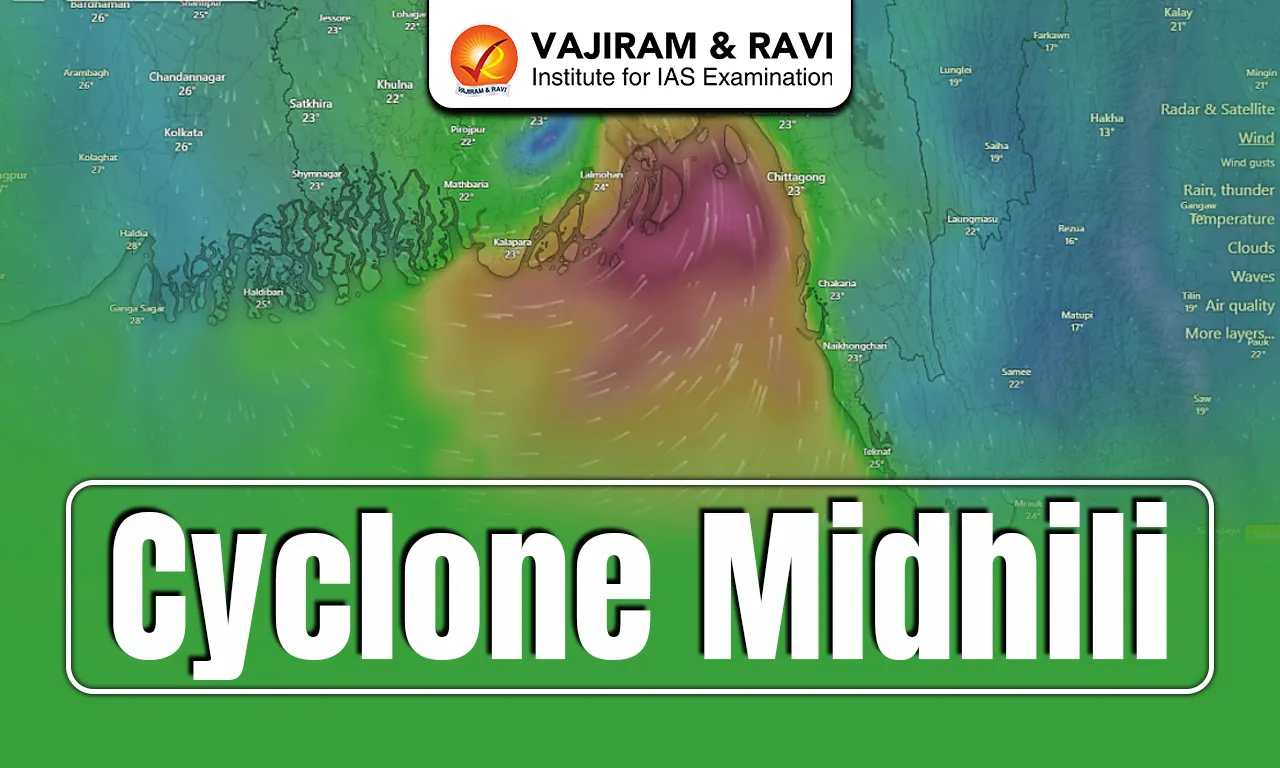
A Cyclone is a large rotating weather system formed around a low pressure area, characterized by inward spiraling winds. In the Northern Hemisphere, winds rotate counterclockwise and such systems usually develop between 5° and 30° latitude over warm ocean waters above 26°C. Cyclone Midhili was one such tropical cyclone that formed over the southeastern Bay of Bengal on 14 November 2023 which intensified into a Severe Cyclonic Storm.
Cyclone Midhili Formation
Cyclone Midhili originated as a low pressure area over the southeastern Bay of Bengal in 2023 and intensified steadily under favourable oceanic conditions. The system strengthened into a cyclonic storm on 17 November and further intensified before making landfall near Khepupara in Patuakhali District of Bangladesh. After landfall, it weakened rapidly and dissipated over Tripura on 18 November, leaving significant human and economic losses.
Cyclone Midhili Features
Cyclone Midhili developed in November 2023 and severely impacted Bangladesh and Northeast India with heavy rain and strong winds.
- Naming: The name “Midhili” was provided by the Maldives under the North Indian Ocean naming system. It became the fifth named storm of the 2023 season.
- Classification: It was classified as a Severe Cyclonic Storm by the Indian Meteorological Department on 17 November 2023.
- Formation: It formed near the Andaman and Nicobar Islands in November 2023 over warm sea surface temperatures of 28-29°C.
- Path: The system initially moved west northwest, later turned north northeast and accelerated toward coastal Bangladesh.
- Wind Speed and Intensity: At peak intensity, maximum sustained winds reached about 102 kmph near Patuakhali. Forecast winds ranged between 62 and 88 kmph at major ports, while squally winds of up to 85 kmph were predicted near landfall.
- Landfall and Dissipation: The cyclone made landfall near Khepupara coast. It weakened quickly into a depression and dissipated over Tripura, India, on 18 November.
- Impact: Several Impacts of the cyclone were:
- Region like Bhola, Chandpur and Barisal recorded rainfall above 200mm in 24 hours.
- Flooding damaged 243,294 hectares of crops, affecting 163,449 farmers and causing losses of 3.87 billion.
- Ten deaths were confirmed in Bangladesh, with 25 fishermen missing.
- Around 1,243 houses were damaged or destroyed.
Cyclone Midhili FAQs
Q1: What is Cyclone Midhili?
Ans: Cyclone Midhili formed as a low pressure area over the southeastern Bay of Bengal on 14 November 2023 and intensified into a cyclonic storm on 17 November 2023.
Q2: How much rainfall was recorded during Cyclone Midhili?
Ans: Bhola recorded the highest 24 hour rainfall of 249 mm, followed by Chandpur with 232 mm and Barisal with 221 mm.
Q3: What was the economic impact of Cyclone Midhili?
Ans: The cyclone damaged 243,294 hectares of crops, affected 163,449 farmers, caused losses of about 3.87 billion in agriculture and around 12 billion loss to the brickfield industry.
Q4: How did Cyclone Midhili form?
Ans: Cyclone Midhili developed from a low pressure area over the southeastern Bay of Bengal. Warm sea surface temperatures of 28 to 29°C, strong poleward outflow, high moisture and low wind shear initially supported intensification into a cyclonic storm.
Q5: What type of cyclone was Cyclone Midhili?
Ans: Cyclone Midhili was a tropical cyclone over the North Indian Ocean basin. It was classified as a Severe Cyclonic Storm by the Indian Meteorological Department.

