
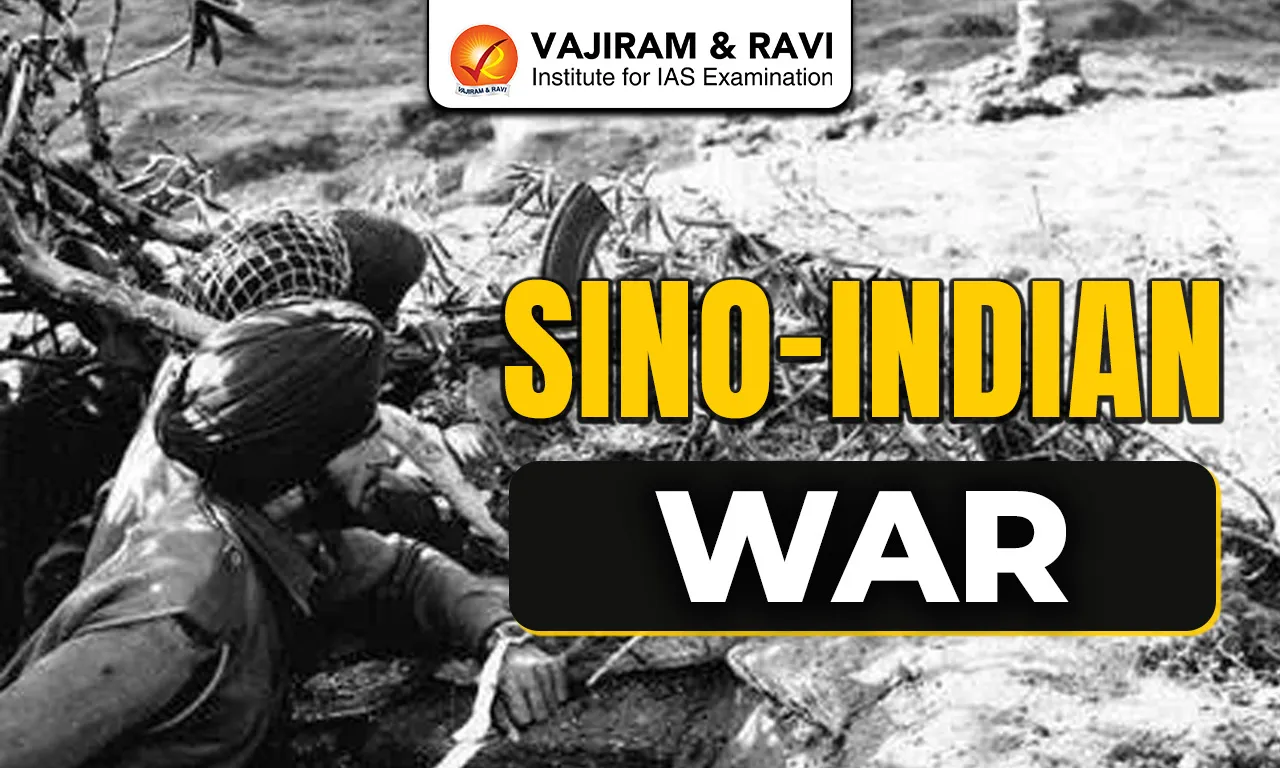
The Sino-Indian War was a short military conflict fought between India and China in 1962. The main reason was a border dispute along the Himalayan region, especially in Aksai Chin and Arunachal Pradesh. The war lasted for about a month and ended with China declaring a unilateral ceasefire. It had a major impact on India’s defence policy and foreign relations.
Sino-India War Background
- India accepted the McMahon Line (1914) in the eastern sector as its boundary, but China did not recognize it. In the western sector, both the countries claimed Aksai Chin.
- China captured Tibet in 1950. Following this India’s border with Tibet became a direct border with China further escalating tensions.
- India gave asylum to the Dalai Lama, who fled Tibet due to Chinese actions. This worsened relations between the two countries.
- The construction of roads by China passing through Aksai Chin since 1956 was considered by India as Chinese aggression over India territory.
- India set up military posts in disputed areas to stop Chinese advances. China viewed this as aggressive.
- Meetings between Indian and Chinese leaders failed to solve the border dispute, leading to war in October 1962.
Sino-Indian Course of War
- The Sino-Indian War began on 20 October 1962 when Chinese forces launched a sudden attack across the Thagla Ridge in the eastern sector (then part of Assam, now Arunachal Pradesh).
- The war was fought in two main sectors:
- Western Sector – Ladakh (Aksai Chin)
- Eastern Sector – Arunachal Pradesh
- In the Western Sector, China attacked areas like Daulat Beg Oldi, Chushul and Demchok. India faced shortages of troops, weapons, winter clothing and road connectivity.
- The Battle of Rezang La (18 November 1962) was a major event where soldiers of 13 Kumaon Regiment fought bravely against heavy Chinese attack. Major Shaitan Singh, who led the battle was awarded the Param Vir Chakra (posthumously).
- In the Eastern Sector, Chinese forces captured important areas like Thagla and Walong. Indian forces were not fully prepared for high-altitude warfare.
- By mid-November 1962, Chinese troops had advanced close to Tezpur in Assam.
- India sought emergency military assistance from countries like the United States, Britain and Canada.
- On 21 November 1962, China declared a unilateral ceasefire and withdrew in the eastern sector, while retaining control over Aksai Chin in the western sector.
- After the war, the boundary came to be known as the Line of Actual Control (LAC).
- India accepted the ceasefire, which officially brought the war to an end.
- Although fighting stopped, tensions between the two countries did not end.
- The war had a long-term impact on India’s defence policy, foreign relations and national security planning.
Causes of India’s Defeat in the 1962 Sino-Indian War
- The war is regarded as a major military setback for India, despite acts of bravery by Indian soldiers.
- China had clear numerical and tactical superiority, deploying far more troops than India.
- The Chinese Army had better weapons, equipment, infrastructure and strong supply lines through Tibet, while India was poorly prepared logistically.
- India deployed around 20,000 troops, whereas China deployed more than 80,000 troops.
- Indian casualties were significant (over 1,300 killed and nearly 4,000 captured), showing the seriousness of the defeat.
- India did not effectively use air power to support its ground forces.
- Indian troops lacked proper winter clothing and modern weapons for high-altitude warfare.
- The war exposed serious weaknesses in India’s defence system and led to later military modernization and reforms.
Aftermath and Impact of the Sino-Indian War
- The 1962 war acted as a major wake-up call for India.
- Defence Minister V.K. Krishna Menon resigned after the defeat.
- The Indian Army was reorganized and steps were taken to modernize weapons and improve training.
- The government focused on building better roads and infrastructure in border areas.
- India changed its defence policy and gave more importance to military preparedness and national security.
- After the war, India increased strategic and military cooperation with Western countries and the Soviet Union.
- The war also led India to review its non-alignment policy and overall military planning.
Sino-Indian War Geopolitical Implications
- The India-China War took place during the Cold War period, shortly after the Cuban Missile Crisis, when the world was mainly focused on tensions between the USA and the Soviet Union.
- At that time, global attention was elsewhere, and China used the situation to strengthen its position along the Indian border.
- After the war, India’s view of China changed completely.
- The earlier feeling of friendship was replaced by caution, suspicion and a more realistic approach in foreign policy.
Strategic Lessons from the Sino-Indian War
- The war showed that diplomacy and peaceful relations must be supported by strong military power and preparedness.
- It highlighted the urgent need to improve border infrastructure, intelligence systems and coordination between the armed forces and the government.
- The conflict made it clear that high-altitude warfare requires special training, proper equipment and modern weapons.
- Overall, the war led India to strengthen its defence system and remain alert along sensitive areas like the Line of Actual Control (LAC), lessons that remain important even today.
Line of Actual Control
- The Line of Actual Control (LAC) is the present boundary that separates areas controlled by India and China. It is not a clearly defined international border but a line based on ground positions after the 1962 war.
- India considers the LAC to be about 3,488 km long, while China believes it is around 2,000 km long. This difference in understanding often leads to tensions.
- The LAC is divided into three sectors:
- Eastern Sector – covers Arunachal Pradesh and Sikkim.
- Middle Sector – includes Uttarakhand and Himachal Pradesh.
- Western Sector – mainly in Ladakh.
- In the eastern sector, the LAC broadly follows the McMahon Line, which was drawn in 1914 and is about 1,140 km long. India accepts it as the boundary, but China does not fully recognize it.
- Because the LAC is not clearly marked on the ground, both sides have different perceptions of the line, which sometimes leads to standoffs and military tensions.
Sino-Indian 1962 War Relevance
- The impact of the 1962 India-China War can still be seen today, as the border dispute between the two countries has not been fully resolved.
- Tensions continue mainly in Ladakh and Arunachal Pradesh due to different views about the Line of Actual Control (LAC).
- A recent example is the 2020 clash in the Galwan Valley, where soldiers of both countries were involved in a serious confrontation.
- These incidents show that the issues which began in 1962 still affect India–China relations and require constant military alertness and strong diplomatic efforts.
Sino-Indian War FAQs
Q1: What was the Sino-Indian War of 1962?
Ans: It was a military conflict fought between India and China in October-November 1962 over border disputes in the Himalayan region.
Q2: In which areas was the war mainly fought?
Ans: The war was fought in two sectors: Western Sector-Ladakh (Aksai Chin) and the Eastern Sector-Arunachal Pradesh (then part of Assam).
Q3: When did the war begin and end?
Ans: The war began on 20 October 1962 and ended on 21 November 1962 when China declared a unilateral ceasefire.
Q4: What were the main causes of the war?
Ans: Main reasons were the border dispute over Aksai Chin and Arunachal Pradesh (McMahon Line), China’s takeover of Tibet, India giving asylum to the Dalai Lama and tensions due to the Forward Policy.
Q5: What is the Line of Actual Control (LAC)?
Ans: The LAC is the present line that separates Indian-controlled and Chinese-controlled areas after the 1962 war. It is not a clearly defined international boundary.

