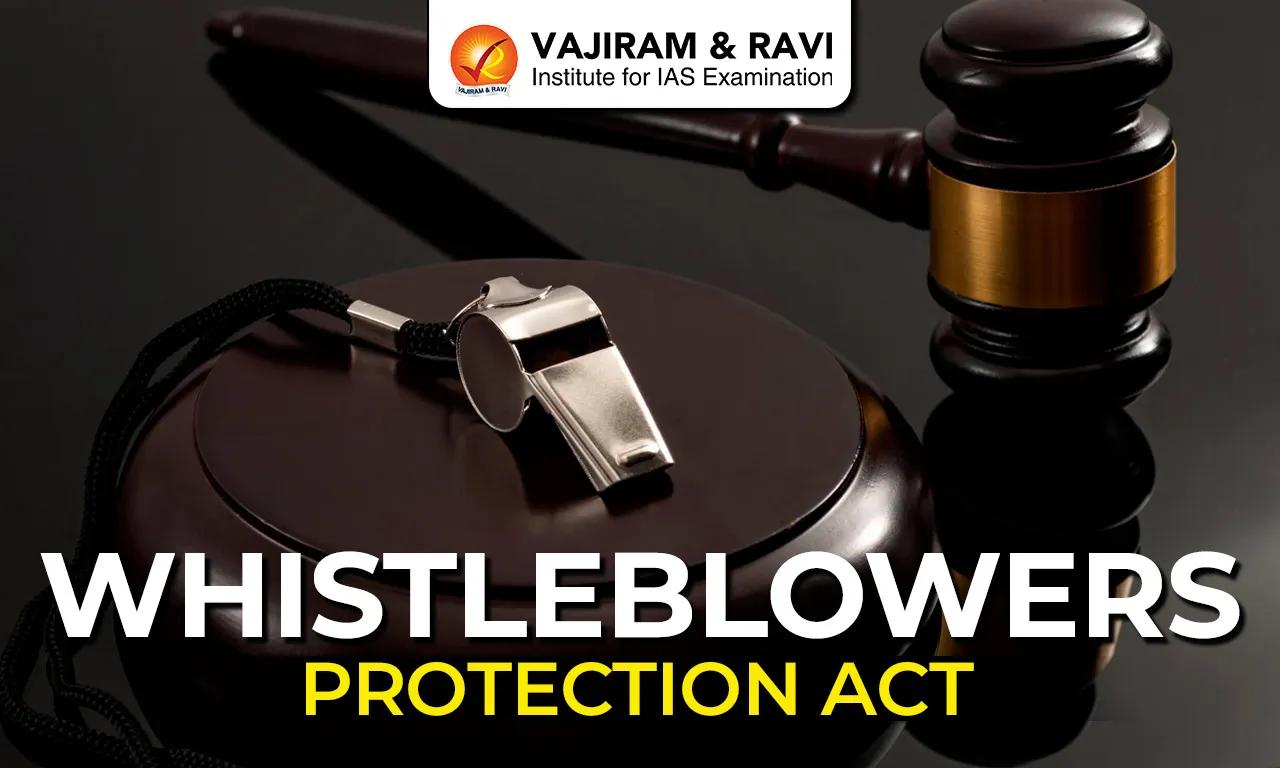
The Whistle Blowers Protection Act, 2014 is a law enacted by the Indian Parliament to provide a legal mechanism for receiving complaints related to corruption, misuse of power, or criminal offences committed by public servants. It aims to protect individuals who expose such wrongdoing in public interest from victimization, harassment, or retaliation.
Whistle blowing is the act of drawing public attention, or the attention of an authority figure, to perceived wrongdoing, misconduct, unethical activity within public, private or third-sector organisations. A whistleblower is someone who reports waste, fraud, abuse, corruption, or dangers to public health and safety to someone who is in the position to rectify the wrongdoing.
Whistleblower Protection Act Background
In the early 2000s, several cases emerged where honest officials who revealed corruption faced harassment, suspension, or even death. The murder of Satyendra Dubey in 2003, after he exposed corruption in a national highway project, created nationwide outrage and highlighted the vulnerability of whistle-blowers. In response, the Government initially empowered the Central Vigilance Commission through an executive resolution in 2004 to receive public interest disclosures. Further, the Second Administrative Reforms Commission in 2007, recommended a dedicated law to protect whistle-blowers.
These developments led to the enactment of the Whistle Blowers Protection Act in 2014 to provide a statutory framework for safeguarding individuals who expose corruption.
Whistleblower Protection Act Objectives
The objectives of Whistleblower Protection Act are as follows:
- To establish a formal mechanism to receive complaints relating to corruption or misuse of power by public servants.
- To protect whistle-blowers from victimization, harassment, or threats.
- To promote transparency, accountability, and ethical governance in public administration.
- To strengthen democratic oversight over executive functioning.
Whistleblower Protection Act Features
Features of Whistleblower Protection Act are as follows:
- Statutory Mechanism: The Whistleblower Protection Act establishes a statutory mechanism to receive and inquire into complaints relating to corruption, abuse of authority, or criminal offences committed by public servants in public interest.
- Eligible Complainants: Permits any public servant or private individual, including NGOs and citizens, to make a disclosure.
- Coverage: Covers Central Government employees, Union Ministers, Members of Parliament, PSUs, and bodies substantially financed by the Central Government
- Competent Authority: Designates the Central Vigilance Commission as the competent authority for examining complaints against central government officials. Provides separate competent authorities for different functionaries, such as the Prime Minister for Ministers and Presiding Officers of Parliament for MPs.
- Court of Appeal: Any person aggrieved by any order of the Competent Authority can make an appeal to the concerned High Court within a period of sixty days from the date of the order.
- Preliminary Scrutiny: Mandates a preliminary scrutiny to determine whether a prima facie case exists before ordering a formal inquiry.
- Protect Whistleblowers
- Ensures strict confidentiality of the whistle-blower’s identity, prohibiting unauthorized disclosure during the inquiry process.
- Prohibits victimization such as transfer, suspension, harassment, or discrimination against the complainant after disclosure.
- Penalizes the disclosure of a whistleblower's identity with imprisonment up to three years and fines up to ₹50,000
- Penalise False Complaints: Filing a false or misleading complaint can lead to imprisonment for up to 2 years and a fine of up to ₹30,000
- Exemptions: The act is not applicable to the Special Protection Group (SPG) personnel and officers, constituted under the Special Protection Group Act, 1988.
Whistle Blowers Protection (Amendment) Bill, 2015
The Whistle Blowers Protection (Amendment) Bill, 2015 proposed that certain types of information, such as matters related to national security, cabinet discussions, and foreign relations, could not be disclosed by whistle-blowers. The government said this was to bring the law in line with the Right to Information Act, 2005. However, many critics felt that these changes would weaken the Act and make it harder to expose corruption, especially in sensitive departments. The Bill was passed in Lok Sabha but later lapsed and did not become law.
Whistleblower Protection Act 2014 Criticism
Key criticisms of the Whistleblower Protection Act 2014 include:
- No Anonymous Complaints: The Act requires the complainant to reveal their identity to the competent authority, leaving them vulnerable to retaliation and danger.
- Weak Protection Measures: The Act lacks robust provisions for physical protection, relocation, and compensation, as seen in several whistleblower killings in corruption cases.
- Excluded Sectors: The legislation primarily focuses on public servants, failing to cover the private sector, which also has high levels of corruption.
- Time Limitations: Under the Whistle Blowers Protection Act, 2014, a complaint cannot be made after 7 years from the date on which the action or offence is alleged to have taken place.
- Implementation Gaps: The mechanisms for investigating complaints are seen as inefficient, with significant bureaucratic delays in providing protection.
- Procedural Issues: The Act lacks a dedicated agency to monitor enforcement, relying on existing authorities that may not act promptly.
Whistleblower Protection Act FAQs
Q1: What is the main purpose of the Whistle Blowers Protection Act, 2014?
Ans: The Act provides a statutory mechanism to receive complaints about corruption, misuse of power, or criminal offences by public servants and protects whistleblowers from victimisation and harassment.
Q2: Who can make a disclosure under the Act?
Ans: Any person including public servants, private citizens, or NGOs can make a public interest disclosure before the designated competent authority.
Q3: Which authority receives whistleblower complaints at the central level?
Ans: At the central level, the Central Vigilance Commission (CVC) acts as the competent authority to receive and examine complaints against central government officials.
Q4: Does the Act allow anonymous complaints?
Ans: No. The Act does not entertain anonymous complaints. The identity of the complainant must be disclosed to the competent authority, though it must be kept confidential.
Q5: What protection is provided to whistleblowers?
Ans: The Act ensures confidentiality of the whistleblower’s identity and prohibits victimisation such as harassment, transfer, or suspension. Unauthorized disclosure of identity is punishable with imprisonment and fine.

