
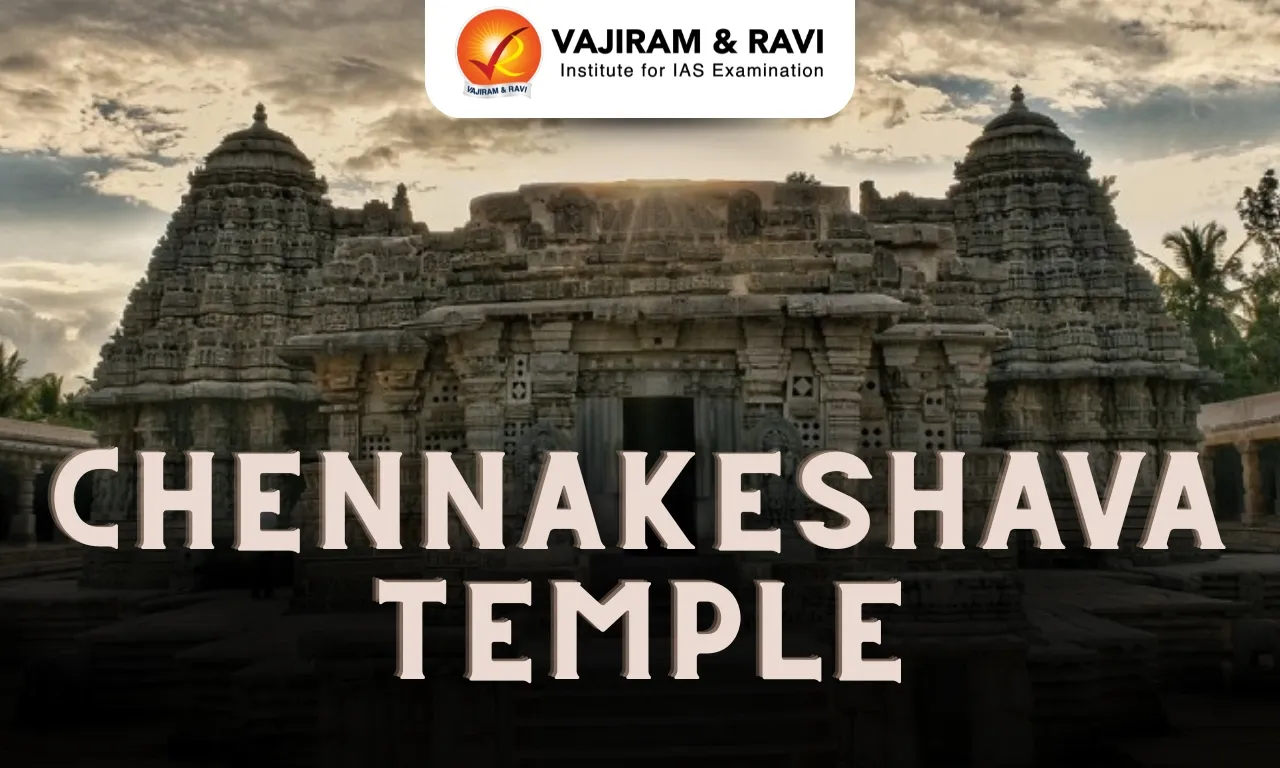
Chennakeshava Temple Latest News
The Prime Minister’s new office complex, Seva Teerth has been built in the Indian architectural tradition inspired by the features of the 12th-century Chennakeshava Temple.
About Chennakeshava Temple
- The Chennakeshava Temple, also referred to as the Keshava, or Vijayanarayana Temple of Belur, is a 12th-century temple in Karnataka.
- It is a Hindu temple dedicated to Lord Vishnu.
- It was commissioned by King Vishnuvardhana in 1117 CE (after a major military victory in 1116 CE over the Cholas in the great battle of Talakkad), on the banks of the Yagachi River in Belur, also known as Velapura.
- The temple was built over three generations and took 103 years to complete.
- The temple is listed as a UNESCO World Heritage Site.
Chennakeshava Temple Architecture
- It is a stunning example of Hoysala architecture.
- The Hoysalas used soft soapstone for their structures, as they were found suitable for intricate carvings.
- Enclosed by a Prakara with a Gopura built in the Vijayanagar style, the temple stands on a platform, or Jagati, and looks like a huge casket.
- The outer walls of the temple are adorned with intricate carvings, which depict various gods, goddesses, and mythical creatures.
- There are more than 80 Madanika sculptures in the temple, dancing, hunting, standing under canopies of trees, and so on.
- One of the unique features of the Chennakeshava Temple is the stepped well, which is located in the temple complex.
Source: TI
Chennakeshava Temple FAQs
Q1: What is the Chennakeshava Temple also known as?
Ans: It is also known as the Keshava Temple or Vijayanarayana Temple of Belur.
Q2: Where is the Chennakeshava Temple located?
Ans: It is located in Belur (also known as Velapura) in Karnataka.
Q3: In which century was the Chennakeshava Temple built?
Ans: It was built in the 12th century.
Q4: Who commissioned the Chennakeshava Temple?
Ans: It was commissioned by King Vishnuvardhana.
Q5: In which year was the temple commissioned?
Ans: It was commissioned in 1117 CE.

