
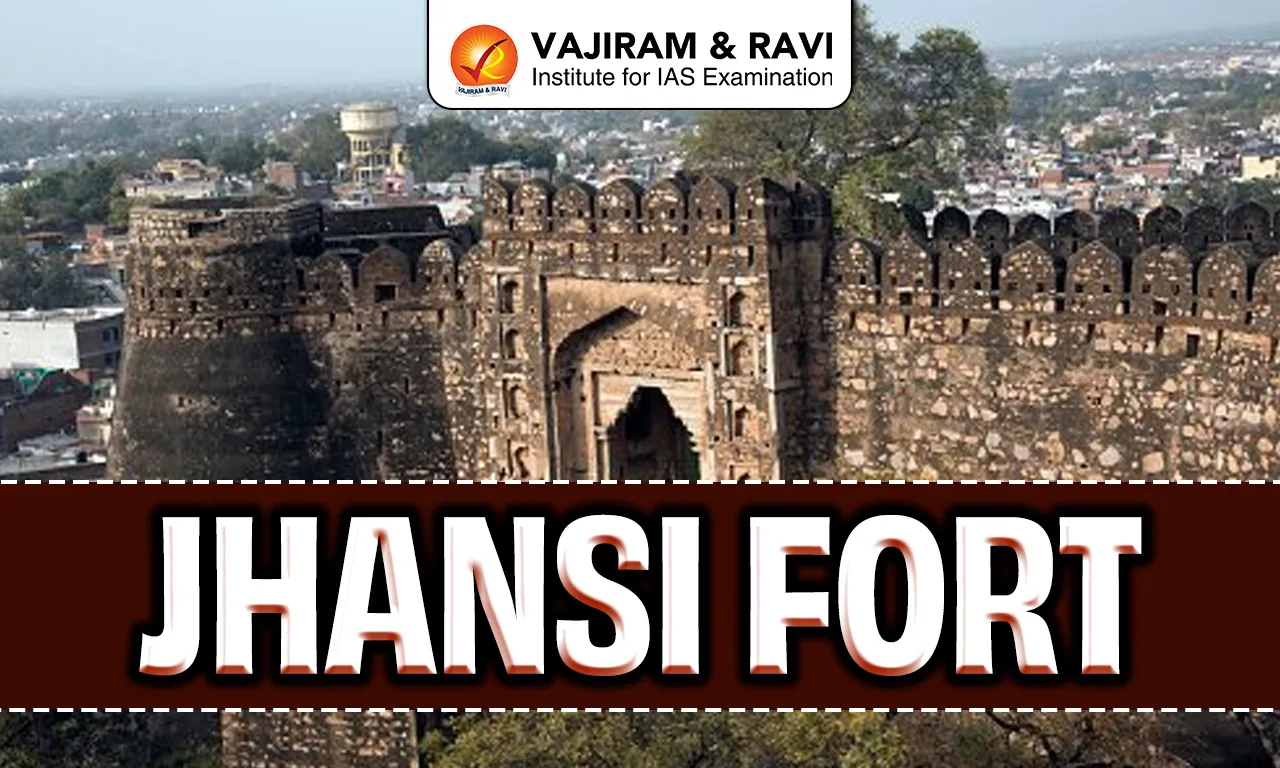
Jhansi Fort is a famous historical fort located in Uttar Pradesh. It is an important symbol of India’s rich history and bravery. The fort is especially known for its role in the Revolt of 1857 and is remembered for the courage shown there during India’s freedom struggle. It is now a protected monument and an important heritage site.
Jhansi Fort
The details of Jhansi Fort such as its history, structure, features, and importance are discussed below. The fort is an important historical monument known for its strong architecture and its connection with India’s past.
Jhansi Fort Location and Origin
- Jhansi Fort is built on a rocky hill called Bangara in present-day Uttar Pradesh.
- Earlier, the town was known as Balwant Nagar.
- The fort served as an important stronghold in the Bundelkhand region from medieval times.
- Jhansi Fort was built by Raja Bir Singh Deo of Orchha in 1613.
- The name “Jhansi” is believed to come from the word “jhainsi”, meaning unclear or indistinct, based on a local legend related to Raja Bir Singh Deo of Orchha.
Jhansi Fort History and Rulers
- In the 18th century, the region saw political struggles.
- In 1742, Naroshankar was appointed Subedar (governor) of Jhansi.
- He strengthened and expanded the fort (the extension was called Shankergarh).
- He also constructed important buildings.
- Later, several Subedars ruled Jhansi.
- Raghunath Rao (II) Newalkar improved administration, increased revenue and built temples like Mahalakshmi Temple and Raghunath Temple.
- After weak rulers, the British accepted Gangadhar Rao as the Raja of Jhansi.
- He was known as a capable and kind administrator.
- In 1842, he married Manikarnika Tambe, who later became famous as Rani Lakshmibai.
Role in the Revolt of 1857
- After the death of Gangadhar Rao, Rani Lakshmibai became the ruler.
- She used the fort as her main residence.
- In 1858, British forces led by General Hugh Rose attacked Jhansi.
- After heavy fighting, the fort was captured on 4 April 1858.
- Rani Lakshmibai escaped bravely and continued the struggle against the British.
- Jhansi Fort became one of the most important centres of resistance during the Revolt of 1857.
Jhansi Fort Structure and Features
- The fort has ten main gates such as Khandero Gate, Datia Gate, Unnao Gate, Laxmi Gate and Sagar Gate.
- Important places inside the fort include:
- Karak Bijli cannon
- Rani Jhansi Garden
- Shiv Temple
- Mazar of Ghulam Gaus Khan, Moti Bai and Khuda Baksh
- The fort also contains sculptures that reflect the rich history of Bundelkhand.
- The fort has thick stone walls.
- It has several bastions (round towers) for security.
- It is a symbol of bravery and resistance.
- It represents medieval military architecture of Bundelkhand.
Jhansi Fort FAQs
Q1: Where is Jhansi Fort located?
Ans: Jhansi Fort is located on a rocky hill called Bangara in Jhansi, Uttar Pradesh.
Q2: Who built Jhansi Fort?
Ans: Jhansi Fort was built by Raja Bir Singh Deo of Orchha in 1613.
Q3: How did Jhansi get its name?
Ans: The name “Jhansi” is believed to come from the word “jhainsi”, meaning unclear or indistinct, based on a local legend.
Q4: What happened at Jhansi Fort in 1858?
Ans: In 1858, British forces led by General Hugh Rose attacked and captured the fort after heavy fighting.
Q5: What are the main features of Jhansi Fort?
Ans: The fort has thick stone walls, several bastions, ten main gates, temples and the famous Karak Bijli cannon.

