
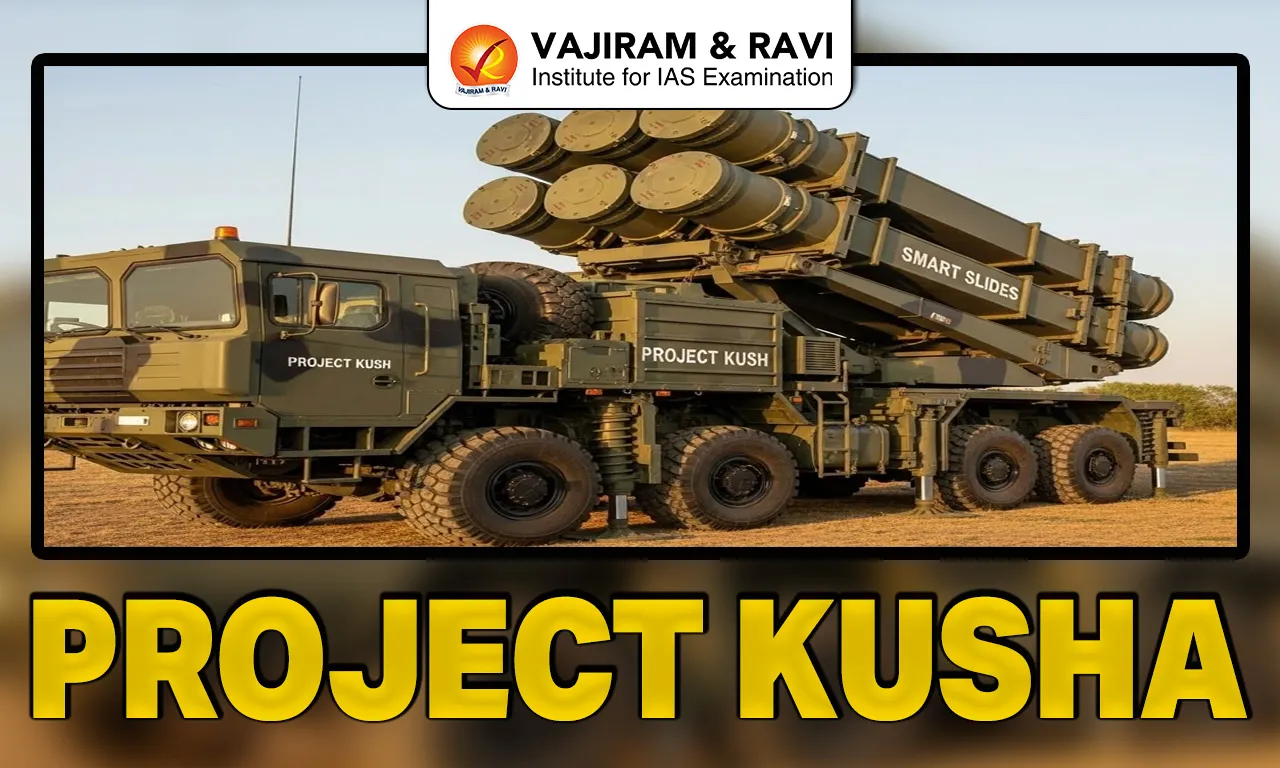
India’s pursuit of strategic autonomy in air defence has entered a transformative phase with Project Kusha, a cutting-edge long-range air defence initiative led by the Defence Research and Development Organisation (DRDO). Designed as a multi-tier surface-to-air missile (SAM) system, Project Kusha aims to protect Indian airspace from emerging and sophisticated aerial threats such as stealth aircraft, drones, cruise missiles, hypersonic weapons, and ballistic threats.
With a projected cost of ₹21,700 crore and expected induction between 2028 and 2030, Project Kusha is set to become a cornerstone of India’s layered air defence architecture, reducing dependence on imported systems while boosting indigenous capability.
What is Project Kusha?
Project Kusha, also referred to as the Extended Range Air Defence System (ERADS) or Precision-guided Long-Range Surface Air Missile is a long-range SAM programme developed to complement and eventually extend beyond India’s current air defence systems.
The system is designed to:a
- Detect, track and neutralise a wide spectrum of aerial threats from fighter jets and drones to cruise missiles.
- Deploy three variants of interceptor missiles (M1, M2, M3) with increasing ranges.
- Integrate with India’s Integrated Air Command and Control System (IACCS) for network-centric air defence.
Why Project Kusha is a Game-Changer in India’s Air Defence Strategy?
Project Kusha marks a transformational shift in India’s air defence capability by introducing an indigenous long-range interception system comparable to global standards. It strengthens strategic autonomy while enhancing India’s ability to counter next-generation aerial threats.
- Strategic Autonomy & Self-Reliance: Developed by the Defence Research and Development Organisation (DRDO), Project Kusha reduces India’s dependence on foreign systems and aligns with the Atmanirbhar Bharat defence vision.
- Multi-Tier Long-Range Protection: With interceptor variants ranging from 150 km to 400 km, it creates a layered defensive shield capable of engaging threats at multiple distances and altitudes.
- Counter to Advanced & Hypersonic Threats: The system is designed to detect and neutralise stealth aircraft, cruise missiles, UAV swarms, and potential hypersonic weapons, enhancing India’s deterrence capability.
- Seamless Integration with National Defence Grid: Project Kusha will integrate with India’s Integrated Air Command and Control System (IACCS), enabling real-time network-centric warfare and coordinated air defence operations.
Also Read: Top 10 Air Defence Systems in the World
Interceptor Variants Under Project Kusha
Project Kusha is built on a three-layer interceptor architecture designed to neutralise threats at varying ranges, altitudes, and speeds.
| Interceptor Variants Under Project Kusha | ||||
|
Variant |
Range (Approx.) |
Primary Targets |
Key Capability |
Strategic Role |
|
Kusha-M1 |
150 km |
Fighter jets, UAVs, cruise missiles |
AESA seeker, high agility interception |
First long-range defensive layer beyond medium-range systems |
|
Kusha-M2 |
250 km |
Stealth aircraft, high-speed missiles |
Advanced booster & network-centric guidance |
Expands engagement envelope in mid-tier defence |
|
Kusha-M3 |
350–400 km |
AWACS, refuellers, high-value airborne assets |
Long-burn propulsion & extended radar cueing |
Backbone of India’s long-range strategic air shield |
Project Kusha vs S-400
Project Kusha represents India’s push toward indigenous long-range air defence capability, while the S-400 is a proven Russian system currently deployed by India. While both systems offer extended interception ranges, Project Kusha focuses on strategic autonomy and future scalability within India’s integrated defence grid.
| Project Kusha vs S-400 | ||
|
Feature |
Project Kusha |
S-400 |
|
Country of Origin |
India |
Russia |
|
Developer |
Defence Research and Development Organisation (DRDO) |
Almaz-Antey |
|
Operational Status |
Under development (expected 2028–2030 induction) |
Operational since 2007; inducted in India from 2021 |
|
Maximum Range |
~350–400 km (M3 variant) |
Up to 400 km (40N6 missile) |
|
Interceptor Variants |
150 km, 250 km, 350–400 km |
40N6 (400 km), 48N6 (250 km), 9M96 series |
|
Target Types |
Aircraft, UAVs, cruise missiles, high-value airborne assets, potential hypersonic threats |
Aircraft, cruise missiles, ballistic missiles, AWACS |
|
Radar & Integration |
Indigenous long-range radar; integrated with India’s IACCS |
Advanced multi-function 3D radar; standalone system integration |
|
Strategic Objective |
Strengthen Atmanirbhar Bharat & defence autonomy |
Strengthen long-range air defence through foreign procurement |
Project Kusha FAQs
Q1: What is Project Kusha?
Ans: Project Kusha is an indigenous long-range surface-to-air missile (SAM) defence system being developed by the Defence Research and Development Organisation (DRDO).
Q2: What is the range of Project Kusha?
Ans: Project Kusha will feature three interceptor variants with approximate ranges of 150 km, 250 km, and 350–400 km, providing multi-layered protection against various aerial threats.
Q3: When will Project Kusha become operational?
Ans: The first prototype trials are expected around 2026, with phased induction into the Indian Air Force likely between 2028 and 2030, subject to successful testing and validation.
Q4: Who will operate Project Kusha?
Ans: The system is primarily being developed for the Indian Air Force (IAF), with future deployment plans for the Indian Navy to strengthen maritime air defence.
Q5: How is Project Kusha different from the S-400 system?
Ans: Unlike the Russian-made S-400, Project Kusha is fully indigenous and aims to provide similar long-range interception capability while strengthening India’s defence self-reliance and integration with domestic command networks.

