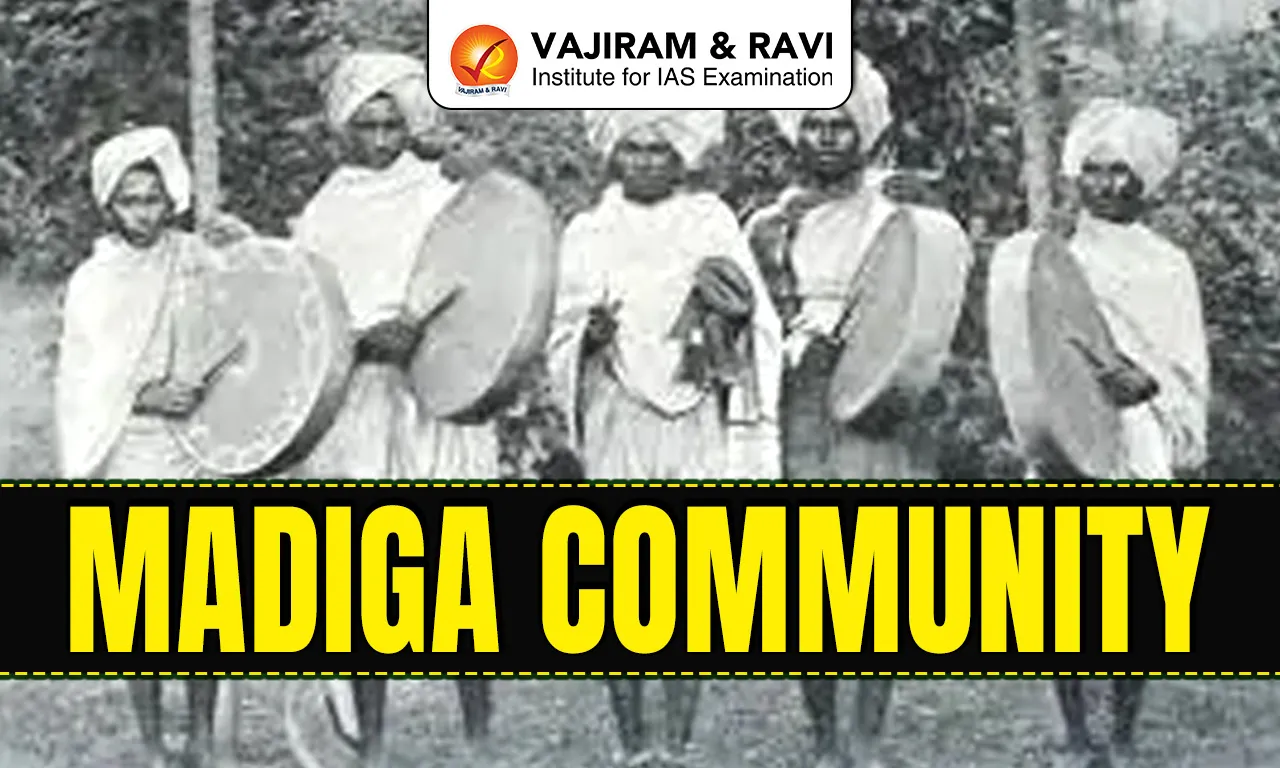
Madiga is a Telugu Scheduled Caste community mainly concentrated in Telangana, Andhra Pradesh, and Karnataka. They largely work as agricultural labourers. In Telangana, they form nearly 50% of the total Scheduled Caste population and play an important socio-political role.
Madiga Community Features
The Madiga community has a large demographic presence and a long history of social exclusion, leading to strong movements demanding equitable reservation benefits and internal sub-categorization within Scheduled Castes.
- Population Share: As per Census 2011, Madigas numbered 6,702,609 in undivided Andhra Pradesh, forming 48.27% of the SC population. Telangana alone has over 3.2 million Madigas, while Andhra Pradesh has about 3.46 million.
- Traditional Occupation: Madigas were historically engaged in tanning leather, making footwear, belts, bags, and crafting the traditional Dappu drum. Many also worked as village service providers under the vetti system, often receiving minimal wages or inam land.
- Sub-Categorization Demand: Claiming dominance of the Mala community in accessing reservation benefits, Madigas demanded equitable distribution. In December 2023, Prime Minister Narendra Modi initiated a high-level committee, chaired by the Cabinet Secretary, to examine internal classification within SCs.
- Judicial Development: On August 1, 2024, the Supreme Court, led by Chief Justice D.Y. Chandrachud, allowed states to sub-classify SCs for fair quota distribution, overturning the 2004 E.V. Chinnaiah judgment and strengthening Madiga demands.
Madiga Community FAQs
Q1: What is the Madiga Community?
Ans: Madiga is a Telugu Scheduled Caste community mainly found in Telangana, Andhra Pradesh, and Karnataka, historically linked with leatherwork and agricultural labour.
Q2: What percentage of SC population do Madigas form in Telangana?
Ans: Madigas constitute nearly 50% of the Scheduled Caste population in Telangana, making them one of the largest SC communities in the state.
Q3: Why do Madigas demand sub-categorization within SCs?
Ans: They argue that reservation benefits have largely gone to relatively dominant SC groups like the Mala community, leading to unequal access to education and government jobs.
Q4: What was the 2024 Supreme Court ruling on SC sub-classification of Madiga Community?
Ans: On August 1, 2024, the Supreme Court allowed states to sub-classify Scheduled Castes for fair distribution of reservation benefits, overturning the 2004 E.V. Chinnaiah judgment.
Q5: What committee was formed to examine Madiga Community demands?
Ans: In December 2023, the Union government formed a high-level committee of secretaries, chaired by the Cabinet Secretary, to study equitable distribution of SC benefits.

