
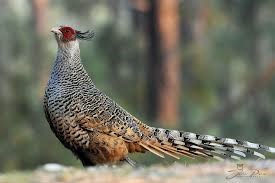
Cheer Pheasant Latest News
Recently, it is observed that hunting and habitat degradation remain the biggest threats of ground-dwelling Cheer Pheasant.
About Cheer Pheasant
- It is also known as Wallich's pheasant or chir pheasant, belongs to the pheasant family, Phasianidae.
- Habitat: It is found in steep, rocky hillsides studded with scrub, stunted trees and grassy slopes between 1,200 and 3,350 metres.
- Distribution: Western Himalaya from northern Pakistan through Kashmir, Himachal Pradesh and Uttarakhand, to central Nepal.
Characteristics of Cheer Pheasant
- The cheer pheasant’s nest is a simple ground scrape, tucked beneath undergrowth or sheltered by rocks.
- It exhibits high natal philopatry—individuals often return to, or remain near, the area where they were born to breed.
- It depends on early successional grasslands created by traditional grass cutting and burning—practices.
- Diet: It depends on items such as roots, tubers, bulbs, buried seeds and possibly insect larvae and earthworms.
Conservation Status of Cheer Pheasant
- IUCN: Vulnerable
- CITES: Appendix I
- Wildlife (Protection) Act, 1972: Schedule I
Source: DTE
Cheer Pheasant FAQs
Q1: What is the conservation status of Cheer Pheasant?
Ans: Vulnerable
Q2: Where is the primary habitat of Cheer Pheasant?
Ans: Steep, rocky hillsides with scrub and grassy slopes

