
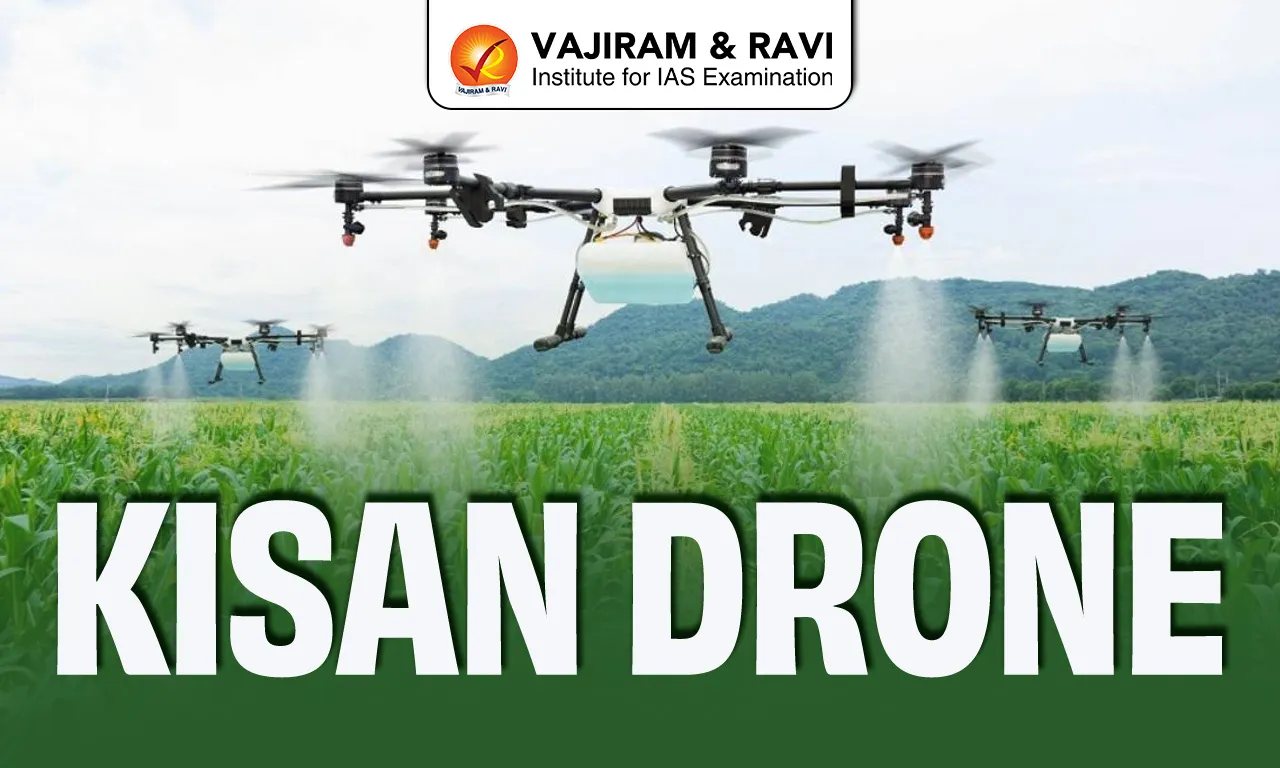
India’s agriculture sector is undergoing a technological transformation, and the Kisan Drone is at the center of this change. It is promoted by the Government of India and highlighted during the Kisan Drone Mahotsav 2022 by Narendra Modi, Kisan Drones are designed to modernize farming through precision spraying, crop monitoring, and faster farm-to-market connectivity.
Kisan Drone Features
Kisan Drones are advanced unmanned aerial vehicles (UAVs) specially designed for agricultural operations such as spraying, crop monitoring, and field mapping.
- Equipped with a chemical tank for spraying pesticides, insecticides, and liquid fertilizers.
- Carrying capacity generally ranges between 5 kg to 10 kg, depending on the model.
- Capable of spraying one acre of land in approximately 15 minutes, saving time and labor.
- Ensures uniform and controlled spraying, reducing chemical wastage.
- Operates using GPS-based navigation for accurate field coverage.
- Supports automated flight paths and pre-programmed routes.
- Reduces direct exposure of farmers to harmful chemicals, improving safety.
- Can be used for crop health monitoring and damage assessment.
- Assists in land mapping and digitization of records under schemes like SWAMITVA Scheme.
Impact on Agriculture
The introduction of Kisan Drones has brought a technological shift in Indian agriculture by promoting precision farming and reducing manual dependency. The impact of Kisan Drone Scheme in agriculture are:
- Increases crop productivity through accurate and timely spraying of pesticides and nutrients.
- Ensures uniform application of chemicals, leading to better crop health and balanced growth.
- Reduces labor dependency, especially during peak agricultural seasons.
- Saves time by covering large areas quickly compared to manual spraying.
- Minimizes farmers’ exposure to harmful pesticides, improving health and safety.
- Helps in early detection of crop diseases, pest attacks, and nutrient deficiencies.
- Supports faster crop damage assessment during floods, droughts, or natural disasters.
- Assists in agricultural insurance claim verification through aerial surveys.
- Reduces input costs by preventing excessive use of fertilizers and pesticides
Also Read: Drone Technology – Drones and UAVs Types, Advantages
Kisan Drone Challenges
While Kisan Drones offer significant potential to modernize Indian agriculture, their large-scale adoption faces practical and structural hurdles.
High Initial Cost
- Agricultural drones are expensive for individual farmers.
- Costs include purchase price, batteries, spare parts, and maintenance.
- Small and marginal farmers may not afford them without subsidies.
Limited Awareness in Rural Areas
- Many farmers are unaware of the benefits and operation of drones.
- Lack of demonstration projects reduces confidence in the technology.
Skill and Training Gap
- Operating drones requires technical knowledge and certified training.
- Rural youth need structured training programs to become licensed drone pilots.
Regulatory and Compliance Issues
- Drone usage must follow aviation rules and airspace restrictions.
- Obtaining permissions and registrations may be time-consuming.
Connectivity and Digital Infrastructure Problems
- Poor internet connectivity in rural areas affects real-time monitoring.
- Lack of digital literacy limits effective utilization of drone data.
Battery Life and Technical Limitations
- Limited battery backup restricts coverage area per flight.
- Technical malfunctions may delay operations during peak farming seasons.
Weather Dependency
- Strong winds, rain, or extreme temperatures can disrupt drone operations.
- Weather unpredictability affects scheduling of spraying activities.
Income Uncertainty
- Experts question whether drones alone can significantly increase farmers’ income.
- Market price fluctuations may offset productivity gains.
Unequal Benefit Distribution
- Concerns exist that agrochemical companies may benefit more from increased spraying.
- Without proper regulation, overuse of chemicals may occur.
Way Forward
- Increase government subsidies and financial assistance for small and marginal farmers to make drones affordable.
- Promote drone services through Farmer Producer Organizations (FPOs) and cooperative societies to enable shared usage.
- Establish dedicated drone training and certification centers in rural areas to build technical skills among youth.
- Integrate drone data with agricultural advisory systems for better crop planning and pest management.
- Improve rural digital infrastructure, including high-speed internet connectivity, to support real-time monitoring.
- Encourage public-private partnerships to reduce costs and promote innovation in agricultural drone technology.
- Provide easy access to credit facilities for purchasing and maintaining drones.
- Develop clear and farmer-friendly regulatory guidelines for drone operations.
- Promote research and development to improve battery life, payload capacity, and weather resistance.
Kisan Drone FAQs
Q1: What is a Kisan Drone?
Ans: A Kisan Drone is an unmanned aerial vehicle used for spraying pesticides, fertilizers, crop monitoring, and transporting agricultural produce.
Q2: How much land can a Kisan Drone cover?
Ans: A Kisan Drone can spray approximately one acre of land in about 15 minutes.
Q3: What is the carrying capacity of a Kisan Drone?
Ans: Most Kisan Drones have a carrying capacity of 5–10 kg, depending on the model.
Q4: How does a Kisan Drone help farmers?
Ans: It saves time, reduces labor costs, ensures uniform spraying, and improves crop monitoring.
Q5: Are Kisan Drones affordable for small farmers?
Ans: The government provides subsidies and financial assistance to make drones accessible, but affordability remains a challenge for small farmers.

