
Leiogalathea Samudragiri Latest News
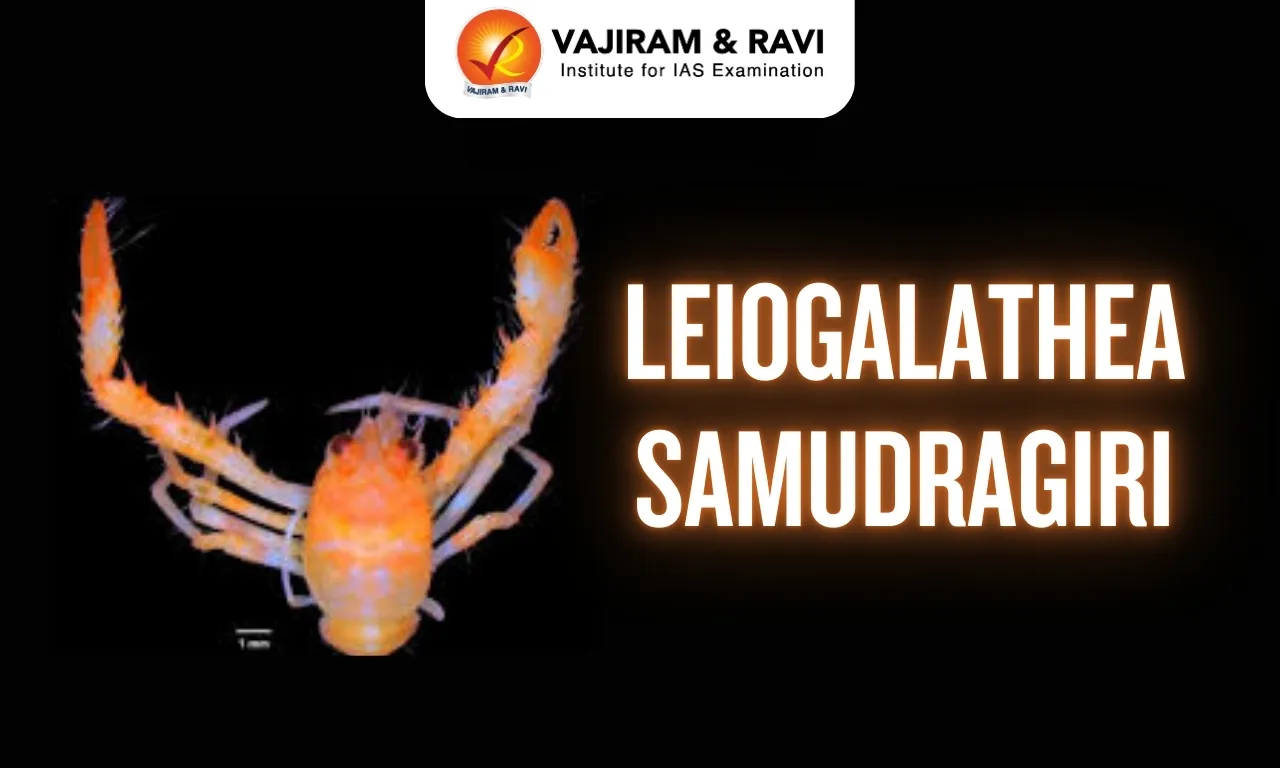
Researchers recently discovered a new species of squat lobster named Leiogalathea samudragiri off Lakshadweep’s coast.
About Leiogalathea Samudragiri
- It is a new species of squat lobster.
- It was found living 360 metres below the surface near Minicoy, part of the Lakshadweep archipelago.
- The discovery was made during a research cruise as part of India’s ambitious Deep Ocean Mission (Samudrayaan program).
- L. samudragiri possesses smooth, uninterrupted ridges running across the top of its shell, whereas its closest relatives have ridges that are broken or interrupted.
- It also features exactly six transverse ridges on the back half of its body.
- It lacks a specific spine on its feelers (antennules) that is commonly found in similar species.
- It is bright orange in colour.
What are Squat Lobsters?
- They are marine crustaceans that resemble small lobsters but are not true lobsters.
- They are more closely related to hermit crabs and porcelain crabs.
- There are well over 900 species of squat lobsters, and they can be found in nearly every marine environment across most latitudes around the world.
- They have small, flat bodies, ranging from 0.7 to 3.5 inches (1.778 to 88.9 mm) in length.
- These decapods (ten-footed) have a front pair of legs that are much longer than their bodies that end in a pair of large claws.
- The lobsters earned their name by tucking their tails under their thorax, giving their bodies a shorter, more “squat” appearance.
- As with many other crustaceans, squat lobsters can use their tail as a paddle to escape backwards very quickly.
Source: RM
Leiogalathea Samudragiri FAQs
Q1: What is Leiogalathea samudragiri?
Ans: It is a new species of squat lobster.
Q2: Near which place was Leiogalathea samudragiri discovered?
Ans: It was discovered near Minicoy in the Lakshadweep archipelago.
Q3: What is unique about the ridges on the shell of Leiogalathea samudragiri?
Ans: It has smooth, uninterrupted ridges across the top of its shell.
Q4: What is the colour of Leiogalathea samudragiri?
Ans: It is bright orange in colour.

