
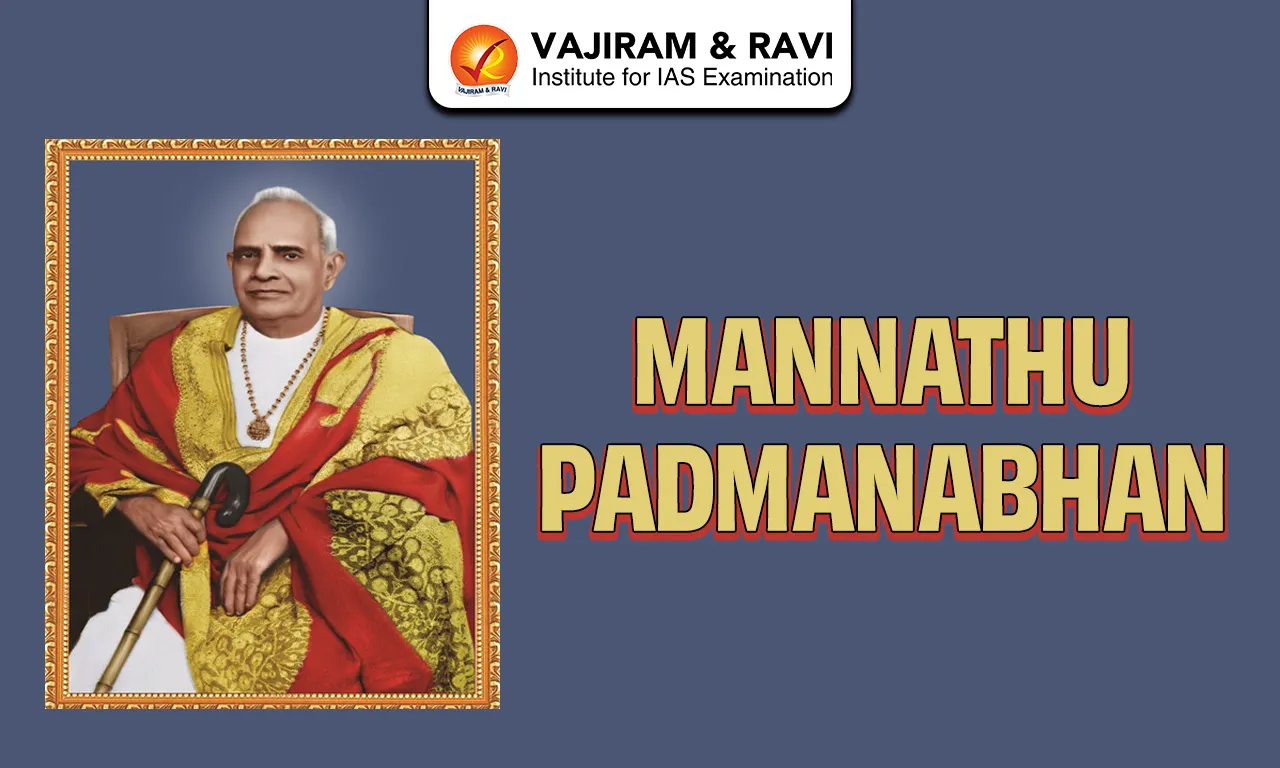
Mannathu Padmanabhan was a prominent social reformer and freedom fighter from Kerala who dedicated his life to equality, dignity and national progress. He emerged as a key figure challenging caste discrimination and social exclusion in the early twentieth century. He was deeply influenced by Mahatma Gandhi and adopted Satyagraha as a powerful instrument of moral resistance. His birth anniversary on 2 January is observed as Mannam Jayanti, reflecting his enduring public legacy across generations.
Mannathu Padmanabhan Biography
Mannathu Padmanabhan was born on 2 January 1878 in Perunna village, Changanacherry, in Kottayam district of erstwhile Travancore to Easwaran Namboothiri and Mannathu Parvathy Amma. He began his professional journey as a school teacher in 1893 and later shifted to legal practice in Magistrate Courts in 1905. In 1914, he founded the Nair Service Society to organise and reform the Nair community, which constituted 12.10% of Kerala’s population as per the 2011 data. He served the organisation as secretary for 31 years and later as president. He passed away at the age of 92 on 25 February 1970.
Mannathu Padmanabhan Contributions
Mannathu Padmanabhan transformed social reform into organised community action through institutions, mass mobilisation and legislative engagement.
- Nair Service Society: On 31 October 1914, he established the Nair Service Society to promote education, discipline and social reform among Nairs. He revived Karayogams as grassroots units, institutionalising community organisation and long term social upliftment.
- Legal Reforms: During 1924-25, the NSS persuaded the Travancore government to enact the Nair Regulation, restructuring the matrilineal Marumakkathayam system and ensuring equitable property division among children, modernising family law practices.
- Anti Untouchability: He actively supported the Vaikom Satyagraha (1924-25) demanding public road access near temples and played a crucial role in the Guruvayur Satyagraha (1931-32), strengthening movements against caste based exclusion.
- Temple Entry: He led the Savarnajatha Satyagraha advocating temple access for oppressed communities, contributing to the broader climate that resulted in progressive temple entry reforms in Travancore.
- Freedom Movement Participation: Associated with the Indian National Congress, he joined national agitations including the Civil Disobedience Movement and was arrested on 14 June 1947 for his involvement in political protests in Travancore.
- Administrative Leadership: As the first President of the Travancore Devaswom Board, he revitalised several temples that had declined in administration and functioning, ensuring systematic governance of religious institutions.
- Legislative and Political Role: He became a member of the Travancore Legislative Assembly in 1949 and later played a decisive role in the 1959 Vimochana Samaram, which led to the dismissal of the communist government under Article 356.
- Regional Political Contribution: In 1964, he was instrumental in forming Kerala Congress, regarded as India’s first regional political party, marking a shift toward state based political mobilisation.
- Literary Works and Writings: He also contributed through influential publications including Ente Jeevitasmaranakal (1989), his autobiography; Mannattinte Sampurnakrithikal (1978), a compilation of complete works; Mannathu Padmanabhante Prasangangal (1982), a collection of speeches; and Mār Mātyūs Attānāsyōsint̲e Pañcakalyāṇi: oru nirūpaṇaṃ (1951), a critical study reflecting his intellectual depth.
Mannathu Padmanabhan Awards and Honours
Mannathu Padmanabhan received national recognition for lifelong service in social reform and nation building initiatives. The major awards and recognition are:
- Padma Bhushan 1966: The Government of India honoured him with the Padma Bhushan in 1966 for distinguished service in social work and public affairs, acknowledging decades of reformist leadership.
- Bharata Kesari Title: The President of India conferred upon him the title Bharata Kesari, meaning Lion of India, recognising his courage in fighting social injustice and promoting unity.
- Mannam Jayanti Observance: His birth anniversary on 2 January is celebrated annually and the NSS headquarters at Perunna hosts commemorative events highlighting his reformist philosophy.
- Memorial: His Samadhi at NSS Headquarters in Changanacherry stands as a memorial site, symbolising his moral authority and lasting imprint on Kerala’s social and political history.
Mannathu Padmanabhan FAQs
Q1: Who was Mannathu Padmanabhan?
Ans: Mannathu Padmanabhan was a Kerala based social reformer and freedom fighter who worked against caste discrimination and founded the Nair Service Society in 1914.
Q2: What is the Nair Service Society (NSS)?
Ans: The Nair Service Society is a community organisation established on 31 October 1914 to promote education, discipline and social reform among the Nair community.
Q3: What role did Mannathu Padmanabhan play in anti untouchability movements?
Ans: He supported the Vaikom Satyagraha (1924-25) and Guruvayur Satyagraha (1931-32), advocating temple entry and equal rights for oppressed communities.
Q4: Which political movements was Mannathu Padmanabhan associated with?
Ans: He participated in the Indian national movement in Travancore, joined the Indian National Congress and was arrested on 14 June 1947 for his activism.
Q5: What awards did Mannathu Padmanabhan receive?
Ans: He was awarded the Padma Bhushan in 1966 and was honoured with the title Bharata Kesari by the President of India for his contributions to social reform.

