Refurbished Medical Devices Latest News
- Recently, the Department of Pharmaceuticals informed the Rajya Sabha that the Ministry of Health and Family Welfare (MoHFW) has constituted a committee to draft a policy on the regulation of refurbished medical devices.
- The panel will define their scope, establish methods to assess safety, performance, and remaining useful life, and recommend guidelines for disposal and waste management.
- The core debate now centres not on whether refurbished medical devices should be allowed, but on how they should be effectively regulated while balancing healthcare access and industrial policy considerations.
About Refurbished Medical Devices
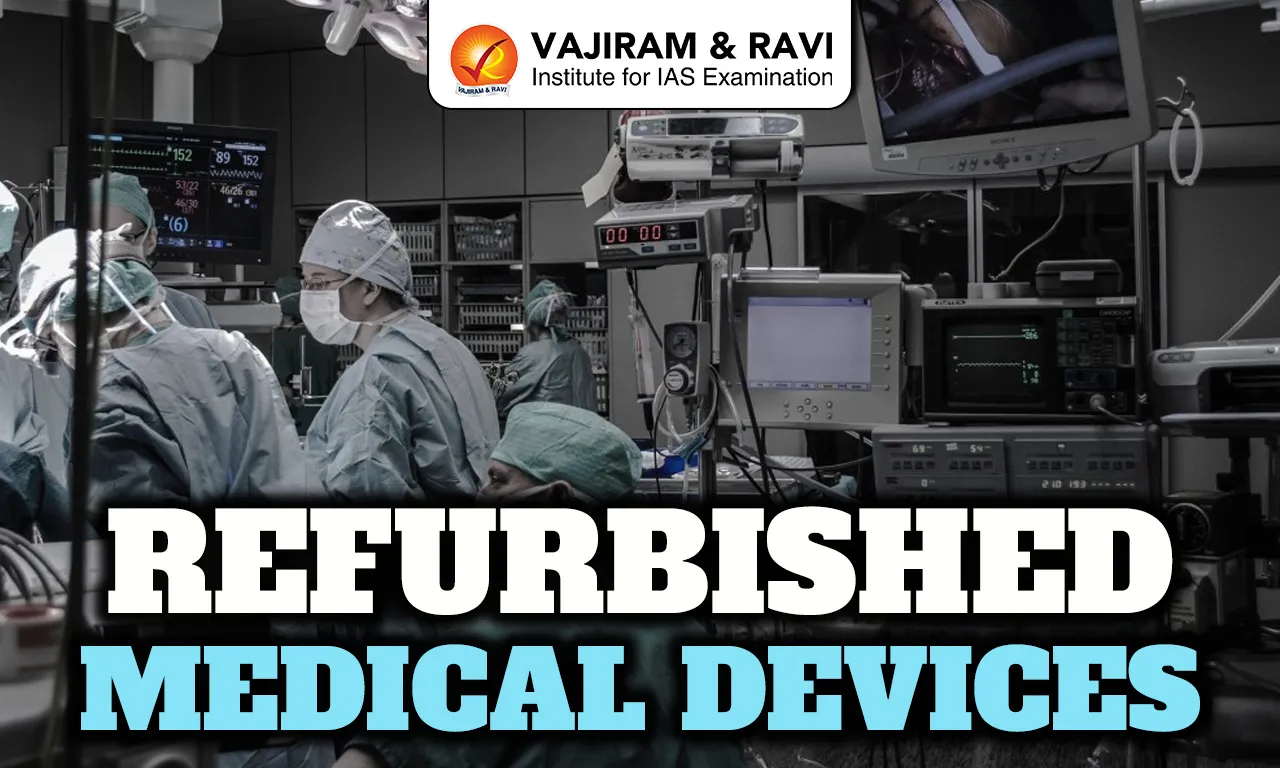
- Refurbished medical devices are previously used equipment restored to original operating standards and resold at lower prices.
- These are typically capital-intensive technologies such as MRI machines, CT scanners, PET-CT systems, advanced endoscopy units, and robotic surgical systems.
Cost Advantage Over New Equipment
- Refurbished systems offer significant cost savings:
- 1.5T MRI machine: New: ₹4–8 crore | Refurbished: ₹1–3.5 crore
- PET-CT system: New: ₹20 crore+ | Refurbished: ₹60 lakh–3.5 crore
- CT scanner: New: ₹2–4 crore | Refurbished: ₹20 lakh–2.5 crore
- These price differences make advanced diagnostics more accessible, particularly for hospitals in Tier-2 and Tier-3 cities.
- For district hospitals, standalone diagnostic centres, and smaller private facilities, refurbished equipment reduces upfront capital costs.
- This supports decentralisation of healthcare and improves access to advanced diagnostics outside major urban centres.
Dependence on Imports
- Despite growth in domestic manufacturing, India remains reliant on imports for advanced imaging and specialised devices due to technological complexity and global supply chain dominance.
- Refurbished equipment is commonly sourced from countries like the US, Germany, Japan, and the Netherlands, where hospitals upgrade systems before the end of their functional life.
Current Government Policy on Refurbished Medical Devices
- India does not have a specific regulatory pathway for refurbished medical devices under the Medical Devices Rules, 2017.
- Although all medical devices were brought under phased regulation from 2017 and notified as “drugs” in 2020 under the Drugs and Cosmetics Act, no separate licensing mechanism exists for refurbished products.
Imports Governed by Waste Management Rules
- At present, refurbished device imports are regulated primarily under the Hazardous and Other Wastes (Management and Transboundary Movement) Rules, 2016.
- Imports are allowed only after obtaining:
- No-objection certificates from an expert committee under the Ministry of Environment, Forest and Climate Change (MoEFCC)
- Technical inputs from the Central Drugs Standard Control Organisation (CDSCO)
- Import authorisation from the Directorate General of Foreign Trade
- Earlier bans on used critical-care devices were relaxed in December 2022, permitting certain high-end equipment under strict scrutiny.
Recent Approvals and Regulatory Clash
- In November 2025, a MoEFCC technical committee approved several refurbished devices for reuse.
- However, in January 2025, CDSCO stated that refurbished devices cannot be imported for sale due to the absence of licensing provisions under the Medical Devices Rules.
- This contradiction created regulatory inconsistency between environmental approvals and medical device regulation.
Policy Ambiguity and Industry Concerns
- India lacks a statutory definition distinguishing “used,” “refurbished,” “reconditioned,” or “remanufactured” devices.
- This creates uncertainty around classification, licensing, compliance, patient safety, and domestic manufacturing policy.
- Industry estimates place the refurbished segment at around ₹1,500 crore, nearly 10% of India’s medical equipment market, highlighting the need for a coherent and unified regulatory framework.
Refurbished Medical Devices: Industry Divide and Policy Debate
- The absence of a clear pathway under the Medical Devices Rules has created uncertainty for both industry and policymakers.
- A key tension lies between promoting domestic manufacturing under Make in India and ensuring affordable access to advanced diagnostics, particularly in Tier-2 and Tier-3 cities.
International Manufacturers’ Perspective
- The Medical Technology Association of India (MTAI), representing global manufacturers, argues against a blanket ban.
- It maintains that refurbished devices are regulated globally rather than prohibited.
- It contends that regulated imports can improve affordability, expand access, support healthcare training goals, and complement industrial initiatives such as Electronics Repair Services Outsourcing.
Domestic Manufacturers’ Concerns
- The Association of Indian Medical Device Industry (AiMeD) strongly opposes easing restrictions without robust regulatory standards aligned with global benchmarks.
- Domestic players argue refurbished devices carry risks of unclear usage history, inconsistent performance, limited traceability, and shorter lifespan.
- They warn that legalising such imports could undermine indigenous manufacturing, weaken emergency preparedness, and turn India into a destination for end-of-life equipment.
- Industry estimates suggest that unauthorised trade in pre-owned equipment is already significant, raising oversight and compliance concerns.
Impact on Innovation and Industrial Policy
- Critics highlight that in developed countries, hospitals upgrade equipment after around 10 years, with older systems refurbished for resale.
- When such systems compete at similar price points with new Indian-made products, they may discourage domestic investment in advanced medical technologies.
- This raises broader questions about balancing healthcare affordability with long-term industrial growth and innovation capacity.
Source: IE
Refurbished Medical Devices FAQs
Q1: What are refurbished medical devices?
Ans: Refurbished medical devices are previously used diagnostic or surgical machines restored to original specifications and resold at lower prices, improving affordability for smaller hospitals and diagnostic centres.
Q2: Why are refurbished medical devices controversial in India?
Ans: Refurbished medical devices raise concerns over safety, traceability, regulatory gaps, and their potential impact on domestic manufacturing under the Make in India initiative.
Q3: How are refurbished medical devices currently regulated?
Ans: Refurbished medical devices are governed mainly under waste management rules, requiring environmental clearance, but lack a dedicated licensing pathway under the Medical Devices Rules, 2017.
Q4: What is the industry divide on refurbished medical devices?
Ans: International manufacturers support regulated imports of refurbished medical devices for affordability, while domestic manufacturers fear they may undermine indigenous innovation and industrial growth.
Q5: Why is a new policy needed for refurbished medical devices?
Ans: A clear regulatory framework for refurbished medical devices would resolve policy inconsistencies, ensure patient safety, protect domestic industry, and improve affordable access to advanced healthcare technologies.

