
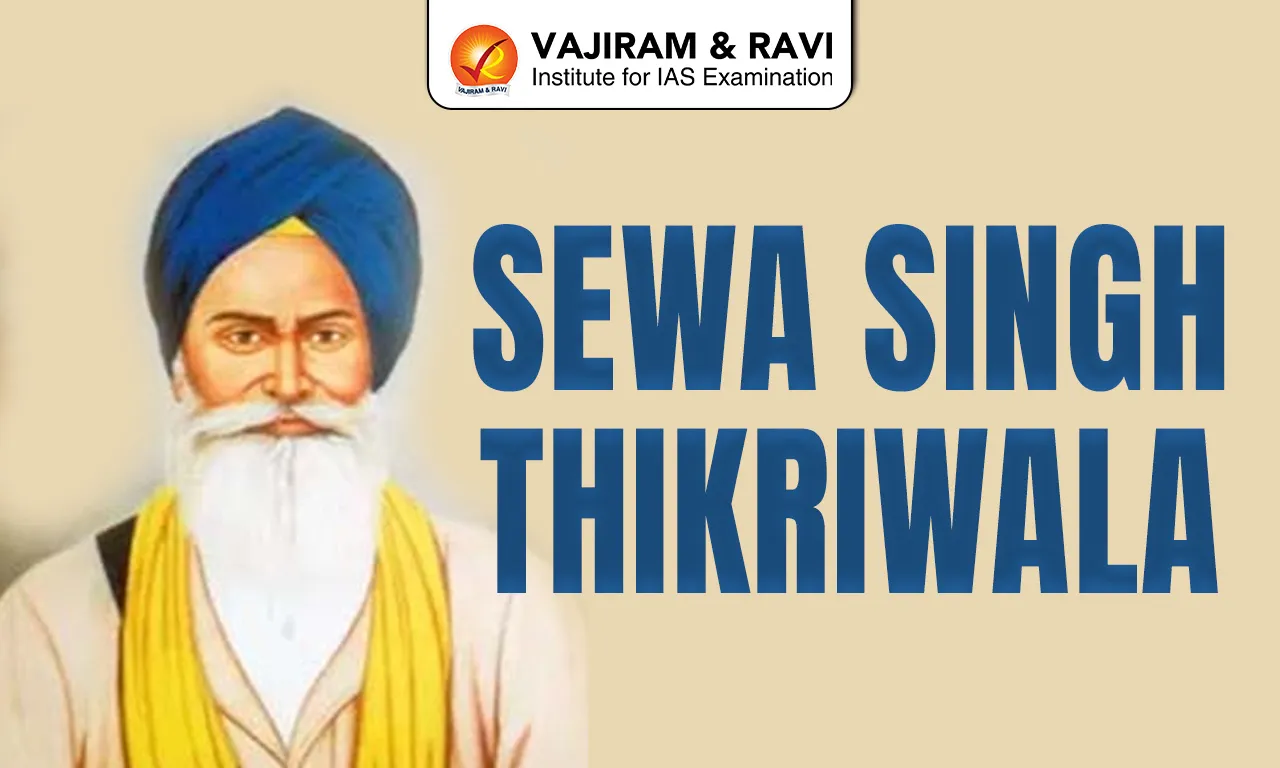
Sewa Singh Thikriwala was a leading figure of Punjab’s princely states reform movement in the early twentieth century. He emerged as a strong voice against autocratic rule in Patiala state. He connected religious reform with political awakening and became president of the Punjab Riyasat Praja Mandal. His imprisonment, repeated prosecutions and death in jail on 19 January 1935 made him a symbol of resistance in the Malwa region of Punjab.
Sewa Singh Thikriwala Biography
Sewa Singh Thikriwala was born in 1886 in Thikriwala village near Barnala in present Sangrur district to Dewa Singh, a senior court official under Maharaja Rajinder Singh of Patiala. After completing middle school, he joined the Hazuri department at Patiala but soon turned toward public service. Inspired by the Singh Sabha reform movement in 1911, he helped organise its first Diwan in his village and promoted Punjabi language teaching. He played a key role in laying the foundation of Gurdwara Thikriwala in 1912, completed within five years through large donations collected domestically and overseas.
Also Read: Narsinh Mehta
Sewa Singh Thikriwala Contributions
He played a decisive role in political mobilisation across princely Punjab through organised movements and institutional leadership.
- Akali Leadership and Gurdwara Reform: After the Nankana Sahib tragedy on 21 February 1921, he actively joined the Akali Movement. He organised an Akali Jatha in Patiala and established close links with the Shiromani Akali Dal and the Shiromani Gurdwara Parbandhak Committee to support democratic management of gurdwaras.
- Punjab Riyasat Praja Mandal Presidency: Inspired by the 1927 Kuthala incident, he founded the Punjab Riyasat Praja Mandal and became its first president. The organisation demanded civil liberties, reduction of oppressive taxation, peasant reforms, expansion of education and establishment of responsible government in princely territories.
- National Level Political Engagement: He hosted major conventions at Lahore in 1929, Ludhiana in 1930 and Shimla in 1931. He participated in the 1929 All India Congress session, the 1931 All India People’s Conference and the 1932 Princely State People’s Association meeting, linking Punjab’s struggle with broader all India politics.
- Confrontation with Patiala State: His direct criticism of the Maharaja led to confiscation of his property during the Shimla Conference period. Negotiations initiated by the Patiala ruler failed when he insisted on an elected assembly, showing his firm commitment to constitutional governance.
- Repeated Imprisonments: In 1923, he was detained for three years in Lahore’s Shahi Qila. In 1926, he received three and a half years in Patiala Jail. In 1930, he was fined Rs 5,000 and sentenced to six years, though released after four months. Further detentions followed in 1931 for Sangrur Satyagraha and in 1932 for the Malerkotla agitation.
- Final Sentence and Martyrdom: In August 1933, he was fined Rs 10,000 and awarded eight years of rigorous imprisonment for defying Patiala orders. After prolonged hunger strikes in 1926 and again during 1933-35 protesting jail ill treatment, he died inside Patiala Central Jail on 19 January 1935.
- Anti Untouchability Efforts: He presided over the 1933 Anti Untouchability Conference at Raikot, showing his commitment beyond political rights toward social equality within Punjabi society.
- Memorial: Every year, a martyrdom fair is organised in Thikriwala on 19 January. Guru Ka Langar started in 1912 still operates. A government high school bears his name and his life size statue stands near the Singh Sabha building on Patiala’s Mall Road. Plans have also been announced to convert his ancestral house into a memorial.
Sewa Singh Thikriwala FAQs
Q1: Who was Sewa Singh Thikriwala?
Ans: Sewa Singh Thikriwala (1886-1935) was a political activist from Patiala princely state in Punjab who led the Punjab Riyasat Praja Mandal and worked for civil liberties, responsible government and reforms in princely states.
Q2: What was the Punjab Riyasat Praja Mandal?
Ans: It was an organisation led by Sewa Singh Thikriwala that demanded protection of civil rights, reduction of heavy taxes, peasant reforms, expansion of education and establishment of elected and accountable government in princely states.
Q3: Why was Sewa Singh Thikriwala imprisoned multiple times?
Ans: He openly criticised the Patiala Maharaja and organised political movements. Between 1923 and 1933, he faced repeated arrests, heavy fines up to Rs 10,000 and long jail sentences for alleged rebellion.
Q4: How did Sewa Singh Thikriwala die?
Ans: He died on 19 January 1935 inside Patiala Central Jail after prolonged imprisonment and hunger strike, protesting against ill treatment and suppression of political rights in the princely state.
Q5: What role did Sewa Singh Thikriwala play in the Akali movement?
Ans: After the Nankana Sahib incident in 1921, he organised an Akali Jatha in Patiala and supported the movement for democratic control of gurdwaras, linking religious reform with political awakening in princely Punjab.

