CERT-In Space Cyber Security Framework, Main Features, Importance

CERT-In Space Cyber Security Framework

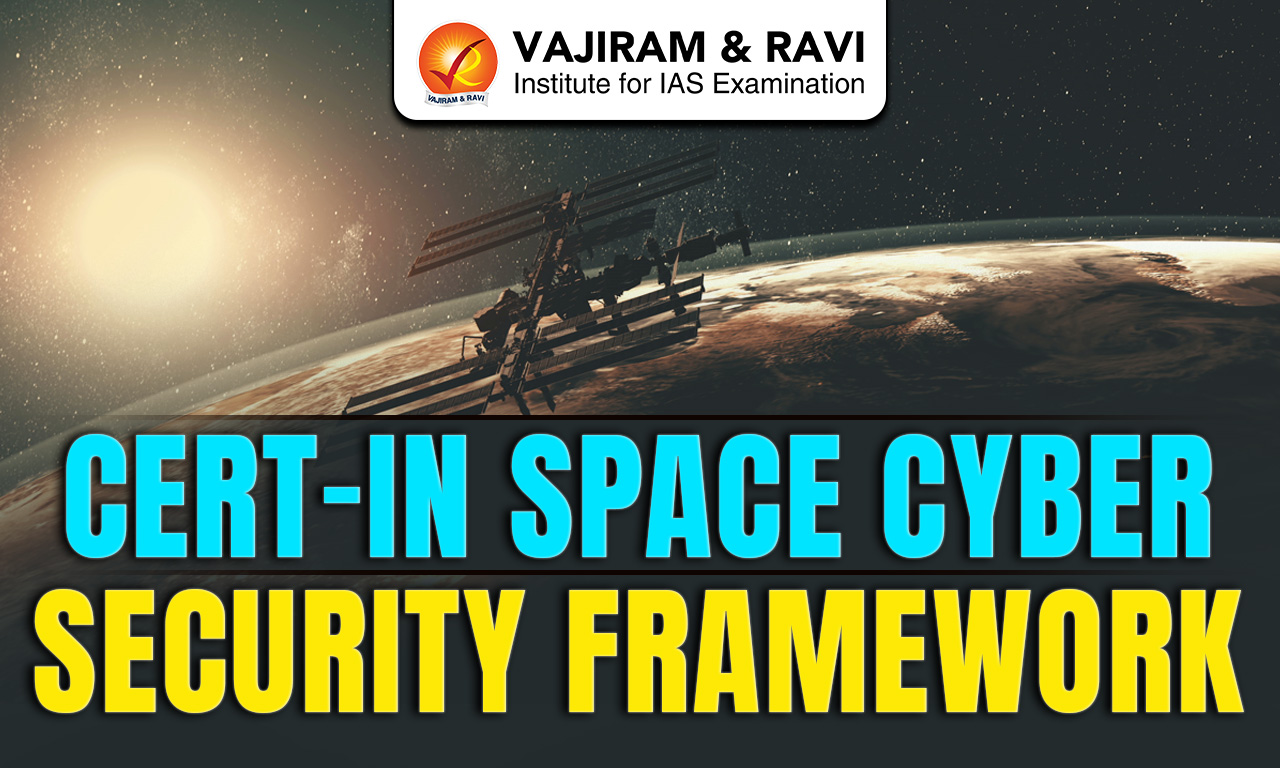
In recent years, space technology has become very important for India’s development and security. Satellite communication helps in providing connectivity in remote areas, disaster management, navigation, defence communication, and broadcasting services. With the growing use of space technology, cyber security of space infrastructure has also become necessary. In this context, the Indian Computer Emergency Response Team (CERT-In) in collaboration with the Satcom Industry Association of India (SIA-India) has released space cyber security guidelines in 2026. The framework was unveiled during the DefSat Conference & Expo 2026 in New Delhi. The initiative reflects India’s growing focus on protecting its space ecosystem from evolving cyber threats.

Need for Space Cyber Security

Space cybersecurity is important because satellite communication systems support connectivity, disaster management, defence communication, navigation, and broadcasting services in India. Increasing dependence on space-based technology has made critical infrastructure such as satellites, ground stations, and communication networks vulnerable to cyber threats.

Cyber attacks like signal jamming, spoofing, and data manipulation can disrupt essential national and strategic services. Protecting space assets is necessary to maintain India’s technological independence, economic growth, and national security.

In this context, Indian Computer Emergency Response Team (CERT-In) and Satcom Industry Association of India (SIA-India) have developed cyber security guidelines to strengthen India’s space ecosystem.

Main Features of CERT-In Space Cyber Security Framework 

  • Comprehensive Ecosystem Coverage: The framework secures the entire space communication ecosystem, including satellites, ground infrastructure, communication links, and space-related supply chains.
  • Defence-in-Depth Approach: It adopts a multi-layered security model based on defence in depth, breadth, and height to address evolving cyber threats. This means security must be ensured at multiple levels such as satellite systems, ground infrastructure, and supply chains.
  • Secure-by-Design Architecture: Encourages integration of cyber security at the design and development stage of space systems rather than adding it later.
  • Threat-Based Risk Assessment: Recognises emerging and sophisticated cyber threats such as jamming, spoofing, unauthorized access, and supply chain vulnerabilities.
  • Stakeholders: The framework covers different stakeholders including satellite operators, equipment manufacturers, private space companies, and government agencies. It encourages clear division of responsibilities and promotes proactive cyber risk management. The framework will also be updated regularly after consultation with industry stakeholders.
  • Public-Private Partnership Model: The initiative reflects cooperation between government and industry. Space technology development now involves private companies, startups, and academic institutions.

CERT-In Space Cyber Security Framework Importance for India

  • Protects India’s critical space infrastructure such as satellites, ground stations, and communication networks.
  • Strengthens national security by securing space systems used in defence and strategic operations.
  • Supports India’s technological sovereignty by reducing cyber dependence on external systems.
  • Promotes safe expansion of India’s space economy, including private space sector participation.
  • Improves reliability of satellite communication during disaster management and emergency services.
  • Enhances India’s preparedness against evolving cyber threats in the global space environment.

About CERT-In

  • The Indian Computer Emergency Response Team (CERT-In) works under the Ministry of Electronics and Information Technology, Government of India.
  • It is the national agency responsible for handling cyber security incidents in India under Section 70B of the Information Technology Act, 2000.
  • CERT-In operates a 24×7 helpdesk to monitor and respond to cyber threats such as hacking, phishing, and other cyber attacks.
  • The organisation provides services related to cyber incident prevention, response coordination, and security quality management across sectors.

About SIA-India

  • The Satcom Industry Association of India (SIA-India) is a non-profit organisation representing India’s space and satellite industry.
  • Its members include satellite operators, manufacturers, startups, academic institutions, suppliers, and law firms working in the space sector.
  • The organisation acts as a bridge between industry and policy-making bodies.
  • It promotes global collaboration and provides a platform for industry stakeholders to communicate with the government regarding space and satellite policies.

CERT-In Space Cyber Security Framework FAQs

Q1: What is the CERT-In Space Cyber Security Framework?

Ans: The CERT-In Space Cyber Security Framework is a guideline developed by the Indian Computer Emergency Response Team (CERT-In) in collaboration with Satcom Industry Association of India (SIA-India) to strengthen cyber security of India’s space ecosystem.

Q2: Why is the CERT-In Space Cyber Security Framework important?

Ans: It is important for protecting satellite communication systems, ground infrastructure, and space assets from cyber threats such as jamming, spoofing, and data manipulation.

Q3: Which sectors are covered under this CERT-In Space Cyber Security Framework?

Ans: The framework applies to government agencies, satellite operators, equipment manufacturers, private space companies, and other stakeholders in the space ecosystem.

Q4: What is the main objective of the CERT-In Space Cyber Security Framework?

Ans: The main objective is to promote secure-by-design technology, improve cyber resilience, and ensure multi-layered security across space infrastructure.

Q5: Is the CERT-In Space Cyber Security Framework mandatory?

Ans: No, the framework is advisory in nature, but it encourages organisations to adopt best cyber security practices for space systems.
Article 326 of Indian Constitution, Provisions, Amendments

Article 326 of Indian Constitution

Article 326 of the Indian Constitution deals with the right to vote in elections to the Lok Sabha and State Legislative Assemblies. It provides for universal adult suffrage, which means every citizen of India who is 18 years or older has the right to vote, regardless of caste, religion, gender, or education. This article ensures that elections are conducted fairly and all eligible citizens can participate in choosing their representatives, making India a true democracy. Article 326 of Indian Constitution has been discussed in detail in this article. 

Article 326 of Indian Constitution Provisions

Article 326 of the Indian Constitution gives every adult Indian citizen the right to vote in elections for the Lok Sabha and State Legislative Assemblies. Any citizen who is 18 years or older can register as a voter, though certain people may be disqualified based on legal provisions.

  • Universal Adult Suffrage: Every Indian citizen aged 18 or above has the right to vote, ensuring that everyone can participate in the democratic process.
  • Applicability: Article 326 specifically applies to elections for the Lok Sabha and State Legislative Assemblies.
  • Voting Age: The voting age was originally 21 but was lowered to 18 by the 61st Constitutional Amendment Act, 1988 to increase youth participation.
  • No Discrimination: Voting rights cannot be denied on the basis of caste, religion, gender, race, or economic status, making elections inclusive and fair.
  • Legal Restrictions: Some citizens may be barred from voting, including those of unsound mind, convicted of serious crimes, involved in corrupt or electoral malpractices, or non-residents of the constituency.
  • Special Cases: Convicted prisoners cannot vote, while undertrial prisoners (not yet convicted) retain their voting rights. Some government employees posted abroad may also face temporary restrictions.
  • Regulation by Law: Parliament and State Legislatures can make laws to regulate elections, define voter eligibility, and list disqualifications. The Representation of the People Acts, 1950 and 1951 are examples of such laws.
  • Direct Elections: Article 326 ensures that representatives in the Lok Sabha and State Assemblies are elected directly by voters, giving citizens a real role in governance.
  • Constitutional Guarantee: The right to vote is protected by the Constitution, so it cannot be taken away arbitrarily. Citizens also have the right to be included in electoral rolls to exercise this right.

Article 326 of Indian Constitution Amendments 

  • Since the Indian Constitution came into effect, Article 326 has mostly stayed the same, setting rules for voting in Lok Sabha and State Assembly elections. The most important change came with the 61st Constitutional Amendment in 1988, which lowered the voting age from 21 to 18 years.
  • Why the change was made: The government wanted to encourage youth participation in democracy. Allowing 18-year-olds to vote gave young citizens a voice in decision-making and helped increase overall voter engagement.
  • Impact on Indian Democracy:
    • Millions of new young voters joined the electoral process.
    • Youth became more politically aware and active.
    • It strengthened the idea of universal adult suffrage, making representation more inclusive.
  • Legal Changes: The Representation of the People Act, 1950 was updated to reflect this new voting age. Originally, Article 326 allowed only citizens aged 21 and above to vote, but after the 61st Amendment, the age was lowered to 18, effective from March 1989.
  • This change not only expanded the electorate but also helped make Indian democracy more representative, encouraging the next generation to participate actively in governance.

Article 326 of Indian Constitution Exceptions and Exclusions 

Article 326 gives every adult citizen the right to vote, but there are some exceptions where people cannot vote.

  • Legal Disqualifications: Only certain individuals are allowed to vote. Non-citizens, such as foreigners or people without Indian citizenship, are not eligible. People declared of unsound mind by a court also cannot vote. Those convicted of serious crimes like corruption, terrorism, or election fraud can lose their voting rights, though they may regain them after serving their sentence or appealing legally. Similarly, anyone punished for electoral malpractices under the Representation of the People Act, 1951 cannot vote.
  • Special Cases: Convicted prisoners lose their right to vote, but undertrial prisoners those who have not yet been convicted can still vote. Some government employees posted abroad, especially in foreign or diplomatic services, may have temporary voting restrictions due to official rules.
  • These exceptions ensure that voting remains fair and lawful while protecting the democratic process.

Significance of Article 326 of the Indian Constitution

    • Article 326 is very important for India’s democracy because it gives every eligible citizen the right to vote in elections for the Lok Sabha (Parliament) and State Legislative Assemblies. By allowing all citizens aged 18 and above to vote, it ensures that everyone has an equal chance to choose their leaders, promoting fairness and equality in governance. This right supports the values of the Constitution, such as justice, liberty, equality, and fraternity, and strengthens the democratic system by making the government accountable to the people.
  • The key significance of Article 326 includes:
    • Universal Adult Suffrage: Every adult citizen has the right to vote, no matter their caste, religion, gender, or economic status, ensuring political equality.
    • Encourages Public Participation: Citizens play an active role in choosing their government, which strengthens democracy at the grassroots and national level.
    • Supports Popular Sovereignty: It reflects the principle that the authority to govern comes from the people themselves.
    • Stability and Transparency: Regular and fair elections ensure that governments are stable and follow democratic procedures.
    • Promotes Accountability: Since leaders are elected directly by the people, they are responsible for their actions and decisions.
    • Increases Political Awareness: By giving citizens the power to vote, it encourages them to learn about policies, governance, and social issues.
  •  

Article 326 of the Indian Constitution FAQs

Q1: What is Article 326 of the Indian Constitution?

Ans: Article 326 gives every adult Indian citizen the right to vote in elections to the Lok Sabha and State Legislative Assemblies, ensuring universal adult suffrage.

Q2: Who can vote under Article 326?

Ans: All Indian citizens aged 18 years or above can vote, regardless of caste, religion, gender, or education.

Q3: What are the exceptions to voting rights under Article 326?

Ans: Voting is restricted for non-citizens, persons of unsound mind, convicted criminals, and those guilty of electoral malpractices. Convicted prisoners cannot vote, but undertrial prisoners can vote.

Q4: What was the main amendment to Article 326?

Ans: The 61st Constitutional Amendment Act, 1988 lowered the voting age from 21 to 18 years to encourage youth participation in democracy.

Q5: How are elections regulated under Article 326?

Ans: Parliament and State Legislatures can make laws to regulate elections, voter eligibility, and disqualifications, such as through the Representation of the People Acts, 1950 and 1951.

Industrial Corridors, Characteristics, Significance, Government Initiatives

Industrial Corridors

In recent years, Industrial Corridors have emerged as a key pillar of India’s development strategy. Recognising their importance, the Government of India, in partnership with State Governments, is developing a network of industrial corridors under the National Industrial Corridor Development Programme (NICDP). 

What are Industrial Corridors?

Industrial corridors are linear development zones that connect major economic centres through an integrated network of roads, railways, ports, and airports, enabling smooth movement of goods, services, and people while supporting large-scale industrial growth along the route.

They represent a shift from scattered industrialisation to planned, infrastructure-driven economic development. They are designed to reduce logistics costs, improve connectivity, attract investment, and integrate India into global value chains.

Industrial Corridors Characteristics 

Their key characteristics include:

  • Faster industrial expansion by closely integrating manufacturing activity with high-quality physical infrastructure.
  • World-class facilities developed along a planned stretch, providing industries with a stable and investor-friendly environment.
  • Industrial clustering and agglomeration, where related industries grow together and benefit from shared services, suppliers, and skilled labour.
  • Targeted development based on regional strengths, ensuring that each corridor builds on the natural and economic advantages of the area.
  • Location along major transport routes, especially freight and railway corridors, to ensure efficient logistics and reduced transit time.

Significance of Industrial Corridors 

Industrial Corridors are significant because of following reasons: 

  • Integrated infrastructure strengthens industrial efficiency: Multimodal transport networks, reliable utilities, and ICT-enabled services create a unified ecosystem that supports efficient industrial operations and the movement of goods.
  • Plug-and-play ecosystems accelerate business readiness: Ready-to-use facilities, assured utilities, and streamlined approvals reduce setup time, helping industries begin operations quickly and competitively.
  • Sustainability initiatives ensure responsible growth: Renewable energy adoption, waste recycling systems, and green building norms help industries expand while limiting environmental impact.
  • Skill development initiatives encourage regional employment: Training programmes and partnerships with educational institutions build a skilled workforce, generating jobs and strengthening local economies.
  • Special Economic Zones attract investment and promote exports: SEZs offer tax incentives and regulatory advantages that draw foreign investment and enhance India’s position in global value chains.
  • Public-Private Partnerships improve development outcomes: Cooperative models between government and industry ensure better planning, efficient resource use, and effective management.
  • Walk-to-work planning elevates quality of life and productivity: Reduced commuting, lower pollution, pedestrian-friendly layouts, and green spaces support healthier lifestyles and more productive urban environments, making industrial cities attractive to investors and workers alike.

Major Industrial Corridors in India (11 under NICDP)

  • Delhi-Mumbai Industrial Corridor (DMIC) - Connects North and West India; backbone of freight-led industrial growth.
  • Chennai-Bengaluru Industrial Corridor (CBIC) - Boosts automobile, electronics, and manufacturing sectors in South India.
  • Amritsar-Kolkata Industrial Corridor (AKIC) - Promotes industrialisation across northern and eastern states.
  • Bengaluru-Mumbai Economic Corridor (BMEC) - Connects Karnataka and Maharashtra; supports heavy industries.
  • Vizag-Chennai Industrial Corridor (VCIC) - Port-led development along the East Coast.
  • Hyderabad-Nagpur Industrial Corridor (HNIC) - Strengthens central India logistics and manufacturing.
  • Hyderabad-Bengaluru Industrial Corridor (HBIC) - Enhances aerospace, defence, and IT-linked manufacturing.
  • Odisha Economic Corridor (OEC) - Focus on mineral-based and port-led industries.
  • Delhi-Nagpur Industrial Corridor (DNIC) - Improves connectivity between North and Central India.
  • Chennai-Kanyakumari Industrial Corridor (CKIC) - Expands industrial development in Tamil Nadu.
  • East Coast Economic Corridor (ECEC) - Integrates eastern coastal states with global markets.

These 11 corridors form the backbone of India’s corridor-based industrial development strategy under NICDP.

Government Initiatives Related to Industrial Corridors 

To promote corridor-led industrialisation, the Government of India, the Government of India has taken several structured and long-term policy measures. One of the most important initiatives is the National Industrial Corridor Development Programme (NICDP).

About National Industrial Corridor Development Programme (NICDP)

  • The National Industrial Corridor Development Programme (NICDP) is the Government of India’s flagship programme for developing industrial corridors across the country. 
  • It aims to create large, well-planned industrial regions supported by strong transport connectivity and modern infrastructure.
  • The programme is aligned with the PM GatiShakti National Master Plan to ensure seamless multimodal connectivity. 
  • It focuses on strong transport linkages, plug-and-play infrastructure, and planned urban development to create future-ready economic zones.
  • The programme is carried out by the National Industrial Corridor Development Corporation Limited (NICDC), which functions under the Department for Promotion of Industry and Internal Trade (DPIIT), Ministry of Commerce and Industry.
  • NICDP covers 11 major industrial corridors across the country, such as the Delhi-Mumbai Industrial Corridor, Chennai-Bengaluru Industrial Corridor, and Amritsar-Kolkata Industrial Corridor. These corridors are supported by freight corridors, highways, ports, and railway networks to ensure strong industrial connectivity.
  • These projects are being developed through a sustainability-focused framework that supports the transition towards Low-Carbon Cities (LCCs). Key elements of this approach include:
    • Creation of extensive green spaces 
    • Provision of public transit systems 
    • Adoption of transit-oriented development (TOD)
    • Integration of renewable energy sources 
    • Reduced dependence on conventional power 
    • Conservation and recycling of water resources 
    • Systematic recovery and recycling of solid waste materials

In 2024, the Government approved 12 additional greenfield smart industrial city projects under NICDP to boost manufacturing capacity, attract investment, and build modern industrial infrastructure across different states.

National Industrial Corridor Development Corporation Limited (NICDC)

The National Industrial Corridor Development Corporation Limited (NICDC) was set up in January 2008 by the Government of India. Earlier, it was known as the Delhi Mumbai Industrial Corridor Development Corporation (DMICDC). It was created to plan, coordinate, and implement projects under the National Industrial Corridor Development Programme (NICDP).

The main role of NICDC is to:

  • Develop smart industrial cities and manufacturing clusters.
  • Build multi-modal logistics hubs that connect industries with roads, railways, and ports.
  • Create business-friendly environments with ready infrastructure and smooth connectivity.
  • Promote sustainable and modern urban planning within industrial regions.
  • Strengthen India’s manufacturing base and boost exports.

NICDC is the key agency responsible for turning the vision of industrial corridors into reality.

National Industrial Corridor Development and Implementation Trust (NICDIT)

  • The National Industrial Corridor Development and Implementation Trust (NICDIT) was formed in December 2016 after expanding the earlier trust fund created for the Delhi-Mumbai Industrial Corridor project.
  • It provides financial support and oversees the proper implementation of industrial corridor projects. 
  • It helps ensure that funds are available for infrastructure development and that projects move forward smoothly.
  • In the Budget Estimates 2026-27, ₹3,000 crore has been allocated to support its activities.

Together, NICDC and NICDIT play an important role in planning, funding, and executing India’s industrial corridor projects.

Conclusion 

Industrial corridors are central to India’s strategy of building a strong, competitive, and sustainable manufacturing sector. Through coordinated infrastructure, smart industrial cities, and institutional support under NICDP, India is creating integrated economic regions that boost investment, generate employment, enhance exports, and promote balanced regional development.

Industrial Corridors FAQs

Q1: What are Industrial Corridors?

Ans: Industrial corridors are planned industrial regions developed along major transport routes like highways, railways, ports, and airports. They connect important economic centres and promote large-scale manufacturing with strong infrastructure and better logistics.

Q2: Why are Industrial Corridors important for India?

Ans: Industrial corridors reduce logistics costs, improve connectivity, attract investment, create jobs, boost exports, and support balanced regional development. They help India become more competitive in global markets.

Q3: How many Industrial Corridors are being developed in India?

Ans: Under the National Industrial Corridor Development Programme (NICDP), 11 major industrial corridors are being developed across the country to strengthen manufacturing and infrastructure.

Q4: Which agency implements Industrial Corridor projects?

Ans: The National Industrial Corridor Development Corporation Limited (NICDC) is responsible for planning and implementing industrial corridor projects in India.

Q5: How do Industrial Corridors promote sustainable growth?

Ans: Industrial corridors focus on renewable energy use, water recycling, waste management, green spaces, public transport, and planned urban development to ensure environmentally responsible industrial growth.

Important Days in March 2026, National and International Days List

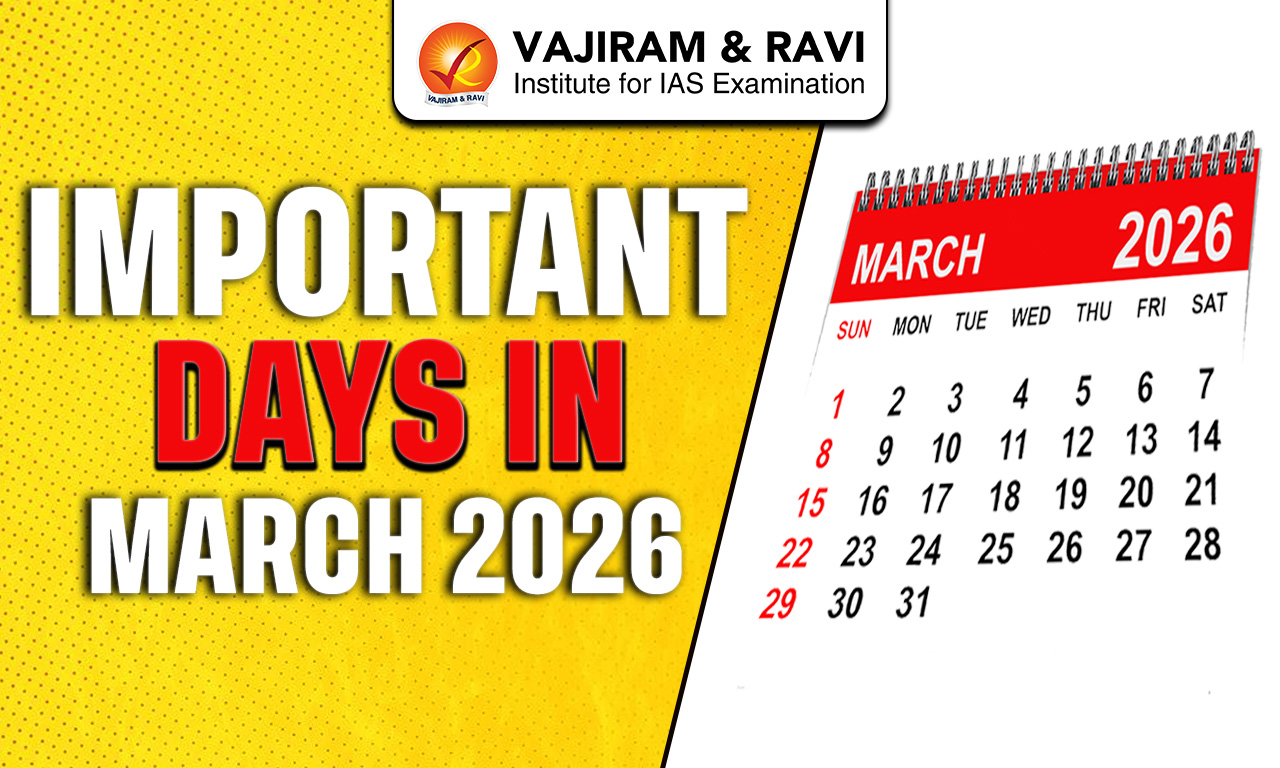
Important Days in March 2026

March 2026 includes several national and international important days observed for awareness, historical remembrance, environmental protection and cultural celebrations. The month of March marks the end of India’s financial year and the beginning of the spring season. From global campaigns on wildlife and water conservation to national observances honouring freedom fighters and security forces. Important Days in March 2026 carries academic, cultural and social importance for students and aspirants preparing for competitive examinations.

Important Days in March 2026 List

The list for the National and International Important Days in March 2026 has been tabulated below:

Important Days in March 2026

Dates

Events

1 March

World Civil Defence Day; Zero Discrimination Day

3 March

World Wildlife Day; Holi (Holika Dahan)

4 March

National Safety Day; Dhulandi

8 March

International Women’s Day

12 March

CISF Raising Day; Anniversary of Dandi March

15 March

Pi Day; World Consumer Rights Day; International Day of Action for Rivers

16 March

National Vaccination Day

18 March

National Vaccination Day (awareness observance reference)

20 March

Ordnance Factory Day; International Day of Happiness; World Sparrow Day; Eid-ul-Fitr (Tentative)

21 March

International Day of Forests; World Poetry Day

22 March

World Water Day

23 March

World Meteorological Day; Shaheed Diwas (Martyrs’ Day)

24 March

World Tuberculosis Day

27 March

World Theatre Day; Ram Navami

31 March

Mahavir Jayanti

Important Days in March 2026 in India and World

March is widely recognised for global awareness campaigns, national commemorations and religious festivals. Below is a date-wise explanation of the major observances. The major Important Days in March 2026 in India and World include:

1 March: Zero Discrimination Day and World Civil Defence Day

Zero Discrimination Day promotes equality and inclusion without bias based on gender, caste, race, or background. World Civil Defence Day recognises the efforts of organisations working to protect people from disasters and emergencies.

3 March: World Wildlife Day and Holika Dahan

World Wildlife Day highlights the importance of conserving wild animals and plant species. On the same day, Holika Dahan marks the symbolic victory of good over evil and begins the festival of colours in India.

4 March: National Safety Day and Dhulandi (Holi)

National Safety Day, also known as Rashtriya Suraksha Diwas, spreads awareness about workplace safety and accident prevention. Dhulandi is the main Holi celebration when people play with colours and water.

8 March: International Women’s Day

This global observance celebrates the achievements of women in social, political, economic and cultural fields. It also promotes gender equality and empowerment.

12 March: CISF Raising Day and Dandi March Anniversary

CISF Raising Day honours the Central Industrial Security Force for safeguarding vital institutions. The anniversary of the Dandi March commemorates the day Mahatma Gandhi began the Salt Satyagraha in 1930.

15 March: Pi Day, World Consumer Rights Day and International Day of Action for Rivers

Pi Day recognises the mathematical constant π (3.14). World Consumer Rights Day promotes awareness about consumer protection and fair trade practices. The International Day of Action for Rivers focuses on protecting rivers and freshwater ecosystems.

16 March: National Vaccination Day

First observed in 1995 when the Oral Polio Vaccine was administered in India, this day stresses the importance of immunisation in preventing life-threatening diseases.

20 March: Ordnance Factory Day, International Day of Happiness and World Sparrow Day

Ordnance Factory Day acknowledges India’s defence manufacturing sector. The International Day of Happiness promotes well-being. World Sparrow Day raises awareness about conserving urban bird populations. Eid-ul-Fitr may also fall around this date depending on moon sighting.

21 March: International Day of Forests and World Poetry Day

International Day of Forests emphasises the importance of forest conservation and sustainable management. World Poetry Day celebrates creative literary expression across cultures.

22 March: World Water Day

World Water Day focuses on freshwater conservation and sustainable water management practices worldwide.

23 March: World Meteorological Day and Shaheed Diwas

World Meteorological Day commemorates the establishment of the World Meteorological Organization and highlights climate and weather awareness. Shaheed Diwas honours the sacrifices of Bhagat Singh, Sukhdev Thapar and Shivaram Rajguru.

24 March: World Tuberculosis Day

This day marks the discovery of the TB bacillus and spreads awareness about prevention and treatment of tuberculosis.

27 March: World Theatre Day and Ram Navami

World Theatre Day celebrates performing arts and cultural expression. Ram Navami marks the birth anniversary of Lord Rama.

31 March: Mahavir Jayanti

Mahavir Jayanti commemorates the birth of Lord Mahavir and holds great significance for the Jain community.

Important Days in March 2026 FAQs

Q1: Why is National Vaccination Day observed in March?

Ans: National Vaccination Day is observed on 16 March to highlight the importance of immunisation, first marked in 1995 with the administration of the Oral Polio Vaccine in India.

Q2: Which major international days are observed in March 2026?

Ans: Important global observances include World Wildlife Day (3 March), International Women’s Day (8 March), World Water Day (22 March) and World Tuberculosis Day (24 March).

Q3: What is the significance of 23 March in India?

Ans: 23 March is observed as Shaheed Diwas to honour the sacrifices of Bhagat Singh, Sukhdev Thapar and Shivaram Rajguru.

Q4: Which environmental awareness days are celebrated in March 2026?

Ans: World Wildlife Day, International Day of Forests, World Water Day and World Sparrow Day focus on wildlife, forests, water conservation and bird protection.

Q5: What major festivals will be celebrated in March 2026?

Ans: Holi, Chaitra Navratri, Gudi Padwa, Ugadi, Ram Navami, Eid-ul-Fitr (tentative) and Mahavir Jayanti are key festivals observed in March 2026.

Operation Lion’s Roar, Background, Impact, Key Details

Operation Lion's Roar

On February 28, 2026, Israel launched a pre-emptive strike on key sites in Tehran, naming it Operation Lion’s Roar, amid concerns over Iran’s nuclear program. The US supported the operation, calling its part Operation Epic Fury, aimed at weakening Iran’s military and missile capabilities. Iran retaliated with missiles under Operation True Promise 4, targeting Israel and regional military sites. Air defenses were activated in Israel, and a state of emergency was declared, though no major casualties were reported.

Operation Lion's Roar Background

The strike followed stalled US-Iran nuclear negotiations in Geneva. Iran maintained its right to enrich uranium for peaceful purposes, while the US demanded strict limits. President Trump had expressed dissatisfaction with the slow pace of talks and described Iran as a major regional threat.

United States “Operation Epic Fury”

The United States has named its part of the campaign alongside Israel as “Operation Epic Fury.” President Donald Trump described it as a major military operation aimed at destroying Iran’s missile and military capabilities. The US says the operation responds to threats from Iran’s nuclear programme and destabilising activities in the region.

Also Read: Operation Sindoor

Iran Operation “True Promise 4”

Iran has named its first wave of missile attacks on Israel as “Operation True Promise 4.” The Iranian military says the operation is a retaliatory strike against Israel and the US, targeting regional military sites. This operation is part of Iran’s ongoing pattern of naming missile and drone strikes in response to Israeli actions

Operation Lion's Roar FAQs

Q1: What is Operation Lion’s Roar?

Ans: It is Israel’s pre-emptive strike on Tehran on February 28, 2026, targeting key sites amid tensions over Iran’s nuclear programme.

Q2: Why did Israel launch the strike?

Ans: Israel acted to prevent Iran from developing nuclear weapons amid stalled US-Iran talks and rising regional threats.

Q3: How did the United States participate?

Ans: The US supported Israel through air and missile strikes, calling its part Operation Epic Fury, aiming to weaken Iran’s military and missile capabilities.

Q4: How did Iran respond?

Ans: Iran launched missiles at Israel in retaliation under Operation True Promise 4, targeting military sites and US-aligned facilities.

Q5: What was the immediate impact?

Ans: Air defenses were activated, missile interceptions occurred, and a state of emergency was declared in Israel, but no major casualties were reported initially.

Casebook on AI and Gender Empowerment, Features, Significance

Casebook on AI and Gender Empowerment

Casebook on AI and Gender Empowerment was launched at the India AI Impact Summit 2026 as an important step towards promoting inclusive and ethical artificial intelligence in India. 

The initiative was developed under the IndiaAI Mission by the Ministry of Electronics and Information Technology (MeitY) in partnership with UN Women, with support from the Ministry of Women and Child Development (MoWCD).

Need of Gender-Responsive AI 

Gender responsive AI is needed because systems depend on data. If the data contains bias, AI can repeat and even increase discrimination. Women, especially in developing countries, often face digital divide, lack of access to finance, limited educational opportunities, and online harassment. Therefore, AI must be designed in a way that supports women’s empowerment rather than creating new inequalities.

Features of Casebook on AI and Gender Empowerment

Key features of Casebook on AI and Gender Empowerment are as follows: 

  • Casebook on AI and Gender Empowerment  brings together 23 real-world AI solutions selected from 233 submissions across more than 50 countries, mainly from the Global South. These solutions demonstrate how artificial intelligence can be used to promote gender equality and women’s empowerment.
  • The solutions cover important sectors such as healthcare, financial inclusion, digital safety, climate resilience, education, and access to justice.
  • Solutions were chosen through a rigorous evaluation process based on measurable impact and real-world implementation. An independent evaluation committee comprising officials from MeitY, MoWCD, and UN Women assessed submissions based on real-world deployment, measurable gender impact, and evidence-based outcomes.
  • The casebook serves as a practical guide for policymakers, researchers, and innovators seeking to integrate gender-responsive principles into AI systems.
  • The initiative demonstrates collaborative governance, MeitY provided strategic direction, UN Women contributed technical expertise on gender and AI, and MoWCD ensured gender-responsive standards.

Casebook on AI and Gender Empowerment Significance for India

Casebook on AI and Gender Empowerment is significant for India because:

  • It promotes inclusive growth by ensuring that AI benefits women and marginalized groups.
  • It supports India’s vision of democratic and responsible AI governance.
  • It helps reduce the digital gender divide by encouraging women’s participation in technology and STEM fields.
  • International recognition, including the visit of António Guterres at the summit, strengthens India’s global leadership in responsible AI.

Challenges in Promoting Gender-Responsive AI in India

  • Gender bias in data and algorithms: Many AI systems are trained on data that already reflects social inequalities. If datasets are not gender-sensitive, AI tools may unintentionally reinforce stereotypes or discrimination.
  • Low participation of women in STEM and AI fields: Women are still underrepresented in technology, research, and leadership roles in AI. This limits diverse perspectives in the design and development of AI systems.
  • Digital gender divide: In many rural and marginalized communities, women have less access to digital devices, internet connectivity, and digital literacy, which restricts their ability to benefit from AI-driven solutions.
  • Scaling and sustainability issues: While pilot projects may show success, expanding them across states and ensuring long-term funding, training, and monitoring requires strong institutional capacity and coordination.
  • Ethical and regulatory gaps: Rapid AI development often moves faster than policy frameworks, creating challenges in ensuring accountability, transparency, and data protection.

Way Forward

India should promote digital literacy among women, encourage their participation in AI innovation, and ensure ethical AI regulations. Public–private and international partnerships must continue to strengthen inclusive AI governance.

Casebook on AI and Gender Empowerment FAQs

Q1: What is the Casebook on AI and Gender Empowerment?

Ans: The Casebook on AI and Gender Empowerment is a publication launched at the India AI Impact Summit 2026 that showcases 23 real-world AI solutions promoting gender equality and women’s empowerment, especially from the Global South.

Q2: Who developed the Casebook on AI and Gender Empowerment?

Ans: Casebook on AI and Gender Empowerment was developed under the IndiaAI Mission by the Ministry of Electronics and Information Technology (MeitY) in partnership with UN Women, with support from the Ministry of Women and Child Development (MoWCD).

Q3: Why is the Casebook on AI and Gender Empowerment important?

Ans: Casebook on AI and Gender Empowerment promotes gender-responsive AI by addressing bias in data and algorithms and ensures that AI systems contribute to inclusive growth and women’s empowerment.

Q4: What sectors are covered under the Casebook on AI and Gender Empowerment?

Ans: The solutions featured in the casebook cover healthcare, financial inclusion, digital safety, climate resilience, education, skills development, and access to justice.

Q5: How does the Casebook on AI and Gender Empowerment help India?

Ans: It strengthens India’s vision of responsible AI governance, reduces the digital gender divide, and enhances India’s global leadership in ethical and inclusive AI development.

Part 9B of Indian Constitution, Background, Articles, Provisions

Part 9B of Indian Constitution

Part 9B of the Indian Constitution deals with cooperative societies. It gives them a constitutional status and ensures they are managed in a democratic and transparent way. This part helps cooperatives play an important role in India’s economic and social development, especially for farmers, workers and small producers. Part 9B of the Indian Constitution has been discussed extensively in this article.

Part 9B of Indian Constitution Background

  • Cooperative societies have been an important part of India for a long time. Farmers, workers and small businesses often come together to form cooperatives to help each other financially and socially. Before Part 9B, cooperatives were mainly governed by state laws, and there was no uniform rule or recognition across the country.
  • This caused problems like mismanagement, lack of transparency, and weak coordination. To fix this, the 97th Constitutional Amendment in 2011 added Part 9B to the Constitution. Now, cooperatives have a constitutional status, which means they are officially recognized and protected. The main aim is to make sure cooperatives are democratic, transparent, and efficient, so they can really help in India’s economic and social development.

Part 9B of Indian Constitution Articles

  • Article 243 ZH : Definitions

(a) Authorised person - A person referred to in Article 243ZQ.

(b) Board - The governing body or board of directors entrusted with the management and control of a cooperative society.

(c) Co-operative society - A society registered or deemed registered under the relevant State law on cooperatives.

(d) Multi-State co-operative society - A cooperative society operating in more than one State and registered under the applicable central law.

(e) Office bearer - President, Vice-President, Chairperson, Vice-Chairperson, Secretary, Treasurer, or any person elected by the board.

(f) Registrar - The Central Registrar for multi-State cooperatives, or the State Registrar appointed under the respective State law.

(g) State Act - A law made by a State Legislature.

(h) State level co-operative society - A cooperative society operating across the entire State, as defined under State law.

  • Article 243 ZI : Incorporation of co-operative societies

Subject to this Part, a State Legislature may make laws for the incorporation, regulation, and winding up of cooperative societies, ensuring voluntary formation, democratic control, member participation and autonomous functioning.

  • Article 243ZJ: Number and term of members of board and its office bearers

(1) The State Legislature shall determine the number of directors, but the board shall not exceed 21 members, including 1 seat for SC/ST and 2 seats for women in societies with individual members.

(2) The term of elected directors and office bearers shall be 5 years, co-terminous with the board. Casual vacancies may be filled by nomination from the same category if less than half the original term remains.

(3) The Legislature shall provide for co-option of up to 2 expert members (banking, finance, management, etc.). 

Such members shall have no voting rights and cannot be elected as office bearers. Functional directors shall be board members but excluded from the 21-member limit.

  • Article 243ZK: Election of members of board

(1) Board elections shall be held before term expiry to ensure immediate assumption of office by the new board.

(2) Election control, including electoral rolls, shall vest in an authority prescribed by State law, which may also set procedures and guidelines.

  • Article 243ZL: Supersession and suspension of board and interim management

(1) Board supersession/suspension shall not exceed six months.

Provided that it may occur in cases of:

(i) persistent default;

(ii) negligence;

(iii) acts prejudicial to the society/members;

(iv) stalemate in constitution or functioning;

(v) failure to conduct elections as per State law.

Provided further that no supersession where there is no Government shareholding/loan/assistance/guarantee.

Provided also that for co-operative banks, the Banking Regulation Act, 1949 applies.

Provided also that for banking co-operatives (other than multi-State), “six months” shall be read as “one year.”

(2) On supersession, the administrator shall conduct elections within the specified period and hand over to the elected board.

(3) State Legislature may prescribe service conditions of the administrator.

  • Article 243ZM: Audit of accounts of co-operative societies

(1) State Legislature may provide for maintenance and annual audit of co-operative society accounts.

(2) State law shall prescribe minimum qualifications/experience for eligible auditors/audit firms.

(3) Every society shall get its accounts audited by an auditor/audit firm under clause (2), appointed by the general body:

Provided that such auditor/audit firm shall be from a State-approved panel.

(4) Audit shall be completed within six months of the close of the financial year.

(5) Audit report of an apex co-operative society shall be laid before the State Legislature as per State law.

  • Article 243ZN: Convening of general body meetings

The Legislature of a State may, by law, provide that every co-operative society shall convene its annual general body meeting within six months of the close of the financial year to transact business as prescribed by such law.

  • Article 243ZO: Right of a member to get information

(1) State Legislature may provide members access to books, information and accounts of the co-operative society.

(2) State Legislature may ensure member participation in management, including minimum meeting attendance and service utilisation as prescribed by law.

(3) State Legislature may provide for co-operative education and training of members.

  • Article 243ZP: Returns

(1) Every co-operative society shall file returns within six months of the close of the financial year to the designated authority, including:

(a) annual activity report;

(b) audited accounts;

(c) surplus disposal plan approved by the general body;

(d) amendments to bye-laws, if any;

(e) declaration of general body meeting and election conduct; and

(f) other information as required by the Registrar under the State Act.

  • Article 243ZQ: Offences and penalties

(1) State Legislature may, by law, provide for offences and penalties relating to co-operative societies.

(2) Such law shall include as offences:

(a) wilfully making false returns/information or failing to furnish required information;

(b) disobeying lawful summons, requisition or written order under the State Act;

(c) employer’s failure to remit deducted amounts to the society within 14 days;

(d) wilful failure to hand over books, accounts, records, cash or property to an authorised person;

(e) adoption of corrupt practices before, during or after board/office-bearer elections.

  • Article 243ZR: Application to multi-State co-operative societies

The provisions of this Part shall apply to multi-State co-operative societies, subject to the modification that references to “Legislature of a State”, “State Act” or “State Government” shall be construed as “Parliament”, “Central Act” or “Central Government”, respectively.

  • Article 243ZS: Application to Union territories

This Part applies to Union Territories; in a UT without a Legislative Assembly, “Legislature of a State” means the Administrator under Article 239, and in a UT with a Legislative Assembly, it means that Assembly: Provided that the President may, by notification, exempt any UT or part thereof.

  • Article 243ZT : Continuance of existing laws

Notwithstanding this Part, any inconsistent State law on co-operative societies existing before the Constitution (97th Amendment) Act, 2011 shall continue until amended, repealed, or for one year from commencement, whichever is earlier.

The Constitution (Ninety-Seventh) Amendment Act, 2011

  • The 97th Constitutional Amendment gave constitutional status to co-operative societies.
  • It made three important changes:
    • It added the words “co-operative societies” in Article 19(1)(c). This made the right to form co-operative societies a Fundamental Right.
    • It inserted Article 43B in the Directive Principles of State Policy. This directs the State to promote voluntary and democratic co-operative societies.
    • It added Part 9B (Articles 243ZH to 243ZT) in the Constitution. This part deals with the incorporation, regulation and winding up of co-operative societies.
  • The Amendment came into force on 15 February 2012.
  • The 97th Amendment was passed by Parliament but not ratified by at least half of the State legislatures, as required under Article 368(2).
  • In Union of India v. Rajendra N. Shah (2021), the Supreme Court applied the doctrine of severability.
  • Valid provisions: Those concerning multi-State cooperative societies and societies in Union Territories remain operative.
  • Invalid provisions: Those affecting single-State cooperative societies were rendered inoperative due to lack of ratification.

Part 9B of Indian Constitution Case Laws

  • Rajendra N. Shah v. Union of India (2013) : In 2013, the Gujarat High Court held that Part 9B was invalid because the Amendment required ratification by at least half of the State Legislatures under Article 368(2), which was not done. However, the rest of the Amendment remained valid.
  • Union of India v. Rajendra N. Shah(2021) : In 2021, the Supreme Court held that Part 9B is valid only for Multi-State Co-operative Societies, and not for State co-operative societies.
  • The Multi-State Co-operative Societies (Amendment) Bill, 2023 aims to strengthen governance, improve transparency, increase accountability and reform the election process in Multi-State Co-operative Societies.

Part 9B of Indian Constitution FAQs

Q1: What is Part 9B of the Indian Constitution?

Ans: Part 9B (Articles 243ZH–243ZT) deals with co-operative societies. It provides constitutional status and lays down provisions for their incorporation, regulation, elections, audit and functioning.

Q2: What changes were made by the 97th Constitutional Amendment Act, 2011?

Ans: The 97th Amendment made forming co-operative societies a Fundamental Right under Article 19(1)(c), added Article 43B as a Directive Principle, and inserted Part 9B to regulate co-operatives constitutionally.

Q3: Who regulates co-operative societies in India?

Ans: Single-State co-operatives are governed by State laws and regulated by the State Registrar, while Multi-State co-operatives fall under the Union List and are regulated by the Central Registrar under the 2002 Act.

Q4: When can a co-operative board be superseded?

Ans: A board may be superseded for default, negligence, prejudicial acts or election failure, but generally not beyond six months (one year for certain co-operative banks), with elections to be held within that period.

Q5: What are the key governance features under Part 9B?

Ans: It limits the board to 21 members, ensures a five-year term, mandates timely elections, provides reservations, and requires an annual audit within six months of the financial year’s end.

Article 124 of Indian Constitution, Provisions, Amendments

Article 124 of Indian Constitution

Article 124 of Indian Constitution deals with the establishment and constitution of the Supreme Court. It aims to ensure an independent, competent, and impartial judiciary, which is essential for the functioning of a constitutional democracy.

Provisions of Article 124 of Indian Constitution 

Provisions of Article 124 of Indian Constitution lays down the framework for the composition, appointment, qualifications, tenure, removal, and conduct of judges of the Supreme Court of India

Establishment and Composition of the Supreme Court

  • Article 124(1) provides that there shall be a Supreme Court of India consisting of the Chief Justice of India and other judges as prescribed by Parliament. 
  • Initially, the Constitution limited the number of judges to a small strength, but Parliament was given the authority to increase the number of judges according to the requirements of the judicial system. This flexibility was introduced to ensure efficient disposal of cases and to manage increasing litigation. 
  • Over time, the number of judges has been increased through legislative action to address the rising judicial workload.
  • At present, the sanctioned strength of the Supreme Court is 34 judges including the Chief Justice of India. 

Appointment and Tenure of Judges

  • Article 124(2) states that Supreme Court judges are appointed by the President of India through a warrant under his hand and seal.
  • The provision has undergone significant interpretation through judicial decisions, which led to the development of the collegium system for judicial appointments. 
  • The collegium system is not mentioned in the Constitution but developed through judicial pronouncements in the Three Judges Cases.
  • The provision also saw the introduction of the National Judicial Appointments Commission through the 99th Constitutional Amendment Act, 2014, which attempted to create a more participatory appointment system involving judiciary and executive. However, in 2015, the Supreme Court declared the NJAC unconstitutional on the ground that it threatened judicial independence.
  • The article further provides that a Supreme Court judge shall hold office until attaining the age of sixty-five years. 
  • A judge may resign by writing a letter addressed to the President. 
  • Parliament has the authority to regulate the determination of the age of judges through legislation.

Qualifications for Appointment

  • Article 124(3) prescribes the eligibility criteria for appointment as a Supreme Court judge. 
  • A person must be a citizen of India and must have either served as a High Court judge for at least five years, practiced as an advocate in a High Court for at least ten years, or be recognised as a distinguished jurist in the opinion of the President

Removal of Judges

  • Article 124(4) provides a procedure for the removal of Supreme Court judges. 
  • A judge can be removed only on the grounds of proven misbehaviour or incapacity. 
  • The removal process requires a parliamentary address supported by a majority of the total membership of each House and at least two-thirds of the members present and voting. 
  • The address must be presented to the President in the same parliamentary session for the removal to be effective. 
  • This rigid procedure protects judicial independence by preventing arbitrary removal of judges.

Regulation of Removal Procedure

  • Article 124(5) allows Parliament to frame laws regulating the procedure for presenting the address and investigating allegations of misbehaviour or incapacity. 

Oath of Office

  • According to Article 124(6), every person appointed as a Supreme Court judge must take an oath or affirmation before entering office. 
  • The oath is administered by the President or a person authorised by the President. 
  • The oath requires judges to uphold the Constitution of India, perform duties without fear or favour, and discharge judicial functions faithfully.

Post-Retirement Restrictions

  • Article 124(7) states that a person who has served as a Supreme Court judge cannot practice law in any court or authority within the territory of India after retirement. This provision is intended to prevent conflict of interest and maintain the dignity and neutrality of the judiciary.

Important Constitutional Amendments Related to Article 124

Constitutional amendments introduced to improve the functioning of the Supreme Court and regulate judicial appointments and service conditions include: 

15th Constitutional Amendment Act, 1963

This amendment made provisions regarding the determination of the age of High Court and Supreme Court judges. It allowed Parliament to prescribe the authority and procedure for determining the age of judges.

99th Constitutional Amendment Act, 2014

This amendment attempted to replace the collegium system by establishing the National Judicial Appointments Commission (NJAC) for judicial appointments.

However, in 2015, the Supreme Court struck down the 99th Amendment as unconstitutional, holding that it violated judicial independence, which is part of the basic structure doctrine.

Judgements Related to Article 124 of Indian Constitution

The appointment of Supreme Court judges has been shaped largely by important judicial interpretations of Article 124. Over time, several landmark Supreme Court judgments have played a crucial role in defining the balance between the executive and the judiciary, especially in matters related to judicial independence and the appointment process.

First Judges Case (1981) / S.P. Gupta Case

  • In the First Judges Case, a seven-judge Constitution Bench interpreted the meaning of the word “consultation” in the Constitution. 
  • The Supreme Court held that consultation did not mean concurrence. 
  • Therefore, the final authority in judicial appointments rested with the Union Government rather than the Chief Justice of India. 
  • This judgment strengthened executive control over judicial appointments. 
  • The Court also ruled that a High Court judge could be transferred to another High Court even without his consent.

Second Judges Case (1993) – Supreme Court Advocates-on-Record Association Case

  • The Supreme Court overruled the First Judges Case and strengthened judicial independence.
  • A nine-judge Constitution Bench established the collegium system. 
  • It was held that the opinion of the Chief Justice of India, formed collectively with senior Supreme Court judges, would have primacy in judicial appointments. The Chief Justice of India should form his opinion after consulting the two senior-most judges of the Supreme Court.
  • In situations where differences arose between the executive and judiciary, the view of the Chief Justice of India would generally prevail.

Third Judges Case (1998)

  • The Supreme Court ruled that the collegium for Supreme Court appointments would consist of the Chief Justice of India and the four senior-most judges of the Supreme Court.
  • It also provided procedural guidance by stating that if two or more judges in the collegium opposed a candidate, the name would not be recommended for appointment.

Fourth Judges Case (2015)

  • In the Fourth Judges Case, the Supreme Court struck down the 99th Constitutional Amendment and the NJAC Act as unconstitutional. 
  • The Court held that the NJAC violated judicial independence, which is part of the basic structure of the Constitution. 
  • The judgment was based on reasons such as inadequate judicial representation in the commission and the potential threat to judicial autonomy.

Article 124 of the Indian Constitution FAQs

Q1: What is Article 124 of the Indian Constitution?

Ans: Article 124 deals with the establishment and constitution of the Supreme Court of India. It provides provisions related to the appointment, qualifications, tenure, and removal of Supreme Court judges.

Q2: How are Supreme Court judges appointed under Article 124?

Ans: Judges are appointed by the President of India. In practice, the collegium system, developed through Supreme Court judgments, plays an important role in judicial appointments.

Q3: What is the retirement age of Supreme Court judges under Article 124?

Ans: A Supreme Court judge holds office until the age of 65 years and can resign by submitting a letter to the President.

Q4: What is the collegium system related to Article 124?

Ans: The collegium system is a judge-led appointment mechanism developed through the Three Judges Cases. It generally consists of the Chief Justice of India and senior Supreme Court judges.

Q5: Can a Supreme Court judge practice law after retirement?

Ans: No. Article 124(7) prohibits a retired Supreme Court judge from practicing in any court or authority in India to maintain judicial independence.

UPSC Daily Quiz 28 February 2026

[WpProQuiz 104]

UPSC Daily Quiz FAQs

Q1: What is the Daily UPSC Quiz?

Ans: The Daily UPSC Quiz is a set of practice questions based on current affairs, static subjects, and PYQs that help aspirants enhance retention and test conceptual clarity regularly.

Q2: How is the Daily Quiz useful for UPSC preparation?

Ans: Daily quizzes support learning, help in revision, improve time management, and boost accuracy for both UPSC Prelims and Mains through consistent practice.

Q3: Are the quiz questions based on the UPSC syllabus?

Ans: Yes, all questions are aligned with the UPSC Syllabus 2025, covering key areas like Polity, Economy, Environment, History, Geography, and Current Affairs.

Q4: Are solutions and explanations provided with the quiz?

Ans: Yes, each quiz includes detailed explanations and source references to enhance conceptual understanding and enable self-assessment.

Q5: Is the Daily UPSC Quiz suitable for both Prelims and Mains?

Ans: Primarily focused on Prelims (MCQ format), but it also indirectly helps in Mains by strengthening subject knowledge and factual clarity.

Article 143 of Indian Constitution, Provisions, Case Laws

Article 143 of Indian Constitution

Article 143 of the Indian Constitution establishes the advisory jurisdiction of the Supreme Court of India which enables the President to seek its opinion on questions of law or facts that are of public importance. This provision acts as a constitutional consultative mechanism between the executive and the judiciary. It was adopted on 6 June 1949 by the Constituent Assembly. The Article allows constitutional doubts to be clarified without initiating adversarial litigation, thereby strengthening institutional dialogue and maintaining constitutional balance.

Article 143 of Indian Constitution

Article 143 of Indian Constitution authorizes the President to consult the Supreme Court on significant constitutional matters requiring authoritative legal interpretation. The provision contains two distinct clauses that define the scope of reference, the Court’s discretion, and the procedural framework. The President acts on the aid and advice of the Union Council of Ministers while making such a reference. As per Article 145(3), references under Article 143 are heard by a Constitution Bench of at least five judges, ensuring collective judicial wisdom in matters of national importance.

Article 143 of Indian Constitution Provisions

The provisions under the Article 143 of Indian Constitution lays down as:

Article 143 (1)

  • Power to Seek Advisory Opinion: If the President believes that a question of law or fact has arisen, or is likely to arise, and it involves public importance, he may refer it to the Supreme Court for consideration and advisory opinion.
  • Court’s Discretion to Respond: After receiving such reference, the Supreme Court may conduct hearings as it considers appropriate and has the discretion to either provide its advisory opinion or decline to answer the question.

Article 143 (2)

  • Reference of Certain Federal Disputes: Notwithstanding the proviso to Article 131, the President may refer disputes mentioned in that proviso to the Supreme Court for its advisory opinion, even if they involve matters otherwise excluded from its original jurisdiction.
  • Mandatory Opinion by Supreme Court: In cases referred under clause (2), the Supreme Court is required to conduct appropriate hearings and must report its opinion to the President, making its response obligatory rather than discretionary.

Article 143 of Indian Constitution Case Laws

Article 143 of Indian Constitution has been invoked around fifteen times since 1950, shaping major constitutional doctrines.

  • Delhi Laws Act Case 1951: Clarified limits of delegated legislation and examined how much legislative power Parliament may transfer to the executive without violating constitutional structure.
  • Kerala Education Bill 1958: Harmonized Fundamental Rights with Directive Principles, explaining how state regulation of minority educational institutions must respect constitutional protections.
  • Berubari Union Case 1960: Held that transfer of Indian territory to a foreign state requires a constitutional amendment under Article 368, not merely executive action.
  • Keshav Singh Case 1965: Explained legislative privileges and confirmed that judicial review can examine legislative actions where constitutional boundaries are crossed.
  • Presidential Election Case 1974: Clarified that the election of the President cannot be invalid merely due to vacancies in State Legislative Assemblies.
  • Special Courts Bill 1978: Recognized validity of pre-enactment judicial scrutiny, indicating that constitutional courts may examine legislative proposals before they become law.
  • Cauvery Water Disputes 1991: Declared that Article 143 cannot be used to review or overturn settled Supreme Court judgments.
  • Ram Janmabhoomi Reference 1993: The Court declined to answer, demonstrating discretion under Article 143(1) where issues were considered inappropriate for advisory determination.

Article 143 of Indian Constitution Significance

Article 143 of Indian Constitution ensures preventive constitutional clarification before executive decisions crystallize into disputes.

  • Advisory Jurisdiction: Establishes a unique consultative power allowing only the President to trigger Supreme Court review without traditional litigation.
  • Constitutional Bench Requirement: Article 145(3) mandates at least five judges, ensuring broad judicial consensus in matters of national constitutional interpretation.
  • Non-Binding Nature: Opinions are advisory, not judgments under Article 141, yet carry persuasive authority usually respected by legislature and executive.
  • Origin in 1935 Act: Derived from Section 213 of the Government of India Act, 1935, which allowed the Governor-General to consult the Federal Court.
  • Federal Harmony: Clarifies Centre-State constitutional boundaries, particularly in legislative competence and assent-related conflicts.
  • Judicial Discretion: The Court may decide procedure, including oral hearings or written submissions, preserving procedural autonomy.
  • Suo Motu Power: The Supreme Court cannot initiate advisory review independently; Presidential reference is mandatory.
  • Comparative Perspective: Unlike the United States Supreme Court, which refuses advisory opinions, India follows a model similar to Canada permitting constitutional consultation.

Article 143 of Indian Constitution FAQs

Q1: What is Article 143 of Indian Constitution?

Ans: Article 143 empowers the President of India to seek the advisory opinion of the Supreme Court on important questions of law or fact that have arisen or are likely to arise.

Q2: Is the Supreme Court’s opinion under Article 143 of Indian Constitution binding?

Ans: No, the opinion given under Article 143 is advisory in nature. It is not binding like a judgment under Article 141, but it carries strong persuasive authority.

Q3: Can the Supreme Court refuse to answer a reference under Article 143 of Indian Constitution?

Ans: Yes, under Article 143(1), the Supreme Court has discretion to decline answering a reference if it finds the issue inappropriate for advisory determination.

Q4: What is the difference between Article 143(1) and Article 143(2)?

Ans: Under clause (1), the Court may choose to give its opinion, while under clause (2), the Court must provide its opinion on specific disputes mentioned in the Constitution.

Q5: How many times has Article 143 of Indian Constitution been used?

Ans: Article 143 has been invoked around fifteen times since 1950, including important references such as the Berubari Case (1960) and the Third Judges Case (1998).

Article 21 of Indian Constitution, List of Rights, Amendments

Article 21 of Indian Constitution

Article 21 of Indian Constitution is one of the most powerful provisions in Part III of the Constitution of India. It protects the core of human existence by guaranteeing life and personal liberty against arbitrary State action. Originally adopted as Draft Article 15 in 1948, it was debated on 6 and 13 December 1948 in the Constituent Assembly. 

The framers deliberately retained the phrase “procedure established by law” instead of “due process.” After adoption on 13 December 1948 without amendment, it became Article 21 in the Constitution of 1950.

Article 21 of Indian Constitution

Article 21 of Indian Constitution states: “No person shall be deprived of his life or personal liberty except according to procedure established by law.” It applies to citizens and non citizens alike. The right can be invoked only against the State as defined under Article 12. Initially interpreted narrowly in A.K. Gopalan, it later acquired expansive meaning through judicial interpretation. The Supreme Court transformed it from a procedural safeguard into a substantive guarantee by insisting that any law affecting life or liberty must follow a just, fair, and reasonable procedure consistent with natural justice.

Rights under Article 21 of Indian Constitution

Article 21 of Indian Constitution has evolved into a source of multiple derivative rights ensuring dignity and fairness.

  • Right to Live with Human Dignity: In Maneka Gandhi, the Court clarified that life means more than animal existence and includes living with dignity, fairness, and freedom from arbitrary or oppressive legal procedures.
  • Right to Livelihood: In Olga Tellis, pavement dwellers were held entitled to livelihood protection, as eviction without alternatives would destroy survival, linking livelihood inseparably with the right to life.
  • Right to Reputation: In Subramaniam Swamy v Union of India, reputation was declared an integral part of dignity under Article 21, and criminal defamation under Section 499 IPC was upheld to protect social value.
  • Right to Healthy Environment: The Court recognized that hygienic atmosphere, ecological balance, clean air, water, and sanitation are essential for meaningful life under Article 21.
  • Noise Free Environment: In Re Noise Pollution, sound at public boundaries cannot exceed 10 dB(A) above ambient standards or 75 dB(A), whichever is lower, protecting health.
  • Right against Custodial Violence: In D.K. Basu, detailed arrest guidelines were mandated, declaring torture or degrading treatment during detention unconstitutional under Article 21 safeguards.
  • Right to Speedy Trial: In Hussainara Khatoon, prolonged undertrial detention was held unconstitutional. Speedy trial applies to investigation, inquiry, appeal, revision, and retrial stages.
  • Right to Free Legal Aid: In M.H. Hoskot, the Court ruled that free legal assistance for indigent accused is a State duty and part of fair procedure.
  • Right to Fair Trial: Presumption of innocence, impartial judges, and unbiased proceedings were recognized as implicit requirements of just procedure under Article 21.
  • Right to Bail: Though bail is governed by CrPC Sections 436 to 450, arbitrary denial affecting liberty must satisfy fairness under Article 21 standards.
  • Right to Travel Abroad: In Satwant Singh and later Maneka Gandhi, impounding passports must follow reasonable procedure respecting personal liberty.
  • Right against Illegal Detention: Joginder Kumar required police to inform relatives of arrest, ensuring transparency and preventing secret detention abuses.
  • Prisoner Rights: Even convicts retain Article 21 protection. In Sunil Batra, prison conditions must respect dignity, health, and humane treatment.
  • Right to Privacy: In K.S. Puttaswamy 2017, privacy was declared intrinsic to life and liberty, subject to legislative backing, legitimate aim, and proportionality test.
  • Telephone Privacy: In PUCL, interception under Section 5(2) Telegraph Act requires procedural safeguards to prevent arbitrary intrusion into private conversations.
  • Reproductive Rights: In Devika Biswas, unsafe sterilization practices were held to endanger health and reproductive autonomy under Article 21 protections.
  • Sexual Orientation Protection: In Suresh Kumar Koushal and later developments, sexual orientation was linked to dignity and equality under Articles 14, 15, and 21.
  • Transgender Identity Rights: In NALSA 2014, self identified gender was recognized, ensuring dignity, medical care, and equality safeguards under Article 21.
  • Disclosure of Disease Exception: In Mr X v Hospital Z, privacy was balanced with partner’s right to health when HIV status disclosure served public interest.
  • Right to Shelter: The Court acknowledged shelter as part of meaningful life, ensuring existence with comfort, privacy, and minimum civic amenities.
  • Right to Die with Dignity: In Common Cause 2018, passive euthanasia and living wills were permitted under safeguards, recognizing dignity at terminal stages.
  • Suicide and Mental Health Protection: Section 309 IPC remains valid after Gian Kaur, but Mental Healthcare Act 2017 reduces criminal consequences and ensures dignity.
  • Death Penalty Safeguards: In Bachan Singh, death penalty limited to rarest of rare; expanded life imprisonment without remission emerged in Swami Shraddananda.
  • Protection from Public Execution: The Supreme Court stayed public hanging in 1985 Rajasthan case, holding barbaric methods violate Article 21 fairness.
  • Protection during Emergency: After the 44th Constitutional Amendment 1978, enforcement of Article 21 cannot be suspended even during Emergency under Article 359.

Case Laws related to Article 21 of Indian Constitution

Judicial interpretation transformed Article 21 into the Constitution’s living core.

  • A.K. Gopalan v State of Madras 1950: Adopted narrow view, treating personal liberty as physical freedom and accepting legislature enacted procedure without substantive fairness review.
  • R.C. Cooper v Union of India 1970: Overruled compartmental approach, holding that fundamental rights overlap, expanding personal liberty beyond isolated interpretation.
  • Kharak Singh v State of UP 1963: Struck down domiciliary visits as unconstitutional intrusion, broadening personal liberty against surveillance without valid law.
  • Maneka Gandhi v Union of India 1978: Introduced fairness doctrine, holding that procedure must be just, fair, reasonable, and consistent with Articles 14 and 19.
  • Hussainara Khatoon v State of Bihar 1979: Recognized speedy trial as essential element of liberty and allowed enforcement through Articles 32 and 226.
  • Sunil Batra v Delhi Administration: Affirmed that prisoners retain dignity and protection against inhuman treatment within correctional institutions.
  • Olga Tellis v Bombay Municipal Corporation 1985: Connected right to life with survival means, preventing arbitrary eviction of economically vulnerable citizens.
  • Vishaka v State of Rajasthan 1997: Held workplace sexual harassment violates dignity and life, issuing binding guidelines before statutory law existed.
  • K.S. Puttaswamy v Union of India 2017: Nine judge bench unanimously declared privacy fundamental, laying three fold test of legality, necessity, proportionality.
  • Common Cause v Union of India 2018: Recognized advance directives and passive euthanasia with medical board oversight and 48 hour decision requirement.
  • D.K. Basu v State of West Bengal: Framed arrest and detention safeguards, requiring documentation and accountability mechanisms.
  • Bachan Singh v State of Punjab: Upheld capital punishment constitutionality but confined it to exceptional circumstances guided by judicial discretion.

Amendments related to Article 21 of Indian Constitution

Constitutional amendments reinforced the protection of life and liberty under Article 21 of Indian Constitution.

  • 44th Constitutional Amendment Act 1978: Modified Article 359 to ensure that the right to life and personal liberty cannot be suspended during Emergency.
  • 86th Constitutional Amendment Act 2002: Inserted Article 21A, mandating free and compulsory education for children aged 6 to 14 years.
  • Right to Education Act 2009: Enacted pursuant to Article 21A, operationalizing State duty to provide elementary education nationwide.

Euthanasia

Euthanasia means intentionally ending a person’s life to relieve unbearable suffering, usually in cases of terminal illness. In India, passive euthanasia was permitted by the Supreme Court in Common Cause 2018 under Article 21, recognizing the right to die with dignity, subject to strict medical safeguards and advance directives.

Procedure Established by Law

Procedure established by law means that a person can be deprived of life or personal liberty only according to a law validly enacted by the legislature. The Constituent Assembly chose this phrase over due process to maintain parliamentary supremacy, while courts later required the procedure to be fair, just, and reasonable.

Due Process of Law

Due process of law means that a law must be substantively fair, reasonable, and just, not merely formally valid. Although not originally adopted in Article 21, the Supreme Court in Maneka Gandhi 1978 introduced due process principles, ensuring that any procedure affecting life or liberty must satisfy fairness and non arbitrariness.

Article 21 of Indian Constitution FAQs

Q1: What does Article 21 of Indian Constitution guarantee?

Ans: Article 21 guarantees that no person shall be deprived of life or personal liberty except according to procedure established by law. It protects both citizens and non citizens against arbitrary State action.

Q2: Does Article 21 of Indian Constitution apply only to citizens?

Ans: No. Article 21 applies to every person within India, including foreigners. However, it can be enforced only against the State as defined under Article 12.

Q3: What is meant by ‘personal liberty’ under Article 21 of Indian Constitution?

Ans: Personal liberty includes freedom from unlawful detention and covers rights such as privacy, dignity, fair trial, and livelihood, as expanded by judicial interpretation.

Q4: Can the right under Article 21 of Indian Constitution be suspended during Emergency?

Ans: After the 44th Constitutional Amendment Act 1978, the right to life and personal liberty under Article 21 cannot be suspended even during a proclaimed Emergency.

Q5: Is the death penalty unconstitutional under Article 21 of Indian Constitution?

Ans: No. In Bachan Singh v State of Punjab, the Supreme Court upheld the death penalty but limited it to the rarest of rare cases, ensuring strict procedural safeguards.

Amondawa Tribe

Amondawa Tribe

Amondawa Tribe Latest News

The Amondawa tribe in Brazil's Amazon lives without clocks, calendars, or numerical age, organising life by natural cycles and identity changes, as revealed by researchers.

About Amondawa Tribe

  • They are an indigenous community living deep inside Brazil’s Amazon rainforest.
  • They were first contacted by the outside world in 1986.
  • They are about 150 strong, continuing their traditional way of life, hunting, fishing, and farming.
  • They live without any concept of time as understood by modern civilisation.
  • They have no linguistic or cultural equivalent for words such as “time", “week", “month" or “year".
  • The tribe can describe events and their sequence but lacks an abstract concept of time as an independent dimension.
  • Daily life revolves around immediate needs, relationships, and the natural environment rather than abstract schedules.
  • One of the most striking aspects of Amondawa society is the absence of numerical age. 
  • Members of the tribe do not track birthdays or calculate how old they are. 
  • Instead, personal growth is marked through identity changes. 
  • As children mature, they receive new names, and a person may change names several times over the course of a lifetime. 
  • In this system, social identity rather than numerical measurement defines stages of life.

Source: N18

Amondawa Tribe FAQs

Q1: Where does the Amondawa tribe live?

Ans: Deep inside the Amazon rainforest in Brazil.

Q2: What are the main traditional occupations of the Amondawa tribe?

Ans: Hunting, fishing, and farming.

Q3: Do the Amondawa people have a modern concept of time?

Ans: No, they do not have a concept of time as understood in modern society.

Q4: Do the Amondawa language and culture have words for week, month, or year?

Ans: No.

Q5: What guides daily life in Amondawa society?

Ans: Immediate needs, relationships, and the natural environment.

Nilgiri Wood Pigeon

Nilgiri Wood Pigeon

Nilgiri Wood Pigeon Latest News

A recent research paper warns that climate change could lead to the habitat of Western Ghats endemic species such as the Nilgiri Wood Pigeon (Columba elphinstonii) and become limited to a few isolated pockets by the end of the century.

About Nilgiri Wood Pigeon

  • It is a species of pigeon endemic to the Western Ghats in India.
  • Appearance: They are best identified in the field by their large size, dark colours and the distinctive checkerboard pattern on their nape.
  • Habitat: It inhabits high-elevation wet evergreen forest, moist evergreen and semi-evergreen forest, including densely wooded ravines and hollows known as ‘sholas’.
  • It occurs primarily in foothills and mountains, up to 2,250 metres above sea level.
  • Distribution: It is mainly found in regions such as the Nilgiris and Anamalai Hills in Tamil Nadu and Kerala. Isolated populations are also reported from locations such as the Biligirirangan Hills, Nandi Hills, and northern Maharashtra.
  • Diet: They are mainly frugivorous and forage in the canopy of dense hill forests.
  • Threats: These are threatened by hunting, deforestation, agricultural and infrastructure expansion, plantation development and climate change.

Conservation Status of Nilgiri Wood Pigeon

  • IUCN: Least Concern
  • Wild Life Protection Act: Schedule-I

Source: TH

Nilgiri Wood Pigeon FAQs

Q1: What is the scientific name of the Nilgiri Wood Pigeon?

Ans: Columba elphinstonii

Q2: Which of the following is a habitat of the Nilgiri Wood Pigeon?

Ans: Western Ghats

Forest Rights Act Cells

Forest Rights Act Cells

Forest Rights Act Cells Latest News

The central government has decided to expand the mandate of Forest Rights Act Cells (FRA cells) to aid the implementation of the Forest Rights Act, 2006 such cells at the State- and Union Territory-level.

About Forest Rights Act Cells

  • FRA cells, sanctioned under the Dharti Aaba Janjatiya Gram Utkarsh Abhiyaan (DAJGUA) scheme launched in October 2024.
  • Aim: To provide technical and administrative support without intervening in statutory decision-making.
  • The State Level FRA Cell comprises three hired manpower i.e. Program Coordinator (FRA), IT/Data/ Program Expert, and MIS Assistant (FRA).
  • District /Sub-Divisional Level FRA Cell comprises two hired manpower i.e. Coordinator (FRA) and MIS /FRA Associate.
  • Progress: Till now Tribal Affairs Ministry sanctioned 324 district-level cells in 18 States and UTs, and 17 cells at the State level.
  • Funding: Ministry of Tribal Affairs

Functions of FRA Cell

  • To assist in completing the process of recognition of rights.
  • Digitization of records, preparation of plans for IFR and CFR beneficiaries to avail the benefits of Govt. schemes,
  • Assist in convergence of Forest villages to revenue villages, and to create awareness amongst all stakeholders ensuring effective implementation of FRA.
  • Assisting claimants and Gram Sabhas in preparing claim documents.
  • Aiding in collection of necessary evidence and resolutions.
  • Helping in digitisation of land records and tracking claim status.
  • Facilitating conversion of forest habitations into revenue villages

Source: TH

Forest Rights Act Cells FAQs

Q1: Under which scheme are FRA Cells sanctioned?

Ans: Dharti Aaba Janjatiya Gram Utkarsh Abhiyaan (DAJGUA)

Q2: What is a key function of FRA Cells?

Ans: Assisting claimants in preparing claim documents

National Science Day 2026, Theme, Raman Effect, CV Raman

National Science Day 2026

National Science Day 2026 is celebrated on 28 February every year. This year the theme is “Women in Science: Catalyzing Viksit Bharat.” The day aims to honour scientific achievements like “Raman Effect” and inspire innovation among young minds. This article delves into the Significance of the day along with the Contributions of Women in the field of Science and Technology. 

National Science Day 2026

National Science Day 2026 is the day when the Raman Effect was discovered by Sir C.V. Raman in 1928. The goal is to promote science and technology, scientific thinking skills through conducting various events like debates, exhibitions, quizzes, and seminars. The day highlights the scientific advancements and inspires future generations to take up careers in science. 

The key highlights of the National Science Day 2026 has been tabulated below:

National Science Day 2026 Overview
Aspect Description

Date

Saturday, 28th February 2026

History

In 1986, NCSTC proposed the designation of February 28 as National Science Day

Purpose

Promotes scientific temper, awareness, and the importance of science in everyday life.

Theme

"Women in Science: Catalyzing Viksit Bharat"

Organizers

Ministry of Science and Technology

Activities

Lectures, seminars, workshops, exhibitions, discussions.

National Science Day 2026 Theme 

National Science Day is celebrated every year with a new unique theme. The theme for the National Science Day 2026 is “Women in Science: Catalyzing Viksit Bharat.” The theme perfectly aligns with the seminars and discussions to be held at the Vigyan Bhawan under the Department of Science and Technology (DST) of Ministry of Science and Technology, Government of India. The theme for 2026 highlights and honors the contribution of Women in Science and Technology. 

National Science Day History

The National Science Day was observed for the first time in 1987, proposed by the National Council for Science and Technology and Communications. The proposal was accepted by the government and 28th February was declared National Science Day to highlight the discovery of Raman Effect. India celebrates the day annually to honor the importance of science in progressing the society and serving a reminder of Indian scientific heritage and the contributions of scientists in global knowledge.

What is the Raman Effect?

The Raman Effect was founded by C.V Raman and K.S. Krishnan in 1928. Under the Raman Effect, the light underwent a shift in wavelength when interacting the molecules of substances. In this discovery, the effect demonstrated that light can be scattered, carrying valuable information about molecular vibrations. Ever since the discovery, this discovery has become an important tool in medicine, chemistry, physics and material composition and properties. This discovery helped him win the Nobel Prize in Physics in 1930.

Who Was C.V. Raman? 

Sir Chandrasekhara Venkata Raman, also known as C.V. Raman was an Indian physicist who made big contributions to spectroscopy and optics. He won a Nobel prize in 1930 for the discovery of the Raman Effect. He is the first Indian scientist to receive a Nobel Prize in Physics and laid the foundation of modern spectroscopy. The Raman Research Institute was founded in 1948 and he also served as the Director of the Indian Institute of Science, Bangalore.

C.V. Raman’s Contributions 

Sir C.V. Raman made groundbreaking contributions to physics and scientific research, leaving a lasting impact across multiple domains:

  • Raman Effect (1928): Explained the scattering of light and its interaction with molecules, earning him the Nobel Prize in Physics (1930).
  • Acoustics: Conducted in-depth studies on musical instruments and wave propagation.
  • Molecular Structure: Advanced the understanding of crystals and liquid structures.
  • Diamonds & Iridescent Substances: Researched the structure of diamonds and the optical properties of iridescent materials.
  • Literary Contributions: Authored key works, including Molecular Diffraction of Light, Acoustical Memoirs, and Why the Sky is Blue (co-authored).
  • Institution Building: Founded the Raman Research Institute to foster scientific progress in India.

National Science Day 2026 Significance

National Science Day 2026 is a key event in fostering scientific awareness and innovation in India. Here's why it matters:

  • Honoring Scientific Excellence: Celebrates the contributions of Indian scientists, especially C.V. Raman.
  • Inspiring Scientific Curiosity: Encourages students to explore science and research.
  • Advancing Science & Technology: Showcases breakthroughs across various fields.
  • Connecting Science & Society: Enhances public understanding of scientific progress.
  • Strengthening Research & Education: Motivates young minds to pursue STEM careers.

Role of Women in Science and Technology

Women have significantly shaped the progress of Science in India in the below highlighted manner. The National Science Day 2026 honors these kind of contributions of Women in the field of Science and Technology. The major contributions of women are:

  • The Prime Minister highlighted major contributions of women scientists and engineers in the successful Chandrayaan 3 mission.
  • Under Chandrayaan 2 Mission, it was for the first time, a space mission of Indian Space Research Organisation was led by two women scientists.
  • Key contributors of Indian Space Technology include Missile Woman of India Tessy Thomas, Rocket Woman of India Ritu Karidhal, and Deputy Project Director Kalpana K.
  • Global Gender Gap Report 2023 by the World Economic Forum states women form 27% of India’s STEM workforce, compared to 32% in non-STEM sectors.
  • According to World Bank data, only 33% of researchers worldwide are women.
  • Globally, just 18% of girls pursue higher-level STEM education, while 35% of boys opt for STEM streams.
  • Women represent only 22% of AI professionals and 28% of engineering graduates, indicating a technology leadership gap.
  • Equal workforce participation could raise India’s GDP by 10% as estimated by scholars.
  • Government initiatives such as Science, Technology and Innovation policy of DST, Indo-US Fellowship for Women in STEMM, Vigyan Jyoti, GATI, KIRAN, and CURIE promote mentoring, institutional reforms, and research participation.
  • Higher female participation improves diversity, decision-making, SDG 5 achievement, targeted interventions, and ensures science benefits society inclusively.

National Science Day FAQs

Q1: Why was 28 February declared as National Science Day?

Ans: To commemorate C.V. Raman’s discovery of the Raman Effect on 28th February 1928.

Q2: What is the theme for National Science Day 2026?

Ans: "Women in Science: Catalyzing Viksit Bharat"

Q3: Why is World Science Day celebrated?

Ans: To highlight the importance of science in society and promote public engagement in scientific advancements.

Q4: Who launched National Science Day?

Ans: The National Council for Science and Technology Communication (NCSTC) in 1986.

Q5: Who is known as the Father of Modern Science in India?

Ans: C.V. Raman is known as the Father of Modern Science in India.

Indian Computer Emergency Response Team (CERT-In)

Indian Computer Emergency Response Team (CERT-In)

Indian Computer Emergency Response Team (CERT-In) Latest News

The Indian Computer Emergency Response Team (CERT-In) and the Satcom Industry Association of India (SIA-India) have jointly released comprehensive guidelines for cyber security across the country’s space ecosystem.

About Indian Computer Emergency Response Team (CERT-In)

  • It is the national nodal agency for responding to computer security incidents as and when they occur.
  • It is a functional organisation of the Ministry of Information & Electronics Technology, Government of India.
  • Objective: Securing Indian cyberspace.
  • CERT-In has been operational since January 2004
  • The constituency of CERT-In is the Indian cyber community.
  • CERT-In has been designated under Section 70B of the Information Technology Act, 2000, to serve as the national agency to perform the following functions in the area of cyber security:
    • Collection, analysis, and dissemination of information on cyber incidents.
    • Forecasts and alerts of cybersecurity incidents.
    • Emergency measures for handling cybersecurity incidents.
    • Coordination of cyber incident response activities.
    • Issue guidelines, advisories, vulnerability notes, and white papers relating to information security practices, procedures, prevention, response, and reporting of cyber incidents.
    • Such other functions relating to cyber security as may be prescribed.
  • To perform these functions, CERT-In is empowered to call for information and issue directions to service providers, intermediaries, data centres, body corporates, and any other person. 
  • CERT-In provides services to organizations in the Government, Public, and Private sectors. In addition, CERT-In provides services to individuals and home users as well.
  • CERT-In collaborates with international counterparts to share information regarding emerging threats, vulnerabilities, and malware.
  • CERT-In creates awareness on security issues through dissemination of information on its website (https://www.cert-in.org.in) and operates a 24x7 incidence response help desk. 
  • Disclosure of information will be followed in accordance with Indian Constitutional laws.
  • To ensure effective governance, a Review Committee oversees CERT-In’s operations. This committee includes but is not limited to representatives from various government ministries, such as:
    • Ministry of Law and Justice
    • Department of Telecommunications
    • Ministry of Home Affairs
    • Group Coordinator for Cyber Law and e-Security
  • The committee meets regularly to assess CERT-In’s performance and provide strategic direction.

About Satcom Industry Association of India (SIA-India)

  • The SIA-India is a non-profit body representing India’s space and satellite sector.
  • Its members include satellite operators, manufacturers, startups, academia, and legal firms, working to shape policy and promote global collaboration.

Source: DDN

Indian Computer Emergency Response Team (CERT-In) FAQs

Q1: What is the primary role of Indian Computer Emergency Response Team (CERT-In)?

Ans: It is the national nodal agency for responding to computer security incidents.

Q2: Under which ministry does CERT-In function?

Ans: Ministry of Electronics and Information Technology.

Q3: Under which section of the IT Act is CERT-In designated as the national cyber security agency?

Ans: Section 70B of the Information Technology Act, 2000.

Q4: Who are the main beneficiaries of CERT-In services?

Ans: Government, public and private sector organizations, as well as individuals and home users.

Central Drugs Standard Control Organisation

Central Drugs Standard Control Organisation

Central Drugs Standard Control Organisation Latest News

Recently, the Central Drugs Standard Control Organisation moved to fast-track approvals for new medicines by allowing No-Objection Certificates (NOCs) for laboratory testing to be issued immediately upon receipt of applications.

About Central Drugs Standard Control Organisation

  • It is the National Regulatory Authority (NRA) of India for the medical devices industry under the provisions of the Drugs and Cosmetics Act 1940.
  • Functions: It is responsible for overseeing the import, manufacture, sale, and distribution of medical devices in the country. The CDSCO ensures that medical devices comply with safety, quality, and efficacy standards.
  • Nodal Ministry: It works under the Directorate General of Health Services, Ministry of Health & Family Welfare, Government of India.
  • Headed By: The Drugs Controller General of India (DCGI) is the head of the CDSCO.
  • Under the Drugs and Cosmetics Act, CDSCO is responsible for,
    • Approval of new drugs; Conduct of clinical trials; Laying down the standards for drugs; Control over the quality of imported drugs in the country; Coordination of the activities of State Drug Control Organizations;
  • CDSCO, along with state regulators, is jointly responsible for the grant of licenses for certain specialized categories of critical drugs such as blood and blood products, I. V. Fluids, Vaccine, and Sera.
  • Headquarters: New Delhi.

Source: TOI

Central Drugs Standard Control Organisation FAQs

Q1: Under which ministry does CDSCO function?

Ans: Ministry of Health and Family Welfare

Q2: What is the primary objective of CDSCO?

Ans: To ensure safety, efficacy, and quality of drugs

Amur Falcon

Amur Falcon

Amur Falcon Latest News

Three Amur falcons tagged with satellite transmitters in Manipur are currently spending their winter migration period across three African countries, officials said recently.

About Amur Falcon

  • It is a migratory raptor of the falcon family.
  • Scientific Name: Falco amurensis
  • This falcon is known by a few other names, such as Eastern Red-footed Falcon, Eastern Red-footed Kestrel, Manchurian Falcon, and Red-legged Falcon.

Amur Falcon Distribution

  • They breed in southeastern Siberia and Northern China and migrate long distances in large flocks to winter in Southern and East Africa.
  • Along the way, large numbers pass through India, with the biggest congregations seen in the northeastern states.
  • It undertakes the longest regular overwater passage of any raptor.

Amur Falcon Features

  • It is an average-sized falcon, with a wingspan of 63–71 cm and weighing about 120 g. 
  • The male and female are distinctly different. 
  • The male is a dark, sooty grey, with brownish-red thighs and vent. 
  • When flying, a white lining of the male’s wings stands out against the sooty grey. 
  • The female has a pattern common among many falcon species, with a dark spotted chest and vent against a white background and a darker, grey back. 
  • A distinctive feature of both the male and the female is the orange of the eye-ring, beak base (the cere) and feet. 
  • As in many birds of prey, the male is smaller than the female.
  • In addition to speed and strength, these birds are known to have keen eyesight for detecting prey from a distance or during flight.

Amur Falcon Conservation Status

It is classified as 'Least Concern' under the IUCN Red List.

Source: IT

Amur Falcon FAQs

Q1: What type of bird is the Amur Falcon?

Ans: A migratory raptor belonging to the falcon family.

Q2: What is the scientific name of the Amur Falcon?

Ans: Falco amurensis.

Q3: Where does the Amur Falcon breed?

Ans: In southeastern Siberia and northern China.

Q4: Where does the Amur Falcon migrate to during winter?

Ans: Southern and East Africa.

Q5: Which country lies along the migration route of large numbers of Amur Falcons?

Ans: India.

Meningococcal Infection

Meningococcal Infection

Meningococcal Infection Latest News

Recently, the Meghalaya government issued an advisory urging people to avoid crowded places and follow health protocols after a meningococcal infection scare.

About Meningococcal Infection

  • Meningococcal infection is a severe, rapidly progressing disease caused by the bacterium Neisseria meningitides.
  • It leads to life-threatening meningitis (infection of the lining of the brain) or meningococcemia (blood poisoning).
  • It infects meninges, the membranes that cover the brain and spinal cord to become inflamed.
  • Transmission
    • People spread meningococcal bacteria to other people by sharing respiratory and throat secretions (saliva or spit).
    • Generally, it takes close or lengthy contact to spread these bacteria. 
    • They are not as contagious as germs that cause the common cold or the flu.
  • Symptoms: It includes high fever, severe headache, stiff neck, and a non-blanching rash.
  • Treatment: It is treated with antibiotics. Other treatments may be needed, including:
    • Help with breathing, such as oxygen therapy.
    • Drugs to treat low blood pressure.
    • Ways to treat damaged or dead skin, including surgeries.

Source: TH

Meningococcal Infection FAQs

Q1: What is the primary cause of Meningococcal Infection?

Ans: Neisseria meningitidis

Q2: Which age group is most susceptible to Meningococcal Infection?

Ans: Adolescents and young adults

Very Short-Range Air Defence System

Very Short-Range Air Defence System

Very Short-Range Air Defence System Latest News

Recently, Defence Research & Development Organisation (DRDO) has successfully conducted three successive flight-trials of the Very Short-Range Air Defence System (VSHORADS) from the Integrated Test Range (ITR), Chandipur off the coast of Odisha.

About Very Short-Range Air Defence System

  • It is a Man Portable Air Defence system.
  • It is designed and developed indigenously by Research Center Imarat in collaboration with other DRDO laboratories and Development cum Production Partners.

Features of Very Short-Range Air Defence System

  • It is short-range, lightweight and portable surface-to-air missiles that can be fired by individuals or small groups to destroy aircraft or helicopters. 
  • Range: They have a maximum range of 8 kilometres and can engage targets at altitudes of 4.5 km. 
  • The missile incorporates many novel technologies including a miniaturized Reaction Control System (RCS) and integrated avionics, which have been successfully proven during the tests. 
    • The RCS is responsible for attitude control and steering by the use of thrusters and is also capable of providing small amounts of thrust in any desired direction or combination of directions.
  • The missile system has the capability to meet the needs of all the three branches of the Armed Forces, viz. Indian Army, Navy, and Air Force.

Source: PIB

Very Short-Range Air Defence System FAQs

Q1: What is the primary purpose of a Very Short-Range Air Defence (VSHORAD) system?

Ans: Defending against short-range aerial threats

Q2: VSHORAD systems typically engage targets at ranges of?

Ans: They have a maximum range of 8 kilometres.

Pangong Lake

Pangong Lake

Pangong Lake Latest News

Ladakh has created history by successfully conducting its maiden 21-km trail running event in sub-zero temperature at 13,862 feet high Pangong Tso, which was registered in Guinness world record as the world's highest frozen lake half marathon.

About Pangong Lake

  • Pangong Lake, also known as Pangong Tso, is an endorheic (hydrologically landlocked) lake in the Himalayas situated at a height of about 4,350 m (14,270 ft).
  • It is situated in eastern Ladakh, extending into the China (Tibet region).
  • It derives its name from the Tibetan word, “Pangong Tso”, which means “high grassland lake”.
  • It is one of the world’s highest brackish water lakes.
  • The lake is 134 km long and almost 5 km wide at its broadest point, with one-third of it lying in India and the other two-thirds in China. 
  • It is famed for its colour changing water, from blue to red and green.
  • During winter, the lake freezes completely, despite being saline water. 
  • The lake is also a breeding ground for different types of birds during the summer season.
  • Bar-headed geese, Brahminy ducks, black-necked cranes and seagulls are commonly spotted here.
  • It is not part of the Indus River basin area and is geographically a separate landlocked river basin.
  • It is in disputed territory. The Line of Actual Control (LAC) passes through the lake.

Source: NDTV

Pangong Lake FAQs

Q1: What type of lake is Pangong Tso?

Ans: An endorheic (landlocked) brackish water lake.

Q2: At what altitude is Pangong Tso located?

Ans: About 4,350 meters above sea level.

Q3: In which region of India is Pangong Tso situated?

Ans: Ladakh.

Q4: Pangong Tso extends into which country beyond India?

Ans: China (Tibet region).

Q5: What proportion of Pangong Tso lies within India?

Ans: About one-third.

Daily Editorial Analysis 28 February 2026

Daily-Editorial-Analysis

International Law is Not Dead, Its Rules Stay Resilient

Context

  • Escalating geopolitical conflicts, including Russia’s invasion of Ukraine, tensions in West Asia, and controversial actions by major powers, have revived claims that international law is collapsing.
  • Some scholars foresee a norm-free world, pointing to institutional withdrawals, unilateral military actions, and a perceived rupture in the global order.
  • Despite mounting challenges, international law persists as an indispensable normative framework shaping state conduct and international cooperation.

The Prohibition on the Use of Force: Crisis or Collapse?

  • A foundational pillar of modern international law is the prohibition on the threat or use of force under Article 2(4) of the United Nations Charter.
  • Recent violations have intensified doubts about its survival; however, repeated breaches do not signify legal extinction.
  • During the Cold War, similar concerns emerged amid widespread armed conflicts.
  • Wars in Afghanistan, the Falklands, the Gulf, Bosnia, Kosovo, Iraq, Syria, and Libya severely strained the prohibition on force.
  • Yet Article 2(4) endured as the central legal benchmark against which state conduct was judged. The persistence of this principle demonstrates that international law can be battered but not extinguished.

Legal Justification and the Power of Normative Constraint

  • The Role of Legal Argument in International Politics
    • The strength of international law lies partly in its capacity to compel states to justify their actions.
    • Legalisation creates expectations that public power must be exercised within recognised rules.
    • Historically, even dominant powers sought to frame military interventions within the doctrine of self-defence exception, expanding its interpretation to align actions with existing norms.
    • Such practices reveal the enduring force of legal justification.
    • The act of offering legal reasoning preserves space for debate, contestation, and normative accountability.
  • A Qualitative Shift in the Present Moment
    • The contemporary challenge is not merely repeated violations but the declining effort to justify them.
    • Rising populist-authoritarianism has introduced a degree of brazenness in which legal reasoning is sometimes sidelined.
    • This erosion of deliberative engagement weakens the culture of compliance and threatens the expectation that power must answer to law.
    • Yet even this shift does not eliminate the system. It signals a struggle over interpretation and authority rather than a disappearance of norms.

Beyond the UN Charter: The Expanding Scope of International Law

  • Over eight decades, the international community has developed dense legal regimes governing trade, investment, aviation, maritime resources, outer space, human rights regime, climate governance, and the control of chemical and biological weapons.
  • This expansion reflects deep global interdependence. Legal frameworks underpin economic exchange, environmental protection, and technological cooperation.
  • Agreements such as the High Seas Treaty and the Pandemic Agreement illustrate ongoing treaty-making process and sustained multilateral engagement.
  • Trade negotiations between major economies further demonstrate reliance on structured legal commitments.
  • International law’s vitality is evident not only in crisis management but also in its routine coordination of complex global systems.

The Judicialisation of International Relations

  • Courts such as the International Criminal Court and the African Court on Human and Peoples’ Rights exemplify the expanding architecture of international adjudication.
  • These institutions embody the judicialisation of international relations, providing structured mechanisms for dispute resolution and individual accountability.
  • Though compliance is uneven, their existence reinforces the principle of peaceful dispute resolution and strengthens the institutional architecture supporting global governance.

The Silent Functioning of International Law

  • It enables goods to cross borders under predictable trade rules, secures civil aviation routes, regulates maritime passage, and facilitates communication networks.
  • This silent operation of law sustains daily life and economic stability: by structuring expectations and reducing uncertainty, international law provides predictability and stability in a fragmented geopolitical environment.
  • Its effectiveness is often invisible precisely because it functions smoothly. The absence of headlines in these areas signals not irrelevance but routine success.

Conclusion

  • International law is undergoing one of its most challenging periods, particularly concerning the prohibition on force.
  • The resilience of Article 2(4), the persistence of legal justification, the breadth of global regulatory regimes, and the proliferation of international courts all demonstrate enduring strength.
  • International law remains a dynamic system shaped by contestation and adaptation. Its continued expansion across domains of trade, environment, health, and human rights affirms its structural importance.
  • International law endures, not as a flawless order, but as a necessary foundation for global stability in an increasingly turbulent world.

International Law is Not Dead, Its Rules Stay Resilient FAQs

Q1. What is the central debate surrounding international law today?
Ans. The central debate concerns whether repeated violations of global norms indicate the collapse of international law or merely reflect a period of crisis and contestation within an enduring legal framework.

Q2. Why does the prohibition on the use of force remain significant despite frequent violations?
Ans. The prohibition remains significant because it continues to serve as the primary legal standard for evaluating and holding states accountable for the use of force in international relations.

Q3. How does legal justification reinforce the authority of international law?
Ans. Legal justification reinforces authority by compelling states to frame their actions within established legal principles, thereby preserving accountability and normative constraint.

Q4. In what ways does international law extend beyond issues of armed conflict?
Ans. International law governs diverse areas such as trade, human rights, climate governance, public health, aviation, and maritime resources, demonstrating its broad and functional role in global cooperation.

Q5. Why is it inaccurate to declare the death of international law?
Ans. It is inaccurate because international law continues to function through treaties, courts, and regulatory systems that structure global interactions and promote stability despite ongoing challenges.

Source: The Hindu


Indivisible Dignity - Supreme Court’s Intervention and the Constitutional Ethic of Respect

Context

  • The Supreme Court’s recent suo motu intervention regarding an NCERT textbook passage allegedly portraying judicial corruption has highlighted the importance of protecting the reputation and dignity of public institutions.
  • The Court’s action underscores that public confidence is central to constitutional governance.
  • However, the episode also raises a broader constitutional issue: whether the principle of dignity and protection from misrepresentation should apply equally to institutions and social communities, especially in educational content.

Supreme Court’s Assertion of Institutional Responsibility

  • Protection of institutional credibility:
    • The Court emphasised that constitutional institutions depend on public trust, not merely legal authority.
    • The misrepresentation in textbooks can cause long-term reputational damage, particularly among young students.
    • Swift judicial intervention signals the need to protect institutional legitimacy in a democracy.
  • Significance of suo motu action:
    • It demonstrates judicial vigilance in safeguarding constitutional institutions, reinforcing the idea that reputational harm can weaken governance structures.

Education and Civic Imagination

  • Role of textbooks in nation-building:
    • Textbooks shape civic consciousness and democratic values.
    • Curriculum choices influence how citizens understand history, society, and constitutional values.
    • Omission or selective representation can produce distorted public understanding.
  • Recent curriculum changes:
    • Recent NCERT revisions have drawn attention to omissions and modifications -
      • Removal of references to the Gujarat riots (Class XII Political Science).
      • Dilution and later removal of references to the Babri Masjid demolition.
      • Reduced coverage of Mughal history, Caste struggles, and Dalit movements.
    • While curriculum revision is normal in governance, cumulative changes raise concerns about sanitised history and selective narratives.

Representation and Social Perception

  • Risks of partial narratives:
    • Communities represented mainly through conflict narratives (which reinforce stereotypes), and victimhood narratives (which obscure agency and achievements).
    • Partial truths, repeated over time, can become deep-rooted prejudice.
  • Importance of balanced representation:
    • Honest history must include oppression and injustice, reform movements, intellectual traditions, and contributions to society.
    • Balanced representation strengthens democratic citizenship.

Constitutional Doctrine of Dignity

  • Justice Ujjal Bhuyan: Emphasised that vilification of communities on grounds of religion, caste, language, or region is constitutionally impermissible.
  • Centrality of fraternity:
    • Fraternity is a core constitutional value. It ensures social cohesion, mutual respect, and shared belonging.
    • Without fraternity, equality becomes formal, and liberty becomes fragmented.

Constitutional Framework

  • The principle of dignity is supported by multiple constitutional provisions.
  • For example,
    • Preamble: Fraternity assures the dignity of the individual.
    • Fundamental Rights: Article 14 (Equality before law), Article 15 (Prohibition of discrimination), Article 21 (Right to life including dignity).
    • Fundamental Duties: Article 51A(e) – Promotion of harmony and brotherhood.
  • Together, these provisions establish a normative framework for respectful public discourse.

Statutory Safeguards

  • Legal provisions addressing hate speech and vilification include -
    • IPC Section 153A – Promoting enmity between groups.
    • IPC Section 153B – Imputations prejudicial to national integration.
    • IPC Section 295A – Outraging religious feelings.
    • IPC Section 505 – Statements causing public mischief.
  • These laws form the legal backbone against communal incitement, though enforcement often appears uneven.

Challenges

  • Selective vigilance: Strong protection of institutions but inconsistent protection of communities creates a perceived hierarchy of dignity.
  • Curriculum politicisation: Educational content influenced by political priorities risk of historical sanitisation.
  • Uneven legal enforcement: Hate speech laws applied inconsistently. Normalisation of stereotypes in public discourse.
  • Weak emphasis on fraternity: Fraternity remains the least discussed constitutional value. The concept saw limited integration into policy and education.

Way Forward

  • Ensure balanced curriculum: NCERT revisions should be evidence-based, transparent, academically rigorous, and include multiple perspectives in historical narratives.
  • Consistent constitutional protection: Equal protection of institutions, individuals, and communities, to avoid hierarchy of dignity.
  • Strengthen legal enforcement: Uniform application of hate speech provisions, and clear standards for intervention.
  • Promote constitutional values: Greater emphasis on fraternity, dignity, and social harmony. Integrate constitutional ethics into education.

Conclusion

  • The Supreme Court’s intervention on NCERT content goes beyond protecting judicial reputation; it signals a broader constitutional principle — dignity is indivisible.
  • A robust democracy must defend both institutions and communities with equal seriousness.
  • The true strength of constitutional governance lies not only in safeguarding its institutions but also in ensuring that every citizen and community enjoys equal respect and belonging.

Indivisible Dignity FAQs

Q1. Why is public trust essential for the functioning of constitutional institutions in a democracy?

Ans. Public trust legitimises constitutional institutions and ensures effective governance beyond mere legal authority.

Q2. How do school textbooks influence civic imagination in a democratic society?

Ans. Textbooks shape citizens’ understanding of history and society, influencing attitudes towards institutions and communities.

Q3. What is the constitutional basis for protecting the dignity of individuals and communities in India?

Ans. Constitutional provisions [Preamble, Articles 14, 15, 21 and Article 51A(e)] collectively guarantee dignity and promote social harmony.

Q4. Why is fraternity considered a foundational value in the Indian constitutional framework?

Ans. Fraternity binds liberty and equality into a cohesive democratic order by fostering mutual respect and belonging.

Q5. What is meant by the idea that “dignity is indivisible” in constitutional governance?

Ans. The principle implies that equal protection must be extended to institutions, individuals and communities without hierarchy.

Source: IE

Daily Editorial Analysis 28 February 2026 FAQs

Q1: What is editorial analysis?

Ans: Editorial analysis is the critical examination and interpretation of newspaper editorials to extract key insights, arguments, and perspectives relevant to UPSC preparation.

Q2: What is an editorial analyst?

Ans: An editorial analyst is someone who studies and breaks down editorials to highlight their relevance, structure, and usefulness for competitive exams like the UPSC.

Q3: What is an editorial for UPSC?

Ans: For UPSC, an editorial refers to opinion-based articles in reputed newspapers that provide analysis on current affairs, governance, policy, and socio-economic issues.

Q4: What are the sources of UPSC Editorial Analysis?

Ans: Key sources include editorials from The Hindu and Indian Express.

Q5: Can Editorial Analysis help in Mains Answer Writing?

Ans: Yes, editorial analysis enhances content quality, analytical depth, and structure in Mains answer writing.

Exercise Vayu Shakti-26

Exercise Vayu Shakti-26

Exercise Vayu Shakti-26 Latest News

The Indian Air Force recently conducted Exercise Vayushakti-26 at the Pokhran field firing range near Jaisalmer.

About Exercise Vayu Shakti-26

  • It was conducted by the Indian Air Force (IAF) at Pokhran air-to-ground range, near Jaisalmer, Rajasthan.
  • The event was last held in February 2024.
  • The exercise showcased the operational preparedness, tactical capabilities, and combat efficiency of the IAF.
  • Guided by the core values of “Achook, Abhedya aur Sateek,” the exercise was aimed to reassure the nation by reaffirming the IAF’s role as a key component of India’s national security architecture.
  • It showcased the air force's capability to execute complex, integrated air operations within a dynamic and realistic battlefield environment.
  • Over 130 aircraft participated in the day-and-night exercise, including Rafale, Su-30 MKI, Mirage-2000, MiG-29, Jaguar, Hawk, Mi-17, C-130J, C-295, C-17, the indigenous advanced light helicopter (ALH) Dhruv and light combat helicopter (LCH) Prachand.
  • The exercise also featured advanced weapon systems such as Short Range Loitering Munitions (SRLM), Akash, SpyDer, and Counter Unmanned Aerial Systems (CUAS).
  • For the first time, Exercise Vayushakti was executed along a defined operational storyline, transforming into a simulated live combat theatre. 
  • The exercise seamlessly integrated offensive air strikes, air defence operations, special forces missions and humanitarian assistance.

Source: HT

Exercise Vayu Shakti-26 FAQs

Q1: Which organization conducts Exercise Vayu Shakti?

Ans: Indian Air Force (IAF).

Q2: Where was Exercise Vayu Shakti-26 conducted?

Ans: At the Pokhran Field Firing Range near Jaisalmer, Rajasthan.

Q3: What is the primary objective of Exercise Vayu Shakti?

Ans: To demonstrate operational preparedness, tactical capability, and combat efficiency of the IAF.

16th Finance Commission: Big Boost for Urban Governance

16th Finance Commission

16th Finance Commission Latest News

  • The latest report of the 16th Finance Commission, tabled in Parliament on February 1, highlights renewed support and strengthened financial backing for urban local governments.

16th Finance Commission: Overview and Key Recommendations

  • The 16th Finance Commission, chaired by Dr. Arvind Panagariya, submitted its report for the period 2026–27 to 2030–31, tabled in Parliament on February 1, 2026.
  • The Commission has recommended that 41% of the divisible pool of central taxes be devolved to states — the same share as recommended by the 15th Finance Commission.
    • The divisible pool excludes the cost of tax collection and revenues from cesses and surcharges.

Criteria for Devolution Among States

  • To distribute central taxes among states, the Commission uses a formula assigning weightage to specific parameters.
  • Income Distance: Reduced from 45% to 42.5%
  • Population (2011): Increased from 15% to 17.5%
  • Demographic Performance: Reduced from 12.5% to 10%
  • Area: Reduced from 15% to 10%
  • Forest Cover: Retained at 10%
  • Tax and Fiscal Effort: Removed (earlier 2.5%)
  • Contribution to GDP: Newly introduced at 10%

16th Finance Commission Boosts Urban Local Governments

  • The Finance Commission (FC) is a constitutional body that recommends how tax revenues should be shared between the Centre and states. 
  • Reconstituted every five years, it also provides grants to local governments. 
  • Since the 10th FC — after the introduction of urban local bodies and panchayats as the third tier — such grants have been a regular feature.
  • The 16th Finance Commission has significantly raised the share of grants for urban local governments to 45%, up from 36% under the 15th FC and 26% under the 13th FC.
  • In absolute terms, it has recommended ₹3.56 lakh crore for urban local bodies — more than double the 15th FC’s ₹1.55 lakh crore and nearly 15 times the allocation of the 13th FC (post-2011 Census).
  • These allocations determine the financial capacity of the lowest tier of government to address local infrastructure, service delivery, and grassroots governance challenges as India’s urban population continues to grow.

Uneven Distribution Across States

  • Grants are distributed according to the 16th FC’s population-based formula, resulting in varied outcomes for states.
  • Kerala’s allocation increased by over 400%.
  • Maharashtra saw a rise of over 300%.
  • Odisha’s allocation grew by only 13%.
  • Bihar experienced an 8% reduction.

Rising Urbanisation and the Need for Greater Urban Funding

  • The 16th Finance Commission’s higher allocation to urban local bodies acknowledges India’s projected urbanisation level of 41% by 2031. 
  • With each decade, a larger share of India’s population is moving to cities, increasing the demand for stronger urban governance.

Data Gaps and Policy Challenges

  • The 2011 Census recorded 31% of Indians living in urban areas — lower than countries like China (45%), Indonesia (54%) and Brazil (87%). 
  • However, other estimates vary widely. A 2015 World Bank report suggested that 54% lived in cities and another 24% in urban clusters, pointing to significant discrepancies. Rapid migration trends further complicate accurate measurement.
  • Inconsistent data hampers effective policy planning and resource allocation. Urban local bodies are particularly affected due to uncertain funding projections.

16th FC’s Financial Cushion

  • The increased 45% share for urban bodies is seen as a buffer against future demographic revisions. 
  • If Census 2027 data shows higher urbanization — say 48% — the enhanced allocation would prevent urban governments from being financially underprepared, unlike earlier cycles when allocations were lower (36% or 26%).
  • The 16th Finance Commission’s recommendations reflect India’s accelerating urban transition, though variations in state-level allocations highlight ongoing complexities in balancing demographic trends and fiscal federalism.

Source: IE | PRS

16th Finance Commission FAQs

Q1: What is the significance of the 16th Finance Commission?

Ans: The 16th Finance Commission recommends fiscal devolution for 2026–31, retaining 41% tax share for states and sharply increasing urban local body grants.

Q2: How does the 16th Finance Commission support urban governance?

Ans: The 16th Finance Commission raises urban grants to 45%, allocating ₹3.56 lakh crore to strengthen city infrastructure and grassroots governance.

Q3: What criteria does the 16th Finance Commission use for tax devolution?

Ans: The 16th Finance Commission uses income distance, population, demographic performance, area, forest cover, and GDP contribution as distribution parameters.

Q4: Why is rising urbanisation important for the 16th Finance Commission?

Ans: The 16th Finance Commission acknowledges projected 41% urbanisation by 2031, ensuring cities receive adequate fiscal support for rapid demographic shifts.

Q5: How are states affected under the 16th Finance Commission formula?

Ans: The 16th Finance Commission applies a population-based formula, resulting in major increases for Kerala and Maharashtra, while Bihar sees a reduction.

Pakistan–Afghanistan Tensions: History Behind the Open Conflict

Pakistan–Afghanistan Tensions

Pakistan–Afghanistan Tensions Latest News

  • Pakistan and Afghanistan have entered a sharp new phase of hostilities, with Pakistan bombing Kabul and other provinces after a cross-border attack on its troops. 
  • Pakistan’s Defence Minister termed the situation an “open war” with the Taliban-led Afghan government.
  • The escalation follows months of tensions, with Islamabad accusing Kabul of sheltering militants responsible for attacks inside Pakistan. However, the strain between the two countries is rooted in a much longer history.
  • Since 1947, relations have largely been marked by distrust, hostility, and recurring confrontations. 
  • These tensions have persisted across changes in governments in Pakistan and major upheavals in Afghanistan, including the Soviet intervention (1979–1989) and the US intervention (2001–2021), during both of which Pakistan supported Afghan resistance groups.

Regime Changes in Afghanistan: A Turbulent Political History

  • End of the Monarchy and Communist Rule (1973–1989) - Afghanistan’s monarchy ended in 1973, followed by a brief nationalist phase and then 11 years of communist rule backed by the Soviet Union. The regime attempted sweeping political and social reforms but failed to stabilise the country.
  • Najibullah and Collapse (1989–1992) - After the Soviet withdrawal, President Najibullah led a nationalist government for three years. His administration collapsed in 1992, paving the way for internal conflict.
  • Civil War and First Taliban Rule (1992–2001) - Afghanistan descended into civil war between Mujahideen factions and the emerging Taliban movement. Formed in 1994, the Taliban — supported by Pakistan — captured Kabul in 1996 and controlled most of the country.
  • US Intervention and Islamic Republic (2001–2021) - Following the September 11, 2001 attacks, the US invaded Afghanistan, ousting the Taliban and establishing the Islamic Republic of Afghanistan. However, the new political system struggled to gain lasting stability, and the Taliban insurgency persisted.
  • Taliban Return to Power (2021) - After the US withdrawal in August 2021, the Taliban swiftly defeated Afghan government forces, regaining control of the entire country — once again with Pakistan’s backing — and re-establishing their rule over Afghanistan.

Persistent Fault Lines in Pakistan–Afghanistan Relations

  • The Durand Line Dispute - A core dispute remains Afghanistan’s refusal to formally recognise the Durand Line as the international border, fuelling recurring tensions over sovereignty and territorial claims.
  • Trade, Transit, and Strategic Control - Disagreements over transit routes and trade access have deepened mistrust, with Afghanistan accusing Pakistan of exerting undue influence and control over its affairs.
  • Mutual Resentment - Many Afghans resent what they perceive as Pakistan’s interference since the fall of the monarchy. Conversely, Pakistan views Afghans as ungrateful, citing its hosting of millions of refugees and support for Afghan resistance movements against the Soviet Union and the United States.
  • The India Factor - India’s presence and engagement in Afghanistan have long shaped Pakistan’s security concerns, adding another layer of complexity to bilateral tensions.
    • Pakistan fears strategic encirclement by India and Afghanistan and seeks to limit Kabul’s ties with New Delhi. 
    • However, Afghan governments resist external influence over their foreign policy choices.
    • Currently, Pakistan views the Taliban’s outreach to India as a betrayal, deepening tensions and reinforcing longstanding suspicions between the two neighbours.

The Durand Line: A Root of Pakistan–Afghanistan Tensions

  • The 2,640-km Durand Line was drawn in 1893 by Sir Mortimer Durand, dividing territories of Afghan ruler Amir Abdul Rehman Khan. 
  • The demarcation split Pashtun tribal lands and was initially meant to define spheres of influence, not a permanent international border.
    • Historical and cultural differences between Pashtuns and the Punjab-dominated Pakistani state remain significant.
  • While British India later treated the Durand Line as a permanent boundary — a position inherited by Pakistan in 1947 — Afghanistan rejected this interpretation. 
  • It even opposed Pakistan’s entry into the United Nations, arguing that Pashtun territories ceded to British India should revert to Afghanistan.
  • The Durand Line dispute remains unresolved. Even in 2018, Afghanistan objected when Pakistan integrated its Tribal Areas into Khyber Pakhtunkhwa, reaffirming Kabul’s long-standing refusal to accept the border’s finality.

Trade and Transit: A Strategic Pressure Point

  • As a landlocked country, Afghanistan depends on transit access through neighbouring states — primarily Pakistan, Iran, and the Central Asian republics. 
  • Among these, the Pakistan route is geographically and economically the most viable.
  • Successive Afghan governments have sought permission for overland trade between India and Afghanistan via the Wagah border. Pakistan has refused to allow Indian exports and aid through its territory, fuelling resentment in Kabul.
  • Tensions intensify when Pakistan restricts goods entering Afghanistan through land routes or via Karachi port. Such actions are widely viewed in Afghanistan as the use of connectivity and transit access as instruments of political coercion.

Source: IE | ToI

Pakistan–Afghanistan Tensions FAQs

Q1: What triggered the latest Pakistan–Afghanistan tensions?

Ans: Pakistan–Afghanistan tensions escalated after cross-border strikes, with Islamabad accusing Kabul of harbouring militants attacking Pakistani forces.

Q2: Why is the Durand Line central to Pakistan–Afghanistan tensions?

Ans: Pakistan–Afghanistan tensions stem from Afghanistan’s refusal to recognise the Durand Line as an international border dividing Pashtun territories.

Q3: How do trade disputes affect Pakistan–Afghanistan tensions?

Ans: Pakistan–Afghanistan tensions deepen when transit routes via Karachi and Wagah are restricted, with Kabul viewing connectivity controls as coercive leverage.

Q4: What role does the Pashtun issue play in Pakistan–Afghanistan tensions?

Ans: Pakistan–Afghanistan tensions are influenced by Pashtun grievances, the Tribal Areas merger, and Taliban-TTP linkages across the border.

Q5: How does India influence Pakistan–Afghanistan tensions?

Ans: Pakistan–Afghanistan tensions are shaped by Islamabad’s fears of Indian influence in Kabul and concerns over strategic encirclement.

New GDP Series 2022-23 Base Year – Explained

GDP Series

GDP Series Latest News

  • The government has released the New GDP Series 2022-23 base year, revising FY26 growth to 7.6% and Q3 growth to 7.8%. 

Introduction of the New GDP Series

  • The Ministry of Statistics and Programme Implementation (MoSPI) has introduced a new GDP series with 2022-23 as the base year, replacing the earlier 2011-12 base year. 
  • Base year revision is a standard statistical exercise undertaken periodically to reflect structural changes in the economy, incorporate new data sources, and improve methodology. 
  • The last major revision was done in 2015, when the base year was shifted to 2011-12.
  • Under the new series, India’s GDP growth for October–December 2025 (Q3 FY26) has been estimated at 7.8%, while full-year growth for FY26 is projected at 7.6% as per the second advance estimates. 
  • This is higher than the earlier estimate of 7.4% for FY26 under the old series. 

Revisions in Growth Rates

  • The new series has led to significant revisions in past growth numbers.
    • FY23-24 growth has been revised downward to 7.2% from 9.2% under the old series. 
    • FY24-25 growth has been revised upward to 7.1% from 6.5%. 
    • FY25-26 growth is estimated at 7.6%. 
  • Quarterly revisions also show changes:
    • Q1 FY26 growth: 6.7%
    • Q2 FY26 growth: 8.4%
    • Q3 FY26 growth: 7.8% 
  • These revisions reflect updated methodology and improved data coverage.
  • MoSPI has indicated that a full back series, recalculated historical GDP data, will be released by December 2026. 

Methodological Improvements

  • The most important methodological change is the shift from the “single-deflator” method to the “double-deflation” method for calculating real Gross Value Added (GVA). 
  • Earlier, a single price deflator was used to adjust nominal values to real terms in most sectors. This could sometimes overstate growth when input and output prices behaved differently.
  • Under double deflation, both inputs and outputs are adjusted separately using their respective inflation rates. 
  • This allows for more accurate measurement of real economic growth and aligns India’s methodology with international best practices.
  • The new series also incorporates additional data sources, such as:
    • GST data
    • e-Vahan vehicle registration data
    • Annual Survey of Unincorporated Sector Enterprises
    • Periodic Labour Force Survey 
  • Further, national accounts have been integrated with Supply and Use Tables to reduce the “discrepancy” between production-based and expenditure-based GDP estimates. 

Sectoral Growth Trends in FY26

  • Secondary Sector
    • The secondary sector is expected to grow at 9.5% in FY26, up from 7.3% in FY25. 
    • Manufacturing is projected to grow at 12.5%, compared to 8.3% in the previous year. 
    • Construction growth is estimated at 6.9%, slightly lower than 7.1% in FY25. 
  • Primary Sector
    • The primary sector is expected to slow to 2.8% in FY26 from 5% in FY25. 
    • Agriculture growth is estimated at 2.5%, down from 4.3%. Mining and quarrying growth is projected at 5%, compared to 11.2% earlier. 
  • Tertiary Sector
    • The services sector is expected to grow at 8.9%, up from 8.3% in FY25. 
    • Trade, hotels, transport and communication are projected to grow at 10.3%, while financial, real estate, IT and professional services are expected to grow at 10%. 
    • This indicates strong momentum in manufacturing and services, offset by a moderation in agriculture.

Downward Revision in Nominal GDP

  • While real growth has been upgraded, the nominal size of the economy has been revised downward.
  • India’s nominal GDP for FY26 is estimated at Rs. 345.47 lakh crore, about 3.3% smaller than earlier estimates under the old series. 
  • The size of the economy for FY24 and FY25 has also been revised downward by about 3.8% each. 
  • Nominal GDP represents the current-price value of the economy and is crucial for calculating fiscal ratios.

Impact on Fiscal Ratios

  • Since fiscal indicators such as fiscal deficit-to-GDP and debt-to-GDP are expressed as a percentage of nominal GDP, a lower GDP base automatically increases these ratios.
  • The fiscal deficit for FY26 is now estimated at 4.51% of GDP instead of 4.36%, even though the absolute deficit amount remains unchanged. 
  • Similarly, the debt-to-GDP ratio for FY27 is pegged at 57.5%, compared to the earlier target of 55.6%. 
  • This makes the government’s debt consolidation path toward its FY2031 target of reducing debt to 50% of GDP steeper.

Source: TH | IE

GDP Series FAQs

Q1: What is the new base year for India’s GDP series?

Ans: The new base year is 2022-23, replacing 2011-12.

Q2: What is India’s projected GDP growth for FY26 under the new series?

Ans: GDP growth for FY26 is projected at 7.6%.

Q3: What major methodological change has been introduced?

Ans: The shift from single deflation to double deflation for calculating real GVA.

Q4: Why has nominal GDP been revised downward?

Ans: Updated methodology and data sources have recalculated the size of the economy at current prices.

Q5: How does a lower nominal GDP affect fiscal ratios?

Ans: It increases fiscal deficit-to-GDP and debt-to-GDP ratios even if the absolute deficit remains unchanged.

Enquire Now