Jobless Growth, Causes, Implications, Data, Impacts, Solutions

Jobless Growth

According to the World Economic Forum Jobless growth refers to a situation where economic growth does not lead to job creation. 

It reflects growth without inclusivity, where the benefits of economic development are concentrated in capital-intensive sectors rather than labour-intensive ones. 

Jobless Growth in India

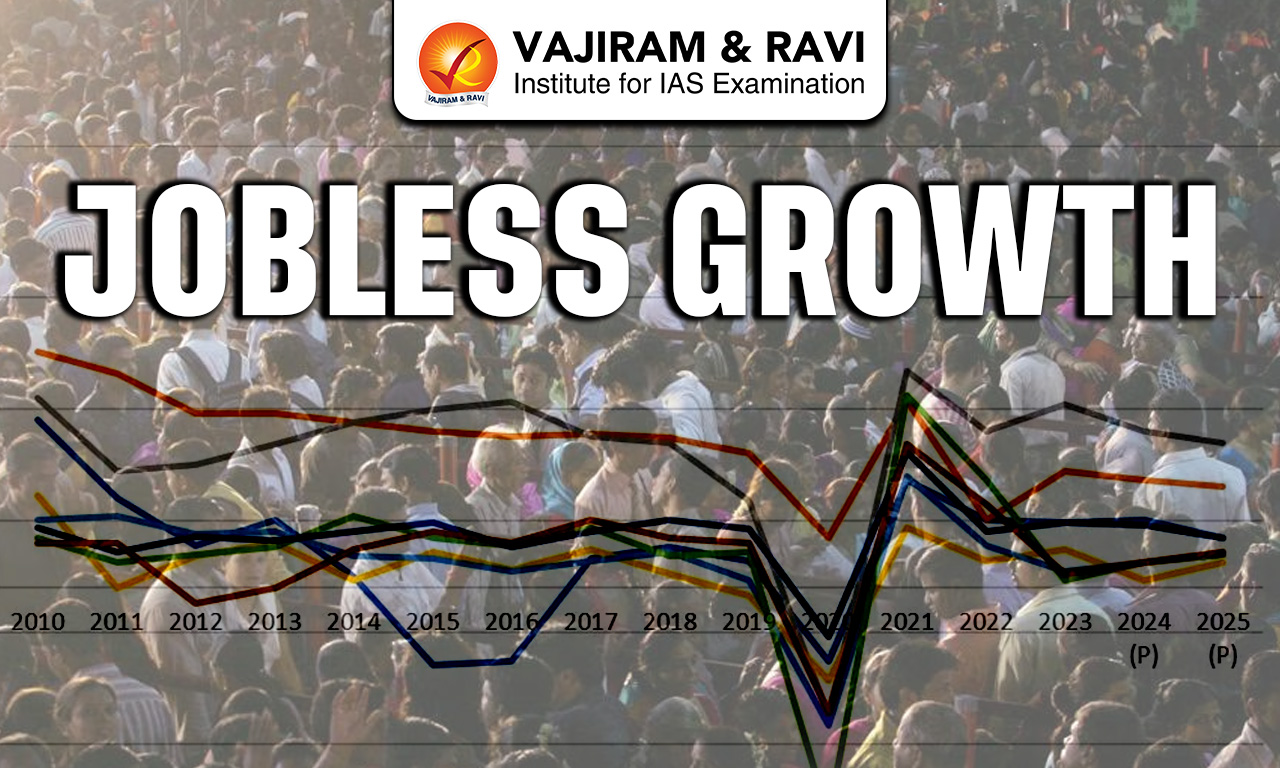
India’s GDP has grown at an average of 6-7% per year over the past decade, yet unemployment rates, particularly among the youth and educated segments, remain high.

  • According to the Economic Survey, India needs 20 million new jobs annually, but current job creation is only about 4 million per year.
  • Employment elasticity (the responsiveness of employment to GDP growth) declined from 0.26 (2000–2012) to 0.001 by 2019.
  • According to the State of Working India 2026 report by Azim Premji University, less than 7% of male Indian graduates secure a permanent salaried job within a year of graduation, and only 3.7% manage to obtain a white-collar position.

Causes of Jobless Growth in India

Main causes of jobless growth in India are:

Capital-Intensive Growth and Higher Labour Productivity

  • India’s GDP growth has largely been driven by capital deepening and technological adoption, which increases output per worker. 
  • While this raises overall economic performance, it reduces the number of jobs created per unit of GDP, contributing to jobless growth.

Premature De-Industrialisation

  • The manufacturing sector’s share in GDP has remained around 14-17%, while its share of employment is only 12%, showing stagnation since 1991. This limits the sector’s capacity to absorb the growing workforce.

Preference for Capital-Intensive Industries

Industries with high automation and mechanisation are favoured over labour-intensive sectors.

  • Push Factors: Complex labour regulations and low skill levels among workers make labour-intensive production less attractive.
  • Pull Factors: Government schemes and historical focus on heavy and basic industries during Five-Year Plans made capital-intensive investments easier and more profitable.

Dwarf Firms

  • Many MSMEs operate at a very small scale due to the nature of government incentives, limiting their capacity to expand production and generate employment.

Service Sector Dominance

  • The service sector contributes around 55% of GDP but employs only about 30% of the workforce, reflecting low labour intensity and a mismatch between growth and job creation.

Rigid Labour Market and Regulatory Burden

  • India has 44 central labour laws, leading to regulatory complexity and compliance costs. Lack of flexibility in hiring and firing, enforced by the Industrial Disputes Act, discourages labour-intensive investment.

Skill Deficit 

  • Only about 4% of the workforce has received formal training, compared with 96% in South Korea, limiting employability in modern, high-productivity sectors.

Implications of Jobless Growth

Jobless growth in India has far-reaching implications: 

  • Inability to Reap Demographic Dividend: India’s large working-age population is underutilised.
  • Lack of Inclusive Growth: Economic gains remain concentrated in capital-intensive sectors.
  • Low Savings and Investment: Unemployed or underemployed households cannot save or invest, limiting domestic capital formation.
  • Stagnation in GDP in the Long Run: Low employment dampens consumption demand.
  • Middle-Income Trap: Without mass employment, India risks being trapped in a growth model that benefits only a few.

Strategies to Address Jobless Growth

  • Promote Secondary Agriculture (Dalwai Panel): Encourage rural small-scale enterprises providing agricultural inputs (SHGs, machinery, seeds) and processing outputs (food processing units).
  • Focus on Labour-Intensive Industries: Textiles, leather, and other low-skill sectors can generate large employment, as seen in Bangladesh.
  • Incentivise Infant Firms: Limit government incentives to initial 5–7 years to encourage growth rather than sustaining small-scale “dwarf” firms.
  • Assemble in India for the World: Integrating assembly-focused manufacturing into Make in India could create up to 8 crore jobs by 2030.
  • Reorient SEZs as Economic and Employment Enclaves (EEE): As recommended by the Baba Kalyani Committee, SEZs can be leveraged to generate both economic output and employment.
  • Infrastructure-Led Employment: Higher public expenditure in infrastructure creates direct and indirect jobs across sectors.
  • Effective Implementation of Labour Codes: Promote fixed-term employment and simplify labour laws to encourage hiring.
  • Skill Development: Strengthen vocational training, apprenticeship schemes, and align skill development with industry needs to bridge the demand-supply gap.

Way Forward

India’s ability to reap its demographic dividend and achieve the vision of a $7 trillion economy is intricately linked to improving employment elasticity. The government must:

  • Boost labour-intensive production,
  • Expand skill development and vocational training,
  • Incentivise firms that generate significant employment, and
  • Ensure effective implementation of employment-linked schemes.

Without these measures, GDP growth risks remaining jobless, undermining inclusive development, social stability, and long-term economic prosperity.

Jobless Growth FAQs

Q1: What is Jobless Growth in India?

Ans: Jobless Growth in India refers to a situation where the economy grows steadily, but employment does not increase proportionally, resulting in GDP expansion without adequate job creation.

Q2: Why is India experiencing Jobless Growth?

Ans: Factors include capital-intensive growth, stagnant manufacturing, dominance of dwarf MSMEs, rigid labour laws, service sector bias, and low skill levels among the workforce.

Q3: How serious is Jobless Growth in India?

Ans: India needs 20 million new jobs annually, yet only about 4 million are created. Employment elasticity fell from 0.26 (2000–2012) to 0.001 by 2019, showing minimal job creation despite high GDP growth.

Q4: What are the implications of Jobless Growth in India?

Ans: It limits the demographic dividend, restricts inclusive growth, reduces savings and investment, risks long-term GDP stagnation, and may trap the economy in a middle-income scenario.

Q5: How can India address Jobless Growth?

Ans: Promote labour-intensive industries, incentivise expanding MSMEs, strengthen rural and small-scale enterprises, implement skill development programs, reform labour laws, and invest in infrastructure-led employment.
Article 132 of Indian Constitution, Provisions, Case Laws

article 132 of indian constitution

Article 132 of Indian Constitution provides appellate jurisdiction to the Supreme Court in cases involving substantial questions of law related to the interpretation of the Constitution. It ensures that important constitutional issues decided by High Courts can be reviewed by the highest court of the country. This provision creates a structured legal pathway for appeals in civil, criminal, or other proceedings where constitutional interpretation is involved. It plays a key role in maintaining uniformity, clarity and authority in constitutional law across India.

Article 132 of Indian Constitution Provisions

Article 132 of Indian Constitution defines conditions under which appeals from High Courts to the Supreme Court are allowed in cases involving constitutional interpretation.

  • Right to Appeal to Supreme Court: Article 132(1) allows an appeal to the Supreme Court from any judgment, decree, or final order of a High Court if the case involves a substantial constitutional question.
  • Applicability: This provision applies to civil, criminal, or any other type of proceeding, ensuring that constitutional issues across all legal matters can reach the Supreme Court.
  • Requirement of High Court Certification: An appeal is permitted only when the High Court certifies that the case involves a substantial question of law related to interpretation of the Constitution.
  • Power of Supreme Court to Grant Leave: Under clause (2), if the High Court refuses certification, the Supreme Court may still allow an appeal if it is satisfied that a substantial constitutional question exists.
  • Appeal by Any Party: Article 132(3) allows any party involved in the case to appeal to the Supreme Court once certification or special leave is granted.
  • Grounds of Appeal: The appeal can be filed on the ground that the constitutional question involved in the case has been wrongly decided by the High Court.
  • Final Order: The explanation clarifies that a “final order” includes decisions on key issues that could completely dispose of the case if decided in favour of the appellant.

Article 132 of Indian Constitution Case Laws

Important judicial decisions highlight the scope of Article 132 of Indian Constitution and clarify its role in constitutional interpretation and appellate jurisdiction.

  • Kesavananda Bharati v. State of Kerala (1973): This landmark case used Article 132 jurisdiction and led to the Basic Structure Doctrine, limiting Parliament’s power to amend the Constitution.
  • Minerva Mills Ltd. v. Union of India (1980): The Supreme Court reaffirmed that constitutional amendments must preserve the basic structure, reinforcing its appellate role in constitutional matters.
  • L. Chandra Kumar v. Union of India (1997): The Court emphasized judicial review as a fundamental feature of the Constitution, showing the importance of Supreme Court appeals in constitutional interpretation.
  • State of West Bengal v. Committee for Protection of Land Rights (2006): The Court clarified that a substantial constitutional question must have wider public importance to qualify for appeal.
  • M.C. Mehta v. Union of India (1987): The case demonstrated that even in environmental matters, constitutional interpretation can bring cases under Article 132 jurisdiction.

Article 132 of Indian Constitution Significance

Article 132 of Indian Constitution ensures constitutional consistency and provides a clear appellate mechanism for resolving important legal questions.

  • Ensures Uniform Interpretation: By allowing appeals to the Supreme Court, Article 132 maintains consistency in interpretation of constitutional provisions across different High Courts.
  • Strengthens Supreme Court Authority: It reinforces the role of the Supreme Court as the final interpreter and guardian of the Constitution in India.
  • Filters Important Cases Only: The requirement of a substantial question of law ensures that only significant constitutional matters reach the Supreme Court.
  • Protects Constitutional Supremacy: The provision ensures that any incorrect interpretation by High Courts can be corrected at the highest judicial level.
  • Supports Rule of Law: It provides a structured legal process for resolving constitutional disputes, strengthening legal certainty and fairness.
  • Balances Judicial Workload: By requiring certification or special leave, it prevents unnecessary appeals and ensures efficient functioning of the Supreme Court.
  • Covers Wide Range of Cases: Since it applies to civil, criminal and other proceedings, it ensures that constitutional issues in all types of disputes are addressed.
  • Clarifies Legal Framework: The concept of “final order” helps determine when an appeal can be made, reducing ambiguity in legal procedures.
  • Reflects Constitutional Intent: The debates during its adoption show that the Article was designed to deal only with constitutional questions, not general legal issues.
  • Ensures Access to Justice: It provides parties an opportunity to challenge incorrect constitutional interpretation, ensuring fairness and justice at the highest level. 

Article 132 of Indian Constitution FAQs

Q1: What does Article 132 of Indian Constitution deal with?

Ans: Article 132 provides for appeals to the Supreme Court from High Courts in cases involving substantial questions of law related to constitutional interpretation.

Q2: When can an appeal be made under Article 132?

Ans: An appeal can be made when the High Court certifies that the case involves a substantial question of law regarding the Constitution.

Q3: Can the Supreme Court allow appeal without High Court certification?

Ans: Yes, the Supreme Court can grant special leave to appeal if it believes the case involves a significant constitutional question as given under Article 132 of Indian Constitution.

Q4: What is meant by a “Final Order” under Article 132?

Ans: A final order includes a decision that can completely dispose of the case if decided in favour of the appellant.

Q5: What is the need of Article 132 of Indian Constitution?

Ans: It ensures uniform interpretation of the Constitution and allows the Supreme Court to act as the final authority on constitutional matters.

Women in Bhakti Movement, Role, Significance, Contributions

Women in Bhakti Movement

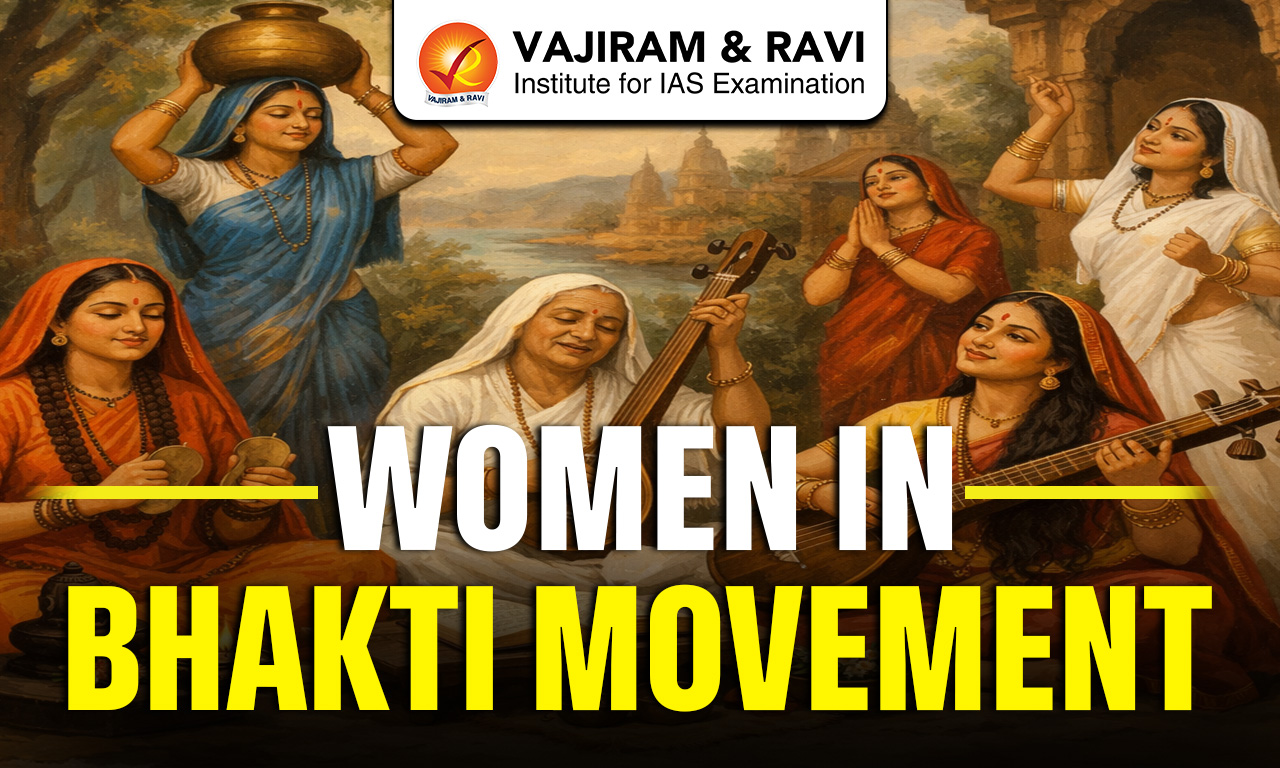
The Bhakti Movement was a major religious and social reform movement in medieval India (6th-17th century) that emphasized personal devotion (bhakti) to God over rituals, caste divisions, and priestly control. It spread across different regions through saints who preached in local languages, making religion more accessible and inclusive.

Within this movement, women Bhakti saints played a crucial role. Despite living in a patriarchal society, they expressed deep devotion through poetry and songs, challenged social restrictions, and asserted their right to a direct relationship with the divine. Their contributions not only enriched devotional traditions but also promoted ideas of equality, dignity, and social reform.

Features of Women Bhakti Saints

Women Bhakti saints shared certain distinctive characteristics:

  • Rejection of ritualism: They emphasized love and devotion rather than elaborate ceremonies.
  • Spiritual equality: They believed that all individuals, regardless of gender or caste, could attain God.
  • Use of vernacular languages: Their compositions in regional languages made their message accessible to common people.
  • Challenge to patriarchy: Many defied societal expectations of marriage, family, and gender roles.
  • Reflection of everyday life: Their poetry often included domestic experiences and social struggles.

Major Women Bhakti Saints and Their Contributions

Women in the Bhakti Movement played an important role by composing devotional songs and poems, expressing their love for God, sharing spiritual teachings, and inspiring people across different regions and communities.

Key women Saints and their contributions:

Andal:

  • Andal, also known as Kothai and Nachiyar is one of the 12 Alvars, who are Tamil saints who patronised Vaishnavism during the Bhakti movement.
  • She was the only female Alvar saint from South India and a great devotee of Lord Vishnu.
  • Her compositions, such as Tiruppavai, advocate complete surrender (prapatti) to God. 
  • She rejected ritual formalism and emphasized pure love and devotion as the highest path to salvation. 

Lal Ded (Lalleshwari): 

  • Lal Ded was a 14th-century Kashmiri mystic saint, poet, and philosopher.
  • She was associated with Kashmir Shaivism.
  • She is revered by both Hindus and Muslims - known as Lalleshwari in Shaivism and Lalla Arifa in Sufi tradition.
  • She emphasized non-dualism and the importance of self-realization over ritualistic practices. 
  • Through her simple yet profound Kashmiri verses, known as Vakhs, she made spiritual ideas accessible to the common people. 

Sant Soyarabai: 

  • Soyarabai was a saint from the Mahar caste in 14th-century Maharashtra, India. 
  • She was associated with the Varkari tradition, a popular Bhakti tradition of Maharashtra centered on the worship of Lord Vithoba (Vithoba).
  • Her teachings focused on the idea that true devotion to God, especially Vithoba, depends on inner purity and sincere faith, not on caste or rituals.
  • Her works strongly criticized untouchability and highlighted the hypocrisy of caste-based hierarchies
  • Through her simple Marathi devotional compositions known as Abhangas, she conveyed ideas of equality, dignity, and direct connection with the divine, making spirituality accessible to the common people. 

Meerabai: 

  • Meerabai was a prominent saint of the Bhakti Movement, known for her intense devotion to Krishna.
  • She was born in a Rajput royal family at Merta in present-day Rajasthan.
  • From childhood, she developed deep devotion to Krishna, whom she considered her divine husband. 
  • She was married to Bhoj Raj, the crown prince of Mewar, the son of Rana Sanga, but she remained emotionally detached from worldly marriage.
  • After marriage, she faced strong resistance from her in-laws, who disapproved of her public singing, interaction with sadhus, and disregard for royal customs.
  • She refused to conform to patriarchal expectations, including practices like purdah and devotion to family deities, which marked her as socially rebellious.
  • Due to continuous persecution and constraints, she renounced royal life and became a wandering saint, traveling to places like Vrindavan and Dwarka.
  • Her philosophy was rooted in Saguna Bhakti, focusing on a personal God with form (Krishna).
  • She emphasized Prem Bhakti (devotion through love), where the devotee seeks complete emotional and spiritual union with God.
  • Meerabai strongly rejected ritualism, priestly dominance, and caste discrimination, advocating a direct and personal connection with the divine.
  • Her teachings promoted spiritual equality, asserting that devotion is open to all irrespective of gender or social status.
  • She composed numerous bhajans (devotional songs) in Braj Bhasha and Rajasthani, making religious ideas accessible to the common people.
  • She played a crucial role in popularizing the Bhakti Movement in North India, especially among women and marginalized groups.

Karaikal Ammaiyar:

  • Karaikal Ammaiyar was one of the earliest and most prominent women saints of the Bhakti Movement in South India.
  • She belonged to the Nayanar tradition (devotees of Lord Shiva) in Tamil Nadu and lived around the 6th century CE.
  • She renounced worldly life and is revered for her intense devotion to Lord Shiva. 
  • Her hymns emphasize asceticism, love, and total surrender to the divine, making her a foundational figure in Tamil devotional literature.

Akka Mahadevi:

  • Akka Mahadevi was a prominent woman saint of the Virashaiva / Lingayat Bhakti Movement in Karnataka.
  • She was a devoted follower of Shiva, whom she worshipped as Chenna Mallikarjuna (Lord of beauty).
  • She rejected marriage and worldly life, choosing a path of complete devotion and renunciation.
  • Known for her radical stance, she is believed to have abandoned clothing, symbolizing detachment from material and social norms.
  • She composed devotional poems called Vachanas in Kannada, expressing intense love and union with God.
  • She was associated with the Anubhava Mantapa, a spiritual assembly of saints led by Basavanna.
  • Advocated equality and rejection of caste hierarchy, key features of the Lingayat movement.
  • Played a crucial role in strengthening the Bhakti Movement in South India, especially among women.

Janabai:

  • Janabai was a prominent woman saint of the Varkari Bhakti tradition in Maharashtra.
  • She was a devotee of Vithoba (Vitthala), the presiding deity of Pandharpur.
  • Born in a low-caste (Shudra) family, she spent much of her life working as a domestic servant in the household of Namdev.
  • She composed devotional songs called Abhangas in Marathi, written in simple language accessible to common people.
  • Her poetry reflects deep devotion and personal bond with Vithoba, everyday life experiences of women and labourers and criticism of caste hierarchy and social inequality
  • She often portrayed God as participating in her daily chores, symbolizing intimacy between devotee and divine.
  • Advocated spiritual equality, emphasizing that devotion is above caste, gender, and social status.

Bahinabai (Bahina Bai):

  • A 17th-century saint from Maharashtra, Bahinabai composed devotional songs that reflect the working lives of rural women, especially in agrarian settings. 
  • Her writings integrate devotion with daily toil, illustrating how spirituality permeates ordinary life.

Significance of Women in Bhakti Movement

Women saints played a pivotal role in the Bhakti Movement by demonstrating that devotion transcended social hierarchies, gender barriers, and ritual formalism, thereby making spirituality accessible to all.

  • Spiritual Democratization: Women saints helped transform Bhakti into a mass-based movement, making religious experience accessible irrespective of gender or caste.
  • Challenge to Patriarchy: By rejecting marriage norms, domestic confinement, and male authority, they asserted women’s agency in spiritual and social spheres.
  • Literary Contributions: Through their poetry, hymns, and songs (bhajans, abhangas, vachanas, vakhs), they enriched regional languages and devotional literature.
  • Popularization of Bhakti: Their compositions were in vernacular languages, making devotion accessible to common people and spreading Bhakti beyond elite circles.
  • Integration of Daily Life and Devotion: Saints like Bahinabai demonstrated that spirituality could coexist with household responsibilities and labor, showing Bhakti as a practical way of life.
  • Inspiration for Future Generations: Their lives and works became a source of inspiration for later saints, reformers, and social movements advocating equality, devotion, and moral courage.

Women in Bhakti Movement FAQs

Q1: Who were the women in Bhakti Movement?

Ans: Women in the Bhakti Movement were female saints and poet-devotees who expressed personal devotion to God, composed devotional songs and poetry, and contributed to regional religious traditions, such as Andal in Tamil Nadu, Lal Ded in Kashmir, Meerabai in Rajasthan, Akka Mahadevi in Karnataka, and Janabai and Soyarabai in Maharashtra.

Q2: What was the role of women in Bhakti Movement?

Ans: Women in Bhakti Movement spread devotion in local languages, challenged social and gender norms, promoted spiritual equality, and made religious practice accessible to all.

Q3: What were the main themes of women in Bhakti Movement?

Ans: The works of women in Bhakti Movement focused on love for God, renunciation, rejection of ritualism, social equality, and integrating devotion with daily life.

Q4: In which languages did women in Bhakti Movement write?

Ans: Women in Bhakti Movement composed poetry and songs in regional languages like Tamil, Kannada, Marathi, Braj Bhasha, Kashmiri, and Rajasthani.

Q5: Why are women in Bhakti Movement significant?

Ans: Women in Bhakti Movement challenged patriarchy, promoted egalitarian spiritual practices, enriched devotional literature, and inspired future generations with devotion and social reform.

Non-Financial Debt, Meaning, Components and Economic Impact

Non-Financial Debt

Non-financial debt refers to the total liabilities or borrowings of sectors that are not part of the financial system. These sectors include households, non-financial corporations (businesses), and governments. In simple terms, it is the debt taken by individuals, companies, and public authorities for consumption, investment, or development purposes, excluding financial institutions like banks and insurance companies.

This concept is often analyzed alongside GDP (Gross Domestic Product) to calculate the debt-to-GDP ratio, which reflects the sustainability of a country’s borrowing.

Components of Non-Financial Debt

Before understanding the components, it is important to look at a quick overview of non-financial debt and its scope across the economy.

Components of Non-Financial Debt

Debt Category

Examples

Key Sectors Involved

Non-Financial Debt

Includes housing loans, credit card debt, government securities such as treasury bills, and corporate bonds issued by non-financial companies

Households, non-financial corporations, and government

Non-financial debt is broadly divided into three major components that represent the borrowing activities of the real economy. These components include households, non-financial corporations, and the government, each contributing differently to economic growth and financial stability.

Household Debt

  • Refers to borrowings by individuals and families for consumption and asset creation
  • Includes home loans, personal loans, vehicle loans, credit card dues, and education loans
  • Plays a key role in boosting consumption and demand in the economy
  • High levels of debt may increase financial vulnerability and reduce savings

Non-Financial Corporate Debt

  • Represents borrowings by companies that are not part of the financial sector
  • Includes bank loans, corporate bonds, trade credit, and external commercial borrowings
  • Used for expansion, production, infrastructure, and business operations
  • Excessive debt can lead to financial stress and insolvency risks

Government Debt

  • Borrowings by central and state governments to finance public expenditure
  • Includes internal debt like treasury bills and bonds, as well as external borrowings
  • Supports development projects, welfare schemes, and economic growth
  • Rising debt levels may result in fiscal deficits and inflationary pressures 

UPSC CSE Prelims PYQ

Question: In the context of the Indian economy, non-financial debt includes which of the following? [2020]

  1. Housing loans owed by households
  2. Amounts outstanding on credit cards
  3. Treasury bills

Select the correct answer using the code given below:

  1. 1 only
  2. 1 and 2 only
  3. 3 only
  4. 1, 2 and 3

Answer: D 1, 2 and 3

Non-Financial Debt FAQs

Q1: What is included in non-financial debt?

Ans: Non-financial debt includes borrowings of households, non-financial corporations, and governments. It excludes debts of financial institutions like banks and insurance companies.

Q2: Why is non-financial debt important?

Ans: It is important because it reflects the borrowing levels in the real economy and helps assess financial stability, growth potential, and economic risks.

Q3: How is non-financial debt measured?

Ans: It is usually measured as a percentage of GDP (debt-to-GDP ratio), which indicates whether the debt level is sustainable for an economy.

Q4: What is the difference between financial and non-financial debt?

Ans: Financial debt refers to borrowings within the financial sector (banks, NBFCs, etc.), while non-financial debt relates to borrowings by households, companies, and governments.

Q5: Can high non-financial debt be harmful?

Ans: Yes, excessively high non-financial debt can lead to defaults, economic slowdown, inflation, and financial crises if not managed properly.

Interest Coverage Ratio (ICR), Formula, Significance

Interest Coverage Ratio

The Interest Coverage Ratio (ICR) is a crucial financial metric used to assess a company’s ability to pay interest on its outstanding debt. It is widely used by investors, banks, and financial analysts to evaluate a firm’s financial health and risk level.

Interest Coverage Ratio

The Interest Coverage Ratio is a debt and profitability ratio that determines how easily a firm can meet its interest obligations. It measures the number of times a company can pay its interest using its available earnings. A higher ratio indicates better financial stability, while a lower ratio indicates financial stress.

Interest Coverage Ratio Formula

The Interest Coverage Ratio (ICR) measures how easily a company can pay interest on its outstanding debt using its earnings. 

Interest Coverage Ratio = Interest Expense / EBIT (Earnings Before Interest and Taxes)​

Interest Coverage Ratio Significance

The Interest Coverage Ratio (ICR) is an important financial metric that shows a company’s ability to pay interest on its debt using its earnings. It helps assess financial stability, creditworthiness, and the risk of default or bankruptcy.

  • It shows how easily a company can meet its interest obligations from its operating profits, indicating repayment capacity.
  • It acts as a quick measure of financial health, where a higher ratio reflects stability and a lower ratio signals financial stress.
  • It is widely used by banks and financial institutions to evaluate the creditworthiness of borrowers before sanctioning loans.
  • It serves as an early warning indicator of financial distress, helping identify companies that may face insolvency or bankruptcy.
  • Firms with a ratio below 1 are often termed “zombie companies” as they cannot meet interest payments from their earnings.
  • Investors use this ratio to assess the risk level of a company and prefer firms with higher ratios for safer investments.
  • In India, it gained importance during the NPA crisis, where institutions like the Reserve Bank of India use it to monitor risky lending and improve banking stability.
  • It helps in evaluating both present financial position and future risk, making it an essential tool in financial analysis. 

UPSC CSE Prelims PYQs

  1. What is the importance of the term “Interest Coverage Ratio” of a firm in India? [2020]
  1. It helps in understanding the present risk of a firm that a bank is going to give a loan to.
  2. It helps in evaluating the emerging risk of a firm that a bank is going to give a loan to.
  3. The higher a borrowing firm’s level of Interest Coverage Ratio, the worse is its ability to service its debt.

Select the correct answer using the code given below:

(a) 1 and 2 only

(b) 2 only

(c) 1 and 3 only

(d) 1, 2 and 3

Answer: (a) 1 and 2 only

Interest Coverage Ratio FAQs

Q1: What is the Interest Coverage Ratio?

Ans: It is a financial ratio that shows how many times a company can pay its interest obligations using its earnings.

Q2: What does a low Interest Coverage Ratio mean?

Ans: It suggests financial stress and difficulty in paying interest, especially if the ratio is below 1.

Q3: What are “zombie companies”?

Ans: These are firms with an Interest Coverage Ratio below 1, meaning they cannot cover interest payments from earnings.

Q4: What is the formula of Interest Coverage Ratio?

Ans: The standard formula is: ICR = EBIT ÷ Interest Expense.

Q5: Why is ICR important for banks?

Ans: Banks use it to assess the risk of lending and ensure that borrowers can repay interest on loans.

Banks Board Bureau (BBB), Composition, Functions

Banks Board Bureau

The Banks Board Bureau (BBB) is an important institution in India’s banking sector that was created to improve the governance and functioning of Public Sector Banks (PSBs). It plays a key role in selecting top-level management and ensuring transparency, efficiency, and accountability in banking operations.

What is Banks Board Bureau (BBB)?

The Banks Board Bureau (BBB) is an autonomous body set up by the Government of India in 2016 to recommend appointments of top executives such as Chairpersons and Managing Directors in Public Sector Banks and financial institutions.

It was established based on the recommendations of the PJ Nayak Committee, which aimed to reform the governance structure of public sector banks in India. The final decision on appointments is made by the Ministry of Finance in consultation with the Prime Minister’s Office.

Banks Board Bureau Composition

The Banks Board Bureau (BBB) is made up of a mix of government officials and experienced professionals to ensure balanced and expert decision-making in the banking sector.

  • The Bureau consists of a Chairman, who is appointed by the Central Government
  • It includes three ex-officio members, namely:
  • Secretary, Department of Financial Services (DFS)
  • Secretary, Department of Public Enterprises (DPE)
  • Deputy Governor of the Reserve Bank of India (RBI)
  • It also has five expert members, selected for their knowledge and experience in banking, finance, and management
  • Out of these expert members, two are from the private sector, bringing diverse perspectives and professional expertise
  • The inclusion of both government officials and private experts helps in maintaining transparency, efficiency, and informed decision-making in appointments and reforms

Banks Board Bureau (BBB) Functions

The Banks Board Bureau (BBB) performs several key functions to improve the working and governance of Public Sector Banks (PSBs) in India. Its role is mainly advisory, but it has a strong influence on decision-making in the banking sector.

  • Recommends candidates for top-level positions like Chairman, Managing Director (MD), and CEO in Public Sector Banks
  • Ensures merit-based and transparent selection of senior banking officials
  • Advises banks on long-term business strategies and growth plans
  • Provides guidance on raising capital and improving financial strength
  • Suggests measures to improve corporate governance and accountability
  • Monitors the performance of Public Sector Banks and recommends improvements
  • Helps in reducing Non-Performing Assets (NPAs) through better policies
  • Promotes professionalism and efficiency in bank management
  • Supports leadership development and succession planning in banks
  • Acts as a link between the government and Public Sector Banks for reforms 

UPSC CSE Prelims PYQs

Que. With reference to the Banks Board Bureau (BBB), which of the following statements are correct? [2022]

  1. The Governor of RBI is the Chairman of BBB.
  2. BBB recommends for the selection of heads for Public Sector Banks.
  3. BBB helps the Public Sector Banks in developing strategies and capital raising plans.

Select the correct answer using the code given below:

  1. 1 and 2 only
  2. 2 and 3 only
  3. 1 and 3 only
  4. 1, 2 and 3

Answer: Option B: 2 and 3 only

Que. The Chairmen of public sector banks are selected by the [2019]

  1. Banks Board Bureau
  2. Reserve Bank of India
  3. Union Ministry of Finance
  4. Management of concerned bank

Answer: Option A: Banks Board Bureau

Banks Board Bureau (BBB) FAQs

Q1: What is the Banks Board Bureau (BBB)?

Ans: The Banks Board Bureau (BBB) is an autonomous body set up by the Government of India to recommend appointments of top officials in Public Sector Banks and improve their governance.

Q2: When was the Banks Board Bureau established?

Ans: The BBB was established in 2016 based on the recommendations of the PJ Nayak Committee.

Q3: What is the main role of BBB?

Ans: Its main role is to recommend candidates for senior positions like Chairman, MD, and CEO in Public Sector Banks and advise on banking reforms.

Q4: Which committee recommended the creation of BBB?

Ans: The PJ Nayak Committee (2014) recommended the establishment of the Banks Board Bureau.

Q5: Who appoints the Chairman of BBB?

Ans: The Central Government appoints the Chairman of the Banks Board Bureau.

Article 98 in Constitution of India, Case Laws, Significance

Article 98 in Constitution of India

Article 98 in the Constitution of India deals with the Secretariat of Parliament and provides an administrative framework for the functioning of both Houses of Parliament. It ensures that the Lok Sabha and the Rajya Sabha have independent secretarial staff to assist in legislative, procedural and administrative work. 

Article 98 in Constitution of India

The Article 98 in Constitution of India was introduced to maintain the autonomy of the legislature from the executive and to ensure efficient functioning without external interference. It reflects the principle of separation of powers by giving Parliament control over its internal administrative machinery and staffing system.

Article 98 in Constitution of India Provisions

Article 98 in Constitution of India provides for separate secretarial staff for Parliament and empowers regulation of recruitment, service conditions and administrative control mechanisms.

  • Separate Secretariat for Each House: Article 98(1) mandates that each House of Parliament, Lok Sabha and Rajya Sabha, must have its own independent secretarial staff to manage legislative work, records and daily functioning efficiently.
  • Provision for Common Posts: The proviso under clause (1) allows creation of common posts for both Houses where joint functions exist, ensuring coordination and avoiding duplication of administrative resources.
  • Legislative Power to Regulate Services: Article 98(2) authorizes Parliament to make laws governing recruitment, appointments, promotions and service conditions of secretarial staff in both Houses.
  • Recruitment and Service Conditions: Parliament can define rules related to salary, tenure, discipline and working conditions of employees serving in the parliamentary secretariats to maintain professionalism and efficiency.
  • President’s Interim Rule Making Power: Under Article 98(3), the President can frame rules for recruitment and service conditions until Parliament enacts a law under clause (2).
  • Mandatory Consultation Requirement: The President must consult the Speaker of the Lok Sabha or the Chairman of the Rajya Sabha before framing such rules, ensuring legislative involvement in administrative decisions.
  • Temporary Nature of Presidential Rules: Rules made by the President remain effective only until Parliament makes a law, after which legislative provisions take precedence over executive rules.
  • Administrative Autonomy Framework: Article 98 establishes a system where Parliament independently manages its staff without relying on executive controlled services, ensuring functional independence.
  • Origin from Draft Article 79A: The provision originated as Draft Article 79A in 1948 and was later adopted as Article 98 in 1950 after debate and approval by the Constituent Assembly.
  • Constitutional Recognition of Secretariat: Article 98 formally recognizes the Secretariat of Parliament as an essential institution for legislative functioning and governance support.

Article 98 in Constitution of India Case Laws

Judicial decisions indirectly interpret Article 98 in Constitution of India by emphasizing legislative autonomy, service rules and non interference in internal parliamentary administration.

  • Sub Committee on Judicial Accountability v. Union of India (1991): The Supreme Court highlighted the importance of independence of parliamentary institutions, reinforcing that secretariats function independently without executive interference.
  • Kameshwar Prasad v. State of Bihar (1962): Though focused on civil services, this case laid principles regarding service conditions and rights, which are relevant for rules framed under Article 98 for parliamentary staff.
  • Union of India v. S. L. Dutta (1991): The Court discussed interpretation of service rules and administrative control, which indirectly applies to rules governing secretariat staff under Article 98(3).

Article 98 in Constitution of India Significance

Article 98 in Constitution of India ensures administrative independence of Parliament and strengthens institutional efficiency through dedicated secretarial systems.

  • Ensures Legislative Autonomy: By providing separate secretariats, Article 98 prevents executive control over parliamentary staff, protecting independence of legislative functioning.
  • Strengthens Separation of Powers: The provision reinforces the constitutional principle that legislature, executive and judiciary must operate independently within their defined domains.
  • Efficient Parliamentary Functioning: Dedicated staff support legislative processes such as drafting bills, maintaining records and assisting committees, ensuring smooth conduct of parliamentary business.
  • Flexibility Through Common Posts: The option to create common posts helps in efficient use of resources for shared services like documentation, research and administrative support.
  • Democratic Accountability Mechanism: Secretariats function under the control of presiding officers who are accountable to their respective Houses, ensuring transparency and responsibility.
  • Continuity Through Interim Powers: The President’s rule making authority ensures that administrative work continues smoothly even in absence of parliamentary legislation.
  • Professional Administrative Structure: By regulating recruitment and service conditions, Article 98 promotes merit based and efficient staffing within parliamentary institutions.
  • Protection from Executive Influence: The requirement of consultation with presiding officers ensures that executive authorities cannot unilaterally control parliamentary administration.
  • Limited Judicial Interference: Courts generally avoid interfering in internal functioning of Parliament unless there is a clear constitutional violation, supporting autonomy granted under Article 98.
  • Foundation for Modern Parliamentary Support: Article 98 provides the base for organized legislative support systems, enabling Parliament to function effectively in handling complex governance responsibilities.

Article 98 in Constitution of India FAQs

Q1: What is Article 98 of the Indian Constitution?

Ans: Article 98 deals with the Secretariat of Parliament and provides for separate secretarial staff for both Houses to support legislative and administrative functions.

Q2: Does each House of Parliament have its own secretariat?

Ans: Yes, Article 98 ensures that both Lok Sabha and Rajya Sabha have independent secretarial staff to manage their work efficiently.

Q3: Who regulates the recruitment of Parliamentary Secretariat Staff?

Ans: Parliament has the power to regulate recruitment and service conditions of secretariat staff through laws under Article 98(2).

Q4: What role does the President play under Article 98?

Ans: The President can make rules regarding recruitment and service conditions until Parliament enacts a law, after consulting the presiding officers.

Q5: Why is Article 98 in Constitution of India important for Parliament?

Ans: It ensures administrative independence of Parliament by preventing executive control over its staff and supporting efficient legislative functioning.

Infrastructure financing in India, Challenges, Initiatives, Institutions

Infrastructure Financing in India

Infrastructure forms the backbone of India’s economic growth and social development, shaping opportunities for industry, employment, and improved quality of life. Efficient infrastructure financing ensures steady capital flow for large projects, attracts private investment, spreads risks, and accelerates project delivery, while aligning growth with sustainability, competitiveness, and inclusive development. Over the past decade, India has prioritised large-scale investment, with the World Bank ranking it among the top five countries globally for job creation through infrastructure among low- and middle-income economies.

Challenges in Infrastructure Financing

Despite its importance, financing infrastructure in India faces multiple challenges:

  • Funding Gaps: Low tax-to-GDP ratio and fiscal constraints limit government expenditure.
  • Private Sector Hesitation: Risks such as cost overruns, currency fluctuations, and complex approval processes discourage private participation.
  • Institutional Limitations: Development Finance Institutions (DFIs) and banks have historically faced liquidity and non-performing asset issues
  • Project Execution Risks: Large projects often experience delays and cost escalations due to construction, land acquisition, and regulatory hurdles.

These challenges highlighted the need for innovative financing mechanisms combining government support, institutional funding, and private capital.

Government initiatives for Infrastructure Financing in India

Here are some of the important government initiatives taken to finance infrastructure projects in India.

Rising Public Capital Expenditure 

Public capital expenditure refers to government spending on creating assets such as roads, buildings, machinery, and equipment.

  • Public Capital Expenditure on Infrastructure has grown sharply from ₹2 lakh crore in FY2014-15 to a Budget Estimate of ₹12.2 lakh crore in 2026-27, reflecting a strong commitment to infrastructure-led growth.
  • The Union Budget 2026-27 emphasis on developing Tier II and Tier III cities with populations above five lakh, aiming to transform them into new growth centres. Investments in housing, transport, and urban infrastructure are expected to ensure balanced regional development beyond metropolitan areas. 
  • To further enhance urban potential, the concept of City Economic Regions (CERs) has been introduced, with ₹5,000 crore allocated per CER over five years. 

Debt Market Reforms

The debt market plays an important role in financing infrastructure by helping governments, companies, and institutions raise long-term funds through bonds. Investors provide money by buying these bonds and earn fixed interest. 

To strengthen India’s debt markets and make them more effective for infrastructure financing, the Government has implemented several measures:

  • Inclusive Access: Debt issues now include incentives for women, senior citizens, armed forces personnel, and retail investors, widening participation.
  • Simplified Compliance: Issuers benefit from streamlined rules, including rationalised norms for large listed companies and digital submission of annual reports.
  • Transparency and Efficiency: The Electronic Book Provider (EBP) framework has been refined for smoother private placements. EBPs are SEBI-mandated platforms for issuing debt securities.
  • ESG Financing: Dedicated frameworks have been introduced for Environmental, Social, and Governance (ESG) debt instruments, including green, social, sustainability, and sustainability-linked bonds.
  • Asset Monetisation: Regulations have been made more flexible to strengthen Infrastructure Investment Trusts (InvITs), allowing developers to recycle capital from completed assets into new projects.

Infrastructure Financing Institutions 

India’s infrastructure financing has shifted from relying mostly on government budgets to a mix of public and private capital. According to the World Bank, India is now the largest recipient of Private Participation in Infrastructure (PPI) investment in South Asia, accounting for over 90% of the region’s total. Key institutions financing India’s infrastructure are: 

National Investment and Infrastructure Fund (NIIF):

  • The NIIF was established in 2015 with support from the Government of India. 
  • It mobilises funds from both domestic and international investors to finance infrastructure projects in sectors such as transport, energy, and digital infrastructure. 
  • It operates multiple funds, including the Master Fund for core infrastructure, the Private Markets Fund for private equity, and the India–Japan Fund for climate and sustainability projects. 
  • The NIIF also partners with sovereign wealth funds, pension funds, and multilateral development banks, making it a key anchor for long-term infrastructure financing.
  • Today, it manages USD 4.9 billion in Assets Under Management (AUM) across its funds. 

National Bank for Financing Infrastructure and Development (NaBFID):

  • Established in 2021, NaBFID is a specialized development finance institution dedicated to strengthening infrastructure financing in India.
  • It provides long-term loans, equity investment, and ESG-focused financing. 
  • The institution also offers advisory services for Public-Private Partnership (PPP) projects, helps develop urban infrastructure through municipal bonds, and works with state and international partners to attract global capital.
  • By December 2025, NaBFID had approved about ₹3.03 lakh crore and disbursed ₹1.09 lakh crore for major infrastructure and social projects.

Indian Railway Finance Corporation (IRFC):

  • Founded in 1986, IRFC raises funds from both domestic and international markets to meet the extra budgetary needs of Indian Railways.
  • It operates on a leasing model, where it buys railway assets like locomotives, coaches, and wagons, and then leases them back to Indian Railways.
  • Over the years, IRFC has financed 13,764 locomotives, 76,735 passenger coaches, and 2,65,815 freight wagons, covering almost three-fourths of the country’s rolling stock fleet.
  • This financing model ensures that Indian Railways can expand and upgrade its infrastructure without depending entirely on the government’s budget.

Infrastructure Investment Trusts (InvITs):

  • InvITs were introduced by SEBI in 2014 to allow people to invest in large infrastructure projects.
  • It helps developers raise funds by tapping into household savings for essential projects.
  • First Public InvIT: Scheduled for launch in 2026, after monetising ₹1.52 lakh crore through Toll-Operate-Transfer (ToT) and private InvITs.
  • InvITs have helped finance highways and large-scale road projects reliably.
    • National Highways Infra Trust (NHIT): Set up by NHAI in 2020, it raised ₹18,380 crore in its fourth round, with total monetisation exceeding ₹46,000 crore across four rounds.
    • Raajmarg Infra Investment Trust (RIIT): In January 2026, it received a AAA (Stable) rating from CARE Ratings, showing safety and reliability for investors
  • In September 2020, the government allowed monetisation of POWERGRID assets through InvITs, the first in the sector, with proceeds used for new and ongoing projects.

Real Estate Investment Trusts (REITs):

REITs are investment vehicles regulated by SEBI that allow people to invest in income-generating real estate projects without actually buying property. Investors buy units in the trust, similar to buying shares in a company, and earn returns from the income generated by the properties owned by the trust.

  • The Union Budget 2026-27 announced the creation of dedicated REITs for Central Public Sector Enterprises (CPSEs). This will help monetise government-owned real estate assets more efficiently and channel funds into new projects.

Infrastructure Risk Guarantee Fund (IRGF) 

Infrastructure projects in India often face challenges like delays, high costs, and risks during construction or early development stages. To tackle these issues, the Government introduced the Infrastructure Risk Guarantee Fund (IRGF) in the Union Budget 2026-27. The fund provides partial guarantees to lenders, reducing the risk of default for private developers and making project financing more secure. Key Benefits of IRGF:

  • Crowding-in Private Capital: By reducing risk, the fund encourages private investors to participate in large infrastructure projects, bringing in more capital alongside government funding.
  • Ensuring Timely Project Completion: The fund helps cover financing gaps, which reduces delays and ensures that projects are finished on schedule.
  • Building Investor Confidence: By offering partial guarantees, the fund reassures both domestic and international investors, boosting trust in India’s infrastructure sector.

Infrastructure Financing in India FAQs

Q1: What is infrastructure financing in India?

Ans: Infrastructure financing in India refers to the process of providing long-term funds to build and maintain physical assets like roads, railways, ports, energy, and urban facilities.

Q2: Which institutions play a key role in infrastructure financing in India?

Ans: Institutions like the National Investment and Infrastructure Fund (NIIF), NaBFID, Indian Railway Finance Corporation (IRFC), InvITs, and REITs are central to mobilising funds, supporting project execution, and enabling private sector participation.

Q3: How does the government support infrastructure financing in India?

Ans: The government increases public capital expenditure, introduces debt market reforms, encourages asset monetisation through InvITs and REITs, and provides partial guarantees via the Infrastructure Risk Guarantee Fund to attract private investment.

Q4: What are InvITs and REITs in infrastructure financing in India?

Ans: InvITs allow investors to invest in large infrastructure projects and help developers recycle capital, while REITs enable investment in income-generating real estate, including government-owned assets, offering transparency and steady returns.

Q5: How does infrastructure financing in India benefit economic growth?

Ans: It accelerates project delivery, creates jobs, attracts private investment, spreads financial risks, strengthens urban and rural infrastructure, and supports sustainable, inclusive, and long-term economic development.

Commercial Paper, Meaning, Types, Features, Procedure, Formula

Commercial Paper

Commercial Paper (CP) is an important short term money market instrument introduced in India in 1990 to help highly rated companies raise funds efficiently. It allows corporates, financial institutions and primary dealers to meet immediate financial needs while offering investors a secure, short duration investment option under the regulatory framework of the Reserve Bank of India.

Commercial Paper

Commercial Paper is an unsecured promissory note issued by eligible entities to raise short term funds for operational requirements such as payroll, inventory and liabilities. It is issued at a discount to face value, carries no collateral backing and reflects market driven interest rates with maturity generally ranging from a few days up to one year.

Commercial Paper Types

Commercial paper exists in different financial forms used in money market transactions globally.

  1. Draft: A written order directing one party to pay a fixed amount to another party, widely used in trade transactions and short term credit arrangements.
  2. Cheque: A special type of draft where a bank is instructed to pay a specified amount on demand from the issuer’s account.
  3. Promissory Note: A formal written promise by the issuer to pay a fixed sum to the holder on a specified future date without attaching any collateral.
  4. Certificate of Deposit: A bank issued instrument acknowledging receipt of funds, offering fixed returns and acting as a short term investment alternative.

Commercial Paper Features

Commercial Paper is designed as a flexible and cost effective short term financing instrument for high credit entities in the financial market.

  • Unsecured Nature: CP is issued without collateral, relying entirely on the issuer’s creditworthiness, making high credit rating mandatory for investor confidence.
  • Short Term Maturity: Maturity ranges from 7 days to 1 year, ensuring quick liquidity and making it suitable for managing temporary funding gaps.
  • Discounted Issuance: It is issued below face value and redeemed at full value, with the difference representing the return to investors.
  • Minimum Investment Size: Issuance is in denominations of ₹5 lakh or multiples, ensuring participation primarily from institutional and high value investors.
  • Regulatory Oversight: Issuance is governed by RBI guidelines, ensuring transparency, discipline and adherence to financial norms.
  • Dematerialised Preference: Although physical form exists, demat format is preferred, especially mandatory for banks, FIs and primary dealers since 2001.
  • Market Trading: All over the counter trades must be reported within 15 minutes on the FIMMDA platform, ensuring transparency in transactions.

Commercial Paper Issuance Procedure

Issuance of CP follows a structured process involving multiple entities to ensure compliance and smooth execution in financial markets.

  • Eligibility Check: Corporates must have minimum tangible net worth of ₹4 crore, sanctioned working capital limits and standard asset classification from banks.
  • Credit Rating: Issuers must obtain rating from agencies like CRISIL, ICRA, CARE, or FITCH, with minimum rating equivalent to P 2 category.
  • Appointment of IPA: A scheduled bank is appointed as Issuing and Paying Agent to handle documentation, verification and payment processes.
  • Disclosure to Investors: Issuers share financial details with potential investors as per standard market practices to ensure informed investment decisions.
  • Deal Confirmation: Agreement between issuer and investor is finalized regarding amount, maturity and pricing before issuance execution.
  • Mode of Issuance: CP is issued either as a promissory note or in dematerialised form through SEBI approved depositories.
  • Fund Transfer: Investors pay discounted value through account payee cheque routed via IPA to issuer’s account.
  • Allotment Process: CP is credited to investor’s demat account or physical certificate is issued after completion of documentation.
  • Reporting Compliance: IPA reports issuance details to RBI within 2–3 days and also updates NDS and ORFS systems.
  • Redemption Process: On maturity, payment is made through IPA; demat holders receive funds electronically, while physical holders present the instrument.

Commercial Paper Formula

Commercial Paper pricing and yield are calculated using discount based valuation reflecting time to maturity and return expectations. Interest rates and liquidity conditions directly impact pricing and yield levels in the CP market.

1. Price Determination

Price depends on face value, yield rate and number of days to maturity, showing discounted purchase value.

Price = Face Value / [1 + yield x (number of days until maturity / 365)]

2. Yield Calculation

Yield reflects annualized return based on difference between purchase price and redemption value over maturity period.

Yield = (Face value – Price) / (Price x Days to Maturity) x 365 x 100

Commercial Paper Significance

Commercial Paper plays a crucial role in modern financial systems by enhancing liquidity, efficiency and flexibility in short term funding markets.

  • Alternative Funding Source: Provides corporates a cheaper option than bank loans, reducing dependency on traditional credit systems.
  • Liquidity Management: Helps companies manage working capital requirements like inventory, wages and operational expenses effectively.
  • Investor Opportunity: Offers individuals, institutions, NRIs and FIIs a short term investment avenue with relatively stable returns.
  • Market Development: Strengthens money market structure by adding diversity and improving financial instrument availability.
  • Flexibility in Borrowing: Issuers can tailor maturity and amount within limits approved by board or rating agencies.
  • Cost Efficiency: Lower issuance cost compared to long term instruments and bank borrowing enhances profitability for firms.

Commercial Paper Limitations

Despite advantages, Commercial Paper has certain constraints that limit its accessibility and widespread usage in financial markets.

  • Restricted Issuers: Only highly rated corporates and institutions can issue CP, excluding small and medium enterprises from this funding option.
  • Credit Risk Dependence: Entire system depends on issuer’s credit rating, making it vulnerable to rating downgrades and investor distrust.
  • Limited Market Share: CP holds a smaller portion in Indian money market compared to other instruments, reducing its overall impact.
  • No Collateral Support: Being unsecured, it lacks asset backing, increasing risk perception among conservative investors.
  • Regulatory Control: Strict RBI guidelines and compliance requirements may limit flexibility in issuance and operations.
  • Stand by Support Uncertainty: Banks are not obligated to provide backup funding, creating liquidity risks in adverse situations.
  • Investment Constraints: High minimum denomination restricts participation mainly to large investors and institutions. 

Commercial Paper UPSC CSE Prelims PYQ

Question. With reference to the Indian economy, consider the following statements:

  1. 'Commercial Paper' is a short-term unsecured promissory note.
  2. 'Certificate of Deposit' is a long-term instrument issued by the Reserve Bank of India to a corporation.
  3. 'Call Money' is a short term finance used for interbank transactions.
  4. 'Zero-Coupon Bonds are the interest bearing short term bond issued by the Scheduled Commercial Banks to corporations.

Which of the statements given above is/are correct?

  1. 1 and 2 only
  2. 4 only
  3. 1 and 3 only
  4. 2, 3 and 4 only

Answer: Option 3- 1 and 3 only

Commercial Paper FAQs

Q1: What is Commercial Paper?

Ans: Commercial Paper is a short term unsecured debt instrument issued by corporates and financial institutions to raise funds for immediate financial needs.

Q2: Who can issue Commercial Paper in India?

Ans: Corporates, primary dealers, and all India financial institutions with required net worth, credit rating, and RBI approval can issue CP.

Q3: Who regulates Commercial Paper issuance in India?

Ans: The issuance and functioning of Commercial Paper in India are regulated through guidelines issued by the Reserve Bank of India.

Q4: How is Commercial Paper issued?

Ans: It is issued at a discount to face value either in physical promissory note form or in dematerialised form through depositories.

Q5: What is the minimum investment amount in Commercial Paper?

Ans: The minimum investment amount in Commercial Paper is ₹5 lakh or multiples thereof, making it suitable mainly for large investors.

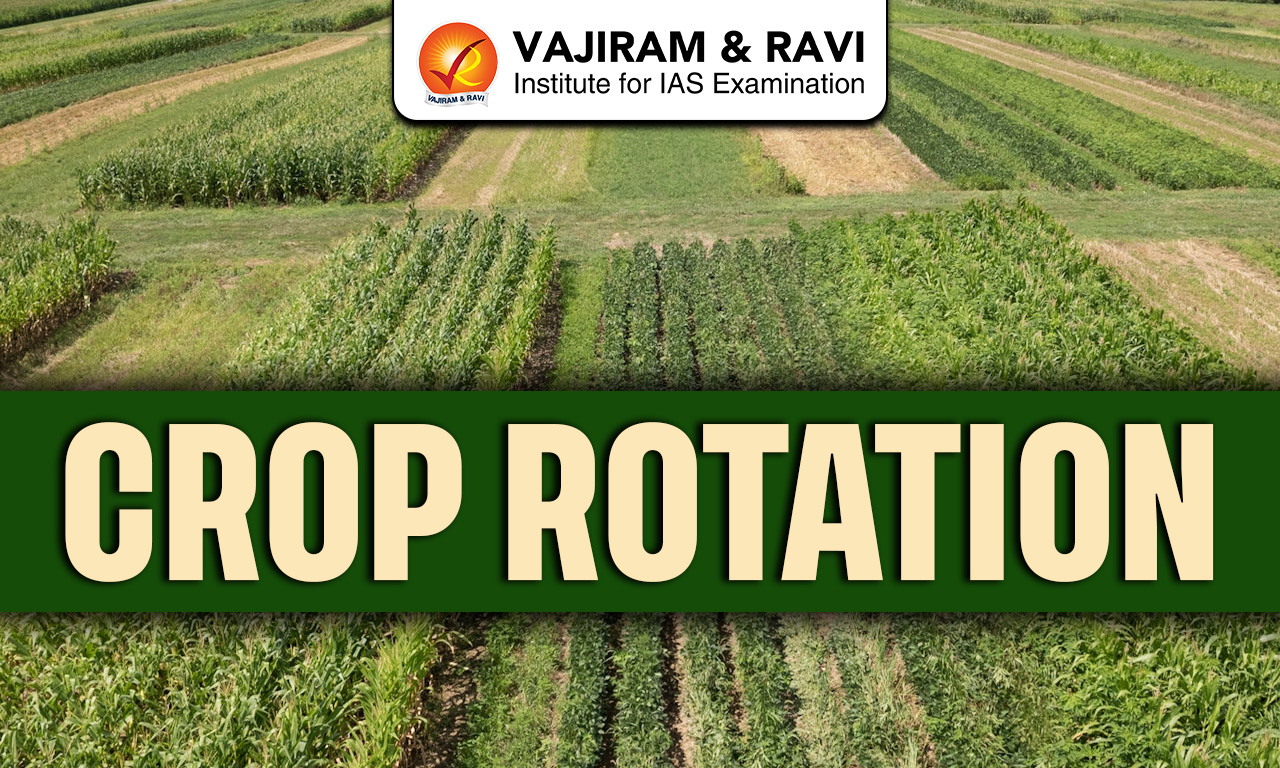
Crop Rotation, Methods, Significance, Example, Indian Aspects

Crop Rotation

Crop Rotation is an essential agricultural practice developed to maintain soil fertility and ensure sustainable farming without heavy investment. The need for Crop Rotation arises due to continuous cropping depleting soil nutrients and increasing pests and diseases. It helps restore soil balance, improve productivity and reduce dependence on chemical inputs while ensuring long term agricultural sustainability.

Crop Rotation

Crop Rotation is the practice of growing different crops sequentially on the same field over different seasons or years to improve soil health and manage pests. It involves planting crops of different species such as cereals and legumes in a planned cycle, allowing efficient nutrient use, reducing pest cycles and enhancing soil structure through varied root systems.

Crop Rotation Methods

Crop Rotation follows different patterns based on duration, crop types and farming conditions to ensure balanced nutrient use and sustainable production.

Based on Duration:

  • One Year Rotation: Crops are grown sequentially within a single year, such as maize followed by mustard, utilizing seasonal variations efficiently.
  • Two Year Rotation: Crops are rotated over two years with multiple combinations like corn, potatoes, sugarcane and peas to balance nutrient demands.
  • Three Year Rotation: A longer cycle includes multiple crops such as rice, wheat, mung and mustard, ensuring complete nutrient replenishment.

Based on Crop Type:

  • Simple Rotation: Involves two or three crops like cereal-legume combinations to maintain soil fertility with minimal complexity.
  • Complex Rotation: Includes several crops over extended periods, sometimes incorporating a dozen crops to maximize diversity and productivity.
  • Legume Based Rotation: Leguminous crops are included to fix atmospheric nitrogen and enrich soil fertility naturally.

Crop Rotation Significance

Crop Rotation is a crucial agricultural strategy that improves soil health, enhances productivity and ensures ecological balance in farming systems.

  • Soil Fertility Improvement: Different crops use and replenish nutrients, especially legumes that fix nitrogen, reducing the need for fertilizers.
  • Pest and Disease Control: Rotating crops breaks pest cycles as pests cannot survive without their preferred host plants.
  • Efficient Resource Use: Crops with different nutrient and water needs ensure optimal use of soil, water and sunlight.
  • Increased Biodiversity: Growing diverse crops supports beneficial organisms, improving ecosystem stability and resilience.
  • Economic Stability: Farmers gain stable income by diversifying crops, reducing risks of total crop failure.
  • Reduced Soil Erosion: Alternating crops with different root structures improves soil binding and reduces runoff.

Crop Rotation Examples

Crop Rotation is practiced using various crop combinations depending on soil conditions, climate and farming objectives.

  • Rice-Wheat Rotation: A common cereal based system providing major calories in India, widely practiced in irrigated regions.
  • Maize-Wheat Rotation: Used in northern regions, balancing nutrient use and improving productivity across seasons.
  • Rice-Pulse Rotation: Pulses are grown after rice to restore nitrogen and improve soil fertility naturally.
  • Cereal-Legume Rotation: Crops like sorghum or millet rotated with pigeon pea or chickpea enhance soil nutrients.
  • Green Manure Rotation: Leguminous crops are grown before rice to improve soil organic matter and fertility.
  • Multi-Crop Rotation: Systems including oilseeds, pulses and cereals provide balanced nutrient cycling and economic benefits.

Crop Rotation in India

Crop Rotation is widely practiced in India due to diverse agro-climatic conditions and the need for sustainable agriculture.

  • Area Coverage: Around 30 million hectares are under Crop Rotation systems which indicates its large scale adoption.
  • Farmer Participation: Approximately 12 to 15 million farmers practice Crop Rotation across the country.
  • Regional Practice: It is common in semi-arid tropics and practiced in almost all states with location specific variations.
  • Dominant Systems: Cereal-cereal rotations like rice-rice and rice-wheat dominate, contributing about 74% of dietary calories.
  • Policy Support: Programs like Soil Health Management under National Mission for Sustainable Agriculture (NMSA) promote Crop Rotation practices.
  • Legume Importance: Legumes are recommended to cover 30% to 50% of cropping area to maintain soil fertility.

Crop Rotation Impacts

Crop Rotation has significant economic, environmental and social impacts that contribute to sustainable agricultural development.

  • Yield Improvement: Studies show yield increases of over 50% in dryland areas due to better soil health and nutrient management.
  • Income Growth: Crop Rotation systems can generate returns between ₹40,472 to ₹59,110 per hectare in rice based systems.
  • Soil Health Enhancement: Improves soil structure, nutrient availability and microbial activity through diverse root systems.
  • Water Efficiency: Crops with different root depths use water efficiently, improving moisture utilization and reducing wastage.
  • Reduced Emissions: Certain Crop Rotations show lower carbon emissions compared to monocropping systems.
  • Biodiversity Promotion: Diverse cropping systems increase soil organisms and ecological balance, strengthening agroecosystems.
  • Resilience Building: Provides stable yields and reduces risk of crop failure, especially in rainfed and climate sensitive regions. 

Crop Rotation FAQs

Q1: What is Crop Rotation?

Ans: Crop Rotation is the practice of growing different crops sequentially on the same land to improve soil fertility and reduce pests.

Q2: What is the need of Crop Rotation?

Ans: It helps maintain soil nutrients, control pests and diseases, improve yields and ensure long term farming sustainability.

Q3: Which crops are commonly used in Crop Rotation?

Ans: Cereals, pulses, oilseeds and legumes are commonly rotated to balance nutrient use and improve soil health.

Q4: How does Crop Rotation improve soil fertility?

Ans: Different crops use and replenish nutrients, especially legumes which fix nitrogen, enhancing soil fertility naturally.

Q5: What is the role of Crop Rotation in pest control?

Ans: It breaks pest and disease cycles by changing crops, preventing pests from surviving and spreading easily.

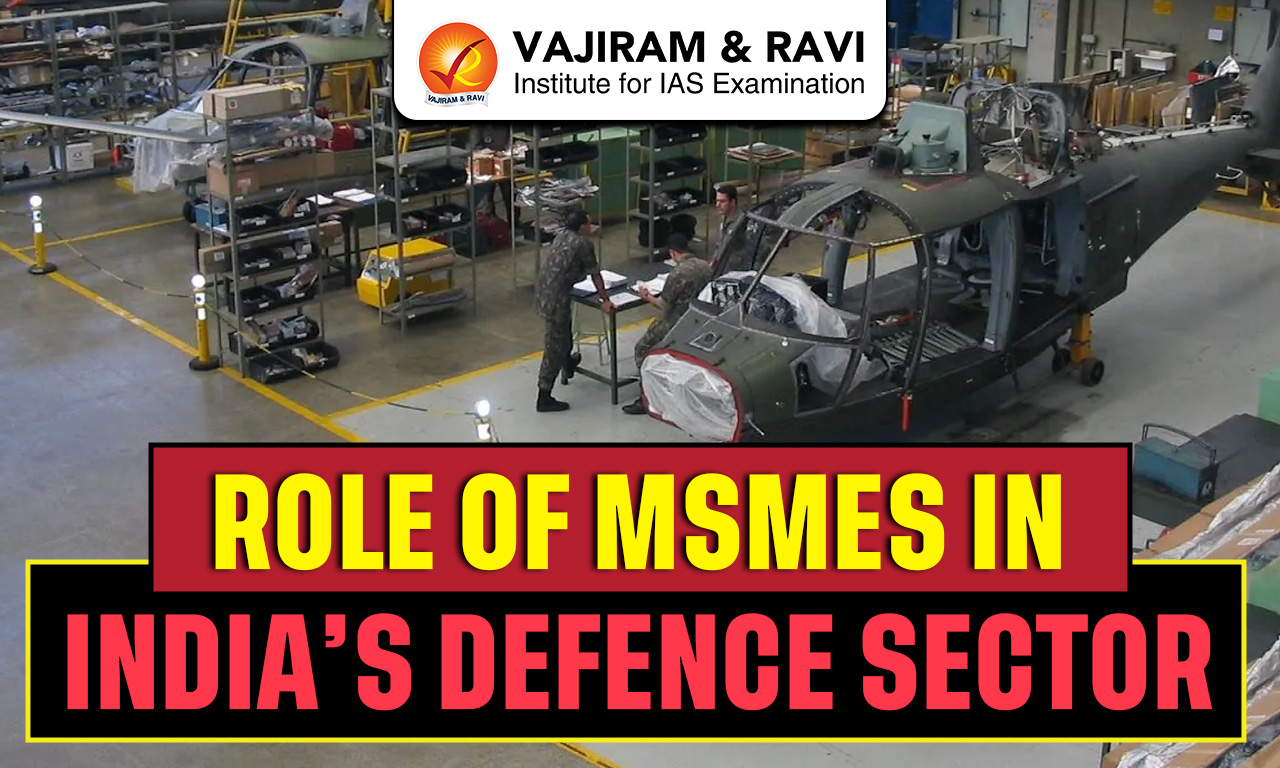
Role of MSMEs in India’s Defence Sector, Challenges, Policy Support

Role of MSMEs in India’s Defence Sector

The role of MSMEs was highlighted during the National Defence Industries Conclave (NDIC) 2026, held at the Manekshaw Centre, New Delhi, which focused on ‘Advanced Manufacturing Technologies’ and industry participation in defence production.

MSMEs Catalysts of Defence Innovation

Micro, Small, and Medium Enterprises (MSMEs), along with start-ups, are emerging as pivotal contributors to India’s defence sector, playing a crucial role in strengthening national security, fostering innovation, and advancing the vision of Aatmanirbhar Bharat in defence manufacturing. Today, nearly 16,000 MSMEs are linked to defence production and supply chains, contributing to areas such as electronics, precision engineering, drones, materials and software systems.

MSMEs can contribute to the self-reliance vision by:

  • Reducing Import Dependence: Defence platforms, from fighter aircraft to missiles, contain thousands of components. Domestic MSMEs can manufacture these parts, lowering reliance on foreign imports.
  • Fostering Innovation: MSMEs are agile and flexible, enabling faster adoption of emerging technologies like drones, artificial intelligence, and robotics.
  • Enhancing Cost Competitiveness: Global defence markets are highly price-sensitive. MSMEs can produce components at lower costs compared to large industrial firms, improving competitiveness.
  • Strengthening Strategic Autonomy: By reducing dependence on imports, MSMEs and start-ups enhance India’s strategic autonomy and contribute to self-reliance in defence manufacturing.
  • Transforming India into a Defence Hub: Integration of innovation, advanced manufacturing technologies, and global best practices by MSMEs is positioning India as a globally competitive defence manufacturing hub.

Government Support and Policy Initiatives

India has undertaken significant policy reforms over the past decade to integrate MSMEs into the defence sector. Key measures include:

Procurement reforms: 

  • The Defence Acquisition Procedure (DAP) 2020 prioritises indigenous procurement through categories such as Buy (Indian-IDDM) and Buy (Indian). 
  • These frameworks mandate high levels of domestic content, creating opportunities for local supply chains.
  • Furthermore, 75% of the defence capital procurement budget is now earmarked for domestic industry, a major shift aimed at reducing import dependence.

Indigenisation push:

  • The government has released multiple positive indigenisation lists banning the import of hundreds of defence items, from sensors and electronic warfare systems to ammunition components. 
  • For MSMEs, these lists effectively create guaranteed domestic markets. 
  • The SRIJAN portal further identifies imported items and invites domestic companies to manufacture them.

Innovation platforms: 

  • One of the most transformative initiatives has been Innovation for Defence Excellence (iDEX). 
  • The Innovation for Defence Excellence (iDEX) programme, launched in 2018, connects MSMEs and start-ups with the armed forces to develop cutting-edge technologies. 
  • From drone swarms to electronic warfare systems, hundreds of challenges have been issued, giving small firms a chance to work directly with defence organisations.

Defence industrial corridors: 

  • Industrial clusters are being developed in Uttar Pradesh and Tamil Nadu, designed to bring together manufacturers, suppliers, testing facilities and research institutions. 
  • Cluster-based development has historically been the most effective way to build high-technology industrial ecosystems.

Budgetary Support: 

  • The Union Budget 2026-27 allocated ₹7.85 lakh crore to the Ministry of Defence, creating opportunities for MSMEs and start-ups to participate in high-value projects.

Collaboration with DRDO: 

  • MSMEs are important partners in DRDO projects and DRDO transfers technologies to them. They are important partners in the industry ecosystem for the production of DRDO developed products. DRDO through its scheme Technology Development Scheme (TDF) funds industries, especially Start-ups and MSMEs upto an amount of Rs 10 Cr. for innovation, research and development of Defence Technologies in the field of Defence and Aerospace.

Strategic Production and Export Goals: 

  • The government aims for ₹3 lakh crore in domestic defence production and ₹50,000 crore in defence exports by 2030. MSMEs and start-ups are expected to play a key role in achieving these targets.

Public Procurement Policy for MSEs:

  • Registered MSMEs benefit from 25% reservation in procurement by defence PSUs, ensuring steady market access.

Outreach and Promotion:

  • The Department of Defence Production (DDP) organises seminars, conclaves, and outreach programmes in Tier II and III cities to promote MSME participation and highlight export opportunities.

Certain regions in India are becoming hotspots for defence-related MSME growth due to existing infrastructure and policy support:

  • Uttar Pradesh Defence Industrial Corridor (UP DIC): Locations like Aligarh, Kanpur, and Jhansi are attracting strong investments.
  • Tamil Nadu Defence Corridor (TNDIC): Cities like Chennai, Salem, and Coimbatore are emerging hubs for aerospace and defence manufacturing.
  • Hyderabad: Known for missile and aerospace production, it houses DRDO labs and global OEM facilities.
  • Pune-Nashik-Aurangabad Belt: Automotive and engineering MSMESs in this belt can easily shift to defence components
  • Bengaluru: An innovation hub for defence tech, AI, and UAVs, with proximity to ISRO, HAL, and R&D labs.

Challenges in Role of MSMEs in India’s Defence Sector

Despite supportive policies, MSMEs face several hurdles that prevent them from fully leveraging opportunities in defence manufacturing:

  • Procurement Complexity: Defence procurement processes are often complex and documentation-heavy. Small companies struggle to meet compliance requirements designed for large contractors, making it difficult to participate effectively.
  • Payment Delays: Delayed payments from prime contractors or government agencies can disrupt cash flows, affecting the ability of MSMEs to scale production or invest in new technologies.
  • Limited Access to Testing Facilities: Defence products require extensive testing—such as ballistics trials, environmental stress tests, and EMI/EMC certification. Access to these facilities is limited and expensive, putting small firms at a disadvantage.
  • Technology Barriers: Advanced defence technologies often need specialised machinery, high-end materials, and significant R&D investment. Many MSMEs lack these resources, restricting their capacity to innovate and scale.
  • Peripheral Role in the Supply Chain: Most MSMEs operate at the margins of the defence industrial architecture, often as subcontractors to larger system integrators. While layered supply chains are normal globally, this limits their involvement in subsystem design, innovation, and higher-value production.
  • Structural Paradox: While policy frameworks encourage MSME participation in defence, operational and resource constraints continue to limit their growth, creating a gap between opportunity and actual engagement.

To transform India into a globally competitive defence manufacturing power, MSMEs must move beyond peripheral roles and become core drivers of innovation, production, and exports, participating in design, subsystem development, and high-value strategic projects.

Role of MSMEs in India’s Defence sector: Opportunities

The rise of low-cost, mass-produced drones and loitering munitions represents a strategic opportunity for India. Lessons from Iran’s drone programme show that scale, cost efficiency, and doctrinal clarity can outweigh high-end sophistication.

MSMEs have already demonstrated capabilities:

  • Solar Industries & Motion (Nagpur & Bengaluru): Developed Nagastra-1, India’s first indigenous loitering munition, with over 80% localisation.
  • NewSpace Research & Technologies (Bengaluru): Produces Sheshnaag-150 swarm loitering munitions, enabling deep strikes beyond 1,000 km.
  • Johnnette Technologies (Noida): Developed JM-1 loitering munition, showcasing rapid procurement-to-deployment cycles.

Strategic Imperatives for MSME Growth

To scale these successes, India must:

  • Shift from Platform-Centric to Volume-Centric Thinking: Mass-produce drones and loitering munitions as ammunition-class assets.
  • Create Dedicated Production Missions: Similar to space or semiconductor programmes, to standardise designs and scale manufacturing.
  • Empower MSMEs as Prime Integrators: Enable direct procurement, provide assured orders, and support scaling with financing and infrastructure.
  • Build Component Sovereignty: Focus on domestic production of sensors, chips, propulsion systems, and other critical subsystems.
  • Integrate MSMEs in Global Supply Chains: Leverage exports and align drones with modern warfare strategy.

About National Defence Industries Conclave (NDIC) 2026

The National Defence Industries Conclave (NDIC) 2026 was organised by the Department of Defence Production (DDP) at the Manekshaw Centre, New Delhi on the theme of “Advanced Manufacturing Technologies”. 

The two-day event aimed to promote active industry participation in defence production, encourage innovation and adoption of emerging technologies, and identify capability gaps and opportunities for collaboration across the defence manufacturing ecosystem. 

The conclave brought together MSMEs, start-ups, Defence Public Sector Undertakings (DPSUs), private defence companies, innovators, policymakers, and academia. 

Key focus areas included artillery systems, small arms, infantry weapons, armoured vehicles, naval platforms, missile systems, advanced materials, composites, and emerging technologies such as artificial intelligence, robotics, smart manufacturing, and Industry 4.0. 

It featured stalls from 20 large defence companies, along with 24 participation from Indian and international companies demonstrating advanced manufacturing technologies in areas such as automation, artificial intelligence, robotics, additive manufacturing and smart materials. 

NDIC 2026 reinforced the role of MSMEs and start-ups as enablers of India’s defence self-reliance, promoted Aatmanirbhar Bharat in defence manufacturing, and strengthened India’s vision of a globally competitive and technologically advanced defence sector.

Role of MSMEs in India’s Defence Sector FAQs

Q1: What is the role of MSMEs in India’s defence sector?

Ans: MSMEs strengthen India’s defence capabilities by supplying critical components, supporting advanced manufacturing, and driving innovation in areas like artillery, armoured vehicles, naval platforms, missiles, AI, and robotics. They reduce dependence on imports, enhance operational readiness, and contribute to India’s vision of self-reliance in defence.

Q2: How do MSMEs contribute to innovation in defence?

Ans: MSMEs, along with start-ups, drive research and development in areas such as advanced materials, composites, propulsion systems, UAVs, and semiconductor manufacturing. Platforms like iDEX and DRDO’s Technology Development Fund (TDF) provide funding, mentorship, and technology support, enabling MSMEs to develop solutions that can be adopted for Indian defence and aerospace needs.

Q3: Which regions in India are emerging as hubs for defence MSMEs?

Ans: Regions such as the Uttar Pradesh Defence Industrial Corridor, Tamil Nadu Defence Corridor, Hyderabad, the Pune-Nashik-Aurangabad belt, and Bengaluru are becoming key centres due to policy support, existing infrastructure, and proximity to R&D and defence production facilities.

Q4: How does the government support MSMEs in the defence sector?

Ans: The government provides support through budgetary allocations, innovation platforms like iDEX, procurement policies reserving 25% of DPSU orders for MSMEs, outreach programs, and skill development initiatives. These measures aim to integrate MSMEs into defence supply chains, expand their capabilities, and promote participation in domestic production and exports.

Q5: What was the significance of NDIC 2026 for MSMEs?

Ans: The National Defence Industries Conclave (NDIC) 2026 highlighted the role of MSMEs and start-ups as key enablers of India’s defence self-reliance. It provided a platform for collaboration with DPSUs, private companies, and academia, showcased emerging technologies, and reinforced MSMEs’ contribution to building a globally competitive and technologically advanced defence sector.

Article 375 of Indian Constitution, Functions, Significance

Article 375 of Indian Constitution

Article 375 of Indian Constitution is a provision that ensures smooth continuity in India’s judicial system after the Constitution came into force in 1950. It states that all courts, judges, and legal proceedings that were functioning before the Constitution would continue to operate until new arrangements were made under the Constitution.

Article 375 of Indian Constitution Key Aspects

  • Article 375: All courts of civil, criminal and revenue jurisdiction, all authorities and all officers, judicial, executive and ministerial, throughout the territory of India, shall continue to exercise their respective functions subject to the provisions of this Constitution.
  • It is part of Part XXI (Temporary, Transitional and Special Provisions) of the Constitution.
  • It allowed courts, judges, police, and administrative officers to continue their work after 1950.
  • It ensured that all these institutions would now function according to the Constitution.
  • It acted as a bridge between the old British-era system and the new constitutional system.

Article 375 of Indian Constitution Scope

  • Applies to all courts and judicial authorities that existed before the Constitution came into force.
  • Covers judges, court officials, and ongoing cases, ensuring they continue without disruption.
  • Validates the continuation of existing legal procedures and practices until new laws or structures are introduced.
  • Operates until the new judicial system (such as High Courts and the Supreme Court) is fully functional under the Constitution.

Article 375 of Indian Constitution Significance

  • Played a key role in ensuring a smooth transition from colonial to constitutional governance.
  • Prevented delays and uncertainty in the administration of justice during the early years of independence.
  • Maintained public confidence in the legal system by ensuring continuity and stability.
  • Acted as a bridge between the old judicial system and the new constitutional framework.

Article 375 of Indian Constitution FAQs

Q1: What is Article 375 of the Indian Constitution?

Ans: Article 375 is a constitutional provision that ensures the continuation of courts, judges, and legal proceedings after the Constitution came into force in 1950.

Q2: Which part of the Constitution includes Article 375?

Ans: It is included in Part XXI, which deals with temporary, transitional, and special provisions.

Q3: What is the main objective of Article 375?

Ans: Its main objective is to ensure continuity of the judicial system and prevent any legal vacuum during the transition to constitutional governance.

Q4: What does Article 375 provide for?

Ans: It allows courts, judges, and administrative authorities functioning before 1950 to continue working under the new constitutional framework.

Q5: What is the scope of Article 375?

Ans: It applies to all pre-Constitution courts, judges, officials, and ongoing cases, ensuring they continue without disruption.

Difference between MLA and MP, Roles, Functions & Key Differences

Difference between MLA and MP

In India, MLAs and MPs are elected representatives who play an important role in the country’s governance. They represent people and take part in law-making, but they work at different levels, state and national. Understanding their difference helps in knowing how the government functions at various levels. The Difference between MLA and MP is discussed in detail in this article.

Difference between MLA and MP

MLAs and MPs are important elected representatives in India who function at different levels of government. The key differences between them in terms of roles, powers, and responsibilities are discussed below in the table.

Aspect

MLA (Member of Legislative Assembly)

MP (Member of Parliament)

Definition

An MLA is an elected representative of a state who is part of the State Legislative Assembly (Vidhan Sabha).

An MP is an elected representative at the national level who is part of Parliament (Lok Sabha or Rajya Sabha).

Level of Government

Works at the state level and deals with governance within a state.

Works at the national level and deals with governance of the entire country.

House

Member of Vidhan Sabha (State Legislature).

Member of Lok Sabha (Lower House) or Rajya Sabha (Upper House).

Representation

Represents a specific constituency within a state.

Represents a constituency at national level (Lok Sabha) or a state (Rajya Sabha).

Legislative Powers

Makes laws on subjects in the State List and Concurrent List.

Makes laws on subjects in the Union List and Concurrent List.

Election Process

Directly elected by the people of a state constituency.

Lok Sabha MPs are directly elected; Rajya Sabha MPs are elected indirectly by state legislatures.

Role in Executive

Can become Chief Minister or a State Minister and take part in state administration.

Can become Prime Minister or Union Minister and take part in central administration.

Term

Usually 5 years, unless the assembly is dissolved earlier.

Lok Sabha: 5 years; Rajya Sabha: 6 years with one-third members retiring every 2 years.

Focus Area

Focuses on state issues like law and order, agriculture, health, and local development.

Focuses on national issues like defence, foreign policy, economy, and national security.

Financial Powers

Participates in the state budget, taxation, and allocation of state funds.

Participates in the Union Budget, national taxation, and financial policies.

Accountability

Accountable to the people of their state constituency.

Accountable to the people of their constituency and the nation.

Importance (Value Addition)

Plays a key role in implementing policies and schemes at the state level.

Plays a major role in framing national laws and policies, ensuring unity and development of the country.

About MP (Member of Parliament)

  • Definition: A Member of Parliament (MP) is an elected representative who represents the people at the national level and participates in the functioning of the Parliament of India.
  • Types of MPs:
    • Lok Sabha MPs: Directly elected by the people from constituencies across the country.
    • Rajya Sabha MPs: Indirectly elected by elected members of State Legislative Assemblies; some are nominated by the President for their expertise.
  • Constitutional Basis: MPs are part of the Union Legislature under Articles 79-122 of the Constitution of India, which deals with the structure and functioning of Parliament.
  • Functions and Powers:
    • Legislative Role: Make laws on subjects in the Union List and Concurrent List.
    • Executive Control: Hold the government accountable through questions, debates, and motions.
    • Financial Powers: Approve the Union Budget and control public expenditure.
    • Deliberative Role: Participate in discussions on national issues and policies.
  • Term of Office:
    • Lok Sabha MPs serve for 5 years (unless dissolved earlier).
    • Rajya Sabha MPs serve for 6 years, with one-third retiring every two years.
  • Qualifications:
    • Must be a citizen of India.
    • Minimum age: 25 years (Lok Sabha) and 30 years (Rajya Sabha).
    • Other qualifications as prescribed by law.
  • Role in Executive: MPs can become Prime Minister or Union Ministers, forming part of the executive branch of the government.
  • Committee System: MPs are part of parliamentary committees (like Public Accounts Committee, Estimates Committee), which help in detailed examination of policies and functioning of the government.
  • Representation Role: MPs represent the interests, issues, and concerns of their constituency or state at the national level.
  • Significance: MPs play a crucial role in law-making, policy formulation, maintaining checks and balances, and strengthening democratic governance in India.

About MLA (Member of Legislative Assembly)

  • Definition: A Member of Legislative Assembly (MLA) is an elected representative who represents people of a constituency at the state level and is part of the State Legislature.
  • Type of Legislature: MLAs are members of the Vidhan Sabha (Legislative Assembly), which is the lower house of the state legislature (in states with a bicameral system).
  • Constitutional Basis: MLAs are part of the State Legislature under Articles 168-212 of the Constitution of India, which deal with the structure and functioning of state legislatures.
  • Functions and Powers:
    • Legislative Role: Make laws on subjects in the State List and Concurrent List.
    • Executive Control: Question the state government and hold it accountable through debates and motions.
    • Financial Powers: Approve the state budget and control state expenditure.
    • Deliberative Role: Participate in discussions on state issues and policies.
  • Term of Office: MLAs usually serve for 5 years, unless the assembly is dissolved earlier.
  • Qualifications:
    • Must be a citizen of India.
    • Minimum age: 25 years.
    • Other qualifications as prescribed by law.
  • Role in Executive: MLAs can become Chief Minister or State Ministers, forming part of the state executive.
  • Committee System: MLAs are part of state-level committees that examine bills, budgets, and government functioning in detail.
  • Representation Role: MLAs represent the interests and issues of people in their state constituency and work on local development.
  • Significance: MLAs play a key role in state governance, policy implementation, and addressing regional issues, which is essential for strengthening India’s federal structure.

Difference between MLA and MP FAQs

Q1: What is the main difference between an MLA and an MP?

Ans: An MLA works at the state level and makes laws for a state, while an MP works at the national level and makes laws for the whole country.

Q2: What are the different types of MPs in India?

Ans: There are two types: Lok Sabha MPs (directly elected by people) and Rajya Sabha MPs (indirectly elected by state legislatures, some nominated).

Q3: What are the legislative powers of MLAs and MPs?

Ans: MLAs make laws on State List and Concurrent List, while MPs make laws on Union List and Concurrent List.

Q4: What is the term of MLAs and MPs?

Ans: MLAs serve for 5 years. MPs: Lok Sabha members serve for 5 years, while Rajya Sabha members serve for 6 years with gradual retirement.

Q5: What role do MLAs and MPs play in the executive?

Ans: MLAs can become Chief Minister or State Ministers, while MPs can become Prime Minister or Union Ministers.

UPSC Daily Quiz 23 March 2026

[WpProQuiz 121]

UPSC Daily Quiz FAQs

Q1: What is the Daily UPSC Quiz?

Ans: The Daily UPSC Quiz is a set of practice questions based on current affairs, static subjects, and PYQs that help aspirants enhance retention and test conceptual clarity regularly.

Q2: How is the Daily Quiz useful for UPSC preparation?

Ans: Daily quizzes support learning, help in revision, improve time management, and boost accuracy for both UPSC Prelims and Mains through consistent practice.

Q3: Are the quiz questions based on the UPSC syllabus?

Ans: Yes, all questions are aligned with the UPSC Syllabus 2025, covering key areas like Polity, Economy, Environment, History, Geography, and Current Affairs.

Q4: Are solutions and explanations provided with the quiz?

Ans: Yes, each quiz includes detailed explanations and source references to enhance conceptual understanding and enable self-assessment.

Q5: Is the Daily UPSC Quiz suitable for both Prelims and Mains?

Ans: Primarily focused on Prelims (MCQ format), but it also indirectly helps in Mains by strengthening subject knowledge and factual clarity.

Multiple Cropping, Types, Benefits, Government Initiatives

Multiple Cropping

Multiple cropping, or multi-cropping, is a farming method where farmers grow more than two crops on the same field within a single growing season instead of planting just one crop. Intercropping is a type of this system in which different crops are grown together at the same time. This method helps farmers increase their total production and earn more income from the same piece of land. However, the selection of crops is important, as farmers usually choose crops that support each other’s growth and make better use of soil nutrients, water, and sunlight.

About Multiple Cropping

  • Multiple cropping is a farming method in which farmers grow two or more crops on the same land within a year, either one after another or together. It helps in using land, water, and sunlight more efficiently and increases total production.
  • This system includes practices like intercropping, mixed cropping, and relay cropping. It allows farmers to earn more income and reduces the risk of complete crop failure, as different crops provide support if one fails. Crops like pulses also help improve soil fertility.
  • However, multiple cropping requires more water, labour, and proper planning. Without good management, it can lead to soil nutrient loss and increased pest problems.

Multiple Cropping Types

Multiple cropping can be practiced in different ways depending on how crops are grown on the same land:

  • Mixed Cropping: In this method, two or more crops are grown together on the same field without any specific pattern. The main aim is to reduce the risk of crop failure, as different crops respond differently to weather conditions.
  • Intercropping: Here, two or more crops are grown at the same time in a planned arrangement, such as in rows. This helps in better use of resources like sunlight, water, and nutrients, and also reduces competition between crops.
  • Relay Cropping: In this system, a second crop is planted before the first crop is fully harvested. This ensures continuous use of land without leaving it empty.
  • Sequential Cropping: In this method, crops are grown one after another in a sequence within a year. For example, a farmer may grow rice in one season and wheat in the next.
  • Ratoon Cropping: In this practice, a new crop grows from the stubble or roots of the previous crop (such as sugarcane), without replanting. This saves time and cost of cultivation.

Multiple Cropping Benefits

  • Higher Production: Farmers grow more than one crop in a year, which increases the total output from the same piece of land.
  • Increased Income: By harvesting multiple crops, farmers can earn more money instead of depending on a single crop.
  • Better Use of Resources: Land, water, sunlight, and soil nutrients are used efficiently throughout the year without leaving the field empty.
  • Reduced Risk of Crop Failure: If one crop fails due to bad weather or pests, other crops can still survive and provide some income.
  • Improves Soil Fertility: Growing crops like pulses helps add nitrogen to the soil, making it more fertile for future crops.
  • More Employment Opportunities: Farming activities continue all year, providing more work for farmers and labourers.
  • Promotes Sustainable Farming: It helps maintain soil health and ensures long-term productivity when managed properly.

Multiple Cropping Disadvantages

  • High Resource Requirement: It needs more water, labour, seeds, and money, which may not be easily available to all farmers.
  • Soil Nutrient Depletion: Continuous cropping can reduce soil fertility if nutrients are not properly managed.
  • Increased Pest and Disease Risk: Growing multiple crops can make it easier for pests and diseases to spread.
  • Requires Proper Knowledge: Farmers need good planning and knowledge to choose suitable crop combinations and timings.
  • Higher Management Effort: Managing different crops at the same time or in sequence can be complex and time-consuming.
  • Water Stress Issues: In areas with limited irrigation, growing multiple crops may lead to water shortages.
  • Market Problems: Farmers may face price fluctuations or lack of proper markets for all the crops grown.

Government Initiatives for Promoting Multiple Cropping

  • Pradhan Mantri Krishi Sinchayee Yojana (PMKSY): This scheme focuses on expanding irrigation facilities and improving water-use efficiency (“Per Drop More Crop”), which helps farmers grow more than one crop in a year.
  • Soil Health Card Scheme: It provides farmers with information about soil nutrients, helping them choose suitable crops and maintain soil fertility under multiple cropping.
  • National Food Security Mission (NFSM): Aims to increase production of crops like rice, wheat, and pulses, encouraging better cropping patterns and higher productivity.
  • Paramparagat Krishi Vikas Yojana (PKVY): Promotes organic farming and crop diversification, which supports sustainable multiple cropping practices.
  • Rashtriya Krishi Vikas Yojana (RKVY): Supports state-level agricultural development, including crop diversification and improved farming techniques.
  • National Mission for Sustainable Agriculture (NMSA): Encourages climate-resilient and sustainable farming practices, including efficient use of resources and diversified cropping.
  • e-NAM (National Agriculture Market): Provides an online platform for farmers to sell different crops easily, helping them get better prices for multiple produce.

Multiple Cropping FAQs

Q1: What is multiple cropping?

Ans: Multiple cropping is a farming method where two or more crops are grown on the same land within a year to increase production and better use resources.

Q2: What is the difference between multiple cropping and intercropping?

Ans: Multiple cropping is a broad term for growing more than one crop in a year, while intercropping is a type of it where crops are grown together at the same time in a planned way.

Q3: What are the main types of multiple cropping?

Ans: The main types include mixed cropping, intercropping, relay cropping, sequential cropping, and ratoon cropping.

Q4: Why do farmers practice multiple cropping?

Ans: Farmers use this method to increase production, earn more income, and reduce the risk of crop failure.

Q5: What are the benefits of multiple cropping?

Ans: It increases production, improves income, uses resources efficiently, reduces risk, improves soil fertility, and provides more employment.
Conglomerate Rock, Geology, Composition, Classification, Properties

Conglomerate Rock

Conglomerate rock is a type of sedimentary rock made up of large, rounded pieces of stones or pebbles that are stuck together by natural minerals. These rounded fragments show that they were carried by water, such as rivers or waves, over a long distance before settling down. Over time, layers of these materials got compacted and cemented to form a solid rock. Conglomerate rock is commonly found in riverbeds, beaches, and areas where strong water currents once existed.

Geology Conglomerate

  • Conglomerate is a type of sedimentary rock made up of rounded pebbles, stones, and sand that are naturally cemented together by materials like silica, calcite, or iron oxide. It looks a bit like sandstone, but instead of fine sand grains, it contains larger, rounded rock pieces.
  • This rock usually forms in places like riverbeds, where strong flowing water carries and smoothens the stones before depositing them. The materials in conglomerate can come from different minerals, but many are rich in quartz.
  • The hardness of conglomerate can vary, and it often looks similar to concrete. It is usually found in thick, rough layers. Because of its appearance, it is sometimes used as a decorative stone in construction.

Also Read: Rock Systems of India

Conglomerate Composition

  • Conglomerate rock can have many different compositions because it is made from a mix of materials. It is a clastic sedimentary rock, which means it forms from broken pieces (called clasts) of other rocks that are carried by water and then deposited.
  • These rounded clasts can be small mineral grains like quartz, or larger pieces of different types of rocks such as igneous, sedimentary, or metamorphic rocks. Over time, these pieces get pressed together.
  • The spaces between these larger fragments are filled with finer materials like sand or mud, known as the matrix. This matrix, along with natural cements like silica, calcite, or iron compounds, helps bind everything together and turn it into solid rock.
  • Because of this mix of different materials, conglomerate can vary a lot in appearance, color, and strength depending on what it is made of and where it was formed.

Conglomerate Rock Classification

Conglomerate rock is classified based on a few important features. These help scientists understand how the rock was formed and what materials it contains.

  • Matrix (material between the stones): Classification depends on how much fine material (like sand, clay, or silt) is present and what type it is. Some conglomerates have a lot of matrix holding the pebbles together, while others have very little.
  • Composition of clasts (pebbles): The type of rock fragments (called clasts) inside the conglomerate also matters. These clasts can be made of different materials like quartz, limestone, or other rocks. If most clasts are of the same type, it tells us about their source.
  • Size of clasts: The size range of the gravel or pebbles is another factor. Conglomerates can contain small pebbles or larger stones, and this helps in identifying the environment where the rock was formed (like rivers or beaches).
  • Purpose of classification: The way conglomerate rocks are classified can change depending on the level of detail needed. For basic study, simple features are used, but for detailed research, scientists may use more specific methods and measurements.

Also Read: Types of Rocks

Conglomerate Characteristics and Properties 

  • Conglomerate is a type of sedimentary rock that has some very easy-to-recognize features.
  • Main characteristic:The most important feature of a conglomerate is the presence of clearly visible, rounded pebbles or stones called clasts. These clasts are cemented together by a finer material known as the matrix.
  • Appearance and composition: Conglomerate often looks similar to concrete because it is made up of large, rounded pebbles held together by substances like calcite, silica, or iron oxide. The rounding of the pebbles usually shows that they were carried by water (like rivers or waves) before becoming part of the rock.
  • Properties: The properties of a conglomerate depend on what materials it is made of.
    • It can be hard or soft, depending on the strength of the cementing material.
    • It can be found in different colours, based on the minerals present in the clasts and matrix.

Conglomerate Uses

  • Use in Construction
    • Low-performance material: Conglomerate rocks do not break cleanly, and their fine particles are not very strong. Because of this, they are mostly used where high-strength material is not required.
    • Crushed aggregate: Conglomerates can be crushed into smaller pieces to produce aggregate, which is used for building roads, foundations, and other construction projects.
    • Cement manufacturing: Certain types of conglomerate are suitable as raw material in cement production, contributing to the binding and structural properties of cement.
  • Decorative and Ornamental Uses
    • Attractive appearance: Many conglomerates are naturally colorful and visually appealing due to the variety of pebbles and minerals they contain.
    • Limited interior use: Despite their beauty, they are rarely used for interior decoration because their uneven breakage makes them difficult to cut and polish cleanly.
  • Art, Sculpture, and Monuments
    • Sculpture material: Well-cemented conglomerate is excellent for making statues, monuments, and sculptures due to its unique texture and hardness.
    • Artifacts and figurines: Its patterns and natural colors make it suitable for crafting small figurines, decorative artifacts, and artistic creations.
  • Dimension Stone Applications
    • Cutting potential: Conglomerates with smaller clasts can be easily shaped and cut into required sizes.
    • When the cementing material is strong and durable, conglomerate can be used for: Flooring tiles, Wall veneers, Roof tiles
    • Durability: Properly cemented conglomerate dimension stones can last long and withstand moderate wear, making them suitable for both functional and decorative construction.

Monarch Butterfly

Monarch Butterfly

Monarch Butterfly Latest News

Recently, there has been a 64 per cent increase in the presence of the Monarch butterfly in Mexican overwintering forests during the 2025-2026 seasons.

About Monarch Butterfly

  • It is known by scientists as Danaus plexippus, which in Greek literally means "sleepy transformation."
  • Appearance
    • Adult monarch butterflies possess two pairs of brilliant orange-red wings, featuring black veins and white spots along the edges.
    • Males, who possess distinguishing black dots along the veins of their wings, are slightly bigger than females.
  • Distribution: It is found in North America, Central America, and South America, Australia, Hawaii, India, and other locations.
  • Habitat: Gardens, Managed Corridors, Agricultural Areas, and Natural and Restored Areas.
  • Life Span: Each adult butterfly lives only about four to five weeks.
  • Reproduction: The mating period occurs in the spring, just prior to migration from the overwintering sites. 
    • Milkweed is the only plant on which monarchs will lay their eggs and the only source of food for baby caterpillars
  • Migration: They travel between 1,200 and 2,800 miles or more from the northeast United States, and southeast Canada to the mountain forests in central Mexico
  • Threats: Illegal logging, land development, loss of milkweed plants, and climate change, all of which affect its habitat and migration.

Source: DTE

Monarch Butterfly FAQs

Q1: What is the scientific name of the Monarch Butterfly?

Ans: Danaus plexippus

Q2: What is a major threat to Monarch Butterfly populations?

Ans: Habitat loss, Climate change and Pesticide use

Sahiwal Cattle

Sahiwal Cattle

Sahiwal Cattle Latest News

Recently, the Indian Council of Agricultural Research– Indian Veterinary Research Institute, Izatnagar, Bareilly successfully produced indigenous Sahiwal cattle calves by using ultrasound-guided ovum pick-up, in vitro fertilization, and embryo transfer (OPU–IVF–ET).

About Sahiwal Cattle

  • It is considered to be one of the best milch cattle breeds of India.
  • The breed derives its name from Sahiwal area in Montgomery district of Punjab in Pakistan.
  • Other Names: These animals are also known as “Lambi Bar”, “Lola”, “Montgomery”, “Multani” and “Teli”.
  • Appearance
    • The cows are brownish red in colour; shades may vary from a mahogany red brown to more greyish red.
    • Extremities in bulls are darker than the rest of body colour. Occasionally there are white patches.
    • Average lactation yield of Sahiwal cows is 2325 kilo grams. The lactation yield ranges from 1600 to 2750 Kg.
  • Characteristics: Its unique traits are, tick-resistant, heat tolerant, high milk production and noted for its high resistance to parasites, both internal and external
  • Due to their heat tolerance and high milk production they have been exported to other Asian countries as well as Africa and the Caribbean. 

What is Ovum Pick-Up-In Vitro Fertilization (OPU-IVF) Technology?

  • Ovum Pick-Up (OPU) is one of the recent and remarkable technologies in the field of reproductive biotechnology.
  • It allows the collection of oocytes from the ovaries of live animals of known pedigree and additionally decreases the interval between generations.
  • This procedure can be performed on pregnant animals less than 100 days in gestation.
  • In OPU, ovarian follicles are punctured in a live animal with the help of a needle attached to a vacuum pump after visualizing them through ultrasonography.
  • The oocytes obtained are then subjected to in vitro maturation (IVM), in vitro fertilization (IVF) and culture (IVC) for embryo production.
  • The embryos thus produced can then be transferred to suitably synchronized recipients for producing offspring of known pedigree.

Source: DTE

Sahiwal Cattle FAQs

Q1: What is the average milk yield of Sahiwal Cattle?

Ans: 1500-2500 kg

Q2: Where is the Sahiwal Cattle breed primarily found?

Ans: Pakistan and India's Punjab region

Chhapgarus ngankeeae

Chhapgarus ngankeeae

Chhapgarus ngankeeae Latest News

Recently, researchers from the Zoological Survey of India discovered a new crab species from the Goan mangroves and named it as Chhapgarus ngankeeae.

About Chhapgarus ngankeeae

  • It is a new species of marine crab.
  • The species has been named in honour of the late Dr Ngan Kee Ng, a noted marine biologist from the National University of Singapore.
  • Habitat: It is found in the muddy intertidal mangrove forests along the west coast of India.

Characteristics of Chhapgarus ngankeeae

  • It is a small crab measuring only about 1.6 centimetres across its squarish, brown, hairy shell.
  • The new species features a noticeably narrower abdomen (the male pleon), with its second and third abdominal segments equal in width.
  • Its tailpiece, or telson, is as broad as it is long.
  • The most distinctive characteristic is the shape of the male reproductive organ (the first gonopod); its hard, chitinous tip features two conspicuously unequal lobes that form a deep V-shaped constriction.
  • Ecological Significance: Mangrove crabs play a crucial role in coastal eco systems by recycling nutrients and supporting food chains.

Source: RM

Chhapgarus ngankeeae FAQs

Q1: What is Chhapgarus ngankeeae?

Ans: A newly discovered crab species

Q2: Where was Chhapgarus ngankeeae crab discovered?

Ans: West coast of India

Litani River

Litani River

Litani River Latest News

Recently, Israeli airstrikes have destroyed the Qasmiyeh Bridge, a key crossing over the Litani River on Lebanon’s southern coastal highway. 

About Litani River

  • It is a major river in Lebanon.
  • Origin: It rises in a low divide west of Baalbek and flows southwestward through the Bekaa valley between the Lebanon and Anti-Lebanon mountains.
  • Near Marjayoun, it bends sharply west and cuts a spectacular gorge up to 900 feet (275 meters) deep through the Lebanon Mountains to the Mediterranean Sea, south of Sidon.
  •  It falls into the Mediterranean Sea.
  • Tributaries: Berdawni River, Chtoura River, Qib Elias River etc
  • Dams: El Wauroun Dam, Qaraoun Dam, or Albert Naqash Dam
  • It provides a major source for water supply, irrigation, and hydroelectricity both within Southern Lebanon and the bekaa and the country as a whole.

Key Facts about Bekaa Valley

  • It is a broad valley of east-central Lebanon, extending in a northeast-southwest direction along the Litani and Orontes rivers.
  • The valley contains nearly half of Lebanon’s arable land.
  • It is not as intensively farmed as the country’s coastal plain because of less rainfall and a wider variation in temperature.

Source: NDTV

Litani River FAQs

Q1: Where is the Litani River located?

Ans: Lebanon

Q2: Where does the Litani River originate?

Ans: Bekaa Valley

Guru Angad Dev

Guru Angad Dev

Guru Angad Dev Latest News

Recently, the Union Home Minister paid tributes to the second Sikh Guru, Shri Angad Dev on the occasion of his Jyoti-Jyot Diwas.

About Guru Angad Dev

  • Guru Angad (31 March 1504--29 March 1552) was born with the birth name of Lahna the village of Matte-di-Sarai in Firozpur district of Punjab, India.
  • He was the second Sikh Guru (1539–52).

Contribution of  Guru Angad Dev

  • He introduced the Gurmukhi script, standardizing the Punjabi language.
  • He made extensive efforts to spread teachings of Guru Nanak Dev far and wide.
  • He introduced the teaching of Punjabi in Gurmukhi script by modifying the existing alphabet.
  • He improved literacy among the Sikhs and started school at Khadur Sahib to teach Gurmukhi to the children.
  • He encouraged physical health building through sports and wrestling as well mental health through discipline and truthful living.
  • He composed 62 hymns in 10 Ragas.
  • He consolidated the institution of Langar started by Guru Nanak Dev Ji.
  • He also established hundreds of new Sangats (Sikh religious Institutions) and thus strengthened the base of Sikhism.

Source: PIB

Guru Angad Dev FAQs

Q1: Who is Guru Angad Dev?

Ans: Second Sikh Guru

Q2: What is Guru Angad Dev's contribution to Sikhism?

Ans: He developed the Gurmukhi script

Provisioning Coverage Ratio (PCR), Meaning, Formula, Example

Provisioning Coverage Ratio

The Provisioning Coverage Ratio (PCR) is a critical financial indicator used to assess the health and resilience of banks, particularly in managing non-performing assets (NPAs).

Provisioning Coverage Ratio (PCR) Meaning

Provisioning Coverage Ratio (PCR) is the percentage of non-performing assets (NPAs) that a bank sets aside from its profits or capital to cover potential losses. The percentage depends on the quality of assets, worse the asset quality, higher the PCR required.

It is calculated as:

PCR (%) = (Provisions for Non-Performing Assets ÷ Gross Non-Performing Assets) × 100

  • Provisions for NPAs are funds set aside to cover potential losses from loans that may not be recovered.
  • Gross NPAs are loans overdue for more than 90 days.

A higher PCR indicates that the bank is better prepared to absorb potential losses from bad loans, helping maintain financial stability.

Example:  Suppose a bank has Gross NPAs = ₹100 crore and Provisions set aside for NPAs = ₹70 crore. Then, PCR (%) = (70 ÷ 100) × 100 = 70%

This means the bank has provisioned 70% of its bad loans. A higher PCR, like this, shows that the bank is well-prepared to absorb losses, even if some loans cannot be recovered.

Provisioning Coverage Ratio (PCR) Significance

The Provisioning Coverage Ratio (PCR) is significant for multiple reasons:

  • Financial Health of Banks: A higher PCR suggests that the bank has adequately provisioned against bad loans, reducing the risk of sudden financial shocks.
  • Investor Confidence: Investors and depositors view a higher PCR positively as it indicates prudent risk management and lower vulnerability to credit losses.
  • Regulatory Oversight: The Reserve Bank of India (RBI) mandates minimum provisioning norms, and PCR is a key tool to monitor compliance. 
  • Economic Stability: Banks with robust PCR levels are better equipped to handle stressed sectors during economic downturns, thereby supporting overall financial stability.

Factors Affecting Provisioning Coverage Ratio (PCR)

  • Quality of Loans: Banks with a higher proportion of risky loans may need to maintain a higher PCR.
  • Regulatory Requirements: RBI sets minimum provisioning requirements for different categories of NPAs.
  • Economic Environment: In periods of economic stress, banks tend to increase provisions to safeguard against rising NPAs, thereby increasing PCR.
  • Bank’s Risk Appetite: Conservative banks maintain a higher PCR to protect against uncertainties, whereas aggressive banks may keep it lower to report higher profits.

Limitations of Provisioning Coverage Ratio (PCR)

While Provisioning Coverage Ratio (PCR) is an important metric, it has some limitations:

  • Does Not Reflect Actual Recoveries: High provisioning does not guarantee that bad loans will be recovered. PCR does not distinguish between recoverable and unrecoverable NPAs, meaning a high PCR could be masking poor loan recovery efforts rather than reflecting genuine financial strength.
  • Profitability Impact: Higher provisions reduce the reported profit of banks, affecting investor perception in the short term.
  • Comparability Issues: Different banks may follow varying provisioning practices, making direct comparison difficult.

Provisioning Coverage Ratio FAQs

Q1: What is Provisioning Coverage Ratio (PCR)?

Ans: Provisioning Coverage Ratio (PCR) is the percentage of non-performing assets (NPAs) that a bank sets aside from its profits or capital to cover potential losses.

Q2: How is Provisioning Coverage Ratio (PCR) calculated?

Ans: PCR is calculated as the provisions for NPAs divided by gross NPAs, multiplied by 100. Provisions are the funds reserved to cover potential loan losses, while gross NPAs are loans overdue for more than 90 days.

Q3: Does a high Provisioning Coverage Ratio (PCR) mean the loans are safe?

Ans: Not always. A high PCR shows that a bank has made adequate provisions, but it does not guarantee recovery of bad loans. PCR does not distinguish between recoverable and unrecoverable NPAs, so it may mask weak loan recovery efforts.

Q4: What factors affect Provisioning Coverage Ratio (PCR)?

Ans: PCR is influenced by the quality of loans, economic conditions, regulatory requirements, and the bank’s risk appetite.

Q5: Why is Provisioning Coverage Ratio (PCR) important?

Ans: PCR is a key measure of a bank’s financial health. It boosts investor confidence, ensures compliance with regulatory norms, and helps banks manage potential losses, contributing to overall financial stability.

Cabinet Committee on Security

Cabinet Committee on Security

Cabinet Committee on Security Latest News

Recently, the Prime Minister Of India chaired a meeting of the Cabinet Committee on Security (CCS) to review the global situation and various mitigating measures taken so far across sectors amid the conflict in West Asia.

About Cabinet Committee on Security

  • It is headed by the Prime Minister, and is responsible for important discussions and decisions on defence policy, expenditure, and matters related to national security.
  • History
    • A committee comparable to the current CCS structure was first formed in independent India in 1947 by then-Prime Minister Jawaharlal Nehru.
    • Formed against the background of a newly independent nation facing national security challenges.
    • It was reportedly chaired by Prime Minister Jawaharlal Nehru, with Home Minister Sardar Patel and Defence Minister Baldev Singh as its members.
    • It was after the 1999 Kargil War that the committee evolved to adopt the present formal structure of the CCS and became a high-powered committee for defence and national security.
    • Over time, the CCS has evolved into the apex decision-making body concerning internal and external security matters of the Government of India.
  • Composition
    • With the Prime Minister as its chairperson, the committee typically comprises the Home Minister, Defence Minister, Finance Minister, and External Affairs Minister as members. 
    • The National Security Advisor (NSA) acts as secretary-level coordinator on matters within its purview.
    • While the defence minister is a permanent invitee to the panel, other members may be included as per requirements. 
    • The Cabinet Secretariat is responsible for maintaining records of all the meetings and proceedings of the CCS.
  • Function: The CCS concerns itself with all matters related to defence, foreign affairs, intelligence, nuclear issues, space policy, and major appointments related to national security.
    • It is also the apex body when it comes to the appointments of the officials in the national security bodies.

Source: IE

Cabinet Committee on Security FAQs

Q1: Who chairs the Cabinet Committee on Security?

Ans: Prime Minister

Q2: What is the primary function of the Cabinet Committee on Security (CCS)?

Ans: To review national security issues

Smog-Eating Photocatalytic Coating

Smog-Eating Photocatalytic Coating

Smog-Eating Photocatalytic Coating Latest News

Recently, the Delhi government   and Indian Institute of Technology (IIT) Madras  collaborated to study “smog-eating” photocatalytic coatings on roads.

About Smog-Eating Photocatalytic Coating

  • It is designed to neutralize harmful gases like nitrogen dioxide and volatile hydrocarbons that contribute to toxic air.
  • Compound used: It usually uses titanium dioxide as a coating which has advantages for being low-cost and chemically stable.
    • Titanium dioxide is also known for its compatibility with traditional construction materials.
    • It has been “demonstrated that TiO₂-based photocatalytically active construction materials can be useful for gaseous depollution and environmental cleaning processes.
  • Working: Photocatalytic activity helps fight pollution by breaking down harmful substances and organic waste into less toxic or harmless matters using light energy, thereby making air and water cleaner.

What is Smog?

  • Smog is used to refer to a type of air pollution caused by a combination of smoke (and other pollutants) and fog.
  • Smog encompasses a broad category of air pollutants created through a multitude of processes that relate specifically to the atmospheric conditions of the formation region. 
  • Two distinct types of smog are recognized
    • Sulfurous smog: It results from a high concentration of sulfur oxides in the air and is caused by the use of sulfur-bearing fossil fuels, particularly coal.
    • Photochemical smog: It occurs most prominently in urban areas that have large numbers of automobiles..

Source: IE

Smog-Eating Photocatalytic Coating FAQs

Q1: Which material is commonly used in smog-eating photocatalytic coatings?

Ans: Titanium dioxide

Q2: What is the primary function of smog-eating photocatalytic coatings?

Ans: To neutralize harmful gases like nitrogen dioxide and volatile hydrocarbons

Kolleru Lake

Kolleru Lake

Kolleru Lake Latest News

According to environmental activists, the Kolleru Lake has suffered a sustained and measurable decline in its ecological health during the last 50 years.

About Kolleru Lake

  • Location: It is a shallow lake located in the state of Andhra Pradesh.
  • It is nestled in the inter-deltaic plain of rivers Krishna and Godavari near the city of Eluru and serves as a natural flood-balancing reservoir for these two rivers. 
  • This lake is also known as the “Peerless Fisherman”s Paradise and Bird Heaven”.
  • Water Source: It receives water from four rivers, namely Budameru, Ramileru, Tammileru, and Errakalva,
  • This lake empties its water into the Bay of Bengal through an outlet called ‘upputera’.
  • The lake was declared as a wildlife sanctuary in November 1999.
  • It was designated as a wetland of international importance in November 2002 under the International Ramsar Convention. 
  • Fauna:
    • It supports over 20 million migratory birds annually, including grey pelicans, painted storks, and open-billed storks. 
    • It is a haven for species migrating from Siberia, Central Asia, and the Himalayas, making it one of India’s richest avian habitats.
  • Significance: The lake is deeply intertwined with local livelihoods, sustaining thousands who depend on fishing, duck farming, and paddy cultivation.

Source: TH

Kolleru Lake FAQs

Q1: Which two rivers feed Kolleru Lake?

Ans: Budameru and Tammileru

Q2: Where is Kolleru Lake located?

Ans: Andhra Pradesh

Bura Chapori Wildlife Sanctuary

Bura Chapori Wildlife Sanctuary

Bura Chapori Wildlife Sanctuary Latest News

The Assam government is moving to create a new Reserved Forest adjacent to the Burhachapori Wildlife Sanctuary in Sonitpur district of Assam.

About Bura Chapori Wildlife Sanctuary

  • Location: It is geographically located on the south bank of the Brahmaputra, in Assam.
  •  It is a part of the Laokhowa-Burachapori eco-system.
  • It is nestled between the Kaziranga National Park (NP) to the east and the Orang NP to the west and Laokhowa WLS to the south.
  • Climate: It falls under the sub-tropical monsoon climatic regime.
  • Vegetation: It comprises a mosaic of wet alluvial grassland, riparian and semi-evergreen forests dotted by wetland and river systems.
  • Flora: The grassland is also rich in various kinds of medicinal herbs and plants.
    • It also has Hollang, Mekai, Dhuna, Udiyam, Nahar, Samkothal, Bheer,
  • Fauna: It is home to the Great Indian one-horned rhinoceros, tiger, leopard, wild buffalo, hog deer, wild pig, and elephants.
    • It also consists of highly endangered Bengal Florican, Black-necked Stork, Mallard, Open billed Stork, Teal, and Whistling Duck among others.

Source: SA

Bura Chapori Wildlife Sanctuary FAQs

Q1: What is Bura Chapori Wildlife Sanctuary famous for?

Ans: Bengal florican habitat

Q2: Where is Bura Chapori Wildlife Sanctuary located?

Ans: Sonitpur district, Assam

Subarnarekha River

Subarnarekha River

Subarnarekha River Latest News

Recently, the Ministry of Environment, Forest and Climate Change has issued instructions to the state government agencies to take action to arrest illegal sand mining and smuggling from Subarnarekha river in Odisha.

About Subarnarekha River

  • Origin: It originates near Nagri village in the Ranchi District of Jharkhand at an elevation of 600 m.
  • It flows for a length of 395 km before outfalling into the Bay of Bengal.
    • The Subarnarekha (meaning “Streak of Gold”) flows east through a copper-mining region and leaves the Chota Nagpur plateau by the Hundrugbagh waterfall.
  • Tributaries: Its principal tributaries joining from right are the Kanchi, the Karkari and the Kharkai.  
  • The basin is bounded by
    • Chhotanagpur plateau on the north and the west, by the ridges separating it from Baitarani basin on the south, by the Bay of Bengal on the south-east and by the Kasai Valley of Kangsabati River on the east. 
  • River Basin: It extends over States of Jharkhand, Odisha and comparatively smaller part in West Bengal.
  • The basin is generally influenced by the South-West monsoon, which onsets in the month of June and extends up to October.
  • Dams and Reservoirs: Getalsud Reservoir, Chandil Dam, Galudih Barrage and Icha Dam.

Source: NIE

Subarnarekha River FAQs

Q1: Where does the Subarnarekha River originate?

Ans: Jharkhand

Q2: Which states does the Subarnarekha River flow through?

Ans: Jharkhand, Odisha, West Bengal

Insurance Penetration and Density in India – Explained

Insurance Penetration

Insurance Penetration Latest News

  • Recent analysis highlights that commonly used indicators like insurance penetration and density fail to capture the true level of household financial protection in India. 

Insurance Penetration and Density

  • Insurance penetration and density are widely used indicators to assess the size and development of the insurance sector.
    • Insurance Penetration: Ratio of total insurance premiums to GDP 
    • Insurance Density: Per capita premium paid (usually in US dollars) 
  • These indicators are internationally accepted and are useful for cross-country comparisons and tracking industry growth.
  • However, their interpretation often leads to misleading conclusions about insurance coverage and financial security.

Limitations of These Indicators

  • Focus on Premiums, Not Protection
    • Both indicators measure premium collection, not the extent of financial protection provided to households.
    • They do not indicate how many people are insured neither do they show whether coverage is sufficient to replace lost income.
    • Thus, high premium growth may not necessarily translate into better financial security.
  • Misleading Interpretation in Public Discourse
    • Insurance penetration is often equated with coverage, which is incorrect.
    • It reflects industry revenue relative to GDP.
    • Changes in GDP growth can affect penetration without any change in actual coverage.
    • Similarly, insurance density does not account for income differences across countries, making international comparisons misleading.

Factors Distorting Insurance Indicators

  • Several factors can distort these indicators without reflecting real improvements in protection:
    • Economic Growth: Rapid GDP growth can reduce penetration ratios even if insurance uptake increases.
    • Product Strategy: Insurers may sell high-premium products, raising penetration without improving coverage.
    • Regulatory Changes: Policy changes affecting commissions or product design can temporarily alter premium trends.
  • These factors show that fluctuations in these indicators do not necessarily reflect changes in insurance adequacy. 

Gap Between Premium and Protection

  • A key issue in India’s insurance sector is the mismatch between premiums paid and actual protection received.
  • Insurance products are often marketed as savings instruments rather than risk protection tools.
  • As a result, premiums may be high, but coverage remains limited.
  • Life insurers settled over 10 lakh death claims, paying around Rs. 33,000 crore, with an average payout of about Rs. 3.3 lakh per claim
  • While the 97% claim settlement ratio indicates efficiency, the relatively low payout suggests limited financial support for families.
  • For most households, such payouts may not provide long-term income replacement.

Rethinking the Concept of Underinsurance

  • India is often labelled an “underinsured” country based on low penetration and density figures. However, this diagnosis may be flawed.
    • Many households already possess some form of insurance (individual, employer-based, or government schemes).
    • The real issue is inadequate coverage, not lack of access.
  • Thus, the focus should shift from expanding reach to improving the adequacy of insurance coverage.

Need for Better Measurement

  • A more meaningful assessment of insurance should focus on protection rather than premium flows. Key questions to consider include:
    • How many households actually have life insurance coverage? 
    • What is the level of coverage relative to household income? 
  • Such indicators would provide a clearer picture of financial security and help design better public policies.
  • The required data is largely available through regulatory filings, census records, and insurance databases, making such measurement feasible.

Policy Implications

  • Improving Financial Protection: Policies should prioritise adequate life cover rather than merely increasing premium volumes.
  • Product Reforms: Encouraging pure risk-based products (like term insurance) can enhance protection.
  • Better Data Framework: Developing new metrics focused on coverage adequacy can improve policy formulation.
  • Public Awareness: Shifting consumer perception from insurance as savings to insurance as protection is essential.

Source: TH

Insurance Penetration FAQs

Q1: What is insurance penetration?

Ans: It is the ratio of total insurance premiums to a country’s GDP.

Q2: What does insurance density indicate?

Ans: It measures the average premium paid per person.

Q3: Why are these indicators considered inadequate?

Ans: They measure premiums, not the level of financial protection.

Q4: What is the key issue in India’s insurance sector?

Ans: The problem is inadequate coverage rather than lack of access.

Q5: What alternative approach is suggested?

Ans: Measuring insurance based on coverage and adequacy relative to income.

Forex Reserves in India: How Forex Reserves Protect Economy During Crises

Forex Reserves in India

Forex Reserves in India Latest News

  • Following the recent escalation of the West Asian conflict, India's economy has begun feeling the strain. 
  • In just two weeks, foreign exchange reserves fell by $19 billion, the rupee weakened by 2.9% to ₹93.72, and stock markets dropped nearly 9%. 
  • Foreign investors have pulled out ₹1.03 lakh crore (~$11 billion) from India in March 2026 alone, reigniting concerns about external sector vulnerability.

Foreign Exchange (Forex) Reserves

  • Forex reserves are funds held by a country's central bank in foreign currencies (like the US dollar). They act as a financial buffer during times of economic stress. 
  • Their key roles include:
    • Funding the current account deficit (CAD) — the gap between what India earns and spends in foreign exchange.
    • Smoothening rupee volatility by selling dollars when foreign investors pull money out (FPI outflows).
    • Strengthening a country's overall macroeconomic credibility.
  • Even if the CAD is small (currently ~1% of GDP), funding it becomes difficult when capital outflows are high — making adequate reserves critical.

Where Do India's Forex Reserves Stand Today

  • As of March 13, 2026, India's forex reserves stood at $709.75 billion (RBI data). 
  • This is enough to cover over 12 months of imports, which is considered very comfortable. 
  • India is currently well above the danger zone, but the recent depletion warrants attention.

India's Historical Vulnerability: From 1991 to the Present

  • India has faced external sector stress multiple times since independence. 
  • The most severe was the 1991 Balance of Payments (BoP) Crisis, when reserves fell so low that India could barely cover 2–3 weeks of imports — a near-bankruptcy situation that forced India to pledge gold and seek IMF assistance.
  • Steps Taken to Address the 1991BoP Crisis
    • Pledged 20 tonnes of gold with the Union Bank of Switzerland to raise $200 million.
    • Shipped 47 tonnes of gold to the Bank of England to raise $405 million.
    • Devalued the rupee in two tranches (9% and 10%) within three days — a total fall of ~18.7% against the dollar (₹20–21 → ₹25–26).
    • The crisis forced the then government to launch landmark economic reforms — abolition of trade licences, rupee convertibility on current account, opening up to FDI, and capital market liberalisation.
  • Since 1991, similar (though less severe) pressures have arisen during:
    • Asian Financial Crisis (1997) - Regional currency contagion
    • Global Financial Crisis (2008) - Capital flight from emerging markets
    • Taper Tantrum (2013) - US Fed signaling rate hikes, FPI outflows
    • COVID-19 Pandemic (2020) - Global uncertainty, rupee pressure
    • Russia-Ukraine War (2022) - Crude oil shock, current account widening
    • West Asian Conflict (2025–26) Ongoing — current episode
  • Each crisis tested India's external sector differently, but the consistent lesson has been the importance of building and maintaining adequate forex reserves as a first line of defence.

Current Concerns and the Road Ahead

  • Despite healthy reserve levels, several risks are building up:
    • FPI Outflows — Foreign Portfolio Investors (FPIs) are pulling money out of Indian equity and debt markets, increasing demand for foreign currency and putting pressure on the rupee.
    • Crude Oil Prices — India imports over 85% of its oil. A prolonged West Asian conflict could push oil prices higher, widening the trade deficit.
    • Supply Chain Disruptions — Conflict-related disruptions could affect India's imports and exports, straining the Balance of Payments (BoP).
    • Widening CAD — Higher oil import bills combined with capital outflows could push the Current Account Deficit higher, requiring more forex to fund it.

Conclusion

  • India's forex reserves are currently robust, but the West Asian conflict is a reminder that external shocks can erode buffers quickly
  • The RBI's ability to intervene in currency markets depends on maintaining adequate reserves.

Source: IE

Forex Reserves in India FAQs

Q1: What are forex reserves in India?

Ans: Forex reserves in India are foreign currency assets held by the RBI, used to fund imports, manage currency volatility, and ensure macroeconomic stability during crises.

Q2: Why are forex reserves in India important?

Ans: Forex reserves in India act as a financial buffer, helping manage capital outflows, stabilise the rupee, and maintain investor confidence during global economic shocks.

Q3: What was India’s forex situation during the 1991 crisis?

Ans: Forex reserves in India fell to cover just 2–3 weeks of imports in 1991, forcing gold pledging, IMF assistance, and major economic reforms.

Q4: What is the current status of forex reserves in India?

Ans: Forex reserves in India stand at around $709 billion, covering over 12 months of imports, indicating strong external sector resilience despite recent pressures.

Q5: What risks do forex reserves in India face today?

Ans: Forex reserves in India face risks from FPI outflows, rising crude oil prices, widening current account deficit, and geopolitical conflicts affecting trade and capital flows.

Children and Social Media in India: Rules, Risks and Gaps in Protection

Children and Social Media in India

Children and Social Media in India Latest News

  • India is relying on a patchwork of laws and platform-led measures to protect children on social media. Risks include exposure to harmful content, online grooming, and cybercrime. 
  • The Digital Personal Data Protection Act, 2023 mandates parental consent before platforms can process children's data. The IT Act and POCSO Act provide additional criminal provisions. 
  • Platforms are also using age-gating, parental controls, and child-focused content ecosystems. The government is considering a graded approach to regulate children's access to social media. 
  • However, experts warn that enforcement gaps, technological loopholes, and easy age misrepresentation continue to undermine these safeguards.

Risks for Children in the Online Space

  • Exposure to Harmful Content - Increased screen time exposes children to inappropriate and harmful content. This can negatively impact mental health, leading to anxiety, stress, and social isolation.
  • Threat of Online Grooming - Children are vulnerable to online grooming, where predators exploit them through digital platforms. This poses serious risks to their safety and well-being.
  • Rising Cybercrime Against Children - NCRB data shows a 32% increase in cybercrimes against children (2021–2022). Indicates growing threats as more children engage online. 

Increasing Internet Usage Among Children

  • A NITI Aayog report reveals the following average daily online usage among Indian children in 2023:
    • Up to 5 years: ~1.5 hours daily (educational content, games)
    • 6–10 years: ~2.5 hours (social media, gaming, videos)
    • 11–15 years: ~4 hours daily
    • 16–18 years: ~6 hours daily
  • As screen time rises sharply with age, so does exposure to unregulated content and online risks. 
  • The data underscores the urgency of stronger child safety frameworks in India's digital space.

India's Regulatory Framework for Children on the Internet

  • India has developed a multi-layered framework combining legislation, platform regulations, and educational initiatives to protect children online. 
  • However, critics note that enforcement remains inconsistent.

Data Protection

  • Under the Digital Personal Data Protection Act, 2023, companies collecting data of users under 18 must obtain parental or guardian consent. 
  • Platforms are also prohibited from tracking or monitoring children's behaviour and serving them targeted advertisements. 
  • A key concern, however, is that children can easily bypass these protections by misrepresenting their age.

Laws Against Online Exploitation

  • Key laws addressing child safety online include:
    • Information Technology Act, 2000 - Criminalises the creation of child sexual abuse material (CSAM).
    • POCSO Act, 2012 — Defines and penalises online sexual exploitation and grooming.
    • Bharatiya Nyaya Sanhita, 2023 — Extends liability to digital offences including trafficking and harassment of children.
    • Juvenile Justice Act, 2015 — Addresses online facilitation of child exploitation.
  • However, there are persistent weaknesses in digital forensic capacity, law-enforcement training, and the uneven functioning of Special POCSO Courts, all of which limit the effective investigation and prosecution of offences.

Content Classification and Parental Controls

  • Under the IT (Intermediary Guidelines and Digital Media Ethics Code) Rules, 2021, OTT platforms must classify their content into five age-based categories:
    • U, U/A 7+, U/A 13+, U/A 16+, A 
  • Mandatory measures include: 
    • Parental locks (U/A 13+ and above) 
    • Age verification (Adult content)

Screen Time and Digital Wellness in Education

  • The Ministry of Education introduced the PRAGYATA Guidelines in July 2020, recommending age-appropriate screen time limits for students. 
  • The guidelines aim to safeguard both the safety and academic welfare of children in a digital learning environment.

Age-Gating Measures by Social Media Platforms

  • Several major social media and tech platforms have introduced age-gating measures and child-safety tools, though their effectiveness remains a subject of debate.

Google’s Parental Control System

  • Minimum age to create a Google account in India is 13 years. 
  • For children below 13, parents can use Family Link to: 
    • Monitor activity 
    • Block inappropriate content 
    • Approve app downloads and manage permissions 
  • At 13, children can manage their accounts independently, though parents are notified if supervision ends.

Instagram’s Teen Safety Features

  • Instagram offers ‘Teen Accounts’ with built-in protections. 
  • Users under 16 require parental approval to relax safety settings. 
  • Aims to provide a safer default environment for young users.

Child-Focused Platforms

  • Platforms like YouTube Kids provide a controlled content environment. 
  • Parents can customise content based on the child’s age. 
  • Instagram had planned a kids-only app, but development was paused in 2021.

Limitations and Criticism

  • These measures are not fully effective.
  • Studies suggest many safety tools can be easily bypassed or ineffective.
  • Platforms dispute such findings but concerns about real-world effectiveness remain.

Source: IE

Children and Social Media in India FAQs

Q1: What are the risks of children and social media in India?

Ans: Children and social media in India expose users to harmful content, online grooming, and cybercrime, impacting mental health and safety as internet usage among children rises significantly.

Q2: What laws regulate children and social media in India?

Ans: Children and social media in India are regulated by DPDP Act 2023, IT Act, POCSO Act, and Juvenile Justice Act, ensuring data protection and punishment for online exploitation.

Q3: Why are safeguards for children and social media in India ineffective?

Ans: Children and social media in India face enforcement gaps, weak age verification, and technological loopholes, allowing minors to bypass protections and access unsafe digital content easily.

Q4: What role do platforms play in children and social media in India?

Ans: Platforms use age-gating, parental controls, and child-friendly content systems, but these measures are not foolproof in addressing risks in children and social media in India.

Q5: What reforms are needed for children and social media in India?

Ans: Children and social media in India require stronger enforcement, better age verification technology, digital literacy, and a graded regulatory approach to improve online safety for minors.

IFD Agreement at WTO – India’s Strategic Dilemma Ahead of MC14

IFD Agreement at WTO

IFD Agreement at WTO Latest News

  • The 14th Ministerial Conference (MC14) of the World Trade Organization (WTO), scheduled in Cameroon, will deliberate on incorporating the Investment Facilitation for Development (IFD) Agreement into the Marrakesh Agreement (1995).
  • With 128 out of 166 WTO members backing the IFD, India—along with South Africa—faces the risk of political isolation, raising critical questions about the future of multilateral trade governance.

What is the IFD Agreement?

  • Objective and scope:
    • The agreement focuses on facilitating Foreign Direct Investment (FDI) rather than liberalising it.
    • It aims to improve the investment climate, enhance transparency and predictability, reduce bureaucratic hurdles (red tape), and promote sustainable development, especially in developing and Least Developed Countries (LDCs).
  • Key features:
    • It emphasizes streamlining procedures, faster approvals, and coordination among agencies.
    • It includes Special and Differential Treatment (SDT) - implementation linked to capacity of developing countries.
    • It explicitly excludes market access, investment protection, Investor-State Dispute Settlement (ISDS), and government procurement and subsidies.
  • Nature of agreement: It is a plurilateral agreement binding only on participating members, open for others to join later.

Global Support and WTO Context

  • Growing backing: Support expanded from 70 countries (2017) to 128 members (out of 166 WTO members) currently. Backed by WTO leadership, including Ngozi Okonjo-Iweala.
  • WTO’s institutional crisis: WTO’s relevance has been under strain due to unilateral tariffs (e.g., by Donald Trump administration), and the paralysis of dispute settlement mechanisms. IFD is seen as an attempt to revitalise WTO rule-making.

India’s Opposition to IFD

  • Threat to multilateralism: WTO operates on consensus-based decision-making. India argues that plurilateral agreements undermine inclusivity, and risk of fragmentation of global trade rules.
  • Two-tier WTO system: Fear of creation of an elite club of rule-makers, and marginalisation of developing countries.
  • Negotiation imbalance: The agreement could shift focus away from unresolved issues like agricultural subsidies, and public stockholding for food security.
  • China angle (strategic concerns):
    • Link with BRI: Around 98 of 128 IFD members are also part of Belt and Road Initiative (BRI).
    • Implications: Standardisation of investment rules may strengthen China’s geo-economic influence, enhance operational ease for cross-border infrastructure networks, and overlap in India’s neighbourhood.

India’s Tactical Position

  • Public stockholding issue:
    • India demands a permanent solution on food security subsidies linked to schemes like Pradhan Mantri Garib Kalyan Anna Yojana (PMGKAY).
    • WTO rules cap subsidies at 10% of production value, and India relies on the Peace Clause (Bali, 2013) to avoid legal action.
  • Negotiation strategy: India may use its opposition to IFD as a bargaining chip, and seek concessions on agriculture and food security.

Challenges

  • External: Growing global consensus in favour of IFD. Pressure from developing nations needing investment. For example, African bloc potentially shifting stance.
  • Internal:
    • Balancing development priorities (FDI inflows) and strategic autonomy.
    • Risk of diplomatic isolation, and reduced influence in WTO negotiations.

Way Forward

  • Calibrated engagement: India should avoid outright rejection and instead engage constructively in shaping IFD provisions.
  • Safeguarding multilateralism: Push for stronger consensus-based safeguards, and protection of developing country interests.
  • Strategic bargaining: Leverage IFD negotiations to secure permanent solution on public stockholding, and progress on agricultural reforms.
  • Alternative coalitions: Strengthen alliances with Global South, and like-minded countries (e.g., South Africa).
  • Domestic reforms: Improve ease of doing business to attract FDI independently of the IFD framework.

Conclusion

  • The IFD Agreement represents a critical inflection point in global trade governance, reflecting a shift from multilateralism to flexible plurilateralism. 
  • India’s resistance stems from systemic concerns over equity, sovereignty, and strategic autonomy, rather than mere opposition to investment facilitation.
  • Going forward, India must adopt a pragmatic and balanced approach—defending its core interests while avoiding isolation—to remain an influential voice in shaping the future of the WTO and global economic order.

Source: IE

IFD Agreement at WTO FAQs

Q1: What is the IFD Agreement at the WTO, and what is its primary objective?

Ans: It aims to streamline procedures and enhance transparency to facilitate global FDI flows, especially in developing and LDC economies.

Q2: Why does India oppose the plurilateral nature of the IFD Agreement?

Ans: Because it undermines WTO’s consensus-based multilateralism and risks creating a two-tier global trading system.

Q3: What are the strategic concerns for India arising from the IFD participants?

Ans: The overlap with the BRI may strengthen China’s geo-economic influence.

Q4: How is India using the IFD negotiations as a bargaining tool in WTO discussions?

Ans: To push for a permanent solution on public stockholding for food security.

Q5: What are the implications of the IFD Agreement for the future of the WTO?

Ans: A shift towards plurilateralism, potentially weakening multilateral consensus and altering the balance between developed and developing countries.

Daily Editorial Analysis 23 March 2026

Daily-Editorial-Analysis

‘Double Engine’ — Cute Slogan, A Serious Federal Question

Context

  • Election campaigns often produce memorable slogans, some of which fade quickly while others leave a lasting imprint on political discourse.
  • The phrase double-engine sarkar is one such slogan that has gained prominence in recent years.
  • It suggests that governance becomes more efficient when the same political party is in power at both the Union and State levels.
  • While this idea appears harmless at first glance, it raises important constitutional questions about the nature of India’s federal structure and the principle of equal governance.

Understanding the Double-Engine Concept

  • At its core, the double-engine idea promotes coordination between the Centre and the States.
  • It implies that shared political leadership leads to smoother decision-making and faster development.
  • In principle, such cooperation aligns with the idea of cooperative federalism, however, the slogan carries a deeper and more problematic implication.
  • It suggests that States governed by parties different from the one ruling at the Centre may face disadvantages in terms of development and resource allocation.
  • This transforms a concept of cooperation into one of conditional governance.

Constitutional Foundations of Federalism

  • India’s Constitution establishes a federal system in which the Union and the States operate as partners within clearly defined spheres.
  • The Union government represents the entire nation, not just politically aligned States.
  • Public funds collected through taxation belong to the Republic as a whole. Citizens across all States contribute equally, regardless of their political choices.
  • Therefore, the distribution of resources must be impartial and based on constitutional principles rather than political considerations.
  • Any deviation from this principle undermines the idea of equal citizenship.

Fiscal Federalism and Institutional Safeguards

  • Role of the Finance Commission
    • To ensure fairness in resource distribution, the Constitution provides for the Finance Commission under Article 280.
    • This body recommends how Union revenues should be shared among States based on objective criteria such as income levels, population, and fiscal capacity.
    • Its primary purpose is to prevent political bias in fiscal transfers.
  • Emerging Concerns
    • Recent debates highlight growing tensions in fiscal federalism.
    • Southern States have raised concerns that the use of updated population data in allocation formulas may penalise them for successfully controlling population growth.
    • Additionally, the increasing reliance on cesses and surcharges, funds not shared with States, has reduced the overall pool of resources available for distribution.

Federal Friction in Governance

  • Gubernatorial Delays
    • Another area of concern is the role of Governors in the legislative process. In several States, Governors have delayed granting assent to Bills passed by elected legislatures.
    • Such delays effectively stall governance and raise questions about the misuse of constitutional offices for political purposes.
    • Judicial interventions have clarified that Governors cannot indefinitely withhold assent and must act within constitutional limits. These rulings reinforce the authority of elected legislatures.
  • The Delhi Governance Experience
    • The governance challenges in Delhi further illustrate federal tensions.
    • Conflicts between the elected government and the Lieutenant-Governor have led to administrative gridlock, often requiring judicial intervention.
    • This situation demonstrates how institutional mechanisms can be used to hinder governance when political alignment is absent.

A Pattern of Centralisation

  • When viewed together, issues in fiscal transfers, gubernatorial delays, and governance conflicts, a broader pattern emerges.
  • The double-engine slogan reflects a reality where political alignment increasingly influences governance outcomes.
  • While the formal structure of federalism remains intact, its spirit is gradually being weakened.
  • This represents a shift from cooperative federalism to a more centralised and politically conditioned system.

The Path Forward: Need for Structural Reforms

  • Addressing these issues requires systemic changes rather than temporary solutions. Key reforms could include:
  • Strengthening the binding nature of Finance Commission recommendations
  • Establishing fixed timelines for Governors to act on Bills
  • Revitalising intergovernmental bodies such as the Inter-State Council
  • These measures would reinforce the constitutional framework and promote genuine cooperative federalism.

Conclusion

  • Political slogans are a natural part of democratic elections, but they must not undermine constitutional values.
  • The double-engine sarkar narrative, by linking development to political alignment, risks distorting electoral choice and weakening the principle of equal citizenship.
  • India’s federal democracy depends not on political uniformity but on the fairness and integrity of its institutions.

‘Double Engine’ — Cute Slogan, A Serious Federal Question FAQs

Q1. What is meant by the double-engine sarkar?
Ans.  The double-engine sarkar refers to a situation where the same political party governs both the Union and State governments, claiming to ensure faster development.

Q2. Why does the concept raise constitutional concerns?
Ans. The concept raises concerns because it implies that development may depend on political alignment, which contradicts the principle of equal treatment of all States.

Q3. What role does the Finance Commission play in federalism?
Ans. The Finance Commission ensures fair distribution of Union revenues among States based on objective and constitutional criteria.

Q4. How can Governors create federal friction?
Ans. Governors can create federal friction by delaying assent to Bills passed by elected State legislatures, thereby obstructing governance.

Q5. What reforms are suggested to strengthen federalism?
Ans. Reforms such as binding Finance Commission recommendations, fixed timelines for Governors, and stronger intergovernmental councils are suggested to strengthen federalism.

Source: The Hindu


India Must Use the AYUSH Opportunity

Context

  • India’s 2026–27 Union Budget, along with its new Free Trade Agreement (FTA) with the European Union, represents a pivotal moment for Ayurveda and other traditional systems of medicine.
  • These developments signal a transition from viewing Ayurveda as an alternative practice to integrating it into both the national healthcare system and the global medical marketplace.
  • While this expansion reflects ambition and opportunity, it also raises important questions about scientific credibility, regulatory standards, and the balance between tradition and evidence.

Strengthening Ayurveda within India

  • Increased Budgetary Support
    • The Indian government’s growing commitment to Ayurveda is evident in the significant rise in funding for the AYUSH Ministry, which has nearly doubled over the past five years.
    • This financial expansion reflects a policy shift aimed at embedding traditional medicine within the mainstream healthcare system rather than treating it as a parallel alternative.
  • Institutional Development and Research
    • The announcement of three new All-India Institutes of Ayurveda marks an important step toward institutionalising traditional medicine.
    • These institutes are expected to function as centres of excellence, combining patient care with advanced research and education, much like premier institutions in modern medicine.
    • Additionally, the expansion of the National AYUSH Mission aims to modernise dispensaries, integrate AYUSH clinics into government hospitals, and strengthen drug-testing infrastructure.
    • Together, these measures are designed to enhance both accessibility and quality.

Global Expansion through the India–EU FTA

  • Opportunities in International Markets
    • The India–EU FTA provides Ayurveda with unprecedented global exposure.
    • It allows Indian practitioners to offer services in certain European countries and enables Indian companies to establish Ayurvedic clinics abroad.
    • The agreement also opens the possibility of mutual recognition of safety certifications, potentially simplifying the export of Ayurvedic products.
  • Regulatory Challenges and Expectations
    • However, entering global markets also means operating within stringent regulatory frameworks. Ayurveda, as part of Traditional, Complementary, and Alternative Medicine (TCAM), will be evaluated based on international standards of safety, efficacy, and quality.
    • This transition requires regulatory harmonisation and adherence to scientific norms that govern global healthcare systems.

The Imperative of Scientific Evidence

  • Bridging the Gap Between Claims and Proof
    • A major challenge in Ayurveda’s global journey is the gap between traditional claims and scientific validation.
    • Without robust evidence, there is a risk of legal disputes, reputational harm, and the reinforcement of stereotypes about unscientific practices.
  • Need for Independent Research
    • Currently, much of the research on AYUSH systems is conducted or overseen by the same institutions that promote them, raising concerns about conflicts of interest.
    • To build global credibility, Ayurveda must undergo rigorous, independent scientific evaluation. This includes:
      • Independently funded clinical trials
      • Transparent research methodologies
      • Peer-reviewed publications
      • Willingness to publish negative findings
    • Such measures are essential for establishing trust in international markets.

Rethinking the Debate: Science and Tradition

  • Beyond the Colonial Argument
    • Criticism of scientific scrutiny is sometimes framed as resistance to Western epistemological dominance.
    • While colonial history did marginalise indigenous medical systems, equating all demands for evidence with cultural bias is misleading.
    • Scientific evaluation should not be seen as a threat but as a necessary step toward validation and acceptance.
  • Science as Strength, Not Threat
    • Demanding empirical evidence does not diminish tradition; rather, it strengthens it.
    • By engaging with scientific methods, Ayurveda can demonstrate its efficacy and relevance in a global context, thereby enhancing its legitimacy.

Coexistence of Medical Systems

  • Distinct Conceptual Frameworks
    • Ayurveda and modern biomedicine are based on fundamentally different understandings of the body and health.
    • Ayurveda views the body as an interconnected system influenced by environmental, dietary, and social factors, with health defined as a state of equilibrium.
    • In contrast, biomedicine focuses on anatomical localisation and targeted interventions.
  • Complementarity Rather Than Competition
    • The relationship between these systems should not be seen as oppositional. Instead, they can function as complementary approaches:
    • Biomedicine offers precision and targeted treatment
    • Ayurveda provides a holistic and integrative perspective
    • Together, they can broaden the understanding of health and enhance the scope of care.

Conclusion

  • Ayurveda’s expansion, supported by domestic policy and international agreements, represents a transformative moment in India’s healthcare landscape.
  • The future of Ayurveda depends not on assertion or cultural pride alone, but on its willingness to embrace rigorous evaluation, transparency, and intellectual openness.
  • By focusing on dialogue between tradition and science, India has the opportunity to position Ayurveda as a credible and valuable contributor to global healthcare.
  • Ultimately, its success will be determined by evidence, integrity, and the courage to be critically examined.

India Must Use the AYUSH Opportunity FAQs

Q1. What does the 2026–27 Union Budget indicate about Ayurveda?
Ans. The budget indicates that Ayurveda is being integrated into the mainstream healthcare system with increased funding and institutional support.

Q2. How does the India–EU FTA benefit Ayurveda?

Ans. The FTA allows Indian practitioners and companies to expand Ayurvedic services and products into European markets.

Q3. Why is scientific evidence important for Ayurveda’s global expansion?
Ans. Scientific evidence is important to ensure credibility, meet international standards, and avoid legal or reputational risks.

Q4. What is a major concern regarding current AYUSH research?
Ans. A major concern is that research is often conducted by the same institutions that promote AYUSH, leading to potential conflicts of interest.

Q5. How can Ayurveda and modern medicine coexist?
Ans. Ayurveda and modern medicine can coexist by complementing each other through holistic and targeted approaches to healthcare.

Source: The Hindu

Daily Editorial Analysis 23 March 2026 FAQs

Q1: What is editorial analysis?

Ans: Editorial analysis is the critical examination and interpretation of newspaper editorials to extract key insights, arguments, and perspectives relevant to UPSC preparation.

Q2: What is an editorial analyst?

Ans: An editorial analyst is someone who studies and breaks down editorials to highlight their relevance, structure, and usefulness for competitive exams like the UPSC.

Q3: What is an editorial for UPSC?

Ans: For UPSC, an editorial refers to opinion-based articles in reputed newspapers that provide analysis on current affairs, governance, policy, and socio-economic issues.

Q4: What are the sources of UPSC Editorial Analysis?

Ans: Key sources include editorials from The Hindu and Indian Express.

Q5: Can Editorial Analysis help in Mains Answer Writing?

Ans: Yes, editorial analysis enhances content quality, analytical depth, and structure in Mains answer writing.

Enquire Now