United Nations Development Partnership Fund

United Nations Development Partnership Fund

United Nations Development Partnership Fund Latest News

Recently, the Indian Permanent Mission to New York with the board of directors of the United Nations Development Partnership Fund reviewed the whole gamut of the fund's operations.

About United Nations Development Partnership Fund

  • It was established in 2017, with $150 million, led by the Government of India.
  • The Fund supports Southern-owned and -led, demand-driven and transformational sustainable development projects across the developing world.
  • It focuses on least developed countries and Small Island developing States.
  • United Nations agencies implement the Fund projects in close collaboration with partnering Governments.
  • The fund is a notable example of South-South cooperation with the system.
  • Its thematic reach spans all 17 SDGs, with several initiatives addressing more than one Goal.
  • These include climate resilience, environmental sustainability, renewable energy, gender equality, health and pandemic response, education and skills, livelihoods, infrastructure, water and sanitation, and agricultural development.
  • Under this, the Commonwealth Window of this Fund aims to catalyze the achievement of the Sustainable Development Goals (SDGs) in the developing countries of the Commonwealth of Nations.
    • Commonwealth of Nations is a voluntary association of independent and equal sovereign States composed mainly of former territories of the British Empire, including India.
  • It is managed by the United Nations Office for South-South Cooperation (UNOSSC).

Source: ET

United Nations Development Partnership Fund FAQs

Q1: What is the primary objective of the UN Development Partnership Fund?

Ans: To support sustainable development in developing countries

Q2: Who can access the UN Development Partnership Fund?

Ans: Governments, NGOs, and private sector entities

Sādhana Saptah Initiative

Sādhana Saptah Initiative

Sādhana Saptah Initiative Latest News

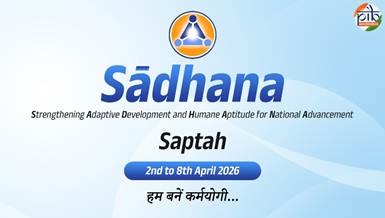
Sādhana Saptah 2026 initiative represents a significant step towards building a future ready civil services system in India. 

About Sādhana Saptah Initiative

  • It is an initiative under Mission Karmayogi, also known as the National Programme for Civil Services Capacity Building
  • The Strengthening Adaptive Development and Humane Aptitude for National Advancement (Sādhana) Saptah aims to foster skills necessary for citizen centric governance. 
  • It is organised by the Department of Personnel and Training, Capacity Building Commission and Karmayogi Bharat.
  • The initiative brings together Central Ministries, States and Union Territories, and training institutions on a common platform to promote responsive and citizen centric governance. 
  • It is structured around three Sutras: Technology, Tradition and Tangible Outcomes, with a focus on building skills required for achieving the vision of Viksit Bharat 2047.
  • It provides multiple learning opportunities through curated courses on the iGOT Karmayogi platform, Samuhik Charcha sessions, thematic webinars and hands-on workshops conducted by training institutions.
  • These activities focus on competencies such as leadership, communication, data analysis, project management and digital governance.

Source: PIB

Sādhana Saptah FAQs

Q1: What are the 'Three Sutras' of Sādhana Saptah 2026?

Ans: Technology, Tradition, and Tangible Outcomes

Q2: What is the primary objective of Sādhana Saptah 2026?

Ans: To strengthen governance capability across Ministries and States

Yuva Sangam

Yuva Sangam

Yuva Sangam Latest News

Recently, registrations for institution-led exposure tours across paired regions under Yuva Sangam Phase-VI were held.

About Yuva Sangam

  • Yuva Sangam is a youth exchange programme that brings young people from different parts of the country together.
  • Focus: It is designed for those aged 18–30 years, including students, National Service Scheme and Nehru Yuva Kendra Sangathan volunteers, and young professionals.
  • It is anchored by the Ministry of Education and implemented through Higher Education Institutions.
  • It creates a structured platform for youth engagement across regions.
  • It was launched under the Government of India’s Ek Bharat Shreshtha Bharat (EBSB) initiative.
  • It supports the experiential learning approach of the National Education Policy 2020, where learning extends beyond classrooms into real-world contexts.
  • The programme is structured around the five thematic pillars — the 5 Ps: 
    • Paryatan (Tourism), Parampara (Traditions & Culture), Pragati (Development & Governance), Paraspar Sampark (People-to-People Connect), and Prodyogiki (Technology & Innovation)

Source: PIB

Yuva Sangam FAQs

Q1: What is the aim of Yuva Sangam?

Ans: It aims to build deeper emotional bonds among young citizens across the country .

Q2: Which ministry launched Yuva Sangam?

Ans: Ministry of Education

Jiyo Parsi Scheme

Jiyo Parsi Scheme

Jiyo Parsi Scheme Latest News

The Universal Parsi Registration Drive special facilitation camp, organised by the Ministry of Minority Affairs and around 300 fresh registrations were completed on the Jiyo Parsi portal of  Jiyo Parsi Scheme.

About Jiyo Parsi Scheme

  • Jiyo Parsi is a flagship Central Sector Scheme of the Government of India aimed at arresting the declining population of the Parsi community.
  • It was launched in 2013-14 and seeks to stabilise and increase the Parsi population through structured interventions and scientific support.
  • The scheme provides:
    • Medical Assistance for fertility treatment and pregnancy-related care
    • Health of Community support including financial assistance for childcare and care of dependent elderly
    • Advocacy initiatives such as counselling, awareness campaigns, and outreach programmes
  • The Scheme will be implemented through the State Governments with the assistance of respective Parsi Institutions. 
  • Eligible Parsi couples would be provided financial assistance under the various components of the schemes through Direct Benefit Transfer (DBT) mode.
  • The State Governments would get the necessary verification, including biometric authentication of all beneficiaries done.
  • Nodal Ministry: Ministry of Minority Affairs

Source: PIB

Jiyo Parsi Scheme FAQs

Q1: Which ministry launched Jiyo Parsi Scheme?

Ans: Ministry of Minority Affairs

Q2: What is the primary objective of Jiyo Parsi Scheme?

Ans: To reverse the declining trend of Parsi population

Project Chetak

Project Chetak

Project Chetak Latest News

Recently, 47th Raising Day of Project Chetak was celebrated at Bikaner, Rajasthan by the Border Roads Organisation (BRO). 

About Project Chetak

  • It was raised in 1980 in the strategically important western sector of India.
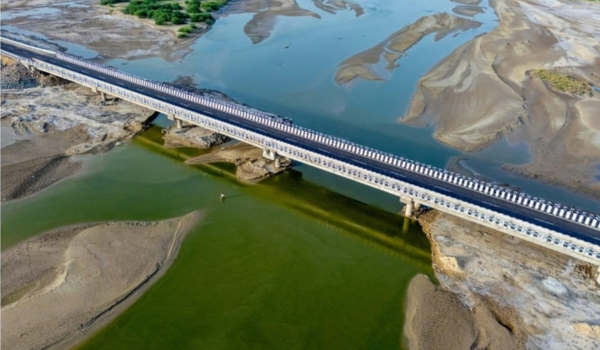
  • It has played a vital role in developing and maintaining infrastructure in Rajasthan, Punjab, and the northern parts of Gujarat.
  • The project has played a vital role in connecting border areas and contributing to national security and regional development, it said.​
  • It is one of the largest BRO projects in terms of geographical area, covering more than 4,000 km of road network and 214 km of ditch-cum-bund.​
  • It supports the defence forces by maintaining key feeder roads towards the International Border with continuous efforts underway to upgrade them to National Highway Double Lane specifications, said the statement.​
  • Motto: ‘Chetak ka Prayas, Desh ka Vikas’

Key Facts about Border Roads Organisation

  • It is a road construction executive force in India that provides support to the Indian Armed Forces.
  • BRO was entirely brought under the Ministry of Defence in 2015.
  • Establishment: It was formed on 7 May 1960 to secure India’s borders and develop infrastructure in remote areas of the north and northeastern states of the country.
  • It develops and maintains road networks in India’s border areas and friendly neighboring countries.
  • BRO specialises in constructing and maintaining Roads, Bridges, Tunnels, Airfields and Marine Works across some of the world’s most challenging terrains.
  • Motto: Shramena Sarvam Sadhyam (everything is achievable through hard work).

Source: PIB

Project Chetak FAQs

Q1: What is Project Chetak?

Ans: It was raised in 1980 in the strategically important western sector of India.

Q2: What is Border Roads Organisation?

Ans: It is a road construction executive force in India that provides support to the Indian Armed Forces.

Barnawapara Wildlife Sanctuary

Barnawapara Wildlife Sanctuary

Barnawapara Wildlife Sanctuary Latest News

Recently, Blackbucks were reintroduced into their natural habitat at Rampur grassland in Barnawapara Wildlife Sanctuary.

About Barnawapara Wildlife Sanctuary

  • Location: It is located in the northern part of the Mahasamund district of Chhattisgarh.
  • It is named after the Bar and Nawapara forest villages, which are in the heart of the sanctuary. 
  • It is spread over an area of 245 sq. km.
  • The tributaries of Mahanadi are the source of water. The River Balamdehi forms the western boundary, and the Jonk River forms the northeastern boundary of the sanctuary. 
  • Vegetation: It mainly consists of tropical dry deciduous forest.
  • Flora: The flora chiefly comprises Teak, Sal, Bamboo and Terminalia being the prominent trees. 
    • Other major plants found in the sanctuary include Semal, Mahua, Ber, and Tendu.
  • Fauna: It is home to neelgai, wild boar, tigers, leopards, Indian bison, porcupines, pythons, antelopes, sambhar and cheetal, along with 150 species of birds, including parrots, blackbucks, herons, egrets, peafowl, etc.

Source: TOI

Barnawapara Wildlife Sanctuary FAQs

Q1: Where is Barnawapara Wildlife Sanctuary located?

Ans: Chhattisgarh

Q2: What type of forest is Barnawapara Wildlife Sanctuary?

Ans: Tropical deciduous forest

FAO Food Price Index

FAO Food Price Index

FAO Food Price Index Latest News

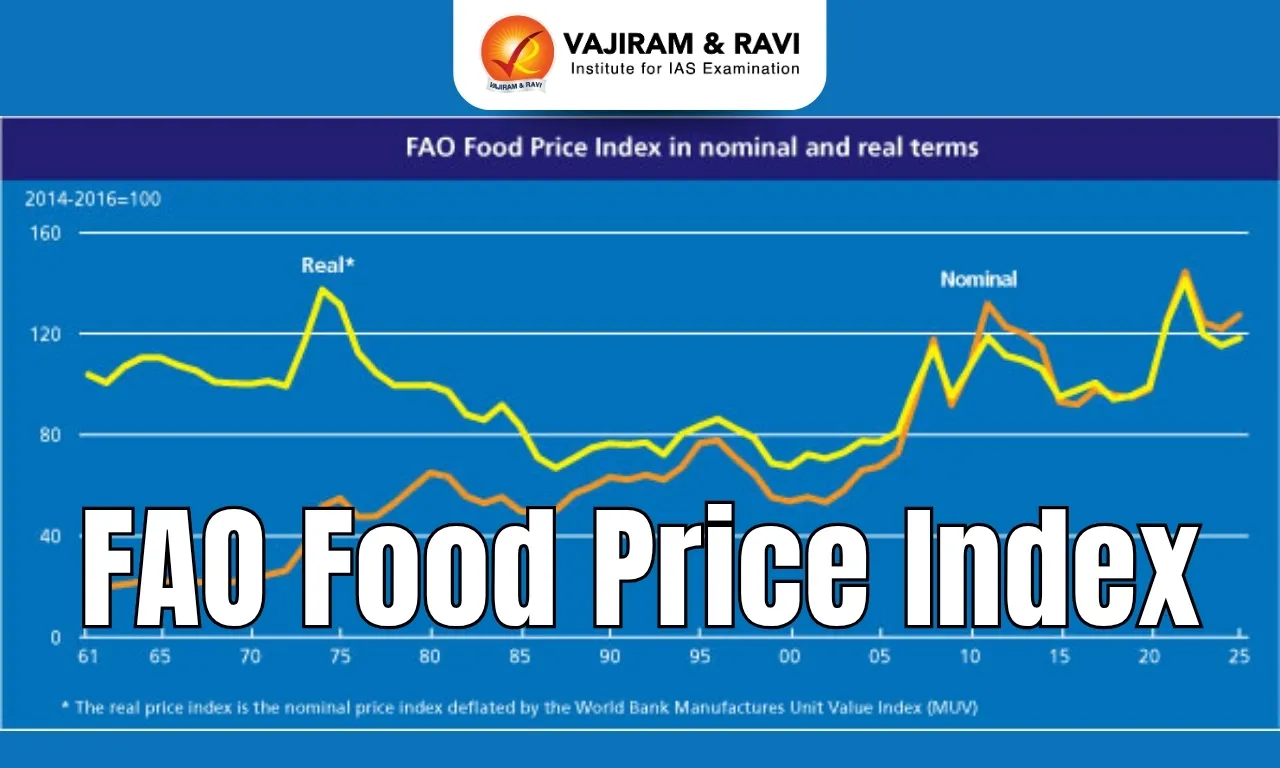
Food and Agriculture Organization (FAO) Food Price Index rose in March 2026, largely due to higher energy costs linked to the escalating conflict in the Middle East

About FAO Food Price Index

  • It is a measure of the monthly change in international prices of a basket of food commodities. 
  • It consists of the average of five commodity group price indices (cereal, vegetable, dairy, meat and sugar), weighted with the average export shares.
  • Base year: 2014-16.

What is the Food and Agriculture Organization?

  • It is a specialized agency of the United Nations that leads international efforts to defeat hunger and improve nutrition and food security.
  • Its goal is to achieve food security for all and make sure that people have regular access to enough high-quality food to lead active, healthy lives.
  • Members: It consists of 195 members – 194 countries and the European Union, FAO works in over 130 countries worldwide.
  • Its sister bodies are the World Food Programme (WFP) and the International Fund for Agricultural Development (IFAD).
  • Reports published by the FAO: The State of the World’s Forests (SOFO), The State of World Fisheries and Aquaculture (SOFIA), The State of Agricultural Commodity Markets (SOCO), The State of Food Security and Nutrition in the World (SOFI).
  • Headquarter: Rome (Italy)

Source: DD News

FAO Food Price Index FAQs

Q1: What is the FAO Food Price Index?

Ans: A measure of monthly change in international food prices

Q2: What is the base period for calculating the FAO Food Price Index?

Ans: 2014-16

Coal Gasification Incentive Scheme

Coal Gasification Incentive Scheme

Coal Gasification Incentive Scheme Latest News

Recently, the Union Minister unveiled India’s roadmap to reduce dependency on imported petroleum, ammonia, and fertilizers, highlighting the ₹8,500 crore coal gasification incentive scheme.

About Coal Gasification Incentive Scheme

  • It was approved on January 24, 2024, for promotion of coal and lignite gasification projects for PSUs and private sector with an outlay of ₹ 8,500 crore.
  • It aims to achieve 100 million tonnes of coal gasification by 2030, leveraging India’s abundant domestic coal reserves to promote sustainable industrial development.
  • It encourages participation from both public and private sector players to establish coal gasification projects across the country.
  • This initiative is a key component of India’s clean coal transition strategy.
  • Significance: It is expected to reduce environmental impact, enhance energy security, and drive economic growth through technological innovation and infrastructure development.
  • Category of Projects
    • Category I: PSU-led projects
    • Category II: Private and PSU projects
    • Category III: Demonstration and small-scale projects

What is Coal Gasification?

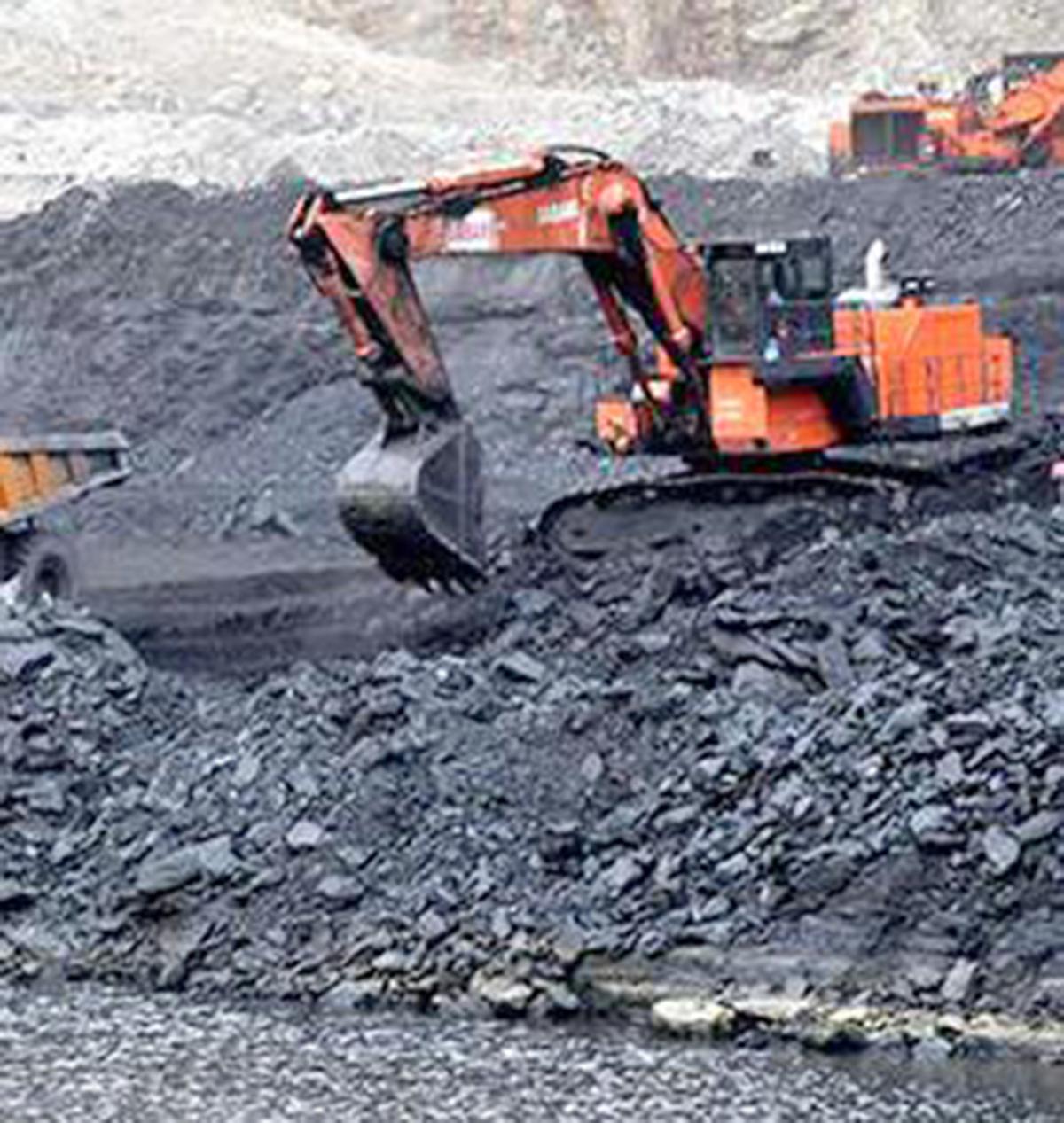
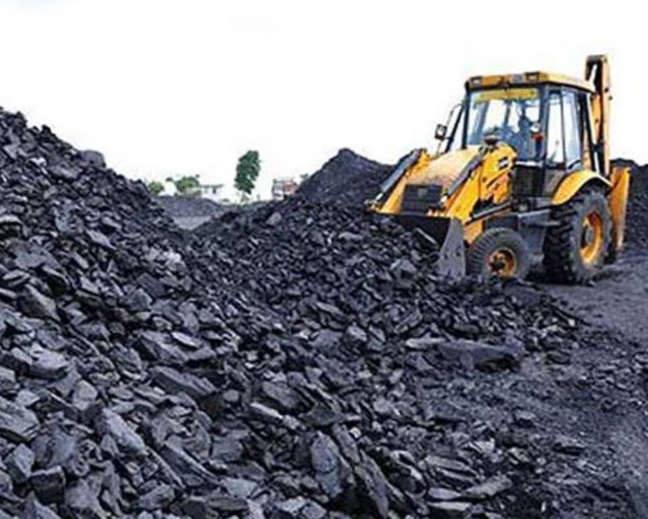
  • It is a thermo-chemical process that converts coal into syngas,
  • A synthetic gas composed mainly of carbon monoxide (CO), hydrogen (H₂), carbon dioxide (CO₂), methane (CH₄), and water vapour (H₂O).
  • Coal is reacted at high temperatures (1000–1400°C) with a controlled amount of oxygen and steam, producing syngas.
  • Process of Coal Gasification
    • Preparation: Coal is finely crushed to increase surface area.
    • Gasification reactor: The powdered coal is fed into a reactor with limited oxygen/air and steam.
    • Chemical reactions: Coal breaks down into syngas components due to partial oxidation.
    • Gas cleaning: Impurities like tar, sulfur, and dust are removed from raw syngas.

Source: ET

Coal Gasification Incentive Scheme FAQs

Q1: What is the target for coal gasification by 2030 under this scheme?

Ans: 100 million tonnes

Q2: What is the primary objective of the Coal Gasification Incentive Scheme?

Ans: To reduce dependence on imported petroleum and fertilizers

Appemidi Mango

Appemidi Mango

Appemidi Mango Latest News

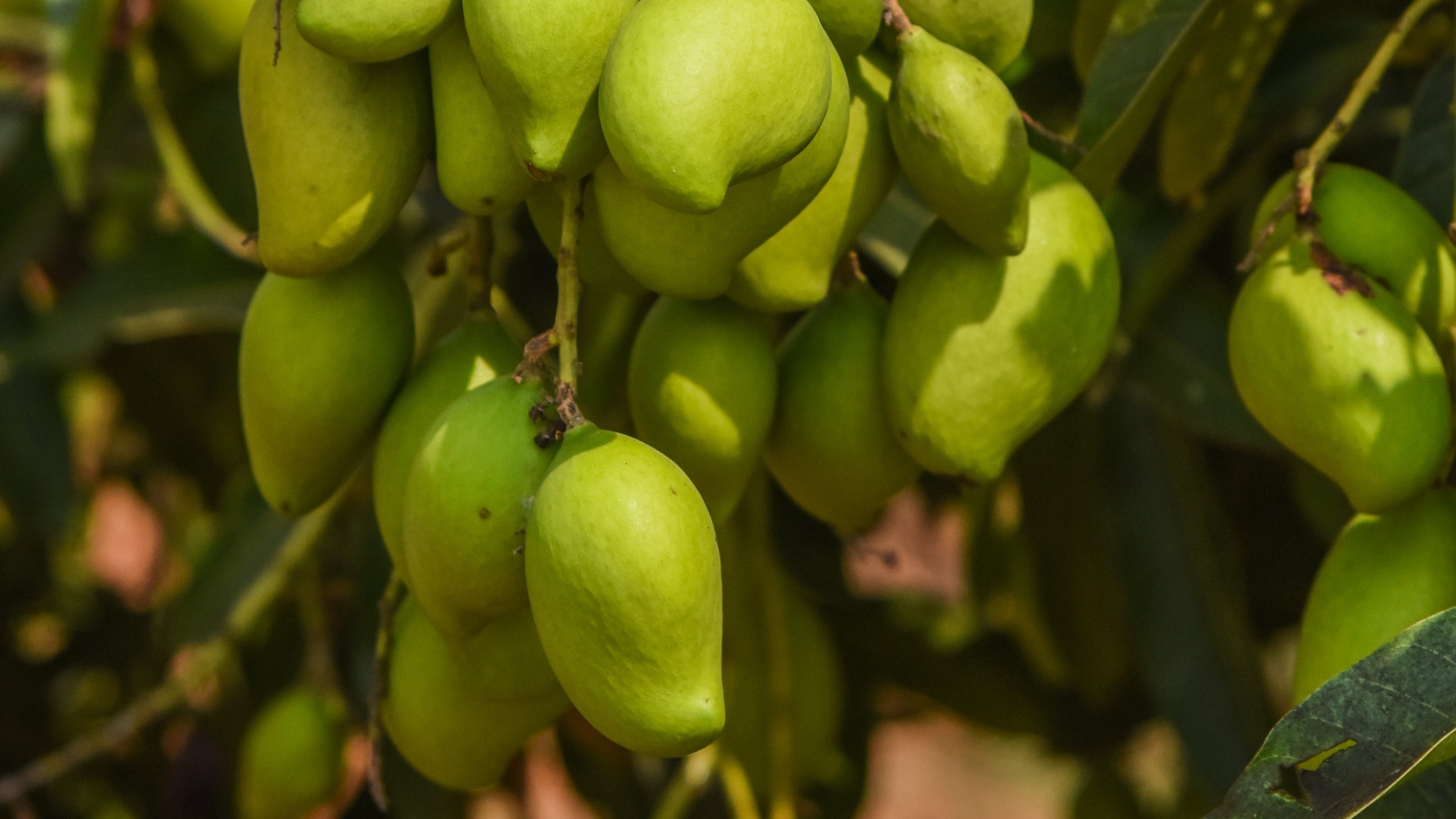
Appemidi mango  (tender mango in Kannada) is facing the threat of climate change and experts are stressing the need for in-situ conservation of the natural trees in the Aghanashini valley of Karnataka.

About Appemidi Mango

  • It is found exclusively in the Uttara Kannada and Shivamogga districts of Karnataka.
  • It is small and tender; it is regarded as the king among raw mango varieties.
  • It is highly sought after by the South Asian pickle industry.
  • These mangoes are pulpy, known for their distinctive aroma and long long shelf life.
  • It has received GI (geographical indication) tag in 2009 in recognition of its culinary and cultural heritage,
  • Uses: It is a traditional pickling variety of mango from Karnataka.

Key Facts about Geographical Indication (GI) Tag

  • It is a sign used on products that have a specific geographical origin and possess qualities or a reputation that are due to that origin.
  • This is typically used for agricultural products, foodstuffs, wine and spirit drinks, handicrafts and industrial products.
  • The Geographical Indications of Goods (Registration and Protection) Act, 1999 seeks to provide for the registration and better protection of geographical indications relating to goods in India.
  • GI tag is valid for 10 years following which it can be renewed.

Source: DH

Appemidi Mango FAQs

Q1: Where is Appemidi Mango primarily grown?

Ans: Karnataka

Q2: What is Appemidi Mango known for?

Ans: Its unique sour taste and use in culinary preparations

Bengal Florican

Bengal Florican

Bengal Florican Latest News

Fewer than 1,000 Bengal floricans remain worldwide, with small, fragmented populations restricted to remnant alluvial grasslands. 

About Bengal Florican

  • It is a grassland indicator species.
  • Habitat: It is a bustard mostly found in the seasonally inundated alluvial grasslands of the Gangetic-Brahmaputra plains.
  • Distribution: It is distributed in the states of Uttar Pradesh, Assam and Arunachal Pradesh in India, in the terai of Nepal and in Bangladesh.
    • Key strongholds in India are Dudhwa National Park in Uttar Pradesh and several sites across Assam—Manas, Kaziranga, Orang, and Dibru-Saikhowa National Parks.
  • The male bird shows black plumage, with a crest and elongated display feathers that are raised during courtship, and white wing patches become visible in flight.
  • It makes vertical leaps, wing movements and vocalisations along with other males, a behaviour known as “lekking”, to establish territories and attract females.
  • It shows reverse sexual dimorphism and colour dichromatism (male and female are differently coloured).
  • Diet: They are omnivorous birds. They eat various insects, fruits, seeds, and flowers and also feed on small snakes and lizards.
  • Threats: Land conversion, expansion of agriculture, annual grassland burning, overgrazing, encroachment, change of river course, fragmentation from infrastructure development, invasive plant species and fire mismanagement have altered their habitat.
  • Conservation Status
    • IUCN: Critically Endangered
    • Wild Life Protection Act 1972: Schedule I 

Source: DTE

Bengal Florican FAQs

Q1: What is unique about male Bengal Floricans?

Ans: Their elaborate courtship displayWhich conservation effort is crucial for Ben

Q2: Where is Bengal Florican primarily found?

Ans: Grasslands of India and Nepal

FCRA Bill Concerns: Why FCRA Bill Concerns Over NGO Control and Government Powers Are Rising

FCRA Bill - Key Concerns and Criticism Explained

FCRA Bill Concerns Latest News

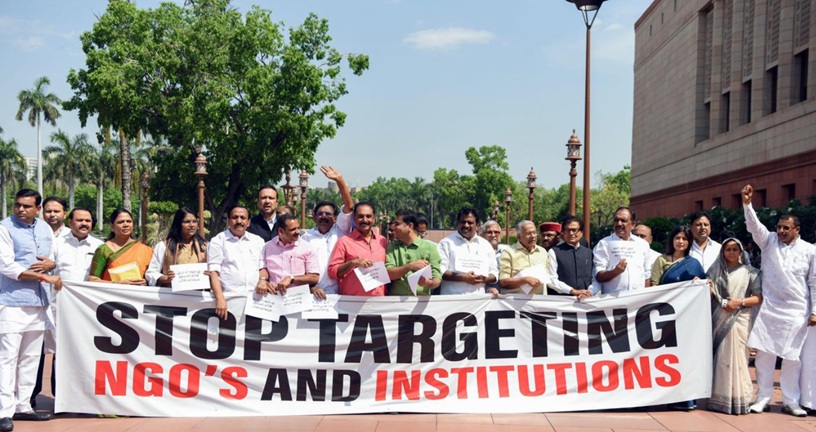
  • The Union government introduced the Foreign Contribution (Regulation) Amendment Bill, 2026 in the Lok Sabha to amend the existing FCRA, 2010, which regulates foreign funding received by NGOs and associations. 
  • However, due to strong Opposition protests, discussion and passage of the Bill were deferred during the Budget Session.
  • The Act requires organisations to obtain registration to receive foreign funds, aiming to ensure that such contributions do not harm national interest, public order, or national security. 
  • Currently, around 16,000 registered associations receive nearly ₹22,000 crore annually under the FCRA framework.

Key Changes Proposed in the FCRA Amendment Bill, 2026

  • The Bill introduces significant changes aimed at strengthening regulation, oversight, and accountability in the use of foreign funds by NGOs and associations.

Creation of a ‘Designated Authority’

  • A major provision is the establishment of a designated authority with powers similar to a civil court. 
  • This authority will:
    • Take over, manage, or dispose of assets created from foreign funds 
    • Act in cases where an NGO’s FCRA registration is suspended, cancelled, or not renewed 
    • Transfer or sell assets to the government or other entities 
  • This addresses a gap in the 2010 Act, which lacked a clear statutory framework for handling such assets, leading to administrative uncertainty and potential misuse.

Expanded Definition of ‘Key Functionary’

  • The Bill also widens the scope of accountability by expanding the definition of a ‘key functionary’. 
  • It now includes: Trustees; Partners; Karta of a Hindu Undivided Family (HUF); Members of governing bodies;  Any person involved in controlling or managing the organization.
  • These individuals will be held liable for FCRA violations, unless they can prove lack of knowledge or that they exercised due diligence.

Additional Changes Proposed in the FCRA Amendment Bill, 2026

  • The Bill introduces several procedural and legal changes aimed at tightening control over foreign funding and improving regulatory clarity.
  • Centralised Approval for Investigations - The amendment to Section 43 requires that any law enforcement agency or State government must obtain prior approval from the Central government before initiating investigations into FCRA-related cases. This centralises oversight of enforcement actions.
  • Timelines for Fund Utilisation and Permissions - The Bill introduces fixed timelines for the receipt and utilisation of foreign contributions under the ‘prior permission’ category (one-time approvals). This replaces the earlier open-ended framework, bringing greater clarity and accountability.
  • Automatic Expiry of Registration - It provides for the automatic cessation of FCRA certificates if: The registration expires; Renewal is not obtained. This ensures stricter compliance with renewal requirements.
  • Reduced Penal Provisions - The Bill proposes to reduce the maximum punishment for FCRA violations from five years to one year of imprisonment, signalling a shift towards relatively lighter penalties.

Regulation of Foreign Donations by MHA under FCRA

  • MHA regulates foreign donations in India through the FCRA to ensure that such funds do not threaten internal security, public order, or national interest.
  • Originally enacted in 1976, the law was replaced by a new framework in 2010 and has since been amended in 2016, 2018, and 2020 to strengthen oversight.
  • Under the FCRA, NGOs must obtain registration valid for five years, after which renewal is mandatory. 
  • Since 2015, the government has cancelled over 18,000 NGO registrations, reflecting stricter enforcement. 
    • As of April 3, around 14,965 NGOs remain registered under the Act.
  • Registered organisations are allowed to receive foreign funds for activities related to social, educational, religious, economic, and cultural purposes, subject to regulatory compliance.

Opposition to the FCRA Amendment Bill, 2026

  • Experts raised concerns over undue government interference in NGOs and minority institutions, especially provisions allowing cancellation of licences and takeover of assets, funds, and properties.
  • Chief Ministers of Tamil Nadu and Kerala have also opposed the Bill, fearing it could be misused against minority institutions, including churches.

Source: TH | PRS

FCRA Bill Concerns FAQs

Q1: What is the FCRA Bill 2026?

Ans: The FCRA Bill 2026 proposes amendments to regulate foreign funding of NGOs, aiming to strengthen oversight and ensure national security and public interest are protected.

Q2: What are the main FCRA Bill concerns?

Ans: Key concerns include government powers to control NGO assets, cancel licences, and increased oversight, raising fears of excessive state interference in civil society organisations.

Q3: What is the designated authority?

Ans: The designated authority is a proposed body with powers to manage, transfer, or dispose of NGO assets when FCRA registration is suspended or cancelled.

Q4: Why are states opposing the Bill?

Ans: Some states fear the Bill could be misused against minority institutions, especially religious organisations, and may lead to centralisation of power over NGOs.

Q5: What is the current status of the Bill?

Ans: The Bill has been introduced in Parliament but its discussion and passage were deferred due to Opposition protests and ongoing political concerns.

Coal Push Solar Curtailment: How Coal Push Solar Curtailment Impacts India’s Power Sector

Coal push solar curtailment

 Latest News

  • As India prepares for a hotter-than-nor

    Coal Push Solar Curtailment

    mal summer with more heatwave days, concerns have emerged over the government’s plan to rely more on coal-based power amid gas shortages caused by the West Asia conflict. 
  • This raises issues like solar curtailment and grid management.

Power Demand and Preparedness

  • The government has stated that India’s power system is adequately prepared to meet peak summer demand. 
  • However, gas supply disruptions have created challenges, especially during periods of high electricity consumption.

Role of Gas-Based Power

  • Although gas-based power contributes a small share to India’s energy mix, it plays a critical balancing role, especially:
    • During non-solar hours (evenings and nights) 
    • When demand is high in summer 
  • Around 10 GW of gas-based capacity is typically used during peak demand periods.

Shift Towards Coal and Alternatives

  • To compensate for reduced gas availability, the government plans to rely on:
    • Coal-based power generation 
    • Renewable energy sources 
    • Energy storage systems 
  • This shift ensures immediate supply but comes with long-term trade-offs.
  • Gas-based power plants are more flexible and responsive:
    • They can ramp up or down quickly 
    • Help balance fluctuations in renewable energy 
    • Ensure grid stability during evening peaks, when solar power is unavailable 
  • Thus, reduced gas usage affects efficient integration of renewables.

Concern: Solar Curtailment

  • A key concern is the curtailment of solar energy (i.e., reducing or stopping solar power generation despite availability).
    • Coal plants are inflexible: They cannot quickly adjust output. 
    • This leads to situations where solar power is reduced to accommodate coal-based generation. 
  • This undermines renewable energy utilisation.

Greater Reliance on Coal-Based Power

  • India’s electricity generation is heavily dependent on coal, contributing over 70%, while gas-based power accounts for only 1–2%. 
  • Despite being costlier than coal and renewables, gas-based plants are crucial during peak demand periods, especially in summer evenings, due to their flexibility.
  • The West Asia conflict has disrupted gas supplies, forcing the government to prioritise limited gas availability for essential sectors. 
  • This has reduced the availability of gas for power generation, increasing dependence on coal-based plants.

Government Measures to Bridge the Gap

  • To meet rising summer demand, the government has initiated several steps:
    • Directed Tata Power’s 4 GW imported coal plant in Gujarat to resume full operations from April 1 after being idle for six months. 
    • Asked thermal power plants to defer maintenance to maximise electricity generation. 
    • Ensured that all generating companies maintain full capacity utilisation, except during unavoidable outages. 
  • These steps are expected to make around 10,000 MW of additional capacity available between April and June 2026.
  • The government is also closely tracking thermal and hydro projects scheduled for commissioning by June 2026 to ensure timely addition of capacity during peak demand.

Role of Hydro and Renewable Energy

  • Hydropower is being carefully scheduled to conserve water for peak demand periods. 
  • Renewable energy expansion is being accelerated, with faster clearances for: 
    • Wind power projects 
    • Battery Energy Storage Systems (BESS)
  • India is prioritising energy security through coal-based generation amid gas shortages, while simultaneously pushing renewables and storage solutions. 
  • The challenge lies in balancing short-term demand with long-term clean energy goals.

Renewable Energy Curtailment: Emerging Concern

  • A higher dependence on coal-based power plants may lead to increased renewable energy (RE) curtailment, especially solar. 
  • This is mainly due to the operational inflexibility of coal plants, which cannot easily reduce output when renewable generation rises.

What is Curtailment and Why It Happens

  • Curtailment refers to the reduction or shutdown of renewable power generation despite availability. 
  • It occurs to maintain grid stability and safety, particularly when:
    • Power supply exceeds demand 
    • The grid faces frequency issues or congestion 
  • Between May and November last year, India curtailed about 23 GW of renewable energy, highlighting the scale of the issue.
  • A major reason behind curtailment is the Minimum Technical Load (MTL) of coal plants.
    • MTL is the lowest level at which a thermal plant can operate safely (currently around 55% capacity). 
    • Coal plants often cannot reduce output below this level, even when solar generation is high during the day. 
  • Experts suggest lowering MTL (possibly to 40%) to better accommodate renewable energy.

Changing Power Generation Pattern

  • Earlier:
    • Solar met daytime demand. 
    • Gas-based plants handled evening peaks.
  • Now:
    • Greater reliance on coal means coal plants remain operational even during daytime.
    • This forces cheaper solar power to be curtailed, despite availability.

Grid Constraints and Regional Challenges

  • Curtailment is also driven by:
    • Transmission congestion, especially in high-renewable states like Rajasthan and Gujarat 
    • Low power demand in certain states (underdrawal) 
    • Limited ability to transfer surplus renewable power across regions 
  • These constraints make it difficult to fully utilise renewable energy.

Operational and Economic Factors

  • Coal plants are preferred for reliability, especially for evening peak demand. 
  • Increasing flexibility in coal plants requires technical adjustments and higher costs, though compensation mechanisms exist. 
  • For utilities, it is often easier to keep coal plants running at minimum load and curtail renewables rather than frequently ramping generation.

Structural Challenge: Lack of System Flexibility

  • Curtailment is not just about renewable availability but about system-wide flexibility, including:
    • Energy storage (BESS) 
    • Flexible demand management 
    • Balancing resources 
  • Without these, integrating large-scale renewables becomes difficult.

Source: IE

Coal Push Solar Curtailment FAQs

Q1: What is solar curtailment?

Ans: Solar curtailment refers to reducing or stopping solar power generation despite availability, usually to maintain grid stability or due to limitations in system flexibility and transmission capacity.

Q2: Why is coal push causing solar curtailment?

Ans: Coal plants are inflexible and cannot reduce output easily, so increased coal use forces grid operators to curtail cheaper solar power during periods of high renewable generation.

Q3: What role does gas-based power play?

Ans: Gas-based plants are flexible and help balance renewable energy by ramping output during peak demand, especially in evenings when solar generation is unavailable.

Q4: What is Minimum Technical Load (MTL)?

Ans: MTL is the lowest level at which a coal plant can operate safely, typically around 55%, limiting its ability to reduce output and accommodate renewable energy.

Q5: What is the long-term challenge?

Ans: The key challenge is balancing energy security with renewable integration, requiring investments in storage, grid flexibility, and transmission infrastructure to reduce curtailment.

Three-Language Formula – The Centre-State Faultline

Three-Language Formula - The Centre-State Faultline

Three-Language Formula Latest News

  • A sharp political exchange between the Chief Minister of Tamil Nadu and the Union Minister of Education brought the debate over language policy and the implementation of the National Education Policy (NEP) 2020 into focus. 
  • The controversy revolves around the three-language formula, raising questions of linguistic diversity, federalism, and educational equity during an election season.

The Three-Language Formula

  • About: It is an educational policy in India, first introduced in 1968 and reinforced by NEP 2020, requiring students to learn three languages: English, Hindi (or another Indian language in non-Hindi states), and the regional/mother tongue. 
  • Objective: It promotes - 
    • National integration: Encourages understanding and communication across linguistic borders.
    • Linguistic/ cultural diversity: Promotes the study of both regional languages and the English language for global connection.
    • Multilingualism: Fosters the development of multiple language skills from a young age. 
  • Key components and implementation:
    • Structure: Students learn three languages up to Class 10, often with a regional language, English, and a third language (often Hindi in non-Hindi states or another Indian language in Hindi states).
    • NEP 2020 integration: The policy encourages flexibility, emphasizing that no language is imposed on any state.
    • CBSE adoption: Starting in the 2026-27 academic session, CBSE is implementing a mandatory third language from Class 6, focusing on studying at least two Indian languages. 

Core Issue - Language Policy vs Federal Autonomy

  • Tamil Nadu’s concerns - Linguistic imposition:
    • The State government views the new curriculum framework as a centralising measure privileging Hindi, and a threat to India’s linguistic diversity.
    • The three-language formula is seen as a covert mechanism for Hindi expansion in non-Hindi regions.
    • Key criticisms:
        • Lack of reciprocity: No mandate for Hindi-speaking states to learn southern or other Indian languages.
        • Administrative gaps: Shortage of teachers and unclear funding.
        • Equity concerns: Policy perceived as one-sided and discriminatory.
        • Broader framing: Issue linked to federalism, fairness, and constitutional rights.
  • Centre’s position - Multilingual empowerment:
    • The Union government rejects allegations of imposition, arguing that policy promotes mother tongue-based education, and multilingualism enhances cognitive and global competencies.
    • The policy is described as a flexible framework, not compulsory Hindi imposition, and a step toward “linguistic liberation”.
    • Funding support through Samagra Shiksha Scheme, and accusation that Tamil Nadu is blocking initiatives like the PM SHRI Schools, and the Navodaya Vidyalayas.

Key Points of Contention

  • Three-language formula: Debate over flexibility vs hidden compulsion, and uniform implementation across states.
  • Fiscal federalism
    • Allegation by Tamil Nadu that the centre is using funds as a tool of coercion. For example, withholding about ₹2,200 crore under Samagra Shiksha.
    • Raises issue of conditional transfers vs state autonomy.
  • Implementation gaps: Questions raised are availability of qualified language teachers, infrastructure and funding clarity, and actual implementation in Hindi-speaking states.
  • Institutional bias: Concerns over the limited teaching of southern languages in central institutions (e.g., Kendriya Vidyalayas), and unequal promotion of classical languages.

Underlying Themes

  • Federalism vs centralisation: Debate reflects tension between cooperative federalism, and centralising tendencies of the Union.
  • Linguistic identity and politics: Language seen as a marker of cultural identity, and a tool of political mobilisation.
  • Education as a concurrent subject: Highlights friction in policy design (Centre) vs implementation (States).

Challenges and Way Forward

  • Trust deficit: Between Centre and States. Strengthening cooperative federalism - institutional dialogue via the Inter-State Council, and the GST Council-like consultative mechanisms in education.
  • Lack of transparent implementation data: Publish State-wise data on language implementation, teacher recruitment and fund allocation.
  • Politicisation of education policy: Fiscal neutrality - decouple education funding from political compliance. Ensure predictable and rule-based transfers.
  • Inadequate teacher capacity and institutional readiness: Ensuring policy flexibility - genuine state-specific adaptations in language policy, and avoiding one-size-fits-all frameworks.
  • Risk of homogenisation vs preservation of diversity: Promoting true multilingualism - encouraging reciprocal language learning, and expansion of non-Hindi languages in northern states.

Conclusion

  • The controversy goes beyond language—it reflects a deeper contest over the nature of Indian federalism and cultural pluralism. 
  • While the Centre emphasises national integration through multilingualism, states like Tamil Nadu stress autonomy and linguistic identity. 
  • A balanced approach—grounded in dialogue, flexibility, and mutual respect—is essential to ensure that education policy strengthens, rather than strains, India’s unity in diversity.

Source: IE

Three-Language Formula FAQs

Q1: What are the key concerns raised by states regarding the three-language formula?

Ans: States fear linguistic imposition, lack of reciprocity, and erosion of federal autonomy under a seemingly flexible three-language framework.

Q2: How the language policy debate reflects tensions in Indian federalism?

Ans: The debate highlights conflicts between centralising tendencies of the Union and states’ demand for autonomy over education and cultural identity.

Q3: What is the role of fiscal federalism in the implementation of education policies in India?

Ans: Conditional funding mechanisms risk undermining state autonomy and can be perceived as tools of coercion in policy implementation.

Q4: What are the challenges in implementing multilingual education in India?

Ans: Key challenges include shortage of trained teachers, uneven implementation, politicisation, and lack of institutional capacity.

Q5: Why is language policy in India as much about identity as it is about education?

Ans: Language policy intertwines cultural identity, political mobilisation, and educational objectives, making it a sensitive and contested domain.

Amaravati as Andhra Pradesh Capital – 2026 Amendment Bill Key Provisions

Amaravati as Andhra Pradesh Capital - 2026 Amendment Bill Key Provisions

Andhra Pradesh Capital Latest News

  • Parliament has passed the Andhra Pradesh Reorganisation (Amendment) Bill, 2026, recognising Amaravati as the sole capital of Andhra Pradesh. 

Background of Andhra Pradesh Reorganisation

  • The state of Andhra Pradesh was bifurcated in 2014 through the Andhra Pradesh Reorganisation Act, 2014, leading to the creation of Telangana and residual Andhra Pradesh.
  • As per the Act, Hyderabad was designated as the joint capital for both states for a period of up to 10 years. 
  • After this transition period ended in June 2024, Hyderabad became the exclusive capital of Telangana, requiring Andhra Pradesh to establish its own capital. 
  • Following bifurcation, the Andhra Pradesh government under N. Chandrababu Naidu identified Amaravati as the new capital and began developing it as a greenfield capital city.

Evolution of Capital Debate in Andhra Pradesh

  • The capital issue in Andhra Pradesh has been politically contested.
  • After coming to power in 2019, the YSR Congress Party proposed a three-capital model with Visakhapatnam as the executive capital, Amaravati as the legislative capital, and Kurnool as the judicial capital. 
  • However, in 2022, the Andhra Pradesh High Court ruled that the capital could not be shifted from Amaravati, citing a lack of legislative competence to reverse earlier policy decisions. 
  • Subsequently, with the return of the National Democratic Alliance government, the state reaffirmed its commitment to Amaravati as the sole capital.

Key Features of the Amendment Bill

  • The Andhra Pradesh Reorganisation (Amendment) Bill, 2026, introduces specific legal provisions to resolve the capital issue.
  • The Bill amends Section 5 of the Andhra Pradesh Reorganisation Act, 2014.
    It explicitly recognises Amaravati as the sole and permanent capital of Andhra Pradesh.
  • It inserts the phrase “at Amaravati” to formally designate the capital location.
    It also clarifies that Amaravati includes areas notified under the Andhra Pradesh Capital Region Development Authority Act, 2014. 
  • Importantly, the Bill gives retrospective effect from June 2, 2024, the date when Hyderabad ceased to be the joint capital.

Rationale Behind the Amendment

  • The amendment was considered necessary to remove ambiguity regarding the capital of Andhra Pradesh.
  • Since the original 2014 Act governs the creation and structure of the state, any change in capital status requires modification of this central legislation.
  • The state government argued that statutory recognition would ensure policy stability and prevent future governments from altering the capital location arbitrarily. 
  • Thus, the amendment aims to provide long-term certainty in governance and infrastructure planning.

Political and Legal Dimensions

  • The passage of the Bill saw broad political consensus in Parliament, with most parties supporting it.
  • However, the YSR Congress Party opposed the Bill in its current form. It raised concerns regarding unresolved issues related to the Land Pooling Scheme, under which farmers had contributed land for capital development. 
  • The party demanded clear timelines and safeguards for compensating farmers and ensuring their interests are protected.
  • The legal dimension of the issue is also significant, as earlier disputes had reached the Supreme Court. The withdrawal of pending litigation aligns with the current policy direction.

Implications of Declaring Amaravati as the Sole Capital

  • The decision has multiple governance and economic implications.
    • Administrative Clarity. It resolves long-standing uncertainty regarding the capital location. 
    • Investor Confidence. Clear policy direction is likely to boost infrastructure investment in Amaravati. 
    • Urban Development. Focused development of a single capital can enhance efficiency in planning and execution. 
    • Political Stability. It reduces the scope for future policy reversals on the capital issue. 
  • At the same time, concerns regarding regional balance and equitable development across the state remain relevant.

Source: TH

Andhra Pradesh Capital FAQs

Q1: What does the 2026 Amendment Bill declare?

Ans: It declares Amaravati as the sole and permanent capital of Andhra Pradesh.

Q2: Why was the Andhra Pradesh Reorganisation Act amended?

Ans: To provide statutory clarity and prevent future changes to the capital location.

Q3: When did Hyderabad cease to be the joint capital?

Ans: On June 2, 2024.

Q4: What was the three-capital proposal?

Ans: It proposed Visakhapatnam, Amaravati, and Kurnool as executive, legislative, and judicial capitals respectively.

Q5: Why did YSRCP oppose the Bill?

Ans: Due to concerns over unresolved issues related to land pooling and farmer compensation.

Enquire Now