OneSCD

OneSCD

OneSCD Latest News

Recently, India co-hosted the launch of OneSCD on the sidelines of the 81st session of the United Nations General Assembly (UNGA 81) in New York.

About OneSCD

  • It is a global partnership to advance equity and transform Sickle Cell Care.
  • It is a multilateral coordination mechanism designed to strengthen and support existing country-led Sickle Cell Disease (SCD) programs and help scale proven approaches to care.
  • Hosted By: It was hosted by the Government of the Federal Republic of Nigeria and co-organized with UNICEF, WHO, Africa CDC, the World Coalition on Sickle Cell Disease, and St. Jude Children’s Research Hospital.
  • It will bring together government leaders, UN agencies, health experts, civil society, and people with lived experience.
  • The partnership focuses on strengthening international cooperation and improving access to prevention, diagnosis, treatment and continuing care for people affected by Sickle Cell Disease.

Key Facts about Sickle Cell Disease

  • It is a group of inherited blood cell disorders that affect hemoglobin, the molecule in red blood cells (RBCs) that delivers oxygen to cells throughout the body. 
  • The most common and severe type of SCD is sickle cell anemia.
  • How Does it Affect Blood Flow?
    • Normally, RBCs are disc-shaped and flexible enough to move easily through the blood vessels.
    • People with SCD have atypical hemoglobin molecules called hemoglobin S, which can distort RBCs into a sickle, or crescent, shape.
    • When RBCs sickle, they do not bend or move easily and can block blood flow to the rest of the body.
    • The sickle-shaped cells can also stick to vessel walls, causing a blockage that slows or stops the flow of blood.  
    • Causes: The cause of SCD is a defective gene, called a sickle cell gene.
  • Symptoms
    • Signs and symptoms of sickle cell disease usually begin in early childhood. 
    • Early stage: Extreme tiredness or fussiness from anemia (low number of RBCs), painfully swollen hands and feet, and jaundice.
    • Later stage: Severe pain, anemia, organ damage, and infections.
  • Treatments: A bone marrow transplant (stem cell transplant) can cure SCD.
  • Gene therapy is also being explored as another potential cure.

Source: News On Air

OneSCD FAQs

Q1: What is OneSCD?

Ans: It is a global partnership to advance equity and transform Sickle Cell Care.

Q2: Which country hosted the OneSCD?

Ans: It was hosted by the Government of the Federal Republic of Nigeria.

United Nations Convention Against Cybercrime

United Nations Convention Against Cybercrime

United Nations Convention Against Cybercrime Latest News

Recently, the Union External Affairs Minister signed the United Nations Convention against Cybercrime, aimed at strengthening global efforts to prevent and combat cybercrime.

About United Nations Convention Against Cybercrime

  • It is the first comprehensive, legally binding global treaty adopted by consensus by 193 UN member states.
  • It was adopted by member states of the UN General Assembly (UNGA) in December 2024 to strengthen global cooperation in combating cybercrime.
  • It is the first universal legally binding instrument to strengthen collective defences against cybercrime. 
  • Purpose: To promote international cooperation, strengthen measures to prevent and combat cybercrime, and support capacity-building, particularly for developing countries.
  • It entered into force last year after securing the required threshold of 40 member-state signatures. By the end of 2025, 93 countries had signed the convention.
  • India has signed this treaty.
  • The convention was developed by the UN Office on Drugs and Crime (UNODC).

Key Provisions of United Nations Convention Against Cybercrime

  • It sets legal standards for addressing offenses such as illegal access, cyber fraud, and online child exploitation, while ensuring human rights and data privacy.
  • It provides States with a range of measures to be undertaken to prevent and combat cybercrime.
  • It facilitates the sharing of electronic evidence across borders and establishes a 24/7 cooperation network among States.
  • It recognises the non-consensual dissemination of intimate images as an offence.
  • It covers crimes such as hacking, ransomware, online financial fraud, illegal interception, money laundering,
  • It applies not only to cyber offences but also to the collection and sharing of electronic evidence in serious crimes.

Source: DD News

United Nations Convention Against Cybercrime FAQs

Q1: What is United Nations Convention Against Cybercrime ?

Ans: It is the first comprehensive, legally binding global treaty adopted by consensus by 193 UN member states.

Q2: When was United Nations Convention Against Cybercrime asopted?

Ans: In the year 2024

Incendiamoeba cascadensis

Incendiamoeba cascadensis

Incendiamoeba cascadensis Latest News

Scientists recently discovered an amoeba named Incendiamoeba cascadensis that can reproduce at temperatures previously considered too extreme for complex life, setting a new record for eukaryotes.

About Incendiamoeba cascadensis

  • It is a new species of amoeba.
  • It was discovered in the geothermal streams of Lassen Volcanic National Park, California, United States.
  • The name Incendiamoeba cascadensis translates to “fire amoeba from the Cascade mountain range”.
  • It can reproduce at temperatures reaching 145°F (63°C), breaking the record for the most heat-tolerant eukaryote.
    • While some thermophilic bacteria and archaea have been found to grow at temperatures exceeding 100°C, the limit for eukaryotic survival has been estimated at 60°C based on previous sampling. 
    • Archaea and bacteria have different cellular organization from eukaryotes.
    • Eukaryotic organisms, including animals, plants, fungi, amoebae, and many other microorganisms, contain a nucleus and other specialized cellular structures. 
  • I. cascadensis divides through mitosis, the process in which one eukaryotic cell produces two daughter cells.
  • It can remain mobile at around 147°F (64°C) and recover after brief exposure to temperatures of approximately 158°F (70°C), although it does not reproduce normally at that temperature. 
  • It had an elongated, worm-like form and a compact, amoeboid shape with pseudopodia.  
  • How does the amoeba survive extreme heat?
    • Extreme heat can damage proteins and destabilise cell membranes. 
    • The findings suggest that the organism has adaptations that help protect its proteins and membranes. 
    • It can also change its shape and movement patterns in response to rising temperatures. 
    • At higher temperatures, the amoeba forms a protective structure that helps it withstand short periods of extreme heat. 
    • However, scientists have not yet identified the precise mechanisms responsible for its heat tolerance.

News: NIE

Incendiamoeba cascadensis FAQs

Q1: What is Incendiamoeba cascadensis?

Ans: It is a newly discovered species of amoeba.

Q2: Where was Incendiamoeba cascadensis discovered?

Ans: It was discovered in geothermal streams of Lassen Volcanic National Park in California, United States.

Q3: At what temperature can Incendiamoeba cascadensis reproduce?

Ans: It can reproduce at temperatures reaching 145°F (63°C).

Q4: What record does Incendiamoeba cascadensis hold?

Ans: It is the most heat-tolerant eukaryote known for reproduction at such high temperatures.

PFOS

What is PFOS

PFOS Latest News

PFOS, a widespread industrial ‘forever chemical’, weakens the body’s ability to fight viral infections, a study has found recently.

About PFOS

  • PFOS (Perfluorooctane Sulfonate or Perfluorooctane Sulfonic Acid) is a synthetic chemical used to make products resistant to stains, grease, soil, and water. 
  • It is an organic perfluorinated compound, consisting of an eight-carbon backbone and a sulfonate functional group. 
  • It is part of a class of chemicals called per- and polyfluoroalkyl substances (PFASs).
    • PFAS, also known as the Forever Chemicals, are a large chemical family of over 10,000 highly persistent chemicals that don’t occur in nature.
  • PFOS is very stable in the environment and hard to break down. PFOS also moves easily through groundwater. 
  • PFOS is of particular concern because it can accumulate up the food chain in aquatic systems and can lead to high concentrations in predatory fish consumed by anglers.
  • It can cause serious health effects, including cancer, endocrine disruption, accelerated puberty, liver and immune system damage, and thyroid changes.    
  • When and how has PFOS been used?
    • Starting in the 1940s, PFOS was used in many consumer and industrial products, including carpets, rugs, upholstered furniture, non-stick cookware, and leather products.  
    • PFOS has also been present in some firefighting foams used at airports, firefighter training facilities, and military airfields.
  • PFOS is listed under the Stockholm Convention on Persistent Organic Pollutants (POPs), subject to international restrictions and exemptions.

News: TH

PFOS FAQs

Q1: What is PFOS?

Ans: PFOS is a synthetic chemical used to make products resistant to stains, grease, soil and water.

Q2: What type of chemical compound is PFOS?

Ans: PFOS is an organic perfluorinated compound.

Q3: What is the basic molecular structure of PFOS?

Ans: PFOS consists of an eight-carbon backbone and a sulfonate functional group.

Q4: Which class of chemicals does PFOS belong to?

Ans: PFOS belongs to the class of per- and polyfluoroalkyl substances (PFASs).

Q5: Why is PFOS considered environmentally persistent?

Ans: PFOS is highly stable in the environment and is difficult to break down.

E-Methanol

E-methanol

E-Methanol Latest News

Recently, the government laid the foundation stone for its first port-based e-methanol production facility at Kandla, involving an investment of ₹2,300 crore.

About E-Methanol

  • It is a low-carbon fuel produced with renewable energy and recycled CO₂.
  • It is part of the family of e-Fuels (electricity-based fuels), meaning its production is made with electricity generated from renewable sources such as wind or solar.
  • E-methanol production typically involves three key steps:
  • Green hydrogen generation: Renewable energy-powered water electrolysis creates the hydrogen feedstock. (Here water (H₂O) molecules are split into oxygen and hydrogen.)
  • CO2 capture: Carbon dioxide is captured from industrial flue gases (e.g. steel mills or cement plants) or directly from the air, reducing overall emissions at the source.
  • Methanol synthesis: The hydrogen and CO2 are combined in a catalytic reactor under pressure, yielding methanol with minimal byproducts.
  • Applications: It can be used in shipping, heavy industry, and chemical manufacturing.

Benefits of E-methanol

  • Lower Carbon Emissions:  It can significantly reduce lifecycle greenhouse gas emissions when produced using renewable electricity and captured carbon dioxide.
  • Reduced Sulfur Emissions: Compared to many conventional fuels, e-methanol produces little to no sulfur emissions during combustion.
  • Lower Particulate Matter: Cleaner combustion characteristics can reduce particulate emissions and improve environmental performance.
  • Renewable Production Cycle: The use of green hydrogen and renewable energy creates a more sustainable production pathway.

Source: PIB

E-Methanol FAQs

Q1: What is E-Methanol?

Ans: It is a low-carbon fuel produced with renewable energy and recycled CO₂.

Q2: What is the benefit of E-Methanol?

Ans: It can significantly reduce lifecycle greenhouse gas emissions when produced using renewable electricity and captured carbon dioxide.

Wayanad Wildlife Sanctuary

Wayanad Wildlife Sanctuary

Wayanad Wildlife Sanctuary Latest News

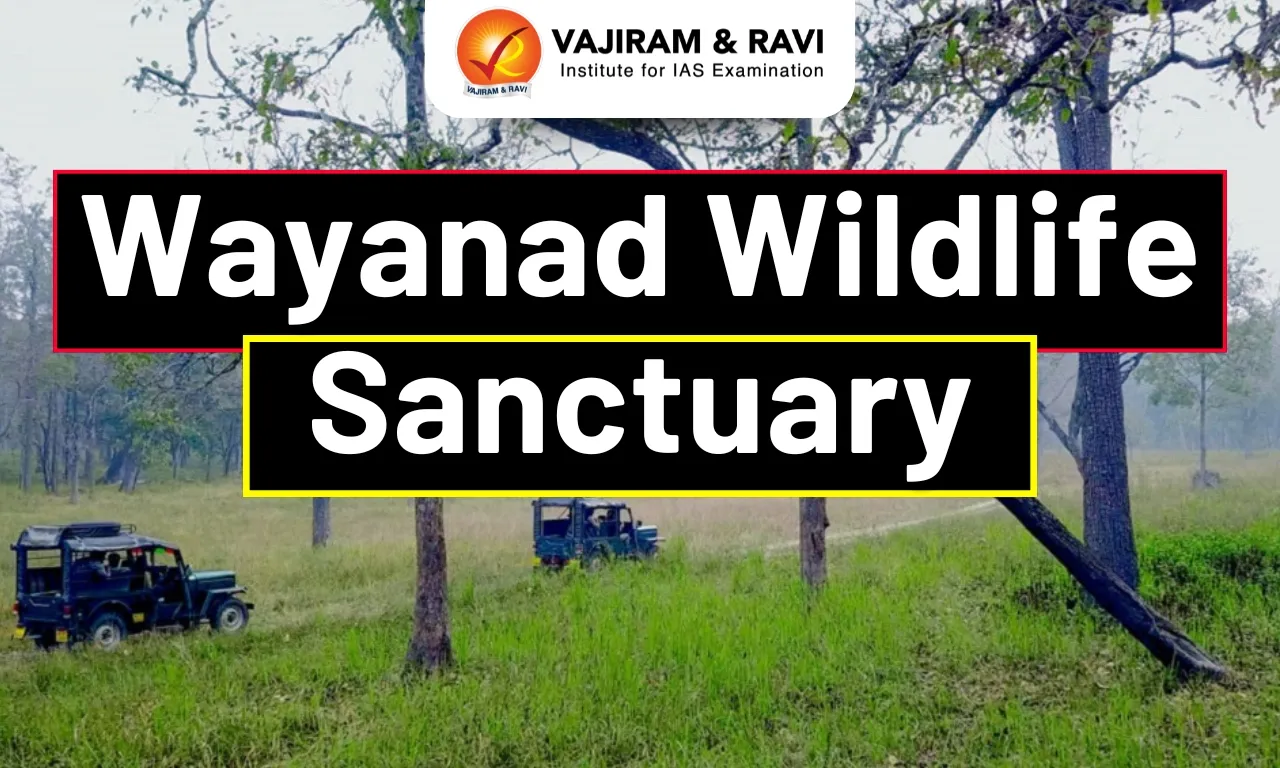
A two-day vulture survey has begun across the Wayanad Wildlife Sanctuary ahead of the upcoming Wildlife Week celebrations in Keralam. 

About Wayanad Wildlife Sanctuary

  • Location: It is located in Wayanad, Keralam, in the southern trenches of the Western Ghats.
  • It is also known as Muthanga Wildlife Sanctuary.
  • It was established in 1973, the sanctuary covers an expansive 344 sq.km. and forms an integral part of the Nilgiri Biosphere Reserve, a UNESCO World Heritage Site.
  • It is bordered by the protected areas of Nagarhole and Bandipur in Karnataka on the northeastern side and Mudumalai in Tamil Nadu on the southeastern side.
  • Rivers: Rivers like the Kabini, Cherupuzha, and Bavali flow through the sanctuary.
  • Tribes: Tribes living in these forests include some scheduled adivasis, such as Paniyas, Kattunaikkans, Kurumas, Ooralis, Adiyans, and Kurichiyas.
  • Vegetation: It is a mosaic of the Western Ghats’ significant vegetation types, ranging from moist deciduous to dry deciduous and semi-evergreen patches.
  • Flora:About one-third of the sanctuary is covered by plantations of teak, rosewood, eucalyptus, and silver oak.
  • Fauna: It boasts one of the largest populations of Asian elephants and tigers, which are considered its flagship species. 
  • Other mammals include leopards, gaur (Indian bison), sambar deer, wild boars, sloth bears, and jungle cats.

Source: TH

Wayanad Wildlife Sanctuary FAQs

Q1: Where is Wayanad Wildlife Sanctuary located?

Ans: Keralam

Q2: Which tribal people reside in Wayanad Wildlife Sanctuary?

Ans: Paniyas, Kattunaikkans, Kurumas, Ooralis, Adiyans, and Kurichiyas.

Gulbarga Tur Dal

Gulbarga Tur Dal

Gulbarga Tur Dal Latest News

Recently, the Agricultural and Processed Food Products Export Development Authority (APEDA) flagged off a shipment of 1 metric tonne of Geographical Indication (GI)-tagged Gulbarga Tur Dal to the Maldives.

About Gulbarga Tur Dal

  • Gulbarga Tur Dal, associated with the Kalaburagi region of Karnataka.
  • It has received the Geographical Indication (GI) registration in 2019.
  • The product is recognised for its distinctive taste and quality and forms an important part of the agricultural economy of the region.

Key Facts about Tur Dal

  • It is one of India’s most important pulse crops and a major source of dietary protein.
  • It is a legume crop and protein-rich food which is primarily consumed as dal in India.
  • It is predominantly a crop of tropical areas mainly cultivated in semi-arid regions of India.
  • Required Climatic conditions
    • Rain: It requires 600-650mm of annual rainfall along with moist conditions for the initial eight weeks and dry conditions during its flowering and pod development phase.
    • Temperature: It can be grown with a temperature ranging from 26 to 30 degree Celsius in the rainy season and 17 to 22 degree Celsius in the post rainy (November to March) season.
    • Soil: It can be grown on all types of soil, however, sandy loam or loam soil is most suitable for its cultivation.
    • It is very sensitive to low radiation at pod development, therefore flowering during the monsoon and cloudy weather, leads to poor pod formation.
    • It is commonly intercropped with a wide range of crops.
  • Diseases: The important diseases of Pigeon pea are Wilt, Sterility mosaic disease, Phytophthora blight, Alternaria blight and Powdery mildew etc.
  • Health benefits: It has low glycaemic index and is rich in thiamine, riboflavin, niacin, vitamin B-6, folate, vitamin A, calcium, zinc, iron and magnesium
  • Major Tur Dal producing states: Uttar Pradesh, Madhya Pradesh, West Bengal, Bihar and Jharkhand.

Source: NIE

Gulbarga Tur Dal FAQs

Q1: Which state is famous for Gulbarga Tur Dal?

Ans: Karnataka

Q2: What is unique about Gulbarga Tur Dal?

Ans: Its distinctive taste and quality and forms an important part of the agricultural economy of the region.

Vizellopsidites miocenicus

What is Vizellopsidites miocenicus

Vizellopsidites miocenicus Latest News

Researchers recently discovered a new species of ancient, microscopic fungus, named Vizellopsidites miocenicus.

About Vizellopsidites miocenicus

  • It is a new species of ancient, microscopic fungus.
  • It was found perfectly preserved on a fossilised plant leaf from up to 12 million years ago in the foothills of the western Himalayas in the Mandi District of Himachal Pradesh.  
  • Because the delicate fungus was practically invisible to the naked eye, the researchers used a chemical process called maceration.
    • It involves bathing the fossil in a series of gentle acids to dissolve the surrounding rock and isolate the leaf's transparent, waxy outer layer. 
    • When they placed this surviving leaf fragment under a high-powered light microscope, the intricate, dark-brown structures of the ancient fungus were revealed.
  • The specific name, miocenicus, directly references the Late Miocene epoch, the geological time period roughly 8 to 12 million years ago when the fungus lived and fossilised. 
  • It features larger cells and a much looser, net-like arrangement of alternating side branches, which grew in dense mats that primarily branched at the tips. 
  • It features distinct, circular fruiting bodies, the structures that once released spores, nestled beneath a dark, protective web of cells. 
  • By comparing the fossil to its modern-day fungal relatives, which grow only in very warm, highly humid tropical environments, the scientists deduced what this region once looked like. 
  • The presence of V. miocenicus serves as direct evidence that millions of years ago, the terrain of the Himachal Himalaya was not the cooler, mountainous environment we know today, but rather a dense, sweltering, and vibrant tropical forest.

News: RM

Vizellopsidites miocenicus FAQs

Q1: What is Vizellopsidites miocenicus?

Ans: It is a new species of ancient, microscopic fungus.

Q2: Where was Vizellopsidites miocenicus discovered?

Ans: It was discovered on a fossilised plant leaf from the foothills of the western Himalayas in Mandi district, Himachal Pradesh.

Q3: What colour were the intricate structures of Vizellopsidites miocenicus?

Ans: They were dark brown.

Q4: When did Vizellopsidites miocenicus live and become fossilised?

Ans: It lived and became fossilised roughly 8 to 12 million years ago during the Late Miocene.

Cool Leaders Award

Cool Leaders Award

Cool Leaders Award Latest News

Recently, inaugural Cool Leaders Award was announced at the Global Cooling Pledge Assembly 2026 held in Singapore.

About Cool Leaders Award

  • It is a global recognition initiative launched by the UNEP Cool Coalition.
  • It recognizes outstanding leadership in advancing sustainable cooling and protecting people from extreme heat.
  • The first Cool Leaders are
    • Singapore: For leadership in passive cooling and heat resilience.
    • United Arab Emirates: For leadership in district cooling and advancing cooling in global climate and development policy.
    • Dong Mingzhu: Chairwoman of Gree Electric Appliances, for spearheading the development of ultra-efficient, low-carbon cooling technologies, including the Zero Carbon Source air-conditioning system.

What is the UNEP Cool Coalition?

  • It is a global platform driving system-level change on sustainable cooling.
  • It was launched in 2019 as a flagship initiative of the UN Secretary-General’s Climate Action Summit.
  • It brings together over 250 actors—including governments, businesses, cities, and financial institutions—to deliver efficient, climate-friendly cooling solutions aligned with the Paris Agreement, the Kigali Amendment, and the 2030 Agenda.

Source: UNEP

Cool Leaders Award FAQs

Q1: Which organisation launched the Cool Leaders Award?

Ans: UNEP Cool Coalition.

Q2: What is the objective of Cool Leaders Award?

Ans: It recognizes outstanding leadership in advancing sustainable cooling and protecting people from extreme heat.

Forum for India-Pacific Islands Cooperation

Forum for India-Pacific Islands Cooperation

Forum for India-Pacific Islands Cooperation Latest News

Recently, the External Affairs Minister chaired a meeting of the Foreign Ministers of the Forum for India-Pacific Islands Cooperation (FIPIC), on the sidelines of the 81st United Nations General Assembly in New York.

About Forum for India-Pacific Islands Cooperation

  • It is a multilateral platform established by India to enhance cooperation with the Pacific Island countries.
  • It was established in 2014 during the Prime Minister of India’s visit to Fiji.
  • Member countries: It includes 14 of the island countries – Cook Islands, Fiji, Kiribati, Marshall Islands, Micronesia, Nauru, Niue, Palau, Papua New Guinea, Samoa, Solomon Islands, Tonga, Tuvalu, and Vanuatu.
  • In line with the “Act East Policy”, through FIPIC, India has primarily focused its efforts on the Pacific Islands.
  • Economic Cooperation: · At this moment, total annual trade of about $300 million between the Indian and Pacific Island countries, whereas exports are around $200 million and imports are around $100 million.
  • FIPIC Summits held: Since 2014 three FIPIC summits have been held, 1st 2014 (Suva, Fiji), 2nd 2015 (Jaipur, India), 3rd 2023 (Port Moresby, Papua New Guinea).

Source: News On Air

Forum for India-Pacific Islands Cooperation FAQs

Q1: What is Forum for India-Pacific Islands Cooperation?

Ans: It is a multilateral platform established by India to enhance cooperation with the Pacific Island countries.

Q2: When was Forum for India-Pacific Islands Cooperation formed?

Ans: It was established in 2014.

Cyclone Arnab 2026, Location, Naming, Tracker, Latest Updates

Cyclone Arnab

Cyclone Arnab 2026 refers to the weather system over the Bay of Bengal that has attracted attention as the next possible cyclone name. However, the system remains a deep depression and is not classified as a cyclonic storm. It is moving towards the north Andhra Pradesh-South Odisha coast, with landfall expected near Kalingapatnam between Visakhapatnam and Gopalpur.

Cyclone Arnab Latest Updates

According to the latest IMD Tropical Weather Outlook issued on September 25, 2026, the system has moved north-northwestwards and weakened from a deep depression into a depression over south interior Odisha and adjoining south Chhattisgarh. At 05:30 AM on September 25, it was located close to Nuapada in Odisha and about 120 km southeast of Raipur in Chhattisgarh.
The system is very likely to continue moving north-northwestwards and maintain depression intensity for the next 12 hours. It is then expected to weaken into a well-marked low-pressure area during the following 12 hours.

Cyclone Arnab 2026

The Cyclone Arnab 2026 system is located over the westcentral and adjoining northwest Bay of Bengal and is being monitored continuously by IMD.

  • Cyclone Classification: The India Meteorological Department has indicated that the system is unlikely to intensify into a cyclone before landfall. Therefore, it is expected to retain deep depression status.
  • Name Arnab: The name Arnab means ocean in Bengali. The name was contributed by Bangladesh for the regional tropical cyclone naming system.
  • Formation Background: The system developed over the Bay of Bengal and intensified from a depression into a deep depression before approaching the north Andhra Pradesh-South Odisha coast.
  • Monitoring System: The system is under continuous observation by the Doppler Weather Radar at Visakhapatnam. Radar monitoring is tracking its movement and structure near the coast.
  • Wind Conditions: Strong winds are expected along the affected coastal areas. The Bay of Bengal Deep Depression 2026 may produce gusty winds along with heavy rainfall during its approach and landfall.

Cyclone Arnab Impacts

The main concern from the Cyclone Arnab system is heavy rainfall, strong winds, rough seas, flooding and localised landslide risks across affected areas.

  • Odisha Impact: Odisha remains among the worst-affected regions. Heavy to very heavy rainfall is expected in several areas, with extremely heavy rainfall possible at isolated places.
  • Red Alert Areas: Koraput, Gajapati and Ganjam faced warnings for heavy to very heavy rainfall and isolated extremely heavy rainfall on September 24.
  • Further Rainfall: Kalahandi, Nabarangpur, Koraput and Malkangiri are expected to receive heavy rainfall during September 24-25.
  • Andhra Pradesh: Coastal Andhra Pradesh is also experiencing the system's effects. Squally weather and strong winds are expected along and off the south Odisha-north Andhra Pradesh coasts.
  • West Bengal: Parts of West Bengal are expected to receive heavy to very heavy rainfall. Darjeeling and Kalimpong were also under landslide warnings.
  • Flood Risk: Heavy rainfall can increase water levels in rivers, water bodies and dams. Low lying areas may face waterlogging and local flooding during intense rainfall.
  • Landslide Risk: Odisha authorities identified 140 landslide prone areas in Gajapati. Rain related risks were also reported from Ganjam, Malkangiri, Koraput, Rayagada and Nabarangpur.
  • Sea Conditions: Very rough seas are expected over the westcentral and northwest Bay of Bengal until the evening of September 24. Coastal waters may gradually improve afterwards.
  • Local Damage: Heavy rain has already resulted in reports of trees being uprooted, houses being damaged, rainwater entering homes and muddy water flowing down hills.

Cyclone Arnab 2026 Management

Preparedness of Cyclone Arnab 2026 focuses on evacuation, shelter management, emergency services, weather monitoring, essential supplies and protection of vulnerable communities.

  • Evacuation: About 8,000 people were moved to safer locations in Odisha. Pregnant women and elderly persons were among those shifted to cyclone centres and temporary relief camps.
  • Emergency Services: Essential supplies, equipment, health services and emergency teams were kept ready. Disaster mitigation teams were placed on high alert for rapid response.
  • Shelter Preparedness: Cyclone and flood shelters were kept ready in vulnerable districts. Temporary relief camps were also arranged for evacuated residents.
  • Vulnerable Areas: Authorities restricted access to identified landslide prone locations. Continuous monitoring was carried out in areas considered vulnerable to landslides and mudslides.
  • Water Monitoring: Officials monitored water levels in rivers, water bodies and dams to identify possible flood risks during periods of intense rainfall.
  • Public Safety: People were advised to stay indoors during strong winds. They should avoid windows, damaged structures, trees, large hoardings, floodwater and exposed electrical equipment.
  • Emergency Kit: Residents should keep drinking water, food, medicines, first aid supplies, torches, batteries, candles, matches and power banks ready for at least two to three days.
  • Evacuation Rules: People in coastal, low lying and flood prone areas should immediately follow evacuation orders. They should move to designated shelters or safer higher ground.

Cyclone Arnab Tracker

The Cyclone Arnab 2026 is being tracked by the latest monitoring systems of the India Meteorological Department Doppler Weather Radar. It’s latest updates are shared to the authorities to improve and monitor preparations to reduce the impacts of the storm.

  • Current Bay of Bengal Deep Depression 2026 Status: According to the IMD update of September 25, 2026, the system has weakened from a deep depression into a depression over south interior Odisha and adjoining Chhattisgarh.
  • Landfall Location: The system crossed between Visakhapatnam and Gopalpur, close to Kalingapatnam, after moving west-northwestwards towards the coast.
  • Post-Landfall Movement: The system is now moving north-northwestwards after landfall. IMD expects it to maintain depression intensity for the next 12 hours and then weaken into a well-marked low-pressure area during the subsequent 12 hours.
  • Wind Forecast: At 05:30 AM on September 25, the depression had maximum sustained surface winds of 45-55 kmph, gusting to 65 kmph. IMD forecasts winds of 35-45 kmph, gusting to 55 kmph, by 05:30 PM on September 25, followed by further weakening.
  • Preparedness: Odisha placed collectors of 11 districts on high alert. Cyclone and flood shelters were kept ready, while at least 5,000 people were moved to safer locations.
  • Post-Landfall Monitoring: Authorities continue to monitor the system as it moves inland across Odisha and adjoining Chhattisgarh. IMD expects associated extreme weather over east, east-central and subsequently adjoining northern plains during the next 3-4 days.
  • Current Location: As of September 25, the depression was located near 20.5°N and 82.5°E, close to Nuapada in Odisha.
  • Expected Weakening: The system is likely to weaken further because of its movement over land. IMD forecasts that it will become a well-marked low-pressure area by September 26, 2026.

Cyclone Arnab 2026 FAQs

Q1: What is Cyclone Arnab 2026?

Ans: Cyclone Arnab 2026 refers to the deep depression over the Bay of Bengal approaching the north Andhra Pradesh-South Odisha coast.

Q2: Where is Cyclone Arnab now?

Ans: As of 25 September 2026, The depression is currently over south interior Odisha and adjoining Chhattisgarh, near 20.5°N and 82.5°E, close to Nuapada in Odisha

Q3: Did Cyclone Arnab make landfall?

Ans: The system crossed the Andhra Pradesh-Odisha coast near Kalingapatnam during the early hours of September 24, 2026, as a deep depression.

Q4: What is the latest status of Cyclone Arnab 2026?

Ans: As of 25 September 2026, The system is moving north-northwestwards and is expected to maintain depression intensity for the next 12 hours before weakening into a well-marked low-pressure area.

Q5: Who named Cyclone Arnab?

Ans: The name Arnab, meaning ocean in Bengali, was contributed by Bangladesh.

Western Ghats ESA: Why Karnataka Opposes the Kasturirangan Report

Understanding Karnataka's Objection to the Western Ghats ESA

Western Ghats ESA Latest News

  • Recently, the Karnataka Legislature unanimously passed a resolution rejecting the K. Kasturirangan Committee report on the Western Ghats in its current form. 
  • This came in response to the seventh draft, published in July 2026, by the Ministry of Environment, Ecology and Climate Change, proposing to declare parts of the Western Ghats as an Ecologically Sensitive Area (ESA). The draft gave states a 60-day window to file objections.
  • This marks the seventh time Karnataka has rejected the draft since it was first published in 2014. 
  • Successive governments have acknowledged the ecological importance of the Western Ghats but have repeatedly flagged the ESA's impact on lives and livelihoods. 
  • Of the six Western Ghats states, Karnataka has the largest area proposed for ESA notification, spread across 10 districts.

Background: Kasturirangan Report

  • Space scientist K. Kasturirangan chaired the High Level Working Group (HLWG), tasked with reviewing the earlier Western Ghats Ecology Expert Panel (WGEEP) report by Prof. Madhav Gadgil.
    • WGEEP (Gadgil Committee): Submitted its report in 2011.
  • It was also tasked to recommend fresh protective measures for the Western Ghats — recognised by UNESCO as one of the world's ecological hotspots.
  • Set up in 2012, HLWG submitted recommendations in 2013. Of the 1.64 lakh sq. km Western Ghats area, the Kasturirangan Committee recommended declaring 59,940 sq. km — covering 4,156 villages across six states — as ESA.

How Much Area Is Involved, State-Wise

  • The committee identified natural landscape covering about 41% of the Western Ghats, of which 37% (≈59,940 sq. km) was biologically rich, with low fragmentation, low population density, and containing protected areas, World Heritage Sites, and tiger/elephant corridors.
  • [my_image src="https://vajiramias.sgp1.cdn.digitaloceanspaces.com/wp/current-affairs/2026/09/27085753/Original-State-wise-area.jpg?v=1790479672" size="full" align="none" width="auto" height="308px" alt="" title="Original State-wise area"]

Current Status

  • The area proposed for notification has reduced to 56,825 sq. km, mainly because Kerala conducted a ground survey and brought its area down to 9,993 sq. km. 
  • Meanwhile, the number of villages has increased in Maharashtra and Goa, but decreased in Karnataka. 
  • The latest draft covers 4,402 villages in total. Final area demarcation depends on state government recommendations, stakeholder views, and the ESA Expert Committee.

Key Recommendations of the Report

  • The Kasturirangan Committee proposes a mix of outright bans and regulated activities:
  • Banned entirely:
    • Mining, quarrying, and sand extraction
    • Setting up red-category industries
    • Thermal power plants
    • Construction of buildings beyond 20,000 sq. metres
    • Township and area development projects
  • Regulated (not banned):
    • Infrastructure and development projects — subject to environmental clearances
    • Hydroelectricity projects — allowed with conditions
    • Any project within 10 km of the ESA requiring clearance — regulated under the EIA Notification, 2006
  • The report also recommends financial incentives for "Green Growth" in the region and a decision-support and monitoring centre.

Kasturirangan vs Gadgil: The Key Difference

  • [my_image src="https://vajiramias.sgp1.cdn.digitaloceanspaces.com/wp/current-affairs/2026/09/27085722/Kasturirangan-vs-Gadgil.jpg?v=1790479641" size="full" align="none" width="auto" height="244px" alt="" title="Kasturirangan vs Gadgil"]
  • The Gadgil approach was broader and more stringent; the Kasturirangan approach is narrower but still contentious in the areas it does cover.

Karnataka's Specific Objections

  • Scope should be narrower: ESA should cover only notified forest areas and other forest areas — not plantations, agriculture/horticulture fields, or residential and public areas.
  • Methodology flaw: Areas were demarcated using satellite data, not a joint physical survey.
  • Land classification gap: No accurate bifurcation exists between revenue and forest land.
  • No livelihood alternatives: The draft provides no reference to alternative livelihood arrangements for affected people.
  • Unaddressed legal categories: Issues like Bagair Hukum (unauthorised cultivation claims), forest rights, deemed forest status, land grants, and pending legal appeals need examination.
  • Village-level objection: Karnataka opposes including entire villages under ESA merely because one-fifth of the village area might be forest.

Karnataka's Way Forward

  • Both Houses of the Karnataka Legislature have:
    • Sought one year to conduct a physical survey of the area.
    • Demanded that Karnataka's portion of the ESA not be finalised until this survey is complete.
    • Announced a high-level committee headed by a retired judge, comprising all stakeholders, to review the report's shortcomings and recommend modifications.
  • Cutting across party lines, legislators have urged the government to follow the "Keralam model" — where physical verification was conducted on the ground and submitted to the Centre, resulting in a reduced ESA footprint for that state.

Source: TH

Western Ghats ESA FAQs

Q1: Why is Karnataka opposing the Western Ghats ESA proposal?

Ans: Karnataka opposes the Western Ghats ESA proposal over concerns about its scope, methodology, land classification, livelihood impacts and inclusion of entire villages.

Q2: What is the Kasturirangan Committee's recommendation for the Western Ghats ESA?

Ans: The Kasturirangan Committee recommended declaring about 59,940 square kilometres across six states as an Ecologically Sensitive Area.

Q3: What activities would be banned under the Western Ghats ESA proposal?

Ans: The Western Ghats ESA proposal would prohibit mining, quarrying, sand extraction, red-category industries, thermal power plants and large construction projects.

Q4: What is Karnataka's main methodological objection to the Western Ghats ESA?

Ans: Karnataka argues that ESA boundaries were identified using satellite data rather than a joint physical survey, creating concerns about accurate land classification.

Q5: What alternative has Karnataka proposed for the Western Ghats ESA?

Ans: Karnataka has sought one year for a physical survey and wants its ESA area finalised only after verification and stakeholder review.

Captive Power Plants (CPPs) – Maximising Power Generation Amid Unusual Demand Surge

Captive Power Plants (CPPs) - Maximising Power Generation Amid Unusual Demand Surge

Captive Power Plants (CPPs) Latest News

  • Amid an unusual surge in electricity demand in September 2026, the Centre has invoked emergency provisions under Section 11 of the Electricity Act 2003.
  • It directs around 112 coal-based captive power plants (CPPs) to operate at maximum available capacity from October 1 to December 31, 2026.
  • The move aims to maximise electricity generation, ensure adequate power availability and address the possibility of sustained high demand beyond the usual summer peak.

Electricity Demand

  • Unprecedented surge:
    • Record peak demand: On September 10, 2026, India's peak electricity demand reached 269 GW, the highest ever recorded for September.
    • Near-summer levels: The demand was close to the year's highest peak of 270 GW, recorded in May 2026.
    • Unusual trend: Electricity demand generally declines after the summer months (April–July). However, demand has remained exceptionally high this September.
  • Factors behind the demand surge:
    • According to power sector experts, the unusually high electricity demand is attributable to -
      • Persistent heat: Continued high temperatures have increased electricity consumption for cooling.
      • Deficient rainfall: Inadequate rainfall has contributed to higher demand for electricity.
      • Increased irrigation demand: Greater dependence on electric pumps for irrigation has added to the demand.
      • El Niño: Weather conditions associated with El Niño have potentially intensified heat and rainfall irregularities.
    • September has recorded the year's highest peak demand only twice in recent years—in 2020–21 and 2023–24.

Emergency Directions to CPPs

  • Section 11 of the Electricity Act empowers the government to require generating companies to operate in extraordinary circumstances to ensure electricity supply.
  • The directive covers all coal-based captive power plants with an installed capacity of 50 MW or more.
  • Key provisions:
    • Maximum generation: Captive power plants must operate at the maximum level of their available capacity.
    • Surplus power supply: After meeting their own electricity requirements, plants must offer surplus electricity through power exchanges, in accordance with applicable regulations.
    • Adequate coal stocks: Generators must maintain sufficient coal reserves to ensure uninterrupted operations and maximise electricity generation.
    • Weekly reporting: Plants must submit weekly reports to the Central Electricity Authority (CEA), detailing electricity generation, captive consumption, surplus power sales, available capacity and coal stocks.
  • What are CPPs?
    • These are electricity-generation facilities established and operated by industrial enterprises or groups of industries primarily to meet their own electricity requirements.
    • Unlike conventional power plants, their primary purpose is not to supply electricity to the public grid. 
    • However, they can contribute to grid stability by supplying surplus electricity when required.

Other Measures

  • Extension of emergency provisions:
    • The Ministry of Power has separately extended the emergency mechanism for Coastal Gujarat Power Ltd (CGPL), Tata Power's 4-GW imported coal-based power plant, until December 31, 2026.
    • The plant has been operating under Section 11 directions since March 2026.
    • Before March, it had remained largely idle for nearly six months because of high imported coal prices and the absence of a viable power purchase arrangement.
    • The extension was limited to Tata Power's plant because other imported coal-based power plants were operational and were not facing similar difficulties.
  • Tariff determination:
    • Invoking Section 11 for high-cost power plants can create financial challenges because imported coal and gas-based electricity are often more expensive than conventional domestic coal-based power.
    • To address this, a committee chaired by the Chairman of the Central Electricity Authority (CEA) determines the tariff for electricity procured from such plants.
    • The committee considers relevant input costs, including fuel expenses, while determining the procurement tariff.
    • Tariff-related measures have been used to protect consumers from sudden increases in electricity prices.

Significance of the Government’s Intervention

  • Ensuring energy security: Mobilising captive power generation can help bridge the gap between electricity demand and available supply.
  • Improving grid reliability: Additional electricity from captive plants can strengthen the availability of power during periods of unusually high demand.
  • Efficient utilisation of generating capacity: Requiring plants to operate at maximum available capacity can help utilise existing infrastructure.
  • Supporting industrial and agricultural demand: Increased electricity availability can help meet the requirements of industries, households and irrigation.
  • Reducing supply disruptions: Mobilising surplus power through exchanges can provide additional electricity to the grid when required.

Conclusion

  • The Centre's decision to invoke Section 11 reflects the challenges posed by increasingly unpredictable electricity demand. 
  • The unusual September demand surge highlights the importance of maintaining adequate generation capacity, fuel reserves and flexible power procurement mechanisms. 
  • In the longer term, improving demand forecasting, diversifying energy sources and strengthening grid infrastructure will be essential for ensuring reliable and affordable electricity supply.

Source: IE

Captive Power Plants (CPPs) FAQs

Q1: What is Section 11 of the Electricity Act, 2003?

Ans: Under Section 11, the government directs power plants to maximise electricity generation during extraordinary circumstances.

Q2: What is the primary purpose of captive power plants?

Ans: They primarily meet industrial electricity requirements and can supply surplus power to the grid through power exchanges.

Q3: What factors contributed to India's unusually high electricity demand in September 2026?

Ans: Persistent heat, deficient rainfall, increased irrigation demand and weather conditions associated with El Niño.

Q4: Why did the Centre extend emergency provisions for Tata Power's Coastal Gujarat Power Ltd (CGPL)?

Ans: To ensure the continued operation of its 4-GW imported coal-based plant and maintain electricity availability.

Q5: What measures should India adopt to ensure reliable, affordable and sustainable electricity supply?

Ans: India should strengthen demand forecasting, diversify its energy mix, promote renewable energy and energy storage.

Enemy State Clause: Why Japan Wants the UN Charter Provision Removed

The Enemy State Clause - A Postwar Relic Back in the Spotlight

Enemy State Clause Latest News

  • In her first-ever address to the United Nations General Assembly (UNGA), Japan's Prime Minister Sanae Takaichi called on the UN to remove references to "enemy states" in its Charter. 
  • The label has recently been used by China and Russia to attack Japan's plans to raise defence spending.

About Enemy State Clause 

  • World War II (1939–45) was fought between the Allied Powers (Great Britain, the Soviet Union, the United States) and the Axis Powers (Germany, Italy, Japan). 
  • Japan was the last Axis power to surrender, in September 1945.
  • The UN Charter, drafted toward the war's end and in force from October 24, 1945, contains numerous references to "enemy states." 
  • The Allies — who drafted the Charter and later took permanent UN Security Council (UNSC) seats — designed it as a mechanism to counter any re-emergence of militarism or fascism in the defeated Axis powers, without needing UNSC approval each time.
  • In other words, the UN Charter's "enemy state" clauses (Articles 53, 77, 107) let Allied powers take military or preventive action against defeated WWII Axis nations without needing prior UNSC authorization.

Where it Appears

  • The term features in three Articles: 53, 77, and 107.
  • Article 53: Permits enforcement action against an "enemy state" through regional arrangements without prior Security Council authorisation — an exception to the normal rule requiring UNSC approval for such action. 
    • Paragraph 2 defines enemy state as any state that was an enemy of a Charter signatory during World War II.
  • Article 107: States that nothing in the Charter invalidates or blocks action taken against a WWII enemy state by the governments responsible for such action as a result of that war. 
    • In effect, it gives the Allied Powers a legal right to act against defeated Axis states without UNSC approval.
  • Article 77(1)(b): Concerns the "trusteeship system" applied to territories detached from enemy states after WWII. 
    • Under the Charter, the UN was to establish an international trusteeship system (Article 75) for "trust territories" — places whose peoples had not yet attained full self-government (Article 73). 
    • There were 11 such territories, across Africa and the Pacific Islands.

Why Japan Wants It Removed

  • The UNGA recognised the clauses as obsolete in 1995.
  • A resolution in 2005 called for deleting enemy state references from the Charter.
  • Japan’s call to remove this cluse is being framed within a wider appeal for UN and UNSC reform, which she called "a matter of utmost importance.

The Geopolitical Backdrop

  • Japanese PM’s remarks come amid rising hostility with China and Russia, both exerting economic and military pressure on Japan.
  • With China: China has restricted access to rare earth magnets needed by Japanese manufacturers.
    • Chinese fighter aircraft and warships have conducted military drills near the Japanese coast.
  • With Russia: Russia has conducted military exercises near Japan and criticised Japan's plans to raise defence spending.
    • In August 2026, Russian President visited the disputed southern Kuril Islands. This led to strong protest by Japan.

How The Clause is Used Against Japan Diplomatically

  • China argues the clauses safeguard the postwar international order.
  • Russia argues the clauses invalidate Japan's territorial claims over the southern Kuril Islands.

Why Nothing Has Changed 

  • Amending the Charter requires approval from all five permanent UNSC members, not just a General Assembly vote. 
  • As experts explained, each P5 member must ratify the change domestically, not merely vote for it.
  • Analysts pointed to a specific factor too: Japan continues to host US troops on its soil, which may fuel Chinese and Russian reservations about removing the clause.
  • They add that the Big Five may fear that revising Charter language could open the door to broader demands — such as reforming UNSC composition itself — which would dilute their influence.

Conclusion

  • The "enemy state" clause is legally dormant but diplomatically alive — a rhetorical weapon precisely because it was never formally deleted. 
  • Its survival for over eight decades reveals less about Japan's past than about the durability of the postwar order the Big Five still control. 
  • Real removal would require the P5 to loosen a grip they show little sign of releasing.

Source: IE | TI

Enemy State Clause FAQs

Q1: What is the Enemy State Clause in the UN Charter?

Ans: The Enemy State Clause refers to provisions allowing certain actions against states that were enemies of Charter signatories during World War II.

Q2: Which UN Charter articles contain the Enemy State Clause?

Ans: The Enemy State Clause appears in Articles 53, 77 and 107, dealing respectively with enforcement action, trusteeship territories and wartime actions.

Q3: Why does Japan want the Enemy State Clause removed?

Ans: Japan wants the Enemy State Clause removed because the UN General Assembly has recognised it as obsolete, while China and Russia still invoke it diplomatically.

Q4: How has the Enemy State Clause been used against Japan?

Ans: China cites the clauses while Russia invokes them in discussions concerning Japan's territorial claims over the southern Kuril Islands.

Q5: Why has the Enemy State Clause not been removed?

Ans: Removing the Enemy State Clause requires approval and domestic ratification by all five permanent Security Council members, making Charter amendment difficult.

ECINET and Electoral Roll Revision – Explained

ECINET and Electoral Roll Revision - Explained

Electoral Roll Revision Latest News

  • The Election Commission has announced a review of ECINET and introduced procedural changes for voters flagged during the ongoing Special Intensive Revision (SIR) of electoral rolls.

ECINET: Digital Infrastructure for Electoral Administration

  • ECINET is the Election Commission's centralised digital platform used for various electoral processes and administrative functions.
  • The platform provides role-based access to field officers according to their statutory responsibilities and is intended to support the flow of electoral information between different levels of election administration.
  • The recent review is significant because electoral processes increasingly depend on digital systems for data management, voter enrolment, verification and communication.
  • The Election Commission has constituted a committee headed by a Senior Deputy Election Commissioner, with an independent expert from an IIT/IIIT, to examine whether ECINET complies with relevant Acts and Rules.
  • The Commission has also stated that further flexibility required by field officers will be incorporated where necessary. Future initiatives involving IT modules and portals are to be discussed by the Committee of Officers (COO) before approval.

Special Intensive Revision of Electoral Rolls

  • A Special Intensive Revision is a detailed exercise for reviewing and updating electoral rolls.
  • During the ongoing exercise, some electors have received notices based on categories described by the Election Commission as “unmapped” or involving “logical discrepancies.”
  • Unmapped Electors
    • These are electors whose names did not appear in the rolls of the previous intensive revision and who were unable to provide the names of their parents or grandparents from that earlier revision.
  • Logical Discrepancies
    • These refer to discrepancies identified by the Election Commission's centralised software, following which additional documentary evidence may be sought from the elector.

Changes in Hearing Procedure

  • The Election Commission has introduced a significant procedural relaxation for electors receiving such notices.
  • Under the revised arrangement:
    • Booth Level Officers (BLOs) will visit the elector's residence to collect required documents. 
    • The documents will be uploaded on ECINET for consideration by the Electoral Registration Officer (ERO). 
    • The elector will generally not be required to appear personally before the ERO or Assistant Electoral Registration Officer (AERO). 
    • A hearing may be conducted in exceptional circumstances, preferably online. 
    • An adult family member may be authorised to attend the hearing on behalf of the elector. 
  • This approach seeks to reduce the administrative burden on electors while retaining a mechanism for verification.

Form 6 and Voter Enrolment

  • Form 6 is the statutory form used for new voter enrolment under the Registration of Electors Rules, 1960.
  • During the SIR exercise, an additional declaration was incorporated into the online version of Form 6 concerning whether the applicant, parents or grandparents appeared in the rolls of the previous intensive revision.
  • The Election Commission has now clarified that Form 6 will revert to its original statutory format after the SIR.
  • For the SIR period, the Commission stated that the additional declaration has been upheld by the Supreme Court; outside the SIR exercise, the forms prescribed under the Registration of Electors Rules, 1960 will apply.

Institutional Processes Within the ECI

  • The recent meeting also addressed certain internal administrative procedures. The Commission stated that:
    • Agendas for Commission meetings will be circulated in advance. 
    • Minutes of meetings will be issued. 
    • Annual Performance Appraisal Reports of officers will be completed within the stipulated period. 
    • Foreign travel of officers will require Commission approval. 
    • Directions issued by Election Commissioners to officers will be complied with. 
  • These measures relate to institutional procedure, administrative accountability and coordination within a constitutional body.

Technology and Electoral Governance

  • The ECINET review highlights a broader issue in contemporary electoral administration: the need to balance digital efficiency with statutory safeguards.
  • Centralised platforms can improve data management, standardise processes and facilitate faster decision-making. 
  • However, because electoral rolls directly determine eligibility to participate in elections, digital systems must operate within clearly defined legal authority, access controls, verification procedures and accountability mechanisms.
  • The inclusion of an independent technical expert in the ECINET review reflects the need for both legal and technological scrutiny of electoral systems.

Source : IE

Electoral Roll Revision FAQs

Q1: What is ECINET?

Ans: ECINET is the Election Commission's centralised digital platform used to support various electoral and administrative processes.

Q2: What is Special Intensive Revision (SIR)?

Ans: SIR is a detailed exercise undertaken to review and update electoral rolls through verification of electors and electoral information.

Q3: Who are “unmapped” electors?

Ans: They are electors whose names did not appear in the rolls of the previous intensive revision and who could not provide relevant parental or grandparental details from that revision.

Q4: What is Form 6?

Ans: Form 6 is the statutory application form used for new voter enrolment under the Registration of Electors Rules, 1960.

Q5: Why is ECINET being reviewed?

Ans: The Election Commission has constituted a committee to verify whether ECINET's functioning complies with the relevant Acts and Rules and to examine its operational requirements.

Enquire Now