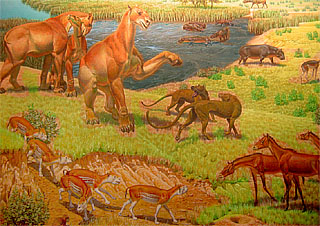
About Miocene epoch:
- The Miocene was a long-lasting epoch in which the earth’s climate rebounded from the cooling of the Oligocene and there was a marked increase in both global temperatures and the total number of mammal species.
- It is often divided into the Early Miocene Epoch (23 million to 16 million years ago), the Middle Miocene Epoch (16 million to 11.6 million years ago), and the Late Miocene Epoch (11.6 million to 5.3 million years ago).
- What changes occurred during this period?
- India collided with Asia, causing a massive upthrust of the Asian continent that created the Tibetan plateau and the Himalayas.
- As Africa moved northwards to link with Europe, the Tethys Sea, a vast seaway that once existed between the two continents Europe and Africa, disappeared.
- As the Miocene progressed, the earth began to cool once more; the climate became more arid and mammalian diversity began to decrease again.
- Grasslands underwent a major expansion in the early Miocene and mammalian herbivores, including rhinos, and many artiodactyls, had to evolve a variety of new adaptation to cope with the more open and arid habitats and coarser vegetation.
- Miocene fossils are abundant in Africa, while there are very earlier fossils from that continent.
- The drop in sea levels during the Miocene associated with the growth of polar ice caps led to the first exposure of what is now Florida in the Miocene.
- In the oceans, the Miocene was a time of changing circulation patterns, probably due to global cooling.
- Patterns of oceanic nutrient distribution changed, leading to increased productivity in some regions and decreased productivity in others.
- The Miocene was a time of accelerated evolution among marine plankton and mollusks, many groups showing increases in biological diversity.
Q1) What is Oligocene?
The Oligocene is a geological epoch that occurred approximately 34 million to 23 million years ago during the Cenozoic Era. It is one of the epochs within the Paleogene period. The Oligocene follows the Eocene epoch and precedes the Miocene epoch.
Source: Exquisitely preserved fossil forest from late Miocene epoch found in Japan


 Last updated on Oct, 2026
→ UPSC 2027 Notification will be released on 13 January 2027 at upsconline.nic.in.
→ Check Nobel Prize 2026 Winners List here.
→ Download PIB PRiSM Monthly Magazine 2026 here.
→ Check UPSC Monthly Current Affairs Magazine The Recitals here.
→ Check out the latest UPSC Syllabus here.
→ Download UPSC Model Answers for Mains 2026
→ UPSC Mains Question Paper 2026 is out now for Essay & GS Paper 1, 2, 3 & 4.
→ UPSC Calendar 2027 has been released.
→ Enroll in Vajiram & Ravi’s UPSC Mains Test Series 2027 for structured answer writing practice, expert evaluation, and exam-oriented feedback.
→ Join Vajiram & Ravi’s UPSC Mentorship Program 2027 for personalized guidance, strategy planning, and one-to-one support from experienced mentors.
→ Go through the UPSC Mains Previous Year Papers to enhance your preparation.
→ UPSC has released UPSC Toppers List 2025 with the Civil Services final result on its official website.
→ Also check Best UPSC Coaching in India