Bacterial Diseases, Causes, Transmission, Symptoms, Incubation Period

Bacterial Diseases

Diseases are conditions that disturb the normal structure or functioning of living organisms, producing specific signs and symptoms. Bacterial diseases are caused by pathogenic bacteria that invade the body, multiply rapidly and disrupt normal physiological processes. While many bacteria are harmless or beneficial, disease causing bacteria can affect humans through contaminated food, water, air, wounds or direct contact. 

Bacterial Diseases

Bacterial diseases are infectious diseases caused by unicellular microorganisms called Bacteria that overcome the body’s natural defenses and multiply in tissues. These bacteria may be aerobic or anaerobic, spore forming or non spore forming, and can survive in diverse environments including soil, water and living hosts. Pathogenic bacteria cause illness by releasing toxins, damaging tissues or triggering immune reactions. The time between bacterial entry and symptom appearance is called the Incubation Period, which varies across diseases such as cholera, tuberculosis and typhoid.

Bacterial Diseases List

The list of Diseases caused by Bacteria are given below:

  1. Diphtheria: Caused by Corynebacterium diphtheriae, it spreads through respiratory droplets, affects the throat, forms a pseudomembrane, and can cause breathing difficulty and suffocation if untreated.
  2. Whooping Cough (Pertussis): Caused by Bordetella pertussis, transmitted through airborne droplets, characterized by prolonged coughing spells, especially dangerous for infants due to breathing complications.
  3. Tetanus: Caused by Clostridium tetani spores entering wounds from soil, produces neurotoxins causing muscle spasms, jaw locking, and high fatality without immunization.
  4. Cholera: Caused by Vibrio cholerae, spreads via contaminated food and water, leads to severe watery diarrhea, dehydration, and electrolyte imbalance within hours.
  5. Typhoid Fever: Caused by Salmonella typhi, transmitted through contaminated water and food, results in prolonged fever, abdominal pain, intestinal perforation, and systemic infection.
  6. Pneumonia: Caused by bacteria like Streptococcus pneumoniae and Haemophilus influenzae, infects lung alveoli, causes fever, chest pain, breathing difficulty, and bluish discoloration in severe cases.
  7. Tuberculosis: Caused by Mycobacterium tuberculosis, spreads through airborne droplets, mainly affects lungs, produces chronic cough, fever, weight loss, and blood-stained sputum.
  8. Syphilis: Caused by Treponema pallidum, sexually transmitted, presents with painless ulcers, skin rashes, fever and can affect nervous and cardiovascular systems if untreated.
  9. Gonorrhoea: Caused by Neisseria gonorrhoeae, transmitted through sexual contact, causes painful urination, pus discharge and infertility if untreated.
  10. Leprosy (Hansen’s Disease): Caused by Mycobacterium leprae, spreads through prolonged close contact, leads to skin lesions, nerve damage, and sensory loss.

Bacterial Diseases FAQs

Q1: What are Bacterial Diseases?

Ans: Bacterial diseases are infections caused by harmful bacteria that enter the body, multiply, and disrupt normal body functions.

Q2: How do Bacterial Diseases spread?

Ans: They spread through contaminated food or water, air droplets, direct contact, wounds, or sexual transmission, depending on the disease.

Q3: What is the Incubation Period in Bacterial Diseases?

Ans: It is the time between the entry of bacteria into the body and the appearance of the first disease symptoms.

Q4: Can Bacterial Diseases be prevented?

Ans: Yes, they can be prevented through vaccination, proper sanitation, safe drinking water, hygiene, and timely antibiotic treatment.

Q5: Are all Bacteria harmful to Humans?

Ans: No, many bacteria are harmless or beneficial; only pathogenic bacteria cause diseases in humans.

India Nepal Relations, History, Indo-Nepal Treaty 1950, Challenges

India Nepal Relations

India Nepal Relations represent one of South Asia’s closest and most distinctive bilateral partnerships. The two countries share an open border, deep civilisational links rooted in Hinduism and Buddhism and extensive social and economic interdependence. It was formalised through the Treaty of Peace and Friendship 1950. The treaty enables free movement, trade and employment across borders. India remains Nepal’s largest trade partner, investor and development partner with cooperation in connectivity, hydropower, security and disaster management.

India Nepal Relations Historical Background

The historical foundation of India Nepal Relations has evolved from the ancient time. Major events in the history of India Nepal Cooperation are:

  • Ancient Civilisational Links: India and Nepal share Hindu and Buddhist traditions, with sites like Pashupatinath, Janakpur, Bodhgaya and Lumbini fostering uninterrupted cultural, religious and pilgrimage exchanges since ancient times.
  • Treaty of Sugauli 1816: The treaty between Nepal and British India defined Nepal’s boundaries along the Kali River, laying the groundwork for later territorial interpretations and disputes like Kalapani and Susta.
  • Post Independence Reset 1950: The 1950 Treaty of Peace and Friendship formalised open borders, reciprocal rights and security cooperation, establishing a special relationship after India’s independence and Nepal’s political transition.
  • Cold War Balancing: Nepal gradually diversified foreign relations, engaging China to balance India’s influence, especially after the 1962 Sino-Indian War reshaped Himalayan strategic equations.
  • Economic Blockade 1989-90: Expiry of trade and transit treaties led to severe shortages in Nepal, GDP growth falling from 9.7% in 1988 to 1.5% in 1989, deeply straining bilateral trust.
  • Democratic Transition 1990: Restoration of democracy in Nepal normalised relations, leading to new trade, transit and economic agreements restoring connectivity and cooperation.
  • Maoist Phase and China Factor: Post-2006 politics saw Nepal diversify partnerships, with increased Chinese investments altering traditional India-centric engagement patterns.
  • Post 2014 Engagement: High-level visits since 2014 revitalised ties through credit lines, hydropower cooperation, disaster assistance and cultural diplomacy.
  • Earthquake Diplomacy 2015: India’s Operation Maitri delivered immediate relief after the earthquake, reinforcing humanitarian cooperation despite later political frictions.

Read About: India China Relations

Indo-Nepal Treaty of Peace and Friendship 1950

The Indo-Nepal Treaty of Peace and Friendship 1950 provides the legal and strategic foundation of bilateral relations, governing mobility, trade, security cooperation and economic privileges. The major features of this treaty are:

  • The treaty grants citizens of both countries rights to reside, work, own property and conduct business in each other’s territory without visas or passports.
  • A 1770 km open border enables free movement of people, supporting livelihoods, remittances and cultural exchanges but also creating security management challenges.
  • The treaty obligates both nations to inform each other of external threats, reinforcing mutual security coordination in the sensitive Himalayan region.
  • Indian and Nepali businesses receive national treatment, ensuring imported goods are treated on par with domestic products after entry.

However, Nepal increasingly views the treaty as unequal, prompting the Eminent Persons Group to recommend revisions, though implementation remains pending.

India Nepal Relations Area of Cooperation

India and Nepal partners in trade, connectivity, energy, defence, culture, development assistance, humanitarian support and multilateral engagement. The major areas of cooperation within India Nepal Relations are:

1. Trade and Economy

Economic ties form the backbone of bilateral relations, with India acting as Nepal’s primary trade partner, transit provider and major investment source.

  • Trade Volume: Bilateral trade reached INR 57,858 crore in 2018-19, with India exporting INR 54,300 crore and Nepal exporting INR 3,558 crore, reflecting asymmetrical dependence.
  • Transit Dependency: India provides transit for nearly all of Nepal’s third-country trade, making Indian ports vital for Nepal’s economic stability.
  • Investment Presence: Indian firms operate in banking, insurance, power, manufacturing, tourism and dry ports, contributing significantly to Nepal’s GDP and employment.
  • Energy Trade: Nepal exported electricity worth Rs 10.38 billion to India by mid-2022, marking hydropower as a growing export sector.

2. Connectivity

Connectivity initiatives strengthen economic integration and people-to-people ties between the two countries.

  • Rail Links: The Jayanagar-Kurtha rail line is operational and being extended to Bardibas, enhancing passenger and freight movement.
  • Electric Rail Corridor: India and Nepal signed MoUs for an electric rail link between Kathmandu and Raxaul, improving cross-border mobility.
  • Petroleum Pipeline: The Motihari-Amlekhgunj pipeline, South Asia’s first cross-border pipeline, ensures secure and affordable fuel supply to Nepal.
  • Inland Waterways: India’s Sagarmatha-to-Sagar initiative links Nepal to Indian waterways, expanding access to the Indian Ocean.

3. Energy and Hydropower

Hydropower cooperation is a strategic pillar benefiting both countries’ energy security and climate goals.

  • Arun-3 Project: The 900 MW Arun-3 hydropower project, implemented by SJVN under BOOT mode, involves ₹1,236 crore Indian investment.
  • Arun-4 Agreement: India and Nepal signed an agreement for the 490.2 MW Arun-4 project, strengthening long-term power cooperation.
  • Pancheshwar Project: The Mahakali Treaty’s Pancheshwar Multipurpose Project aims to generate 1,200 MW while supporting irrigation and flood control.
  • Export Commitment: India agreed to import 10,000 MW of electricity from Nepal over a decade, boosting Nepal’s revenue base.

4. Defence Cooperation

Defence ties reinforce mutual trust and regional security.

  • Gorkha Regiments: Around 32,000 Nepali citizens serve in Indian Army Gorkha regiments, symbolising historic military integration.
  • Surya Kiran Exercise: Annual joint military exercise Surya Kiran enhances interoperability, disaster response and counterterrorism coordination.
  • Honorary Ranks: Army chiefs of both nations confer honorary General ranks, reflecting deep institutional respect.

5. Cultural Ties

Cultural diplomacy strengthens grassroots relations beyond formal politics.

  • Sister Cities: India signed Sister-City Agreements linking Kathmandu-Varanasi, Lumbini-Bodhgaya and Janakpur-Ayodhya.
  • Educational Exchanges: India provides over 1,500 scholarships annually to Nepali students across technical and academic disciplines.
  • Religious Tourism: Shared pilgrimage circuits boost tourism and cultural understanding.

6. Humanitarian and Development Assistance

India is Nepal’s largest development and disaster-response partner.

  • Development Aid: India has provided over USD 1.5 billion since 2008 for health, education, infrastructure and rural development.
  • Disaster Relief: Operation Maitri after the 2015 earthquake delivered rapid relief and reconstruction support.
  • Operation Vaccine Maitri: India supplied nearly 9.5 million COVID-19 vaccine doses to Nepal under this operation.
  • Operation Ajay: India helped various Nepalese citizens to evacuate from Israel during Israel-Hamas conflict along with the Indian Citizens.
  • Operation Ganga: During Russia-Ukraine War, India helped Nepal through evacuating citizens from Ukraine and neighbouring nations.

Read About: India Pakistan Relations

India Nepal Relations Challenges

Despite strong ties, bilateral relations face strategic, political, economic and security challenges requiring sustained dialogue and cooperation.

  • Territorial Disputes: Kalapani and Susta disputes intensified after Nepal’s 2019 map claim, complicating diplomatic trust and border management.
  • Treaty Perception Issues: The 1950 treaty is criticised in Nepal as outdated and unequal, affecting public sentiment and political narratives.
  • Trade Imbalance: Nepal imports over 64% from India but exports less than 10%, creating persistent economic asymmetry.
  • China’s Influence: China’s Belt and Road investments in Nepal challenge India’s traditional influence and buffer-state dynamics.
  • Border Security: The open border is exploited for smuggling, fake currency circulation, human trafficking and insurgent movement.
  • Trust Deficit: Delays in project execution and perceptions of political interference fuel anti-India sentiment among sections of Nepali society.

Recent Currency Map Issue: Nepal circulated NPR 100 notes with disputed Kalapani, Lipulekh and Limpiyadhura, symbolically asserting claims, intensifying diplomatic tensions and complicating bilateral trust.

India Nepal Relations FAQs

Q1: What is the basis of India Nepal Relations?

Ans: India Nepal relations are based on shared culture, open borders, economic interdependence and the 1950 Treaty of Peace and Friendship.

Q2: Why is the 1950 India Nepal Treaty controversial?

Ans: Nepal considers the treaty unequal, citing security provisions and economic clauses and has sought its review through diplomatic mechanisms.

Q3: What are the main border disputes between India and Nepal?

Ans: The key disputes involve Kalapani, Lipulekh, Limpiyadhura and Susta regions, arising from differing interpretations of historical boundary agreements.

Q4: How does India support Nepal’s economy?

Ans: India is Nepal’s largest trade partner, transit provider, energy buyer and development assistance contributor across infrastructure and social sectors.

Q5: Why is Nepal strategically important for India?

Ans: Nepal acts as a Himalayan buffer, impacts regional security, controls critical river systems and influences India’s engagement with China in South Asia.

National Monetisation Pipeline (NMP), Objectives, Significance

National Monetisation Pipeline

The National Monetisation Pipeline (NMP) is a major initiative launched by the Government of India with the aim of unlocking value from existing public infrastructure assets. Instead of selling these assets completely, the government leases them to private investors for a fixed period while retaining ownership. The idea is to use private sector efficiency to generate revenue, which can then be reinvested in building new infrastructure across the country.

Under the NMP, the government has identified a pipeline of assets worth around ₹6 lakh crore to be monetised between FY 2022 and FY 2025. These assets are mainly in sectors like roads, railways, power, oil & gas pipelines, and telecom.

National Monetisation Pipeline (NMP)

The National Monetisation Pipeline (NMP) is a structured and transparent roadmap that lists major infrastructure assets to be monetised over a fixed period. It was first announced by the Finance Minister and covers core revenue‑generating assets belonging to the Central Government and its departments. These include:

  • National highways and expressways
  • Railway infrastructure and stations
  • Power generation and transmission networks
  • Oil and natural gas pipelines
  • Telecom assets and urban infrastructure
  • Ports, airports, and warehousing units

Read About: International Solar Alliance

National Monetisation Pipeline Objective

The primary objectives of the National Monetisation Pipeline are simple but powerful:

  • Resource Generation: Create financial resources for new infrastructure projects by monetising existing, mature assets, ensuring funds are available for critical development without increasing government debt.
  • Private Sector Participation: Involve private players to bring in technical expertise, operational efficiency, and professional management skills, improving the performance and maintenance of public assets.
  • Unlock Value: Realise the inherent value in public assets that are underutilised or not generating optimal returns, converting idle capital into productive financial resources.
  • Sustainable Financing: Establish a consistent, transparent mechanism to attract institutional investors and patient capital, enabling long-term, reliable funding for infrastructure projects.
  • Economic Growth: Stimulate economic activity by creating jobs, boosting investment, and accelerating the development of quality infrastructure across sectors.

National Monetisation Pipeline Significance

  • Boosts Economic Growth: By generating funds from existing assets, NMP supports new infrastructure projects, stimulating overall economic activity and enhancing productivity.
  • Funds National Infrastructure Pipeline (NIP): Monetisation proceeds provide critical funding for the NIP, helping build modern highways, railways, ports, and energy infrastructure without increasing government debt.
  • Improves Asset Efficiency: Private sector management ensures better operation, maintenance, and utilisation of assets, leading to enhanced service quality and performance.
  • Unlocks Underutilised Assets: Idle or non-core public assets are monetised to realise their full potential, turning dormant resources into productive investments.
  • Encourages Private Investment: Attracts domestic and foreign investors through structured models like TOT, InvITs, and PPPs, promoting long-term partnerships and innovation.
  • Enhances Transparency and Accountability: Provides a clear roadmap of assets, timelines, and expected revenues, ensuring transparency and building public and investor trust.
  • Supports Sustainable Financing: Creates a predictable and transparent funding mechanism for infrastructure, reducing dependence on government budgets and fostering economic stability.
  • Creates Jobs and Employment Opportunities: The monetisation process and subsequent infrastructure development generate direct and indirect employment, contributing to socio-economic development.

Read About: Money Supply

Challenges Associated with National Monetisation Pipeline

  • Lack of Identifiable Revenue Streams: Some assets do not generate stable or predictable income, making it difficult to attract private investors.
  • Regulatory and Ownership Concerns: Retention of ownership by the government can create fears of political interference, limited operational autonomy for private players, and potential governance issues.
  • Absence of Independent Regulators: Many sectors, such as railways, roads, and ports, lack strong independent regulatory bodies to oversee operations, pricing, and service quality.
  • Asset-Specific Challenges: Certain assets face low capacity utilisation or limited investor interest, such as gas and petroleum pipelines, power sector assets with regulated tariffs, and national highways with fewer than four lanes.
  • Impact on End-User Prices: Monetisation and transfer of public infrastructure to private operators could lead to higher costs for consumers.
  • Risk of Monopoly and Cronyism: A few large business houses may corner major assets, reducing competition and potentially leading to unfair practices.

Way Forward

  • Ensure open and transparent processes for asset selection, valuation, and monetisation to build trust among investors and the public.
  • Develop strong and independent regulatory bodies across sectors like railways, roads, ports, and power to provide operational autonomy, fair pricing, and effective dispute resolution.
  • Make policies investor-friendly by providing clarity, long-term security, and predictable returns to attract domestic and foreign capital.
  • Focus on assets with stable and identifiable income streams to ensure successful monetisation and minimise investment risks.
  • Communicate the benefits of monetisation, such as improved infrastructure, economic growth, and employment, while preventing unfair price increases for end-users.
  • Establish a robust system to track monetisation projects, assess outcomes, and take corrective action wherever necessary.

National Monetisation Pipeline (NMP) FAQs

Q1: What is the National Monetisation Pipeline (NMP)?

Ans: The NMP is an initiative by the Government of India to lease public infrastructure assets to private operators while retaining government ownership.

Q2: Which sectors are covered under NMP?

Ans: Major sectors include roads, railways, ports, airports, power generation and transmission, oil and gas pipelines, telecom, and urban infrastructure.

Q3: What is the total monetisation target of NMP?

Ans: The government aims to monetise assets worth around ₹6 lakh crore over the period FY 2022–2025.

Q4: Does NMP mean privatisation of government assets?

Ans: No. NMP involves leasing or monetising the usage rights of assets to private players, but the government retains ownership throughout.

Q5: How does NMP benefit the economy?

Ans: It generates revenue for new projects, improves efficiency of public assets, attracts private investment, creates jobs, and accelerates infrastructure development across the country.

Gold Reserves in India, Geological Distribution, Major Gold Fields

Gold Reserves in India

Gold is one of the most valuable mineral resources and holds immense economic, strategic, and geographical importance for India. From ancient times to the modern era, gold has functioned not only as a precious metal but also as an international currency and store of value. In geographical terms, the distribution of Gold Reserves in India is closely linked to auriferous rock systems, river basins, and the Peninsular Plateau.

Gold Reserves in India

Gold is an important mineral resource of India and holds economic, strategic, and geographical significance. It generally occurs in auriferous rocks and is also found in alluvial deposits in the sands of several rivers. Gold Reserves in India are unevenly distributed and are mainly concentrated in the Peninsular Plateau region.

State-wise Gold Reserves in India

  • Gold Reserves in India occurs mainly in auriferous hard rocks and alluvial (placer) deposits found in river sands.
  • The distribution of gold reserves is uneven and largely concentrated in the Peninsular Plateau region.
  • Karnataka is the largest producer of gold in India, with major mining areas at Kolar, Hutti (Raichur), Dharwad, and Hassan.
  • Kolar Gold Field is one of the deepest gold mines in the world, though most high-grade reserves are now exhausted.
  • Hutti Gold Field is currently the most productive gold mine but is nearing maximum exploitation with low-grade ore left.
  • Andhra Pradesh is the second-largest producer, with Ramagiri (Anantapur district) as the most important gold field.
  • Bihar holds about 45% of India’s primary gold ore resources, mainly in the Chotanagpur Plateau region.
  • Rajasthan accounts for around 23% of gold ore resources, often associated with copper and polymetallic belts.
  • Jharkhand has alluvial gold in the sands of the Subarnarekha River, Sona Nadi, and Sonapat Valley.
  • West Bengal contributes about 3% of gold ore resources, largely in alluvial form.
  • Madhya Pradesh has around 2% of gold ore resources, with limited economic viability.
  • Kerala has small quantities of alluvial gold along the river terraces of Punna Puzha and Chabiyar Puzha

Read about: Silver Production in India

Major Gold Fields in India

Kolar Gold Field (KGF), Karnataka

  • Located in Kolar district of Karnataka, along the Dharwar Craton of the Peninsular Plateau.
  • One of the oldest and deepest gold fields in the world, with mining depths reaching over 3 km.
  • Gold occurs mainly in auriferous quartz reefs within ancient metamorphic rocks.
  • Played a major role in India’s gold production during the colonial period.
  • At present, most high-grade reserves are exhausted, and mining activities have largely ceased due to low economic viability.pp

Hutti Gold Field, Karnataka

  • Situated in Raichur district of Karnataka.
  • Currently the most productive gold mine in India.
  • Gold is found in schist belts associated with the Dharwar geological system.
  • The mine has been extensively exploited, and the remaining ore is of low grade, making extraction costly.
  • Operated by Hutti Gold Mines Limited (HGML), a Government of Karnataka undertaking.

Ramgiri Gold Field, Andhra Pradesh

  • Located in Anantapur district of Andhra Pradesh.
  • Second most important gold-producing region after Karnataka.
  • Gold occurs in quartz veins within ancient crystalline rocks.
  • Mining activity has declined due to poor ore quality and high extraction costs.
  • The region also has small quantities of alluvial and placer gold deposits in nearby river systems.

Other Minor Gold Occurrence Areas

  • Jharkhand: Alluvial gold in the sands of Subarnarekha River, Sona Nadi, and Sonapat Valley.
  • Kerala: Alluvial gold along river terraces of Punna Puzha and Chabiyar Puzha.
  • Rajasthan and Bihar: Presence of gold-bearing ore resources, though large-scale commercial mining is limited.

Gold Distribution Across the World

Gold is widely distributed across the world but occurs in economically viable quantities mainly in regions with ancient crystalline rocks, stable continental shields, and major orogenic belts. Most global gold deposits are associated with Precambrian cratons, where long geological processes enabled gold mineralisation.

South Africa

  • Home to the Witwatersrand Basin, the richest gold-bearing region in the world.
  • Gold occurs in conglomerate (placer-type) deposits formed in ancient sedimentary basins.
  • Mines are extremely deep, increasing extraction costs but still holding vast reserves.

Australia

  • One of the world’s top gold producers.
  • Major deposits located in Western Australia, especially the Yilgarn Craton.
  • Gold occurs in both lode (hard rock) and placer deposits.

Russia

  • Possesses large gold reserves in Siberia and the Russian Far East.
  • Gold is found in both primary hard rock deposits and alluvial river placers.
  • Increasing exploration has boosted production in recent years.

China

  • Leading global producer of gold.
  • Major gold belts located in Shandong Peninsula, Henan, and Inner Mongolia.
  • Deposits mainly occur in hydrothermal veins within ancient rock systems.

United States of America

  • Significant gold deposits in Nevada (Carlin Trend), Alaska, and California.
  • Carlin-type deposits are low-grade but extensive, making them economically viable.

Canada

  • Rich gold resources in the Canadian Shield, especially in Ontario and Quebec.
  • Gold is associated with greenstone belts of Precambrian age.

Ghana

  • Major gold-producing country in West Africa.
  • Deposits concentrated in the Ashanti and Birimian belts.
  • Gold mining plays a crucial role in the national economy.

Indonesia

  • Hosts one of the world’s largest gold mines, Grasberg, in Papua.
  • Gold is often found along with copper deposits in volcanic and tectonically active regions.

Chile

  • Gold occurs mainly as a by-product of copper mining in the Andes.
  • Deposits are associated with young fold mountains and volcanic activity.

Gold Reserves in India FAQs

Q1: What are gold reserves?

Ans: Gold reserves refer to gold deposits found in the earth’s crust as well as gold held by a country as a valuable mineral and store of wealth.

Q2: In what forms does gold occur in India?

Ans: Gold occurs in auriferous hard rocks (primary deposits) and as alluvial or placer deposits in river sands.

Q3: Which state is the largest producer of gold in India?

Ans: Karnataka is the largest producer of gold in India.

Q4: Which are the major gold fields of India?

Ans: The major gold fields are Kolar Gold Field, Hutti Gold Field, and Ramagiri Gold Field.

Q5: Which state holds the maximum gold ore resources in India?

Ans: Bihar holds the maximum share of primary gold ore resources, around 45%.

Doubling Farmers’ Income, Objectives, Reforms, Challenges, Impact

Doubling Farmers’ Income

Doubling Farmers’ Income is a long term national development objective focused on improving the real income of agricultural households through productivity, diversification, cost reduction, price assurance and market reforms. Agriculture supports nearly half of India’s workforce but contributes less than one-fifth to national income, highlighting structural income stress. Recognising this imbalance, the Government of India adopted a comprehensive, income centric approach, supported by institutional reforms, public investment and convergence of schemes across ministries and states.

Doubling Farmers’ Income

Doubling Farmers’ Income refers to increasing the real income of farmers through multiple income sources rather than relying only on crop output. An Inter Ministerial Committee was constituted in April 2016 under the chairmanship of Ashok Dalwai to examine strategies for achieving this goal. The Committee submitted its final report in September 2018. An Empowered Body was formed on January 23rd 2019 to monitor implementation.

Read about: Agriculture in India

Doubling Farmers’ Income Objectives

Doubling Farmers’ Income objectives focus on addressing structural weaknesses of Indian agriculture through productivity, income security and livelihood diversification as mentioned below:

  • Crop Productivity Enhancement: Increase yield per hectare through improved seeds, soil health management, precision farming, and technology adoption to raise output without proportionate cost increases.
  • Livestock Productivity Growth: Expand livestock’s contribution to agricultural income by improving breeds, veterinary coverage, disease control, and dairy infrastructure, targeting a higher share in agricultural GVA.
  • Cost Reduction in Farming: Lower input costs by promoting micro irrigation, soil test based fertiliser use, mechanisation, and efficient energy use to improve net income margins.
  • Cropping Intensity Improvement: Increase multiple cropping through irrigation expansion and short duration crops, enabling farmers to harvest more than one crop annually from the same land.
  • Diversification to High Value Agriculture: Shift farm area towards horticulture, oilseeds, pulses, fisheries, beekeeping, and agroforestry that generate higher returns per hectare.
  • Remunerative Price Realisation: Ensure fair prices through MSP reforms, procurement mechanisms, and price deficiency payments to protect farmers from distress sales.
  • Non Farm Income Expansion: Enable surplus rural labour to move into processing, storage, services, and agri enterprises, reducing pressure on small landholdings.

Doubling Farmers’ Income Reforms

Major policy, institutional and technological reforms undertaken to operationalise Doubling Farmers’ Income strategies are:

  • Budgetary Support Expansion: Allocation for the Department of Agriculture and Farmers Welfare increased from ₹21,933.50 crore in 2013-14 to ₹1,27,290.16 crore in 2025-26.
  • Direct Income Support via PM KISAN: Eligible farmers receive ₹6,000 annually, providing predictable income support and cushioning consumption needs, especially for small and marginal farmers.
  • Risk Mitigation through PMFBY and RWBCIS: Crop insurance reduces income volatility by covering yield and weather related losses, supported by technology based assessment mechanisms.
  • Market Price Stabilisation under PM AASHA: Price Support Scheme, Price Deficit Payment Scheme, and Market Intervention Scheme protect farmers when market prices fall below MSP.
  • Technology Adoption through Digital Agriculture Mission: Agristack, crop sown registry, and decision support systems enable data driven farming.
  • e-NAM Market Integration: Integration of over 1,400 mandis enhances price discovery, transparency, and inter state trade, reducing dependence on local intermediaries.
  • Agriculture Infrastructure Fund Expansion: Interest subvention and credit guarantees support warehouses, cold storages, grading units, and logistics, reducing post harvest losses.
  • Farmer Producer Organisation Promotion: Formation of 10,000 FPOs strengthens collective bargaining, input procurement, value addition, and market access.
  • Natural and Sustainable Farming Push: National Mission on Natural Farming promotes low input, climate resilient agriculture, reducing chemical dependency and production costs.
  • Allied Sector Promotion: Beekeeping, fisheries, agroforestry, and bamboo cultivation diversify income sources.

Doubling Farmers’ Income Challenges

Various challenges faced due to the Doubling Farmers’ Income has been listed below:

  • Small and Fragmented Landholdings: Average operational holding around 1.08 hectare restricts mechanisation, economies of scale and adoption of advanced technologies.
  • Irrigation Gaps: Large rainfed areas remain vulnerable, with micro irrigation adoption still below potential.
  • Market Price Volatility: Harvest time prices often fall below MSP due to procurement and logistics limitations.
  • Climate Change Risks: Increasing frequency of droughts, floods and heat stress affects yields, livestock health and long term income stability.
  • Credit and Insurance Exclusion: A significant share of small farmers still relies on informal credit, while insurance penetration and timely claim settlement remain uneven.
  • Digital Divide: Limited digital literacy and smartphone access reduce benefits from digital platforms, advisories and online markets.
  • Post Harvest Losses: Inadequate storage and processing facilities lead to significant losses, especially for perishable horticulture produce.
  • Livestock Health Gaps: Incomplete vaccination coverage affects productivity and income from allied activities.

Doubling Farmers’ Income Impact

Various measurable outcomes and trends linked to Doubling Farmers’ Income initiatives have been listed below:

  1. Rising Farm Household Income: Average monthly income increased from ₹6,426 in 2012-13 to ₹10,218 in 2018-19, a 59% nominal rise.
  2. Improved Consumption Levels: Rural per capita consumption expenditure rose from ₹1,430 in 2011-12 to ₹4,122 in 2023-24, indicating enhanced purchasing power.
  3. Horticulture and Allied Sector Growth: Horticulture output surpassed foodgrain production, showing successful diversification into higher value crops.
  4. Infrastructure Creation: 2454+ cold storage and logistics projects sanctioned under Agriculture Infrastructure Fund with investment of ₹8,258 crore by June 2025.
  5. Digital Market Integration: e-NAM integrated over 1473 mandis, facilitating transparent price discovery and interstate trade.
  6. Global Competitiveness: India emerged as a leading producer of milk, fruits, vegetables and millets, supporting export growth and price realisation.
  7. Dairy Sector Leadership: India contributes about 25% of global milk production, strengthening farm income stability.
  8. Skill and Employment Creation: ICAR documented over 75,000 farmer success stories where incomes more than doubled through scheme convergence.

Doubling Farmers’ Income FAQs

Q1: What is meant by Doubling Farmers’ Income?

Ans: It means increasing farmers’ real income through productivity growth, cost reduction, better prices, diversification, and non-farm livelihood opportunities.

Q2: Who recommended the strategy for Doubling Farmers’ Income?

Ans: An Inter-Ministerial Committee chaired by Ashok Dalwai was constituted in April 2016 to recommend strategies for this objective.

Q3: Which sectors support Doubling Farmers’ Income besides crops?

Ans: Allied sectors like dairy, fisheries, poultry, beekeeping, agroforestry, and horticulture significantly support farm income growth.

Q4: How does MSP contribute to Doubling Farmers’ Income?

Ans: MSP ensures price assurance by fixing minimum prices at least 1.5 times the cost of production for major crops.

Q5: What are the main challenges in achieving Doubling Farmers’ Income?

Ans: Fragmented landholdings, climate risks, price volatility, irrigation gaps, and limited market access slow income growth.

Climatic Regions, Definition, Classification, Climatic Regions of India

Climatic Regions

Climate refers to the long term average of weather conditions over a period of at least 30 years, covering temperature, rainfall, wind, humidity and pressure patterns. Climatic regions emerge because solar energy is unevenly distributed across Earth due to latitude, Earth’s curvature, axial tilt, atmospheric circulation, ocean currents and surface characteristics. These strongly influence vegetation, agriculture, settlement patterns, biodiversity and economic activities of the regions.

Climatic Regions

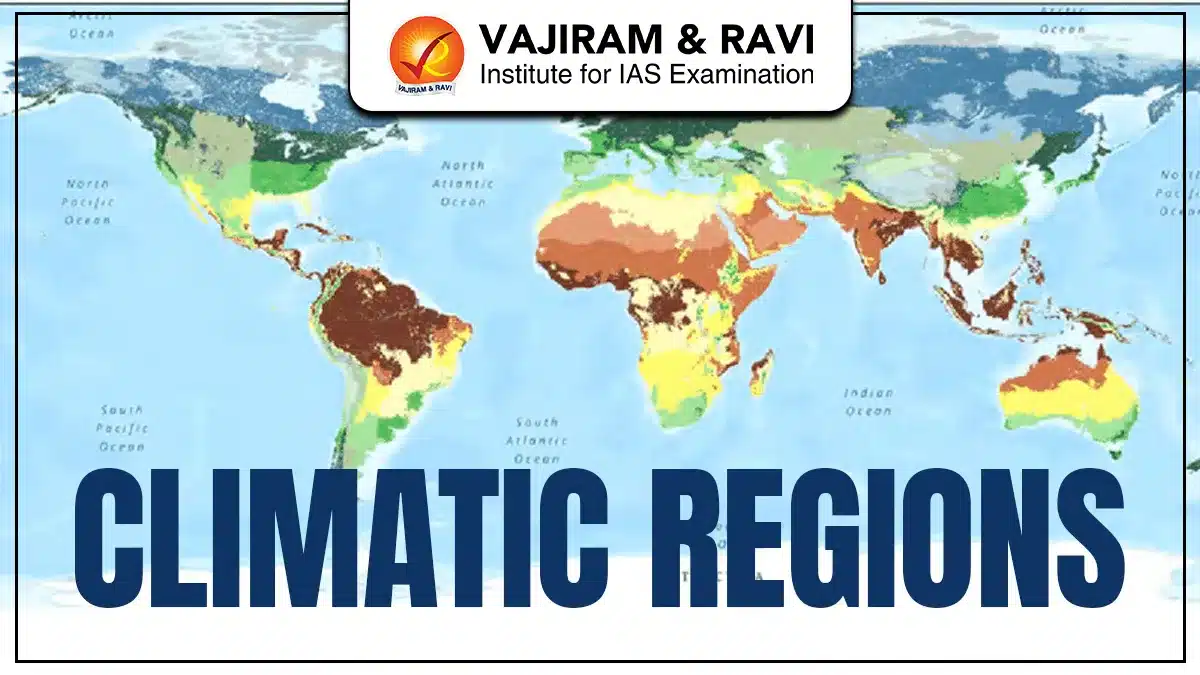
Climatic regions are large areas of the Earth that experience similar long term atmospheric conditions, including temperature range, rainfall pattern, seasonality, and wind systems. Regions near the equator receive direct solar radiation and remain warm throughout the year, while polar regions receive oblique sunlight and remain cold. Elevation, distance from oceans, prevailing winds, vegetation cover, and ocean currents further modify regional climates, creating diverse climatic belts across continents and oceans. Climatic regions also explain why deserts, rainforests, grasslands, and tundra exist in specific belts.

Read about: Climate of India

Climatic Regions Classification

There are three globally accepted methods of classification of Climatic Regions given below:

  1. Koppen Climatic Classification: Developed by Wladimir Koppen, this system links climate with natural vegetation using mean monthly temperature and precipitation data, dividing the world into five major climatic groups labeled A, B, C, D and E. The classification uses temperature thresholds, seasonal rainfall patterns, and vegetation limits, making it empirical and widely applicable for mapping climatic regions across continents.
  2. Thornthwaite Climatic Classification: Proposed by C.W. Thornthwaite, it classifies climatic regions based on precipitation effectiveness and evapotranspiration, emphasizing water availability for plant growth. He introduced a moisture index comparing precipitation with potential evapotranspiration, helping identify wet, humid, sub-humid, semi-arid and arid climatic regions.
  3. Global Climatic Classification: This approach groups climatic regions into equatorial, tropical, temperate, polar and desert climates based on latitude, solar energy receipt, and global atmospheric circulation.

Climatic Regions of the World

Various Climatic Regions of the World with their location, characteristics and economic activities has been discussed here:

  1. Hot Wet Equatorial Climatic Region: Found between 5° - 10° latitudes, this region has uniform temperatures of 24 - 27°C and heavy rainfall exceeding 150 - 300 cm, supporting dense evergreen rainforests like the Amazon selvas.
  2. Tropical Monsoon Climatic Region: Located between 5° - 30° latitudes, it experiences high temperatures and seasonal rainfall from monsoon winds, supporting deciduous forests and intensive agriculture in South and Southeast Asia.
  3. Savanna (Sudan) Climatic Region: A transitional belt between equatorial forests and deserts, it has distinct wet and dry seasons, annual rainfall of 100 - 150 cm, and tall grasses with scattered deciduous trees.
  4. Hot Desert Climatic Region: Found between 15° - 30° latitudes, deserts like Sahara and Thar experience extreme temperatures, very low rainfall, high diurnal range, and xerophytic vegetation adapted to drought.
  5. Mediterranean Climatic Region: Located between 30° - 45° latitudes on western continental margins, it has hot dry summers and mild wet winters, supporting orchard farming, vineyards, and evergreen shrubs.
  6. Temperate Continental (Steppe) Climatic Region: Found in continental interiors, this region experiences temperature extremes, low rainfall, treeless grasslands, and extensive mechanized wheat cultivation.
  7. Warm Temperate Eastern Margin Climatic Region: Present on eastern continental margins, it has warm humid summers, cool winters, moderate rainfall, and supports crops like maize, cotton, tobacco, and rice.
  8. Cool Temperate Western Margin Climatic Region: Influenced by westerlies and ocean currents, it has mild temperatures, rainfall throughout the year, deciduous forests, and mixed farming systems.
  9. Cool Temperate Continental (Siberian) Climatic Region: Found between 50° - 70°N, it experiences long severe winters, short summers, coniferous taiga forests, and supports lumbering and fur trapping.
  10. Cool Temperate Eastern Margin (Laurentian) Climatic Region: A mix of maritime and continental influences, it has cold snowy winters, warm wet summers, dense forests, and major fishing and timber industries.
  11. Arctic or Polar Climatic Region: Located beyond Arctic and Antarctic Circles, it has extremely low temperatures, permafrost, tundra vegetation, and limited human activities due to harsh conditions.

Read about: Tropical Climate

Climatic Regions of India

The Climatic Regions of India based on the Koppen Classification Method has been discussed below:

  1. Tropical Monsoon with Short Dry Winter (Amw): Found along the western coast south of Mumbai, this region receives over 300 cm rainfall and supports dense tropical forests and plantation agriculture.
  2. Tropical Monsoon with Dry Summer (As): Present along the Coromandel Coast, this region receives winter rainfall of 75 - 100 cm from retreating monsoons, influencing rice cultivation.
  3. Tropical Savanna Climate (Aw): Covering most of peninsular India, it has seasonal rainfall around 75 cm and supports dry deciduous forests and mixed cropping.
  4. Semi-Arid Steppe Climate (BShw): Found in rain-shadow regions and parts of Rajasthan, Haryana, and Gujarat, it receives 12 - 25 cm rainfall and supports pastoralism.
  5. Hot Desert Climate (BWhw): Dominant in western Rajasthan, it receives less than 12 cm rainfall annually and has sparse xerophytic vegetation.
  6. Monsoon Climate with Dry Winters (Cwg): Covering the Ganga Plains and Assam, this region receives 100 - 200 cm rainfall and is India’s major agricultural belt.
  7. Cold Humid Climate (Dfc): Found in northeastern Himalayan regions, it experiences heavy rainfall around 200 cm and supports dense mountain forests.
  8. Tundra Climate (Et): Present in high altitude Himalayan regions, it has average temperatures between 0 - 10°C and limited vegetation.

Polar Climate (E): Found in higher Himalayan areas of Jammu and Kashmir and Himachal Pradesh, precipitation occurs as snow with extremely low temperatures.

Climatic Regions FAQs

Q1: What are Climatic Regions?

Ans: Climatic regions are large areas of the Earth that share similar temperature patterns, rainfall distribution, and seasonal weather conditions.

Q2: Which factor mainly determines Climatic Regions of the world?

Ans: Latitude is the primary factor, along with pressure belts, prevailing winds, ocean currents, and altitude.

Q3: Why do Equatorial Regions receive rainfall throughout the year?

Ans: Equatorial regions receive year round convectional rainfall due to intense heating and rising moist air near the Equator.

Q4: Which Climatic Region supports grassland vegetation instead of forests?

Ans: Temperate grassland regions support grasses due to moderate rainfall insufficient for dense forest growth.

Q5: Why is the Mediterranean Climate ideal for orchard farming?

Ans: The Mediterranean climate has dry summers and mild wet winters, favourable for crops like olives, grapes, and citrus fruits.

India-US Relations, Evolution, Challenges, Strategic Cooperation

India-US Relations

India-US Relations have evolved into a comprehensive strategic partnership, covering defence, trade, technology, and people-to-people ties. Over the years, both countries have strengthened political, economic, and security cooperation while collaborating on global and regional issues. Despite shared strategic interests, the relationship faces challenges in trade, technology, and foreign policy. Moving forward, sustained dialogue, mutual trust, and partnership in innovation and security can further deepen bilateral ties.

India-US Relations Evolution

  • Cold War Phase (1947-1991): Relations remained limited due to India’s non-aligned stance and closer ties with the Soviet Union, while the U.S. aligned with Pakistan during this period.
  • Post-Cold War Re-engagement (1991-2000): India’s economic liberalisation and the end of the Cold War opened new avenues for cooperation, particularly in trade and investment.
  • Strategic Breakthrough (2005-2008): The India-US Civil Nuclear Deal (2005) ended India’s nuclear isolation and symbolised mutual strategic trust.
  • Institutionalisation of Strategic Dialogue (2008-2015): Expansion of defence cooperation, regular strategic dialogues, and growing people-to-people ties strengthened bilateral engagement.
  • Major Defence Partner Status (2016): The U.S. designated India as a Major Defence Partner, enabling access to advanced defence technologies.
  • Foundational Agreements Era (2016-2020): Signing of LEMOA, COMCASA, and BECA enhanced interoperability, logistics support, and intelligence sharing.
  • Comprehensive Global Strategic Partnership (2020 onwards): Elevation of ties to a comprehensive partnership covering defence, technology, energy, climate change, and global issues.
  • Focus on Emerging Technologies & Indo-Pacific (Recent Years): Initiatives like iCET, Quad cooperation, and supply-chain resilience reflect the future-oriented nature of the partnership.

Read About: India China Relations

India-US Relations Political and Diplomatic

Political and diplomatic engagement forms the backbone of India-US relations, providing strategic direction and continuity to the partnership.

  • High-Level Political Visits: Frequent exchanges at the level of the Prime Minister of India and the U.S. President have strengthened mutual trust and delivered strategic outcomes. Leaders also interact regularly at G20 Summits, Quad Leaders’ Summits, and India-US-Japan Trilateral meetings.
  • Institutionalised Dialogue Mechanisms: A wide-ranging dialogue architecture provides long-term stability to the relationship, including:
    • India-US 2+2 Ministerial Dialogue (Foreign and Defence Ministers)
    • India-US Commercial Dialogue
    • Economic and Financial Partnership
    • Trade Policy Forum (TPF)
    • Strategic Energy Partnership
    • Homeland Security Dialogue
  • Strategic Coordination on Global Issues: India and the US closely consult on counter-terrorism, Indo-Pacific security, climate change, and global governance reforms, reflecting growing strategic convergence.
  • Multilateral and Minilateral Engagement: Both countries coordinate positions in forums such as the Quad, UN, G20, and WTO, enhancing their collective diplomatic influence.

India-US Relations Defence and Security Cooperation

Defence and security cooperation has emerged as a core pillar of the India-US strategic partnership, driven by shared security concerns, growing mutual trust, and convergence in the Indo-Pacific. Over the years, cooperation has expanded from limited engagement to deep military interoperability, defence trade, intelligence sharing, and joint operational coordination.

  • Defence Trade and Technology Cooperation: The United States has become one of India’s leading defence suppliers, with defence procurements exceeding USD 15 billion. The Defence Technology and Trade Initiative (DTTI) promotes co-development and co-production of advanced defence technologies, aligning with India’s Make in India and Atmanirbhar Bharat goals.
  • Major Defence Partner Status: In 2016, the US designated India as a Major Defence Partner, facilitating access to advanced technologies and placing India on par with Washington’s closest defence allies in terms of technology sharing.
  • Foundational Defence Agreements:The signing of four key agreements has institutionalised defence cooperation and enhanced interoperability:
    • GSOMIA (2002): Protection of classified military information
    • LEMOA (2016): Logistics support for refuelling and replenishment
    • COMCASA (2018): Secure and encrypted military communications
    • BECA (2020): Sharing of geospatial intelligence and satellite data
  • Joint Military Exercises and Interoperability: India conducts more military exercises with the US than with any other country. Major exercises include Yudh Abhyas, Vajra Prahar, Cope India, and the Malabar naval exercise under the Quad framework, enhancing combat readiness and interoperability.
  • Maritime Security and Indo-Pacific Cooperation: Both countries cooperate in maritime domain awareness, anti-piracy operations, freedom of navigation, and humanitarian assistance and disaster relief (HADR), reinforcing a free and open Indo-Pacific.

Read About: India Pakistan Relations

India-US Relations Economic and Trade Ties

Economic and trade engagement is a key pillar of India-US relations, underpinned by growing market complementarities, investment flows, and innovation-driven cooperation.

  • Trade Volume and Composition: The U.S. is India’s largest trading partner, with bilateral trade covering pharmaceuticals, gems and jewellery, machinery, electronics, textiles, chemicals, and agricultural products. In 2024, India exported goods worth about USD 87.3 billion to the U.S., reflecting deepening economic interdependence.
  • Investment and Corporate Linkages: American firms are among the top investors in India, particularly in technology, defence, manufacturing, financial services, and clean energy. At the same time, Indian companies in IT, pharmaceuticals, steel, and automotive sectors have invested heavily in the U.S., generating jobs and innovation.
  • Technology, Innovation, and Supply Chains: Economic ties increasingly focus on semiconductors, digital trade, AI, and critical minerals, strengthening supply chain resilience and reducing over-dependence on single sources.
  • Challenges in Trade Relations: Persistent issues include tariff disputes, absence of a Free Trade Agreement, IPR concerns, regulatory barriers, and differences over data localisation and visa policies.

India-US Relations Science, and Space Cooperation

Science, technology, and space cooperation is a future-defining pillar of India-US relations, reflecting shared innovation-driven growth objectives and strategic trust.

  • Institutional Framework for S&T Cooperation: India-US collaboration is anchored in the Science and Technology Cooperation Agreement (2005), renewed for ten years in 2019.
  • Emerging and Critical Technologies: Both countries prioritise cooperation in artificial intelligence, quantum computing, semiconductors, biotechnology, cybersecurity, and advanced materials. The Initiative on Critical and Emerging Technologies (iCET) provides a strategic framework for government-industry-academia collaboration.
  • Research, Innovation and Academic Linkages: Extensive partnerships between universities, research institutions, and startups support joint R&D, skill development, and innovation ecosystems, strengthening long-term technological competitiveness.
  • Space Cooperation (ISRO-NASA Partnership): India and the US have a long history of cooperation in earth observation, satellite navigation, space science, and planetary exploration. The India-US Joint Working Group on Civil Space Cooperation regularly reviews progress and identifies new collaboration areas.
  • Future-Oriented Space Collaboration: ISRO and NASA are working together on Mars exploration, heliophysics, space situational awareness, and human spaceflight-related research, enhancing scientific capability and strategic trust.

India-US Relations Cooperation in Multilateral Forums

India and the United States closely cooperate in multilateral and minilateral forums to address global governance challenges, regional security, and economic stability.

  • Quadrilateral Security Dialogue (Quad): India, the US, Japan, and Australia work together to ensure Indo-Pacific security, uphold freedom of navigation, and cooperate on critical areas such as climate action, critical technologies, resilient supply chains, and quality infrastructure development.
  • I2U2 Group (India-Israel-UAE-US): This emerging minilateral platform focuses on practical economic cooperation, particularly in clean energy, food security, advanced technology, and infrastructure, linking South Asia, the Middle East, and the US.
  • Indo-Pacific Economic Framework for Prosperity (IPEF): A US-led initiative aimed at deepening economic engagement in the Indo-Pacific, with India playing a key role in pillars related to supply chains, clean energy, and fair economic practices.
  • Global Multilateral Institutions (UN, G20, WTO, IMF, World Bank): India and the US coordinate positions to reform global governance, promote inclusive and sustainable growth, and address transnational challenges such as pandemics, trade disruptions, financial stability, and development financing.
  • Minerals Security Partnership (MSP): India’s participation enhances critical mineral supply chain resilience, reduces dependence on single-source suppliers, and supports energy transition and advanced manufacturing goals.
  • Artemis Accords: Cooperation under the Artemis Accords strengthens peaceful and transparent space exploration, enabling collaboration in lunar exploration, space science, and the responsible use of outer space.

People-to-People Ties and Indian Diaspora in the US

  • Largest Skilled Diaspora: The Indian diaspora, about 4.8 million strong, is one of the most educated and economically influential communities in the US.
  • Technology & Innovation Linkages: Indian-origin engineers and scientists play a key role in Silicon Valley, AI, and startup ecosystems, strengthening tech cooperation.
  • Political Influence: Indian-Americans have growing representation in the US Congress, administration, and local governance, shaping pro-India policies.
  • Education & Academic Exchanges: Over 200,000 Indian students in the US enhance educational ties, research collaboration, and knowledge exchange.
  • Business & Investment Bridge: Indian-origin CEOs and entrepreneurs promote two-way investments, startups, and global value chains.
  • Cultural Diplomacy: Festivals, yoga, cinema, and cultural institutions promote soft power, mutual understanding, and societal goodwill.

India-US Relations Areas of Divergence and Challenges

  • Tariff Escalation & Trade Barriers: The U.S. has doubled tariffs on Indian goods to 50%, including punitive duties linked to India’s Russian oil purchases, impacting exports in sectors like textiles, gems, and seafood. 
  • Trade Deficit & Market Access Issues: The U.S.-India trade deficit rose to ~$45.8 billion in 2024-25, with deep disagreements over agricultural access, dairy, and non-tariff barriers, complicating bilateral economic talks.
  • H-1B Visa Policy Tensions: The U.S. introduced a $100,000 fee on H-1B visa applications, increasing costs for Indian IT firms and creating uncertainty for thousands of professionals amid processing delays.
  • Technology & Data Regulation Friction: India’s data localisation and digital policy frameworks continue to clash with U.S. demands for open cross-border data flows and stronger IP protections, affecting tech and digital services cooperation. (based on ongoing policy debates)
  • Geopolitical Divergence - Russia & Energy: Continued Indian imports of Russian crude have drawn U.S. trade threats and tariff pressure, reflecting deeper strategic differences over the Russia-Ukraine conflict and sanctions policy.
  • Strategic Autonomy vs U.S. Policy Expectations: India’s multi-aligned approach balancing ties with Russia, Iran, and Western partners, often contrasts with U.S. geopolitical priorities, creating diplomatic friction despite shared Indo-Pacific goals.

Way Forward for India-US Relations

  • Deepen Strategic Trust: Enhance high-level political dialogue and defence cooperation to manage differences while strengthening the Indo-Pacific partnership.
  • Resolve Trade & Economic Frictions: Pursue a balanced trade framework by addressing tariffs, market access, digital trade, and mobility issues (H-1B visas) through institutional mechanisms.
  • Strengthen Technology & Innovation Ties: Expand cooperation in semiconductors, AI, defence tech, clean energy, and space, ensuring mutually acceptable data governance and IP regimes.
  • Respect Strategic Autonomy: Acknowledge India’s multi-alignment approach while aligning on shared interests such as maritime security, supply chains, and regional stability.
  • People-to-People & Talent Mobility: Facilitate smoother movement of students, researchers, and professionals to sustain innovation-led growth and soft power linkages.

Cooperate on Global Challenges: Work together on climate action, global health, supply chain resilience, and reform of multilateral institutions to promote inclusive global governance.

India-US Relations FAQs

Q1: Why are India-US relations important for India?

Ans: India-US relations are crucial for economic growth, defence modernization, technology access, and maintaining a balance of power in the Indo-Pacific region.

Q2: What is the strategic significance of India-US relations?

Ans: Strategically, the partnership helps counter regional security challenges, especially China’s assertiveness, and supports a free, open, and rules-based Indo-Pacific order.

Q3: What are the key areas of cooperation between India and the US?

Ans: Major areas include defence and security, trade and investment, science and technology, space cooperation, counter-terrorism, climate change, and people-to-people ties.

Q4: What defence agreements have strengthened India-US relations?

Ans: Key agreements include GSOMIA, LEMOA, COMCASA, and BECA, which enhance logistics support, intelligence sharing, and military interoperability.

Q5: What are the main challenges in India-US relations?

Ans: Challenges include trade disputes, technology and data policy differences, visa and immigration issues, and divergences over foreign policy and strategic autonomy.

UPSC Daily Quiz 6 January 2026

UPSC Daily Quiz

[WpProQuiz 60]

UPSC Daily Quiz FAQs

Q1: What is the Daily UPSC Quiz?

Ans: The Daily UPSC Quiz is a set of practice questions based on current affairs, static subjects, and PYQs that help aspirants enhance retention and test conceptual clarity regularly.

Q2: How is the Daily Quiz useful for UPSC preparation?

Ans: Daily quizzes support learning, help in revision, improve time management, and boost accuracy for both UPSC Prelims and Mains through consistent practice.

Q3: Are the quiz questions based on the UPSC syllabus?

Ans: Yes, all questions are aligned with the UPSC Syllabus 2025, covering key areas like Polity, Economy, Environment, History, Geography, and Current Affairs.

Q4: Are solutions and explanations provided with the quiz?

Ans: Yes, each quiz includes detailed explanations and source references to enhance conceptual understanding and enable self-assessment.

Q5: Is the Daily UPSC Quiz suitable for both Prelims and Mains?

Ans: Primarily focused on Prelims (MCQ format), but it also indirectly helps in Mains by strengthening subject knowledge and factual clarity.

Adiabatic Lapse Rate, Definition, Type, Dry and Saturated Lapse Rates

Adiabatic Lapse Rate

The Adiabatic Lapse Rate (ALR) refers to the rate at which the temperature of an air parcel changes as it rises or descends in the atmosphere without exchanging heat with the surrounding air. This temperature change occurs due to the expansion and compression of air under varying atmospheric pressure. 

The concept is fundamental to understanding atmospheric stability, cloud formation, rainfall, and weather systems, making it highly relevant for UPSC Geography.

What is Adiabatic Lapse Rate?

The Adiabatic Lapse Rate is defined as the rate of temperature decrease (or increase) of an air parcel with altitude when the parcel does not gain or lose heat to its environment. It is expressed in degrees Celsius per 1,000 meters. This concept helps explain thunderstorm development, cloud height, orographic rainfall, and cyclonic systems.

Types of Adiabatic Lapse Rate

The Adiabatic Lapse Rate has two types based on moisture content.

1. Dry Adiabatic Lapse Rate (DALR)

  • Refers to the rate of temperature change in an unsaturated air parcel as it rises or descends in the atmosphere.
  • The temperature of dry air decreases at a constant rate of 9.8°C per 1,000 meters during ascent due to adiabatic expansion.
  • No condensation occurs because the air has not reached its dew point temperature.
  • Latent heat is not released, so cooling is rapid and uniform.
  • When the air descends, it warms at the same rate due to compression.
  • DALR is important in explaining mountain winds (foehn and chinook), clear-sky conditions, and the initial uplift of air masses.

2. Saturated / Moist Adiabatic Lapse Rate (SALR)

  • Applies when the rising air becomes saturated (relative humidity reaches 100%) and condensation begins.
  • The temperature decreases at a slower and variable rate, generally between 4°C and 7°C per 1,000 meters.
  • Latent heat of condensation is released during cloud formation, which offsets some of the cooling caused by expansion.
  • Due to varying moisture content, the SALR is not constant and changes with altitude and temperature.
  • Plays a vital role in cloud growth, precipitation, thunderstorms, cyclones, and monsoon rainfall.

What is Temperature Inversion?

Definition: Temperature inversion is a condition in which temperature increases with height, instead of decreasing as per the normal lapse rate, leading to atmospheric stability.

Cause: It occurs when cool air is trapped near the surface by an overlying layer of warmer air, preventing vertical mixing of air.

Radiation Inversion:

  • Develops during clear, calm nights when the Earth loses heat rapidly by radiation.
  • The ground cools faster than the air above it.
  • Example: Dense winter fog and smog in the Indo-Gangetic Plains.

Valley Inversion:

  • Cold, dense air flows downslope and accumulates in valleys.
  • Common in mountainous regions.
  • Example: Lower temperatures in Himalayan and Kashmir valleys.

Subsidence Inversion:

  • Occurs when air descends under high-pressure systems and warms by compression.
  • Produces dry and stable conditions.
  • Example: Clear skies in subtropical high-pressure belts.

Frontal Inversion:

  • Forms when warm air overrides colder air along a front.
  • Common in mid-latitude cyclones.
  • Example: Temperature inversion near warm fronts in temperate regions.

Impact on Environment:

  • Traps pollutants, smoke, and dust, worsening air quality.
  • Reduces rainfall and convection.
  • Example: Severe air pollution episodes in Delhi during winter.

What is Latent Heat?

  • Latent heat is the heat energy absorbed or released during a change of state without any change in temperature.
  • It becomes active during phase changes such as evaporation, condensation, melting, and freezing.
  • In the atmosphere, latent heat is absorbed during evaporation of water vapor.
  • It is released during condensation, warming the surrounding air.
  • It plays a key role in cloud formation, rainfall, thunderstorms, and cyclones.
  • Release of latent heat reduces the saturated adiabatic lapse rate.

Adiabatic Lapse Rate FAQs

Q1: What is the Adiabatic Lapse Rate?

Ans: It is the rate at which the temperature of an air parcel changes as it rises or descends without exchanging heat with the surrounding air.

Q2: Why is the SALR lower than the DALR?

Ans: Because latent heat is released during condensation, which partially offsets cooling in rising saturated air.

Q3: How does Adiabatic Lapse Rate differ from Environmental Lapse Rate?

Ans: ALR refers to a moving air parcel, while Environmental Lapse Rate (ELR) refers to the actual temperature change of the surrounding atmosphere with height.

Q4: What happens during a temperature inversion?

Ans: The temperature increases with height, trapping cooler air below, which can lead to fog, smog, and air pollution.

Q5: What is the significance of Adiabatic Lapse Rate?

Ans: It is crucial for understanding cloud formation, rainfall, cyclones, thunderstorms, and atmospheric stability.

North East Insurgency in India, Causes, Impacts, Insurgent Groups

North East Insurgency in India

The North East region of India, comprising eight states: Assam, Arunachal Pradesh, Manipur, Meghalaya, Mizoram, Nagaland, Tripura, and Sikkim, has long been affected by insurgency. These movements, rooted in ethnic, political, and economic grievances, have posed serious challenges to India’s security and development. Over the decades, various insurgent groups have operated in the region, demanding autonomy, independence, or special rights for their communities.

The article on North East Insurgency in India has been discussed below.

North East Insurgency in India

The North East Insurgency in India refers to armed movements by various ethnic and political groups seeking autonomy or separate statehood. It emerged due to factors such as ethnic diversity, economic backwardness, political alienation, and porous international borders. Over time, government measures like peace accords, development initiatives, and security operations have reduced insurgency, though challenges remain.

Causes of Insurgency in the North East

The insurgency in North East India has multiple overlapping causes:

  • Ethnic Diversity and Identity Politics – The region is home to more than 200 ethnic groups with distinct languages, cultures, and traditions. Many groups feel marginalized and demand recognition or autonomy.
  • Historical Neglect and Economic Backwardness – Lack of infrastructure, unemployment, and poor access to education and healthcare have fueled resentment among local populations.
  • Political Alienation – Some communities feel excluded from mainstream political processes, prompting demands for separate states or independence.
  • Illegal Migration – Migration from neighboring countries like Bangladesh has been a major flashpoint, particularly in Assam, leading to social tension and insurgent movements.
  • Cross-Border Support for Insurgents – Proximity to international borders with Myanmar, Bangladesh, and China has allowed insurgent groups to receive support and safe havens from across the border.
  • Exploitation of Natural Resources – Disputes over land, forests, and mineral resources have intensified conflicts between locals and the government.

Impact of Insurgency on Society and Economy

  • Loss of Lives and Displacement: Prolonged violence has resulted in civilian casualties, forced migration, and long-term displacement of local communities.
  • Economic Stagnation: Persistent instability discourages private investment, slows industrial growth, and limits tourism and trade in the region.
  • Unemployment and Poverty: Disruption of normal economic activities increases joblessness, making youth vulnerable to insurgent recruitment.
  • Damage to Infrastructure: Insurgent attacks on roads, bridges, railways, and public assets delay development and increase reconstruction costs.
  • Social Fragmentation: Ethnic tensions, mistrust, and fear weaken social cohesion and disrupt traditional community life.
  • Human Development Setbacks: Education and healthcare services are frequently interrupted, lowering literacy levels, health outcomes, and overall quality of life.

Government Policies and Counter-Insurgency Measures

  • Military Deployment: The Indian Army, Assam Rifles, and Central Armed Police Forces are actively deployed across insurgency-affected areas to maintain law and order and neutralize militant groups.
  • Key Counter-Insurgency Operations:
    • Operation All Clear successfully dismantled Assamese insurgent camps along the Indo-Bhutan border.
    • Operation Sunrise, conducted in coordination with Myanmar, targeted insurgent networks operating in Manipur and Nagaland, significantly weakening cross-border militant infrastructure.
  • Cross-Border Coordination: India has strengthened cooperation with Bangladesh and Myanmar to curb the movement of insurgents, dismantle ULFA camps, and prevent illegal arms trafficking.

Dialogue and Negotiation

  • Peace Accords: Landmark agreements such as the Mizo Peace Accord (1986) and the Bodo Peace Accord (2020) led to the surrender of over 1,500 militants and included a ₹1,500 crore development package for socio-economic upliftment.
  • Ceasefire Arrangements: Ceasefire agreements with groups like NSCN were extended up to 2023, helping sustain peace and facilitate political dialogue in Nagaland.
  • Community Rehabilitation:
    • The Bru Accord (2020) enabled the permanent resettlement of displaced Bru families.
    • The Karbi Anglong Peace Agreement (2021) ended decades-long insurgency in the region.
    • Rehabilitation schemes provide financial assistance, skill training, and livelihood support to surrendered militants.

Structural Autonomy

  • State Reorganization: States such as Meghalaya, Nagaland, and Mizoram were carved out of Assam, while Manipur and Tripura were upgraded from Union Territories to states, ensuring greater political autonomy.
  • Constitutional Safeguards:
    • Article 244(2) establishes Autonomous District and Regional Councils under the Sixth Schedule.
    • Article 371(A) grants special constitutional protections to Nagaland, preserving customary laws and practices.
  • Economic Autonomy: Special administrative and economic packages support decentralized governance and region-specific development.

Development Initiatives

  • Institutional Framework: The Ministry of Development of North Eastern Region (MDoNER) acts as the central nodal agency for coordinating socio-economic development.
  • Industrial & Trade Connectivity: The North-East Industrial Corridor, linking Dawki (Meghalaya) to Moreh (Manipur), aims to boost trade, investment, and regional integration.
  • Infrastructure Development: Strategic projects such as the Bogibeel Rail-cum-Road Bridge, Bhupen Hazarika Bridge, and Daporijo Bridge (Arunachal Pradesh) have significantly improved connectivity.
  • Social and Economic Programs:
    • NESIDS and World Bank-assisted NERLP focus on livelihood generation and infrastructure creation.
    • The UDAN scheme enhances air connectivity, reducing isolation of remote areas.
  • AFSPA Rationalisation: AFSPA has been fully withdrawn from Meghalaya and partially reduced in Arunachal Pradesh, reflecting improved security conditions and efforts to strengthen civil-military relations.

Challenges

  • Porous International Borders: The North East shares nearly 5,500 km of international borders with five countries, making it vulnerable to insurgent movement, illegal arms trafficking, and cross-border support networks.
  • Economic Backwardness: Despite being resource-rich, the region faces high unemployment, inadequate infrastructure, and low industrial growth, allowing insurgency to function as an alternative economic “industry” for marginalized youth.
  • Geographical Constraints: Mountainous terrain, dense forests, and poor connectivity restrict mobility of security forces and complicate sustained counter-insurgency operations.
  • Political Alienation: Perceptions of central neglect, delayed implementation of autonomy provisions, and ineffective execution of development schemes continue to fuel discontent.
  • Fragmentation of Insurgent Groups: The presence of multiple outfits such as NSCN, ULFA, and NDFB, often divided into rival factions, leads to inter-group violence and undermines peace processes.

Way Forward

  • Strengthen Border Management: Enhance border fencing, surveillance technologies (drones, sensors), and intelligence sharing with neighboring countries to curb cross-border movement of insurgents and arms.
  • Inclusive Economic Development: Promote region-specific industrialization, skill development, and employment generation to address economic backwardness and reduce the appeal of insurgency.
  • Effective Implementation of Autonomy Provisions: Ensure timely and transparent execution of Sixth Schedule and Article 371 safeguards to address political alienation and strengthen local self-governance.
  • Sustained Political Dialogue: Continue negotiations with all insurgent factions, including splinter groups, to achieve comprehensive and lasting peace settlements.
  • Infrastructure and Connectivity Push: Accelerate road, rail, digital, and air connectivity projects to integrate remote areas with national markets and administrative systems.

North East Insurgency in India FAQs

Q1: What is meant by insurgency in North East India?

Ans: Insurgency in North East India refers to armed movements by various groups seeking autonomy, separate statehood, or independence, driven by ethnic identity, political grievances, and economic neglect.

Q2: Which states of the North East are most affected by insurgency?

Ans: Assam, Manipur, Nagaland, and Tripura have historically been the most affected, though the intensity of insurgency has declined significantly in recent years.

Q3: What are the main causes of insurgency in the North East?

Ans: Key causes include ethnic diversity, political alienation, economic backwardness, porous international borders, illegal migration, and weak implementation of development policies.

Q4: How has the Indian government responded to North East insurgency?

Ans: The government has adopted a multi-pronged strategy involving security operations, peace accords, political dialogue, development initiatives, and selective application of AFSPA.

Q5: What is the role of AFSPA in countering insurgency?

Ans: AFSPA provides special powers to the armed forces in disturbed areas to maintain law and order, though its application has been gradually reduced as security conditions improve.

Suryastra Rocket System

Suryastra Rocket System

Suryastra Rocket System Latest News

Recently, the Indian Army has signed a ₹293 crore contract with private defence manufacturer NIBE Limited, in collaboration with Israel, for the supply of suryastra rocket launcher system. 

About Suryastra Rocket System

  • It is India’s first indigenous universal multi-calibre rocket launcher system.
  • Developed by: It is developed by Pune-based NIBE Limited in collaboration with Israel’s Elbit Systems. 

Key Features of Suryastra Rocket System

  • It is an advanced long-range rocket launcher system.
  • Range: It is capable of executing precision surface-to-surface striking targets at ranges of 150 and 300 kilometers. 
  • Multi-target Capability: It is designed to engage multiple targets simultaneously at varying ranges.
  • Precision: It achieves a high degree of accuracy with a circular error probable (CEP) of less than five metres during trials.
  • The same launcher is also capable of firing loitering munitions up to a range of 100 km.
  • Technology used: The system is based on Elbit Systems’ PULS (Precise & Universal Launching System) launcher technology.
  • It is equipped with a modern fire control system that integrates GPS, inertial navigation, and digital ballistic computation.
  • Its semi-automated reload and shoot-and-scoot capabilities reduce exposure to counter-battery fire.

Source: TH

Suryastra Rocket System FAQs

Q1: What is the range of Suryastra?

Ans: 150 km and 300 km

Q2: What is the precision of Suryastra?

Ans: Circular Error Probable (CEP) of 5 meters

Industrial Research and Development Promotion Program

Industrial Research and Development Promotion Program

Industrial Research and Development Promotion Program Latest News

Recently, the government announced relaxation for deep-tech startups to avail recognition under Department of Scientific and Industrial Research’s (DSIR) Industrial Research and Development Promotion Program.

About Industrial Research and Development Promotion Program

  • It is a research and Development programme of the Department of Scientific and Industrial Research, Govt. of India.
  • Focus Area: Engineering Science, Environment Science, Natural and Applied sciences, Agricultural, Medical and Social sciences
  • Funding Agency: Department of Scientific and Industrial Research (DSIR), Govt. of India
  • Eligibility Criteria 
    • The applicant should be a company registered under the Companies Act, 1956 or 2013.
    • The company shall be eligible for consideration only after the completion of three financial years after formation.
    • The applicant should have a regular source of income at least during the last two years.
    •  The companies seeking recognition for their in-house R&D units should be engaged in manufacture or production.
    • The R&D unit(s) should be located in non -residential areas.

Key Facts about the Department of Scientific and Industrial Research

  • It was established in 1985.
  • Nodal Ministry: It functions under the Ministry of Science and Technology.
  • Mandate: It has a mandate to carry out the activities relating to indigenous technology promotion, development, utilization and transfer.
  • Functions of Department of Scientific and Industrial Research
    • It focuses on the promotion, development, deployment, and transfer of indigenous technologies.
    • It actively collaborates with industry, academic institutions, research organizations, and government agencies to nurture a robust, innovation-led ecosystem.

Source: PIB

Industrial Research and Development Promotion Program FAQs

Q1: What is the primary objective of the Industrial Research and Development Promotion Program (IRDPP)?

Ans: To support industrial research and development

Q2: Which department is responsible for implementing the IRDPP?

Ans: Department of Scientific and Industrial Research (DSIR)

Popocatépetl Volcano

Popocatépetl Volcano

Popocatépetl Volcano Latest News

Recently, a team of scientists obtained the first 3D images from inside Mexico's Popocatépetl volcano.

About Popocatépetl Volcano

  • Popocatépetl means "Smoking Mountain” in the Aztec Nahuatl language.
  • Location: It is located in central Mexico roughly 45 miles (72 kilometers) southeast of Mexico City. 
  • It is on the border of the states of México and Puebla.
  • The volcano lies on the Trans-Mexican Volcanic Belt, which is the result of the small Cocos Plate subducting beneath the North American Plate.
  • It is one of Mexico's most active volcanoes, with recorded eruptions since 1519.
  • Elevation: It is a steep-sided stratovolcano that rises to an elevation of 5452 m (17,883 ft) above sea level. 
  • Popocatépetl is one of the most dangerous volcanoes in the Ring of Fire.

What is Stratovolcano?

  • It is a tall, steep, and cone-shaped type of volcano.
  • They are typically found above subduction zones, and they are often part of large volcanically active regions, such as the Ring of Fire that frames much of the Pacific Ocean.
  • They comprise the largest percentage (~60%) of the Earth’s individual volcanoes.
    • These more viscous lavas allow gas pressures to build up to high levels. Therefore, these volcanoes often suffer explosive eruptions. 
  • They are usually about half-half lava and pyroclastic material, and the layering of these products gives them their other common name of composite volcanoes.
  • At the peak, stratovolcanoes usually have a small crater.

Source: TH

Popocatépetl Volcano FAQs

Q1: Where is Popocatépetl Volcano located?

Ans: Mexico

Q2: What is another name for a Strato Volcano?

Ans: Composite Volcano

C-Reactive Protein (CRP)

C-Reactive Protein (CRP)

C-Reactive Protein (CRP) Latest News

Accumulating evidence over the past two decades demonstrates that a biomarker called C-reactive protein – which signals the presence of low-grade inflammation – is a better predictor of risk for heart disease than cholesterol.

About C-Reactive Protein (CRP)

  • It is a protein made by the liver.
  • The level of CRP increases when there's inflammation in the body. 
    • Inflammation is your body's way of protecting your tissues and helping them heal from an injury, infection, or other disease.
  • A CRP test measures the level of CRP in your blood. 
  • By measuring the levels of CRP in your blood, a CRP test can tell your health care provider how much inflammation you have in your body. 
  • High CRP levels may mean you have an acute or chronic health condition, such as:
    • Infections from bacteria or viruses.
    • Inflammatory bowel disease, disorders of the intestines that include Crohn's disease and ulcerative colitis.
    • Autoimmune disorders, such as lupus, rheumatoid arthritis, and vasculitis.
    • Lung diseases, such as asthma.
  • Smoking and exposure to environmental toxins such as polluted air and hazardous waste can also cause high CRP levels.

Source: LS

C-Reactive Protein (CRP) FAQs

Q1: What is C-reactive protein (CRP)?

Ans: It is a protein made by the liver.

Q2: When do C-reactive protein (CRP) levels increase in the body?

Ans: CRP levels increase when there is inflammation in the body.

Q3: What can a C-reactive protein (CRP) test tell a health care provider?

Ans: It can indicate how much inflammation is present in the body.

Q4: What does high C-reactive protein (CRP) levels indicate?

Ans: High CRP levels may indicate either an acute or chronic health condition.

Socotra Island

Socotra Island

Socotra Island Latest News

Hundreds of tourists are stuck on the Yemeni island of Socotra after flights were grounded over clashes on the mainland.

About Socotra Island

  • It is an island in the Indian Ocean about 340 km southeast of Yemen, to which it belongs. 
  • The largest of several islands extending eastward from the Horn of Africa, Socotra has an area of about 3,600 sq.km.
  • The Hajhir Mountains occupy Socotra’s interior, whereas narrow coastal plains lie in the north and a broader plain in the south. 
  • To the southwest and west are the smaller islands of Samḥah and Darzah, called al-Ikhwān (“the Brothers”), and ʿAbd al-Kūrī, all of which also belong to Yemen. 
  • The island has a total population of around 70,000 people who speak their Socotri language. 
  • Apart from the main town of Hadibo, there exists little infrastructure on the island.
  • It broke off from the Arabian Peninsula some 80 million years ago and is often called the "Galápagos of the Indian Ocean." 
  • Socotra is a treasure trove of endemic flora and fauna, meaning they are found nowhere else on Earth. 
  • For example: 37% of Socotra’s 825 plant species, 90% of its reptile species,  and 95% of its land snail species do not occur anywhere else in the world.
  • In 2008, Socotra was recognised as a UNESCO World Heritage Site.

Source: ET

Socotra Island FAQs

Q1: Where is Socotra Island located?

Ans: It is located in the Indian Ocean about 340 km southeast of Yemen.

Q2: To which country does Socotra Island belong?

Ans: Socotra belongs to Yemen.

Q3: Which mountain range occupies the interior of Socotra?

Ans: The Hajhir Mountains occupy the interior of Socotra.

Q4: What nickname is given to Socotra due to its unique biodiversity?

Ans: It is called the “Galápagos of the Indian Ocean.”

Q5: Why is Socotra considered a biodiversity hotspot?

Ans: Because it has high levels of endemic flora and fauna found nowhere else on Earth.

Calamaria Mizoramensis

Calamaria Mizoramensis

Calamaria Mizoramensis Latest News

A new species of reed snake was recently found in Mizoram, which the researchers named after the state where it was found, calling it Calamaria Mizoramensis.

About Calamaria Mizoramensis

  • It is a new species of non-venomous reed snake.
  • It was discovered in Mizoram.
  • The new species is nocturnal and semi-fossorial, inhabiting humid, forested hill environments.
  • Habitats of C. Mizoramensis have been recorded at elevations ranging from 670 to 1,295 metres above sea level, including locations close to human settlements.
  • The new species is small with a dark brown to blackish body with faint stripes and a yellow underside.
  • Its occurrence in other parts of India remains unverified, but it is likely to be present in adjoining states such as Manipur, Nagaland, and Assam.

Key Facts about Reed Snakes

  • They are small, slender, non-venomous snakes.
  • They belong to the genus Calamaria.
  • Family: Colubridae
  • They are found in southern and southeastern Asia. 
  • Mostly found in:
    • Moist forests
    • Leaf litter
    • Under logs, stones, and soil
  • They are fossorial/semi-fossorial – spend most of their time underground or hidden in leaf litter.
  • Typically brown, reddish, or blackish in color.
  • They eat small, soft-bodied invertebrates.

Source: HT

Calamaria Mizoramensis FAQs

Q1: What is Calamaria mizoramensis?

Ans: It is a new species of non-venomous reed snake.

Q2: Where was Calamaria mizoramensis discovered?

Ans: It was discovered in Mizoram.

Q3: Is Calamaria mizoramensis nocturnal?

Ans: Yes, it is a nocturnal species.

Q4: In what type of environment does Calamaria mizoramensis live?

Ans: It inhabits humid, forested hill environments.

Q5: What are the key physical features of Calamaria mizoramensis?

Ans: It is small, with a dark brown to blackish body with faint stripes and a yellow underside.

Dnyanganga Wildlife Sanctuary

Dnyanganga Wildlife Sanctuary

Dnyanganga Wildlife Sanctuary Latest News

A tiger cub identified as PKT7CP1, rescued three years ago, has been recently sent to Dnyanganga Wildlife Sanctuary in Maharashtra's Buldhana district for rewilding.

About Dnyanganga Wildlife Sanctuary

  • It is located in the Buldhana district of Maharashtra, near the Dnyanganga River. 
  • It is part of the Melghat Tiger Reserve.
  • Spanning around 205 sq.km., the sanctuary features two lakes.
  • Thе sanctuary is bordеrеd by thе scеnic hills of thе Wеstеrn Ghats, which is a UNESCO World Hеritagе Sitе.
  • The terrain is undulating, interspersed with hillocks having gentle slopes.
  • It has a very extreme climate; the winters are very cold, whereas the summers are very hot. 
  • Flora: The forest area is Southern tropical dry deciduous forest, consisting mainly of Teak and Anjan.
  • Fauna
    • The sanctuary is home to diverse wildlife, including leopards, sloth bears, barking deer, blue bulls (nilgai), spotted deer, hyenas, jungle cats, jackals, and occasionally tigers.
    • Over 150 bird species also inhabit the area.

Source: DEVD

Dnyanganga Wildlife Sanctuary FAQs

Q1: Where is Dnyanganga Wildlife Sanctuary located?

Ans: It is located in the Buldhana district of Maharashtra, near the Dnyanganga River.

Q2: Is Dnyanganga Wildlife Sanctuary part of the Melghat Tiger Reserve?

Ans: Yes, it is part of the Melghat Tiger Reserve.

Q3: What is the total area of Dnyanganga Wildlife Sanctuary?

Ans: It spans around 205 sq.km.

Q4: What type of terrain is found in Dnyanganga Wildlife Sanctuary?

Ans: The terrain is undulating and interspersed with hillocks having gentle slopes.

Q5: What type of forest characterizes Dnyanganga Wildlife Sanctuary?

Ans: It consists of Southern tropical dry deciduous forest.

Rice Crop

Rice Crop

Rice Crop Latest News

Recently, the Union Agriculture Minister said India’s rice production has reached 150.18 million tonnes, compared to China’s 145.28 million tonnes.

About Rice Crop

  • Rice is a tropical crop and the staple food for the majority of the Indian population.
  • Growing Season: It is primarily a Kharif crop, grown during the southwest monsoon season (June to October) but it can also be cultivated in Rabi and summer seasons under assured irrigation.

Required Climatic Conditions for Rice Crop

  • Rice is grown under varying conditions in India from 8°N to 30°N latitude and from sea level to about 2,500 metre altitude. 
  • The average annual rainfall required for rice is 150 cm.
  • Temperature: Between 25°C and 35°C.
  • Soil: It can be grown on a variety of soils including silts, loams and gravels and can tolerate acidic as well as alkaline soils.
  • The crop requires standing water (10-12 cm deep) during most of its growing season.
  • Major Rice Producing states: It is most commonly cultivated in states such as West Bengal, Uttar Pradesh, Punjab, Andhra Pradesh, Tamil Nadu, Bihar, Odisha, and Assam.
  • Nutrition: It has a higher nutritional value and is rich in Vitamins A, B, and calcium.

Source: News On Air

Rice Crop FAQs

Q1: Which is a major rice-producing state in India?

Ans: West Bengal

Q2: What is the primary season for rice cultivation in India?

Ans: Kharif

OPEC+

OPEC+

OPEC+ Latest News

Recently, the Organization of the Petroleum Exporting Countries (OPEC)+ has agreed in principle to maintain steady oil output despite rising political tensions among key members and widening geopolitical uncertainty. 

About OPEC+

  • It is the alliance of major oil-exporting nations. 
  • It is an extension of the Organization of the Petroleum Exporting Countries formed in 2016.
  • It consists of 22 oil-exporting countries which meet regularly to decide how much crude oil to sell on the world market.
  • Members of OPEC+: It comprises 12 OPEC countries plus Azerbaijan, Bahrain, Brunei, Kazakhstan, Russia, Mexico, Malaysia, South Sudan, Sudan, and Oman.
  • These nations aim to work together on adjusting crude oil production to bring stability to the oil market.

Key Facts about Organization of the Petroleum Exporting Countries

  • It is a permanent intergovernmental organization of oil-exporting countries.
  • It was established in 1960 by the five founding members Iran, Iraq, Kuwait, Saudi Arabia, and Venezuela. 
  • Currently, it has 12 members, including Algeria, Congo, Equatorial Guinea, Gabon, Libya, Nigeria, and the United Arab Emirates.
  • Angola withdrew its membership effective 1 January 2024.
  • Headquarters: Vienna, Austria.

Source: News on Air

OPEC+ FAQs

Q1: When was OPEC+ formed?

Ans: 2016

Q2: What is the primary goal of OPEC+?

Ans: To stabilize global oil prices

Justice Mission 2025

Justice Mission 2025

Justice Mission 2025 Latest News

China's military moved army, naval, air force, and artillery units around ​Taiwan recently for its "Justice Mission 2025" drills.

About Justice Mission 2025

  • It is a large-scale inter-service military exercise by China around Taiwan.
  • It involves coordinated ground, air, navy, and missile units. 
  • The activities focussed on "sea-air combat readiness patrol, joint seizure of comprehensive superiority, blockade on key ports and areas, as well as all-dimensional deterrence outside the island chain.
  • The drills aim to test joint combat capabilities and serve as a warning against "Taiwan independence" and external interference, asserting China's sovereignty over the island.
  • Beijing claims Taiwan as part of its sovereign territory and has refused to rule out using military action to seize the island democracy.
  • The exercise follows large-scale arms sales to Taiwan valued at more than USD 10 billion by the United States, Taiwan's main security backer.

Source: HBL

Justice Mission 2025 FAQs

Q1: What is Justice Mission 2025?

Ans: It is a large-scale inter-service military exercise by China around Taiwan.

Q2: What is the main objective of Justice Mission 2025?

Ans: The drills aim to test joint combat capabilities and warn against “Taiwan independence” and external interference.

Q3: What claim does China assert through Justice Mission 2025 exercise?

Ans: China asserts its sovereignty over Taiwan.

Daily Editorial Analysis 6 January 2026

Daily Editorial Analysis

Indian Aviation Safety, Its Dangerous Credibility Deficit

Context

  • Aviation safety is founded on the principle that even a single loss of life is unacceptable.
  • This conviction underpins the global framework established by the International Civil Aviation Organization (ICAO), which stresses collective responsibility and openness.
  • The crash of Air India Flight 171 in June 2025 highlights a disturbing gap between these principles and their implementation in India, raising serious concerns about transparency, regulatory independence, and international credibility.

ICAO Principles and the Centrality of Transparency

  • ICAO recognises aviation as an interconnected global system in which a failure in one state affects all others.
  • Transparency and the free exchange of safety information are essential to collective action, effective regulation, and public confidence.
  • Annex 13 mandates independent, non-punitive accident investigations focused solely on preventing future occurrences.
  • India, as an ICAO signatory, is obligated to uphold these standards. However, the handling of the AI 171 investigation reflects a retreat from openness, replacing clarity with delay and ambiguity, thereby weakening trust in the investigative process.

The AI 171 Crash and Troubling Indicators

  • AI 171 crashed within a minute of take-off from Ahmedabad, killing 241 passengers and 19 people on the ground.
  • The rapid recovery of the Cockpit Voice Recorder (CVR) and Digital Flight Data Recorder (DFDR), with assistance from the U.S.
  • National Transportation Safety Board (NTSB), underscored the gravity of the event.
  • The need for commando protection for the chief investigator further suggested the sensitivity of the findings.
  • The preliminary report, released a month later, raised more questions than it answered.
  • It confirmed that both engine fuel control switches moved to cut-off seconds after lift-off and recorded a brief cockpit exchange denying intentional action.
  • Since these switches require deliberate mechanical movement, the absence of detailed analysis is deeply concerning.
  • The CVR and DFDR should conclusively reveal cockpit actions, crew roles, and ambient cues during the critical seconds, particularly with NTSB expertise available.
  • The lack of clarity points to reluctance in addressing uncomfortable conclusions.

International Friction and Political Interference

  • Serious differences reportedly emerged between Indian authorities and international investigators.
  • The NTSB’s strictly technical mandate leaves no room for political influence, and resistance to altering findings appears to have strained cooperation.
  • This breakdown has been described by experienced safety officials as unprecedented.
  • Such discord undermines assurances of a truthful and transparent investigation.
  • In aviation safety, credibility is earned through impartiality and openness, not national defensiveness.
  • Political interference compromises both the integrity of the investigation and India’s standing within the global aviation community.

A Pattern of Regulatory Weakness

  • The AI 171 case reflects long-standing systemic issues. After the 2010 Mangalore crash, official claims of ICAO compliance were contradicted by later findings of concealed safety violations.
  • Following the 2020 Kozhikode crash, promised corrective actions remain largely unimplemented years later.
  • The Directorate General of Civil Aviation (DGCA) has repeatedly yielded to political and commercial pressure, delaying enforcement of safety requirements and granting repeated extensions.
  • The mishandling of the AI 171 crash site, where evidence was compromised and flights resumed without adequate rescue and fire-fighting services, further illustrates institutional failure and disregard for established safety protocols.

Information Vacuum and Misinformation

  • Delayed and ambiguous communication has created fertile ground for misinformation.
  • Speculative narratives, particularly on social media, have misrepresented technical systems such as ACARS and Inmarsat, which operate within encrypted and restricted frameworks.
  • In the absence of authoritative clarity, such claims gain traction despite lacking factual basis.
  • In contrast, Air India’s restraint in avoiding speculative commentary reflects responsible conduct, highlighting the obligation of investigative authorities to provide timely, accurate information.

Lessons from International Best Practices

  • International practice demonstrates a stark contrast. Following a UPS MD-11 cargo crash in November 2025, the NTSB conducted daily briefings, rapidly analysed recorder data, and coordinated with the Federal Aviation Administration (FAA).
  • Within days, the FAA issued an Emergency Airworthiness Directive grounding the aircraft type.
  • The absence of similar action after AI 171 strongly indicates that international regulators do not believe a systemic defect exists in the Boeing 787.
  • This suggests that the probable cause lies elsewhere, knowledge that, if withheld, only deepens suspicion about the investigation’s integrity.

Conclusion

  • The tragedy of AI 171 extends beyond the crash itself to its aftermath. Lack of transparency, investigative delays, and the marginalisation of foreign expertise risk isolating India from the global aviation safety community.
  • Such isolation undermines diplomatic standing, regulatory credibility, and passenger confidence.
  • Aviation safety cannot coexist with secrecy or political interference.
  • To honour its responsibilities and restore trust, India must recommit to independent investigation, transparency, and meaningful regulatory reform. Failure to do so risks repeating history at an unacceptable human cost.

Indian Aviation Safety, Its Dangerous Credibility Deficit FAQs

 Q1. What core principle does ICAO emphasise for global aviation safety?
Ans. ICAO emphasises transparency and collective responsibility as the foundation of aviation safety.

Q2. What key issue did the AI 171 preliminary report fail to clarify?
Ans. The report failed to clearly explain the mechanical movement of both engine fuel control switches.

Q3. Why was international cooperation strained during the AI 171 investigation?
Ans. Cooperation was strained due to political interference and disagreements over technical findings.

Q4. What recurring weakness is highlighted in India’s aviation safety system?
Ans. The analysis highlights regulatory weakness and susceptibility to political pressure.

Q5. What lesson does international best practice offer after aviation accidents?
Ans. International best practice shows that rapid transparency and decisive regulatory action improve safety.

Source: The Hindu


The Parallel Track That Keeps U.S.-India Ties Going

Context

  • India–United States relations in 2025 reflect a complex and paradoxical phase.
  • While political engagement has been strained by economic disputes, shifting strategic priorities, and the postponement of the Quad Leaders’ Summit scheduled to be hosted by India, the underlying architecture of cooperation remains strong.
  • This contrast highlights a dual-track dynamic in bilateral relations, where political uncertainty coexists with expanding institutional collaboration.
  • Defence, technology, and multilateral mechanisms continue to anchor the partnership, demonstrating that strategic depth extends beyond summit diplomacy.

Political and Economic Frictions

  • Bilateral tensions have been driven largely by trade and tariff disputes, particularly U.S. sanctions related to India’s purchase of Russian crude oil.
  • These measures have coincided with a sharp decline in Indian exports to the U.S. in 2025, underscoring the economic cost of political friction.
  • The delayed Quad Leaders’ Summit and limited official communication further reflect this uneasy phase.
  • India’s concerns are compounded by Washington’s growing engagement with Pakistan and comparatively lower tariff barriers for both Pakistan and China.
  • S. cooperation with Islamabad, centred on port access and critical mineral supply chains, signals a pragmatic approach rooted in immediate geopolitical and economic interests.
  • From New Delhi’s perspective, this reinforces apprehensions about shifting U.S. priorities and the possibility of a U.S.-China accommodation.
  • Nevertheless, American officials continue to emphasise India’s strategic importance, indicating recalibration rather than disengagement.

Sustained Institutional and Multilateral Engagement

  • Despite strained political signals, institutional cooperation has continued to expand.
  • The July 2025 Quad Foreign Ministers’ Meeting in Washington launched initiatives covering maritime security, counterterrorism, economic cooperation, critical technologies, and humanitarian assistance.
  • The Quad Counterterrorism Working Group’s third meeting in December 2025 further reinforced the grouping’s functionality and Quad’s operational relevance beyond leadership-level summits.
  • High-level visits by India’s External Affairs Minister S. Jaishankar and the Indian Navy Chief to the United States fit within this broader pattern of sustained engagement.
  • These interactions signal continuity and reaffirm commitment to long-term collaboration, even amid diplomatic caution.

Defence Cooperation as the Cornerstone

  • Defence cooperation remains the most stable pillar of the relationship and the defence cooperation cornerstone of bilateral ties.
  • Since the 2008 civil nuclear agreement, defence and security frameworks have steadily deepened.
  • Foundational agreements such as LEMOA, COMCASA, and BECA have enabled logistical support, secure communications, and intelligence sharing, significantly enhancing military interoperability.
  • This momentum continued with the Initiative on Critical and Emerging Technologies and the India-U.S. Defence Acceleration Ecosystem (INDUS-X).
  • A major milestone was the signing of a 10-year Defence Framework Agreement in October 2025, institutionalising long-term coordination, information sharing, and technological collaboration aimed at strengthening Indo-Pacific stability.
  • Regular military exercises, including Yudh Abhyas, Tiger Claw, and Malabar, continue to deepen trust and operational synergy between the armed forces.

Expanding Technological and Industrial Collaboration

  • Beyond defence operations, bilateral cooperation has expanded into industrial and technological domains.
  • Hindustan Aeronautics Limited’s billion-dollar agreement with General Electric for fighter jet engines highlights growing defence-industrial integration.
  • The joint NASA–ISRO NISAR satellite launch in July 2025 further reflects advanced technological cooperation, supporting disaster management, agricultural planning, and infrastructure resilience.
  • At the regional level, the Quad Ports of the Future Conference held in Mumbai in November 2025 underscored the importance of technology and infrastructure cooperation.
  • With participation from 24 Indo-Pacific partners, the initiative highlighted quality, secure, and resilient port infrastructure as a strategic priority, linking connectivity with economic security and regional development.

Conclusion

  • India-U.S. relations in 2025 demonstrate significant institutional resilience despite political headwinds.
  • While leadership-level engagement faces constraints from economic disputes and geopolitical recalibrations, cooperation continues through strong bureaucratic frameworks, reflecting bureaucratic continuity and shared strategic interests.
  • Looking ahead, sustaining this momentum will require deeper institutional understanding beyond defence, including regulatory alignment, technological integration, and expanded sectoral cooperation.
  • Ultimately, the durability of the partnership will rest on its capacity to preserve a long-term strategic partnership that can withstand short-term political volatility while remaining responsive to an evolving global order.

The Parallel Track That Keeps U.S.-India Ties Going FAQs

 Q1. Why do India–U.S. relations appear strained in 2025?
Ans. India–U.S. relations appear strained due to trade disputes, tariffs, and shifting U.S. geopolitical priorities.

Q2. What explains the delay of the Quad Leaders’ Summit?
Ans. The Quad Leaders’ Summit was delayed due to political and economic tensions affecting bilateral relations.

Q3. Which area remains the strongest pillar of India–U.S. cooperation?
Ans. Defence cooperation remains the strongest pillar of India–U.S. bilateral relations.

Q4. How has institutional cooperation continued despite political strains?
Ans. Institutional cooperation has continued through defence agreements, multilateral mechanisms, and regular high-level engagements.

Q5. What will determine the future resilience of India–U.S. relations?
Ans. The future resilience of India–U.S. relations will depend on deeper institutional understanding and expanded cooperation beyond defence.

Source: The Hindu


Venezuela, US Power Play and India’s Latin America Opportunities

Context

  • The dramatic US intervention involving the seizure of Venezuelan President Nicolás Maduro marks a significant shift in Washington’s Latin America policy.
  • Unlike earlier efforts aimed at outright regime change, the current US strategy appears focused on “regime seduction”—co-opting the existing power structure to realign Venezuela geopolitically.
  • This development has wider implications for great power rivalry, regional politics in Latin America, and India’s foreign policy priorities.

Key Developments

  • Nature of the US intervention

    • Trump’s move is among the most audacious US actions in Latin America in recent decades.
    • Strategy focuses on co-opting the Maduro establishment, not dismantling it.
    • Interim President Delcy Rodríguez’s tentative outreach to Washington may signal a reset in US–Venezuela relations.
  • Background of US–Venezuela engagement

    • Engagement attempts predate Trump; the Biden administration explored rapprochement post-2022 Ukraine war to access Venezuelan oil amid sanctions on Russia.
    • Recent negotiations failed, but the current crisis may reopen diplomatic channels.

Geopolitical Implications

  • Regional power dynamics: A post-Maduro realignment could lead to -
    • Reassertion of US dominance in Latin America.
    • Acceleration of rightward political drift, reversing decades of left-wing populism.
    • Direct challenge to Cuban, Russian, Chinese, and Iranian influence in the Western Hemisphere.
  • Impact on Great Power competition:
    • Venezuela has been a hub of anti-American geopolitics, supported by Russia and China.
    • Trump’s revival of a muscular Monroe Doctrine, reinforced by the “Trump Corollary”, targets China’s expanding economic footprint.

India’s Response - Strategic Restraint

  • Why India remained cautious

    • India’s reaction was criticised as too timid, especially compared to BRICS partners.
    • However, restraint mirrors India’s stance on -
      • Russia–Ukraine war (2022)
      • US–Israeli strikes on Iran
    • India has moved away from moralistic diplomacy, recognising the limits of international law in great power politics.
    • India invokes sovereignty norms primarily in cases of Chinese territorial aggression, given its direct security stakes.
  • Limited stakes in Latin America

    • Venezuela lies outside India’s core strategic theatre.
    • Latin America itself is internally divided. For example, Brazil’s President Lula da Silva condemned the US action, while conservative forces across the region welcomed Maduro’s ouster.

India, BRICS, and Strategic Priorities

  • Russia and China have invested heavily in Venezuela to contest US primacy.
  • India, despite rhetoric of a multipolar world, does not share their objective of undermining US dominance in the Western Hemisphere.
  • India’s true strategic focus remains -
    • Limiting Chinese dominance in Asia
    • Building a “multipolar Asia”, not a post-American global order.

Economic Dimension - Missed Opportunities

  • Why Latin America matters to India

    • The “Year of Trump’s Tariffs” has compelled India to diversify export markets.
    • Latin America, with its combined GDP of around $5.5 trillion and a population exceeding 650 million, remains an under-explored commercial terrain.
    • India’s annual bilateral trade with the region is underwhelming at $45 billion (China’s - $500 billion). The city-state of Singapore does as much trade with Latin America as India.
  • Emerging opportunity

    • As the US pressures Latin American states to reduce dependence on China, many will seek diversification rather than substitution.
    • This opens space for Indian trade, investment, and technology partnerships.

Structural Weaknesses in India’s Latin America Policy

  • Persistent diplomatic neglect despite historical connections (e.g., Tagore’s 1924 Argentina visit).
  • Symbolic gestures (roads named after Simón Bolívar, San Martín) contrast with -
    • Poor political literacy about the region
    • Infrequent high-level visits
    • Thin commercial diplomacy
    • Weak institutional presence
  • Past ideological fascination (Fidel Castro, Che Guevara) yielded cultural symbolism, not strategic policy.

Challenges for India and Way Ahead

  • Limited diplomatic bandwidth and expertise on Latin America: Insufficient understanding of Latin American political economy and society. So,
    • Sustained political engagement with Latin American countries beyond episodic diplomacy.
    • Targeted trade diplomacy focusing on pharmaceuticals, IT services, automobiles, renewable energy, and defence manufacturing.
    • Develop region-specific expertise within MEA and policy think tanks.
  • Over-reliance on BRICS alignment: Treat Latin America as an independent strategic and economic theatre, not merely through the BRICS or US–China prism.
  • Weak trade infrastructure: Strengthen institutional presence—embassies, trade offices, academic and cultural exchanges.

Conclusion

  • The Venezuela crisis is not just a spectacle of US interventionism; it is a signal of reshaped geopolitics in Latin America amid renewed great power rivalry.
  • India’s cautious diplomacy may be strategically sound in the short term, but its long-standing neglect of the region is no longer tenable.
  • As Latin America enters a new political phase and seeks economic diversification, India must move beyond symbolic internationalism to purposeful engagement.

India’s Latin America Opportunities FAQs

Q1. How does the recent US intervention in Venezuela reflect a shift in Washington’s approach?

Ans. The US strategy has shifted from outright regime change to “regime seduction” by co-opting the existing power elite.

Q2. What are the geopolitical consequences of a potential post-Maduro strategic reorientation of Venezuela?

Ans. It could reassert US dominance in Latin America, accelerate the region’s rightward political drift, etc.

Q3. Why has India adopted a restrained diplomatic response to the US action in Venezuela?

Ans. India prioritises strategic realism over moral posturing, reserving sovereignty-based criticism mainly for Chinese violations.

Q4. Why should India reconsider its prolonged neglect of Latin America?

Ans. Latin America’s large market offers India underexplored economic and strategic opportunities.

Q5. Why “tailing BRICS partners” is an inadequate strategy for India’s engagement with Latin America.

Ans. India’s interests in the region differ from Russia and China, necessitating an independent strategy.

Source: IE

Daily Editorial Analysis 6 January 2026 FAQs

Q1: What is editorial analysis?

Ans: Editorial analysis is the critical examination and interpretation of newspaper editorials to extract key insights, arguments, and perspectives relevant to UPSC preparation.

Q2: What is an editorial analyst?

Ans: An editorial analyst is someone who studies and breaks down editorials to highlight their relevance, structure, and usefulness for competitive exams like the UPSC.

Q3: What is an editorial for UPSC?

Ans: For UPSC, an editorial refers to opinion-based articles in reputed newspapers that provide analysis on current affairs, governance, policy, and socio-economic issues.

Q4: What are the sources of UPSC Editorial Analysis?

Ans: Key sources include editorials from The Hindu and Indian Express.

Q5: Can Editorial Analysis help in Mains Answer Writing?

Ans: Yes, editorial analysis enhances content quality, analytical depth, and structure in Mains answer writing.


How the Supreme Court Broadened the Meaning of Terrorist Act Under UAPA

Meaning of Terrorist Act

Meaning of Terrorist Act Latest News

  • The Supreme Court of India granted bail to five of the seven accused in the 2020 Northeast Delhi riots case but denied relief to Umar Khalid and Sharjeel Imam. 
  • The Court held that the accused did not stand on equal footing, creating a hierarchy of culpability by distinguishing alleged principal planners from those with subsidiary or facilitative roles, even though all faced similar charges.
  • All accused are booked under the Unlawful Activities (Prevention) Act, along with the Arms Act and other penal provisions. 
  • Central to the ruling are two issues: what constitutes a “terrorist act” and who determines it, and whether prolonged pre-trial incarceration is justified under anti-terror law. 
  • Beyond immediate bail outcomes, the order endorses an expansive interpretation of “terrorist act”, with implications for future UAPA cases.

Hierarchy of Roles’ in the Alleged Conspiracy

  • The Supreme Court of India centred its bail decision on an individualised assessment of culpability, holding that the accused did not occupy the same position within the alleged conspiracy. 
  • The Court noted a clear hierarchy of roles, rather than treating all accused as equally culpable.

Principal Accused: Alleged Masterminds

  • For Umar Khalid and Sharjeel Imam, the Court found that prosecution material placed them at the level of conceptualisation, direction, orchestration, and mobilisation. 
  • They were described as “ideological drivers” and “masterminds”, allegedly responsible for strategising the transformation of protests against the Citizenship (Amendment) Act into disruptive chakka jams aimed at paralysing Delhi. 
  • The allegations suggested a central and directive role.

Co-Accused Granted Bail: Peripheral Roles

  • In contrast, the five accused granted bail were characterised as “local-level facilitators” or “site-level executors”. 
  • Their roles were termed derivative, indicating that they acted on instructions from higher levels of the alleged conspiracy rather than shaping it.
  • The Court held that continued incarceration of these minor participants would be disproportionate, especially since the investigation was complete and the trial had seen significant delays.

How the Law Defines a ‘Terrorist Act’

  • Section 15 of the Unlawful Activities (Prevention) Act (UAPA) defines a terrorist act as one carried out with intent to threaten India’s unity, integrity, security, economic security, or sovereignty, or to strike terror among people.
  • The provision lists methods such as bombs, explosives, firearms, or inflammable substances, and also adds a broader clause—“or any other means”.
  • The prosecution argued that an alleged “chakka jam” (road blockade) planned by the accused could fall under “any other means”, even if it did not involve conventional weapons, because of its intended impact and consequences.

Defence’s Stand: Protest Is Not Terror

  • Defence Counsel contended that road blockades are a legitimate democratic protest. 
  • Since Section 15 primarily refers to violent methods, he argued that “any other means” should be read narrowly to include only other violent means.

Supreme Court’s View

  • Rejecting the defence claim that the acts were mere political dissent, the Court accepted the prosecution’s view that sustained choking of arterial roads and systemic disruption of civic life can amount to calibrated acts threatening India’s unity and integrity. 
  • When such blockades are planned, synchronised, and timed with international events—such as the Donald Trump visit in 2020—they may prima facie fall within the definition of a terrorist act.
  • The Court emphasised that the focus is not just on the weapon used, but on the design, intent, and effect of the act.

Impact on Bail Under Section 43D(5)

  • Under Section 43D(5) of the UAPA, bail is barred if accusations appear prima facie true. 
  • Applying this, the Court found that witness statements, chats, and meeting records established a prima facie conspiracy against Khalid and Sharjeel Imam. 
  • As a result, the statutory bar on bail operated fully against them.

Prolonged Incarceration and the Bail Question

  • All appellants highlighted their long custody since 2020, with the trial still at the charge-framing stage. 
  • They relied on the Union of India v. K A Najeeb ruling, where the Supreme Court of India held that constitutional courts may grant bail under UAPA if there is no likelihood of a speedy trial, to protect Article 21 rights to life and liberty.

SC’s Clarification on K.A. Najeeb

  • The Court clarified that K.A. Najeeb is not a mechanical rule. 
  • Delay does not automatically override statutory bail bars; it acts as a trigger for heightened judicial scrutiny, not a “trump card.”
  • The Court noted the voluminous record—over 1,000 documents and 835 witnesses—and procedural objections by the defence, holding that the delay cannot be attributed solely to the prosecution.
  • The Court held that delay must be weighed against the gravity of the offence and the role of the accused. 
  • For alleged “masterminds” Umar Khalid and Sharjeel Imam, their conspiratorial centrality meant the statutory bar on bail prevailed despite delay.
  • For co-accused characterised as facilitators with limited logistical or local roles, continued custody was deemed punitive. 
    • As they lacked the autonomous capacity to affect the trial, the balance tilted in favour of liberty.

Source: IE | IE | LL

Meaning of Terrorist Act FAQs

Q1: How did the Supreme Court broaden the meaning of terrorist act?

Ans: The Supreme Court broadened the meaning of terrorist act by holding that non-violent acts like coordinated road blockades may qualify under UAPA based on intent and impact.

Q2: Why is the meaning of terrorist act important in bail decisions?

Ans: The meaning of terrorist act is crucial because under UAPA, bail is barred if accusations appear prima facie true, directly affecting liberty and prolonged incarceration.

Q3: How did the Court link protests to the meaning of terrorist act?

Ans: The Court ruled that protests causing sustained civic disruption, threatening economic security, can fall within the meaning of terrorist act if strategically planned.

Q4: What role did Section 15 play in expanding the meaning of terrorist act?

Ans: Section 15’s phrase “any other means” allowed the Court to expand the meaning of terrorist act beyond weapons to include coordinated non-violent actions.

Q5: How does this ruling affect future UAPA cases?

Ans: By widening the meaning of terrorist act, the ruling lowers the bail threshold under UAPA and strengthens prosecutorial discretion in protest-related cases.

Trump’s Arctic Ambition: Why the US Wants Greenland After Venezuela

Trump’s Arctic Ambition

Trump’s Arctic Ambition Latest News

  • Leaders of Denmark and Greenland have sharply rejected US President Donald Trump’s assertion that the United States needs Greenland “for defence”. 
  • The response comes amid a year-long US campaign signalling interest in taking control of Greenland. Trump has repeatedly floated the idea of “purchasing” the Arctic island, and has not ruled out the use of force, escalating tensions.
  • The crisis intensified after Trump doubled down on Greenland’s strategic necessity, while aides shared provocative maps showing the island draped in the US flag. 
  • Denmark has accused Washington of encouraging secessionist sentiments within Greenland, turning the issue into a major diplomatic flashpoint with implications for Arctic security, sovereignty, and international law.

Why the US Wants Greenland: Strategic and Resource Interests

  • US interest in Greenland is primarily driven by geostrategy. During the Cold War, Greenland served as a crucial forward base, a role that continues today. 
  • The US operates the Pituffik Space Base (formerly Thule Air Base), which enables early warning and missile defence, allowing monitoring of potential threats from Russia, China, and North Korea. 
  • Its location also offers strategic reach across Europe and Asia.

Arctic Power Competition

  • As Russia and China expand their Arctic military presence, Greenland’s importance has grown. 
  • Control or influence over the island strengthens US positioning in the emerging Arctic security theatre, where melting ice is opening new routes and strategic spaces.

Critical Minerals and Supply Chains

  • Greenland holds significant rare earth mineral reserves, vital for electronics, electric vehicles, and defence systems. 
  • With China dominating global supply, access to alternative sources is strategically attractive. 
  • However, Greenland passed a law banning uranium mining in 2021, complicating large-scale extraction plans.

A Longstanding US Interest in Greenland

  • The United States has expressed interest in Greenland for over a century. As early as 1867, the US State Department noted Greenland’s strategic location and natural resources, though no formal action followed.
  • During World War II, the US moved into Greenland after Nazi Germany occupied Denmark. In 1946, President Harry S Truman offered $100 million to Denmark to purchase Greenland, and even explored exchanging parts of Alaska for Greenlandic territory.
  • In 1951, the US and Denmark signed a defence agreement allowing the US to build and operate military bases in Greenland, cementing a long-term American military presence.
  • Interest resurfaced during Donald Trump’s first term (2017–21), when he publicly proposed buying Greenland as a “large real estate deal.” 
  • After Danish Prime Minister Mette Frederiksen dismissed the idea as absurd, Trump cancelled an official visit to Denmark, highlighting the diplomatic sensitivity around the issue.

Why Denmark and Greenland Are Wary of Trump

  • Concerns in Denmark and Greenland have intensified following US President Donald Trump’s actions in Venezuela, including the capture of President Nicolás Maduro. 
  • The episode heightened anxieties about sovereignty and intervention, making Trump’s remarks on Greenland more alarming.

Alleged ‘Three-Phase’ Strategy

  • A report by Danish Broadcasting Corporation (DR) claimed the Trump administration pursued a three-phase plan to take over Greenland:
    • Charm offensive—including outreach such as a visit by Donald Trump Jr
    • Direct pressure on Denmark—with JD Vance travelling to Greenland and publicly criticising Denmark
    • Influence operations—alleged efforts to identify and cultivate local supporters to fuel a secessionist movement

Has the US Bought Territories in the Past

  • Alaska Purchase (1867) - The United States purchased Alaska from Russia in 1867 for $7.2 million, adding about 1.5 million sq km to US territory. Alaska became a US state in 1959.
  • Louisiana Purchase (1803) - In 1803, under President Thomas Jefferson, the US bought over 2 million sq km of land from France for $15 million, dramatically expanding the nation westward.
  • Danish West Indies (1917) - In 1917, the US purchased the Danish West Indies from Denmark. The islands were renamed the US Virgin Islands, becoming a permanent US territory.

Source: IE | ToI

Trump’s Arctic Ambition FAQs

Q1: What is Trump’s Arctic ambition regarding Greenland?

Ans: Trump’s Arctic ambition refers to renewed US efforts to assert control or influence over Greenland due to its strategic location, military value, and critical mineral resources.

Q2: Why is Greenland important to Trump’s Arctic ambition?

Ans: Greenland’s position enables missile defence, Arctic dominance, and access to rare earth minerals, making it central to Trump’s Arctic ambition and US geostrategic planning.

Q3: How have Denmark and Greenland reacted to Trump’s Arctic ambition?

Ans: Denmark and Greenland have strongly rejected Trump’s Arctic ambition, calling it a violation of sovereignty and warning against interference and influence operations.

Q4: Has the US pursued Trump’s Arctic ambition before?

Ans: Trump’s Arctic ambition builds on long-standing US interest, including past purchase attempts, Cold War military presence, and defence agreements with Denmark.

Q5: What could Trump’s Arctic ambition mean for global geopolitics?

Ans: Trump’s Arctic ambition could heighten Arctic militarisation, strain NATO unity, challenge international law, and intensify US rivalry with China and Russia.

Police Social Media Monitoring in India – Explained

Social Media Monitoring

Social Media Monitoring Latest News

  • Indian States have significantly expanded dedicated police social media monitoring cells over the last five years to address emerging digital-era crime trends.

Background: Social Media and Policing in India

  • The rapid expansion of social media platforms such as Facebook, X (formerly Twitter), WhatsApp, Instagram and Snapchat has transformed the nature of crime, public mobilisation and information dissemination in India. 
  • While these platforms have strengthened democratic participation and communication, they have also become channels for cybercrime, misinformation, hate speech, radicalisation and coordination of unlawful activities.
  • In response, policing in India has increasingly incorporated digital surveillance and online intelligence gathering as part of internal security management. 
  • Social media monitoring has thus emerged as a critical component of modern policing, aimed at both crime prevention and public order maintenance.

Growth of Social Media Monitoring Cells

  • According to an analysis of police infrastructure data, the number of dedicated social media monitoring cells across States and Union Territories rose from 262 in January 2020 to 365 in January 2024
  • These cells are distinct units tasked with tracking online activity, unlike earlier arrangements where such functions were embedded within cybercrime police stations.
  • The expansion reflects an institutional recognition that digital platforms require specialised monitoring capabilities, trained personnel, and real-time response mechanisms.

State-wise Trends and Expansion

  • The growth of monitoring cells has been uneven across States, reflecting differences in population size, internal security challenges and digital penetration. 
  • States with the highest number of such cells include Bihar (52), Maharashtra (50), Punjab (48), West Bengal (38) and Assam (37).
  • Several States have witnessed rapid scaling up since 2021. 
  • For instance, Assam expanded from 1 cell in 2022 to 37 in 2024, while West Bengal increased from 2 to 38 cells in the same period. Punjab doubled its capacity between 2022 and 2024.
  • In Manipur, the number of monitoring cells rose from 3 in 2020 to 16 in 2024, despite prolonged internet shutdowns during ethnic violence in 2023. 
  • This highlights the perceived importance of digital monitoring even in disrupted connectivity environments.

Institutional Framework and Data Source

  • The data on social media monitoring cells is compiled under the Data on Police Organisations (DoPO) reports, prepared annually by the Bureau of Police Research and Development
  • These reports provide a comprehensive snapshot of police infrastructure, manpower, technology adoption and capacity gaps across India.
  • Significantly, social media monitoring cells began to be recorded as separate units only from 2021, indicating a formal administrative shift towards recognising digital surveillance as a standalone policing function.

Rationale Behind Increased Monitoring

  • Police officials cite evolving crime patterns as the primary reason for expanding monitoring infrastructure. Social media platforms are increasingly used for:
    • Coordinating organised crime and cyber fraud
    • Spreading misinformation and disinformation
    • Mobilising crowds during protests or riots
    • Radicalisation and extremist recruitment
    • Online harassment, stalking and financial scams
  • The objective of monitoring is largely preventive, enabling early identification of threats, tracking viral misinformation, and intervening before online activity translates into offline violence or crime.

Related Trends in Police Modernisation

  • The expansion of social media monitoring cells has coincided with broader trends in police modernisation. 
  • The number of cybercrime police stations increased from 376 in 2020 to 624 in 2024, reflecting the growing burden of digital crime.
  • Additionally, police forces across States and Union Territories collectively possess over 1,100 drones, used for surveillance, crowd monitoring and disaster response.
  • However, these technological advances coexist with structural challenges, including over 5.9 lakh vacancies in police forces nationwide, underscoring gaps in manpower even as technological capacity expands.

Governance and Civil Liberties Concerns

  • The rise of social media monitoring raises important constitutional and legal questions, particularly related to privacy, freedom of speech, and procedural safeguards. 
  • Following the Supreme Court’s recognition of the right to privacy as a fundamental right (Puttaswamy judgment), any form of surveillance must meet tests of legality, necessity and proportionality.

Source: TH

Social Media Monitoring FAQs

Q1: What are police social media monitoring cells?

Ans: They are dedicated police units that track online platforms to prevent and detect crime and public order threats.

Q2: How much have these monitoring cells increased in India?

Ans: Their number rose from 262 in 2020 to 365 in 2024.

Q3: Which States have the highest number of such cells?

Ans: Bihar, Maharashtra, Punjab, West Bengal and Assam.

Q4: Which agency compiles data on police monitoring infrastructure?

Ans: The Bureau of Police Research and Development through DoPO reports.

Q5: Why is social media monitoring important for policing today?

Ans: Because many crimes, misinformation campaigns and security threats now originate or spread through digital platforms.

Enquire Now