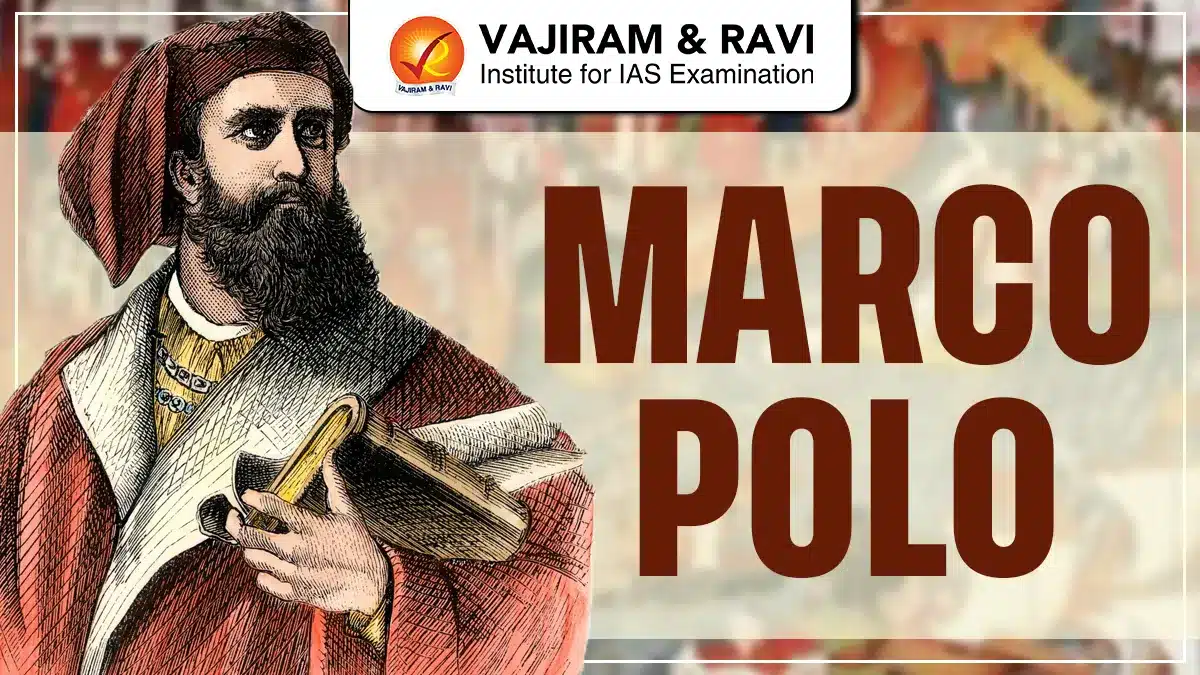
Marco Polo (1254-1324), Biography, Book, Expeditions, Visit to India

Marco Polo

Marco Polo was one of the most important European travelers of the medieval world. Born in Venice around 1254 CE, he journeyed across Asia along the Silk Road between 1271 and 1295 CE. His travels opened a new window for Europe to understand Asia, especially the Mongol Empire, China, India and Southeast Asia. At a time when Asia was largely unknown to Europeans, Marco Polo provided detailed descriptions of geography, administration, economy, culture and customs. His experiences were recorded in The Travels of Marco Polo, which became a landmark work in world history.

Marco Polo Biography

Marco Polo was born around 1254 in Venice to a merchant family deeply involved in long distance Asian trade networks. His father Niccolò Polo and uncle Maffeo Polo were experienced traders who had already travelled across Asia and met the Mongol ruler Kublai Khan before Marco joined them. In 1271, at about seventeen years of age, Marco travelled with them along the Silk Road to China. He spent nearly seventeen years in the Mongol Empire under the Yuan dynasty, serving as a trusted emissary of Kublai Khan. After returning to Venice in 1295, he was captured during a war with Genoa, where he narrated his experiences to Rustichello da Pisa. Marco Polo died in 1324, leaving behind a legacy that reshaped Europe’s understanding of Asia.

Marco Polo’s Book

Marco Polo’s book records his experiences across Asia and became Europe’s primary source of information about the Eastern world.

  • Title and composition: Written around 1300, dictated to Rustichello da Pisa during Genoese imprisonment, using Franco-Italian literary language.
  • Alternate names: Known as The Travels of Marco Polo, Book of the Marvels of the World and Il Milione.
  • Purpose of the book: Served as a guide for merchants describing distances, trade routes, currencies and regional products.
  • Geographical coverage: Describes China, India, Persia, Japan, Southeast Asia and the Mongol Empire.
  • Unique contributions: First European record of paper money, porcelain, gunpowder and salt revenue systems.
  • Historical impact: Influenced European cartography, including the Catalan Atlas and Fra Mauro Map.
  • Cultural significance: Inspired explorers such as Christopher Columbus and later European travellers.
  • Manuscript spread: Over 150 manuscript versions exist across Latin, French, Italian and other languages.
  • Reliability: Many details verified later by Chinese records and archaeological evidence.
  • Enduring value: Remains a cornerstone source for understanding medieval Asia through European eyes.

Marco Polo Expeditions

Marco Polo undertook one of the longest and most detailed journeys of the medieval world, spanning nearly 24 years across continents.

  • Departure year: Began journey in 1271 with father and uncle from Venice.
  • Route taken: Travelled via Acre, Persia, Hormuz, Central Asia and the Silk Road.
  • Arrival in China: Reached Kublai Khan’s court at Shangdu between 1271-1275.
  • Service under Kublai Khan: Appointed foreign emissary due to linguistic skills and administrative abilities.
  • Diplomatic missions: Travelled across China, Myanmar, Vietnam, Indonesia and Sri Lanka.
  • Duration in China: Lived within the Yuan Empire for about 17 years.
  • Return journey: Left China in 1292 escorting Mongol princess Kököchin to Persia.
  • Maritime route: Sailed through South China Sea, Sumatra, Indian Ocean and Arabian Sea.
  • Journey risks: Out of 600 travellers, only 18 survived the dangerous sea voyage.
  • Total distance: Covered approximately 15,000 miles before returning to Venice in 1295.

Marco Polo Visit to India

Marco Polo visited India during his return journey from China, offering rare European observations of medieval Indian society.

  • Period of visit: Travelled to India between 1292 and 1294 CE.
  • Entry point: Landed on the Coromandel Coast of southern India.
  • Regions visited: Travelled through Tamil Nadu, Kerala and parts of southern India.
  • Pandyan kingdom: Visited the prosperous Pandya territory near present day Thanjavur.
  • Kakatiya rule: Travelled during the reign of Queen Rudramma Devi (1261-1295 CE).
  • Trade focus: Observed thriving trade networks involving pearls, gems, textiles and spices.
  • Horse imports: Noted large scale import of horses for South Indian rulers.
  • Religious sites: Visited the tomb of St. Thomas near present day Chennai.
  • Maritime trade: Documented India’s strong connections with China and Southeast Asia.
  • Strategic importance: Recognised southern India as a key link in Indian Ocean trade.

Marco Polo Accounts of India

Marco Polo provided detailed descriptions of Indian society, economy, customs, religion and natural environment.

  • Social customs: People sat on the ground to eat, using only the right hand for food.
  • Travel safety: Reported that travelling with valuables at night was safe.
  • Dietary habits: Rice was the staple grain, while meat consumption was limited in many communities.
  • Alcohol consumption: Noted widespread use of beer and fermented beverages.
  • Hygiene practices: Drinking vessels were personal and never shared.
  • Chewing habits: Described chewing of betel leaves and tambur leaves mixed with spices and lime.
  • Religious beliefs: Mentioned cow worship, astrology, omens and temple rituals.
  • Status of women: He observed female rulers like Rudramma Devi, rare in medieval societies.
  • Royal wealth: Described Pandyan rulers wearing immense quantities of gold, pearls and gemstones.
  • Trade activities: Horse imports, pepper, indigo, incense and textiles were major economic goods.
  • Economic prosperity: Identified South India as one of the richest regions globally.
  • Natural diversity: Documented elephants, peacocks, parrots, lions and exotic flora, larger and richer than Europe.
  • Agricultural products: Noted cultivation of pepper, indigo, incense and date wine.
  • Religious sites: He visited the tomb of St. Thomas near modern Chennai, a shared pilgrimage center.
  • Dress and climate: Light clothing was common due to hot climate conditions.
  • Belief systems: Astrology and horoscope consultations influenced decisions and daily actions.
  • Cultural values: Observed preference for dark skin and local beauty standards.
  • Ascetic practices: Mentioned naked holy men following non violence.
  • Urban organisation: Highlighted busy ports and well developed trade towns.
  • Historical importance: Provides invaluable foreign perspective on 13th century India.

Marco Polo FAQs

Q1: Who was Marco Polo?

Ans: Marco Polo was a Venetian merchant and explorer who travelled across Asia in the 13th century and documented his experiences.

Q2: Why is Marco Polo famous?

Ans: He is famous for his book The Travels of Marco Polo, which gave Europeans detailed knowledge about Asia, China and India.

Q3: Which Asian ruler did Marco Polo serve?

Ans: Marco Polo served Kublai Khan, the Mongol ruler and founder of the Yuan Dynasty in China, as a foreign emissary.

Q4: When did Marco Polo visit India?

Ans: Marco Polo visited India between 1292 and 1294 CE during his return journey from China by sea.

Q5: What is the historical importance of Marco Polo’s accounts?

Ans: His writings provide valuable information on Asian geography, trade, culture, economy and societies of the 13th century.
UPSC Daily Quiz 19 January 2026

UPSC Daily Quiz

[WpProQuiz 71]

UPSC Daily Quiz FAQs

Q1: What is the Daily UPSC Quiz?

Ans: The Daily UPSC Quiz is a set of practice questions based on current affairs, static subjects, and PYQs that help aspirants enhance retention and test conceptual clarity regularly.

Q2: How is the Daily Quiz useful for UPSC preparation?

Ans: Daily quizzes support learning, help in revision, improve time management, and boost accuracy for both UPSC Prelims and Mains through consistent practice.

Q3: Are the quiz questions based on the UPSC syllabus?

Ans: Yes, all questions are aligned with the UPSC Syllabus 2025, covering key areas like Polity, Economy, Environment, History, Geography, and Current Affairs.

Q4: Are solutions and explanations provided with the quiz?

Ans: Yes, each quiz includes detailed explanations and source references to enhance conceptual understanding and enable self-assessment.

Q5: Is the Daily UPSC Quiz suitable for both Prelims and Mains?

Ans: Primarily focused on Prelims (MCQ format), but it also indirectly helps in Mains by strengthening subject knowledge and factual clarity.

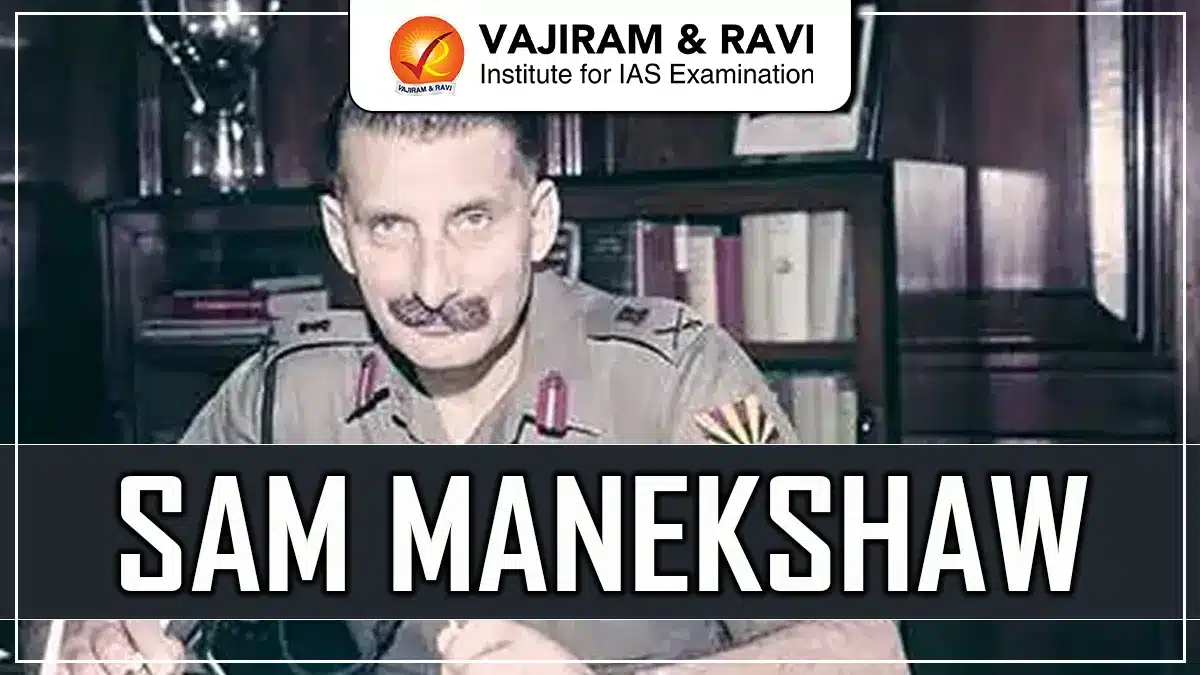
Sam Manekshaw (1914-2008), Biography, Military Career, Battles

Sam Manekshaw

Field Marshal Sam Hormusji Framji Jamshedji Manekshaw, popularly known as Sam Bahadur, remains one of India’s most respected military leaders. He was born on 3 April 1914 and by serving the nation for nearly four decades, he shaped India’s military history through courage, clarity of command and strategic vision. As the Chief of the Army Staff during the 1971 conflict, he led India to a decisive victory that resulted in the creation of Bangladesh. He was also the first Indian Army officer to be elevated to the rank of Field Marshal, symbolising a lifetime of distinguished service.

Sam Manekshaw Biography

Sam Manekshaw was born in Amritsar to Parsi parents, Dr Hormusji Manekshaw and Hilla Mehta, who had migrated from Valsad in Gujarat. Educated at Sherwood College, Nainital and Hindu College, Amritsar, he initially aspired to study medicine in London. When that plan failed, he joined the first batch of the Indian Military Academy in 1932, graduating in 1935. Known for discipline, humour and intellectual sharpness, he developed leadership traits early. His personal values, multilingual skills and cultural openness shaped his long and effective military journey until his death on 27 June 2008 at the age of 94.

Sam Manekshaw Military Career

A four decade long military career defined by frontline bravery, staff excellence and top level command made Manekshaw a unique figure in Indian military history.

  • Commission and Early Service: Commissioned in 1935, he initially served with the Royal Scots before joining the 4/12 Frontier Force Regiment in Burma, gaining operational exposure under British Indian Army structures.
  • World War II Experience: During the Burma campaign of 1942, he displayed exceptional courage at the Battle of Pagoda Hill, sustaining severe injuries yet continuing command, earning the Military Cross for gallantry.
  • Post War Staff Roles: After recovery, he attended the Staff College at Quetta and later served in key planning roles, including supervising the disarmament of over 10,000 Japanese prisoners without incident.
  • Post Independence Transition: Following Partition in 1947, he chose the Indian Army over Pakistan and was reassigned to the 8th Gorkha Rifles, becoming deeply respected among Gorkha troops.
  • Operational Planning Roles: He played a vital role during the Kashmir conflict and Hyderabad crisis, serving in the Military Operations Directorate, though he never commanded a battalion in combat post Independence.
  • Senior Command Appointments: Rising to brigadier and major general, he commanded the 26th Infantry Division and later headed training institutions, modernising Indian Army manuals and doctrines.
  • Political Trial and Vindication: In 1962, he faced a politically motivated treason inquiry, was exonerated fully, but missed active participation in the Sino-Indian War, a major career setback.
  • Army Commander Roles: From 1963 onwards, he led Western and Eastern Commands, restoring morale and readiness and successfully managing insurgencies in Nagaland and Mizoram.

Battles Fought by Sam Manekshaw

Though not always in battlefield command, Manekshaw’s involvement shaped outcomes in several key military engagements.

  1. World War II Burma Campaign: At Pagoda Hill near the Sittang River, he led a counter attack against Japanese forces despite 30 percent casualties, altering local tactical balance.
  2. 1947-48 Kashmir Conflict: He conducted aerial reconnaissance with V P Menon and advised rapid troop deployment, influencing India’s timely military intervention in Jammu and Kashmir.
  3. Hyderabad Police Action: As a planner, he supported integration operations, ensuring minimal resistance and swift restoration of Indian authority over the princely state.
  4. Nathu La and Cho La Clashes 1967: As Eastern Army Commander, he endorsed firm military responses, resulting in India’s first clear tactical victory against Chinese forces post 1962.
  5. 1971 Indo-Pak War: As Chief of the Army Staff, he oversaw all land operations, leading to Pakistan’s decisive defeat in the eastern theatre.

Sam Manekshaw Role in 1971 Indo-Pak War

Manekshaw’s leadership during the 1971 conflict combined strategic patience, joint operations and psychological warfare to secure a historic victory.

  • He advised delaying war until December 1971, citing monsoon floods, troop readiness and Chinese threat, ensuring optimal military preparedness.
  • In response to Pakistan's Operation Searchlight, He assessed Pakistan’s crackdown in East Pakistan and prepared India for a decisive military response.
  • Under his direction, about 75,000 Bangladeshi guerrillas were trained and armed in Mukti Bahini through Operation Jackpot, which weakened the Pakistani forces before formal hostilities began.
  • He coordinated Army, Navy and Air Force operations under Operation Trident and Operation Python, ensuring air superiority, naval blockades and rapid ground advances across multiple fronts.
  • Four Indian formations advanced simultaneously into East Pakistan, isolating Dhaka within 12 days and preventing organised Pakistani resistance.
  • His radio messages to Pakistani troops emphasised inevitable defeat and honourable surrender, significantly lowering enemy morale.
  • On 16 December 1971, 93,000 Pakistani soldiers surrendered at Dhaka, marking the largest capitulation since World War II and the birth of Bangladesh.

Sam Manekshaw Awards and Honours

Sam Manekshaw received some of India’s highest military and civilian honours for bravery, leadership and national service.

  • Military Cross 1942: Awarded for gallantry at Pagoda Hill in Burma, recognising leadership under fire despite life threatening injuries.
  • Padma Bhushan 1968: Conferred for effective handling of insurgencies in Nagaland and Mizoram while commanding Eastern Army.
  • Padma Vibhushan 1972: Awarded for exceptional service during the 1971 war and his contribution to national security.
  • Field Marshal Rank 1973: Promoted on 1 January 1973, becoming India’s first Field Marshal, a ceremonial yet historic five star rank.
  • International Recognition: Honoured as an honorary General of the Nepalese Army and awarded Nepal’s Order of Tri Shakti Patta

Sam Manekshaw Quotes

Sam Manekshaw’s wit and clarity made his words as influential as his commands. Few of his major sayings and quotes are:

“Give me a man or a woman with common sense and who is not an idiot and I assure you can make a leader out of him or her.”

“If a man says he is not afraid of dying, he is either lying or is a Gurkha.”

“Professional knowledge has to be acquired the hard way. It is a continuous study and you never acquire it in today’s fast moving technological world that you are living in.”

“He who neither drinks, nor smokes, nor dances, he who preaches & even occasionally practices piety, temperance and celibacy, is generally a saint, or a mahatma or more likely a humbug, but he certainly won’t make a leader or for that matter, a good soldier.”

Sam Manekshaw FAQs

Q1: Why is Sam Manekshaw called Sam Bahadur?

Ans: He earned the nickname “Sam Bahadur” from Gurkha soldiers, reflecting bravery, affection and fearless leadership.

Q2: What was Sam Manekshaw’s role in the 1971 Indo-Pak war?

Ans: He served as Chief of the Army Staff and planned India’s overall military strategy leading to Pakistan’s surrender.

Q3: Which rank made Sam Manekshaw unique in Indian history?

Ans: He became India’s first Field Marshal in 1973.

Q4: How many Pakistani soldiers surrendered in 1971?

Ans: About 93,000 Pakistani troops surrendered at Dhaka on 16 December 1971.

Q5: What leadership quality defined Sam Manekshaw most?

Ans: Strategic clarity combined with moral courage and professional integrity.

Puranas, Origin, Classification, Significance, Influence

Puranas

Puranas are ancient Sanskrit texts that preserve Hindu mythology, history, cosmology, and ethical teachings in an accessible form. They were traditionally compiled by Sage Veda-Vyasa, with origins tracing back to the post-Vedic period and oral transmission before being written down. Puranas are classified based on the three gunas into Sattvika (Vishnu), Rajasa (Brahma), and Tamasa (Shiva), and include 18 Mahapuranas and numerous Upapuranas. They are significant for spreading spiritual knowledge, moral values, cultural traditions, and historical information, influencing art, festivals, social cohesion, and daily life in Indian society.

Puranas Origin

The term Purana literally means “ancient” in Sanskrit. According to legend, Sage Veda-Vyasa is credited with compiling the Puranas. It is believed that originally there was only one Purana, which Vyasa passed on to his disciple Lomaharshana. Lomaharshana’s students then created their own Purana compilations, leading to the eighteen Mahapuranas we know today.

The Puranas likely originated between the 4th and 5th centuries CE, though some were composed in later centuries. While their content may overlap with the Vedas, the Puranas were largely composed during the Gupta period, with texts like the Bhagavata Purana (10th century CE) and Skanda Purana (14th century CE) being notable examples.

Classification of Puranas

The Puranas are classified based on the three Gunas (qualities), Sattva, Rajas, and Tamas, corresponding to Vishnu, Brahma, and Shiva. This classification highlights the primary deity and theme of each Purana.

1. Sattvika Puranas (Vishnu-Oriented)

These Puranas emphasize devotion to Lord Vishnu and his avatars. They focus on dharma, moral teachings, and the preservation of the universe.

Examples and Features:

  • Vishnu Purana: Discusses Vishnu’s avatars, cosmology, and genealogy of kings.
  • Bhagavata Purana: Highlights Krishna’s life and teachings, emphasizing bhakti (devotion).
  • Padma Purana: Covers pilgrimages, festivals, and Vishnu-related rituals.
  • Emphasis on righteous living and devotion to Vishnu.

2. Rajasa Puranas (Brahma-Oriented)

These texts are primarily concerned with creation, knowledge, and worldly duties. They highlight the active, dynamic aspects of the universe and human life.

Examples and Features:

  • Brahma Purana: Focuses on creation myths, genealogy, and legends of sages.
  • Brahmanda Purana: Discusses cosmology, historical narratives, and dharma.
  • Bhavishya Purana: Contains prophecies, social rules, and historical accounts.
  • Emphasis on knowledge, action, and moral responsibilities.

3. Tamasa Puranas (Shiva-Oriented)

These Puranas center around Lord Shiva and the concepts of destruction and transformation. They often describe asceticism, meditation, and the cycles of creation and dissolution.

Examples and Features:

  • Linga Purana: Focuses on Shiva worship, rituals, and philosophical teachings.
  • Skanda Purana: Contains extensive details of pilgrimages and Shiva-related legends.
  • Markandeya Purana: Includes Devi Mahatmya, worship of Shakti, and ethical narratives.
  • Emphasis on renunciation, transformation, and devotion to Shiva.

18 Puranas

The 18 Mahapuranas are the major Puranic texts that cover a wide range of themes including mythology, cosmology, genealogy of gods and kings, rituals, and philosophy. Each Purana has its unique focus, length, and contribution to Hindu religious and cultural knowledge.

18 Puranas
S.No Name of Purana Approx. Verses Highlights

1

Vishnu Purana

23,000

Vishnu’s avatars, cosmology, genealogy of kings

2

Bhagavata Purana

18,000

Krishna’s life, bhakti, philosophical teachings

3

Narada Purana

25,000

Devotion, religious rites, pilgrimages

4

Garuda Purana

19,000

Death, afterlife, ethics, rituals

5

Padma Purana

55,000

Pilgrimages, festivals, Vishnu-related legends

6

Varaha Purana

24,000

Varaha avatar of Vishnu, cosmology, dharma

7

Skanda Purana

81,100

Shiva legends, pilgrimages, temples, rituals

8

Agni Purana

15,400

Rituals, cosmology, arts, medicine, astronomy

9

Brahma Purana

24,000

Creation myths, genealogy, legends of sages

10

Brahmanda Purana

12,000

Cosmology, history, geography, dharma

11

Brahmavaivarta Purana

18,000

Krishna-Radha stories, devotion, spiritual teachings

12

Linga Purana

11,000

Shiva worship, rituals, philosophy

13

Markandeya Purana

9,000

Devi Mahatmya, Shakti worship, ethics

14

Bhavishya Purana

14,500

Prophecies, social rules, historical events

15

Vamana Purana

10,000

Vamana avatar of Vishnu, dharma, legends

16

Matsya Purana

14,000

Matsya avatar, cosmology, genealogy, rituals

17

Surya Purana

10,000

Solar deity worship, festivals, rituals

18

Vayu Purana

24,000

History, geography, mythology, dynasties

Puranas Significance

The Puranas play a crucial role in preserving and transmitting Hindu mythology, history, culture, and spiritual teachings in an accessible form.

  • Puranas made religious and spiritual knowledge accessible to all, including women and shudras, unlike the Vedas.
  • They preserved oral traditions by being recited aloud, ensuring the transmission of culture and mythology across generations.
  • Puranas cover a wide range of topics such as mythology, cosmology, genealogy of gods and kings, rituals, festivals, geography, medicine, arts, astronomy, grammar, and philosophy.
  • They provide historical insights on dynasties, political history, urban settlements, and administration, mentioning periods like the Mauryan, Satavahana, and Gupta dynasties.
  • Through stories of gods, sages, and heroes, they teach dharma, karma, ethical conduct, and moral values for both spiritual and worldly life.
  • Puranas integrated regional deities, local customs, and rituals, promoting cultural unity and a syncretic Hindu tradition.
  • They influenced Indian arts, music, classical dance forms, storytelling, and drama, including Bharatanatyam and Rasa Lila.
  • Many Hindu festivals such as Holi, Diwali, and Durga Puja are described and elaborated in Puranas.

Differences between Vedas and Puranas

Vedas are authoritative, ritual-focused texts, while Puranas are narrative, inclusive, and encyclopedic, making religious and cultural knowledge accessible to the general population. The Differences between Vedas and Puranas is given below.

Differences between Vedas and Puranas
Vedas Puranas

Considered Shruti texts, meaning “that which is heard,” and regarded as the most authoritative scriptures in Hinduism.

Considered Smriti texts, meaning “that which is remembered,” respected but secondary to the Vedas in authority.

Composed between 1500 BCE and 900 BCE for Rig Veda; other Vedas like Sama, Yajur, and Atharva composed between 1200–900 BCE.

Composed mainly between 3rd century CE and 10th century CE, with some additions even later; originated largely during the Gupta period.

Focus on rituals, sacrifices (yajnas), mantras, meditation, and spiritual knowledge for the priests and scholarly community.

Focus on mythology, cosmology, genealogy of gods and kings, ethical guidance, festivals, pilgrimages, arts, and sciences for the general population.

Written in highly complex Sanskrit, often requiring guidance for comprehension; primarily intended for scholars, priests, and initiates.

Written in simpler Sanskrit, often in narrative form, making it accessible to common people including women and lower social groups.

Divided into four sections: Samhitas (mantras and hymns), Brahmanas (ritual commentaries), Aranyakas (forest texts), and Upanishads (philosophy and meditation).

Divided into 18 Mahapuranas (major) and numerous Upapuranas (minor), each focusing on specific deities, themes, and encyclopedic knowledge.

Emphasizes universal truths, metaphysics, and eternal spiritual laws, forming the core of Hindu theology.

Emphasizes practical knowledge, devotion, dharma, and cultural traditions, bridging spiritual teachings with everyday life.

Traditionally compiled by Sage Veda Vyasa; transmitted orally before being documented.

Traditionally compiled or compiled under the guidance of Sage Veda Vyasa, but many Puranas were written by multiple authors over centuries.

Audience was limited to priests, scholars, and those trained in Sanskrit and rituals, making knowledge less accessible to the general population.

Intended for all sections of society, including women, farmers, and lower castes, serving as a medium for mass education and cultural integration.

Influence of Puranas on Indian Society

  • Puranas played a central role in preserving and transmitting cultural, religious, and social knowledge across generations in ancient and medieval India.
  • They encouraged cultural synthesis by integrating diverse beliefs, rituals, and practices into a coherent Hindu framework.
  • Regional deities and local traditions were incorporated into Puranic narratives, promoting acceptance of local and regional faiths within mainstream Hinduism.
  • Puranas contributed to the spread of literacy and oral education, as they were recited aloud in villages and towns, making knowledge accessible to people of all social strata.
  • They influenced performing arts, including classical dance forms like Bharatanatyam, folk theatre, music, and storytelling traditions such as Rasa Lila.
  • Many festivals and rituals, including Holi, Diwali, and Durga Puja, are described and codified in the Puranas, shaping the religious calendar of India.
  • Puranas provided historical and geographical information, documenting dynasties, towns, temples, rivers, and urban planning, which is useful for studying political and cultural history.
  • They reinforced moral, ethical, and social values, teaching dharma, karma, devotion, and righteous conduct through stories of gods, heroes, and sages.
  • Puranas served as a medium of social cohesion, connecting diverse linguistic, cultural, and regional communities under shared myths, rituals, and traditions.
  • Their encyclopedic content influenced science, medicine, astronomy, and arts, contributing to the holistic development of Indian knowledge systems.

Puranas FAQs

Q1: What does “Purana” mean?

Ans: Purana is a Sanskrit word meaning “ancient” or “old”, referring to texts that preserve ancient knowledge, myths, and traditions.

Q2: Who compiled the Puranas?

Ans: Traditionally, Sage Veda-Vyasa is credited with compiling the Puranas, though many were written and updated by multiple authors over time.

Q3: How many Puranas exist?

Ans: There are 18 Mahapuranas (major) and numerous Upapuranas (minor), each focusing on different deities, themes, or aspects of knowledge.

Q4: Are Puranas part of the Vedas?

Ans: No, Puranas are Smriti texts (“that which is remembered”), secondary to the Vedas (Shruti), but still highly respected and widely studied.

Q5: What topics do the Puranas cover?

Ans: Puranas cover mythology, cosmology, genealogy of gods and kings, rituals, festivals, arts, geography, medicine, and ethical teachings.

Swaran Singh Committee, Recommendations, Key Details

Swaran Singh Committee

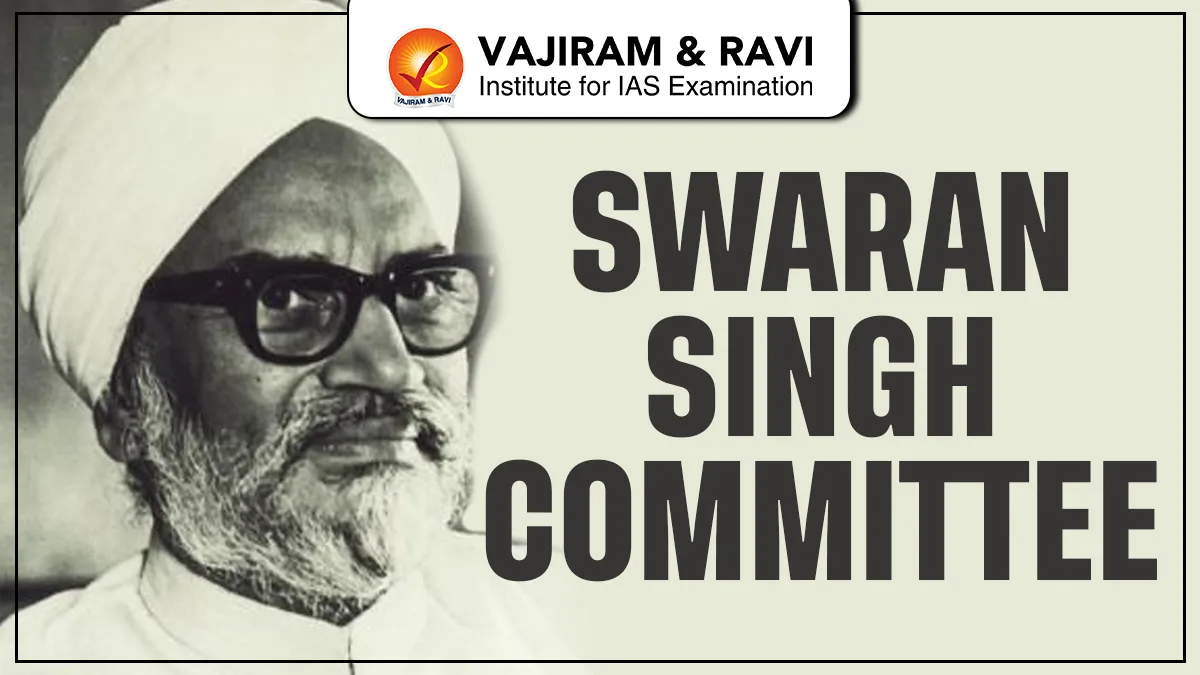
The Swaran Singh Committee was formed in 1976 to review the Indian Constitution and suggest ways to strengthen national unity and governance. It was headed by Sardar Swaran Singh and recommended the inclusion of Fundamental Duties for citizens. The committee emphasized that citizens should balance their rights with responsibilities toward the nation. Its suggestions were implemented through the 42nd Constitutional Amendment Act, 1976, which added Part IV-A (Article 51A) on Fundamental Duties. All the key recommendations of this committee have been discussed below in detail.

Recommendations of the Swaran Singh Committee

The Swaran Singh Committee made several landmark recommendations. Although not all were accepted by the government, many shaped constitutional reform, especially through the 42nd Constitutional Amendment Act, 1976.

I. System of Government

  • The Committee recommended retaining the Parliamentary system in India rather than adopting the Presidential or any other system.
  • It observed that, due to India’s vast size and regional diversity, the Parliamentary system best preserves national unity and integrity.
  • It ensures greater responsiveness to the voice of the people compared to other systems.

II. The Preamble

  • The Committee recommended that Secularism and Socialism be explicitly mentioned in the Constitution.
  • Proposed amendment to the Preamble: replace "Sovereign Democratic Republic" with "Sovereign, Democratic, Secular, Socialist Republic".
  • Suggested inserting the words "and integrity" after "unity" to emphasize the nation’s territorial and cultural integrity.

III. Amendment of the Constitution

  • Recommended that the constituent power of Parliament under Article 368 should be unquestionable.
  • Proposed a new clause stating that any amendment passed according to Article 368 cannot be challenged in any court.
  • Emphasized that the Constitution is the supreme law of the land, and amendments should have the same sanctity as the original text.

IV. Power of Judicial Review

  1. Constitutional Validity of Laws
    • Recommended that challenges to the validity of Central laws be made only in the Supreme Court, and challenges to State laws in the respective High Courts, with an appeal to the Supreme Court.
    • Bench composition:
      • Supreme Court: minimum 7 judges, decision supported by at least two-thirds.
      • High Court: minimum 5 judges, decision supported by at least two-thirds.
    • Emphasized that legislatures generally act within constitutional limits but judicial oversight is necessary.
  2. Article 226
    • Suggested deleting "and for any other purpose" from Article 226 to limit extraordinary powers of High Courts.
    • Recommended that High Courts continue issuing writs for fundamental rights and cases of substantial failure of justice.
    • Introduced conditions for interim orders, requiring prior notice to the respondent and opportunity to be heard.
  3. Service Matters
    • Recommended the establishment of Administrative Tribunals at both the State and Central levels to decide service-related disputes.
  4. Industrial and Labour Disputes
    • Recommended setting up an All-India Labour Appellate Tribunal to hear appeals from Labour and Industrial Courts.
  5. Revenue, Land Reforms, and Food Distribution
    • Suggested tribunals for disputes relating to:
      • Revenue collection
      • Land reforms and urban property ceilings
      • Procurement and distribution of foodgrains and other essential commodities
    • Writ jurisdiction of Supreme Court and High Courts over these matters to be excluded, but appeals under Article 136 remain.
  6. Election Matters
    • Recommended that no writs should lie in relation to election disputes.
  7. Article 227
    • Proposed omitting references to tribunals in Article 227.

V. Directive Principles

  • Recommended widening the scope of Article 31-C to include all Directive Principles in Part IV.
  • Laws implementing Directive Principles should not be challenged for contravening Fundamental Rights, except for protections for minorities, Scheduled Castes, Scheduled Tribes, and Other Backward Classes.

VI. Disqualification for Membership

  • Recommended creating a 9-member body to determine disqualification of MPs and MLAs.
  • Suggested amending Articles 102(1)(a) and 191(1)(a) to clarify disqualification for holding offices of profit, reducing ambiguity.

VII. Emergency: Article 352

  • Recommended clarifying that the President may declare emergency only for the specific part of India concerned.
  • Suggested provisions to lift emergency selectively in parts of the territory.

VIII. Centre-State Coordination

  1. Concurrent Subjects
    • Recommended including Agriculture and Education in the Concurrent List.
    • Clarified that administration remains with State Governments while policies are centrally coordinated.
  2. Deployment of Forces
    • Suggested empowering the Centre to deploy police or similar forces under its control in States during grave law and order situations.
    • Recommended that consultation with States should occur wherever possible.

Swaran Singh Committee on Fundamental Duties

Among all recommendations, the most enduring contribution is the concept of Fundamental Duties of Indian citizens. These duties were inserted into the Constitution as Part IV-A under Article 51A via the 42nd Amendment Act, 1976.

  • Based on its recommendation, Part IV-A (Article 51A) was added to the Constitution containing 10 Fundamental Duties, later increased to 11 by the 86th Amendment Act, 2002.
  • The committee emphasized that citizens must respect the Constitution, National Flag, and National Anthem, which was fully accepted and incorporated in Article 51A(a).
  • It recommended promoting unity, sovereignty, and integrity of India, which was accepted and included as a constitutional duty.
  • The suggestion to promote harmony, brotherhood, and renounce practices derogatory to the dignity of women was accepted and included among the duties.
  • The recommendation to protect the environment, forests, wildlife, and show compassion for living creatures was accepted and added under Article 51A(g).
  • The idea of developing scientific temper, humanism, and the spirit of inquiry was accepted and included to promote rational and progressive thinking in society.
  • The committee suggested safeguarding public property and abjuring violence, which was accepted and made part of the Fundamental Duties.
  • The recommendation that citizens should strive for excellence in all spheres of individual and collective activity was also accepted and included.
  • One of the major recommendations was that Fundamental Duties should be made legally enforceable, but this was not accepted because it could lead to excessive state control and misuse of power.
  • The committee proposed that violation of Fundamental Duties should attract punishment, but this was rejected to protect democratic freedoms and individual liberty.
  • It also recommended that laws made to enforce Fundamental Duties should be kept beyond judicial review, which was not accepted as it would weaken the basic structure of the Constitution.
  • The suggestion to make payment of taxes a Fundamental Duty was rejected since taxation is already governed by statutory law and enforcement mechanisms exist.
  • The committee supported stronger central authority and restrictions on Fundamental Rights, but many such ideas were later reversed by the 44th Constitutional Amendment Act, 1978 to restore democratic balance.

Swaran Singh Committee FAQs

Q1: When was the Swaran Singh Committee formed and why?

Ans: The Swaran Singh Committee was formed in 1976 to review the Constitution and recommend measures to strengthen national unity, governance, and citizens’ responsibilities.

Q2: What was the most important contribution of the Swaran Singh Committee?

Ans: Its most important contribution was the recommendation to include Fundamental Duties in the Constitution under Article 51A.

Q3: How many Fundamental Duties were recommended by the committee?

Ans: The committee initially recommended eight Fundamental Duties, but ten were adopted in 1976 and an eleventh was added in 2002.

Q4: Who headed the Swaran Singh Committee?

Ans: The committee was headed by Sardar Swaran Singh, a senior Indian politician and former Union Minister.

Q5: Are Fundamental Duties legally enforceable?

Ans: Fundamental Duties are moral obligations and are non-justiciable, meaning they cannot be enforced by law.

Sunset Clause, Meaning, Origin, Need, Types, Examples

Sunset Clause

A Sunset Clause is a legal provision that fixes an expiry date for a law, rule or statutory provision unless it is renewed by the legislature. Unlike permanent laws, sunset based laws automatically lapse after a specified period. This mechanism is designed to ensure periodic review, prevent accumulation of outdated legislation and keep governance responsive to changing social, economic and political realities. It is often described as a system of compulsory legislative self review that balances flexibility with accountability.

Sunset Clause Origin

The origin of the Sunset Clause can be traced to Roman law, where temporary delegation of powers was common during emergencies. The Roman Senate granted time bound authority for taxation and military mobilization, often ending before a magistrate’s tenure. Philosophers like Plato advocated time limited laws. These principles were later codified in the Codex Iustinianus. An exception arose when Julius Caesar assumed lifelong dictatorship, highlighting risks of removing temporal limits.

Sunset Clause Need

A Sunset Clause ensures laws remain relevant by forcing periodic legislative evaluation instead of allowing permanent continuation without review.

  • It avoids accumulation of obsolete laws by ensuring expiry unless actively renewed after reassessment of relevance and effectiveness.
  • It is useful when long term impacts of new policies are unknown, allowing temporary enforcement and evidence based continuation decisions.
  • It limits extraordinary powers granted during crises, preventing misuse once exceptional conditions subside.
  • It compels lawmakers to justify continuation, enhancing transparency and legislative responsibility.

Sunset Clause Types

Sunset Clauses vary based on duration, conditions and review mechanisms, offering flexibility across policy areas.

  1. Fixed Term Sunset Clause: Laws expire on a predetermined date, such as tax incentives ending after ten years unless renewed by statute.
  2. Conditional Sunset Clause: Expiry depends on fulfillment or failure of specific conditions, often used in environmental or regulatory laws.
  3. Review Based Sunset Clause: Laws continue only after mandatory periodic performance reviews, linking survival to measurable outcomes.

Sunset Clause in India Examples

India uses Sunset Clauses mainly in constitutional provisions, fiscal laws and regulatory frameworks. The major examples of the usage of Sunset Clause are listed below:

  • Article 334 of the Constitution: Reservation of seats for Scheduled Castes and Scheduled Tribes in legislatures was originally limited to ten years, reflecting periodic reassessment of social equity needs.
  • Special Economic Zones Act 2005: Tax incentives for SEZ developers ended on March 31, 2017 and for units on March 31, 2020, enforcing fiscal discipline.
  • Tax Holidays and Exchange Controls: Many income tax exemptions and foreign exchange relaxations include expiry dates to avoid long term revenue loss.
  • TADA Act 1987: The anti terror law included a Sunset Clause and was allowed to lapse in 1995, acknowledging civil liberty concerns.

Sunset Clause across World Examples

Globally, Sunset Clauses are integral to democratic lawmaking, especially in advanced legal systems. The major examples of the Sunset Clause application worldwide has been listed below:

  • United States Constitution Article I, Section 8: Congressional authority to raise armies is limited to two years, preventing permanent militarization.
  • USA Patriot Act: Surveillance powers were subject to sunset provisions, with several sections lapsing on March 15, 2020, due to non renewal.
  • United Kingdom and Germany: Temporary counter terror and financial regulations routinely include Sunset Clauses requiring parliamentary renewal.
  • Australia Anti Terror Laws: Since 2005, several counter terrorism powers carry ten year sunset limits to protect civil liberties.
  • Thomas Jefferson’s Proposal: He suggested constitutional expiration after nineteen years to prevent past generations binding future ones.

Sunset Clause Features

Sunset Clauses have distinct characteristics that differentiate them from permanent legislative provisions.

  • Automatic Expiry: Laws cease to operate automatically after a specified date unless explicitly extended by legislative action.
  • Built in Review Mechanism: They mandate evaluation of effectiveness, relevance and impact before renewal decisions.
  • Temporary Legal Nature: Often applied to experimental, fiscal, or emergency laws where permanence may be risky.
  • Clear Time Definition: They specify exact expiry timelines or measurable conditions to avoid ambiguity.
  • Legislative Supremacy: Final authority for continuation rests with elected legislatures, preserving democratic control.

Sunset Clause Significance

The Sunset Clause plays a critical role in maintaining a dynamic and accountable legal system.

  • Ensures Legal Relevance: Prevents outdated laws from remaining enforceable despite changing societal conditions.
  • Protects Civil Liberties: Automatically ends potentially intrusive laws, reducing risk of prolonged rights violations.
  • Promotes Policy Innovation: Encourages governments to experiment with temporary measures without long term commitment.
  • Improves Governance Efficiency: Forces prioritization of effective laws while eliminating redundant or ineffective ones.
  • Strengthens Public Trust: Demonstrates legislative willingness to review and justify continued state authority.

Sunset Clause FAQs

Q1: What is a Sunset Clause?

Ans: A Sunset Clause is a legal provision that sets an expiry date for a law or regulation unless it is renewed by the legislature.

Q2: Why is a Sunset Clause used in laws?

Ans: It is used to ensure periodic review, prevent outdated laws from continuing, and maintain legislative accountability and relevance.

Q3: Which Article of the Indian Constitution contains a Sunset Clause?

Ans: Article 334 contains a sunset provision for reservation of seats for Scheduled Castes and Scheduled Tribes in legislatures.

Q4: Are Sunset Clauses used only in India?

Ans: No, Sunset Clauses are widely used in countries like the United States, United Kingdom, Germany, and Australia.

Q5: Can a law with a Sunset Clause be extended?

Ans: Yes, such a law can continue if the legislature reviews it and passes a renewal or extension before expiry.

Apartheid System, Meaning, History, Role of India and UN

Apartheid System

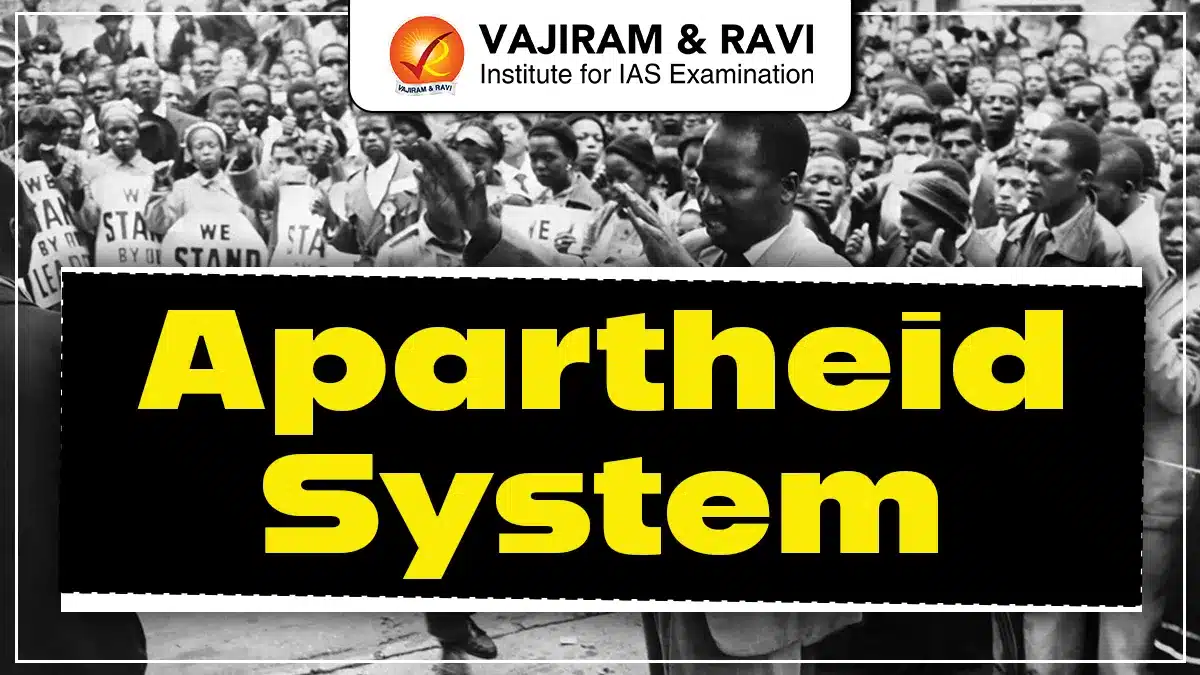
The Apartheid System was a legally enforced structure of racial segregation and discrimination in South Africa. It was imposed by white minority governments to maintain political, economic and social dominance over non-white populations, mainly Black Africans, Coloureds and Indians. Apartheid classified people by race, restricted movement, denied political rights, segregated education and housing and enforced inequality through law. Though abolished legally in the 1990s, its social and economic consequences continue to shape South Africa’s racial and economic divides even today.

Apartheid System

The Apartheid System functioned through a rigid legal framework that institutionalised racial hierarchy, enforced separation in daily life and denied non-whites basic civil, political and economic rights. Laws controlled residence, marriage, education, employment, voting and movement, ensuring white supremacy across all sectors. The system was divided into petty apartheid, affecting everyday social interactions and grand apartheid, reshaping land ownership, citizenship and economic participation. These features collectively reduced the Black majority to cheap labour while concentrating wealth, land and power in white hands.

Apartheid System Historical Background

Apartheid emerged from colonial racial practices, formalised in 1948 and enforced through legislation to sustain white minority rule in South Africa.

  • Colonial Roots: Racial discrimination began with European colonisation from 1652, where land dispossession, slavery and pass laws restricted Black movement and economic freedom.
  • Pre 1948 Pass Laws: Nineteenth and early twentieth century governments introduced pass systems limiting Black access to white areas, laying foundations for apartheid control mechanisms.
  • Institutionalisation in 1948: The National Party formalised apartheid after winning elections, turning informal racial practices into binding national law.
  • Population Registration Act 1950: This law classified all citizens as White, Black, Coloured, or Indian, determining rights, residence and access to services.
  • Group Areas Act 1950: It segregated residential and business areas by race, leading to forced removals of nearly 3.5 million Black Africans between 1960 and 1983.
  • Prohibition of Mixed Marriages Act 1949: It criminalised interracial marriages, reinforcing racial purity ideologies within the legal system.
  • Bantu Education Act 1953: This law created a separate education system designed to prepare Black students only for manual labour roles.

Anti Apartheid Movement

The Anti Apartheid Movement was a global and domestic struggle aimed at dismantling racial segregation and ending minority rule in South Africa. It became the first successful transnational social movement of the twentieth century, linking internal resistance with global solidarity. The movement sought to overthrow apartheid internally and impose international political, economic and cultural sanctions externally.

  • First Phase (Pre 1960s): Nonviolent resistance led by the African National Congress and South African Communist Party used protests, boycotts and civil disobedience.
  • Second Phase (Post 1960s): The struggle internationalised, gaining support from the United Nations, African states, India and global civil society. The UN adopted the International Convention on the Suppression and Punishment of the Crime of Apartheid, framing apartheid as a crime against humanity.
  • Third Phase (Post 1980s): Mass strikes, demonstrations and sabotage aimed to make South Africa ungovernable under apartheid rule. By 1990, bans on political organisations were lifted and major apartheid laws were repealed under mounting internal and external pressure.

Apartheid System Impact on Indians

Apartheid imposed systematic discrimination on Indians, restricting their rights, mobility and economic participation while placing them below whites in racial hierarchy.

  • Racial Classification: Indians were legally categorised as non-white, divided into indentured labourers on plantations, merchant traders in urban markets and ex-indentured settlers
  • Land Restrictions: The Asiatic Land Tenure and Ownership laws limited Indian property ownership and segregated Indian communities spatially.
  • Economic Marginalisation: Indian traders faced licensing restrictions and exclusion from white commercial zones, limiting business growth opportunities.
  • Social Segregation: Indians were barred from white public facilities, schools, hospitals and recreational spaces under petty apartheid regulations.
  • Community Divisions: Indians were divided into indentured labourers, merchants and settled families, each facing distinct but interconnected forms of discrimination.

Apartheid System Role of India

India played a pioneering international role in opposing apartheid through diplomacy, sanctions and moral leadership.

  • Gandhi’s Early Influence: Mahatma Gandhi’s experiences in South Africa inspired early resistance through nonviolent protest and political organisation.
  • Natal Indian Congress: Founded in 1894, it became the leading Indian political organisation opposing racial discrimination and apartheid policies.
  • Trade Sanctions: India became the first country to sever trade relations with South Africa in 1946, later imposing a complete embargo.
  • UN Initiative: India brought apartheid to the United Nations in 1946, internationalising the issue before many newly independent states emerged.
  • Support to ANC: The African National Congress maintained a representative office in New Delhi from the 1960s, reflecting India’s sustained support.
  • Non Aligned Movement: Apartheid remained on the agenda from the first NAM conference in 1961, with India actively shaping collective opposition.
  • AFRICA Fund: India contributed to financial and diplomatic efforts sustaining the global Anti Apartheid Movement.

Apartheid System Role of UN

The United Nations played a decisive role in delegitimising apartheid and mobilising international pressure against South Africa.

  • Initial Complaints: The UN first addressed apartheid after South Africa passed discriminatory laws against Indian land ownership in 1946.
  • Condemnation: In 1971, the UN declared apartheid a crime against humanity, marking a major moral and legal shift.
  • Sanctions: Diplomatic, economic and cultural sanctions were imposed, including a mandatory arms embargo in 1977.
  • Special Committees: The UN established the Special Committee against Apartheid in 1963 and the Centre against Apartheid in 1976.
  • International Convention: In 1973, the UN adopted the Convention on the Suppression and Punishment of the Crime of Apartheid.
  • Suspension: South Africa was suspended from the UN General Assembly in 1974 and readmitted only after democratic transition in 1994.

Anti Apartheid Leaders

Anti Apartheid leaders symbolised moral courage, resistance and reconciliation in the struggle against institutional racism.

  • Nelson Mandela: A founding figure of resistance, he spent 27 years in prison before leading South Africa as its first Black President in 1994. Influenced by Gandhian principles, he emphasised reconciliation, justice and peaceful coexistence after apartheid’s collapse. He received the Nobel Peace Prize in 1993, symbolising international endorsement of the Anti Apartheid Struggle.
  • Yusuf Dadoo: An Indian origin leader, he played a key role in underground resistance and global mobilisation against apartheid.
  • ANC Leadership: Leaders like Oliver Tambo strengthened international alliances and sustained resistance during years of political repression.

Black Economic Empowerment Policy

The Black Economic Empowerment policy aimed to correct Apartheid Era economic exclusion but remains politically contested in its outcomes.

  • Policy Objective: BEE seeks to increase Black ownership, management control and workforce representation in South Africa’s economy.
  • Legal Framework: The Broad Based Black Economic Empowerment Act was enacted in 2003 to institutionalise economic transformation.
  • Ownership Gaps: No Johannesburg Stock Exchange listed company is fully Black owned, reflecting limited success in wealth redistribution.
  • Management Control: In 2022, whites, only 8 percent of the population, held 65.9 percent of top management roles, while Blacks held 13.8 percent.
  • Employment Inequality: Blacks constitute 82.8 percent of unskilled labour but remain underrepresented in senior and skilled positions.
  • Unemployment Disparities: In April–June 2024, Black unemployment stood at 37.6 percent, compared to 7.9 percent among whites.
  • Political Debate: Critics argue BEE benefits a small Black elite, while supporters see it as essential for dismantling apartheid’s economic legacy.

Apartheid System FAQs

Q1: What was the Apartheid System?

Ans: Apartheid was a legally enforced system of racial segregation in South Africa from 1948 to 1994 that denied non-whites political, social and economic rights.

Q2: Who implemented Apartheid System in South Africa?

Ans: Apartheid was implemented by white minority governments led by the National Party to maintain political and economic control over the non-white majority.

Q3: How did the Anti Apartheid Movement succeed?

Ans: It succeeded through sustained internal resistance, international sanctions, global solidarity and pressure from the United Nations and supportive countries.

Q4: What role did India play against Apartheid System?

Ans: India opposed apartheid through early trade sanctions, raising the issue at the United Nations, supporting the ANC and promoting global anti-racism efforts.

Q5: Is the impact of Apartheid System still visible today?

Ans: Yes, racial and economic inequalities persist in South Africa, reflected in unemployment gaps, unequal management representation and ongoing debates on Black Economic Empowerment.

ASEEM Portal, Objectives, Features, Significance, Details

ASEEM Portal

India’s skilling ecosystem required a technology driven platform to connect skilled workers with real employment opportunities, especially after large scale workforce disruptions caused by COVID 19. To address this gap, the Government of India launched the ASEEM Portal, a data backed digital solution aimed at strengthening employment linkages, improving labour market transparency and supporting sustainable livelihoods for skilled youth and migrant workers across sectors.

ASEEM Portal

The ASEEM Portal (Aatmanirbhar Skilled Employee Employer Mapping) was launched in 2020 by the Ministry of Skill Development and Entrepreneurship (MSDE) as a national skill management information system. Developed and managed by the National Skill Development Corporation (NSDC) in collaboration with Bengaluru based Betterplace, the portal functions as a directory of India’s skilled workforce. It uses artificial intelligence to map skilled workers with job opportunities by analysing real time demand and supply patterns across states, districts, sectors and job roles. As per official data, over 1.3 crore candidates have been registered on the portal, including workers integrated from the Skill India ecosystem.

ASEEM Portal Objectives

The ASEEM Portal aims to bridge skill gaps and improve employment outcomes using technology driven workforce mapping.

  • Demand-supply matching: Connect skilled workers with industry requirements through real time analytics across districts, states and economic sectors.
  • Employment for migrants: Support migrant workers impacted by COVID 19 by integrating SWADES Skill Card and Vande Bharat Mission data.
  • Career pathway development: Enable structured skilling, up-skilling and re-skilling aligned with emerging job opportunities.
  • Policy support: Provide objective, data backed insights to policymakers for better workforce and skilling decisions.
  • Unified workforce database: Integrate candidate data from PMKVY, DDU-GKY, NULM, fee based programs and other schemes.

ASEEM Portal Features

The ASEEM Portal is an AI-powered digital platform designed for employers, workers and policymakers.

  • AI based analytics: Generates real time insights on skill gaps, migration patterns, industry demand and workforce availability.
  • Three digital interfaces: Employer portal, candidate application and analytics dashboard for seamless stakeholder interaction.
  • Employer portal: Enables employer onboarding, demand aggregation, workforce forecasting and candidate selection.
  • Candidate application: Allows workers to create profiles, track opportunities and receive job suggestions.
  • Management dashboard: Offers reports, trends and gap analysis for planning and decision making.
  • Mobile application: Ensures accessibility through smartphone based registration and job search.
  • Secure data systems: Maintains data integrity and security through NSDC owned and managed servers.

ASEEM Portal Significance

The ASEEM Portal strengthens India’s skilling ecosystem by improving transparency, inclusion and employment outcomes.

  • Employment facilitation: Acts as a national match making engine connecting skilled workers with available jobs.
  • Support to migrants: Integrates nearly 10 lakh migrant profiles, helping reintegrate returning workers into local economies.
  • Employer efficiency: Provides employers instant access to skilled manpower data for informed hiring decisions.
  • Skill ecosystem convergence: Prevents duplication by integrating multiple central and state skilling schemes.
  • Policy relevance: Enables evidence based workforce planning and sectoral assessment for government agencies.
  • Post COVID recovery: Addresses labour market disruptions caused by the pandemic through localized job mapping.
  • Talent economy vision: Aligns with India’s goal of becoming a global talent powerhouse through organised skilling systems.

ASEEM Portal FAQs

Q1: What is the ASEEM Portal?

Ans: ASEEM (Aatmanirbhar Skilled Employee Employer Mapping) is an AI based digital platform that maps skilled workers with suitable job opportunities across India.

Q2: Which ministry launched the ASEEM Portal?

Ans: The ASEEM Portal was launched in 2020 by the Ministry of Skill Development and Entrepreneurship (MSDE) to bridge the demand-supply gap in skilled manpower.

Q3: Who develops and manages the ASEEM Portal?

Ans: The portal is developed and managed by the National Skill Development Corporation (NSDC) in collaboration with the Bengaluru based company Betterplace.

Q4: How does ASEEM help job seekers and migrants?

Ans: ASEEM helps job seekers, including migrant workers, by providing job matching, skill based opportunities and integration of data from major skilling schemes.

Q5: Why is the ASEEM Portal important for policymakers?

Ans: The portal provides real time analytics on skill demand, migration patterns and workforce trends, supporting evidence based policymaking in skill development.

Umbilo Shree Ambalavaanar Alayam

Shree Ambalavaanar Alayam

Umbilo Shree Ambalavaanar Alayam Latest News

The 151-year-old Umbilo Shree Ambalavaanar Alayam temple in Durban, a national monument, faces potential discontinuation of civic services due to a pending bill amid fraud allegations.

About Umbilo Shree Ambalavaanar Alayam

  • It is a Hindu temple located in Durban, South Africa.
  • Built in 1875, it was established by indentured labourers who arrived in Durban from India. 
  • It is the oldest Hindu temple on the African continent.
  • It is also known as the Cato Manor Second River Temple and is situated on a hill amongst lush vegetation in Cato Manor. 
  • The temple complex is home to three deities - the first temple, dedicated to Lord Shiva, is known as Ambalavaanar; the second in honour of the 'mother', is known as Sri Draupadi Alayam; and the third is the Phutu (Phutuvan) Temple.
  • The temple's architecture reflects traditional South Indian design, featuring intricate carvings and vibrant colors. 
  • Over the years, the temple has been known as 'the temple that refused to die' because of the many challenges it faced.
  • It was declared a National Heritage Site in 1980 by the apartheid-era National Monuments Council.

Source: DEVD

Umbilo Shree Ambalavaanar Alayam FAQs

Q1: What is Umbilo Shree Ambalavaanar Alayam?

Ans: It is a Hindu temple located in Durban, South Africa.

Q2: In which year was Umbilo Shree Ambalavaanar Alayam built?

Ans: It was built in 1875.

Q3: Who established Umbilo Shree Ambalavaanar Alayam?

Ans: Indentured labourers who arrived in Durban from India.

Q4: By what other name is Umbilo Shree Ambalavaanar Alayam known?

Ans: The Cato Manor Second River Temple.

Q5: Which architectural tradition does Umbilo Shree Ambalavaanar Alayam follow?

Ans: Traditional South Indian temple architecture.

Key Facts about United Arab Emirates

Key Facts about United Arab Emirates

United Arab Emirates Latest News

The President of the United Arab Emirates Sheikh Mohamed bin Zayed Al Nahyan is visiting India and will hold official talks with the Prime Minister of India.

About United Arab Emirates

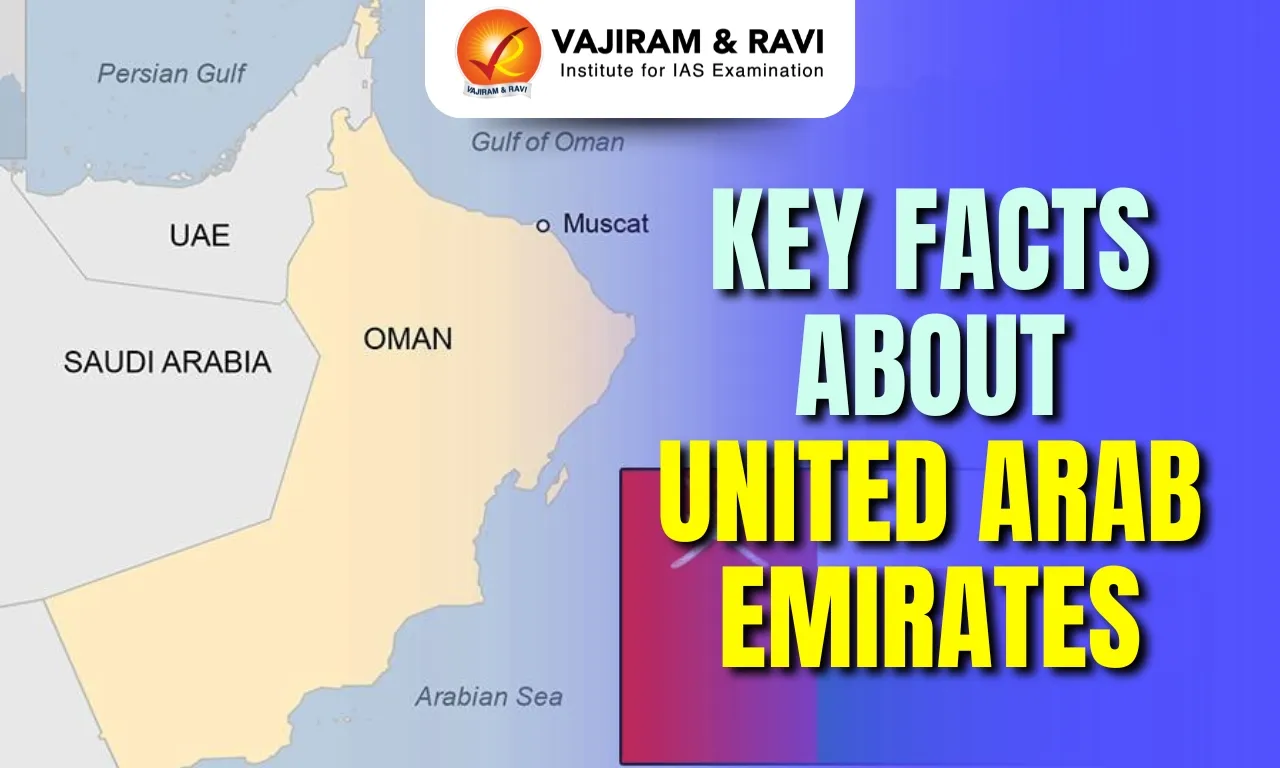
  • Location: It is a Middle East country that is located on the north east edge of the Arabian Peninsula.
  • Bordering Countries: It is bordered by Saudi Arabia in the south and west; and Oman in the east.
  • Maritime Boundary: Gulf of Oman (East), Persian Gulf (North).
  • Capital City: Abu Dhabi

Geographical Features of United Arab Emirates 

  • Terrain: The emirates comprise a mixed environment of rocky desert, coastal plains and wetlands, and waterless mountains. 
  • Climate: The climate is hot and humid along the coast and is hotter still, but dry, in the interior. 
  • Highest point: Jabal Bil 'Ays 1,905 m Mountain
  • Major Ports: Port Rāshid and Port Jebel Ali
  • Natural Resources: It mainly consists of petroleum and natural gas.
  • Tropic of Cancer passes through UAE, specifically Abu Dhabi emirate. 

Source: TH

United Arab Emirates FAQs

Q1: What is the capital city of the United Arab Emirates?

Ans: Abu Dhabi

Q2: What is the official language of the UAE?

Ans: Arabic

Indian Bison

Indian Bison

Indian Bison Latest News

Recently, the Indian bison population in Debrigarh wildlife sanctuary has recorded a robust jump of 189 individuals within a year, taking the total head count to 848.

About Indian Bison

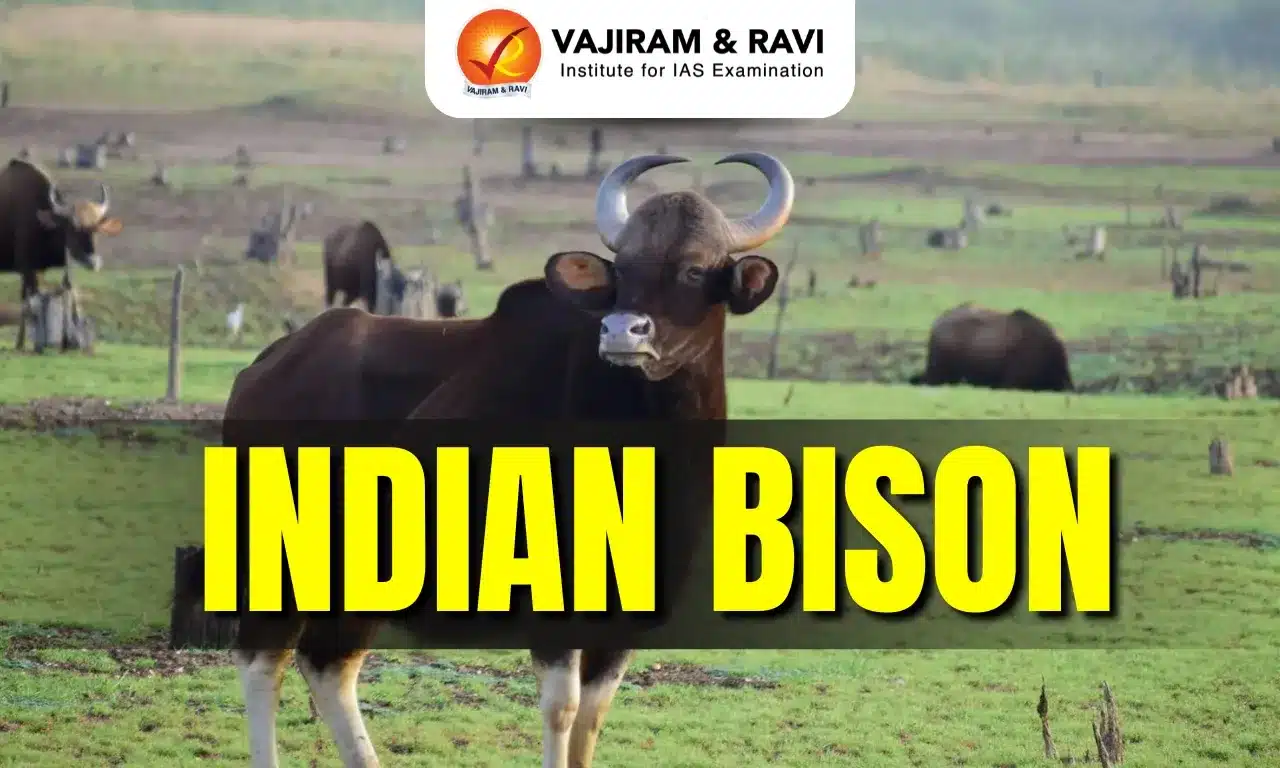
  • It is the largest species among the wild cattle and the Bovidae.
  • Distribution:  These are indigenous to the South and Southeast parts of Asia.
  • Habitat: Gaurs are primarily found in evergreen and semi-evergreen forests along with moist deciduous forests with open grasslands.
  • They prefer hilly-terrains below an altitude of 1,500-1,800 m with large and undisturbed forest tracts and abundant water.
  • Conservation Status of Indian Bison
  • Ecological Significance: It plays a vital role in maintaining ecological balance in forests besides serving as important prey species for tigers.
  • They also help shape vegetation dynamics and contribute to seed dispersal.
  • Threats: Loss of habitat throughout most of their range. Another serious concern is susceptibility to domestic cattle diseases like rinderpest, hoof, or mouth disease.

Key Facts about Debrigarh wildlife Sanctuary

  • Location: It is situated in the Bargarh district of Odisha.
  • It is located near Hirakud Dam (the longest dam in India and the longest earthen dam in the world) on the Mahanadi River.
  • Vegetation: Most of the plant sanctuary is covered with mixed and dry deciduous forest.
  • Flora: Major trees found here are Sal, Asana, Bija, Aanla, Dhaura, etc..
  • Fauna: Indian leopards, sloth bears, chousingha (four-horned antelope), sambar deer, gaurs (Indian bison).

Source: NIE

Indian Bison FAQs

Q1: Where is the Indian Bison primarily found?

Ans: India and Southeast Asia

Q2: What is the conservation status of Indian Bison?

Ans: Vulnerable

Brandt’s Hedgehog

Brandt’s Hedgehog

Brandt’s Hedgehog Latest News

A new species of hedgehog, Brandt’s hedgehog, not so far found in India, has been recently discovered in Jammu and Kashmir, DNA analysis and morphological studies reveal.

About Brandt’s Hedgehog

  • It is a species of desert hedgehog.
  • Scientific Name: Paraechinus hypomelas

Brandt’s Hedgehog Distribution

It is native to parts of the Middle East and Central Asia, with a range that includes Iran, Afghanistan, Pakistan, and parts of Turkmenistan.

Brandt’s Hedgehog Habitat  

  • It inhabits arid and semi-arid regions, including rocky deserts, scrublands, and dry mountain slopes. 
  • The species is adapted to environments with sparse vegetation, loose or stony soils, and extreme temperature fluctuations between day and night. 
  • It is often associated with areas that provide natural shelter, such as rock crevices, abandoned burrows, or dense shrubs. 
  • It is still capable of digging dens when absolutely needed. It hibernates during colder weather.

Brandt’s Hedgehog Features

  • It is about 9-12 inches long and weighs around 500-900 grams. 
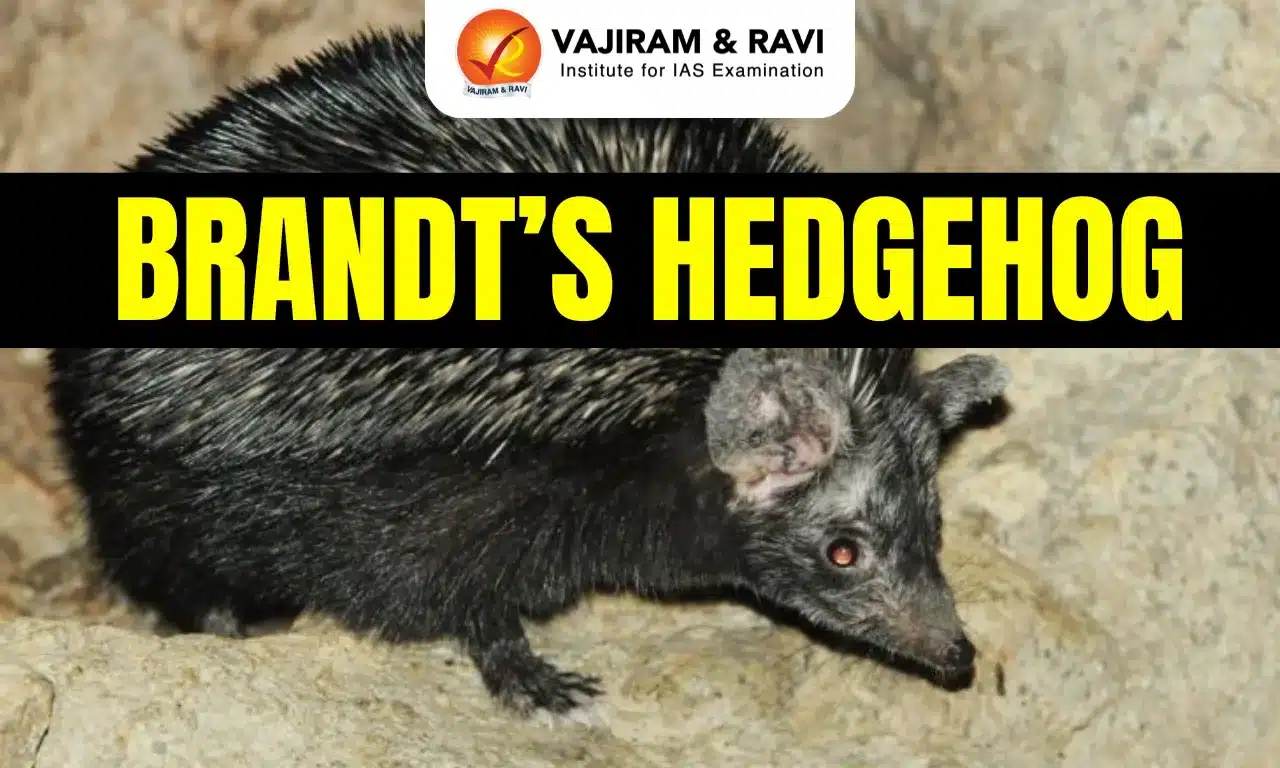
  • It has a black brownish face with a few white hairs interspersed on the forehead. 
  • They have large ears with a narrow base. 
  • Both the dorsal and ventral surfaces as well as the limbs are usually blackish brown. 
  • It has five short-nailed toes on each of its two front paws. 
  • Its back paws have four toes each with nails that constantly grow long. 
  • It is a faster runner due to lighter needle protection. 
  • It is predominantly nocturnal.

Brandt’s Hedgehog Conservation Status

It is classified as 'Least concern' under the IUCN Red List.

Source: HT

Brandt’s Hedgehog FAQs

Q1: What is Brandt’s Hedgehog?

Ans: It is a species of desert hedgehog.

Q2: Which regions are part of the natural distribution of Brandt’s Hedgehog?

Ans: The Middle East and Central Asia, including Iran, Afghanistan, Pakistan, and parts of Turkmenistan.

Q3: What type of habitat does Brandt’s Hedgehog prefer?

Ans: Arid and semi-arid regions such as rocky deserts, scrublands, and dry mountain slopes.

Q4: What is the IUCN Red List conservation status of Brandt’s Hedgehog?

Ans: Least Concern.

Soft Matter

Soft Matter

Soft Matter Latest News

Every morning, as you use either your toothpaste or shampoo, you engage with soft matter, materials that flow like liquids under force but hold their shape at rest.

About Soft Matter

  • Soft matter, or soft materials, is a sub-field of “condensed matter”, referring to a variety of materials that can be easily deformed or structurally altered by thermal fluctuations or nominal external stress. 
  • Soft materials include colloids, polymers, foams, gels, liquid crystals, and many biomaterials
  • They exhibit many useful and appealing properties, which account for their ubiquity in everyday life, finding use in a diverse range of applications in industry including, food, medical, automotive, construction, transportation, electronics, and manufacturing.
  • Everyday examples include curd, toothpaste, shampoo, soap bubbles, and living cells.
  • One of the important characteristics of soft matter is their physical structures in the mesoscopic scale. 
  • It is the properties and interactions of these structures that determine the overall behavior of the material. 
  • Unlike “hard materials” such as metals, ceramics, or glass, the building blocks of soft matter are held together by weak forces. 
  • As a result, soft material properties can be markedly affected as a result of small changes in temperature, applied force, time, and environment.

Source: TH

Soft Matter FAQs

Q1: What is soft matter?

Ans: It refers to a variety of materials that can be easily deformed or structurally altered by thermal fluctuations or nominal external stress.

Q2: What kind of external influences can easily deform soft materials?

Ans: Thermal fluctuations and nominal external stress.

Q3: Which types of materials are classified as soft matter?

Ans: Colloids, polymers, foams, gels, liquid crystals, and many biomaterials.

Q4: What are some everyday examples of soft matter?

Ans: Curd, toothpaste, shampoo, soap bubbles, and living cells.

Q5: How do soft materials differ from hard materials like metals or ceramics?

Ans: Soft materials are held together by weak forces and deform easily, unlike hard materials.

ICGS Sankalp

ICGS Sankalp

ICGS Sankalp Latest News

Recently, Indian Coast Guard Ship (ICGS) Sankalp visited Port Louis in Mauritius as part of overseas deployment in the Indian Ocean Region.

About ICGS Sankalp

  • ICGS Sankalp is an offshore patrol vessel which was commissioned in 2008.
  • The vessel is indigenously built by the Goa Shipyard Limited.
  • It is equipped with state-of-the-art navigation and communication equipment.
  • Functions: It is designed primarily for extended maritime surveillance, exclusive economic zone (EEZ) protection, search and rescue operations, and enforcement of maritime laws within India's vast oceanic domains.

Features of ICGS Sankalp

  • The ship is 105-meter-long with an endurance of 6,500 nautical miles.
  • Capacity: It has displacement capacity of approximately 2,325 tonnes at full load.
  • It consists of HAL Chetak rotary-wing aircraft for enhanced aerial surveillance and SAR.
  • Armaments: It is equipped with primary armament consisting of two 30 mm CRN-91 twin-barrel naval guns, designed for surface engagement and controlled by an integrated fire control system.
  • It is also fitted with davits to deploy up to five high-speed interceptor boats.

Source: DD News

ICGS Sankalp FAQs

Q1: What is ICGS Sankalp?

Ans: An offshore patrol vessel of the Indian Coast Guard

Q2: What is the primary role of ICGS Sankalp?

Ans: Maritime surveillance and patrol

Chips to Start-Up Programme

Chips to Start-up Programme

Chips to Start-Up Programme Latest News

The Chips to Start-up Programme has delivered measurable outcomes across capacity building, infrastructure access, and hands-on chip design enablement.

About Chips to Start-Up Programme

  • It is an umbrella capacity-building initiative launched by the Ministry of Electronics and Information Technology (MeitY) in 2022.
  • Funding and Tenure: Total outlay of ₹250 crore over five years.
  • Target: It targets the development of 85,000 industry-ready professionals across undergraduate, postgraduate, and doctoral levels.
  • It aims to catalyse the incubation of 25 start-ups and enable 10 technology transfers.

Features of Chips to Start-Up Programme

  • It seeks to provide access to SMART lab facilities, train one lakh students, generate 50 patents, and support at least 2,000 focused research publications. 
  • It supports innovation, enhances employability, and enables academic institutions to play a more active role in India’s semiconductor value chain.
  • Programme Approach and Implementation
    • The C2S Programme adopts a comprehensive approach, providing students with hands-on experience in chip design, fabrication, and testing.
    • It is achieved through regular training sessions in collaboration with industry partners, combined with mentorship and practical support.
      • Students gain access to advanced chip design tools, fabrication facilities, and testing resources, including state-of-the-art EDA software and semiconductor foundries.
      • These opportunities also include implementing R&D projects under the C2S Programme to develop working prototypes of Application-Specific Integrated Circuit (ASICs), Systems-on-Chip (SoCs), and Intellectual Property (IP) Core designs.

Source: PIB

Chips to Start-Up Programme FAQs

Q1: What is the nodal agency for implementing the C2S Programme?

Ans: C-DAC (Centre for Development of Advanced Computing)

Q2: Which ministry launched the Chips to Start-up (C2S) Programme?

Ans: Ministry of Electronics and Information Technology

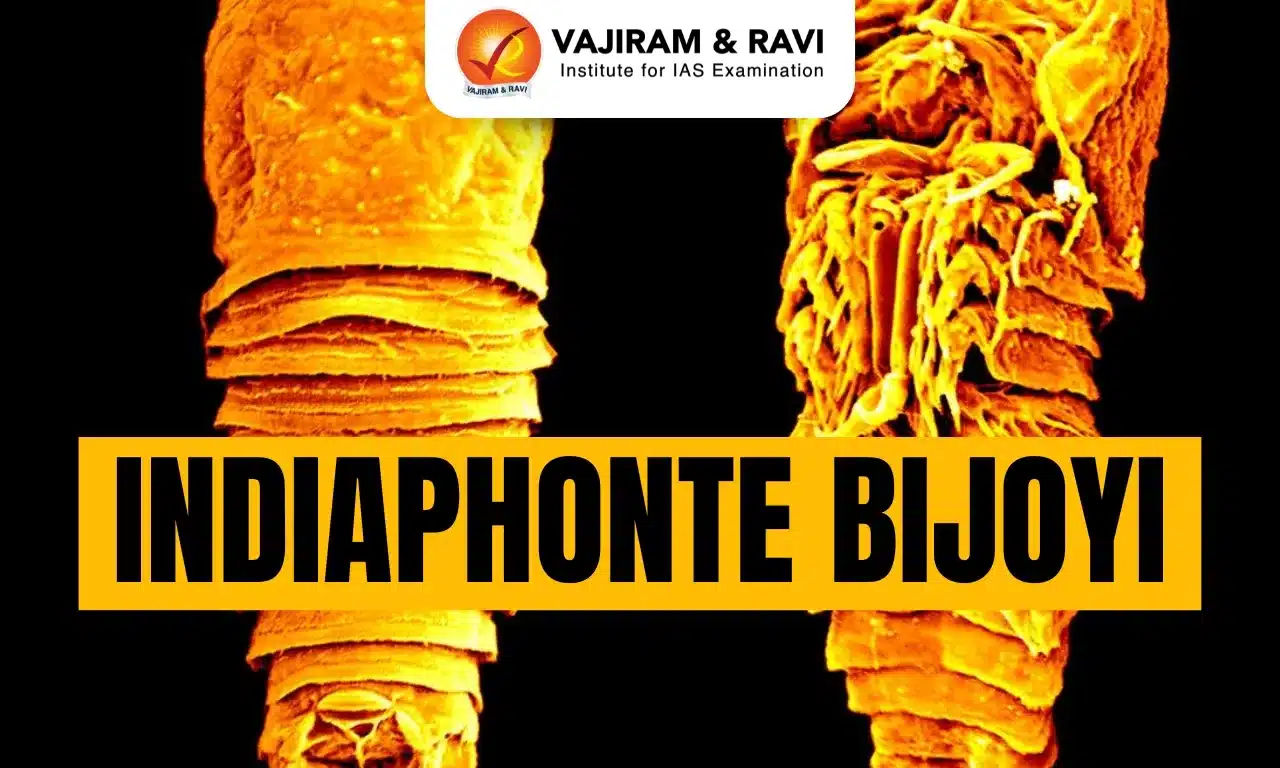
Indiaphonte Bijoyi

Indiaphonte Bijoyi

Indiaphonte Bijoyi Latest News

Recently, a microscopic crustacean was discovered in Kavaratti which has been named Indiaphonte bijoyi, with the generic name Indiaphonte.

About Indiaphonte Bijoyi

  • It is a tiny crustacean discovered from the Kavaratti lagoon in the Lakshadweep islands.
  • It belongs to the family Laophontidae within the Copepoda class.
  • Habitat: It lives in sediments in aquatic environments.

Characteristics of Indiaphonte Bijoyi

  • It has a semi-cylindrical, depressed body that is wider in the middle and tapering towards the posterior.
  • It also has antennae-like appendages at the front.
  • The females are slightly larger than the males.
  • It is essentially Meiofauna, tiny invertebrate animals less than 1 millimetre in size.

Key Facts about Laophontidae

  • It is the most diverse family with 350 species across 77 genera within the order Harpacticoida. 
  • They are microscopic in size and play a vital role in maintaining the health of marine and freshwater ecosystems.
  • Ecological Role
    • They are sensitive to pollution, oil spills, heavy metals, and climate change and are considered reliable bio-indicators of environmental change.
    • They are widely used in aquaculture and fisheries, especially as live feed for fish larvae.
    • They produce and convert omega-3 fatty acids such as Eicosapentaenoic Acid (EPA) and Docosahexaenoic Acid (DHA) that are essential for the growth of fish and shellfish and contribute significantly to human nutritional security.

Source: TH

Indiaphonte Bijoyi FAQs

Q1: Indiaphonte bijoyi belongs to which family?

Ans: Laophontidae

Q2: Where was Indiaphonte bijoyi discovered?

Ans: Kavaratti lagoon, Lakshadweep islands

Bor Tiger Reserve

Bor Tiger Reserve

Bor Tiger Reserve Latest News

Two new safari gates at the Bor Tiger Project were inaugurated recently.

About Bor Tiger Reserve

  • It is located in the Wardha District of Maharashtra
  • It is the smallest tiger reserve in India by area.
  • It covers an area of 138.12 sq.km., which includes the drainage basin of the Bor Dam.
  • It is centrally located among several other Bengal tiger habitats.
    • Towards the northeast lies the Pench Tiger Reserve, towards the east is the Nagzira Navegaon Tiger Reserve, and to the southeast is the Karhandla Wildlife Sanctuary.
    • The Tadoba Andhari Tiger Reserve is located to the southeast, the Melghat Tiger Reserve stands to the west, and the Satpura Tiger Reserve lies to the northwest.
  • Vegetation: The area is populated by the Dry Deciduous Forest type.
  • Flora: Teak, tendu, bamboo, tarot, and gokhru are some of the abundant species.
  • Fauna
    • Apart from tigers, the reserve is home to several other mammals like leopards, sloth bears, sambar deer, Indian bison (gaur), chital, wild boars, and more.
    • It has recorded diversity of just under 200 avian species, with migratory waterfowl such as the tufted duck, northern shovelers, as well as the elegant fish specialist, the osprey. 
    • Commonly seen resident species include the Indian peafowl, black-hooded oriole, and Indian paradise flycatcher.

Source: TOI

Bor Tiger Reserve FAQs

Q1: Where is Bor Tiger Reserve located?

Ans: In the Wardha District of Maharashtra.

Q2: What distinction does Bor Tiger Reserve hold among India’s tiger reserves?

Ans: It is the smallest tiger reserve in India by area.

Q3: Which tiger reserve lies to the northeast of Bor Tiger Reserve?

Ans: Pench Tiger Reserve.

Q4: What type of forest vegetation dominates Bor Tiger Reserve?

Ans: Dry Deciduous Forest.

Daily Editorial Analysis 19 January 2026

Daily Editorial Analysis

Corruption and Prior Sanction — Case of a Divided House

Context

  • The split verdict delivered by Justices B.V. Nagarathna and K.V. Viswanathan in Centre for Public Interest Litigation (CPIL) v. Union of India marks a significant moment in India’s constitutional and anti-corruption
  • The dispute concerns Section 17A of the Prevention of Corruption Act, 1988, which bars inquiry or investigation into allegations against public servants for decisions taken in the discharge of official duties without prior sanction of the appropriate government.
  • The controversy revives longstanding questions regarding the balance between shielding honest officials and preserving investigative independence.

Historical and Legal Context

  • The conflict surrounding Section 17A follows earlier judicial interventions against executive control over corruption investigations.
  • The Single Directive, which required government approval before investigating senior bureaucrats, was struck down in Vineet Narain v. Union of India (1998).
  • The judgment emphasised that the rule of law, equality before law, and protection against the politician-bureaucrat nexus demand insulation of investigative agencies from executive interference.
  • Parliament later reintroduced a similar threshold through Section 6A of the Delhi Special Police Establishment Act, enacted via the Central Vigilance Commission Act, 2003.
  • In Dr. Subramanian Swamy v. Director, CBI (2014), the Supreme Court invalidated Section 6A, declaring differential investigative thresholds for senior officials discriminatory and violative of Article 14.
  • The Court reiterated that however high you may be, the law is above you, underscoring the principle of accountability irrespective of official rank.
  • Section 17A of the PC Act, inserted in 2018, extended the protective threshold from senior bureaucrats to all public servants.
  • Critics argue that this framework suppresses corruption detection and conflicts with Lalita Kumari v. State of Uttar Pradesh (2014), which mandates FIR registration upon disclosure of a cognisable offence.
  • The government defended Section 17A as a safeguard against frivolous complaints and a necessary measure for administrative confidence and policy stability.

The Competing Judicial Views

  • Justice Nagarathna’s Position: Section 17A is Unconstitutional

    • Justice Nagarathna held that Section 17A imposes an impermissible barrier to initial inquiry and thus protects the corrupt.
    • The vice lies not in who grants approval but in the requirement of prior sanction itself.
    • For her, Section 17A revives protections previously rejected and undermines transparency, probity, and the demands of the rule-based governance.
    • She identified structural conflicts of interest: the government both oversees the accused officials and grants approval for investigations, enabling a shared departmental interest to deny sanction.
    • The arrangement promotes an institutional nexus that discourages scrutiny and allows wrongdoing to remain unchecked.
  • Justice Viswanathan’s Position: Section 17A is Constitutional with Safeguards

    • Justice Viswanathan agreed that vesting approval power in the government would be unconstitutional but viewed prior sanction as legitimate to prevent policy paralysis and shield honest decision-makers from vexatious complaints.
    • The constitutional defect lies in placement, not existence. He proposed that the Lokpal, conceived as an independent anti-corruption authority, could serve as an external filter.
    • The Lokpal Act and PC Act operate in the same normative field, as both incorporate mechanisms for screening, accountability, and protection against misuse, allowing an institutional equilibrium that balances governance and scrutiny.

The Core Constitutional Disagreement, Broader Implications and the Way Forward

  • The Core Constitutional Disagreement

    • The core disagreement centres on whether prior investigative filters are impermissible barriers or permissible institutional checks if independent.
    • Justice Nagarathna rejects any pre-investigation threshold as inconsistent with earlier jurisprudence, while Justice Viswanathan endorses a hybrid model where an independent authority mitigates abuse while preventing executive veto.
  • Broader Implications and the Way Forward

    • The dispute engages three constitutional concerns: separation of powers, anti-corruption capability, and administrative efficiency.
    • The resolution will shape India’s state accountability
    • Excessive investigative insulation promotes impunity, whereas unmediated investigative power risks bureaucratic hesitation and diminished state capacity in economic and administrative fields.

Conclusion

  • The split verdict in CPIL v. Union of India illustrates a constitutional struggle to balance governance, integrity, and oversight within the modern administrative state.
  • A larger Bench of the Supreme Court will now determine whether investigative autonomy, filtered scrutiny, or an institutional hybrid best reflects constitutional commitments to democracy and the rule of law.

Corruption and Prior Sanction — Case of a Divided House FAQs

Q1. What legal issue was central to CPIL v. Union of India?
Ans. The central issue was the constitutional validity of Section 17A of the Prevention of Corruption Act, which required prior government approval for corruption investigations against public servants.

Q2. Why did Justice Nagarathna consider Section 17A unconstitutional?
Ans. Justice Nagarathna considered Section 17A unconstitutional because it created a pre-investigation barrier that protected corrupt officials and impeded investigative independence.

Q3. What alternative approach did Justice Viswanathan propose?
Ans. Justice Viswanathan proposed that prior approval could be constitutional if the sanctioning power was placed with an independent authority such as the Lokpal instead of the government.

Q4. Which earlier judgments influenced the debate around Section 17A?
Ans. The debate was influenced by earlier judgments such as Vineet Narain (1998) and Subramanian Swamy (2014), which rejected executive control over corruption investigations.

Q5. What broader constitutional concern underlies the disagreement between the judges?
Ans. The broader constitutional concern was how to balance the protection of honest public decision-making with the need to ensure robust and unbiased anti-corruption enforcement.

Source: The Hindu


A Display Plan for the Piprawaha Relics

Context

  • The recent partial reunification of ancient Buddhist gems associated with the historical Buddha marks a moment of considerable significance for India’s cultural heritage sector.
  • These artifacts, dispersed for more than a century, were reacquired from abroad by an Indian conglomerate and subsequently transferred to the government, prompting a celebratory public exhibition inaugurated in Delhi by Prime Minister Narendra Modi.
  • Beyond the event itself lies a deeper question about the long-term stewardship, presentation, and interpretation of these relics.
  • If handled with care and foresight, their return has the potential to shift public attitudes toward India’s museums, enhance heritage governance, and position India as a central destination for global Buddhist pilgrimage.

Buddhist Relics and Early Indian Heritage Practices

  • Understanding the historical place of relics in Buddhism clarifies why such objects, often visually modest and materially unremarkable, commanded extraordinary devotion.
  • Following the Buddha’s passing, his corporeal remains, including ash and bone fragments, were periodically divided among followers and ultimately placed in vessels with gems and offerings.
  • These relics were interred in stupas, large hemispherical mounds that functioned simultaneously as reliquaries, teaching devices, and ritual centres.
  • Their power derived not from aesthetic value but from their perceived ability to sanctify spaces, cultivate devotion, and transform the spiritual lives of those who approached them.

Sanchi as a Model of Spatial and Ritual Engagement

  • The Great Stupa at Sanchi illustrates the sophisticated strategies through which relics were contextualized in early India.
  • Initially constructed under Ashoka and later expanded, the stupa complex incorporated gateways at the cardinal directions leading to a circumambulatory path.
  • Carved reliefs on the gateways depicted episodes from the Buddha’s life, scenes of worship, auspicious symbols, and figures in foreign dress, suggesting both historical continuity and cross-cultural interaction along emerging trade routes.
  • Such visual programs prepared visitors emotionally and intellectually to encounter the relics, while railings and monastic presence facilitated a semi-secluded sacred environment conducive to reflection and community-building.
  • The success of these strategies is reflected in Sanchi’s growth as a major religious centre supported by diverse social strata and by the expansion of Buddhist sites across the subcontinent.

Adaptation Across Regions and Symbolic Presence

  • As Buddhism spread, relic-centred practices evolved.
  • In peninsular India, for example, rock-cut cave complexes often contained monolithic stupas that lacked corporeal relics yet conveyed the Buddha’s presence symbolically through sculpture and architectural design.
  • This adaptation demonstrates that Buddhist sacred environments could operate even in the absence of physical remains, underscoring the importance of spatial, visual, and ritual framing in mediating sacred experience.
  • Such precedents offer instructive models for contemporary institutions seeking to present relics in ways that respect both historical traditions and modern sensibilities.

Contemporary Challenges of Display and Stewardship

  • With little of the original Piprawaha stupa surviving, the recently reunited relics are expected to move into a public institution after the Delhi exhibition.
  • Merely placing them behind glass vitrines would replicate a colonial museological model that encourages passive viewing and strips objects of ritual potency.
  • To avoid this, museums must articulate and implement long-term strategies that honour the multifaceted roles relics have historically played.
  • Thoughtfully designed spaces should allow visitors to engage with the relics through chanting, contemplation, meditation, or aesthetic appreciation, acknowledging that relics can still function as living objects within the cultural sphere.

Institutional Responsibilities and Community Engagement

  • The return of the relics should also catalyse systemic changes in heritage education and governance.
  • Museums could establish grants and fellowships encouraging collaboration among art historians, anthropologists, scientists, and filmmakers to trace how artifacts shape social worlds.
  • Educational initiatives should introduce postgraduate students and heritage practitioners to stewardship, restitution ethics, and interpretive methodologies.
  • Simultaneously, institutions must engage communities living near heritage sites to combat illicit antiquities trafficking by training them in documentation practices, legal awareness, and heritage advocacy.
  • Such programs align India’s heritage stewardship with international norms while empowering local custodians.

Conclusion

  • The reunification of the Piprawaha relics represents more than an act of repatriation; it provides an opportunity to reimagine heritage stewardship in India.
  • By adopting historically informed display strategies, enhancing educational infrastructures, and involving communities in heritage protection, India can ensure that these relics are not merely preserved but meaningfully revived.
  • If such efforts succeed, the relics will not only have returned to the land of the Buddha but will once again be able to exert their transformative aura, inviting both local and international publics to engage with India’s profound Buddhist past.

A Display Plan for the Piprawaha Relics FAQs

Q1. Why is the reunification of the Buddhist gems considered significant?
Ans. The reunification is significant because it symbolizes a major act of cultural restitution and has the potential to transform India’s heritage stewardship and museum practices.

Q2. What role did stupas play in early Buddhist traditions?
Ans. Stupas served as reliquaries for the Buddha’s corporeal remains and functioned as ritual, pedagogical, and devotional spaces for followers.

Q3. How did the Great Stupa at Sanchi prepare visitors to engage with relics?
Ans. The Great Stupa at Sanchi prepared visitors through carved gateways, visual narratives, and spatial pathways that guided pilgrims toward a meaningful encounter with the relics.

Q4. What contemporary problem arises if relics are merely placed in glass vitrines?
Ans. Placing relics in glass vitrines risks reducing them to inert display objects and reinforces a colonial model of passive viewing that strips the relics of their ritual and symbolic vitality.

Q5. What broader reforms could the return of the relics inspire in India’s heritage sector?
Ans. The return could inspire reforms in museum education, community engagement, ethical stewardship, and the development of new interpretive and collaborative programs.

Source: The Hindu

Daily Editorial Analysis 19 January 2026 FAQs

Q1: What is editorial analysis?

Ans: Editorial analysis is the critical examination and interpretation of newspaper editorials to extract key insights, arguments, and perspectives relevant to UPSC preparation.

Q2: What is an editorial analyst?

Ans: An editorial analyst is someone who studies and breaks down editorials to highlight their relevance, structure, and usefulness for competitive exams like the UPSC.

Q3: What is an editorial for UPSC?

Ans: For UPSC, an editorial refers to opinion-based articles in reputed newspapers that provide analysis on current affairs, governance, policy, and socio-economic issues.

Q4: What are the sources of UPSC Editorial Analysis?

Ans: Key sources include editorials from The Hindu and Indian Express.

Q5: Can Editorial Analysis help in Mains Answer Writing?

Ans: Yes, editorial analysis enhances content quality, analytical depth, and structure in Mains answer writing.

Tackling Child Trafficking in India – Legal Framework and Institutional Response

Child Trafficking

Child Trafficking Latest News

  • India’s response to child trafficking has come under focus following recent judicial directions and data highlighting low conviction rates despite large-scale child rescues. 

Understanding Child Trafficking in India

  • Child trafficking remains a persistent and grave violation of human rights in India. 
  • It involves the recruitment, transportation, harbouring or receipt of children for purposes of exploitation, including forced labour, sexual exploitation, slavery, servitude, or organ removal. 
  • Despite extensive constitutional and statutory safeguards, trafficking networks continue to operate due to socio-economic vulnerabilities and weak enforcement outcomes.
  • Official data indicate that thousands of children are rescued every year, yet convictions remain disproportionately low, exposing gaps between law, enforcement, and justice delivery. 

International and Domestic Legal Definitions

  • At the international level, child trafficking is defined under the Palermo Protocol (2000), which treats any movement or exploitation of a child for exploitative purposes as trafficking, irrespective of consent. 
  • This principle has been incorporated into India’s domestic legal framework.
  • Under the Bharatiya Nyaya Sanhita (BNS), 2023, trafficking is defined broadly to include recruitment, transportation or harbouring through coercion, deception, abuse of power, or inducement for exploitation. 
  • The law recognises multiple forms of exploitation, including physical, sexual, economic, and organ trafficking, ensuring a comprehensive scope. 

Constitutional Protection of Children

  • The Constitution of India provides a strong foundation for protecting children against exploitation. 
  • Article 23 prohibits human trafficking and forced labour, while Article 24 bans employment of children in hazardous industries. 
  • Additionally, Article 39(e) and (f) directs the State to ensure that children are protected from abuse and are provided conditions of freedom, dignity, and healthy development.
  • These constitutional principles impose a positive obligation on the State to prevent exploitation and address the structural conditions that enable trafficking. 

Key Legislations Addressing Child Trafficking

  • India has enacted multiple sector-specific laws to address different dimensions of child trafficking:
    • Bharatiya Nyaya Sanhita, 2023: Criminalises trafficking and the buying and selling of minors.
    • Immoral Traffic (Prevention) Act, 1956: Targets trafficking for sexual exploitation.
    • Juvenile Justice (Care and Protection of Children) Act, 2015: Focuses on care, rehabilitation, and reintegration of trafficked children.
    • Protection of Children from Sexual Offences (POCSO) Act, 2012: Provides stringent punishments for sexual offences against children, including life imprisonment and death penalty in extreme cases.
  • The POCSO Act is notable for being gender-neutral and for enabling fast-track courts to ensure speedy trials. 

Judicial Interventions and Supreme Court Guidelines

  • The judiciary has played a critical role in shaping India’s anti-trafficking response. In landmark judgments, the Supreme Court has recognised trafficking as a violation of the fundamental right to life and dignity.
  • Cases such as Vishal Jeet v. Union of India, M.C. Mehta v. State of Tamil Nadu, and Bachpan Bachao Andolan v. Union of India established preventive, rehabilitative, and regulatory principles. 
  • More recently, the Court has issued strict guidelines emphasising victim-centric approaches, accountability of authorities, and coordinated enforcement. 

Structural Challenges in Tackling Child Trafficking

  • Despite a robust legal framework, several challenges persist:
    • Low conviction rates, which weaken deterrence
    • Socio-economic vulnerabilities such as poverty, migration, disasters, and family breakdown
    • Misuse of digital platforms for recruitment under the guise of jobs or opportunities
    • Fragmented enforcement, due to trafficking networks operating across State boundaries
  • Law and order, being a State subject, further complicates coordinated action, making Centre-State cooperation essential. 

Way Forward: Strengthening India’s Anti-Trafficking Response

  • A multi-dimensional strategy is required to tackle child trafficking effectively. 
  • This includes improving investigation quality, strengthening rehabilitation mechanisms, enhancing digital surveillance, and ensuring faster trials. 
  • Most importantly, conviction rates must improve to establish credible deterrence.
  • Equally critical is addressing root causes through social protection, education, livelihood support, and awareness programmes. 
  • A strong institutional partnership between the Union and States is indispensable for disrupting trafficking networks operating across jurisdictions.

Source: TH

Child Trafficking FAQs

Q1: What is child trafficking under Indian law?

Ans: It involves recruiting, transporting or exploiting a child for forced labour, sexual exploitation, slavery or organ removal, irrespective of consent.

Q2: Which law currently defines trafficking in India?

Ans: The Bharatiya Nyaya Sanhita, 2023 provides the primary legal definition of trafficking.

Q3: How does the Constitution protect children from trafficking?

Ans: Articles 23, 24 and 39 prohibit trafficking, forced labour and child exploitation.

Q4: Why are conviction rates low despite large rescues?

Ans: Weak investigations, cross-border networks, and poor coordination reduce successful prosecutions.

Q5: Why is Centre-State cooperation crucial in tackling trafficking?

Ans: Trafficking networks operate across State boundaries while law and order is a State subject.

Board of Peace for Gaza – Trump Invites India to Join the Proposed Board

Board of Peace for Gaza

Board of Peace for Gaza Latest News

  • The U.S. President Donald Trump invited India to join the proposed Board of Peace for Gaza, a new governance and conflict-management mechanism.
  • The initiative emerges from  a group of Islamic countries backed Trump’s peace plan for Gaza and coincides with broader U.S. efforts to restructure global governance outside traditional multilateral institutions, especially the United Nations (UN).
  • The proposal has triggered a global debate on the future of the post-World War II international order, particularly the relevance and authority of the UN Security Council (UNSC).

Board of Peace for Gaza

  • Purpose and mandate:
    • To supervise Gaza’s transitional governance, stabilisation, and reconstruction.
    • To oversee a temporary technocratic, apolitical Palestinian administration.
    • To manage funding for redevelopment until the Palestinian Authority (PA) completes institutional reforms.
    • Trump now seeks to expand this Gaza-specific mechanism into a global conflict-resolution template.
  • Composition and leadership:
    • Chaired by U.S. President Donald Trump, its members include select invited countries and global leaders (e.g., Tony Blair).
    • It will operate as an invitation-only body, not based on universal membership.
  • UN linkage:
    • UNSC Resolution 2803 authorised a Board to supervise Gaza’s transition until 2027.
    • Russia and China abstained, but the countries of the Global South voted for it. 

India’s Position

  • Current status: India has received the invitation but has not formally responded. Pakistan has also been invited.
  • India’s stated principles:
    • Consistent support for a Two-State Solution (Israel and Palestine coexisting).
    • India welcomed the first phase of Trump’s peace plan, especially release of hostages, and enhanced humanitarian assistance to Gaza.
  • On military involvement: The U.S. is seeking troops for a temporary International Stabilisation Force (ISF). India has clearly ruled out participation, as ISF is not a UN peacekeeping mission.

Broader Global Governance Debate

  • Challenge to the UN system: 
    • Critics argue the Board of Peace undermines UN Charter principles, sovereign equality of states, and collective decision-making.
    • It is seen as an attempt to sidestep the UNSC and concentrate authority in the U.S.-led executive body.
  • Trump’s multilateral skepticism:
    • Because of the continuation of Trump’s long-standing approach. For example, withdrawal from UNESCO, WHO; exit from over 60 international organisations.
    • Aligned with Project 2025 (the Heritage Foundation’s blueprint for Trump’s second term), which called for sharp reductions in multilateral commitments and a preference for ad hoc coalitions where the US sets the agenda.
  • From Gaza to global template:
    • Trump aims to transform the Board into a general crisis-management club.
    • It is framed as a solution to UNSC paralysis, especially veto politics.
    • It risks diverting funds, legitimacy, and attention away from the UN if successful.

Key Challenges and Way Ahead

  • For global order:
    • Erosion of multilateralism and UN centrality. Rise of exclusive, power-driven governance mechanisms. Undermining rules-based international order.
  • For India:
    • Tension between commitment to reformed multilateralism, and pragmatic engagement with the U.S.-led initiatives.
    • Risk of legitimising a system that weakens India’s long-term push for UNSC reform, and marginalises voices of the Global South.
  • India’s options:
    • Calibrated engagement: Engage diplomatically without endorsing erosion of UN authority. Maintain distinction between political oversight and military involvement.
    • Defend UN-centric multilateralism: Reiterate support for UNSC-authorised mechanisms. Resist normalisation of extra-UN security architectures.
    • Strategic autonomy: Balance ties with the U.S. while safeguarding India’s principled positions. Coordinate with like-minded countries of the Global South.
    • Push for UN reform: Use the crisis to highlight urgency of UNSC reform, not its bypassing.

Conclusion

  • The invitation to India to join the Board of Peace for Gaza places New Delhi at a critical crossroads in global diplomacy. 
  • While the initiative promises flexibility and decisiveness in conflict management, it also represents a fundamental challenge to the UN-led multilateral order that India has long defended. 
  • As global governance enters a phase of extraordinary flux, it tests India’s ability to balance principle with pragmatism in an evolving world order.

Source: TH | IE

Board of Peace for Gaza FAQs

Q1: What is the ‘Board of Peace for Gaza’?

Ans: It is a U.S.-led, invitation-only body to oversee Gaza’s transitional governance, marking a shift away from UN-based multilateralism.

Q2: What is India’s dilemma in responding to the U.S. invitation to join the Board of Peace for Gaza?

Ans: Engaging pragmatically with the U.S.-led initiative or upholding its long-standing commitment to UN-centric multilateralism and a two-state solution.

Q3: How does the Board of Peace initiative challenge the authority and relevance of the UNSC?

Ans: By concentrating agenda-setting and decision-making under U.S. leadership.

Q4: Why has India ruled out participation in the proposed International Stabilisation Force (ISF) for Gaza?

Ans: Because the ISF is not a UN-mandated peacekeeping operation, consistent with India’s principled approach to overseas military deployments.

Q5: What lessons does the ‘Board of Peace’ debate hold for India’s pursuit of ‘reformed multilateralism’?

Ans: It underscores the need for India to push harder for UN reform while resisting the normalisation of exclusive, power-centric alternatives.

Tiger Global Tax Ruling: Supreme Court Impact on Startups

Tiger Global Tax Ruling

Tiger Global Tax Ruling Latest News

  • The Supreme Court of India has ruled that venture capital firm Tiger Global’s $1.6-billion stake sale in Flipkart to Walmart is subject to taxation. 
  • The verdict, closely watched by foreign investors, is seen as a landmark decision that could influence cross-border deal structures and have wider implications for India’s startup ecosystem.

Dispute Over India–Mauritius Tax Treaty

  • The case arose from Tiger Global’s 2018 exit, executed through its Mauritius-based entities. 
  • Tiger Global claimed protection under the India–Mauritius Double Taxation Avoidance Agreement (DTAA). 
    • A DTAA is a bilateral treaty to prevent the same income from being taxed in both nations — the country where the income is earned and the country where the company is based out of.
  • However, the Supreme Court ruled that the DTAA benefit could not be extended in this case.

Court Rejects Treaty Benefits, Overturns High Court Order

  • In denying DTAA protection, the Supreme Court overturned an August 2024 ruling of the Delhi High Court, which had set aside a 2020 decision of the Authority for Advance Rulings (AAR). 
  • The AAR had earlier concluded that the transaction was prima facie structured to avoid tax.

Broader Implications for Startup Investments

  • Mauritius had long been a favoured investment route into India due to the non-taxability of capital gains until 2016. 
  • The judgment comes amid slowing startup funding, as investors increasingly prioritise profitability and clear tax certainty, potentially reshaping how foreign capital approaches Indian startup exits.

Background: Tiger Global’s Flipkart Investment

  • After acquiring a stake in Flipkart, Mauritius-based entities of Tiger Global—Tiger Global International II, III, and IV Holdings—went on to invest in several Indian companies.
  • Claim for Tax Exemption - Following the stake sale, the Tiger Global entities sought a “nil” withholding tax certificate from Indian tax authorities. They argued that capital gains were exempt under the India–Mauritius DTAA due to the “grandfathering” clause for shares acquired before April 1, 2017.
    • Grandfathering essentially means exempting an activity from a new law or regulation.
  • Tax Authorities’ Rejection - Indian tax authorities rejected the request, concluding that the Mauritius entities lacked independent decision-making. They held that real control over share purchases and sales did not rest with these entities.
  • Authority for Advance Rulings (AAR) Decision - The matter was taken to the Authority for Advance Rulings, which in 2020 dismissed Tiger Global’s claim. 
    • The AAR found that the investment structure was primarily designed to obtain DTAA benefits and that effective control lay outside Mauritius—particularly in the United States—through a complex web of entities.
  • Delhi High Court Intervention - On appeal, the Delhi High Court overturned the AAR ruling, holding that the conclusion of tax avoidance was arbitrary and unsustainable.

Supreme Court’s Final Word

  • The Supreme Court of India reversed the High Court’s decision. 
  • It held that DTAA protection applies only where assets are directly owned by a Mauritian entity’s permanent establishment
  • The Flipkart transaction, he ruled, fell outside this scope—rendering the gains taxable in India.

Implications of the Verdict for Indian Startups and Investors

  • End of Automatic Treaty Benefits - Tax experts warn that the ruling weakens automatic reliance on the India–Mauritius DTAA. Merely holding a Tax Residency Certificate (TRC) will no longer guarantee capital gains tax exemption.
    • TRC is an official document from a country’s tax authority. 
    • It proves that an individual or entity is a tax resident there for a specific period. This is crucial for claiming benefits under a DTAA.
  • Substance Over Form Becomes the Test - The judgment reinforces a shift toward examining economic substance. Investors must now show genuine commercial rationale, autonomous decision-making, and real operations in treaty jurisdictions.
  • Higher Tax Uncertainty and Litigation Risk - According to practitioners, the ruling raises uncertainty for venture capital and private equity exits. Exit planning, valuations, and indemnities may need reassessment amid increased scrutiny and potential disputes.
  • Impact on Offshore Investment Structures - Structures routed through Mauritius or Singapore—especially pre-2017 investments—could face closer examination. While closed cases may not reopen automatically, reassessments are now more likely where legally permitted.
  • Costlier Risk Management - Experts anticipate tax insurance and indemnity mechanisms becoming scarcer and more expensive, adding to compliance costs and complicating deal-making for startups and foreign investors alike.

Startup Funding Slowdown Amid Investor Caution

  • The Supreme Court ruling comes against the backdrop of a broader slowdown in India’s startup funding. 
  • In 2025, tech startups raised $10.5 billion, down 17% from 2024 and 4% from 2023. While seed-stage funding fell sharply, early-stage investments showed resilience, signalling selective but continued investor confidence.

Source: IE | IE

Tiger Global Tax Ruling FAQs

Q1: What did the Supreme Court decide in the Tiger Global tax ruling?

Ans: The Tiger Global tax ruling held that Flipkart stake sale gains are taxable in India, denying treaty benefits under the India–Mauritius DTAA.

Q2: Why was DTAA protection denied?

Ans: The court found that Tiger Global’s Mauritius entities lacked real economic substance and independent decision-making, central to the Tiger Global tax ruling.

Q3: What is the impact on foreign investors?

Ans: The Tiger Global tax ruling increases tax uncertainty, requiring investors to demonstrate commercial substance rather than rely solely on residency certificates.

Q4: Does the ruling affect past investments?

Ans: While closed cases may not reopen automatically, the Tiger Global tax ruling strengthens reassessment powers where permitted under Indian tax law.

Q5: Why does this matter for Indian startups?

Ans: The Tiger Global tax ruling may reshape exit planning, valuations, and deal structures, especially as startup funding slows and investor caution rises.

India Rice Production: Growth, Surplus and Hidden Costs

India Rice Production

India Rice Production Latest News

  • India has overtaken China to become the world’s largest rice producer in 2024–25, producing about 150 million metric tonnes and accounting for nearly 28% of global output. 
  • While this marks a sharp rise from a decade ago and reflects stagnant Chinese production, the achievement has downsides. 
  • Paddy’s profitability has encouraged its spread into water-scarce regions, yields remain uneven across states, and its dominance raises concerns about water stress, crop diversification, and long-term nutritional security.

Steady Rise in India’s Rice Production

  • Long-Term Growth Trend - India’s rice output has grown consistently since the Green Revolution era. Between 1969–70 and 2024–25, the area under paddy expanded by over 36%, yields tripled, and total production rose nearly fourfold.
  • Sharp Expansion in the Last Five Years - The most notable surge occurred recently. Paddy area increased from 43.66 million hectares in 2019–20 to 51.42 million hectares in 2024–25, while production jumped from 118.87 to 150 million metric tonnes.
  • Growing Global Share - As output rose, India’s share of global rice production climbed from 21.95% in 2011 to about 28% in 2024, placing it just ahead of China and far above other producers like Bangladesh and Indonesia.

India’s Rice Stocks: Surplus Beyond Food Security Needs

  • Rising Central Pool Reserves - With sustained production growth and high procurement, rice stocks in the central pool have risen steadily. As of January 1, 2026, stocks stood at 63.06 million metric tonnes, including unmilled paddy.
  • Far Above Buffer and Welfare Requirements - This level far exceeds prescribed norms. Stocking rules require only 7.61 million tonnes on January 1, while annual needs under the NFSA and welfare schemes are about 37.2 million tonnes.
  • Efforts to Reduce Excess - The government has attempted to offload surplus rice through open market sales and by diverting rice for ethanol production. Despite these measures, stocks remain elevated.
  • Procurement Concentrated in Few States - During the 2023–24 kharif season, the Food Corporation of India procured 525.48 lakh tonnes—about 38% of national output. Over half of this came from Punjab, Haryana, Chhattisgarh, and Odisha.

Why Paddy Dominates Indian Agriculture

  • Wide Cultivation and Scale - Paddy is India’s most widely grown crop, cultivated in over 600 districts and spread across more than 514 lakh hectares—far exceeding the area under wheat or other major crops.
  • Assured Returns Through MSP - A key attraction is assured procurement at Minimum Support Price. Paddy offers higher net returns per hectare than crops like maize and moong, making it financially safer for farmers.
  • Weak Performance of Alternative Crops - Stagnant or declining yields in crops such as cotton reduce their attractiveness. Compared to global averages, India’s yields in some non-paddy crops remain low.
  • Strong Export Demand - India is the world’s leading rice exporter, earning substantial foreign exchange from basmati and non-basmati rice exports to West Asia, North America, and Europe, reinforcing paddy’s appeal.
    • The country exported six million tonnes of basmati and 14.13 million tonnes of non-basmati rice during 2024-25, earning $5.9 billion and $6.5 billion respectively. 
    • India exported basmati to Saudi Arabia, Iraq, Iran, Yemen, the UAE, the US, the UK, Kuwait, Oman, Qatar, Jordan and Israel during 2024-25. 

Environmental and Regional Challenges of Paddy Cultivation

  • Paddy is an extremely water-intensive crop, requiring nearly 1–3 tonnes of water to produce just one kilogram of rice
  • Its widespread cultivation has severely depleted groundwater in many regions. 
  • In Punjab, excessive groundwater extraction has led to serious environmental and health problems, while paddy expansion into already water-stressed states has worsened declining water tables.
  • Rice productivity also varies sharply across states due to differing agro-climatic conditions. 
  • In 2024–25, yields ranged from 4,428 kg per hectare in Punjab and 3,928 kg in Andhra Pradesh to much lower levels in Bihar (2,561 kg) and Uttar Pradesh (2,824 kg), compared to the national average of 2,929 kg per hectare.

Push for Crop Diversification Away from Paddy

  • With a growing preference for paddy among farmers, the Union government is intensifying efforts to promote crop diversification. 
  • The objective goes beyond farm incomes to include nutritional security and conservation of scarce water resources.

Incentives Linked to Fiscal Savings

  • The Agriculture Ministry has proposed incentivising farmers who shift away from paddy to alternative crops. 
  • These incentives could be financed from savings in the economic cost of rice, estimated at ₹1.36 lakh per hectare
  • This cost reflects expenses borne by the Food Corporation of India on MSP-based procurement, milling, transport and storage.
    • According to officials, rice stored by the FCI costs around ₹33 per kg, and with an average yield of 41.25 quintals per hectare, government spending reaches about ₹1,36,000 per hectare, excluding subsidies on power, fertilisers and seeds.
  • Officials suggest focusing diversification efforts on districts with below-national-average paddy yields (2,929 kg per hectare) and relatively lower paddy coverage.

Promoting Oilseeds and Pulses

  • The strategy prioritises oilseeds and pulses to reduce India’s heavy dependence on edible oil imports. 
  • These crops would be promoted in a phased manner, aligned with agro-climatic suitability and soil conditions, to ensure sustainable transitions for farmers.

Source: IE

India Rice Production FAQs

Q1: Why has India rice production increased sharply in recent years?

Ans: India rice production rose due to higher MSP, assured procurement, expanded acreage, improved yields, and strong export demand, especially for basmati and non-basmati rice.

Q2: How does India rice production compare with China?

Ans: India rice production overtook China in 2024–25 with 150 million tonnes, while China produced about 145 million tonnes, reflecting stagnation in Chinese output.

Q3: Why are high rice stocks a concern?

Ans: Excess India rice production has pushed central stocks far above buffer norms, increasing storage costs and forcing the government to find disposal alternatives.

Q4: What environmental issues arise from India rice production?

Ans: India rice production strains groundwater resources, especially in water-scarce states, due to paddy’s high water requirement and widespread cultivation.

Q5: How is the government responding to paddy overdependence?

Ans: The government plans crop diversification incentives, encouraging oilseeds and pulses to reduce water stress and rebalance India rice production.

Guillain-Barre Syndrome

What is Guillain-Barre Syndrome?

Guillain-Barré Syndrome (GBS) Latest News

A Guillain-Barré Syndrome (GBS) outbreak has hit Madhya Pradesh’s Neemuch district recently, with two deaths reported in Manasa town.

About Guillain-Barré Syndrome (GBS)

  • It is a rare neurological disorder in which a person’s immune system mistakenly attacks part of their peripheral nervous system.
  • This is the part of the nervous system outside the brain and spinal cord. 
  • It controls muscle movement, pain signals, and temperature and touch sensations.
  • Since the body's own immune system does the damage, GBS is called an autoimmune disease.
  • GBS is also called acute inflammatory demyelinating polyradiculoneuropathy (AIDP).
  • It can occur at any age, but it most commonly affects people between 30 and 50.

Guillain-Barré Syndrome (GBS) Causes

  • The exact cause of the disease remains unclear, but it is often observed following a viral or bacterial infection, vaccination, or major surgery.
  • At such times, the immune system becomes hyperactive, leading to this rare condition.

Guillain-Barré Syndrome (GBS) Symptoms

  • Patients often begin with an unknown fever, followed by weakness and other nervous system-related symptoms. 
  • It can increase in intensity over a period of hours, days, or weeks until certain muscles cannot be used at all. 
  • Some cases of GBS are very mild and only marked by brief weakness. Others cause nearly devastating paralysis, leaving the person unable to breathe on their own.
  • It is potentially life-threatening. People with GBS should be treated and monitored as quickly as possible

Guillain-Barré Syndrome (GBS) Treatment

  • There’s no known cure for GBS. 
  • Several treatment options can ease symptoms and help speed recovery. 
  • Most people recover completely from GBS, but some serious illnesses can be fatal. 
  • While recovery may take up to several years, most people are able to walk again six months after symptoms first began.
  • Some people may have lasting effects, such as weakness, numbness, or fatigue.

Source: NDTV

Guillain-Barré Syndrome (GBS) FAQs

Q1: What is Guillain-Barré Syndrome (GBS)?

Ans: It is a rare neurological disorder in which the body’s immune system attacks the peripheral nervous system.

Q2: What is the other medical name for Guillain-Barré Syndrome?

Ans: Acute inflammatory demyelinating polyradiculoneuropathy (AIDP).

Q3: What are the commonly observed triggers of Guillain-Barré Syndrome?

Ans: Viral or bacterial infections, vaccination, or major surgery.

Q4: What are the initial symptoms of Guillain-Barré Syndrome?

Ans: An unknown fever followed by muscle weakness and nervous system-related symptoms.

Q5: Is there a permanent cure for Guillain-Barré Syndrome?

Ans: No, there is currently no known cure.

Enquire Now