Martian Moons Exploration Mission

Martian Moons Exploration Mission

Martian Moons Exploration Mission Latest News

Japan is preparing to launch an ambitious Martian Moons eXploration (MMX) mission to one of Mars’ mysterious moons, Phobos, by using Japan's H3 rocket.

About Martian Moons Exploration Mission

  • It is a mission of the Japan Aerospace Exploration Agency (JAXA). 
  • The mission will primarily focus on Phobos, a Martian moon that has never been explored.
  • Focus: It will observe the topography, internal structure, composition, and gravity of the moon, and return samples of sand.
  • It aims to collect at least 10 grams of material from Phobos and return it to Earth in 2031.
  • It will also study both Phobos and Deimos, Mars’ two small moons, to investigate their origins and evolution.
  • The mission will travel to the Martian system aboard Japan's H3 rocket from the Tanegashima Space Center.
  • It is scheduled to reach Mars in 2027.
  • It will deploy a small rover, developed jointly by the German Aerospace Center (DLR) and France's CNES, to study the surface and support exploration.
  • NASA is contributing two key technologies to this mission
    • MEGANE instrument, which will analyse the elemental composition of Phobos, and a pneumatic sampler designed to collect surface material.
    • Pneumatic sampler that uses high-pressure nitrogen gas to lift surface particles into a collection container.

Source: IT

Martian Moons Exploration Mission FAQ's

Q1: Martian Moons Exploration Mission is an initiative of which organisation?

Ans: Japan Aerospace Exploration Agency (JAXA). 

Q2: What is the aim of Martian Moons Exploration Mission ?

Ans: It aims to collect at least 10 grams of material from Phobos and return it to Earth in 2031.

YJ-21 Missile

YJ-21 Missile

YJ-21 Missile Latest News

Footage released by Chinese state media recently has for the first time shown the launch of a YJ-21 anti-ship ballistic missile by a Chinese People’s Liberation Army H-6K bomber, eight years after the missile was unveiled.

About YJ-21 Missile

  • The YJ-21, also known as the Eagle Strike 21, is a Chinese hypersonic anti-ship ballistic missile.  
  • It is designed for striking large, high-value naval targets, such as aircraft carriers. 
  • It entered service in 2022. 
  • Initially deployed on naval platforms, a bomber-launched variant was revealed in May 2024, significantly extending its operational reach.  

YJ-21 Missile Features

  • It is a solid-fueled, two-stage missile with unique aerodynamic and propulsion systems optimized for hypersonic flight.
  • The missile achieves cruise speeds exceeding Mach 6 during its midcourse phase and reaches terminal velocities up to Mach 10.  
  • It has a maximum range of approximately 1,500 km.
  • The missile’s high-speed trajectory is coupled with a quasi-ballistic flight path, allowing it to execute high-G maneuvers during its terminal approach. 
  • It uses an inertial navigation system (INS) as well as an active radar-homing or infrared terminal-state seeker.

News: MWM

YJ-21 Missile FAQs

Q1: What is the YJ-21 Missile?

Ans: The YJ-21 is a Chinese hypersonic anti-ship ballistic missile.

Q2: What is the primary objective of the YJ-21 Missile?

Ans: To strike large, high-value naval targets, such as aircraft carriers.

Q3: What is the approximate maximum range of the YJ-21 Missile?

Ans: Approximately 1,500 km.

Q4: Which navigation system does the YJ-21 Missile use?

Ans: An Inertial Navigation System (INS).

PUFFINS Telescope Mission

PUFFINS Telescope Mission

PUFFINS Telescope Mission Latest News

A Bengaluru-born astronomer Dr. Ramya Anche will be heading the $20 million NASA space telescope mission PUFFINS. 

About PUFFINS Telescope Mission

  • A PUFFIN (Polarimetry in the Ultraviolet to Find Features in INterStellar dust) is a SmallSat selected under NASA’s highly competitive Astrophysics Pioneers programme.
  • It is a NASA funded mission and is a joint effort between the University of Arizona, McDonald Observatory and other scientists.
  • It involves sending up a small satellite that will contain a telescope with an aperture of about 10 inches to observe the ultraviolet light of about 70 stars.
  • It will study the smallest grains of dust between the stars.
  • It will observe them using UV spectropolarimetry,
  • It gives scientists insights into the characteristics, presence, and behavior of interstellar dust particles.
  • The measurements are supposed to provide information on the particles’ characteristics and how they behave in relation to the magnetic field of the Milky Way galaxy.
  • The mission intends to bridge the gaps that exist in existing astronomy studies, especially those concerning the observation of interstellar dust particles using ultraviolet polarisation.
    • Interstellar dust refers to particles that exist in the space between the stars.
    • These particles have sizes ranging from less than 50 nanometers; therefore, they cannot be detected using the traditional optical or infrared techniques.

Source: TH

PUFFINS Telescope Mission FAQs

Q1: What is the aim of PUFFINS Telescope Mission?

Ans: It will study the smallest grains of dust between the stars.

Q2: What is Interstellar dust ?

Ans: Interstellar dust refers to particles that exist in the space between the stars.

National Strategic Trade Command Centre (NSTCC)

National Strategic Trade Command Centre (NSTCC)

National Strategic Trade Command Centre Latest News

The Commerce and Industry Minister recently launched the National Strategic Trade Command Centre (NSTCC) in New Delhi.

About National Strategic Trade Command Centre

  • It is a strategic initiative aimed at strengthening the monitoring, analysis, and governance of India’s international trade ecosystem through integrated data analytics and evidence-based decision-making. 
  • At its core is an integrated analytics and visualisation platform designed to convert trade-related data into actionable insights. 
  • It was developed by the Department of Commerce under the Ministry of Commerce and Industry. 
  • It will provide senior policymakers and government officials with a consolidated view of India’s trade performance, export promotion schemes, regulatory approvals, application processing, and operational indicators. 
  • It enables users to analyse information at multiple levels, including national trade performance, Regional Authorities, schemes, products, destination markets, and individual applications, subject to role-based access permissions. 
  • In its initial phase, the command centre brings together dashboards covering key functions of the Directorate General of Foreign Trade (DGFT) and related trade domains. 
    • These include the Importer Exporter Code (IEC), Advance Authorisation, Export Promotion Capital Goods (EPCG), Certificate of Origin (CoO), SCOMET (Special Chemicals, Organisms, Materials, Equipment and Technologies), restricted imports and exports, and other regulatory and trade facilitation processes. 
    • These dashboards will enable monitoring of scheme utilisation, processing efficiency, export obligations, trade patterns, and operational performance across regional authorities. 
  • The initiative has three main objectives: 
    • Improving the monitoring of trade and pending applications.
    • Comparing the performance of schemes and regional offices.
    • Using data to identify procedural hurdles and simplify regulations. 
  • The centre will also help officials identify export opportunities, assess how effectively businesses are using India's trade agreements, and track the country's position in international markets. 
  • It has been designed to leverage existing digital infrastructure, including DGFT systems and the Trade Connect ePlatform. 
  • It will also provide a framework for the phased integration of additional datasets from other departments and trade-related agencies. 
  • Going forward, the NSTCC is envisaged to evolve into a broader whole-of-government decision-support mechanism, with phased access for authorised stakeholders, including relevant ministries, states, Export Promotion Councils, and other institutions.

News: NOA

National Strategic Trade Command Centre FAQs

Q1: What is the National Strategic Trade Command Centre (NSTCC)?

Ans: It is a strategic initiative to strengthen the monitoring, analysis and governance of India's international trade through integrated data analytics.

Q2: What is the primary objective of National Strategic Trade Command Centre (NSTCC)?

Ans: To improve trade monitoring, support evidence-based decision-making and strengthen trade governance.

Q3: Which department developed the National Strategic Trade Command Centre (NSTCC)?

Ans: It was developed by the Department of Commerce under the Ministry of Commerce and Industry.

Q4: What is the core component of National Strategic Trade Command Centre (NSTCC)?

Ans: An integrated analytics and visualisation platform that converts trade-related data into actionable insights.

Financial Services Institutions Bureau

Financial Services Institutions Bureau

Financial Services Institutions Bureau  Latest News

Recently, the government reconstituted the Financial Services Institutions Bureau.

About Financial Services Institutions Bureau    

  • It is an autonomous body of the Government of India set up under the Department of Financial Services (DFS), Ministry of Finance.
  • It replaced the erstwhile Banks Board Bureau (BBB) in July 2022.
  • Structure: 
    • FSIB is headed by a chairman, a central government nominee. 
    • The board comprises the Secretaries of the DFS, the chairman of IRDAI, and a deputy governor of the RBI. 
    • Additionally, it will have three part-time members who are experts in banking and three more from the insurance sector. 

Functions of Financial Services Institutions Bureau

  • To recommend persons for appointment as whole-time directors (WTDs) and non-executive chairpersons (NECs) on the Boards of Directors in Public Sector Banks, financial institutions and Public Sector Insurers
  • To advise the Government on matters relating to appointments, transfer or extension of term of office and termination of services of the said directors;
  • To advise the Government on the desired management structure at the Board level for PSBs, FIs and PSIs;
  • To advise the Government on a suitable performance appraisal system for WTDs and NECs in PSBs, FIs and PSIs;
  • To advise the Government on formulation and enforcement of a code of conduct and ethics for whole-time directors in PSBs, FIs and PSIs;
  • To advise the Government on evolving suitable training and development programmes for management personnel in PSBs, FIs and PSIs;
  • To help PSBs, FIs and PSIs in terms of developing business strategies and capital raising plan etc.

Source: BL

Financial Services Institutions Bureau FAQs

Q1: What is Financial Services Institutions Bureau?

Ans: It is an autonomous body of the Government of India set up under the Department of Financial Services (DFS), Ministry of Finance.

Q2: The Financial Services Institutions Bureau replaced which organisation?

Ans: It replaced the erstwhile Banks Board Bureau (BBB) in July 2022.

Brihadiswara Temple

Brihadeeswarar Temple

Brihadiswara Temple Latest News

The Archaeological Survey of India (ASI) recently launched conservation works on the upper rampart of Brihadiswara Temple in Thanjavur.

About Brihadiswara Temple

  • Brihadiswara (Brihadeshwara) is a Hindu temple dedicated to Lord Shiva located in the city of Thanjavur in Tamil Nadu.
  • It is also known as Periya Kovil, RajaRajeswara Temple, and Rajarajesvaram. 
  • It is one of the largest temples in India and is an example of Dravidian architecture during the Chola period.
  • It was constructed under the patronage of the Chola emperor Rajaraja I between 1003 and 1010 CE. 
  • It is part of the UNESCO World Heritage Site known as the “Great Living Chola Temples”, with the other two being the Gangaikonda Cholapuram and Airavatesvara Temple, both constructed by Chola rulers and located northeast of Thanjavur. 

Brihadiswara Temple Architecture

  • It is a masterpiece of Dravidian architecture, which is characterized by the use of pyramid-shaped towers, pillared halls, enclosed courtyards, and sculpted walls. 
  • The temple complex spans over 40 acres and is decorated with masses of sculptures and inscriptions that spotlight the era’s devotion and craftsmanship.
  • The entire temple structure is made out of granite. The construction of the temple out of granite was done without mortar. 
  • The temple stands amidst fortified walls that were probably added in the 16th century. 
  • The central tower, or vimana, is 66 m high and is the tallest in the world. It is also the most ornate and elaborate, with intricate carvings and paintings.  
  • The Kumbam (the apex or the bulbous structure on the top) at the top of vimana is carved out of a single rock and weighs around 80 tons. 
  • There is a big statue of Nandi (sacred bull), carved out of a single rock measuring about 4.9 m long and 4.0 m high at the entrance. 
  • The temple complex is surrounded by two concentric rectangular enclosures (prakarams) with massive walls. 
  • These enclosures are entered through ornate gateways known as gopurams. 
  • Unlike later Tamil temples where the gopurams are taller than the central vimana, at Brihadeeswara, the vimana remains the tallest structure, emphasizing the primacy of the main shrine. 

News: TH

Brihadiswara Temple FAQ's

Q1: Where is Brihadiswara Temple located?

Ans: In Thanjavur, Tamil Nadu.

Q2: What are the other names of Brihadiswara Temple?

Ans: Periya Kovil, RajaRajeswara Temple and Rajarajesvaram.

Q3: Brihadiswara Temple is an example of which architectural style?

Ans: Dravidian architecture.

Q4: Who commissioned the construction of Brihadiswara Temple?

Ans: Chola emperor Rajaraja I.

Q5: Brihadiswara Temple is part of which UNESCO World Heritage Site?

Ans: The Great Living Chola Temples.

Thwaites Glacier

Thwaites Glacier

Thwaites Glacier Latest News

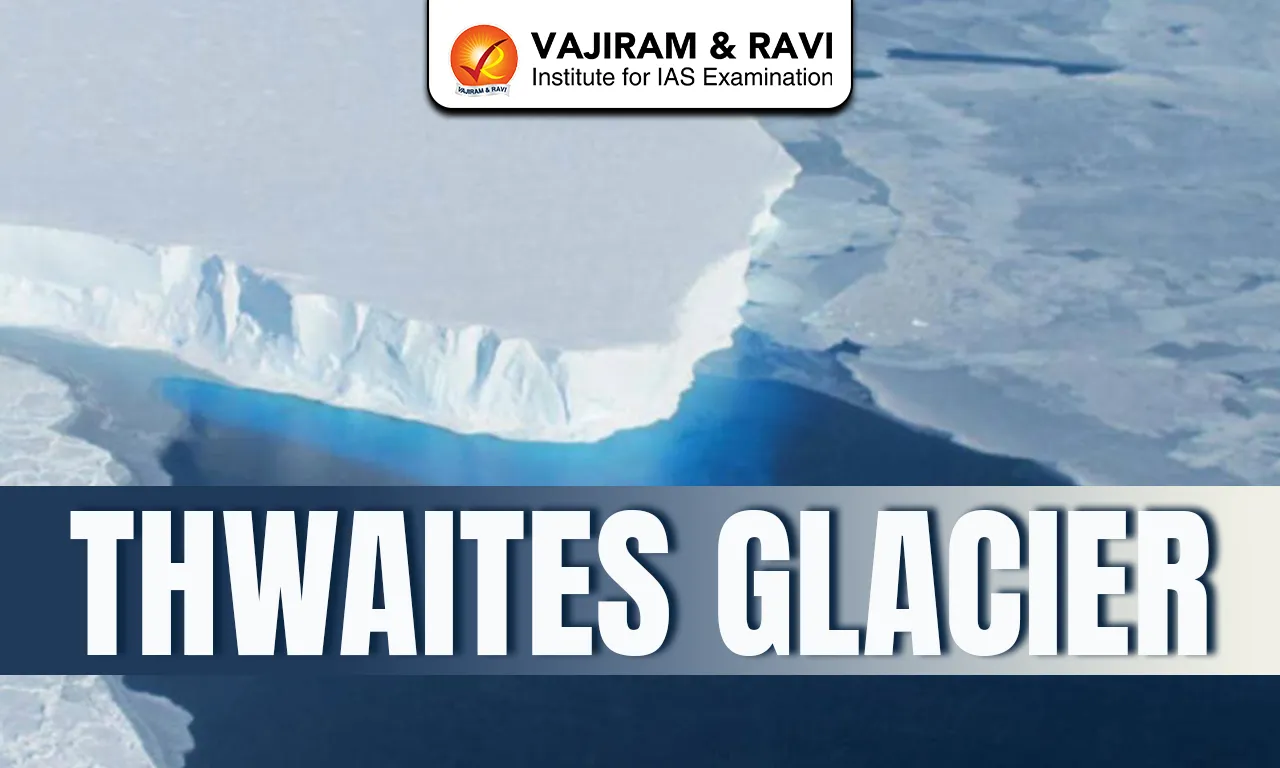
Antarctica’s “Doomsday Glacier” could add up to 3 cm to global sea levels by 2100, twice as much as earlier estimates suggested, according to a new study.

About Thwaites Glacier

  • Thwaites Glacier, often referred to as the Doomsday Glacier, is a large glacier located on the north coast of West Antarctica, bordering the Amundsen Sea.
  • It is a fast-flowing glacier covering an area of approximately 192,000 sq.km., an area about the size of the U.S. state of Florida and slightly smaller than the island of Great Britain. 
  • It has the world’s widest glacial interface with the ocean, extending roughly 120 km. 
  • It is named for American glacial geologist and geomorphologist Frederik T. Thwaites. 
  • A portion of the glacier is an ice shelf over the Amundsen Sea, held up in several places by underwater plateaus.  
  • It is one of the most vulnerable and important glaciers in the world in terms of future global sea-level rise.

Impacts of Melting of Thwaites Glacier

  • It has been becoming thinner, retreating, and contributing to sea-level rise.
  • It contributes 4% to global annual sea-level rise, and its collapse could destabilise the West Antarctic Ice Sheet (WAIS), which would cause catastrophic sea-level rise.
  • If the entire Thwaites Glacier were to melt, it could raise the world’s oceans by about 65 centimeters (over 2 feet).
  • It also acts as a buffer, holding back neighboring glaciers that contain around three meters of potential sea level rise.
  • If it weakens beyond a point, other glaciers may lose ice faster as well, further increasing sea-level rise.
  • Higher sea levels will cause coasts to flood more easily, worsen erosion, increase storm surges, and threaten cities, low-lying islands, and ports.
  • Scientists also report that the temperatures of the bottom waters in the Amundsen Sea have been increasing from continued global warming. 
  • There is evidence that the warming waters are slowly melting submerged ice at the base of the glacier, thereby making the glacier more unstable and raising concerns that it will collapse.

News: TP

Thwaites Glacier FAQs

Q1: What is Thwaites Glacier commonly known as?

Ans: The Doomsday Glacier.

Q2: Where is Thwaites Glacier located?

Ans: In West Antarctica, bordering the Amundsen Sea.

Q3: Why is Thwaites Glacier important in the context of climate change?

Ans: It is highly vulnerable to melting and has significant implications for future global sea-level rise.

Q4: What percentage of global annual sea-level rise does Thwaites Glacier contribute?

Ans: Approximately 4%.

Right to Internet Access – Supreme Court Ruling on Children’s Digital Rights

Right to Internet Access

Right to Internet Access Latest News

  • On October 15, 2026, the Supreme Court recognised the right to access and use the internet as a fundamental right under Articles 21 and 19(1)(a), rejecting blanket restrictions on children's internet access as a solution to online abuse.

Constitutional Basis of Internet Access

  • The Supreme Court, in a Bench comprising Justices J.B. Pardiwala and K. Vinod Chandran, held that the right to access and use the internet is a fundamental right under Article 21 read with Article 19(1)(a) of the Constitution.
    • Article 21: Protects the right to life and personal liberty.
    • Article 19(1)(a): Guarantees freedom of speech and expression, which can be exercised through digital platforms.
    • Article 19(1)(g): Protects the freedom to practise any profession or carry on any occupation, trade or business, including through the internet, subject to constitutional restrictions.
  • The internet has become an important medium for education, information, communication and creative expression. 
  • Its significance is particularly high for children in remote areas, where digital platforms may provide access to learning opportunities that are otherwise unavailable.
  • The judgment also builds on the Supreme Court's recognition of digital access as an intrinsic component of the right to life in Pragya Prasun v. Union of India (2025).

Judicial Evolution of Digital Rights

  • The constitutional status of internet access has evolved through judicial interpretation.
  • Anuradha Bhasin v. Union of India (2020)
    • The Supreme Court held that freedom of speech and expression and the freedom to carry on trade or business through the internet are constitutionally protected under Articles 19(1)(a) and 19(1)(g). 
    • However, it left open the question of whether internet access itself constituted a fundamental right.
  • Pragya Prasun v. Union of India (2025)
    • The Court recognised digital access as an intrinsic component of Article 21 and emphasised the State's responsibility to develop inclusive digital ecosystems that serve both privileged and marginalised sections of society.
  • Supreme Court ruling of October 2026
    • The Court expressly recognised the right to access and use the internet as a fundamental right under Article 21 read with Article 19(1)(a). 
    • It also clarified that protecting children from online exploitation does not justify imposing a blanket ban on their internet access.

Child Safety and the Limits of Blanket Restrictions

  • The case arose from a petition by the NGO Just Rights for Children Alliance concerning the continued availability of Child Sexual Exploitation and Abuse Material (CSEAM) on social media platforms.
  • The Court held that the primary responsibility lies with those who create, circulate or seek such material and with intermediaries that fail to detect and remove it. 
  • Denying children internet access because of these failures would shift the burden from the wrongdoers to the victims.
  • Concerns with blanket restrictions
    • Questionable effectiveness: Children may bypass restrictions and migrate to unregulated platforms that expose them to greater risks.
    • Reduced reporting: Fear of punishment for accessing prohibited platforms may discourage children from reporting online threats, grooming or exploitation.
    • Privacy risks: Age-verification systems may require the collection and monitoring of sensitive personal data, creating risks of surveillance and misuse.
    • Digital exclusion: Broad restrictions may limit access to education, information, creative expression and other legitimate online opportunities.
  • The Court therefore considered blanket restrictions disproportionate, while acknowledging that age-appropriate safeguards remain necessary.

Safeguards for Children in the Digital Environment

  • The judgment favoured targeted and proportionate safeguards rather than a complete denial of internet access.
    • Parental oversight: Encourage parental consent, guidance and supervision for children's access to social media platforms.
    • Dedicated child mode: Develop child-specific accounts with age-appropriate privacy and safety settings.
    • Privacy by default: Make children's accounts private by default and restrict contact or messages from unknown adults.
    • Content moderation: Strengthen moderation of advertisements and content accessible to children.
    • Detection and removal: Improve technological tools used by intermediaries to detect and remove CSEAM.
    • Digital literacy: Teach children to recognise online risks, follow safe practices and seek help without fear of reprisal.
  • The Court also recognised that the government may restrict children's access to specific categories of services that are inherently harmful, such as adult-content websites. 
  • Such restrictions must be distinguished from a blanket ban on internet access.

Responsibilities of the State and Digital Platforms

  • Protecting children online requires coordinated action by government authorities, digital intermediaries, parents and educational institutions.
  • The Supreme Court sought information from the Union government on the technological tools used by intermediaries to detect and remove CSEAM and on the feasibility of deploying such tools across the industry.
  • Effective digital governance requires platforms to improve content moderation, respond promptly to reports of exploitation and adopt safety-by-design principles. 
  • Government regulation should establish clear accountability standards while protecting privacy and legitimate online expression.
  • The State must also promote inclusive digital access so that safety measures do not disproportionately disadvantage children from rural, economically weaker or otherwise marginalised backgrounds.

Source: IE | TOI

Right to Internet Access FAQs

Q1: Which constitutional provisions protect the right to internet access?

Ans: The Supreme Court recognised the right to access and use the internet under Article 21 read with Article 19(1)(a) of the Constitution.

Q2: What did the Supreme Court decide in October 2026?

Ans: The Court recognised internet access as a fundamental right and rejected blanket restrictions on children's access as a proportionate solution to online abuse.

Q3: What is CSEAM?

Ans: Child Sexual Exploitation and Abuse Material refers to material depicting or involving the sexual exploitation or abuse of children.

Q4: Why can blanket internet restrictions be harmful to children?

Ans: They may restrict education and expression, push children towards unsafe platforms, discourage reporting of abuse and create privacy risks through age-verification systems.

Q5: What safeguards did the Supreme Court support?

Ans: The Court supported measures such as parental oversight, dedicated child modes, private-by-default accounts, restrictions on contact from unknown adults and stronger content moderation.

US Waiver of Russia Sanctions – Relief for India, but Energy Vulnerabilities Persist

US Waiver of Russian Sanctions

US Waiver of Russian Sanctions Latest News

  • US President Donald Trump has waived sanctions, restrictions and duties under Lindsey O. Graham Sanctioning Russia and Iran Act, 2026, citing US national interest as the basis for the waiver.
  • This has temporarily eased the threat of punitive measures against major buyers of Russian oil, including India and China. 
  • The waiver is significant for India because it imports over 88% of its crude oil requirements, while Russia has emerged as its largest crude supplier. 

Russia-From Peripheral to India’s Largest Oil Supplier

  • India’s dependence on Russian crude increased sharply after Russia’s invasion of Ukraine in February 2022. 
  • As Western sanctions restricted Russian energy markets, Moscow offered discounted crude to willing buyers, and Indian refiners expanded purchases.
  • India imported around 1.9 million barrels per day (bpd) of Russian crude in September 2026, accounting for more than 35% of its oil imports. Russian supplies had reached a record 2.8 million bpd in July.
  • Russia displaced traditional West Asian suppliers to become India’s largest source of crude.
  • This relationship has become particularly important because disruptions in supplies through the Strait of Hormuz have increased the risks associated with excessive dependence on West Asian energy sources.

What the Graham Act Meant

  • The Graham Act authorised wide-ranging sanctions and restrictions against Russia and countries purchasing Russian oil and gas.
  • It provided for potentially steep duties—including 100% tariffs on goods from major importers of Russian crude or natural gas under specified conditions. The Act also targeted countries allegedly facilitating sanctions evasion.
  • However, Section 115 empowered the US President to waive such measures if he certified that doing so was in the national interest of the United States. 

Why did Trump Waive the Measures?

  • The decision reflects the tension between geopolitical sanctions and domestic energy security. 
  • Higher fuel prices have become politically sensitive in the US ahead of the midterm elections. 
  • The administration has simultaneously sought greater Russian diesel supplies, highlighting the contradiction between sanctioning Russian energy purchases and seeking Russian fuel to moderate domestic prices.
  • The waiver therefore demonstrates how energy security, inflation and electoral considerations can influence sanctions policy.

Positive Implications for India

  • Immediate energy-security relief:
    • The waiver reduces the immediate risk that punitive US tariffs would make Russian crude economically unattractive for Indian refiners. 
    • Losing Russian supplies suddenly could have increased India’s import bill and intensified inflationary pressures.
    • Russia also provides India with an important source of supply diversification, particularly when geopolitical tensions disrupt West Asian supplies.
  • India-US trade negotiations:
    • The Russian-oil issue had become a major point of friction in India-US trade negotiations. 
    • With the immediate tariff threat receding, the two countries may have greater room to advance a bilateral trade agreement.

Challenges for India

  • EU remains a concern:
    • The easing of US pressure does not eliminate India's exposure to Western sanctions. 
    • The European Union has separately targeted entities involved in facilitating Russia-related sanctions evasion, creating compliance risks for Indian companies.
    • Thus, Indian refiners and financial institutions must continue to carefully manage secondary sanctions, sanctions compliance and access to Western markets.
  • Competition from China:
    • The US waiver does not guarantee abundant Russian crude.
    • Chinese refiners have increased purchases amid disruptions in Middle Eastern supplies and have reportedly been willing to book Russian cargoes in advance and pay higher prices. 
    • As a result, Russian crude available to Indian refiners could become tighter and more expensive.
    • This highlights an important limitation: India’s energy security cannot depend excessively on one discounted supplier, even if that supplier currently offers economic advantages.
  • Inflationary dimension:
    • The issue has direct domestic macroeconomic implications. 
    • India’s retail inflation increased from 4.83% in August to 5.54% in September 2026, while food inflation rose sharply to 7.74%.
    • Higher global crude prices can raise transportation, logistics, fertiliser and production costs, thereby generating cost-push inflation and worsening the current-account burden.

Way Forward for India

  • India should pursue strategic diversification rather than dependence by -
    • Maintaining diversified crude sourcing from Russia, West Asia, the US and other suppliers.
  • Expanding strategic petroleum reserves.
    • Increasing renewable energy, electric mobility and energy efficiency.
    • Strengthening domestic refining and storage capacity.
    • Developing resilient payment and shipping mechanisms compatible with international sanctions.
    • Using diplomatic engagement to prevent energy trade from becoming a major source of India-US friction.
  • The episode illustrates the broader principle of “strategic autonomy”.

Conclusion

  • The US waiver provides India short-term relief on energy security, inflation and trade negotiations, but it does not eliminate longer-term vulnerabilities. 
  • India’s sustainable strategy should therefore combine diversified energy sourcing, strategic reserves, renewable transition and pragmatic diplomacy rather than excessive dependence on any single geopolitical partner.

Source: IE | ToI

US Waiver of Russia Sanctions FAQs

Q1: Why has Russian crude become important for India’s energy security?

Ans: Discounted Russian crude diversified India’s import sources, reduced costs and partly offset disruptions in West Asia.

Q2: What is the significance of the US waiver of Russia-related sanctions for India?

Ans: It reduces the immediate risk of punitive tariffs, and creates greater space for India-US trade negotiations.

Q3: Why does the US waiver not completely eliminate India’s concerns?

Ans: India remains exposed to EU sanctions, sanctions-compliance risks, supply constraints and growing Chinese competition.

Q4: How can excessive dependence on imported crude threaten India’s macroeconomic stability?

Ans: Higher crude prices can widen the import bill and current-account deficit while fuelling inflation.

Q5: How can India balance energy security with geopolitical pressures?

Ans: India should diversify suppliers, expand strategic petroleum reserves, accelerate renewables and energy efficiency.

Global Monetary Tightening, Why Central Banks Have Limited Options

Global Monetary Tightening

Global Monetary Tightening Latest News

  • Global monetary policy is at a critical juncture. Geopolitical tensions in West Asia, elevated crude oil prices, rising U.S. Treasury yields, and persistent inflation are complicating the outlook for central banks worldwide. 
  • After a prolonged period of monetary easing, policymakers now have less room to cut rates further — and renewed inflationary pressures could even force some to reconsider tightening.

How Is This Cycle Different From 2022?

  • The crucial distinction lies in the starting point:
    • In 2022, major central banks — the U.S. Federal Reserve, European Central Bank — began tightening from exceptionally low or negative rates. 
    • India’s repo rate stood at just 4% at the start of its own tightening cycle.
    • Today, borrowing costs across many economies are already restrictive, while fresh inflationary pressures threaten growth.

The Resulting Dilemma

  • Low starting rates in 2022 gave central banks greater room to hike.
  • Now, with rates already high, further tightening risks weakening consumption, investment, and employment.
  • Simultaneously, energy-price shocks may prevent rate cuts as fast as desired.
  • This creates a difficult trade-off: easing too soon could prolong inflation; keeping rates high too long could undermine growth.

The Global Economic Outlook

  • Experts note the global economy has shown resilience despite supply-chain disruptions and high oil prices — but the prolonged West Asia conflict threatens this resilience.
  • Additional uncertainty stems from: tariff unpredictability from Washington, rising public debt, and the AI investment boom.
  • World Bank projection: Global growth is expected to slow to 2.6% in 2026, down from 2.9% in 2025.

Crude Oil: The Central Constraint

  • Brent crude was trading at ~$105/barrel recently— sharply up from $70/barrel or lower before the U.S.-Iran conflict began in February 2026.
  • Oil is a critical input for transport, manufacturing, and other industries; rising costs often get passed on to consumers.
  • For India specifically: 
    • Higher crude prices increase the import bill.
    • A weaker rupee makes dollar-priced oil imports costlier.
    • Together, these worsen the current-account balance and push up domestic prices.

The U.S. Treasury Yield Factor

  • U.S. 10-year Treasury yield climbed to 5.34% — its highest since 2002; the 30-year yield rose to 5.69%.
  • Why Yields are Rising: Inflation concerns, elevated crude prices, rising government borrowing, and expectations that rates will stay “higher for longer.”
  • The AI investment boom adds further pressure, as technology firms’ heavy spending on data centres competes with other borrowers for capital.
  • Why This Matters for India: Rising U.S. yields make dollar assets more attractive, potentially pulling capital away from emerging markets, pressuring the rupee. A weaker rupee raises import costs for energy, complicating the RBI’s ability to ease policy.

Developed vs. Developing Economies

  • Both face the challenge of balancing inflation control with growth.
  • Emerging markets like India face additional vulnerabilities: imported energy costs, currency depreciation, and volatile international capital flows.
  • Developed economies face similar risks but are typically less sensitive to dollar strength and external financing costs.

Conclusion

  • The current moment in global monetary policy is not defined by entirely new risks, but by their unfortunate convergence — persistent inflation, limited room for monetary easing, and tighter global financial conditions arriving together. 
  • Unlike 2022, when central banks tightened from historic lows, today’s policymakers must navigate from an already-restrictive starting point, leaving them with far fewer easy choices. 
  • For India, the interplay of elevated crude prices, a pressured rupee, and rising global yields poses a layered challenge — one that could constrain the RBI’s policy flexibility even as domestic growth considerations demand support.

Source: TH

Global Monetary Tightening FAQs

Q1: Why is global monetary tightening becoming more difficult for central banks?

Ans: Global monetary tightening is complicated by persistent inflation, geopolitical tensions, elevated crude oil prices and rising bond yields, limiting policymakers’ ability to adjust interest rates.

Q2: How does the current monetary policy cycle differ from 2022?

Ans: Global monetary tightening began from historically low rates in 2022, whereas today’s restrictive borrowing costs leave central banks less room to raise rates without weakening growth.

Q3: How do rising crude oil prices constrain the Reserve Bank of India?

Ans: Global monetary tightening pressures India because expensive crude increases import costs and domestic inflation, while rupee depreciation further raises energy bills and complicates monetary easing.

Q4: Why do rising U.S. Treasury yields matter for India?

Ans: Global monetary tightening faces additional pressure as higher U.S. Treasury yields attract capital toward dollar assets, potentially weakening the rupee and increasing India’s import costs.

Q5: What challenges do emerging economies face during global monetary tightening?

Ans: Global monetary tightening exposes emerging economies such as India to imported energy inflation, currency depreciation and volatile capital flows, complicating efforts to balance price stability with growth.

CNAP Caller Name Identification, India’s New Telecom Rule Explained

CNAP Caller Name Identification

CNAP Caller Name Identification Latest News

  • Starting November 1, 2026, telecom operators — Airtel, Jio, Vodafone Idea — must make caller name identification mandatory for mobile users, as per a circular issued by the Department of Telecommunications (DoT). 
  • Technically called Calling Name Presentation (CNAP), this service will display the caller’s registered name alongside their number on the recipient’s phone screen, even for unsaved contacts. 
  • The move is aimed at helping users make informed decisions before answering calls, and comes amid rising instances of online fraud, including “digital arrest” scams.

What Exactly Is CNAP?

  • As per the DoT circular: “Calling name presentation service presents the calling name identity of the calling user on the user terminal of the called user... as recorded in subscriber data record of the originating telecommunication service provider.”

Key Features

  • The originating telecom operator (the network from which the call is made) provides this service automatically, with no separate request needed from users.
  • The caller identification display will have two fields: 
    • First field: The caller’s phone number (existing practice).
    • Second field: The caller’s registered name.

Scope and Rollout

  • Applicable only to 4G networks at present.
  • 2G, 3G networks, and landline connections will be covered under separate rollout plans later.
  • For saved contacts, the already-saved name will display as usual.
  • For unsaved numbers: 
    • Domestic calls → shows the name registered in the telecom database.
    • International calls → displays simply as “international call.”

Privacy Safeguards

  • The DoT has mandated a security-by-design approach to protect user privacy:
    • Telcos cannot retain the calling name identity after a call ends.
    • Users who have enabled Calling Line Identification Restriction (CLIR) are exempt — their names will not appear under CNAP.
    • Telcos must ensure secure database, network, and connectivity infrastructure.

Provisions for Businesses

  • Business and bulk-connection users can display a custom preferred name, different from their registered subscriber name.
  • This preferred name must be either: 
    • A trademark registered under the Trade Marks Registry (under the Controller General of Patents, Designs and Trade Marks, DPIIT), or
    • A trade name registered on the GST portal.
  • Telcos are required to conduct due diligence, maintaining documentary proof of the registered name before assigning it for display.

Why This Matters

  • Fraud Prevention: CNAP is a direct response to the surge in phone-based scams, particularly impersonation frauds like “digital arrest” cons, where fraudsters pose as law-enforcement or government officials.
  • Consumer Protection: Enables users to identify and verify callers before engaging, reducing vulnerability to unsolicited or fraudulent calls.
  • Business Transparency: Allows legitimate businesses to present a recognisable, registered identity, helping distinguish genuine commercial calls from spam or scam numbers.
  • Balancing Privacy and Transparency: The CLIR exemption and no-retention policy reflect regulatory care to protect caller privacy even while improving recipient safety.

Conclusion

  • The CNAP mandate marks a significant regulatory intervention at the intersection of consumer protection, digital safety, and telecom governance. 
  • By making caller identification a default feature rather than an optional app-based service, the DoT shifts the burden of fraud prevention from individual vigilance to systemic design — while carefully preserving privacy through the CLIR exemption and no-retention norms. 
  • As India grapples with increasingly sophisticated phone-based scams, this reform exemplifies how regulatory architecture can be calibrated to serve both security and individual rights simultaneously.

Source: IE | NDTV | BS

CNAP Caller Name Identification FAQs

Q1: What is CNAP caller name identification?

Ans: CNAP caller name identification, or Calling Name Presentation, displays a caller’s registered name alongside their phone number, including for contacts not saved on the recipient’s phone.

Q2: When will mandatory CNAP caller name identification begin in India?

Ans: CNAP caller name identification is scheduled to become mandatory from November 1, 2026, under a Department of Telecommunications circular covering major mobile operators.

Q3: How will CNAP caller name identification help prevent fraud?

Ans: CNAP caller name identification helps users assess unknown callers before answering, potentially reducing exposure to impersonation scams, unsolicited calls and fraudulent claims by fake officials.

Q4: What privacy safeguards apply to CNAP caller name identification?

Ans: CNAP caller name identification includes privacy safeguards: telecom operators cannot retain caller-name identity after calls end, and users enabling Calling Line Identification Restriction remain exempt.

Q5: Can businesses use a preferred name under CNAP caller name identification?

Ans: CNAP caller name identification allows businesses and bulk connections to display a preferred name if supported by a registered trademark or GST trade name, subject to verification.

Macquarie ‌Island

Macquarie Island

Macquarie ‌Island Latest News

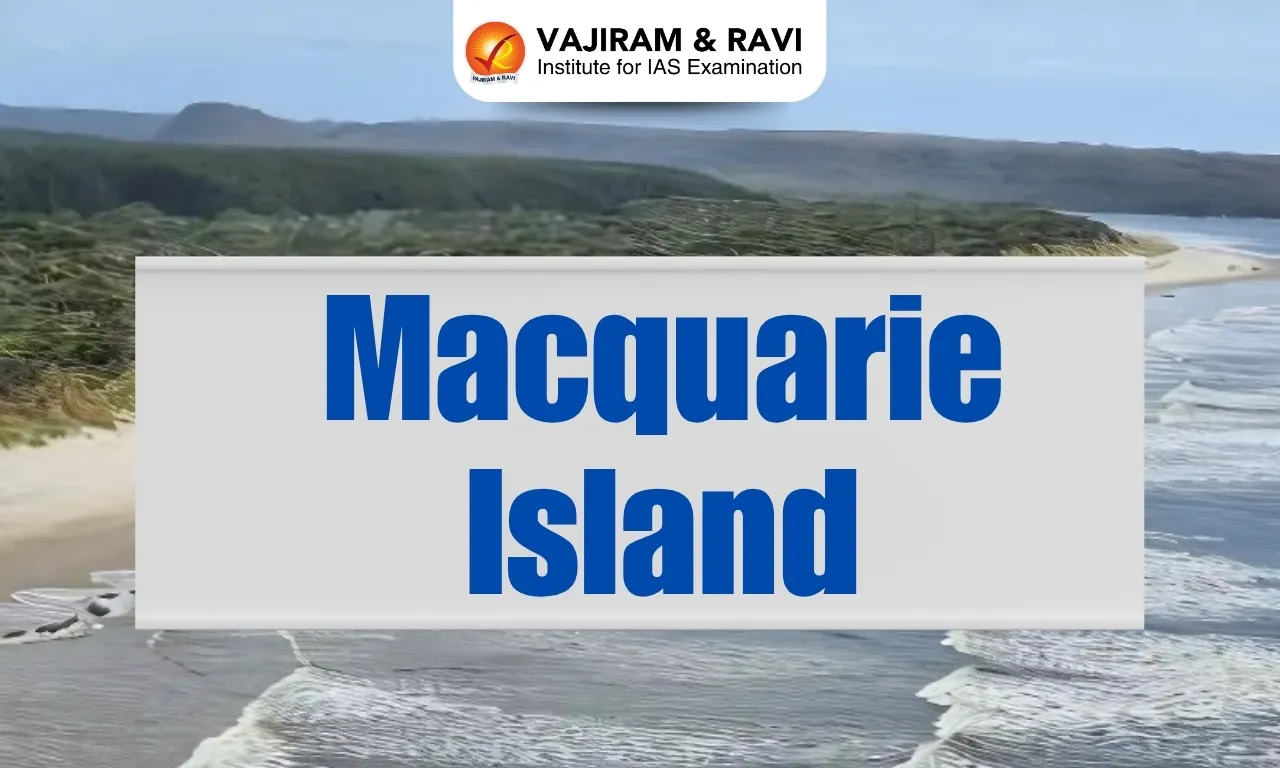
Australia recently confirmed its first ​case of H5N1 bird ​flu on the sub-Antarctic Macquarie ‌ Island, with ​the deadly virus found in the remote territory's vulnerable elephant seal population.

About Macquarie ‌Island

  • It is a subantarctic island located in the southwestern part of the Pacific Ocean.
  • The island is politically a part of the Australian island state of Tasmania, and regionally it forms a part of Oceania.  
  • It is geographically positioned about 1,500 km to the southeast of the principal island of Tasmania, approximately midway between the island nation of New Zealand and the continent of Antarctica. 
  • In 1978, Macquarie Island became a part of the Tasmanian State Reserve and was subsequently designated as a UNESCO World Heritage Site in 1997. 
  • It covers an area of 128 sq. km. and measures about 34 km in length and has a maximum width of 5 km.  
  • It has no permanent human population, but a meteorologic and geologic research station has been maintained on the island since 1948.
  • It is a site of major geoconservation significance, being the only place on earth where rocks from the earth’s mantle (6 km below the ocean floor) are being actively exposed above sea level. 
    • The island is an exposed portion of the undersea Macquarie Ridge, where the Pacific and Indian-Australian plates meet. 
    • This geological evolution of the island began about 10 million years ago and continues even today with the island being seismically active.
  • Macquarie Ridge is one of only 3 such ridges that impede the Antarctic Circumpolar Circulation.
    • This results in distinct differences between the west and east sides of the ridge, which are used in different ways by different species.
  • There are a few small glacial lakes on the island.
  • Flora: Although the island is treeless, there are a variety of native vegetation types, including grasses and many species of moss. 
  • Fauna: 
    • It serves as a vital breeding ground for several penguin species, including the royal penguin, which breeds exclusively on the island, along with king, gentoo, and southern rockhopper penguins. 
    • The island is also home to various fur seal species, such as the New Zealand fur seal and the southern elephant seal. 

News: DEVD

Macquarie ‌Island FAQs

Q1: Where is Macquarie Island located?

Ans: Macquarie Island is a subantarctic island in the southwestern Pacific Ocean.

Q2: Politically, Macquarie Island is part of which Australian state?

Ans: Tasmania.

Q3: What makes Macquarie Island geologically unique?

Ans: It is the only known place where rocks from Earth's mantle are actively exposed above sea level.

Q4: Macquarie Island is an exposed portion of which undersea geological feature?

Ans: The Macquarie Ridge.

Q5: Which penguin species breeds exclusively on Macquarie Island?

Ans: The royal penguin.

Kamchatka Peninsula

Kamchatka Peninsula

Kamchatka Peninsula Latest News

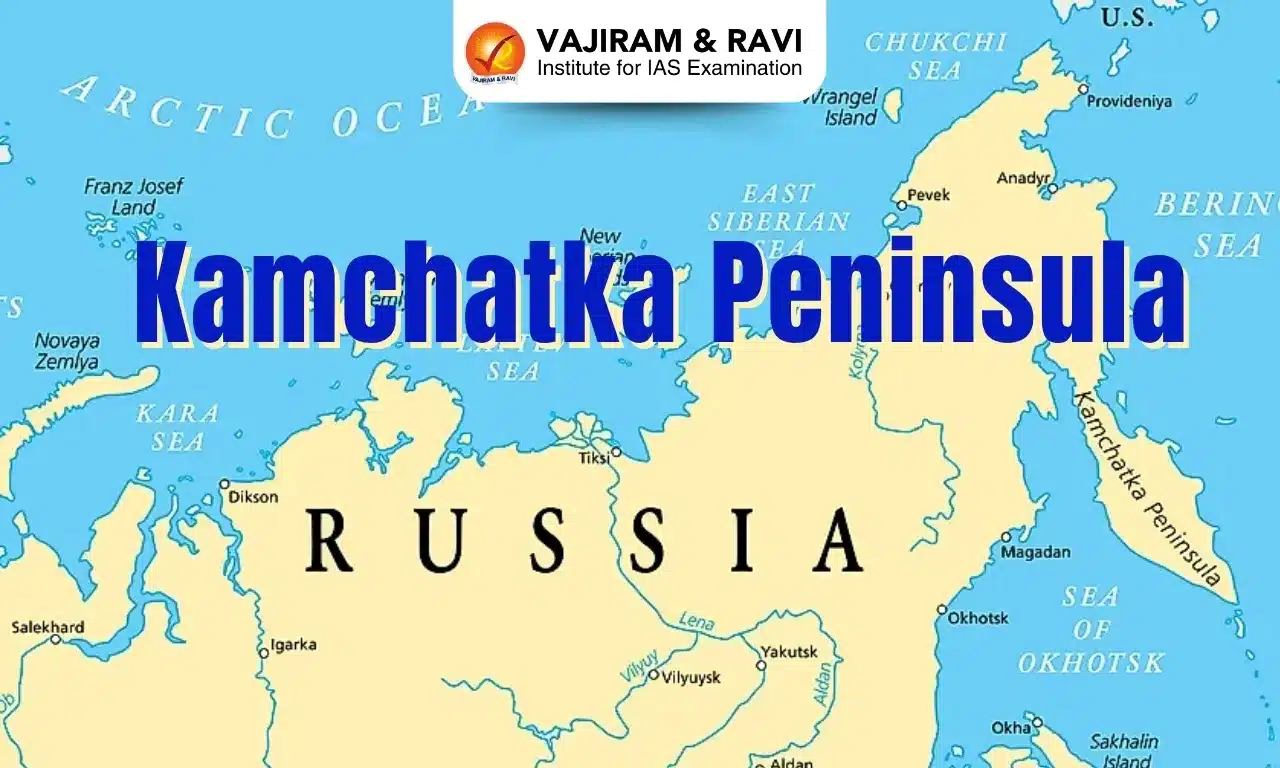
Recently, an earthquake of magnitude 7 has struck the Kamchatka Peninsula region of Russia.

About Kamchatka Peninsula

  • Location: It lies in far eastern Russia, between the Sea of Okhotsk on the west and the Pacific Ocean and Bering Sea on the east.
  • It is one of the world’s most concentrated areas of geothermal activity.
  • It contains the “volcanoes of Kamchatka”, a UNESCO World Heritage Site.
  • It is part of the Kamchatka Krai. Kamchatka, also known as a land of fire and ice, sits on the Pacific Ring of Fire and is home to over 150 volcanoes, including 29 active volcanoes.
  • It is one of the largest peninsulas in the world.
  • Climate: It experiences severe, with prolonged, cold, and snowy winters and wet, cool summers.
  • Highest Point: The Klyuchevskaya Sopka in the Eastern Range is the highest point on the Kamchatka Peninsula. 
    • The Kuril island chain runs from the southern tip of the peninsula to a short distance from Japan’s northern Hokkaido Island.

Source: NDTV

Kamchatka Peninsula FAQs

Q1: Where is Kamchatka Peninsula?

Ans: It lies in far eastern Russia, between the Sea of Okhotsk on the west and the Pacific Ocean and Bering Sea on the east.

Q2: What type of climate is found in Kamchatka Peninsula?

Ans: It experiences severe, with prolonged, cold, and snowy winters and wet, cool summers.

Enquire Now