UPSC Daily Quiz 11 November 2026

UPSC Daily Quiz

[WpProQuiz 295]

UPSC Daily Quiz FAQs

Q1: What is the Daily UPSC Quiz?

Ans: The Daily UPSC Quiz is a set of practice questions based on current affairs, static subjects, and PYQs that help aspirants enhance retention and test conceptual clarity regularly.

Q2: How is the Daily Quiz useful for UPSC preparation?

Ans: Daily quizzes support learning, help in revision, improve time management, and boost accuracy for both UPSC Prelims and Mains through consistent practice.

Q3: Are the quiz questions based on the UPSC syllabus?

Ans: Yes, all questions are aligned with the UPSC Syllabus 2025, covering key areas like Polity, Economy, Environment, History, Geography, and Current Affairs.

Q4: Are solutions and explanations provided with the quiz?

Ans: Yes, each quiz includes detailed explanations and source references to enhance conceptual understanding and enable self-assessment.

Q5: Is the Daily UPSC Quiz suitable for both Prelims and Mains?

Ans: Primarily focused on Prelims (MCQ format), but it also indirectly helps in Mains by strengthening subject knowledge and factual clarity.

Extracellular Vesicles (EVs)

Extracellular Vesicles (EVs)

Extracellular Vesicles Latest News

Extracellular vesicles (EVs) can modify pathological progression in Alzheimer’s disease (AD), the most common neurodegenerative disease in older adults, by spreading pathogenic factors.

About Extracellular Vesicles

  • EVs are small membranous nanoparticles secreted by all types of cells into the extracellular space.
  • They can be found in numerous bodily fluids, including blood, urine, cerebrospinal fluid, and more.   
  • The biochemical composition of EVs mainly consists of lipids, proteins, and nucleic acids. 
  • Derived from cells, EVs obtain their appearance based on the cargo transferred from the donor cells, known as their molecular signature.
  • Unlike other cellular components, EVs are not capable of replication. 
  • EVs are broadly classified into:
    •  Exosomes (30–150 nm): Originate from endosomal compartments.
    •  Microvesicles (100–1000 nm): Shed directly from the plasma membrane.
    •  Apoptotic bodies (>1000 nm): Released by dying cells.
  • EVs have a wide range of uses in various fields, and their therapeutic potential is currently being explored in many preclinical and clinical studies. 
  • Intercellular communication: 
    • EVs play an important role in intercellular communication by transferring biological molecules, such as proteins, lipids, and nucleic acids, between cells. 
    • This process can influence various physiological and pathological processes, including immune response, tissue regeneration, and cancer progression.
  • Diagnostic markers: 
    • EVs can serve as diagnostic markers for various diseases, as they contain biomolecules that reflect the physiological state of the parent cell. 
    • For example, circulating EVs have been shown to contain biomarkers for cancer and neurodegenerative diseases, and their analysis can aid in disease diagnosis and prognosis.
  • Drug delivery: 
    • EVs can be engineered to deliver therapeutic molecules, such as drugs or nucleic acids, to target cells. 
    • These offer several advantages over traditional drug delivery systems, including high biocompatibility, low immunogenicity, and the ability to cross biological barriers.
  • Tissue engineering: 
    • EVs can promote tissue regeneration and repair by modulating cellular behavior and signaling pathways. 
    • These have been used in various tissue engineering applications, including bone regeneration, cartilage repair, and wound healing.

News: NAT

Extracellular Vesicles FAQs

Q1: What are Extracellular Vesicles (EVs)?

Ans: EVs are small membrane-bound particles secreted by cells into the extracellular space.

Q2: In which bodily fluids can extracellular vesicles be found?

Ans: They are found in blood, urine, cerebrospinal fluid and other bodily fluids.

Q3: What are the major biochemical components of extracellular vesicles?

Ans: Lipids, proteins and nucleic acids.

Q4: Are extracellular vesicles capable of replication?

Ans: No. Extracellular vesicles are not capable of replication.

Q5: What is the primary role of extracellular vesicles in intercellular communication?

Ans: They transfer biological molecules, including proteins, lipids and nucleic acids, between cells.

Asia-Pacific Economic Cooperation

Asia-Pacific Economic Cooperation

Asia-Pacific Economic Cooperation Latest News

The United States President has said he will likely meet the Chinese President and Russian President in a rare trilateral leaders’ meeting on the sidelines of the Asia-Pacific Economic Cooperation (APEC) gathering in Shenzhen. 

About Asia-Pacific Economic Cooperation

  • It is a regional economic forum established in 1989 to leverage the growing interdependence of the Asia-Pacific.
  • It aims to create greater prosperity for the people of the region by promoting balanced, inclusive, sustainable, innovative, and secure growth and by accelerating regional economic integration.
  • Focus: The focus of APEC has been on trade and economic issues, and hence, it terms the countries as “economies”.
  • Functioning: APEC operates on the basis of voluntary cooperation and consensus.
    • Its decisions are non-binding, allowing economies with diverse systems and levels of development to work together in a flexible and pragmatic way.
    • APEC achieves its goals by promoting dialogue and arriving at decisions on a consensus basis, giving equal weight to the views of all members.. 
  • Member Countries: It has 21 members.
    • The grouping’s current members are Australia, Brunei, Hong Kong, New Zealand, Papua New Guinea, the Philippines, Indonesia, China, Japan, South Korea, Russia, Canada, the United States, Mexico, Peru, Chile, Malaysia, Vietnam, Singapore, Thailand, and Taiwan.
    • India is not a member country of APEC
  • Secretariat: It is located in Singapore.

Source: TH

Asia-Pacific Economic Cooperation FAQs

Q1: What is Asia-Pacific Economic Cooperation ?

Ans: It is a regional economic forum established in 1989 to leverage the growing interdependence of the Asia-Pacific.

Q2: Where is Asia-Pacific Economic Cooperation Secretariat is located?

Ans: It is located in Singapore

Red Ochre

Red Ochre

Red Ochre Latest News

Rock paintings in red ochre, believed to be around 4,000 years old, have been recently discovered at Karadimalai in Ottampattu Thandari village in Villupuram district, Tamil Nadu.

About Red Ochre

  • It is a natural earth pigment, typically composed of iron oxide, that ranges in color from yellow to deep red. 
  • It is one of the earliest pigments used by humankind, with a history stretching back tens of thousands of years.  
  • Early people applied it for frame and face painting, cave drawings, and ritual burials, which illustrates the pigment's cultural importance. 
  • It can be found throughout the world in many different red tones and levels of transparency and opacity. 
  • It was used in Ancient cave paintings in all parts of the globe. 
    • From the famous Lascoux Caves in France to the rock shelters of Bhimbetka in India, prehistoric painters used the pigment. 
  • Red ochre is chemically stable, meaning it does not easily undergo chemical reactions that lead to decomposition or degradation. 
    • This stability helps preserve its color and composition over long periods, even in burial environments or conditions with varying levels of moisture.  
  • In the modern era, red ochre continued to serve both artistic and industrial purposes, from traditional painting to ceramics and architectural coatings. 
  • Its exceptional permanence and non-toxicity ensured its survival even as synthetic pigments emerged.

News: NIE

Red Ochre FAQs

Q1: What is Red Ochre?

Ans: Red ochre is a natural earth pigment primarily composed of iron oxide.

Q2: What is the typical colour range of ochre pigments?

Ans: They range from yellow to deep red.

Q3: Why is red ochre historically significant?

Ans: It is one of the earliest pigments used by humankind, with a history stretching back tens of thousands of years.

Q4: Why is red ochre considered suitable for preserving ancient paintings?

Ans: Because it is chemically stable and does not easily undergo reactions that cause decomposition or degradation.

Centre Declares Bihar’s Ranivas Mound an Archaeological Site of National Importance

Ranivas Mound

Ranivas Mound Latest News

Recently, Ranivas Mound has been declared an archaeological site of national importance through a central government notification.

About Ranivas Mound

  • Location: It is located in the state of Bihar and takes its name from local legends.
  • It is situated near the world famous Buddhist site of ‘Kesariya stupa’.
  • It is spread over 1.63 acres and is under the ownership of the Bihar government.
  • In 1861, Alexander Cunningham (Archaeological Survey of India (ASI) first director general), visited the site.
    • He explored the mound and conducted some excavations. In his report, he mentioned the existence of an old Buddhist establishment with a temple enshrining a huge image of Buddha.
  • Archaeological sites and ancient monuments of national importance are declared under The Ancient Monuments and Archaeological Sites and Remains Act, 1958 (AMASR Act).

Key Facts about Archaeological Survey of India (ASI)

  • It was established in 1861 under Sir Alexander Cunningham.
  • It works to protect India’s historical heritage, including ancient temples, forts, tombs, sculptures and archaeological remains.
  • It conducts scientific excavations, studies inscriptions, maintains protected monuments and helps preserve evidence of India’s past.
  • The headquarters of the Archaeological Survey of India is in New Delhi.
  • Its work is governed by important laws, including the Ancient Monuments and Archaeological Sites and Remains Act, 1958, and the Antiquities and Art Treasures Act, 1972.

Source: TH

Ranivas Mound FAQs

Q1: Where is Ranivas Mound ?

Ans: Bihar

Q2: Where is Archaeological Survey of India located?

Ans: New Delhi

Dibang River

Dibang River

Dibang River Latest News

Communities living downstream of a hydropower project on the Dibang River have stepped up the heat on the governments of Assam and Arunachal Pradesh, with the latter already burning due to opposition to two other proposed mega dams.

About Dibang River

  • It is an important tributary of the Brahmaputra.
  • It flows through the states of Arunachal Pradesh and Assam. 
  • The Dibang Valley, a district of Arunachal Pradesh, is named after this river.
  • Course:
    • It originates near Keya Pass on the Indo-Chinese border in the Upper Dibang Valley district of Arunachal Pradesh.
    • The region all along the upper course of the river is located in the Great Himalayan Mountain Range, with its northern and eastern reaches bordering Tibet. 
    • Cutting deep gorges through the Mishmi Hills, it enters the plains at Nizamghat (Bomjir) and meets the Lohit and then the Dihang (Siang) River near Sadiya in Assam, below which the combined stream is known as the Brahmaputra.
    • It stretches approximately 275 kilometers from its origin in the Mishmi Hills to its confluence with the Brahmaputra River in Assam. 
  • Major Tributaries: Dri, Mathun, Talon, Eme, Ahi, Emra, and Awa.
  • It is an important lifeline for the Idu Mishmi tribal community, supporting their traditional lifestyle, agriculture, and fishing practices.  

Dibang Multipurpose Project

  • It is a flood control cum hydroelectric power project planned to be developed on the Dibang River in Arunachal Pradesh.
  • At 2,880 MW installed capacity, it will be the country’s biggest hydropower facility.
  • It is being developed by India’s state-run National Hydroelectric Power Corporation (NHPC).
  • The Project is designed as an energy storage project, with flood moderation as one of the key objectives, besides power generation. 
  • It involves the construction of a 278-metre-high concrete gravity dam, which is planned to be India's highest concrete gravity dam.
  • The dam is planned to be constructed with the Roller Compacted Concrete (RCC) technique, and it will be the highest RCC dam in the world.

News: TH

Dibang River FAQs

Q1: Which river is the Dibang an important tributary of?

Ans: It is an important tributary of the Brahmaputra.

Q2: Through which Indian states does the Dibang River flow?

Ans: Arunachal Pradesh and Assam.

Q3: Where does the Dibang River originate?

Ans: Near Keya Pass, along the Indo-China border in the Upper Dibang Valley district of Arunachal Pradesh.

Q4: Which rivers join the Dibang to form the Brahmaputra river system in Assam?

Ans: The Lohit and Dihang (Siang) rivers.

Q5: What is the approximate length of the Dibang River?

Ans: Approximately 275 kilometres.

Sindhudurg Fort: Nagpur Prison Inmates Recreate Shivaji Maharaj’s Historic Sea Fort

Sindhudurg Fort

Sindhudurg Fort Latest News

A replica of Sindhudurg Fort built by inmates of Nagpur Central Prison is bringing Maharashtra’s maritime heritage into an unusual setting, as more than 125 fort models across the city await inspection in the second edition of the Shivvaibhav Fort Competition.

About Sindhudurg Fort

  • It is a historical fort that occupies an islet in the Arabian Sea, just off the coast of Maharashtra.
  • It lies on Kurte Island, very near the coast of Malvan town in the Konkan region, 450 kilometres south of Mumbai.
  • The fort was built by Maratha king Shivaji Maharaj between 1664 and 1667. 
  • The main objective was to counter the rising influence of foreign colonizers (English, Dutch, French, and Portuguese merchants) and to curb the rise of the Siddis of Janjira.
  • It is recognized as a UNESCO World Heritage Site as part of the Maratha Military Landscapes of India. 

Sindhudurg Fort Features

  • It is spread over 48 acres with fortified walls that are 29 feet high and 12 feet thick and stretch for two miles.
  • The fort was built using local stone and lime mortar, with iron nails embedded in it to make it stronger.  
  • As many as 52 bastions with embrasures for cannons guard its walls.
  • One of the most ingenious features of the fort is its camouflaged entrance, strategically hidden to mislead enemies, adding an extra layer of defense. 
    • The main gate, Dilli Darwaj, is visible only from close quarters and seems to be part of the walls. 
  • A handprint and footprint of the Maratha King are embedded on a slab within the fort.
  • There is a temple dedicated to Shivaji inside the fort. 
  • Despite being encircled by seawater, the fort features several freshwater wells, a remarkable achievement of medieval engineering.

News: TOI

Sindhudurg Fort FAQs

Q1: Where is Sindhudurg Fort located?

Ans: Sindhudurg Fort is located on Kurte Island in the Arabian Sea, off the coast of Malvan in Maharashtra.

Q2: Who built Sindhudurg Fort?

Ans: The fort was built by Maratha king Shivaji Maharaj between 1664 and 1667.

Q3: What was the main objective behind the construction of Sindhudurg Fort?

Ans: To counter the influence of European colonial powers and curb the growing power of the Siddis of Janjira.

Q4: What is the distinctive defensive feature of Sindhudurg Fort's entrance?

Ans: Its camouflaged entrance, designed to mislead approaching enemies.

Chinar Tree

Chinar Tree

Chinar Tree Latest News

In a significant step towards preserving Kashmir’s iconic natural heritage, around 30,000 Chinar trees across Jammu and Kashmir have been geo-tagged and digitally documented to strengthen their protection, conservation and monitoring. 

About Chinar Tree

  • It is also known as Oriental plane tree, maple tree and locally it is called Boueen.
  • Chinar is a distinctive feature of Kashmir’s landscape and is found in almost every part of the Valley.
  • The tree is believed to have been introduced in Kashmir from Persia.
  • Habitat: Chinar trees characteristically grow in Eastern Himalayas. It spreads wide across a region of cool climate with sufficient water.

Features of Chinar Tree

  • It can grow up to 30 meters in height and have a girth of 10 to 15 meters at ground level.
  • It takes around 150 years for a Chinar to reach its full size.
  • The Chinar tree’s leaves change colors with the seasons, transforming from deep green in summer to vibrant shades of red, amber, and yellow in autumn.

Uses of Chinar Tree

  • The tree has several properties – leaves and bark are used as medicine, the wood, known as lace wood, is used for delicate interior furniture and the twigs & roots are used for making dyes.

Key Facts about the Geotagging of Chinar

  • A QR-based digital plate has been affixed to each identified Chinar using a specialised spring-enabled metal mechanism.
  • By scanning the QR code, a person can get required information about the Chinar tree including its location, health, age and other relevant characteristics.
  • The Chinar tree is a protected species under J&K Preservation of Specified Trees Act, 1969 and even pruning requires official approval.

Source: NIE

Chinar Tree FAQs

Q1: Where do we find Chinar Tree ?

Ans: Chinar is a distinctive feature of Kashmir’s landscape and is found in almost every part of the Valley.

Q2: What are the applications of Chinar?

Ans: The tree has several properties – leaves and bark are used as medicine.

Central Bureau of Narcotics

Central Bureau of Narcotics

Central Bureau of Narcotics Latest News

Recently, the Central Bureau of Narcotics (CBN) celebrated its 77th Foundation Day.

About Central Bureau of Narcotics

  • It is a central government organization dealing with the international trade of Narcotic Drugs, Psychotropic Substances, and Precursor Chemicals.
  • It works under the ambit of various United Nations Conventions and the provisions of Narcotic Drugs and Psychotropic Substances Act, 1985.
  • Nodal Ministry: It works under the Department of Revenue (DoR), Ministry of Finance.
  • Headquarter: Gwalior
  • Organization Structure
    • The Narcotics Commissioner is the head of the Central Bureau of Narcotics.
    • A Deputy Narcotics Commissioner is in-charge of each of the three opium growing States of Rajasthan, Madhya Pradesh and Uttar Pradesh.
    • The Deputy Narcotics Commissioner is assisted by the Assistant Narcotics Commissioner and District Opium Officers.
    • The District Opium Officer issues licences for cultivation of opium poppy as per the General Licencing Conditions notified by the Central Government.

Functions of Central Bureau of Narcotics

  • Supervision over licit cultivation of opium poppy in India
  • Preventive and enforcement functions especially in the three poppy growing States.
  • Investigation of cases under the NDPS Act, 1985 and filing of complaint in the Court.
  • Issue of licences for manufacture of synthetic narcotic drugs.
  • Issuance of Export Authorisations/ Import Certificate for export/ import of Narcotic Drugs and Psychotropic Substances.
  • Issuance of No Objection Certificate (NOC) for import/ export of a select number of Precursor Chemicals.

Source: PIB

Central Bureau of Narcotics FAQs

Q1: What is Central Bureau of Narcotics?

Ans: It is a central government organization dealing with the international trade of Narcotic Drugs, Psychotropic Substances, and Precursor Chemicals.

Q2: Central Bureau of Narcotics works under which ministry?

Ans: It works under the Department of Revenue (DoR), Ministry of Finance.

Insurance Regulatory and Development Authority of India (IRDAI)

Insurance Regulatory and Development Authority of India

Insurance Regulatory and Development Authority of India Latest News

According to the Insurance Regulatory and Development Authority of India financial statements prepared as per Indian Accounting standards (IndAS) will be the basis for the Risk Based Capital (RBC) framework proposed for insurers in India.

About Insurance Regulatory and Development Authority of India

  • It is a statutory body formed under the Insurance Regulatory and Development Authority Act, 1999 (IRDAI Act 1999), for the overall supervision and development of the insurance sector in India.
  • It acts under the Ministry of Finance, Government of India.
  • The main goals of IRDAI are
    • To safeguard the interest of the policyholders by fair business conduct and settlement of claims within time.
    • Developing and nurturing the Indian insurance industry.
    • To regulate the business of insurance with transparency, fairness, and honest practice.
    • Facilitating financial prudence of the insurers through solvency and stability checks of insurers.
    • To regulate premium charges and policy terms for preventing unscrupulous pricing and unaffordability.
  • It is responsible for registering and/or licensing insurance, reinsurance companies, and intermediaries according to the regulations. 
  • It sets the eligibility criteria, qualifications, and capital requirements for obtaining licenses in the insurance business.
  • Head Office: Hyderabad.
  • Composition: It consists of a Chairman, five full-time members, and four part-time members, all appointed by the Government of India.

Source: TH

Insurance Regulatory and Development Authority of India FAQs

Q1: What is Insurance Regulatory and Development Authority of India ?

Ans: It is a statutory body formed under the Insurance Regulatory and Development Authority Act, 1999 (IRDAI Act 1999).

Q2: Where is the headquarter of Insurance Regulatory and Development Authority of India located?

Ans: Hyderabad

Ecuador

Ecuador

Ecuador Latest News

India and Ecuador held the sixth round of their Foreign Office Consultations (FOC) in New Delhi, reviewing progress in bilateral relations and exchanging views on regional and global developments.

About Ecuador

  • Location: It is a country located on the northwestern edge of South America.
  • Bordering countries: It is bordered by Colombia to the north, by Peru to the south and east.
  • Maritime boundaries: It shares borders with the Pacific Ocean to the west.
  • Capital City: Quito

Geographical Features of Ecuador

  • It consists of 4 geographic regions namely
    • Coastal lowlands and mountain area; the Central Andes Mountains and its two major chains Cordillera Occidental in the West and the Cordillera Oriental in the east.
  • Climate: Tropical along coast, becoming cooler inland at higher elevations; tropical in Amazonian jungle lowlands.
  • Highest Point: The highest point in Ecuador is Mount Chimborazo, at 20,560ft (6,268m).
  • Volcano: Cotopaxi is one of the world’s highest active volcanoes located in the Andes Mountains.
  • Rivers:  It is drained by the rivers Babahoyo, Chira, Coca, Curaray.
  • Natural Resources: It mainly consists of Petroleum, fish, timber, hydropower.

Source: DD News

Ecuador FAQs

Q1: Where is Mount Chimborazo located?

Ans: Ecuador

Q2: What is the capital city of Ecuador?

Ans: Quito

Ningol Chakouba Festival

Ningol Chakouba Festival

Ningol Chakouba Festival Latest News

Manipur is celebrating the Ningol Chakouba festival which is known for strengthening the bond of love between married ladies and their brothers.

About Ningol Chakouba Festival

  • It is celebrated every year in Manipur on the second day of Hiyangei month of the Meitei calendar. 
  • Ningol means ‘married woman’ and Chakouba means ‘invitation for feast’; so the festival is the one where the married women are invited to their parents’ home for a feast. 
  • The main component of the festival is the visit of married sisters to their maternal homes for grand feast and joyous reunion followed by giving away the gifts.
  • It is customary for the son of the family to extend a formal invitation to his sister for Ningol Chakkouba a week before the gathering. 

History of Ningol Chakouba

  • It dates back to the time when King Nongda Lairen Pakhangba ruled in Manipur.
  • The Queen Laisana used to invite her brother Poireiton to the King’s palace for a feast once in a year. So, it was known as Piba (brother/son) Chakouba rather than Ningol Chakouba.
  • The tradition changed during the time of King Chadrakirti Singh (1831-1886) in the 19th century. He invited his sisters for the feast as it was difficult for him to visit their places in one day.
  • Thus, the tradition changed to Ningol Chakouba since then and continued to become an integral part of Manipur’s rich culture and heritage.

Source: News On Air

Ningol Chakouba Festival FAQs

Q1: Ningol Chakouba Festival is celebrated in which state?

Ans: Manipur

Q2: What is Ningol Chakouba Festival?

Ans: The main component of the festival is the visit of married sisters to their maternal homes for grand feast and joyous reunion followed by giving away the gifts.

Vitamin K Deficiency: How Modern Diets Affect Blood Clotting and Bone Health

Vitamin K

Vitamin K Latest News

A 347% increase has been witnessed in the number of newborns suffering from the Vitamin K Deficiency Bleeding (VKDB) in the US between 2017 and 2025, a new study has found.

About Vitamin K

  • It is a fat-soluble vitamin that comes in two forms. 
    • The main type is called phylloquinone (Vitamin K1), found in green leafy vegetables like collard greens, kale, and spinach. 
    • The other type, menaquinones (Vitamin K2), are found in some animal foods and fermented foods. 
      • Menaquinones can also be produced by bacteria in the human body.
  • Function: 
    • Vitamin K is known as the clotting vitamin. 
    • The body needs vitamin K to make certain proteins in the liver that cause blood to clot. These proteins are called clotting factors.  
    • Prothrombin is a vitamin K-dependent protein directly involved with blood clotting. 
    • Vitamin K helps maintain strong bones in older adults. Osteocalcin is a protein that requires vitamin K to produce healthy bone tissue. 
    • Researchers suggest that this vitamin has other benefits too, such as easing morning sickness and protecting cognitive functions, including thinking, memory, learning, and organizing skills. 
    • It may also help protect heart health. 
  • Your body stores vitamin K in the liver and other body tissues, including the brain, heart, pancreas, and bone. 
  • It is broken down very quickly and excreted in urine or stool. 
  • Because of this, it rarely reaches toxic levels in the body even with high intakes, as may sometimes occur with other fat-soluble vitamins.
  • Vitamin K deficiency in adults is rare but may occur in people taking medications that block vitamin K metabolism, such as antibiotics, or in those with conditions that cause malabsorption of food and nutrients. 

What is Vitamin K Deficiency Bleeding (VKDB)?

  • It is also known as haemorrhagic disease of the newborn. 
  • This is a bleeding disorder caused in babies when they don't have enough vitamin K to help their blood to clot.
  • Newborns have low levels of vitamin K due to low amounts being transferred across the placenta during pregnancy, low amounts in breast milk, and not having enough gut bacteria to create vitamin K initially.
  • The limited amount of blood clotting proteins at birth increases the risk of bleeding in infants if they are not given vitamin K supplements.  
  • The bleeding can occur anywhere on the inside or outside of the body. When the bleeding occurs inside the body, it can be difficult to notice. 
  • Commonly, a baby with VKDB will have bleeding into their intestines or into their brain, which can lead to brain damage and even death. 
  • Infants who do not receive the vitamin K shot at birth can develop VKDB at any time up to 6 months of age.

News: ET

Vitamin K FAQs

Q1: What type of vitamin is Vitamin K?

Ans: Vitamin K is a fat-soluble vitamin.

Q2: What are the two main forms of Vitamin K?

Ans: Phylloquinone (Vitamin K1) and menaquinones (Vitamin K2).

Q3: Why is Vitamin K commonly known as the clotting vitamin?

Ans: Because it is essential for producing proteins required for blood clotting.

Q4: In which organs and tissues does the body store Vitamin K?

Ans: Your body stores vitamin K in the liver and other body tissues, including the brain, heart, pancreas, and bone.

Q5: Is Vitamin K deficiency common in adults?

Ans: No. Vitamin K deficiency in adults is rare.

River Sand Mining in India – Supreme Court Panel’s Recommendations

River Sand Mining

River Sand Mining Latest News

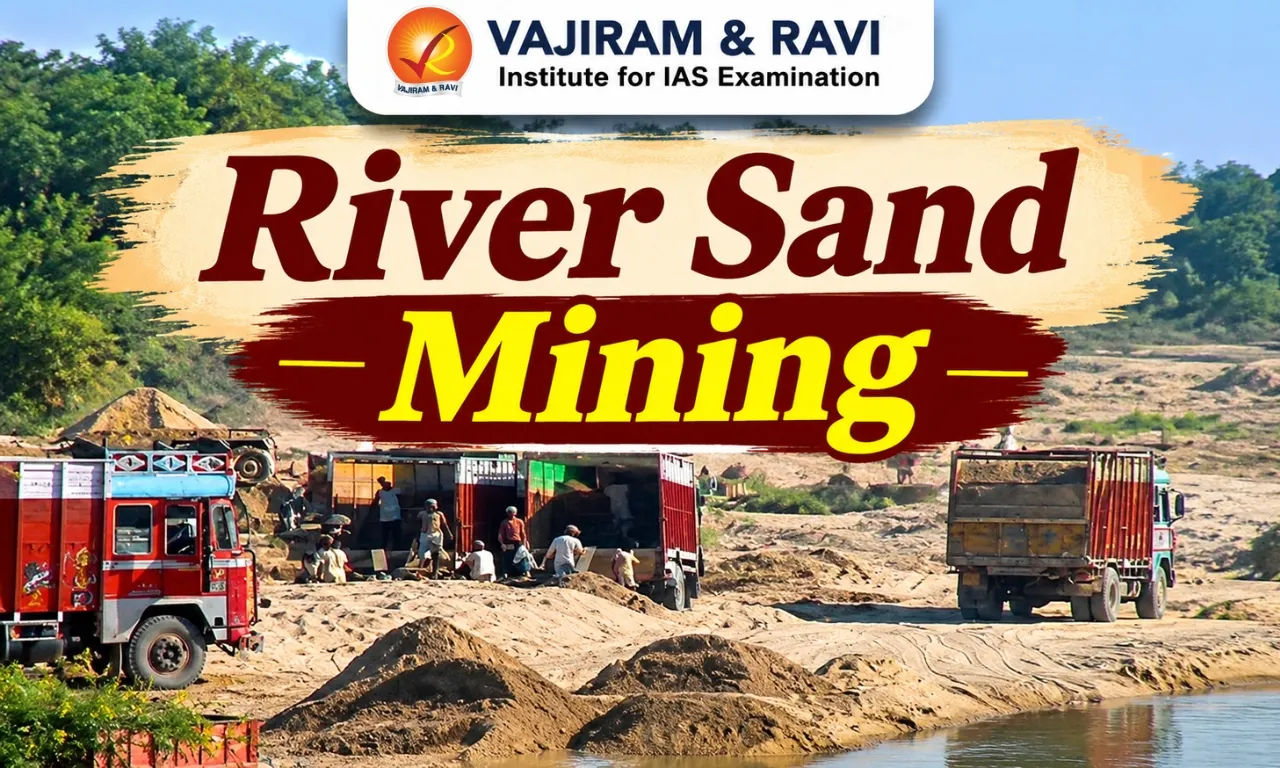
  • The Supreme Court-appointed Central Empowered Committee (CEC) has recommended phasing out unsustainable sand extraction from active river channels within three years and developing alternative sources to meet construction demand.

Background and CEC Recommendations

  • The recommendations form part of CEC Report No. 36 of 2026, submitted to the Supreme Court on November 2, in the suo motu proceedings concerning illegal sand mining in the National Chambal Sanctuary.
  • The Supreme Court had expanded the proceedings to cover river sand mining across India, after expressing concern over its damaging impact on river ecosystems.
  • The CEC has proposed a time-bound roadmap to progressively phase out unsustainable extraction from active river channels over three years. 
  • The transition would be supported by alternative sources, including:
    • Reservoir sediment: Sand recovered through planned desilting of dams.
    • Manufactured Sand (M-sand): Produced by crushing and processing suitable rock. It can substitute natural river sand in construction when it meets Bureau of Indian Standards (BIS) specifications.
    • Recycled Construction and Demolition (C&D) Waste: Recovered material that can help meet construction requirements.

Reservoir Desilting as an Alternative

  • The CEC has recommended a time-bound desilting programme, with contracts for eligible works awarded within three years, followed by a structured 10-year cycle for reservoirs identified as suitable.
  • The proposed framework includes:
    • Assessing all storage dams older than 15 years that have not undergone systematic desilting.
    • Desilting approximately one-tenth of suitable reservoirs annually.
    • Selling recovered sand through transparent mechanisms.
    • Ensuring that desilting is based on technical and environmental suitability rather than treating it as mandatory for every dam.
  • The Ministry of Jal Shakti has been recommended as the lead agency for developing a national framework in consultation with relevant institutions, including the Central Water Commission, National Dam Safety Authority, Ministry of Environment, Forest and Climate Change, and State Governments.

Reservoir Sedimentation and Storage Loss

  • The CEC cited Ministry of Jal Shakti data presented to Parliament in December 2025:
    • Of the 439 assessed reservoirs, average gross storage loss due to sedimentation was 19.24%.
    • Twenty-three reservoirs had lost more than half of their storage capacity.
    • Gobind Sagar reservoir, behind the Bhakra Dam, had declined from 9,868 million cubic metres (MCM) to approximately 7,300 MCM, representing a reduction of about 26%.
  • Desilting could therefore serve a dual purpose: restoring reservoir storage capacity and supplying part of the construction sector's demand for sand.
  • However, the CEC cautioned that total accumulated sediment cannot be treated as entirely recoverable or commercially usable sand. Its technical recoverability and environmental acceptability require assessment.

Digital Monitoring and Traceability

  • To improve regulation and curb illegal extraction, the CEC recommended a digital monitoring system covering:
    • Mining permissions and permitted quantities
    • Actual mineral extraction
    • Electronic transit permits
    • End-use of extracted material
  • Secure electronic transit permits should incorporate unique QR codes, barcodes or RFID-based identification to improve traceability of mineral movement.

Challenges in Implementing the Recommendations

  • Limited national data: There is no consolidated and reliable national database quantifying the volume or value of illegally extracted river sand.
  • Uncertain reservoir potential: The usable quantity of construction-grade sand available in reservoirs has not been adequately assessed at the national level.
  • Centre-State coordination: Sand, classified as a minor mineral, and water are State subjects. Implementation will require coordination between the Union Government and State Governments.
  • Construction demand: Alternative sources must be developed without disrupting legitimate construction requirements.
  • The CEC also highlighted an earlier 2020 report on Rajasthan, which found that legal sand collection declined from approximately 57 million tonnes annually to 5 million tonnes after mining restrictions imposed by the Supreme Court. The report identified the resulting supply gap as a major driver of illegal mining.

Conclusion

  • The CEC's recommendations seek to shift India's approach from restricting illegal river sand mining towards developing sustainable alternatives and improving mineral traceability. 
  • Reservoir desilting, M-sand and recycled construction waste could reduce pressure on river ecosystems while supporting construction demand. 
  • Their implementation will depend on scientific assessments, environmental safeguards and effective Centre-State coordination.

Source: IE

River Sand Mining FAQs

Q1: What is the Central Empowered Committee (CEC)?

Ans: The CEC is a committee appointed by the Supreme Court to assist it in matters concerning environmental protection and related issues.

Q2: What has the CEC recommended regarding river sand mining?

Ans: It has recommended a time-bound roadmap to phase out unsustainable extraction from active river channels within three years.

Q3: What is Manufactured Sand (M-sand)?

Ans: M-sand is produced by crushing and processing suitable rocks. It can replace natural river sand in construction when it meets BIS specifications.

Q4: Why is reservoir desilting being proposed?

Ans: Desilting can help restore reservoir storage capacity and recover sediment that may be suitable for construction use.

Q5: What is the proposed desilting cycle?

Ans: The CEC has recommended assessing storage dams over 15 years old that have not been systematically desilted, followed by desilting around one-tenth of suitable reservoirs annually as part of a structured 10-year cycle.

Apple’s India Manufacturing Challenges: Worker Deaths at Tata’s Hosur Plant

Apple’s India Manufacturing Challenges

Apple’s India Manufacturing Challenges Latest News

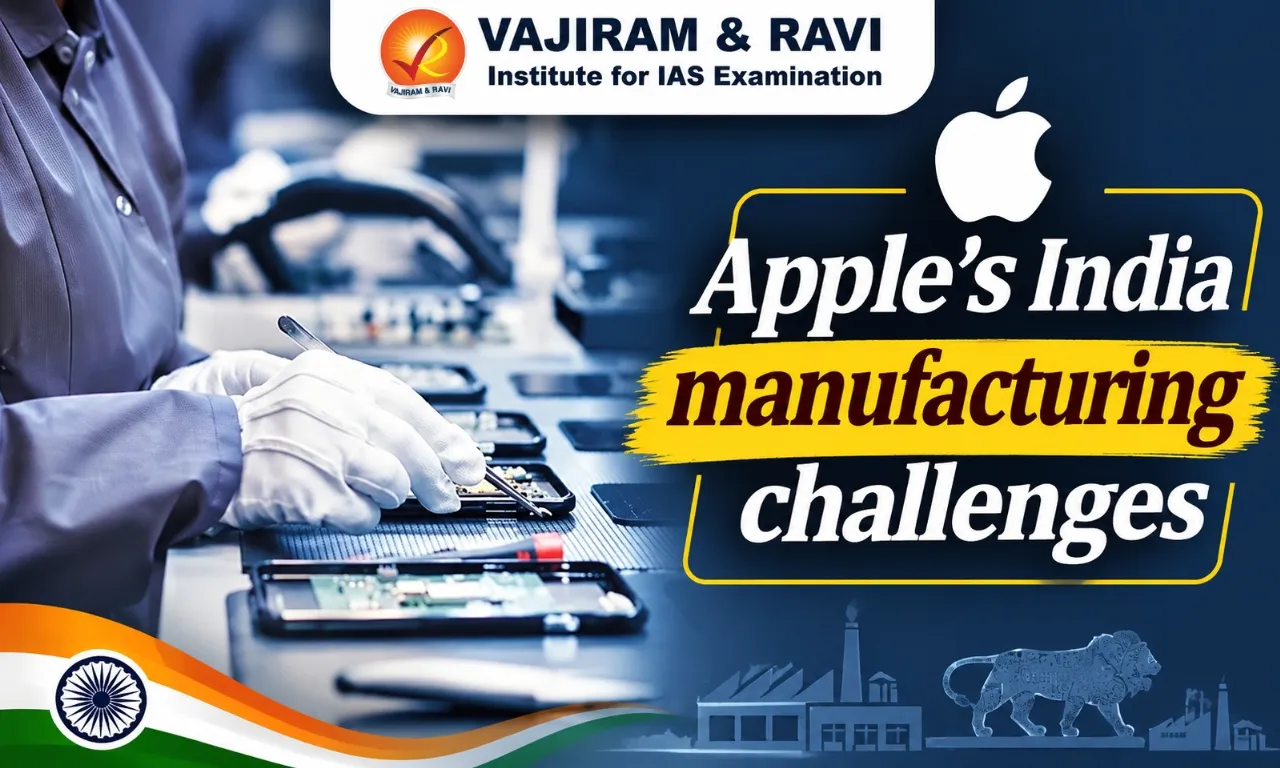
  • Recently, three contract workers died at a Tata Electronics factory in Hosur, Tamil Nadu, while performing maintenance at an effluent treatment plant. 
  • The incident has renewed scrutiny of safety and operational standards in Apple’s rapidly expanding Indian manufacturing ecosystem, which now produces roughly 25% of global iPhones. 
  • This is not an isolated event — it is the latest in a long pattern of fires, protests, environmental violations, and security breaches plaguing Apple’s Indian supply chain.

What Happened at Hosur

  • Three workers inhaled suspected toxic gases while inspecting a nano-filtration tank at an effluent treatment plant operated by Nalco Water (a subsidiary of US-based Ecolab) within Tata’s facility.
  • The Tamil Nadu government has ordered an investigation; Apple and Tata are conducting their own inquiries.
  • The incident raises questions about industrial safety standards at facilities increasingly critical to Apple’s global supply chain — especially as India moves from mere assembly to manufacturing sophisticated components.

How India Became Central to Apple’s Supply Chain

  • Apple began iPhone assembly in India in 2017, initially with older models.
  • Expansion accelerated due to: 
  • India now contributes ~25% of global iPhone production.
  • Two key manufacturing partners: 
    • Tata Group: ~40% of domestic iPhone assembly.
    • Foxconn (Taiwan): remainder of assembly operations.
  • Tata’s rise was driven by acquiring Wistron’s Indian operations (2023) and later taking over Pegatron’s Indian iPhone business.
  • Tata’s Hosur facility is strategically significant — it manufactures precision-engineered metal casings and back panels, reflecting India’s shift toward deeper local value addition, not just assembly of imported components.

A Pattern of Recurring Problems

  • Cybersecurity Breach (June 2026)
    • A ransomware attack on Tata’s Hosur iPhone assembly facility leaked over 200,000 files on the dark web, including confidential supplier details, component specs, and images of the then-unreleased iPhone 18 Pro.
    • This was particularly damaging given Apple’s strict confidentiality protocols around unreleased products.
    • Tata responded by restricting internal system access and hiring a global forensic consultant.
  • Environmental Allegations (2026)
    • The Tamil Nadu Pollution Control Board (TNPCB) warned of possible factory closure over alleged groundwater contamination from wastewater discharge affecting nearby farmland and wells.
    • Tata disputed the findings, claiming freshwater sample analyses showed no contamination; the regulator eventually accepted Tata’s explanation and dropped action.
  • Employment Discrimination (2024-25)
    • Foxconn faced allegations of systematically excluding married women from assembly-line jobs at its Sriperumbudur (Tamil Nadu) plant, exposed via a Reuters investigation.
    • This triggered scrutiny from the Union Labour Ministry and the National Human Rights Commission (NHRC).
    • NHRC criticised labour officials in January 2025 for inadequate investigation, but a subsequent government probe cleared Foxconn of wrongdoing.
    • Foxconn later removed age, gender, and marital-status criteria from job advertisements.
  • Fires and Production Disruptions
    • September 2024: A major fire at Tata’s Hosur facility (chemical storage area) temporarily halted iPhone back-panel component manufacturing — then a crucial domestic supply source.
    • September 2023: Pegatron suspended iPhone assembly at its Chennai facility after a fire.
    • Earlier 2023: Foxlink (iPhone charger manufacturer) halted production in Andhra Pradesh after a fire caused partial building collapse.
  • Worker Unrest
    • December 2021: Foxconn’s Chennai-area factory shut for over three weeks after ~250 workers fell ill, triggering protests over living conditions and food safety; Apple later found the facility did not meet its standards.
    • December 2020: Workers at Wistron’s Narsapura (Karnataka) plant vandalised property protesting alleged non-payment of wages, forcing a three-month shutdown.

Conclusion

  • As India cements its position as a critical node in Apple’s global supply chain, the recurring pattern of fires, worker unrest, environmental concerns, and now fatal industrial accidents signals that manufacturing scale has outpaced safety and governance systems. 
  • For India’s electronics manufacturing ambitions to be sustainable, stronger enforcement of industrial safety, labour rights, and environmental compliance must keep pace with its growing share of global production.

Source: IE | IT

Apple’s India Manufacturing Challenges FAQs

Q1: What happened at Tata Electronics’ Hosur plant?

Ans: Three contract workers died after inhaling suspected toxic gases while inspecting a nano-filtration tank at an effluent treatment plant inside Tata’s facility.

Q2: Why has India become important to Apple’s global manufacturing operations?

Ans: Apple’s India manufacturing challenges accompany its growing production footprint, driven by efforts to diversify beyond China and India’s smartphone Production Linked Incentive scheme.

Q3: What role does Tata Group play in Apple’s Indian supply chain?

Ans: Tata accounts for approximately 40% of domestic iPhone assembly and manufactures precision-engineered metal casings and back panels at its Hosur facility.

Q4: What recurring problems have affected Apple’s Indian manufacturing ecosystem?

Ans: Apple’s India manufacturing challenges include industrial fires, worker protests, cybersecurity breaches, environmental allegations and concerns over employment discrimination at supplier facilities.

Q5: What measures are needed to make India’s electronics manufacturing ecosystem sustainable?

Ans: Addressing Apple’s India manufacturing challenges requires stronger enforcement of industrial safety standards, labour rights and environmental regulations alongside expanding manufacturing capacity.

India’s Russia-Ukraine Diplomacy: 2026 Peace Talks and India’s Expanding Role

India’s Russia-Ukraine Diplomacy

India’s Russia-Ukraine Diplomacy Latest News

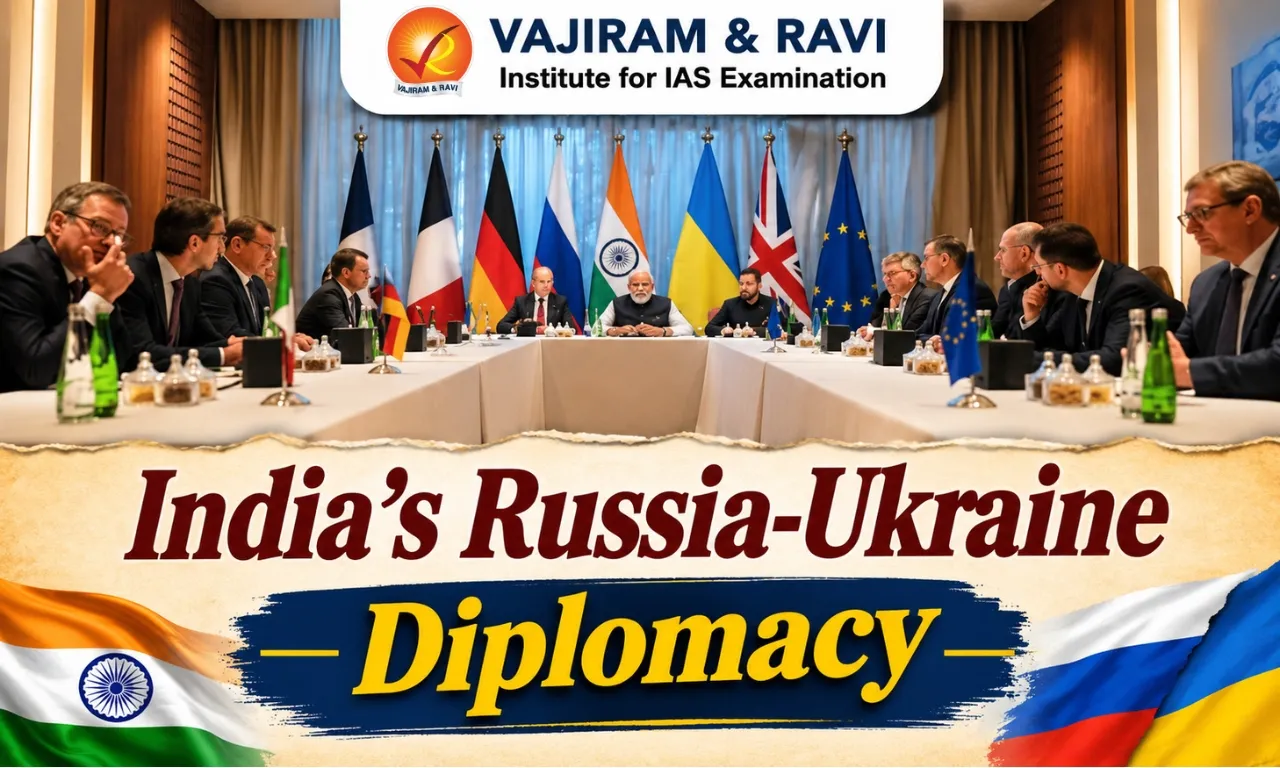
  • On November 10-11, 2026, delegations from the US, Russia, and Ukraine met in Abu Dhabi for the third round of US-mediated peace talks, aiming to end the nearly five-year war — Europe’s deadliest conflict since World War II. 
  • Alongside, India has emerged as an active diplomatic player, engaging both Moscow and Kyiv at the highest levels, with concrete proposals on maritime security and humanitarian concerns.

The Road to Abu Dhabi: Earlier Rounds of Talks

  • May-June 2025 (Istanbul): First direct talks since the 2022 invasion. A 28-point US-Russia peace plan demanded Ukraine renounce NATO membership and give up its long-range arsenal — rejected by Zelenskyy. 
    • Europe countered with demands for an Article 5-style security guarantee (collective defence principle). No consensus reached.
  • February 2026 (Geneva): Russia insisted Ukraine cede the entire Donbas region before any ceasefire; Kyiv rejected this and demanded an unconditional ceasefire. 
    • Talks collapsed, further disrupted by the US-Israel conflict with Iran, which diverted US diplomatic bandwidth.

What’s on the Table Now

  • Territory: Russia controls Crimea (annexed 2014) and parts of eastern/southern Ukraine, claiming Donetsk, Luhansk, Zaporizhzhia, and Kherson. It wants Ukraine to withdraw from Donbas; Ukraine rejects this, though US negotiators see room for limited mutual concessions.
  • Security Guarantees: Ukraine demands credible guarantees against future Russian aggression, having earlier sought NATO membership — a key trigger cited for Russia’s 2022 invasion.
  • European Security Architecture: Russia wants this framework discussed before resolving the immediate conflict; EU’s Ursula von der Leyen insists it should follow a ceasefire. 
    • Notably, Russia has blocked European participation in talks, even as France, Germany, UK, Italy, EU, and NATO hold parallel discussions with US/Ukrainian officials in Abu Dhabi.

Impact of US Midterm Elections

  • Democrats’ “blue wave” win in the US Congress could push for greater military aid to Ukraine and tougher sanctions on Russia once new members take office in January.
  • However, Trump’s administration retains control over the immediate negotiations; a shift in Congress doesn’t automatically alter foreign policy, depending instead on bipartisan legislative support.

India’s Diplomatic Role

  • A day before the talks, PM Modi spoke with Zelenskyy; hours later, EAM Jaishankar spoke with Lavrov — reflecting India’s engagement with both sides at the highest level.
  • Zelenskyy urged India to leverage its diplomatic ties with world leaders to help end the war, highlighting food security as a cooperation area.
  • Ukraine’s FM Andrii Sybiha called India’s proposal the “most comprehensive” among those received from India, Egypt, Turkey, and the US; Putin praised Modi’s “very good ideas.”

India’s Three-Part Truce Proposal

  • Reduce attacks around the Black Sea to enable Ukrainian agricultural exports.
  • Halt Russian attacks on Ukraine’s energy infrastructure.
  • Ukraine refrains from attacking Russian positions along the line of contact.

Why the Black Sea Matters

  • The Black Sea is critical for both nations: 
    • Ukraine’s three key ports (Odesa, Chornomorsk, Pivdennyi) handle ~90% of its agricultural exports; 
    • Russia transports 77-81% of its grain exports (42-44 million tonnes) via the Azov-Black Sea region.
  • Continued fighting threatens 400 million people across Africa, West Asia, and Asia with food shortages and malnutrition.
  • India’s direct stakes: 5 Indian seafarers killed, 2 missing in Black Sea attacks; India imports ~1.97 million barrels/day of Russian crude (~35% of total oil imports) — making safe shipping a vital national interest.

India’s Broader Regional Concerns

  • India has also called for free and safe navigation through the Strait of Hormuz, amid the West Asia conflict, engaging Iran, Israel, and the US.
  • Foreign Secretary Vikram Misri visited the UAE as part of these sustained diplomatic efforts.

What If Talks Fail?

  • Diplomacy would likely continue through separate channels (prisoner exchanges, shipping safety), even without a comprehensive deal.
  • Unresolved territorial and security disputes would mean continued Western support for Ukraine and continued Russian military operations — with spillover effects on global trade, energy prices, and food security.

Conclusion

  • India’s shift from advocating peace to proposing concrete, actionable measures marks a significant evolution in its Russia-Ukraine diplomacy — driven as much by humanitarian concern as by its own economic and strategic stakes in energy security and global trade. 
  • While India remains outside the formal Abu Dhabi talks, its channels with both Moscow and Kyiv position it as a credible facilitator in an otherwise deadlocked peace process.

Source: IE | IT | IE

India’s Russia-Ukraine Diplomacy FAQ

Q1: What is the significance of the 2026 US-mediated Russia-Ukraine peace talks?

Ans: The talks seek to end the prolonged Russia-Ukraine war, addressing territorial disputes, security guarantees and European security architecture through renewed diplomacy.

Q2: What are the major issues under discussion in the Abu Dhabi peace talks?

Ans: The key issues include territorial control, Ukraine’s security guarantees and the sequencing of discussions on the future European security architecture.

Q3: How is India’s Russia-Ukraine diplomacy evolving?

Ans: India’s Russia-Ukraine diplomacy has moved beyond advocating peace to proposing concrete measures on maritime security, energy infrastructure and humanitarian concerns.

Q4: What are the three components of India’s proposed Russia-Ukraine truce?

Ans: India’s Russia-Ukraine diplomacy proposes reducing Black Sea attacks, halting Russian strikes on Ukrainian energy infrastructure and preventing Ukrainian attacks along the line of contact.

Q5: Why is the Black Sea strategically important for India?

Ans: The Black Sea matters to India’s Russia-Ukraine diplomacy because attacks threaten Indian seafarers, Russian crude shipments, agricultural exports and wider global food security.

Daily Editorial Analysis 11 November 2026

Daily-Editorial-Analysis

Transparency is Essential to Institutional Credibility

Context

  • The proposed amendments to the Foreign Contribution (Regulation) Act (FCRA), 2010, have generated debate among civil society organisations, Opposition parties and Christian institutions.
  • The Government argues that the amendments will strengthen transparency, financial accountability and oversight of foreign-funded organisations.
  • However, critics fear that excessive regulation could restrict legitimate charitable, educational, healthcare and social-service activities, particularly those undertaken by minority institutions.

FCRA Amendments and the Need for Regulatory Balance

  • Transparency versus Institutional Freedom

    • Foreign contributions support education, healthcare, humanitarian assistance and poverty alleviation.
    • Organisations receiving such funds must remain accountable for their sources and utilisation.
    • Preventing financial irregularities and diversion is a legitimate government responsibility.
    • However, regulation must remain proportionate and non-discriminatory.
    • Excessive government control could weaken organisations providing essential services to disadvantaged communities.
    • Foreign funding regulations must not become instruments for restricting legitimate civil society activities.
  • Minority Rights and Voluntary Accountability

    • Transparency is not an attack on minority rights; rather, it strengthens public trust.
    • Religious and charitable organisations must also examine their internal accountability mechanisms.
    • The Catholic Church in Tamil Nadu operates numerous social-service organisations through its dioceses.
    • Publishing audited annual accounts, income-and-expenditure statements and major funding sources would strengthen institutional credibility.
    • Accountability must operate in both directions: governments must respect institutional freedom, while organisations must remain answerable to donors, beneficiaries and stakeholders.

Institutional Power and Financial Accountability

  • Influence Must Accompany Responsibility

    • Religious organisations such as the Society of Jesus and Salesians of Don Bosco, along with dioceses and congregations of women religious, have established extensive educational, healthcare and social-service networks.
    • Their contributions are significant, but institutional influence creates corresponding responsibilities.
    • Organisations exercising considerable social influence must demonstrate financial integrity, administrative transparency and public accountability.
  • Transparency in Educational Institutions

    • The educational sector has witnessed allegations concerning admission-related donations, capitation fees and other payments, particularly in professional institutions.
    • Such allegations should not be treated as established wrongdoing without evidence. Nevertheless, they underline the importance of transparent financial practices.
    • Institutions receiving substantial fees, donations and grants should maintain independently audited accounts and disclose their broad financial position.
    • This can include funding sources, expenditure statements and the purposes for which resources are utilised.
    • Transparency need not compromise individual privacy or institutional autonomy. Instead, it can strengthen public confidence and counter allegations of financial mismanagement.

The Unfinished Question of Dalit Christians

  • Demand for Scheduled Caste Status

    • The Catholic Bishops' Conference of India (CBCI) has raised concerns about the FCRA amendments and the continuing denial of Scheduled Caste status to Christians of Scheduled Caste origin.
    • It has sought an early resolution of the matter pending before the Supreme Court.
    • For decades, Dalit Christians have demanded recognition of their historical and continuing social disadvantages.
    • Their argument is that caste discrimination does not disappear through religious conversion.
    • The Church has acknowledged that caste discrimination persists within Indian society and its own institutions, making social equality an important institutional responsibility.
  • Institutional Influence and Social Justice

    • The Church possesses considerable organisational reach, financial resources and institutional influence.
    • These resources could be mobilised to advance the constitutional rights of Dalit Christians.
    • An important question is whether the Church has demonstrated the same sustained commitment to the rights of its most marginalised members as it has in opposing regulatory changes affecting its institutions.
    • If caste discrimination survives conversion, social justice and constitutional equality must remain central to the Church's public advocacy.
    • Institutional accountability must extend beyond financial disclosure to include equality, representation and protection of disadvantaged communities.

The Way Forward

  • Balancing State Regulation and Institutional Independence

    • The appropriate approach lies neither in unrestricted government intervention nor in unchecked institutional freedom. It lies in accountable autonomy.
    • Minority institutions have made valuable contributions to India's educational, healthcare and social-development sectors.
    • Their constitutional freedom must be protected. However, institutional autonomy cannot mean exemption from legitimate financial scrutiny.
    • The Government must ensure that FCRA regulations do not become instruments of arbitrary control, selective enforcement or discrimination against minority organisations.
  • Accountability as the Foundation of Public Trust

    • The credibility of minority institutions depends not only on opposing excessive government regulation but also on practising transparency internally.
    • The poor, faithful, beneficiaries, parents, students and communities supporting these organisations have a legitimate interest in understanding how institutional resources are managed.
    • Voluntary financial disclosure, independent audits and effective internal accountability can strengthen institutional credibility.
    • Minority rights and institutional accountability are complementary principles that reinforce democratic values.

Conclusion

  • The proposed FCRA amendments raise important questions about government regulation, minority rights and institutional responsibility.
  • While preventing the misuse of foreign contributions is legitimate, regulatory powers must remain proportionate and protect genuine charitable and educational activities.
  • The way forward is accountable autonomy, supported by constitutional safeguards, independent audits, financial transparency and equal treatment.
  • Ultimately, institutional credibility depends not merely on defending freedom but also on transparently serving the communities that sustain and depend upon these institutions.

Transparency is Essential to Institutional Credibility FAQs

Q1. What was the primary objective of demonetisation in 2016?

Ans. It aimed to curb black money, counterfeit currency and promote digital payments.

Q2. How much demonetised currency returned to the banking system?

Ans. Approximately 99.3% of the demonetised currency returned to the banking system.

Q3. Why were acute medicines more affected than chronic medicines?

Ans. Acute medicines require urgent purchases, leaving consumers little time to search for affordable alternatives.

Q4. What was the impact of demonetisation on acute medicine sales?

Ans. Acute medicine sales volume declined by approximately 3.6% relative to chronic medicines.

Q5. What is the major policy lesson from the study?

Ans. Economic interventions must protect essential healthcare consumption by strengthening public health infrastructure and ensuring uninterrupted access to medicines.

Source: The Hindu


Arrest, Detention and Personal Liberty - Strengthening Constitutional Safeguards under Article 22

Context

  • The Supreme Court [in Sujit Das and Others v. Union of India (2026)] has reaffirmed that personal liberty is the foundation of a liberal democracy and that arrest must remain a measure of last resort.
  • In a significant judgment delivered by a two-judge Bench, the Court restricted the police practice of keeping individuals in informal custody before formally recording their arrest.
  • The judgment strengthens the safeguards under Article 22(2) of the Constitution, and also addresses the misuse of criminal law, prolonged pre-trial detention and the erosion of civil liberties.

Article 22 - Protection Against Arbitrary Arrest and Detention

  • Article 22(1): An arrested person must be informed of the grounds of arrest and cannot be denied the right to consult and be defended by a legal practitioner of their choice.
  • Article 22(2): Every arrested person must be produced before a magistrate within 24 hours, and detention beyond this period requires judicial authorisation.
  • Article 21: Protection of life and personal liberty requires that any deprivation of liberty must follow a fair, just and reasonable procedure.

Arrest and Detention - No Scope for Informal Custody

  • No artificial distinction: The Court disapproved contrary HC interpretations and held that arrest and detention cannot be artificially separated to circumvent constitutional safeguards.
  • When does the 24-hour period begin? The period begins from the moment the police exercise control over an individual's liberty, rather than from the time they formally record the arrest.
  • No investigative buffer zone: Police cannot detain individuals for interrogation, investigation or medical examination before formally arresting them and thereby postpone the constitutional deadline.
  • Unconstitutional practice: Informal or undocumented custody cannot be used as a device to evade judicial scrutiny.
  • Reference from previous judgment: The SC in Niranjan Singh v. Prabhakar Rajaram Kharote (1980) rejected attempts to justify informal police custody as something distinct from arrest.
  • Key directions of the SC: If detention continues beyond 24 hours without production before a magistrate, the person must be released Hence, magistrates may refuse remand if detention is unnecessarily prolonged.

Judicial Safeguards

  • Important judicial precedents:

    • Sakal Papers v. Union of India (1961): Fundamental rights must be interpreted broadly rather than through a narrow approach.
    • Niranjan Singh (1980): Rejected artificial distinctions between informal custody and formal arrest.
    • Prabir Purkayastha v. State (2024): The SC emphasised that failure to communicate the grounds of arrest violates Article 22(1).
    • Nagaraj v. Union of India (2006): Fundamental rights are not gifts from the State; the Constitution recognises rights that individuals inherently possess.
  • Broader interpretation: The constitutional safeguards must be interpreted to expand, rather than dilute, individual liberty.

Concerns over the Criminal Justice System

  • Excessive criminalisation:

    • Governments have increasingly relied on creating new offences (~7,305 criminal offences as per central laws alone) and enhancing punishments rather than addressing the structural causes of crime.
    • Economic inequality, weak macroeconomic regulation and market dynamics also contribute to criminalisation and incarceration.
  • Rising burden of undertrial prisoners:

    • According to the NCRB, ~72.6% of prisoners are undertrials, meaning they are yet to be convicted.
    • Prolonged pre-trial detention undermines the presumption of innocence and disproportionately affects economically weaker sections.
  • Shrinking civil liberties: Stringent bail provisions under special laws, coupled with prolonged investigations and custodial detention, have weakened the practical enjoyment of personal liberty.

Institutional Concerns - Separation of Powers

  • Section 15 of BNSS, 2023 empowers State governments to appoint Special Executive Magistrates (SEMs), including police officers not below the rank of Superintendent of Police.
  • The practice is questioned for producing arrested persons before SEMs who are themselves serving police officers.
  • Such arrangements raise concerns regarding judicial independence, impartial scrutiny of detention and the separation of executive and judicial functions.

Unfulfilled Constitutional Commitment

  • The 44th Constitutional Amendment Act, 1978, sought to strengthen safeguards against preventive detention by reducing the permissible period of detention without obtaining the opinion of an Advisory Board.
  • However, the relevant provision has not been brought into force, reflecting the inadequate commitment of successive governments towards strengthening due process and protecting civil liberties.

Way Forward

  • Strengthen due process: Ensure strict compliance with Articles 21 and 22 at every stage of arrest, detention and investigation.
  • Independent judicial oversight: Produce detained individuals before judicial magistrates and prevent police authorities from exercising quasi-judicial powers over their own investigations.
  • Reduce excessive criminalisation: Review redundant criminal offences and adopt proportionate, evidence-based criminal justice policies.
  • Reform bail and undertrial detention: Promote bail as the norm, ensure timely trials and reduce unnecessary incarceration.
  • Accountability in policing: Maintain transparent records of the actual time of detention and impose accountability for illegal custody.
  • Uphold constitutional morality: Courts must interpret fundamental rights expansively to prevent executive overreach.

Conclusion

  • By treating detention and arrest as synonymous for the purposes of Article 22(2), the Supreme Court has closed an important procedural loophole exploited by investigating agencies.

Arrest, Detention and Personal Liberty FAQs

Q1. How does Article 22(2) protect individuals against arbitrary arrest and detention?

Ans. It mandates production before a magistrate within 24 hours of arrest.

Q2. Why did the SC reject the distinction between arrest and informal detention?

Ans. Such a distinction enables police to evade the 24-hour constitutional safeguard.

Q3. How does excessive criminalisation undermine personal liberty in India?

Ans. It increases unnecessary arrests, incarceration and undertrial detention.

Q4. What are the constitutional concerns surrounding the BNSS, 2023?

Ans. Institutional impartiality, judicial independence and separation of powers when police officers exercise magistrate-like functions.

Q5. What measures need to strengthen civil liberties within India's criminal justice system?

Ans. Ensure strict compliance with Articles 21 and 22, promote bail, reduce excessive criminalisation, etc.

Source: IE


Strategic Autonomy Must Guide India’s Starlink Policy

Context

  • A public spat recently erupted when Elon Musk accused Indian “oligarchs” of blocking Starlink’s entry into India, which the government denied, clarifying that all satellite operators undergo the same regulatory process.
  • While the debate centred on Musk, Mukesh Ambani, and telecom competition, it obscured a far more important question: how much control will India actually have over Starlink once it operates domestically?
  • This article highlights why strategic autonomy must guide India’s Starlink policy as satellite internet becomes increasingly important for remote connectivity, border security and military operations.

Starlink’s Unique Role — Not a Fibre/Mobile Replacement

  • Fibre and mobile networks are optimised for density — costly and time-consuming to set up, but serve many users per area.
  • Starlink is optimised for reach — it connects remote areas without towers or cables, but has limited per-region user capacity (it has previously stopped onboarding residential users in capacity-saturated areas).
  • Starlink is best suited for isolated settlements, border regions, ships, and disaster-hit zones — areas where governments and militaries need reliable connectivity for soldiers, drones, sensors, and command centres.
  • This makes Starlink’s India operations a matter of national security, not just consumer choice.

The Core Risk: Limited Indian Control

  • India can license and penalise Starlink, but SpaceX retains direct control over its satellites, software, and terminal access.
  • The network could remain active in areas where India orders a shutdown — or be disabled precisely when India needs it most.

India’s Regulatory Safeguards

  • Satellite internet operators must route Indian user traffic through domestic gateways (ground stations). They cannot bypass Indian gateways via inter-satellite links or route traffic through foreign gateways.
  • Operators must provide monitoring access to security agencies and comply with security-related shutdown orders.
  • Starlink has shown compliance willingness — announcing Indian gateway sites and India-specific data controls.
  • Enforcement challenge: while domestic gateways can be inspected, verifying whether Indian traffic is secretly routed abroad depends largely on SpaceX’s own disclosures.
  • Trade-off: restricting inter-satellite rerouting also removes a layer of network redundancy during gateway failures.

Lessons from Global Experiences

  • Iran: Since 2023, has repeatedly complained to the ITU about unauthorised Starlink terminals operating on its soil. Despite the ITU’s Radio Regulations Board reiterating calls to stop transmissions, it lacks authority to suspend satellite frequency assignments — enforcement has failed for years.
  • Ukraine: A contrasting case — SpaceX cooperated with Ukrainian authorities to block Starlink terminals used by Russian forces.
    • However, Ukraine also faced disruption: In October 2026, Starshield (military Starlink variant) lost connectivity for fast-moving terminals, disrupting drone and frontline operations.
    • Reports suggested a White House-linked order (denied by Trump), coinciding with US pressure on Ukraine over strikes on Russian refineries — restored only by October 24.
  • This reveals that SpaceX’s dependence on US regulatory approval and contracts gives Washington significant leverage — a risk if American and Indian interests diverge during a crisis.

The Way Forward: Building Alternatives

  • Excluding Starlink entirely would sacrifice critical connectivity for remote areas — India should retain strict licensing while strengthening compliance verification.
  • Reducing dependency risk requires alternatives:
    • Maintain backup connections and tested switching procedures for military/essential users.
    • Use multiple satellite internet providers from different jurisdictions to avoid single-entity dependence.
    • Expand ground infrastructure — a parliamentary review found only 30% of gram panchayats had functional BharatNet connectivity as of February 2026.
    • Since fibre/towers cannot cover oceans, mountains, or remote frontiers, India must develop its own domestic satellite constellations, simultaneously boosting indigenous satellite and rocket industry capacity.

Conclusion

  • India must neither reject Starlink’s connectivity benefits nor blindly trust foreign-controlled infrastructure.
  • True strategic autonomy lies in robust licensing, independent verification capacity, and building indigenous satellite alternatives — ensuring essential communications survive even when global providers falter or refuse cooperation.

Strategic Autonomy Must Guide India’s Starlink Policy FAQs

Q1. Why is Starlink considered different from conventional fibre and mobile networks?

Ans. Starlink prioritises connectivity in remote and sparsely populated areas, whereas fibre and mobile networks serve dense populations but require extensive ground infrastructure.

Q2. Why does Starlink’s operation in India raise national security concerns?

Ans. SpaceX retains control over satellites, software and terminal access, potentially allowing network disruptions or continued operations despite Indian government shutdown orders.

Q3. What regulatory safeguards has India introduced for satellite internet operators?

Ans. Operators must route Indian traffic through domestic gateways, provide security agencies monitoring access and comply with security-related shutdown orders issued by authorities.

Q4. What lessons do Iran and Ukraine offer India regarding Starlink dependence?

Ans. Iran highlights enforcement limitations, while Ukraine demonstrates how SpaceX’s operational decisions and external political pressures can disrupt critical military connectivity.

Q5. What measures can India adopt to reduce dependence on foreign satellite providers?

Ans. India should diversify satellite providers, maintain backup connections, strengthen BharatNet, improve compliance verification and develop indigenous satellite constellations and launch capabilities.

Source: TH

Daily Editorial Analysis 2026 FAQs

Q1: What is editorial analysis?

Ans: Editorial analysis is the critical examination and interpretation of newspaper editorials to extract key insights, arguments, and perspectives relevant to UPSC preparation.

Q2: What is an editorial analyst?

Ans: An editorial analyst is someone who studies and breaks down editorials to highlight their relevance, structure, and usefulness for competitive exams like the UPSC.

Q3: What is an editorial for UPSC?

Ans: For UPSC, an editorial refers to opinion-based articles in reputed newspapers that provide analysis on current affairs, governance, policy, and socio-economic issues.

Q4: What are the sources of UPSC Editorial Analysis?

Ans: Key sources include editorials from The Hindu and Indian Express.

Q5: Can Editorial Analysis help in Mains Answer Writing?

Ans: Yes, editorial analysis enhances content quality, analytical depth, and structure in Mains answer writing.

Hindu Succession Act 1956, Provisions, Features, Amendment, Criticism

Hindu Succession Act

The Hindu Succession Act 1956 created a single legal system for property inheritance among Hindus in India. It established clear rules for who inherits property when a person dies (including without will). Recent Supreme Court observations emphasized that inheritance under the Act is shaped by cultural practices, lineage rules, and legislative intent. The Court highlighted that succession is not only about gender justice but about the broader Hindu social structure, where inheritance follows traditional family-based norms.

Hindu Succession Act 1956 Latest News

  • Supreme Court Ruling: The Supreme Court recently ruled that a grandson has no automatic birthright in his grandfather’s property if it has been inherited by his father under the Hindu Succession Act, 1956.
  • Section 8 of the Act: Under Section 8, the property of a Hindu male who dies without a will (intestate) passes to his Class I legal heirs, including his wife, sons, daughters and children of predeceased sons or daughters.
  • Grandson’s Inheritance Rights: The Court clarified that a grandson whose father is alive is not a separate Class I heir and cannot directly claim a share in his grandfather’s property under Section 8.
  • Father’s Ownership Rights: Once the grandfather’s property is divided among his legal heirs, the share received by the father becomes his individual (self-acquired) property, and his children cannot claim ownership merely by birth.
  • Background of the Case: The ruling came after a grandson challenged his father’s sale of land received through a family partition in 1994. The Supreme Court upheld the Madras High Court’s decision, confirming that the father was the exclusive owner of his inherited share.

Hindu Succession Act 1956

The Hindu Succession Act 1956 defines how a Hindu’s property is distributed when they die. It applies to Hindus, Sikhs, Jains, and Buddhists, and creates uniform succession rules across regions. The Act recognizes Class I and Class II heirs and a system of agnates and cognates. The Supreme Court recently upheld its inheritance rules, noting that inherited property often returns to the source family to preserve lineage. The Court stressed that reforms must come from Parliament because inheritance affects the entire society and changes require broad agreement.

Hindu Succession Act Provisions

The Hindu Succession Act provides rules for inheritance classification, rights of heirs, distribution order, and property return to source families based on lineage principles.

  • Class I heirs inherit equally: sons, daughters, widow, and mother.
  • Class II heirs inherit only when no Class I heirs exist.
  • Property goes to agnates and then cognates when no Class I or II heirs survive.
  • Recognizes both separate property and ancestral property.
  • Upholds cultural lineage, ensuring inherited property without heirs returns to the source family.
  • A woman may distribute property freely through a will.
  • Reform responsibility lies with Parliament, not courts.

Hindu Succession Act Intestate Provisions

The Hindu Succession Act specifies different rules for intestate succession for Hindu men and Hindu women, with clear lineage based prioritization.

  • A Hindu woman’s property first devolves on her husband and children.
  • If no husband or children survive, the husband’s heirs inherit.
  • Only if no husband’s heirs exist does the property pass to her parents.
  • Property inherited from parents or in-laws returns to that side if she dies without direct heirs.
  • A Hindu man’s property goes equally to wife, children, and mother.
  • If these do not exist, the father inherits.
  • Self-acquired property devolves by statutory order.
  • Ancestral property follows customary lineage-based principles.

Hindu Succession Act Features

The Hindu Succession Act governs Hindus nationwide, integrates traditional schools of law, and lays out uniform rules for inheritance and devolution.

  • Applies to Hindus, Sikhs, Jains, and Buddhists
  • Does not automatically apply to Scheduled Tribes unless notified.
  • Covers both Mitakshara and Dayabhaga schools; creates uniform inheritance rules.
  • In Mitakshara, property rights arise at birth; in Dayabhaga, after the father’s death.
  • Dayabhaga allows male and female coparceners; Mitakshara originally allowed only male coparceners.
  • Defines coparcenary rights and ancestral property rules.
  • Creates equality in Class I heir inheritance.
  • Establishes priority among heirs based on relationship.

Hindu Succession Act Criticism

Despite its progressive design, the Act faces criticism for unequal lineage rules and limited rights for women in certain family structures.

  • Critics argue inheritance rules reinforce cultural norms over gender equality.
  • Married women’s property returning to husband’s family is contested.
  • Unequal treatment in source-based property return is debated.
  • Scheduled Tribe women remain excluded under Section 2(2).
  • Practical barriers restrict women's use of coparcenary rights.
  • Social pressure prevents equal exercise of inheritance claims.
  • Courts stress that major changes must come through Parliament.
  • Reform proposals from the Law Commission and NCW remain pending.

Hindu Succession Act Amendments

The amendments under Hindu Succession Act strengthened women’s property rights, modernized coparcenary rules, and aligned inheritance with contemporary constitutional principles. The Hindu Succession Act Amendment 2005 brought changes as:

  • Granted daughters equal coparcenary rights by birth.
  • Allowed daughters to demand partition and hold ancestral property as full owners.
  • Applied to Mitakshara families across India.
  • Eliminated earlier restrictions on daughters’ property claims.
  • Recognized daughters’ rights irrespective of marital status.
  • Reinforced equal inheritance within the joint family system.

Hindu Succession Act UPSC

The Hindu Succession Act 1956 continues to evolve, with judicial and legislative attention focused on balancing cultural norms and gender-sensitive inheritance rules.

  • Recent Supreme Court rulings reaffirmed cultural lineage as central to inheritance.
  • The Court noted that property flow must reflect family structure traditions.
  • Amendments should come legislatively because inheritance affects millions.
  • Women retain full autonomy through wills despite structural limitations.
  • Discussions continue on Scheduled Tribe women’s inheritance inclusion (2023).
  • The 174th Law Commission and National Commission for Women supported equal rights reforms.
  • Debates focus on balancing gender equity and Hindu family systems.
  • Future changes must reflect broad social consensus and constitutional values.

Hindu Succession Act FAQs

Q1: What is the Hindu Succession Act?

Ans: The Hindu Succession Act, 1956 governs inheritance and property distribution for Hindus, Sikhs, Jains, and Buddhists when a person dies. It defines heirs, succession order, and property rights.

Q2: What did the 2005 amendment change in the Hindu Succession Act?

Ans: The 2005 amendment granted daughters equal coparcenary rights by birth, allowing them the same rights as sons in ancestral property.

Q3: How does property devolve when a Hindu woman dies intestate?

Ans: Her property goes first to her children and husband. If none exist, it devolves to her husband’s heirs, then her parents’ heirs.

Q4: Are Scheduled Tribes covered under the Hindu Succession Act?

Ans: No, Scheduled Tribes are excluded under Section 2(2) unless the Central Government notifies otherwise.

Q5: What were the Supreme Court’s recent observations on inheritance under Hindu Succession Act?

Ans: The Supreme Court held that inheritance must reflect cultural context, stressed legislative change (not judicial), and noted women can freely distribute property through wills.

Enquire Now