Important Glaciers in India, Region Wise List, Examples

Important Glaciers in India

Important Glaciers in India are primarily distributed across the Karakoram and Himalayan mountain ranges, extending through Ladakh, Himachal Pradesh, Uttarakhand and Sikkim. These glaciers act as vital freshwater reserves and feed major river systems, including the Indus, Ganga and Brahmaputra. Their geographical distribution, associated mountain ranges and river sources are important aspects of India's physical geography.

Important Glaciers in India

India has several major glaciers concentrated in the northern and northeastern mountainous regions. The Karakoram Range contains some of the largest glaciers, while the Himalayas host numerous valley glaciers that contribute to the flow of major perennial rivers.

What are Glaciers?

Glaciers are large, slowly moving masses of ice formed through the accumulation and compaction of snow over several years. They develop when snowfall consistently exceeds ice loss through melting and other processes. Glaciers are important indicators of climate change and regulate freshwater availability.

List of Important Glaciers in India Region Wise

The following table presents Important Glaciers in India, classified region wise according to their geographical location and associated mountain ranges.

List of Important Glaciers in India
Glacier State/Region Mountain Range

Siachen Glacier

Ladakh

Karakoram

Biafo Glacier

Ladakh

Karakoram

Baltoro Glacier

Ladakh

Karakoram

Hispar Glacier

Ladakh

Karakoram

Batura Glacier

Ladakh

Karakoram

Godwin Austen Glacier

Ladakh

Karakoram

Rimo Glacier

Ladakh

Karakoram

Bara Shigri Glacier

Himachal Pradesh

Pir Panjal

Chhota Shigri Glacier

Himachal Pradesh

Pir Panjal

Sonapani Glacier

Himachal Pradesh

Pir Panjal

Gangotri Glacier

Uttarakhand

Garhwal Himalayas

Bandarpunch Glacier

Uttarakhand

Greater Himalayas

Milam Glacier

Uttarakhand

Kumaon Himalayas

Pindari Glacier

Uttarakhand

Kumaon Himalayas

Kafni Glacier

Uttarakhand

Kumaon-Garhwal

Satopanth Glacier

Uttarakhand

Garhwal Himalayas

Chorabari Glacier

Uttarakhand

Garhwal Himalayas

Zemu Glacier

Sikkim

Eastern Himalayas

Kanchenjunga Glacier

Sikkim

Eastern Himalayas

Examples of Important Glaciers in India

Major examples of the Important Glaciers in India include:

1. Siachen Glacier

Key highlighting features of the Siachen Glacier has been listed below:

  • Location: Siachen Glacier is situated in the Karakoram Range near the Nubra Valley in Ladakh. It is an important geographical feature of India's northern mountainous region.
  • Length: Extending approximately 75 km, it is the longest glacier in India and the second largest glacier outside the polar and sub polar regions.
  • Tributaries: Lolofond and Teram Shehr are its major tributary glaciers. Its meltwater contributes to the Nubra River, which subsequently joins the Shyok River.
  • Strategic Importance: The glacier is disputed between India and Pakistan and is recognised as the highest battlefield in the world, making it strategically significant.

2. Gangotri Glacier

The major highlights of the Gangotri Glacier has been listed below:

  • Location: Gangotri Glacier lies in the Uttarkashi district of Uttarakhand in the Garhwal Himalayas. It originates near the Chaukhamba peaks at high elevations.
  • River Source: It is the principal glacial source of the Bhagirathi River, which later joins the Alaknanda River at Devprayag to form the Ganga.
  • Length and Features: Approximately 30 km long, Gangotri is the largest glacier in Uttarakhand. It is a valley glacier comprising several interconnected tributary glaciers.
  • Tributaries: Major tributary glaciers include Chaturangi, Raktavarna and Meru. Together, these contribute to the extensive glacial system and its meltwater discharge.

3. Hispar Glacier

The key details related to the Hispar Glacier has been given below:

  • Location: Hispar Glacier is situated in the Karakoram region and occupies a tributary valley of the Hunza River system.
  • Length: Approximately 49 km long, it is sometimes recognised as the third largest glacier of the Karakoram region.
  • Connection: Hispar Glacier connects with the Biafo Glacier, forming an extensive glacial system across the Braldoh Valley.
  • Tributary: Kunyong/Lak Glacier, approximately 24 km long, is an important tributary associated with the Hispar glacial system.

4. Biafo Glacier

The key details related to the Biafo Glacier has been mentioned below:

  • Location: Biafo Glacier lies in the Karakoram Range, between the Hispar and Baltoro glaciers, occupying the Braldoh Valley.
  • Geographical Significance: It is considered as the fourth largest glacier of the Karakoram region and forms an important part of the extensive glacial landscape.
  • Formation: The glacier has developed through the convergence of nine smaller glaciers, creating a large interconnected ice system.
  • River System: It occupies the valley of the Gori Ganga River, making its geographical relationship with the surrounding drainage system important.

5. Bara Shigri Glacier

The key highlights related to the Bara Shigri Glacier has been detailed below:

  • Location: Bara Shigri Glacier is situated in the Lahaul and Spiti region of Himachal Pradesh, within the Pir Panjal Range.
  • River Source: Its meltwater feeds the Chandra River, which forms part of the Chenab River system.
  • Regional Significance: It is one of the important glaciers of the Pir Panjal region and contributes to the drainage of the Chandra Valley.
  • Geographical Feature: The Pir Panjal glaciers are comparatively smaller and less numerous than those found in the Karakoram Range.

6. Pindari Glacier

The major highlights related to the Pindari Glacier has been given below:

  • Location: Pindari Glacier is located in the Bageshwar district of Uttarakhand, south of Nanda Devi, in the upper reaches of the Kumaon Himalayas.
  • River Source: It is the source of the Pindar River, which subsequently joins the Alaknanda River, contributing to the Ganga river system.
  • Length: The glacier extends approximately 4-5 km and is an important valley glacier of the Kumaon Himalayan region.
  • Geographical Significance: Its location near major Himalayan peaks, including Nanda Devi East and Nanda Kot, makes it an important feature of regional physical geography.

7. Zemu Glacier

The key details related to Zemu Glacier has been mentioned here:

  • Location: Zemu Glacier is situated at the base of Kanchenjunga in North Sikkim, within the Eastern Himalayan mountain system.
  • Length: Extending approximately 26 km, it is the largest glacier in the Eastern Himalayas.
  • River System: The glacier flows eastward towards the headwaters of the Zemu River and is considered one of the possible sources of the Teesta River.
  • Physical Features: It is approximately one kilometre wide and has an ice thickness of around 180 metres, making it an important glacial feature of Sikkim.

8. Baltoro Glacier

The major details related to the Baltoro Glacier has been listed below:

  • Location: Baltoro Glacier is situated in the Karakoram Range, west of the Siachen Glacier and forms part of the region's extensive glacial network.
  • Length: It extends approximately 65 km and is among the major glaciers of the Karakoram mountain system.
  • River Source: The glacier gives rise to the Shigar River, which subsequently joins the Indus River.
  • Geographical Significance: Its location within the Karakoram region highlights the concentration of large mountain glaciers outside the polar and sub polar regions.

Important Glaciers in India FAQs

Q1: Which is the Longest Glacier in India?

Ans: Siachen Glacier, located in the Karakoram Range of Ladakh, is the longest glacier in India, extending approximately 75 kilometres.

Q2: Which is the Largest Glacier in Uttarakhand?

Ans: Gangotri Glacier is the largest glacier in Uttarakhand and serves as the principal glacial source of the Bhagirathi River.

Q3: Which is the Largest Glacier in the Eastern Himalayas?

Ans: Zemu Glacier, located at the base of Kanchenjunga in Sikkim, is the largest glacier in the Eastern Himalayas.

Q4: Which Glacier is the source of the Ganga River?

Ans: Gangotri Glacier is the principal glacial source of the Bhagirathi River, which joins the Alaknanda at Devprayag to form the Ganga.

Q5: Which Indian Glacier is known as the Highest Battlefield in the World?

Ans: Siachen Glacier in the Karakoram Range is known as the highest battlefield in the world due to its strategic location.

UPSC Daily Quiz 27 November 2026

UPSC Daily Quiz

[WpProQuiz 306]

UPSC Daily Quiz FAQs

Q1: What is the Daily UPSC Quiz?

Ans: The Daily UPSC Quiz is a set of practice questions based on current affairs, static subjects, and PYQs that help aspirants enhance retention and test conceptual clarity regularly.

Q2: How is the Daily Quiz useful for UPSC preparation?

Ans: Daily quizzes support learning, help in revision, improve time management, and boost accuracy for both UPSC Prelims and Mains through consistent practice.

Q3: Are the quiz questions based on the UPSC syllabus?

Ans: Yes, all questions are aligned with the UPSC Syllabus 2025, covering key areas like Polity, Economy, Environment, History, Geography, and Current Affairs.

Q4: Are solutions and explanations provided with the quiz?

Ans: Yes, each quiz includes detailed explanations and source references to enhance conceptual understanding and enable self-assessment.

Q5: Is the Daily UPSC Quiz suitable for both Prelims and Mains?

Ans: Primarily focused on Prelims (MCQ format), but it also indirectly helps in Mains by strengthening subject knowledge and factual clarity.

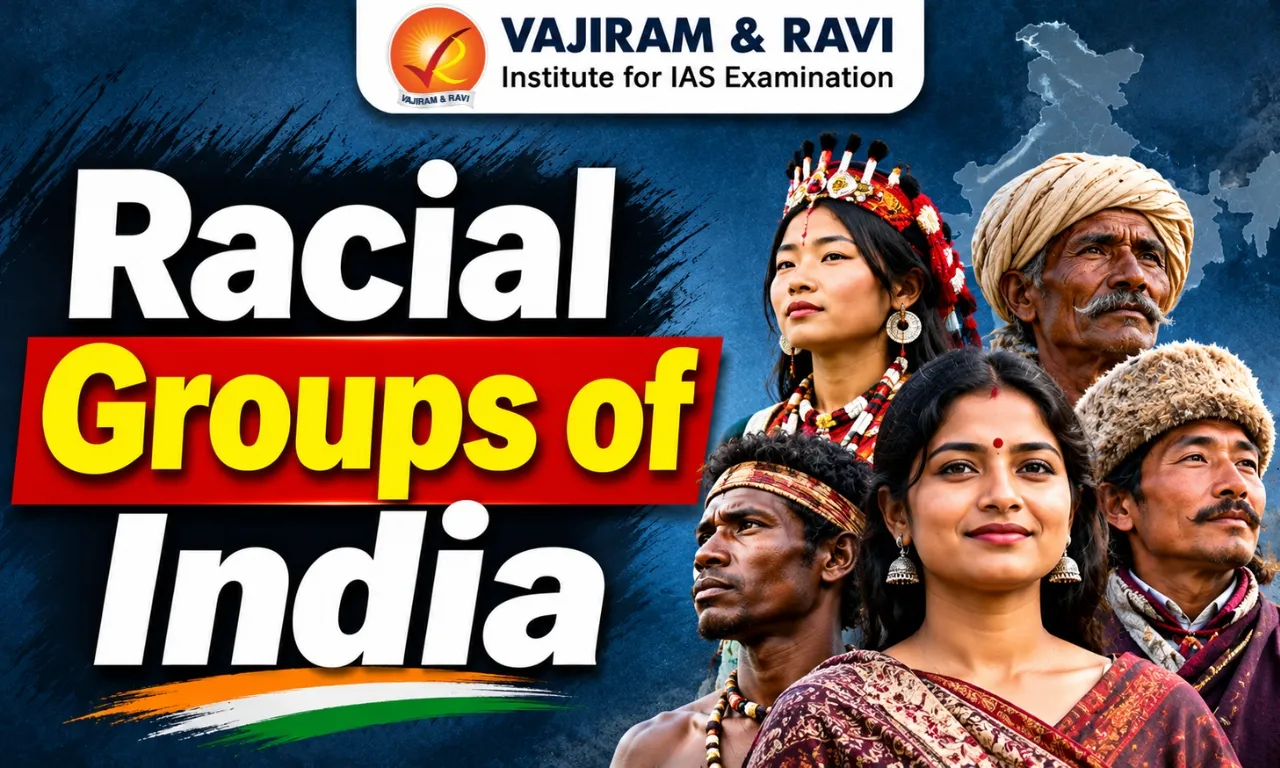
Racial Groups of India, Characteristics, Geographical Distribution

Racial Groups of India

Racial Groups of India reflect the country's rich ethnic diversity, shaped by thousands of years of migration, population intermixing and cultural interactions. Anthropologists such as B.S. Guha, Herbert Risley and J.H. Hutton historically classified the Indian population based on physical characteristics and presumed ancestral origins. However, modern anthropology and genetic studies reject rigid racial classifications and emphasise shared ancestry, genetic diversity and continuous population interaction as the foundations of India's diverse population. 

Racial Groups of India and Their Classification

India has a diverse population shaped by centuries of human migration, cultural interaction, intermixing and geographical adaptation. People from different regions entered the Indian subcontinent at different periods through land and sea routes, contributing to its rich ethnic, linguistic and cultural diversity.

Traditionally, race was defined as a group of people sharing certain inherited physical characteristics, such as skin colour, hair texture, facial features, height and head shape. Early anthropologists used anthropometry (systematic measurement of the human body) to classify human populations.

Major Racial Classifications of India

Several anthropologists attempted to classify the Indian population based on physical characteristics and presumed ancestral origins.

Anthropologist Racial Classification

Herbert Hope Risley (1901)

Classified the Indian population into seven racial types, including Indo-Aryan, Dravidian and Mongoloid.

A. C. Haddon (1924)

Classified the population into five major groups, including Pre-Dravidians, Dravidians, Indo-Aryans, Indo-Alpines and Mongolians.

J. H. Hutton (1931)

Classified Indian populations into different groups based on their presumed sequence of migration.

Egon von Eickstedt (1934)

Identified three principal groups: Weddid, Melanid and Indid.

B. S. Guha (1935)

Classified the Indian population into six major racial types and nine subtypes.

These classifications are important for understanding the history of Indian anthropology. However, modern anthropology and genetics no longer recognise these categories as distinct biological races.

Racial Groups of India According to B.S. Guha

Biraja Sankar Guha (1894-1961) was an Indian physical anthropologist who developed one of the most widely studied historical racial classifications of India. His classification was based on anthropometric measurements conducted between 1930 and 1933 in connection with the 1931 Census of India.

His research covered 2,511 individuals from 39 population groups using 38 physical measurements and observations. His findings were published in 1935 and subsequently in Racial Elements in the Population in 1944.

According to B.S. Guha, the Indian population could be classified into the following six major racial types:

Major Racial Groups Subtypes

Negrito

No major subdivision

Proto-Australoid

No major subdivision

Mongoloid

Palaeo-Mongoloid (long-headed and broad-headed) and Tibeto-Mongoloid

Mediterranean

Palaeo-Mediterranean, Mediterranean and Oriental Mediterranean

Western Brachycephals

Alpinoid, Dinaric and Armenoid

Nordic

No major subdivision

Guha's classification became an important framework in traditional Indian anthropology and human geography. Nevertheless, it represents a historical anthropological classification rather than a scientifically valid division of contemporary populations.

Racial Groups of India Characteristics

Early anthropologists classified Indian populations using physical characteristics such as stature, skin colour, hair texture, facial structure and head shape. The following characteristics reflect B.S. Guha's historical descriptions, rather than fixed biological attributes of present-day communities.

1. Negritos

  • Origin: Earlier anthropologists considered them among the earliest inhabitants of the Indian subcontinent and associated them with early human migration from Africa.
  • Physical Characteristics: Short stature, dark complexion, tightly curled or woolly hair, broad and flat nose, prominent forehead and slightly protruding jaws.
  • Historical Significance: Older studies identified similarities among Andaman Islanders and certain communities of southern India, although the existence of a distinct Negrito element in mainland India remains disputed.

2. Proto-Australoids

  • Origin: Traditional anthropologists considered them an early population group that settled in central and southern India. Different scholars proposed different geographical origins.
  • Physical Characteristics: Short stature, dark brown complexion, long head, wavy or curly hair, broad nose and prominent brow ridges.
  • Historical Significance: Earlier scholars associated this category with several tribal communities of central, eastern and southern India. However, claims regarding their specific migration origins remain uncertain.

3. Mongoloids

  • Origin: Earlier classifications associated this group with migrations from East Asia through the northern and eastern mountain passes.
  • Physical Characteristics: Straight hair, prominent cheekbones, relatively flat facial structure, sparse facial hair and an epicanthic fold of the eyelids.
  • Subgroups: B.S. Guha divided this historical category into two principal groups:
    • Palaeo-Mongoloids: Further divided into long-headed and broad-headed types, historically associated with the sub-Himalayan and northeastern regions.
    • Tibeto-Mongoloids: Described as relatively tall, with broad heads, and historically associated with the Himalayan and Tibetan regions.

4. Mediterraneans

  • Origin: Traditional anthropologists believed that these populations migrated from the eastern Mediterranean region and Southwest Asia.
  • Physical Characteristics: Medium stature, relatively long head, dark hair and eyes, with varying skin tones and facial features.
  • Subgroups: B.S. Guha classified them into three categories:
    • Palaeo-Mediterraneans: Described as having medium stature, darker complexion and a long head.
    • Mediterraneans: Described as having medium to tall stature, long head and a relatively narrow nose.
    • Oriental Mediterraneans: Distinguished in older classifications by a relatively long and convex nose.
  • Historical Association: Earlier scholars linked this category with the development of agriculture and the Indus Valley Civilisation, although modern research does not assign civilisations to distinct racial types.

5. Western Brachycephals

  • Origin: Earlier anthropologists associated this category with migrations from western and northwestern regions of the Indian subcontinent.
  • Physical Characteristics: Broad head, relatively prominent nose and varying stature, complexion and facial structure.
  • Subgroups: They were classified into three major categories:
    • Alpinoids: Described as having medium stature, broad head and round face.
    • Dinarics: Described as relatively tall, with a broad head, long face and prominent nose.
    • Armenoids: Described as sharing certain characteristics with Dinarics but differing in head and nose structure.

6. Nordics

  • Origin: Traditional classifications associated this category with migrations from Central Asia and northern Eurasia during the second millennium BCE.
  • Physical Characteristics: Tall stature, long head, relatively fair complexion, prominent nose and well-built body.
  • Historical Association: Earlier scholars linked this category with Indo-Aryan-speaking populations. Modern anthropology, however, distinguishes linguistic identity from biological ancestry.

Racial Groups of India Geographical Distribution

According to traditional anthropological classifications, different racial elements were associated with various geographical regions of India. Migration routes, mountain ranges, river valleys, forests and geographical isolation were considered important factors influencing their distribution.

Historical Racial Group Geographical Distribution According to Older Classifications

Negritos

Andaman Islands and certain pockets of Kerala, Tamil Nadu and Rajmahal Hills.

Proto-Australoids

Central and southern India, particularly Jharkhand, Odisha, Chhattisgarh, Madhya Pradesh and parts of the Western Ghats.

Mongoloids

Ladakh, Sikkim, Arunachal Pradesh, Assam, Nagaland, Manipur, Mizoram, Meghalaya and Tripura.

Mediterraneans

Southern India, the Ganga Valley, Maharashtra, Bengal, Rajasthan and Punjab.

Western Brachycephals

Gujarat, Maharashtra, Karnataka, Tamil Nadu, Odisha and West Bengal.

Nordics

Northwestern India, particularly Punjab, Haryana, Rajasthan and Jammu and Kashmir.

These geographical associations reflect historical anthropological theories. Modern genetic studies show considerable ancestral overlap and population intermixing across these regions, rather than clearly defined racial boundaries

Racial Groups of India and Ethnic Diversity

India's ethnic diversity is the result of thousands of years of migration, cultural exchange, environmental adaptation and interaction among different communities. Its geographical location between West, Central, East and Southeast Asia made it an important centre of human settlement and cultural interaction.

  • Historical Migration: Different populations entered the Indian subcontinent through northwestern mountain passes, northeastern corridors and maritime routes, contributing to its diverse ancestral composition.
  • Geographical Factors: Mountains, forests, plateaus and islands influenced population settlement, while fertile river valleys encouraged migration, interaction and intermixing.
  • Linguistic Diversity: India is home to several major language families, including Indo-Aryan, Dravidian, Austro-Asiatic and Tibeto-Burman, reflecting its complex cultural history.
  • Cultural Assimilation: Migrant communities interacted with existing populations, leading to the development of diverse customs, traditions, languages and religious practices.
  • Maritime Interactions: Historical trade and migration brought Arabs, Jews, Parsis, Africans and Europeans to India's coastal regions, enriching its ethnic and cultural diversity.
  • Social Structure and Endogamy: Marriage within particular communities over several centuries contributed to the preservation of distinct social identities and genetic variations.
  • Unity in Diversity: Despite differences in language, religion, ancestry and cultural practices, India's population shares a long history of interaction and coexistence.

Difference Between Race and Ethnicity

Basis Race Ethnicity

Meaning

A historically constructed classification based largely on perceived physical differences.

A shared cultural identity based on language, history, ancestry and traditions.

Basis of Classification

Traditionally based on skin colour, hair texture and facial characteristics.

Based on shared customs, language, religion and cultural heritage.

Nature

Socially constructed, without distinct biological boundaries.

Cultural, social and sometimes ancestral.

Modern Perspective

Fixed biological racial categories are scientifically outdated.

Remains relevant for understanding cultural identity and social diversity.

Racial Classification of India Modern Perspectives

Modern scientific research has transformed the understanding of India's population history. Instead of dividing people into fixed racial groups, contemporary studies focus on genetic ancestry, migration, population intermixing and cultural evolution.

Genetic Ancestry of Indian Populations

Modern genetic studies have identified several ancestral components that contributed to the formation of present-day Indian populations.

  • Ancestral North Indians (ANI): An ancestral population component genetically related to populations of West Asia, Central Asia and Europe.
  • Ancestral South Indians (ASI): An ancestral population component formed within the Indian subcontinent, with distant genetic relationships to ancient Andamanese lineages.
  • Ancient Ancestral South Indians (AASI): An ancient hunter-gatherer-related ancestry associated with early modern human settlements in the Indian subcontinent.
  • Iranian-Related Ancestry: An ancient ancestral component that intermixed with AASI-related populations and contributed to the ancestry associated with the Indus Valley Civilisation.
  • Steppe-Related Ancestry: Associated with migrations from the Eurasian Steppe after approximately 2000 BCE, contributing to the genetic composition of several Indian populations.
  • East and Southeast Asian Ancestry: Contributed to the genetic composition of several northeastern and Himalayan communities and some Austro-Asiatic-speaking populations.

Major Genetic Studies on Indian Population

Study Key Findings

David Reich and Others (2009)

Identified ANI and ASI as major ancestral components contributing to the genetic diversity of many Indian populations.

Priya Moorjani and Others (2013)

Identified extensive population intermixing approximately 4,200–1,900 years ago, followed by increasing endogamy.

Vagheesh Narasimhan and Others (2019)

Used ancient DNA to explain the contribution of AASI, Iranian-related and Steppe-related ancestry to South Asian populations.

Rakhigarhi Genome Study (2019)

Found that the sampled Harappan individual possessed Iranian-related and indigenous South Asian ancestry without Steppe-related ancestry.

GenomeIndia Project (2025)

Examined India's extensive genetic diversity and highlighted the influence of ancestral populations, founder effects and centuries of endogamy.

Constitutional and Social Perspective on Race in India

India's constitutional framework promotes equality and prohibits discrimination based on racial identity.

  • Article 14: Guarantees equality before the law and equal protection of laws.
  • Article 15: Prohibits discrimination on grounds of religion, race, caste, sex or place of birth.
  • Article 16: Ensures equality of opportunity in public employment and prohibits discrimination on specified grounds, including race.
  • Census of India: Independent India discontinued racial classification in the Census from 1951 onwards, reflecting its commitment to equality and national integration.
  • Bezbaruah Committee (2014): Examined concerns regarding discrimination against people from northeastern India and recommended measures to strengthen their protection.

Traditional Racial Classification vs Modern Genetic Approach

Traditional Racial Classification Modern Genetic Approach

Based primarily on physical characteristics.

Based on DNA, genetic ancestry and population history.

Assumed distinct and fixed racial groups.

Recognises continuous genetic variation and intermixing.

Often associated language with race.

Treats linguistic identity and genetic ancestry separately.

Focused on successive migrations of racial groups.

Examines migration, intermarriage, adaptation and endogamy.

Sometimes reinforced social hierarchies.

Recognises human diversity without racial hierarchy.

The modern understanding of India's population highlights its shared ancestry, extensive genetic diversity and rich cultural heritage. Rather than representing separate biological races, India's diverse communities reflect thousands of years of migration, interaction and population intermixing. 

Racial Classification of India Limitations

Traditional racial classifications of India contributed to the early development of physical anthropology. However, they have several scientific and methodological limitations that make them unsuitable for explaining modern population diversity.

  • Lack of Scientific Validity: Traditional classifications assumed the existence of distinct and relatively pure racial groups, whereas modern genetic studies demonstrate extensive intermixing among human populations.
  • Overdependence on Physical Characteristics: Skin colour, stature, facial features and head shape are influenced by genetic variation, environmental conditions, nutrition and adaptation, making them unreliable indicators of fixed racial identity.
  • Limited Sample Size: Early anthropological studies examined relatively small and selective population samples, which could not adequately represent India's vast and diverse population.
  • Differences Among Anthropologists: Scholars such as Risley, Hutton and B.S. Guha proposed different racial categories for the same population, highlighting inconsistencies in classification methods.
  • Confusion Between Race and Language: Earlier classifications often treated Aryan and Dravidian as racial groups, although these terms primarily refer to linguistic and cultural identities.
  • Colonial Bias and Social Discrimination: Some classifications attempted to associate physical characteristics with caste hierarchy and social status, reinforcing discriminatory assumptions without scientific justification.
  • Neglect of Population Intermixing: Traditional classifications failed to adequately explain centuries of migration, intermarriage and genetic exchange that shaped India's population.

Racial Groups of India FAQs

Q1: What are the major racial groups of India?

Ans: According to B.S. Guha's historical classification, the six major racial groups of India are Negritos, Proto-Australoids, Mongoloids, Mediterraneans, Western Brachycephals and Nordics.

Q2: Who classified the Indian population into six racial groups?

Ans: B.S. Guha (Biraja Sankar Guha) classified the Indian population into six major racial types and nine subtypes in 1935, based on anthropometric studies.

Q3: What is the basis of racial classification in India?

Ans: Traditional racial classification was based on physical characteristics such as skin colour, hair texture, stature, facial features, head shape and presumed ancestral origins.

Q4: Which racial group was historically considered among the earliest inhabitants of India?

Ans: The Negritos were considered among the earliest inhabitants of India by traditional anthropologists. However, modern genetic studies do not support such rigid racial classifications.

Q5: What is the difference between race and ethnicity?

Ans: Race is a historically constructed classification based on perceived physical differences, whereas ethnicity refers to a shared cultural identity based on language, ancestry, customs and traditions.


Achanakmar Amarkantak Biosphere Reserve, Biodiversity, Area

Achanakmar Amarkantak Biosphere Reserve

Achanakmar Amarkantak Biosphere Reserve is an important ecological region spread across Madhya Pradesh and Chhattisgarh. Recognised by UNESCO under the Man and the Biosphere (MAB) Programme, it is known for its tropical deciduous forests, rich biodiversity and important river systems. Its location in the Maikal hill ranges makes it significant for biodiversity conservation, ecosystem protection and the preservation of natural resources in Central India.

Achanakmar Amarkantak Biosphere Reserve

Achanakmar Amarkantak Biosphere Reserve is an interstate biosphere reserve covering 3,835.51 sq. km across Madhya Pradesh and Chhattisgarh.

  • Establishment: The Government of India declared it a Biosphere Reserve on 30 March 2005, making it the 14th Biosphere Reserve in the country.
  • Location: It extends across Bilaspur district in Chhattisgarh and Anuppur and Dindori districts in Madhya Pradesh, forming an important ecological region of Central India.
  • Geographical Setting: It lies in the Deccan Peninsula and Central Highlands biogeographic province, covering the Maikal hill ranges and adjoining parts of the Vindhya and Satpura ranges.
  • Zonation: The reserve has core, buffer and transition zones. Achanakmar Wildlife Sanctuary forms its core zone, while the surrounding landscapes support conservation and human activities.
  • Area Distribution: The core zone covers 551.55 sq. km, while approximately 3,283.96 sq. km comprises the surrounding buffer and transition areas.
  • River Systems: The reserve is associated with the Narmada, Johila and Son rivers. It forms an important watershed region separating river systems draining towards the Arabian Sea and Bay of Bengal.
  • Human Settlements: The reserve includes numerous revenue and forest villages inhabited by tribal and non tribal communities. Agriculture and collection of medicinal plants and non timber forest products support local livelihoods.
  • Tribal Population: The reserve is inhabited by tribal communities, particularly the Baiga, Gond, Kol and Pradhan, whose livelihoods depend on agriculture, medicinal plants and non-timber forest produce.

Achanakmar Amarkantak Biosphere Reserve Biodiversity

Achanakmar Amarkantak Biosphere Reserve supports diverse tropical deciduous vegetation and wildlife, making it an important region for biodiversity conservation.

Flora

  • Forest Vegetation: Tropical deciduous forests dominate the reserve, with moist deciduous vegetation covering much of its landscape and dry deciduous forests occurring in the southern parts.
  • Plant Diversity: Its vegetation includes different plant groups such as thallophytes, bryophytes, pteridophytes, gymnosperms and angiosperms, reflecting varied ecological conditions.
  • Important Species: Sal and its associated tree species dominate several forest areas, while bamboo and other vegetation contribute to the ecological diversity of the region.
  • Endemic Plants: Caloplaca amarkantakana, Isoetes bilaspurensis and Bothriochloa grahamii are among the plant species identified as endemic to this region.
  • Medicinal Plants: The reserve supports several plants with medicinal and food value, making its vegetation important for traditional knowledge and local livelihoods.
  • Conservation Concerns: Invasive weeds such as Lantana and Parthenium threaten natural vegetation and require effective management to protect native plant communities.

Fauna

  • Mammals: The reserve provides habitat to important mammals, including tigers, leopards, Indian bison (gaur), sloth bears, sambar, spotted deer and barking deer.
  • Other Wildlife: Four horned antelope, wild dogs, wild boars, foxes, jackals, monkeys and giant squirrels are among the other animals found in the region.
  • Threatened Species: The reserve supports threatened wildlife, including the Bengal tiger, Indian wild dog, four horned antelope and Asian white backed vulture.
  • Avian Diversity: Its forests and associated habitats provide shelter to several bird species, including the sarus crane and Asian white backed vulture.
  • Amphibian Diversity: The sacred grove bush frog (Philautus sanctisilvaticus) is an important threatened amphibian associated with the reserve's biodiversity.
  • Habitat Significance: Dense forests, grasslands, valleys and perennial water sources create suitable habitats for wildlife and support ecological diversity across different seasons.

Achanakmar Amarkantak Biosphere Reserve UNESCO Recognition

Achanakmar Amarkantak Biosphere Reserve was included in UNESCO's World Network of Biosphere Reserves on 11 July 2012 under the Man and the Biosphere (MAB) Programme. This international recognition highlights its ecological importance and supports biodiversity conservation, sustainable development and the protection of natural ecosystems through coordinated conservation efforts.

Achanakmar Amarkantak Biosphere Reserve Challenges

The Achanakmar Amarkantak Biosphere Reserve faces growing ecological and human pressures that affect forest conservation, wildlife habitats, water resources and the livelihoods of local communities.

  • Human Encroachment: Settlements, agricultural expansion and forest clearing within sensitive areas increase habitat fragmentation and put pressure on natural vegetation and wildlife habitats.
  • Tribal Relocation Issues: Relocation of villages from core areas remains challenging, while restrictions on forest produce collection affect the traditional livelihoods of Baiga and Gond communities.
  • Overgrazing and Wildlife Conflict: Excessive livestock grazing creates competition for food with wild herbivores, while encounters between wildlife and farmers increase human-wildlife conflict.
  • Mining and Deforestation: Bauxite mining around the reserve and other mining activities in adjoining regions threaten forest cover, ecological stability and watershed health.
  • Tourism and Water Pollution: Pilgrimage activities around Amarkantak increase construction, waste generation and sewage discharge, creating pressure on sanitation and the water quality of the Narmada.
  • Seasonal Water Scarcity: Dependence on seasonal streams reduces water availability during summer, affecting wildlife and increasing pressure on existing water resources.
  • Invasive Species and Forest Fires: Lantana and Parthenium restrict native vegetation regeneration, while seasonal forest fires and changing rainfall patterns threaten forest ecosystems.
  • Interstate Coordination: Managing the reserve across Madhya Pradesh and Chhattisgarh creates administrative challenges in coordinating forest protection, wildlife corridors, patrolling and conservation policies.

Achanakmar Amarkantak Biosphere Reserve FAQs

Q1: Where is Achanakmar Amarkantak Biosphere Reserve located?

Ans: It is located across Madhya Pradesh and Chhattisgarh, covering parts of Bilaspur, Anuppur and Dindori districts.

Q2: When was Achanakmar Amarkantak Biosphere Reserve established?

Ans: The Government of India declared it a Biosphere Reserve on 30 March 2005.

Q3: When was Achanakmar Amarkantak Biosphere Reserve recognised by UNESCO?

Ans: UNESCO included it in the World Network of Biosphere Reserves on 11 July 2012 under the MAB Programme.

Q4: Which rivers originate from the Achanakmar Amarkantak region?

Ans: The Narmada, Johila and Son rivers originate from the Amarkantak region associated with this biosphere reserve.

Q5: Which wildlife sanctuary forms the core zone of Achanakmar Amarkantak Biosphere Reserve?

Ans: Achanakmar Wildlife Sanctuary forms the core zone, covering an area of 551.55 sq. km.

Indian Circus, History, Evolution, Famous Personalities, Challenges

Indian Circus

Indian Circus is a traditional performing art that combines acrobatics, gymnastics, juggling, magic and entertainment. The modern Indian circus emerged in 1880 with the establishment of the Great Indian Circus by Vishnupant Chatre, known as the Father of Indian Circus. Despite its cultural and economic significance, the industry faces declining popularity, financial challenges and limited institutional support, highlighting the need for its revival. 

Indian Circus History and Evolution

The Indian Circus is a distinctive performing art that combines acrobatics, gymnastics, traditional entertainment and artistic skills. Although India has a long history of street performances, the modern circus, inspired by Philip Astley (Father of Modern Circus), emerged in India during the 1880s.

  • Beginning of Modern Circus: In 1879, Giuseppe Chiarini's Royal Italian Circus toured India, inspiring Indian artists and entrepreneurs to establish their own circus companies.
  • Great Indian Circus (1880): Vishnupant Chatre established India's first modern circus company, which held its first performance on March 20, 1880, and later toured different parts of India and Sri Lanka.
  • Great Bengal Circus (1887): Founded by Priyanath Bose, the circus gained widespread popularity through its performances across India and Southeast Asia.
  • Establishment of Circus Academy (1901): Keeleri Kunhikannan established a circus training school at Chirakkara in Kerala, which produced several nationally and internationally recognised circus artists.
  • Grand Malabar Circus (1904): Established by Pariyali Kannan, a disciple of Keeleri Kunhikannan, it became the first circus company in Kerala and contributed to the growth of the industry.
  • Expansion of Indian Circus: Several prominent circus companies emerged during the 20th century, including the Great Royal Circus (1909), Grand Bombay Circus (1920), Gemini Circus (1951), Rajkamal Circus (1958), Jumbo Circus (1977) and Rambo Circus (1991).
  • International Recognition: In 1964, Gemini Circus became the first Indian circus to participate in the International Circus Festival in the Soviet Union. It also gained popularity through Indian films such as Mera Naam Joker.

Indian Circus Key Features

The Indian Circus is a combination of traditional performing arts and modern entertainment that showcases human strength, flexibility, creativity and artistic excellence. Its major features include:

  • Acrobatics and Gymnastics: Indian circuses feature various physically demanding performances, including trapeze acts, aerial stunts, balancing exercises and somersaults, requiring exceptional strength and coordination.
  • Traditional Performing Arts: Circuses incorporate indigenous entertainment forms such as tightrope walking, juggling and magic shows, helping preserve traditional artistic skills.
  • Comedy and Musical Entertainment: Clowns, musicians, dancers and comedians form an important part of circus performances, making them entertaining for audiences of all age groups.
  • Travelling Nature: Indian circus companies traditionally move from one village, town or city to another, setting up large tents and temporary performance facilities.
  • Specialised Training: Circus performers undergo rigorous physical training and regular practice to develop flexibility, discipline, balance and the ability to perform complex stunts.
  • Cultural Diversity: Indian circuses bring together artists from different regional, linguistic and cultural backgrounds, promoting teamwork and cultural exchange.
  • Animal Performances: Historically, trained animals such as elephants, lions and tigers were major circus attractions. However, animal welfare concerns and legal restrictions have encouraged a shift towards human-centric performances.

Indian Circus Famous Personalities

Several artists, trainers and entrepreneurs contributed significantly to the growth of the Indian circus industry and helped it gain international recognition.

Famous Personality Major Contributions

Vishnupant Chatre

Known as the Father of Indian Circus, he established the Great Indian Circus in 1880 and laid the foundation of the modern circus industry in India.

Keeleri Kunhikannan

Known as the Father of Kerala Circus, he established a circus academy at Chirakkara in 1901 and trained numerous successful circus performers.

Priyanath Bose

Founded the Great Bengal Circus in 1887 and contributed to the international popularity of Indian circus through performances across Southeast Asia.

Pariyali Kannan

A disciple of Keeleri Kunhikannan, he established the Grand Malabar Circus in 1904, the first circus company in Kerala.

Baburao Kadam

Established the Grand Bombay Circus in 1920, which later became known as the Great Bombay Circus following a merger in 1947.

Kannan Bombayo

A renowned Indian tightrope walker trained at Kunhikannan's academy who gained international recognition through performances in European and American circuses.

M. K. Raman

A disciple of Keeleri Kunhikannan who continued his legacy by training circus artists after his death in 1939.

K. Damodaran

Established Asia's first American-style three-ring circus, transforming a small travelling circus into a large entertainment enterprise.

M. V. Shankaran

Founded Gemini Circus in 1951 and Jumbo Circus in 1977, contributing significantly to the international recognition of Indian circus.

Gopalan Mulloli

Established Rajkamal Circus in 1958, which later expanded its performances across India and Gulf countries.

P. T. Dilip

Founded Rambo Circus in 1991 by merging Oriental Circus, Arena Circus, Victoria Circus and Fantasy Circus.

Indian Circus Cultural and Socio-Economic Significance

The Indian Circus is an important part of India's performing arts heritage, contributing to cultural preservation, employment generation and the promotion of traditional artistic skills.

  • Preservation of Cultural Heritage: Preserves traditional performing arts such as acrobatics, tightrope walking, juggling and indigenous physical skills.
  • Employment Generation: Provides livelihood opportunities to performers, trainers, musicians, technicians and other support staff.
  • Cultural Integration: Brings together artists from diverse regional, linguistic and cultural backgrounds, promoting cooperation and cultural exchange.
  • International Recognition: Circus companies such as Gemini Circus and Great Royal Circus have showcased Indian artistic talent globally.
  • Contribution to Local Economy: Travelling circuses generate demand for transportation, accommodation, food services and local vendors.
  • Affordable Entertainment: Provides accessible and affordable entertainment to rural and urban communities, particularly in areas with limited recreational facilities.
  • Development of Physical and Artistic Skills: Promotes physical fitness, discipline, coordination, teamwork and artistic creativity through specialised training.

Indian Circus Challenges

The Indian circus industry has witnessed a significant decline since the late 1990s due to changing entertainment preferences, financial difficulties and limited institutional support. The number of circus companies declined from around 300 in 1990 to nearly 30 in 2017.

  • Declining Popularity: Television, cinema and digital entertainment have reduced public interest in traditional circus performances, particularly among younger generations.
  • Occupational Risks: Dangerous stunts, poor working conditions and inadequate safety measures discourage people from pursuing circus as a career.
  • Financial Constraints: Rising operational costs, declining ticket sales and limited government assistance have affected the financial sustainability of circus companies.
  • Shortage of Skilled Performers: Limited training institutions, rigorous physical training and declining career interest have created a shortage of skilled circus artists.
  • Traditional Business Structure: Hereditary business practices and secrecy surrounding training techniques restrict professional management, innovation and new talent.
  • Lack of Social Security: Many performers retire around the age of 40 and struggle to find alternative employment without adequate pensions, insurance and financial support.
  • Impact of COVID-19 Pandemic: Restrictions on public gatherings and suspension of live performances further worsened the financial condition of circus companies and artists.

Indian Circus Legal Regulations

The Indian circus industry is subject to various legal regulations aimed at protecting children, ensuring animal welfare and safeguarding the rights and safety of performers.

  • Child Labour Regulations: In 2011, the Supreme Court directed the prohibition of child employment in circuses to protect children from exploitation, hazardous working conditions and denial of educational opportunities.
  • Animal Welfare Regulations: Restrictions on the use of wild animals in circus performances aim to prevent animal cruelty, forced training and exploitation in the name of entertainment.
  • Regulatory Oversight: Government authorities have taken action against circus companies violating animal welfare norms, encouraging a transition towards ethical and animal-free entertainment models.
  • Occupational Safety: Proper training, protective equipment, regular inspections and effective workplace safety measures are essential to prevent accidents and protect circus performers.

These regulations highlight the need to balance the preservation of traditional performing arts with child protection, animal welfare and occupational safety.

Indian Circus Revival

The revival of Indian Circus requires government support, cultural recognition, professional training and modernisation to preserve this traditional performing art and ensure sustainable livelihoods for circus artists.

  • Recognition as a Performing Art: Bringing circus under the Ministry of Culture could ensure better policy support, institutional assistance and preservation of its cultural heritage.
  • Strengthening Circus Academies: Provide financial and institutional support to training centres, such as the Indian Circus Academy established at Thalassery in 2010, to develop skilled performers.
  • Government Support and Social Security: Provide financial assistance to circus companies, along with health insurance, pensions, accident compensation and rehabilitation support for artists.
  • Improvement in Safety Standards: Ensure strict safety regulations, modern equipment and professional training to reduce accidents and make circus a viable career option.
  • Modernisation and Animal-Free Performances: Introduce digital technology, advanced lighting, aerial acts and innovative storytelling to attract younger audiences while ensuring animal welfare.
  • Integration with Tourism and Cultural Promotion: Promote circus through cultural festivals, tourism initiatives and public events to preserve traditional arts, attract audiences and generate revenue.

Indian Circus FAQs

Q1: What is Indian Circus?

Ans: Indian Circus is a traditional performing art that combines acrobatics, gymnastics, juggling, magic, comedy and other forms of entertainment.

Q2: Who is known as the Father of Indian Circus?

Ans: Vishnupant Chatre is known as the Father of Indian Circus. He established the Great Indian Circus, India's first modern circus company, in 1880.

Q3: Which state is known as the Cradle of Indian Circus?

Ans: Kerala is known as the Cradle of Indian Circus because of its significant contribution to circus training and the pioneering efforts of Keeleri Kunhikannan.

Q4: Who was Keeleri Kunhikannan?

Ans: Keeleri Kunhikannan, known as the Father of Kerala Circus, established a circus training academy at Chirakkara in 1901 and trained several renowned circus artists.

Q5: What is the cultural significance of Indian Circus?

Ans: Indian Circus preserves traditional performing arts, generates employment, promotes cultural integration and showcases Indian artistic talent internationally.

Archaeological Sources of Indian History, Types, Sites, Examples

Archaeological Sources of Indian History

Archaeological Sources of Indian History provide material evidence for reconstructing the political, economic, social and cultural developments of ancient and medieval India. They include excavated remains, inscriptions, coins, pottery, monuments and artefacts. These sources are particularly important for understanding prehistoric communities and the Indus Valley Civilization, where written records are unavailable or remain undeciphered.

What are Archaeological Sources?

Archaeological Sources are physical remains of human activities preserved at historical sites or recovered through exploration and excavation. They are considered primary historical evidence because they originate from the period being studied. These remains help establish chronology, understand ancient societies and examine the reliability of literary accounts.

Types of Archaeological Sources

Archaeological Evidence can be classified into different categories according to the nature of remains and the historical information they provide.

  • Excavations and Explorations: Archaeological surveys and systematic digging uncover settlements, tools, structures and artefacts. They reveal successive cultural phases, settlement patterns and changes in human activities, particularly during prehistoric and Harappan periods.
  • Inscriptions: Records engraved on pillars, rocks, copper plates, cave walls and temple structures provide information about rulers, administrative arrangements, land grants, religious donations and political events. Their systematic study is known as epigraphy.
  • Coins: Ancient coins provide evidence about political authority, economic conditions, monetary systems, trade relations and religious practices. Their metal composition, inscriptions, symbols and portraits help establish dynasties and historical chronology.
  • Monuments and Architecture: Temples, stupas, caves, forts, palaces and other structures reflect religious traditions, architectural developments, construction techniques and royal patronage. They also provide evidence of the artistic achievements of different historical periods.
  • Pottery: Different pottery traditions help identify archaeological cultures and establish the relative chronology of settlements. Ochre Coloured Pottery, Painted Grey Ware and Northern Black Polished Ware are important examples.
  • Tools, Seals and Artefacts: Stone implements, metal objects, beads, ornaments, seals and other recovered materials reveal technological development, craft production, occupational activities and commercial connections among ancient communities.
  • Biological Remains: Animal bones, seeds and other organic remains provide evidence about food habits, agricultural practices, animal domestication and the relationship between early communities and their environment.
  • Burial Sites and Burial Practices: Human burials, grave goods and associated objects provide evidence about funerary customs, social distinctions and beliefs concerning death.

Methods of Archaeology

Archaeological investigation combines field exploration, controlled excavation and scientific analysis to identify sites and reconstruct their historical sequence.

  • Exploration: Archaeologists conduct surface surveys, examine geographical features and map ancient settlements to identify potential excavation sites. Alexander Cunningham's mapping of Buddhist remains helped locate important historical places and understand ancient routes.
  • Excavation: Systematic digging uncovers buried remains in a controlled manner. Horizontal excavation exposes the layout of settlements, while vertical excavation examines successive cultural layers and their chronological development.
  • Stratigraphy: This method studies the arrangement of archaeological layers. Deeper layers are generally older than those above them, helping establish relative chronology through associated pottery, coins, structures and other recovered materials.
  • Radiocarbon Dating: Carbon 14 dating determines the approximate age of organic remains such as charcoal, seeds and bones. It is particularly useful for dating archaeological material up to approximately 50,000 years old.
  • Scientific Analysis: Thermoluminescence helps date fired materials such as pottery. Archaeobotany examines ancient plant remains, while archaeozoology studies animal remains to reconstruct agriculture, food consumption and domestication practices.

Prehistoric Archaeological Sources

Prehistoric cultures are reconstructed primarily through material remains because written records are unavailable for these early phases of human history.

  • Bhimbetka (Madhya Pradesh): Its rock shelters contain paintings depicting animals, hunting activities and community life, particularly associated with the Mesolithic period. The site received UNESCO World Heritage recognition in 2003.
  • Mehrgarh (Balochistan, Pakistan): Situated near the Bolan Pass, Mehrgarh provides evidence of early farming and animal herding from approximately 7000 BCE. Its archaeological remains help explain developments preceding mature Harappan culture.
  • Burzahom (Kashmir): This Neolithic settlement is particularly known for its pit dwellings and distinctive burial practices. The discovery of dogs buried alongside humans provides important evidence about early social and domestic life.
  • Chirand (Bihar): Located in Saran district, Chirand is an important Neolithic site in the Gangetic plains. Its large collection of bone tools reflects the technological practices of settled agricultural communities.

Harappan Archaeological Sources

The Indus Valley Civilization is understood mainly through archaeological discoveries because its script remains undeciphered, making excavated material essential for historical reconstruction.

  • Discovery of Harappan Civilisation: Daya Ram Sahni began excavations at Harappa in 1921, followed by R.D. Banerji at Mohenjo daro in 1922. John Marshall announced the discovery of this previously unknown civilisation in 1924.
  • Dholavira (Gujarat): Discovered by J.P. Joshi in 1968 and subsequently excavated by the Archaeological Survey of India, Dholavira is notable for its sophisticated water conservation arrangements. It became a UNESCO World Heritage Site in 2021.
  • Rakhigarhi (Haryana): Situated in Hisar district, Rakhigarhi is the largest known Harappan site in India. It is among the five major Harappan urban centres, alongside Harappa, Mohenjo daro, Ganweriwala and Dholavira.
  • Kalibangan: Kalibangan in Rajasthan provides evidence of a ploughed agricultural field and fire altars. 
  • Lothal: Lothal in Gujarat contains a brick built structure widely identified as a dockyard, indicating maritime commercial activities.
  • Seals and Urban Planning: Steatite seals bearing animal figures and undeciphered inscriptions provide evidence of Harappan craftsmanship and exchange. Grid pattern streets, covered drainage systems and Mohenjo daro's Great Bath demonstrate organised urban planning.

Medieval History Archaeological Sources

Medieval Archaeological Remains help reconstruct political authority, economic arrangements, religious patronage and regional developments beyond information preserved in contemporary literary accounts.

  • Royal Inscriptions and Copper Plates: Inscriptions issued by Chola, Chalukya and Paramara rulers record royal genealogies, military achievements, land grants and administrative arrangements, providing valuable evidence about regional kingdoms and their governance.
  • Sultanate and Mughal Inscriptions: Arabic and Persian inscriptions on mosques, gateways and tombs preserve construction dates, royal titles and patronage details. The Qutub Minar complex and Alai Darwaza are important architectural examples.
  • Vijayanagara Inscriptions: Tamil, Kannada and Telugu inscriptions from the Vijayanagara period document land donations, taxation arrangements and exemptions. They provide evidence about local administration, temple institutions and the relationship between rulers and religious establishments.
  • Medieval Coins: Coins issued by Sultanate rulers, Mughal emperors and regional dynasties reveal monetary standards, metal composition, minting practices and political authority. Their inscriptions and dates also help establish the chronology of different reigns.
  • Architecture and Fortifications: Forts, palaces, temples, mosques and stepwells demonstrate regional architectural traditions and engineering capabilities. The Red Fort, Humayun's Tomb, Taj Mahal, Gol Gumbaz and Gwalior Fort are significant examples.

Inscriptions (Epigraphy) as Archaeological Sources

Inscriptions provide contemporary evidence about political developments, administration, religious activities and royal achievements, making them particularly valuable for reconstructing historical chronology.

  • Decipherment of Brahmi: James Prinsep deciphered the Brahmi script in 1837, enabling historians to read Ashokan inscriptions. This development significantly improved the reconstruction of Mauryan political and administrative history.
  • Ashokan Edicts: Issued during the third century BCE in Brahmi, Kharosthi, Greek and Aramaic, these inscriptions describe Dhamma, administration and the Kalinga War. The Maski inscription directly identifies Ashoka by name.
  • Hathigumpha Inscription: Located at Udayagiri near Bhubaneswar, Odisha, this Prakrit inscription written in Brahmi records the achievements and activities of Kalinga ruler Kharavela, providing important evidence about his reign.
  • Junagadh Rock Inscription: Issued by Shaka ruler Rudradaman I around 150 CE in Sanskrit, it records the restoration of Sudarshana Lake, originally constructed during the Mauryan period. It is among the earliest long Sanskrit inscriptions.
  • Allahabad Pillar Inscription: Also known as Prayag Prashasti, this inscription was composed by Harisena in Sanskrit. It describes Samudragupta's military campaigns, conquests and diplomatic relations, making it an important source for Gupta history.
  • Aihole Inscription: Composed by Ravikirti in 634 CE, this Sanskrit inscription praises Chalukya ruler Pulakeshin II and records his victory over Harshavardhana. It is particularly important for understanding Deccan political history.
  • Uttaramerur Inscriptions: Dating to the reign of Parantaka I in the tenth century CE, these Tamil inscriptions describe village assemblies, committee selection procedures and local administrative arrangements under the Cholas.

Coins (Numismatics) as Archaeological Sources

Numismatic Evidence (Coins) helps establish political chronology and understand monetary systems, economic activities, trade networks and cultural interactions across different historical periods.

  • Punch Marked Coins: Among the earliest Indian coins, these were mainly made of silver and carried multiple symbols stamped onto metal pieces. Their appearance from approximately the sixth century BCE reflects expanding trade and urbanisation.
  • Indo Greek Coins: Issued by Greek rulers in north-western India, these coins commonly feature royal portraits and inscriptions identifying individual rulers. They provide valuable evidence about political succession and Indo Greek cultural interactions.
  • Kushana Coins: Rulers such as Vima Kadphises and Kanishka issued gold and copper coins depicting Indian, Greek and Iranian deities. Their designs reflect religious diversity and extensive commercial and cultural connections.
  • Gupta Coins: Gupta rulers issued numerous gold coins known as dinaras, carrying royal portraits, titles and symbols. Samudragupta's veena player coin demonstrates royal association with music and the artistic achievements of the period.
  • Satavahana and Roman Coins: Satavahana rulers issued lead and potin coins bearing their names. Discoveries of Roman gold and silver coin hoards in South India indicate extensive maritime trade during the early centuries CE.
  • Medieval Currency: Sultanate and Mughal coins provide evidence about monetary policies and economic conditions. Gold mohurs, silver rupaiyas and copper dams reflect different currency denominations and the financial arrangements of ruling authorities.
  • Religious and Political Symbols: Vijayanagara coins depicting deities such as Venkateshwara and Shiva, alongside coins associated with Akbar's religious policies, help examine royal symbolism and changing religious orientations.

Monuments, Architecture and Art as Archaeological Sources

Architectural Remains preserve evidence of religious beliefs, artistic expression, technological capabilities and political patronage across ancient and medieval Indian history.

  • Stupas: Sanchi and Bharhut are important Buddhist architectural sites featuring carved gateways, railings and narrative sculptures. Their artistic representations provide information about Buddhist traditions, contemporary society and everyday activities.
  • Rock Cut Caves: Barabar, Ajanta, Ellora and Karle demonstrate the development of cave architecture and artistic traditions. Ajanta and Ellora are particularly important for understanding religious sculpture, paintings and architectural techniques.
  • Temple Architecture: The Gupta period Dashavatara Temple at Deogarh, Pallava monuments at Mahabalipuram and Chola Brihadisvara Temple at Thanjavur illustrate the evolution of temple architecture and regional artistic traditions.
  • Sarnath Lion Capital: The polished sandstone capital from Ashoka's pillar at Sarnath depicts four lions and reflects Mauryan artistic excellence. It forms the basis of India's National Emblem.
  • Indo-Islamic Architecture: Medieval structures such as the Red Fort, Humayun's Tomb, Taj Mahal and Gol Gumbaz demonstrate architectural synthesis involving Persian, Central Asian and indigenous Indian traditions.
  • Regional Architecture: Brihadisvara Temple, Khajuraho temples and Gwalior Fort illustrate regional construction techniques, religious patronage and defensive architecture. Such structures help trace the cultural and political developments of medieval kingdoms.
  • Rock Art: Prehistoric paintings and engravings provide visual evidence of hunting, animals, community activities and early artistic expression. Bhimbetka is an important example for understanding prehistoric life and cultural practices.

Pottery Traditions as Archaeological Sources

Pottery provides important chronological markers for identifying archaeological cultures and understanding technological developments, settlement patterns and regional cultural transitions.

  • Ochre Coloured Pottery (OCP): Primarily identified in the Upper Ganga plains and associated with copper hoards, OCP broadly belongs to the second millennium BCE. It represents a significant cultural phase following mature Harappan developments.
  • Black and Red Ware (BRW): Found across central, eastern and southern India, this pottery tradition is associated with Chalcolithic and megalithic cultures. Its distribution indicates the presence of diverse regional communities and cultural practices.
  • Painted Grey Ware (PGW): Broadly dated between 1100 and 500 BCE, PGW is associated with iron using settlements in the Ganga-Yamuna doab and Haryana. It is frequently linked with the later Vedic cultural phase.
  • Northern Black Polished Ware (NBPW): Dating approximately from 700 to 200 BCE, this fine, glossy pottery is associated with early urbanisation, coinage and Mahajanapadas. It is predominantly found across the Gangetic plains.

Importance and Limitations of Archaeological Sources

Archaeological Sources of Indian History are valuable for their contemporary and physical nature, but their interpretation has limits that every historian must recognise.

  • Filling Gaps in History: Archaeology provides the main direct evidence for prehistoric cultures and the Harappan civilisation, where written texts are absent or the script cannot yet be read.
  • Testing Literary Claims: Material evidence can confirm or challenge literary traditions; for example, Cunningham followed the route of Hiuen Tsang and identified Sankisa, Sravasti and Kausambi on the ground.
  • Providing Chronology: Layers, pottery sequences and scientific methods such as radiocarbon dating give relative and absolute chronology in a verifiable form, which literary texts rarely provide for early periods.
  • Limitations: Remains are incomplete because perishable materials decay and only some sites are excavated; undeciphered scripts and differing interpretations add uncertainty, as debates over excavations at Keeladi (Keezhadi) in Tamil Nadu dating show.

Archaeological Sources vs Literary Sources

Archaeological Sources are physical remains found in the ground or on surviving structures, while Literary Sources are written texts such as the Vedas, Puranas and travel accounts. Archaeology is the main source for prehistory and the Harappan phase and it often confirms or corrects literary claims.

Archaeological Sources of Indian History FAQs

Q1: What are the Archaeological Sources of Indian History?

Ans: Archaeological Sources are physical remains of the past, including inscriptions, coins, monuments, pottery, tools, seals and excavated settlements. They provide primary evidence for reconstructing ancient and medieval Indian history.

Q2: Why are Archaeological Sources important for studying Ancient Indian History?

Ans: They provide direct evidence of prehistoric cultures, the Indus Valley Civilization, political developments, economic activities, religious practices and technological progress, particularly where written records are unavailable.

Q3: What is the difference between Epigraphy (Inscriptions) and Numismatics (Coins)?

Ans: Epigraphy is the study of inscriptions engraved on materials such as stone, pillars and copper plates, whereas numismatics is the study of coins and their historical significance.

Q4: Which Archaeological Sites provide evidence of Prehistoric India?

Ans: Important prehistoric archaeological sites include Bhimbetka in Madhya Pradesh, Mehrgarh in Balochistan, Burzahom in Kashmir and Chirand in Bihar. They provide evidence of early human activities, agriculture and settlement patterns.

Q5: How do Archaeological Sources help reconstruct the Harappan Civilization?

Ans: Excavated cities, seals, pottery, drainage systems, buildings and artefacts provide information about Harappan urban planning, trade, agriculture, craftsmanship and social organisation, despite the civilisation's undeciphered script.

Delimitation Bill 2026, Background, Proposed Reforms, Latest News

Delimitation Bill

The Delimitation Bill 2026 seeks to reorganise India's parliamentary and State Assembly constituencies, revise seat allocation and facilitate the implementation of 33% reservation for women in legislatures. Introduced alongside the Constitution (131st Amendment) Bill 2026, it raises important constitutional questions concerning electoral representation, federalism, population distribution and women's political participation.

Delimitation Bill Latest News

As of November 27, 2026, Parliament is scheduled to reconvene for special sittings from November 30 to December 3, following the April 2026 defeat of the Constitution (131st Amendment) Bill. The Union Cabinet is expected to consider amendments to the proposed legislation before its reintroduction.

What is Delimitation Bill 2026?

The Delimitation Bill 2026 (Bill No. 108 of 2026) is a proposed law to readjust Lok Sabha and State Legislative Assembly constituencies and allocate seats. It provides for establishing a Delimitation Commission and aims to facilitate women's reservation through a revised delimitation exercise.

What is Delimitation?

Delimitation refers to redrawing the boundaries of parliamentary and State Assembly constituencies and readjusting seat allocation according to population. Its objective is to maintain the principle of One Person, One Vote, One Value by ensuring broadly equal representation across constituencies.

Delimitation Bill Background

The legislative framework and earlier delimitation exercises provide the context for understanding the proposed reforms. The background of the Delimitation Bill include:

  • Constitutional Provisions: Articles 81 and 82 govern Lok Sabha composition and parliamentary delimitation, while Article 170 provides for readjustment of State Assembly constituencies. Article 327 empowers Parliament to legislate on electoral matters.
  • 1971 Census Based Freeze: The 42nd Constitutional Amendment Act 1976, froze the allocation of Lok Sabha seats among States and constituency boundaries based on the 1971 Census to prevent demographic performance from affecting representation.
  • 84th Constitutional Amendment 2001: This amendment extended the freeze on inter State seat allocation until the first Census after 2026. It allowed constituency readjustment without changing the overall allocation of seats among States.
  • 106th Constitutional Amendment 2023: Also known as the Nari Shakti Vandan Adhiniyam, it introduced 33% reservation for women in the Lok Sabha and State Legislative Assemblies, including seats reserved for SCs and STs.
  • Introduction of Legislative Package: On April 16, 2026, the government introduced the Constitution (131st Amendment) Bill 2026, the Delimitation Bill 2026 and the Union Territories Laws (Amendment) Bill 2026.
  • Objective of the Package: The proposals aimed to enable delimitation using the latest published Census, increase Lok Sabha strength and facilitate the implementation of women's reservation before the 2029 general elections.

Proposed Reforms under Delimitation Bill 2026

The revised proposals under Delimitation Bill seek to modify parliamentary representation, preserve State wise seat proportions and advance women's reservation.

  • Increase in Lok Sabha Strength: The original proposal sought to increase the maximum Lok Sabha strength from 550 to 850 members, comprising up to 815 members from States and 35 from Union Territories.
  • Uniform 50% Increase in Seats: Reported November 2026 amendments propose increasing Lok Sabha representation by 50% across all States, aiming to expand representation without changing their relative share of seats.
  • Extension of 1971 Census Freeze: The revised proposal reportedly seeks to extend the freeze on using the 1971 Census for determining proportional seat allocation among States by another 25 years.
  • Use of 2011 Census: The reported amendments propose using the 2011 Census for redrawing constituency boundaries within individual States while retaining the existing basis for inter State seat proportions.
  • Constitution of Delimitation Commission: The Commission will comprise a sitting or former Judge of the Supreme Court as Chairperson, the Chief Election Commissioner or an Election Commissioner nominated by the CEC, and the State Election Commissioner of the State concerned as ex officio members.
  • Associate Members: Each State will have 10 non voting associate members in the Commission, comprising five Lok Sabha MPs and five State Legislative Assembly members, who will assist in the delimitation process.
  • Finality of Commission Orders: Delimitation Commission orders will have the force of law and cannot be challenged in courts. They will be placed before Parliament and State Assemblies without modifications.
  • Implementation of Women's Reservation: The Constitution (131st Amendment) Bill 2026, seeks to delink women's reservation from waiting for a fresh Census, facilitating the implementation of the 33% quota before the 2029 general elections.
  • Rotation of Reserved Constituencies: The proposed framework provides for allocating seats reserved for women by rotation among constituencies in States and Union Territories, with the reservation intended to remain effective for 15 years unless extended by Parliament.

Why was the 131st Constitutional Amendment Bill Defeated Earlier?

The 131st Constitutional Amendment Bill 2026 failed to secure the constitutionally required special majority in the Lok Sabha on April 17, 2026. The Delimitation Bill 2026 was not put to vote; it was withdrawn afterwards. .

  • Failure to Secure Special Majority: The Constitution (131st Amendment) Bill received 298 votes in favour and 230 against out of 528 members present and voting, falling short of the required 352 votes.
  • Article 368 Requirement: A constitutional amendment requires a majority of the total membership of the House and at least two-thirds of members present and voting. The Bill failed to satisfy this requirement.
  • Concerns over Federalism: Opposition members argued that population based seat redistribution could disadvantage southern States that had achieved better population control compared with more populous northern States.
  • North-South Representation Debate: Concerns arose that increasing representation according to population could alter the relative parliamentary strength of States and disturb the existing balance in India's federal structure.
  • Census and Delimitation Linkage: Opposition parties questioned the proposal to use the 2011 Census instead of waiting for a fresh Census, raising concerns about the basis and timing of constituency redistribution.
  • Women's Reservation Concerns: Opposition members argued that the 33% women's reservation introduced through the 106th Constitutional Amendment should be implemented on the existing 543 Lok Sabha seats without making it dependent on delimitation.
  • Withdrawal of Allied Bills: Following the defeat of the constitutional amendment, the government withdrew the associated Delimitation Bill 2026 and the Union Territories Laws (Amendment) Bill 2026.

Delimitation Bill 2026 FAQs

Q1: What is the Delimitation Bill 2026?

Ans: The Delimitation Bill 2026 is proposed legislation to readjust Lok Sabha and State Assembly constituencies, revise electoral boundaries and establish a Delimitation Commission.

Q2: What is the Constitution (131st Amendment) Bill 2026?

Ans: It is a proposed constitutional amendment seeking changes to parliamentary representation and the implementation framework for 33% reservation for women in the Lok Sabha and State Legislative Assemblies.

Q3: Which Census is proposed to be used for delimitation under the 2026 Bill?

Ans: The original proposal provided for using the latest published Census, implying the 2011 Census. Reported November 2026 amendments propose using the 2011 Census for redrawing constituencies within States.

Q4: Which Constitutional Articles deal with delimitation in India?

Ans: Articles 81 and 82 deal with Lok Sabha composition and delimitation, Article 170 concerns State Legislative Assemblies and Article 327 empowers Parliament to legislate on electoral matters.

Q5: Why was the Constitution (131st Amendment) Bill 2026, defeated?

Ans: It failed to secure the two-thirds majority of members present and voting required under Article 368. It received 298 votes in favour against the required 352 votes on April 17, 2026.

Siphamia bengalensis: New Bioluminescent Fish Species Discovered in Bay of Bengal

Siphamia Bengalensis

Siphamia Bengalensis Latest News

Recently, marine biologists have discovered a new cardinalfish and named it Siphamia bengalensis.

About Siphamia Bengalensis

  • It is a new species of miniature, bioluminescent cardinalfish.
  • It was discovered in the coastal waters of Bay of Bengal.
  • It belongs to a fascinating group of marine fish capable of glowing in dark ocean depths using light produced by symbiotic bacteria.
  • Appearance: It measures less than five centimetres long.

Key Features of Siphamia Bengalensis

  • It features a shimmering silvery-grey body decorated with three bold, horizontal black stripes running from its snout to its tail, with the middle stripe cutting directly across its large eye.
  • Its fins feature light-orange bases, while its head and cheeks are speckled with tiny black dots.
  • It has fewer saw-like serrations along the edge of its gill cover (preopercle), a deeper and more slender body profile, and noticeably longer pelvic fins.
  • Inside its body, the fish harbours a specialised, striated light organ along the sides of its tongue, housing luminous bacteria that allow it to produce light.

Source: RM

Siphamia Bengalensis FAQs

Q1: What is Siphamia Bengalensis ?

Ans: It is a new species of miniature, bioluminescent cardinalfish.

Q2: Where was Siphamia Bengalensis discovered?

Ans: It was discovered in the coastal waters of Bay of Bengal.

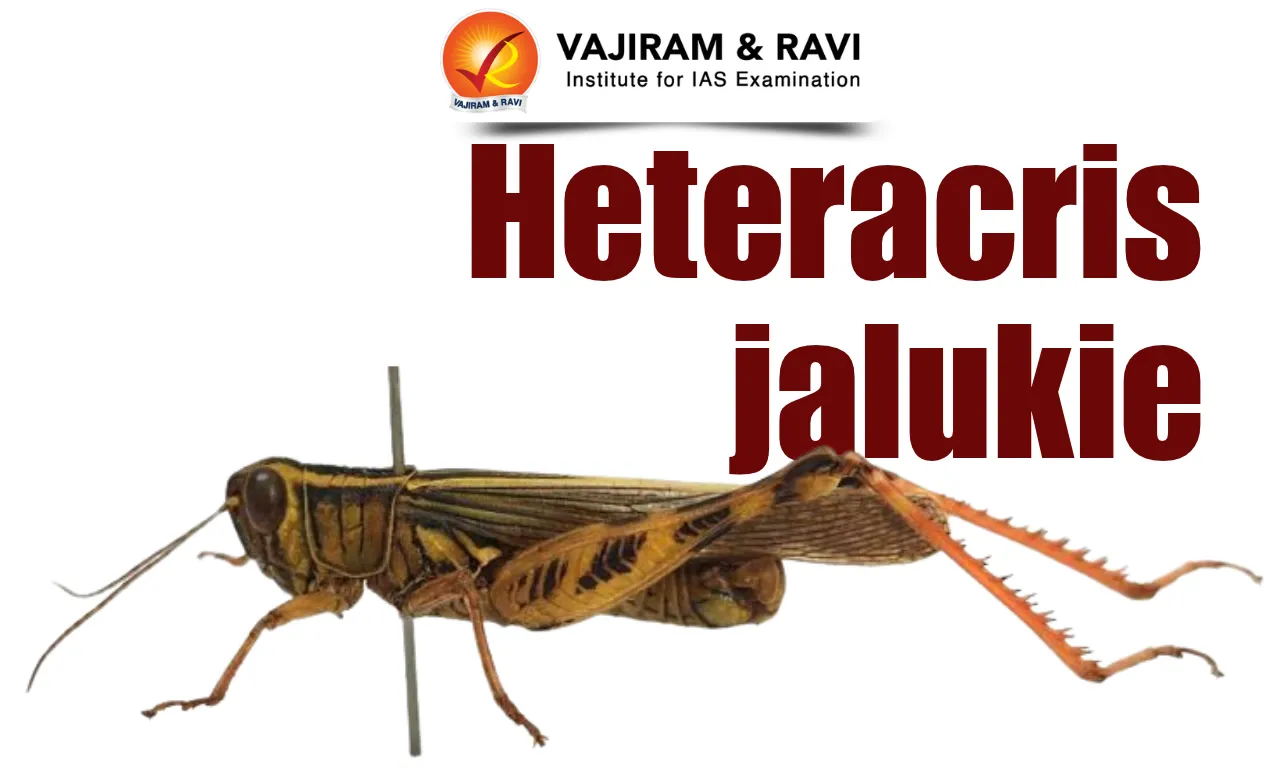
Heteracris jalukie: New Grasshopper Species Discovered in Nagaland’s Peren District

Heteracris jalukie

Heteracris jalukie Latest News

Scientists associated with the Zoological Survey of India’s (ZSI) North-Eastern Regional Centre in Shillong have contributed to the identification of a new grasshopper species named Heteracris jalukie from Nagaland recently.

About Heteracris jalukie

  • It is a new species of grasshopper.
  • It was discovered in Jalukie B village in the Peren district of Nagaland.  
  • It was found along the edge of a bamboo-dominated moist forest.
  • The species has been named after Jalukie, the village where it was collected. 
  • It marks the first recorded occurrence of the grasshopper genus Heteracris in Northeast India. 
    • Before this study, only three valid species of the genus were recognised in India, with records from other parts of the country.  
  • The new species has been distinguished from other known Indian members of the genus through a combination of physical characteristics, including its distinctive male reproductive structures. 
  • It also has fully developed transparent wings without dark spots or transverse bands and bright reddish-orange hind legs.

News: HUB

Heteracris jalukie FAQs

Q1: What is Heteracris jalukie?

Ans: It is a newly discovered species of grasshopper.

Q2: Where was Heteracris jalukie discovered?

Ans: In Jalukie B village in Peren district of Nagaland.

Q3: What are the distinctive wing characteristics of Heteracris jalukie?

Ans: It has fully developed transparent wings without dark spots or transverse bands.

Q4: What is the distinctive colour of the hind legs of Heteracris jalukie?

Ans: Bright reddish-orange.

Collagen Supplements Under Scrutiny as Investigation Questions Anti-Ageing Benefits

Collagen

Collagen Latest News

A recent investigation has uncovered significant flaws in the research supporting collagen supplements, highlighting the lack of convincing evidence that they meaningfully reverse or slow skin ageing despite claims of promoting firmer, younger-looking skin.

About Collagen

  • Collagen is the most abundant protein in your body.  It accounts for about 30% of your body’s total protein. 
  • Your body naturally produces collagen, which you can also obtain through dietary sources, such as chicken and fish skin, as well as collagen supplements. 
  • Collagen is the primary building block of your body’s skin, muscles, bones, tendons and ligaments, and other connective tissues. 
    • Collagen constitutes at least 70% of the dry weight of human skin. 
    • It’s also found in your organs, blood vessels and intestinal lining. 
  • Proteins are made from amino acids. The main amino acids that make collagen are proline, glycine and hydroxyproline. 
    • These amino acids group together to form protein fibrils in a triple helix structure.
  • Your body also needs the proper amount of vitamin C, zinc, copper and manganese to make the triple helix. 
  • Types:
    • Some 28 types of collagen have been identified. 
    • They differ by how the molecules are assembled, the cell components that are added and where the collagen is used in your body. 
    • Type I is the major form of collagen found in the dermis, providing tensile strength in the skin. 
    • Type III is the other main dermal collagen, particularly in fetal skin. 
    • All collagen fibrils have at least one triple helix structure. 
  • Collagen’s specific roles include:
    • Helping fibroblasts form in your dermis (middle skin layer), which helps new cells grow.
    • Playing a role in replacing dead skin cells.
    • Providing a protective covering for organs.
    • Giving structure, strength and elasticity to your skin.
    • Helping your blood to clot.
    • Collagen also contributes to building and maintaining muscle.
  • What happens to collagen with ageing?
    • Your body produces less collagen as you age, and existing collagen breaks down at a faster rate. 
    • The collagen is also lower in quality than when you were younger. 
    • Women experience a significant reduction in collagen production after menopause. 
    • It’s normal for everyone to experience a decline in collagen production after age 60. 
  • What diseases and other factors damage collagen?
    • Autoimmune diseases (your body’s immune system attacks its own tissue) can damage collagen. 
      • Rheumatoid arthritis, lupus, dermatomyositis and scleroderma are autoimmune, connective tissue diseases known to damage collagen.
    • Genetic mutations can also damage collagen. Collagen construction errors result in conditions such as Ehlers-Danlos syndrome and osteogenesis imperfecta.
    • It can be further compromised by lifestyle factors such as smoking, excessive drinking, a diet high in sugar, and overexposure to the sun. 

News: TH

Collagen FAQs

Q1: What is collagen?

Ans: Collagen is the most abundant protein in the human body.

Q2: Approximately what percentage of the body's total protein is made up of collagen?

Ans: About 30%.

Q3: Which tissues and organs of the human body contain collagen?

Ans: Skin, muscles, bones, tendons, ligaments, organs, blood vessels and the intestinal lining.

Q4: Which amino acids are the main building blocks of collagen?

Ans: Glycine, proline and hydroxyproline.

Q5: What is the structural arrangement of collagen protein fibrils?

Ans: They are arranged in a triple helix structure.

Cyprus: Indian PM’s Talks with President Put Mediterranean Island Nation in Focus

Cyprus

Cyprus Latest News

Turkiye recently raised concerns at the UNSC over increased Cyprus military activities in the Eastern Mediterranean, citing reported negotiations with India to acquire BrahMos supersonic cruise missiles as one of the key threats to regional stability.

About Cyprus

  • It is a Eurasian island country, located in the extreme northeastern corner of the Mediterranean Sea. 
  • It lies south of the Anatolian Peninsula.
  • It is the third-largest Mediterranean island after Sicily and Sardinia.
  • Cyprus belongs geographically to Western Asia (the Middle East) and politically to Europe.  
  • Across the sea, it is located to the southeast of Greece, to the south of Turkey, to the west of Lebanon and Syria, and to the north of Egypt, Israel, and the Palestinian Gaza Strip.  
  • It is a member of the European Union (EU), having joined on 1 May 2004.
  • Ethnic groups: Greek Cypriot (78%), Turkish Cypriot (18%), Armenian and other (4%). 
  • Capital and largest city: Nicosia (Lefkosia).
  • Independence: 16 August 1960, from British rule. 
  • Government: Presidential Republic.
  • Division of Cyprus: 
    • Cyprus has remained divided since 1974, following Turkish military intervention in the northern part of the island.
    • The southern part is under the effective control of the internationally recognised Republic of Cyprus.
    • The northern part is administered by the self-declared Turkish Republic of Northern Cyprus (TRNC), which is recognised only by Turkey.
    • The United Nations maintains a buffer zone, commonly known as the Green Line, separating the two parts.
    • Nicosia is widely recognized as the last divided capital city in Europe. 
  • Geographical Features:
    • Climate: Mediterranean climate, with hot, dry summers and mild, relatively rainy winters. 
    • Mountain Ranges: Kyrenia and Troodos Mountains. The highest point is Mount Olympus (1,952 metres) in the Troodos range.
    • Rivers: The Pedieos is the longest river in Cyprus.
    • Natural Resources: It mainly consists of Copper, pyrites, asbestos, gypsum, timber, salt, marble, and clay earth pigment.

News: HBL

Cyprus FAQ's

Q1: Where is Cyprus geographically located?

Ans: Cyprus is a Eurasian island country located in the northeastern part of the Mediterranean Sea.

Q2: Which country lies to the north of Cyprus?

Ans: Turkey.

Q3: Which country lies southeast of Cyprus?

Ans: Greece.

Q4: What is the capital and largest city of Cyprus?

Ans: Nicosia (Lefkosia).

Q5: Which event led to the division of Cyprus in 1974?

Ans: Turkish military intervention in the northern part of the island.

Chariot-1 Foundation Model: MeitY Launches Indigenous AI Models for Indian Languages

Chariot-1 Foundation Models

Chariot-1 Foundation Model Latest News

Recently, the Ministry of Electronics and Information Technology (MeitY) launched the Chariot-1 Foundation Models.

About Chariot-1 Foundation Model

  • The Chariot-1 is a suite of indigenous artificial intelligence (AI) models consisting of a Large Language Model (LLM) and a Text-to-Speech (TTS) model.
  • These are developed by Chariot Artificial Intelligence Pvt. Ltd. under the IndiaAI Mission.
  • These are developed through pre-training from scratch in India
  • Three key research innovations
    • The Chariot team showcased three research innovations integrated into the training of the Chariot-1 models.
      • IndicShift: It is an open-source technology that introduces a shared alphabet for Indian scripts. It also improves model performance on Indian languages by 5-8 per cent using the same computing resources, while maintaining performance in English and coding tasks.
      • Nested Training: It enables three model sizes to be trained simultaneously through a single training run and a shared set of weights. The approach reportedly improves training speed by 62 per cent compared with training the three model sizes independently.
      • Mixture of Vocabularies: It divides the model’s vocabulary into 11 groups and  reduces the number of vocabulary entries evaluated per word by 5.7 times and improves training speed by 38 per cent on the same GPUs, with negligible changes in model loss.

Key Facts about  Chariot-1 Large Language Model (LLM)

  • It is an 11-billion-parameter mixture-of-experts model, with 4 billion active parameters per token.
  • It is available in three model sizes-10.7 billion, 1.7 billion and 745 million parameters-catering to varying computational requirements and deployment environments.

Key facts about Chariot-1 Text-to-Speech (TTS) Model

  • It is designed to generate speech in English and 10 Indian languages: Hindi, Bengali, Marathi, Tamil, Telugu, Kannada, Malayalam, Gujarati, Punjabi and Odia.
  • It has the ability to understand context and determine how numbers, dates, currencies, units, URLs and abbreviations should be verbalised. 
  • It recorded over 97% verbalisation accuracy on the Async TTS Pronunciation Benchmark.

Source: PIB

Chariot-1 Foundation Model FAQ's

Q1: What is Chariot-1 Foundation Mode?

Ans: The Chariot-1 is a suite of indigenous artificial intelligence (AI) models consisting of a Large Language Model (LLM) and a Text-to-Speech (TTS) model.

Q2: Under which mission Chariot-1 Foundation Model was developed?

Ans: IndiaAI Mission

Postal Operations Scheme: Cabinet Approves ₹1,141 Crore for Modernisation Until 2031

Postal Operations Scheme

Postal Operations Scheme Latest News

The Union Cabinet has approved the continuation of the Postal Operations scheme during the 16th Finance Commission Cycle from FY 2026-27 to FY 2030-31 with a proposed outlay of Rs. 1,141 Crore.

About Postal Operations Scheme 

  • It is a Central Sector Scheme.
  • It seeks to strengthen postal infrastructure, improve operational efficiency and support the growing requirements of logistics, e-commerce and digital service delivery across the country. 
  • Implementation Period: The scheme is intended to be implemented over a period of five years from FY 2026-27 to FY 2030-31. 
  • Nodal Ministry: Department of Posts under the Ministry of Communications

Sub-schemes of Postal Operations Scheme

  • Rural Business and Access to Postal Network: It aims to upgrade infrastructure, strengthen financial inclusion, digital connectivity and local economic development while improving last-mile delivery and enhancing access to postal and citizen-centric services in underserved regions. 
  • Mail Network Optimization: It envisages modernization of mail operations through centralized delivery systems, mechanization, advanced IT solutions under Advanced Postal Technology (APT 2.0), GIS-based services and upgraded infrastructure.
  • Parcel Network Optimization: It includes construction of Parcel Hubs and expansion of Parcel Packaging Units (PPUs) aligned with the redesigned sorting framework to streamline parcel movement, reduce handling points, ease capacity constraints and improve transit times.
  • Infrastructure Upgrade and Augmentation of Infrastructure for International Mails: It aAims to strengthen international mail services by upgrading Foreign Post Offices (FPOs) and Sub Foreign Post Offices (SFPOs) to improve infrastructure and expedite processing of international consignments.
  • Marketing Functions including Quality of Service: It is focused on promotion, branding, outreach and customer engagement through multi-channel campaigns across television, digital, radio, print and outdoor platforms.
  • Philately Operations: It promotes philately through exhibitions, seminars, quizzes, school philatelic clubs and innovative stamp designs.

Source: PIB

Postal Operations Scheme FAQs

Q1: What is the aim of Postal Operations Scheme?

Ans: It seeks to strengthen postal infrastructure, improve operational efficiency and support the growing requirements of logistics, e-commerce and digital service delivery across the country. 

Q2: What is the time period of Postal Operations Scheme?

Ans: The scheme is intended to be implemented over a period of five years from FY 2026-27 to FY 2030-31. 

C-DAC: India’s Supercomputing Pioneer Behind PARAM 8000 and Indigenous Technology

Centre for Development of Advanced Computing

Centre for Development of Advanced Computing Latest News

The Centre for Development of Advanced Computing (C-DAC) is targeting the middle of 2028 to develop a full-fledged indigenous graphics processing unit (GPU), with plans to make it price-competitive through economies of scale.

About Centre for Development of Advanced Computing

  • It is the premier R&D organization of the Ministry of Electronics and Information Technology (MeitY) for carrying out R&D in IT, Electronics, and associated areas. 
  • It was established in 1988.
  • Headquarters: Pune, Maharashtra.
  • Established with the aim of bridging the gap between academia and industry, C-DAC has been at the forefront of technology innovation for over three decades. 
  • Different areas of C-DAC had originated at different times, many of which came out as a result of identification of opportunities. 
  • The setting up of C-DAC in 1988 itself was to build supercomputers in the context of the denial of the import of Supercomputers by the USA. 
    • Since then C-DAC has been undertaking the building of multiple generations of Supercomputers. 
  • C-DAC built India’s first indigenously built supercomputer, Param 8000, in 1991.
  • The Institute has made a significant foray into various activities such as software solutions, product development, and network services, supporting the IT industry. 
  • It is involved in implementing the National Supercomputing Mission, jointly with IISc Bengaluru.

News: TH

Centre for Development of Advanced Computing FAQs

Q1: What is the Centre for Development of Advanced Computing (C-DAC)?

Ans: It is a premier research and development (R&D) organisation under the Ministry of Electronics and Information Technology (MeitY).

Q2: When was the Centre for Development of Advanced Computing (C-DAC) established?

Ans: 1988.

Q3: Where is the headquarters of Centre for Development of Advanced Computing (C-DAC) located?

Ans: Pune, Maharashtra.

Q4: Which organisation developed India's first indigenously built supercomputer, PARAM 8000?

Ans: Centre for Development of Advanced Computing (C-DAC).

Q5: Which are the major areas of activity of C-DAC apart from supercomputing?

Ans: Software solutions, product development and network services.

Tunga River: Pollution Board Identifies Seven Pollution Sources in Karnataka

Tunga River

Tunga River Latest News

Four persons from Bengaluru, including three law students, drowned in the Tunga River at Mahishi in Tirthahalli taluk of Shivamogga district, Karnataka, recently.

About Tunga River

  • Tunga River, also known as the Thunga River, is an important river flowing through the Karnataka state.
  • Course:
    • The river originates in the Western Ghats on a hill called Varaha Parvata. 
    • The birthplace of Tunga is called Gangamoola, which is a cave inside Varaha Parvatha.  
    • After its origin, the river flows through two districts, the Chikmagalur and Shimoga district of Karnataka. 
    • After flowing for 147 km, it merges with the Bhadra River, near the city of Shimoga. 
    • From this stage the river becomes the Tungabhadra River, which then starts flowing in the east direction and eventually merges with the Krishna River in the state of Andhra Pradesh. 
  • The river is famous for the sweetness of its water.  
  • A dam has been constructed across the Tunga River at Gajanur, while a larger dam is built on the Tungabhadra River at Hospet, both of which play crucial roles in irrigation and hydroelectric power generation in the region. 
  • During the medieval period, the Tunga River and its surrounding areas witnessed the rise and fall of several dynasties, including the Western Chalukyas and the Hoysalas. 
  • Sringeri, on the banks of the Tunga, has several temples, the most important being the Sarada Temple and the Vidyasankara Temple. 

News: TH

Tunga River FAQs

Q1: In which Indian state does the Tunga River flow?

Ans: Karnataka.

Q2: Where does the Tunga River originate?

Ans: It originates in the Western Ghats on a hill called Varaha Parvata.

Q3: What is the birthplace of the Tunga River called?

Ans: The birthplace of Tunga is called Gangamoola, which is a cave inside Varaha Parvatha.

Q4: How long does the Tunga River flow before merging with the Bhadra River?

Ans: Approximately 147 km.

eSankhyiki Portal: Government’s Statistics Platform Offers Access to Over 2,291 Datasets

eSankhyiki Portal

eSankhyiki Portal Latest News

Recently, the Ministry of Statistics and Programme Implementation (MoSPI) has launched a State Dashboard on its eSankhyiki portal.

About eSankhyiki Portal

  • It is a one-stop window for official statistics in India.
  • It provides real-time inputs for planners, policy-makers, researchers and the public at large.
  • The objective of this portal is to establish a comprehensive data management and sharing system for ease of dissemination of official statistics in the country.
  • It enables users to search datasets, explore indicators through interactive visualisations, and consult the accompanying metadata.
  • Currently, the eSankhyiki portal hosts 43 statistical products with 1109 datasets comprising more than 139 million records.
  • It has two modules namely
    • Data Catalogue Module: This module catalogues the major data assets of the Ministry at one place for ease of access.
      • It allows users to search within datasets, including within tables, and download data of interest to increase its value and re-usability.
      • The module has seven data products, namely National Accounts Statistics, Consumer Price Index,Index of Industrial Production, Annual Survey of Industries, Periodic Labour Force Survey, Household Consumption Expenditure Survey and Multiple Indicator Survey.
    • Macro Indicators Module: This module offers time series data of key macro indicators with features for filtering and visualizing data enabling ease of access for the users.
      • The module also allows users to download custom datasets, visualizations and share them through APIs, thereby increasing the re-usability of data.
      • The first phase of the module includes four major products of MoSPI: National Accounts Statistics, Consumer Price Index, Index of Industrial Production, and Annual Survey of Industries, encompassing the data of the last ten years.

Source: PIB

eSankhyiki Portal FAQs

Q1: What is eSankhyiki Portal ?

Ans: It is a one-stop window for official statistics in India.

Q2: What is the objective of eSankhyiki Portal?

Ans: The objective of this portal is to establish a comprehensive data management and sharing system for ease of dissemination of official statistics in the country.

Colombo Security Conclave (CSC) – Strengthening India’s Indian Ocean Security Architecture

Colombo Security Conclave (CSC)

Colombo Security Conclave (CSC) Latest News

  • The 8th National Security Adviser (NSA)-level meeting of the Colombo Security Conclave (CSC) was hosted by the Maldives. India was represented by National Security Adviser Ajit Doval.
  • Member countries adopted the Roadmap of Cooperation for 2026–27 to strengthen regional coordination against emerging security threats in the Indian Ocean Region (IOR).

Colombo Security Conclave (CSC) - An Overview

  • Established: 2011 as a trilateral security initiative involving India, Sri Lanka and the Maldives.
  • Objective: Promote closer cooperation among Indian Ocean countries and strengthen regional security through collective action.
  • Evolution: Mauritius subsequently joined as a full member, while the grouping has expanded its engagement with other regional partners.
  • Membership: India, Maldives, Mauritius and Sri Lanka are the current members. Bangladesh's membership has been approved, subject to completion of internal formalities. Seychelles has been welcomed as a prospective full member.
  • Recent development: Bangladesh participated in the 8th meeting, while Australia and Malaysia attended as guest nations.

Five Pillars of CSC Cooperation

  • The CSC operates through five key pillars to address traditional and non-traditional security challenges.
  • Pillars:
    • Maritime Safety and Security: Maritime surveillance, safety of sea lanes and addressing maritime threats.
    • Counterterrorism: Combating terrorism, radicalisation and extremist networks.
    • Combating Transnational Crime: Preventing human trafficking, illicit trafficking and organised crime.
    • Cyber Security: Addressing cyber threats and protecting critical infrastructure and technology.
    • Humanitarian Assistance and Disaster Relief (HADR): Coordinated responses to natural disasters and humanitarian emergencies.

Key Outcomes of the 8th NSA-Level Meeting

  • Roadmap of Cooperation 2026–27:
    • Adopted a roadmap identifying priority activities, key deliverables and planned initiatives under all five pillars.
    • Aims to translate political commitments into practical regional cooperation.
  • Capacity-building and Institutional Cooperation:
    • Emphasis on joint training programmes, sharing best practices and capacity-building initiatives.
    • Strengthening institutional capabilities to tackle evolving security challenges.
  • Review of Earlier Commitments: The CSC's first Secretary-General, Vice Admiral (Retd.) S.N. Ghormade, presented a review of progress in implementing decisions taken at the 7th NSA-level meeting in New Delhi (November 2025).
  • Collective Commitment: Member states reaffirmed their commitment to regional peace, stability and security through sustained cooperation and coordinated responses.

Strategic Significance for India

  • Neighbourhood First Policy: Strengthens security partnerships with India's immediate maritime neighbours.
  • MAHASAGAR Vision: Supports India's vision of Mutual and Holistic Advancement for Security and Growth Across Regions (MAHASAGAR).
  • Maritime Security: Helps protect critical sea lanes, maritime trade routes and strategic infrastructure in the Indian Ocean.
  • Regional Leadership: India views the CSC as an important instrument for strengthening its regional security architecture, reinforcing India's role as a reliable security partner and a net security provider in the IOR.
  • Countering Strategic Competition: Provides a platform for regional countries to coordinate responses to growing geopolitical competition and China's expanding strategic presence in the Indian Ocean.

Emerging Security Challenges in the Indian Ocean

  • The regional security environment is becoming increasingly complex due to the convergence of traditional and non-traditional threats.
  • For example,
    • Maritime threats: Piracy, illegal fishing, maritime disputes and threats to shipping routes.
    • Terrorism: Cross-border extremist networks and radicalisation.
    • Transnational organised crime: Drug trafficking, human trafficking and illicit maritime activities.
    • Cyber threats: Cyberattacks targeting ports, communication networks and critical infrastructure.
    • Geopolitical competition: Growing strategic rivalry and competition for influence in the Indo-Pacific.

Other Challenges and Way Forward

  • Differences in national security priorities: Develop a shared regional security vision.
  • Limited institutional and technological capabilities: Strengthen joint training, technology-sharing and capacity-building.
  • Trust deficit and geopolitical rivalries: Promote transparency, dialogue and confidence-building measures.
  • Cross-border nature of emerging threats: Establish stronger intelligence-sharing and coordinated response mechanisms.
  • Implementation gaps: Ensure measurable outcomes and regular monitoring of the 2026–27 roadmap.

Conclusion

  • The Colombo Security Conclave (CSC) represents an important step towards collective security and cooperative regionalism in the Indian Ocean. 
  • Its effectiveness will depend on converting diplomatic commitments into sustained operational cooperation, ensuring a secure, stable and rules-based maritime order.

Source: ToI | IE

Colombo Security Conclave (CSC) FAQs

Q1: What is the primary objective of the Colombo Security Conclave (CSC)?

Ans: To strengthen regional cooperation and collective security among Indian Ocean countries.

Q2: What are the five pillars of cooperation under the CSC?

Ans: Maritime security, counterterrorism, combating transnational crime, cybersecurity, and HADR.

Q3: How does the CSC complement India's Neighbourhood First Policy and MAHASAGAR vision?

Ans: It strengthens maritime partnerships, regional capacity-building and collective security in the Indian Ocean Region.

Q4: Why is the Colombo Security Conclave strategically important for India?

Ans: It safeguards maritime trade routes and promotes a cooperative security architecture in the Indian Ocean.

Q5: What are the major challenges facing the effective functioning of the CSC?

Ans: Geopolitical rivalries, institutional capacity gaps, differing national priorities and weak operational coordination.

Fiscal Cost of Cash-Transfer Schemes – Why Every Subsidy Needs a Social DPR

Fiscal Cost

Fiscal Cost Latest News

  • Cash transfers and universal subsidies have moved to the centre of electoral competition across Indian states. 
  • This has revived the debate on whether every such scheme, including poll promises, should be backed by a published Social Detailed Project Report (DPR) before public money is committed.

Cash Transfers and Universal Subsidies

  • A DPR is the standard document guiding any infrastructure project. It sets out objectives, alternatives considered, financial and economic analysis, risks, baseline data and success criteria.
  • Social policies, by contrast, are often the outcome of an electoral promise and are implemented without any comparable prior (ex ante) appraisal, even though they affect human capabilities more directly than infrastructure does.
  • Cash transfers and subsidies are perpetual in nature and politically hard to reverse. They therefore demand prior evaluation as well as real-time monitoring.
  • Social policies are also vulnerable to electoral clientelism, which is why they should follow the same principles of public expenditure as infrastructure: evidence, accountability, equity, efficiency and fiscal responsibility.

How Fast State Spending on Cash Transfers and Subsidies Is Rising

  • Twelve states are expected to spend nearly ₹1.68 trillion on unconditional cash-transfer schemes for women in 2025-26, according to PRS Legislative Research. 
    • This is roughly 0.5% of GDP, up from less than 0.2% two years earlier.
  • The RBI's study of state budgets shows total subsidy outlay rising from ₹1.87 trillion in 2018-19 to ₹4.26 trillion in 2025-26.
  • Promises made in election manifestos are often implemented soon after a government takes office, or just before the next election, without serious assessment of needs or financial commitments.

Why Social Schemes Escape Scrutiny

  • Benefits of cash transfers are visible and excludable, which makes them electorally attractive. Benefits of public goods such as infrastructure, education and healthcare are diffused across society, making attribution uncertain.
  • When cash transfers are announced prominently as poll promises, that itself precludes prior scrutiny of design flaws, targeting errors, hasty implementation and fiscal cost.
  • Many schemes are rolled out without needs assessment, beneficiary identification or adequate funding. A top-down, target-chasing approach replaces democratic, bottom-up planning.
  • When fiscal limits are approached, they are handled after the fact through more borrowing or cuts to essential spending, instead of through disciplined choices at the start.
  • An ex ante appraisal creates an audit trail, so that the legislature, auditors, the media and citizens can later ask whether the scheme delivered what it promised.

Why Priorities Matter: The Tamil Nadu Scholarship vs Teacher Vacancy Example

  • Tamil Nadu allocated nearly ₹1,000 crore in 2026-27 for scholarships to help government school students continue higher education.
  • However, RTI-based reports show 7,198 vacancies in permanent teaching posts in government arts and science colleges, and nearly 9,000 if professional colleges and universities are included.
  • Filling these posts would cost about ₹1,080 crore a year, rising annually. The state's large revenue and fiscal deficits leave little room for this.
  • Funding scholarships alone sends students to colleges without regular teachers. 
  • Deciding which need comes first is a normative choice that requires weighing alternatives.

Universal vs Targeted Subsidies: The Inclusion-Exclusion Trade-off

  • A truly universal scheme includes the undeserving, which reduces the per-capita benefit for those in need. This is an inclusion error.
  • A targeted scheme excludes some of the deserving, which is an exclusion error, but it raises the per-capita benefit for the needy.
  • Choosing between the two requires ex ante appraisal, ideally using behavioural models and micro-simulations to predict the effects of a scheme before it is launched.

Common Design Flaws in Cash-Transfer Schemes

  • Failure to build capabilities: higher household income does not automatically improve beneficiaries' agency, especially without social and intra-household equity.
  • Failure to reach intended beneficiaries: the poorest may drop out due to missing bank accounts or ration cards.
  • Lack of trial runs: respecting recipients' choices and agency requires prior evaluation and pilots, which poll-driven announcements rarely allow.

Proposed Way Forward

  • Know the problem first: Before launching a scheme, study who actually needs help and why. Set clear objectives and decide how to identify the right beneficiaries, so that the needy are not left out and the well-off do not get benefits meant for others.
  • Fix the amount sensibly: The benefit should reflect people's real situations, such as their gender, where they live and whether they are widowed, destitute or married.
  • Compare the options: Check whether a different design would work better: benefits for all or only for the needy, cash or goods and services, with or without conditions.
  • Weigh costs against benefits: Work out whether the scheme does more good than it costs. This includes checking how households use the money, whether the benefit reaches women within the family, whether local prices rise because of it, and how much the transfer actually helps a household's spending.
  • Make sure the poorest are covered: Track how many of every 100 eligible households actually receive the benefit. Some of the poorest may miss out because they lack a bank account or a ration card.
  • Plan for the next ten years: Estimate how the cost will grow with inflation and more beneficiaries, and whether government revenue can keep up. Build in an end point, such as an expiry date set by the legislature, a compulsory periodic review, or a time limit for each beneficiary, so the scheme does not continue without scrutiny.

Source: TH

Fiscal Cost FAQs

Q1: What is a social DPR?

Ans: It is a published Detailed Project Report for a social scheme, setting out objectives, beneficiaries, costs, alternatives, risks and distributional impact before funds are committed.

Q2: How much are states spending on cash transfers for women?

Ans: Nearly ₹1.68 trillion across 12 states in 2025-26, about 0.5% of GDP, compared with under 0.2% two years earlier.

Q3: Why are cash transfers and subsidies hard to reverse?

Ans: They are perpetual in nature, and withdrawing a benefit once given carries a political cost, so they become long-term fiscal commitments.

Q4: What are inclusion and exclusion errors?

Ans: Inclusion errors occur when benefits reach people who do not need them. Exclusion errors occur when deserving people are left out. Universal schemes tend toward the first and targeted schemes toward the second.

Q5: Does this mean cash-transfer schemes should be stopped?

Ans: No. The proposal is for rigorous prior appraisal, real-time monitoring and sunset mechanisms so that schemes are better designed and fiscally sustainable.

Advertising Standards Council of India: Real Estate and Betting Ads Lead Complaint Trends

Advertising Standards Council of India

Advertising Standards Council of India Latest News

Recently, the Advertising Standards Council of India (ASCI) said that digital media accounted for nearly 98% of advertising violations flagged by the ASCI between April and September 2026.

About Advertising Standards Council of India  

  • It is a voluntary self-regulatory organization of the advertising industry in India. 
  • It was established in 1985, ASCI is registered as a non-profit company under Section 25 of the Company Act.
  • It is committed to the cause of self-regulation in advertising, ensuring the protection of the interests of consumers. 
  • It seeks to ensure that advertisements conform to its Code for Self-Regulation, which requires advertisements to be legal, decent, honest, and truthful and not hazardous or harmful while observing fairness in competition. 
  • It looks into complaints across all media, such as Print, TV, Radio, hoardings, SMS, Emailers, Internet/web-site, product packaging, brochures, promotional material, and point of sale material, etc.
  • Structure
    • A Board of Governors, which includes 16 members drawn from prominent businesses, media agencies, and advertisers, among others.
    • The Consumer Complaints Council (CCC), a body that investigates complaints and decides whether advertisements adhere to the Advertisement Standards Council of India Code.
    • A Secretariat, headed by the Secretary General, oversees the day-to-day operations of the organisation.
  • While ASCI is not a government body, its role has been widely acknowledged, and in 2006, the Ministry of Information and Broadcasting issued a mandate requiring all TV advertisements in India to follow ASCI’s codes. 
  • ASCI is a part of the Executive Committee of the International Council on Ad Self-Regulation (ICAS).

Source: IE

Advertising Standards Council of India FAQs

Q1: What is Advertising Standards Council of India ?

Ans: It is a voluntary self-regulatory organization of the advertising industry in India. 

Q2: Under which act Advertising Standards Council of India was formed?

Ans: Under Section 25 of the Company Act.

Front-of-Pack Warning Labels in India: Supreme Court’s New Food Labelling Rules

Front-of-pack Warning Labels in India

Front-of-pack Warning Labels in India Latest News

  • The Supreme Court has cleared the way for packaged food items to carry front-of-package nutrition labelling (FoPNL), indicating whether a product is high in fat, sugar, or salt. 
  • The ruling, delivered by a bench of Justices J B Pardiwala and K Vinod Chandran, sharply departs from the FSSAI's earlier star-rating proposal, instead mandating separate warning labels for each nutrient of concern — a major win for public health advocates.

What the Supreme Court Has Ordered

  • The Court has laid down detailed implementation directions to prevent the labelling's purpose from being diluted:
    • Pictorial Representation: Each hexagonal warning must carry a pictorial symbol alongside the words "High Fat," "High Sugar," or "High Salt" — ensuring accessibility across varying literacy and education levels.
    • Separate Hexagons: Unlike FSSAI's proposal of a single hexagon for multiple warnings, the Court mandated separate hexagons per nutrient — meaning a product could carry one, two, or three hexagons depending on how many nutrients of concern it is high in.
    • Total Sugars and Saturated Fat, Not Added Sugar/Fat: The Court ruled that thresholds must be based on "total sugars" and "saturated fat", not "added sugar" and "added fat" as FSSAI had proposed — since "added" criteria could be misused (e.g., manufacturers using fruit concentrate to sweeten products while technically avoiding "added sugar" labelling).
    • Scientific Threshold-Setting: FSSAI must reformulate thresholds based on evidence — neither too low (causing "label fatigue" if nearly all products get warnings) nor too high (letting harmful products escape labelling).
    • Proportional Label Size: Hexagon size must be proportional to the package's display panel, occupying not less than 4-5% of it, in line with international practice.
    • No Deceptive Beverage Category Labels: Beverages not high in sugar must not carry labels resembling warning hexagons used for high-sugar beverages.
    • Exempted Foods List: FSSAI must prepare a clear, reasoned list of exempted foods — typically single-ingredient packages like sugar, salt, or oil.
    • Preventing Circumvention via Additives: FSSAI must act if industry responds to warning labels by introducing preservatives/additives that defeat the label's purpose.
    • Implementation Timeline: FSSAI's stated four-month timeline must be adhered to, with safeguards against businesses flooding the market with unlabelled products during the transition period.

Why This Ruling Matters: The Court's Reasoning

  • The Court held that an interpretive FoPNL is a reasonable measure to protect fundamental and statutory rights, given India's public health crisis linked to non-communicable diseases (NCDs) and consumption of HFSS (High Fat, Sugar, Salt) foods/Ultra-Processed Foods (UPFs).
  • The Supreme Court has reminded the State that public health is not a bargaining chip... consensus is not a prerequisite for public health. 
  • The judgment explicitly bars FSSAI from letting industry objections delay regulation.

How This Differs from FSSAI's Original Proposal

  • FSSAI's regulatory journey went through several shifts:
    • 2022: Proposed a star-rating system (like electrical appliances), based on a study — heavily opposed by health experts who feared even unhealthy products with 0.5 stars would appear "positive."
    • 2025: Proposed a fact-based FoPNL, showing nutrient content as a percentage of Recommended Dietary Allowance — criticised as merely repackaging existing back-of-pack information without clear harm signalling.
    • Final FSSAI proposal (before Court): A single red hexagon with textual warning, to be rolled out in two phases — first for foods high in two of three harmful nutrients, later extended to foods high in even one nutrient. 
      • It did not propose pictorial warnings, separate hexagons, or total-sugar/fat-based thresholds, and gave no implementation timeline.
  • The Supreme Court's order overrides these gaps, mandating a more rigorous, consumer-friendly framework.

Why India Needs Warning Labels: The Public Health Case

  • Non-communicable diseases (NCDs) cause around 6 million deaths annually in India — nearly 63% of all deaths — projected to rise to 75% by 2030.
  • Key disease burden figures: 
    • 101 million people living with diabetes.
    • 136 million with pre-diabetes.
    • 315 million with hypertension.
    • 254 million with generalised obesity.
  • India's ultra-processed food (UPF) sector grew 13.37% in retail sales value between 2011 and 2021, intensifying the need for regulatory intervention.

Global Context: Do Warning Labels Work?

  • At least 44 countries have implemented front-of-pack labelling.
  • Two broad label types exist: 
    • Interpretive labels: Convey an at-a-glance score/star (considered more effective).
    • Non-interpretive labels: Display raw nutritional data without interpretation.
  • Global models: 
    • Australia/New Zealand: Health Star Rating.
    • Netherlands, Czech Republic, Singapore: Healthier-choice symbols.
    • UK: Traffic-light system (red/yellow/green for salt, sugar, fat).
    • Chile and others: Black "stop sign" warnings.
  • 10 countries — including Chile, Peru, Israel, Mexico, Uruguay, Brazil, Argentina, Colombia, Venezuela, and Canada — use warning labels similar to what India has now adopted.
  • Evidence of impact: Chile saw a 24% drop in sugary drink consumption after implementing warning labels, according to a position paper by the Public Health Foundation of India, Centre for Science and Environment, and Indian Academy of Paediatrics.

Conclusion

  • By mandating separate, pictorial, science-based warning labels, the Supreme Court has decisively shifted India's food labelling debate from industry-friendly ambiguity toward consumer-first clarity. 
  • With the real battle now moving to threshold-setting, how FSSAI defines "high" sugar, salt, and fat will determine whether this judgment translates into genuine public health gains.

Source: IE | NDTV

Front-of-pack Warning Labels in India FAQs

Q1: What are front-of-pack warning labels in India?

Ans: Front-of-pack warning labels in India are prominent nutritional warnings identifying packaged foods high in fat, sugar or salt to inform consumers.

Q2: What directions has the Supreme Court issued regarding warning labels?

Ans: Front-of-pack warning labels in India must use separate pictorial hexagons for high fat, sugar and salt, with scientifically determined nutritional thresholds.

Q3: How does the Supreme Court's ruling differ from FSSAI's earlier proposal?

Ans: Front-of-pack warning labels in India replace FSSAI's proposed star-rating approach with separate pictorial warnings and thresholds based on total sugars and saturated fat.

Q4: Why are front-of-pack warning labels important for public health?

Ans: Front-of-pack warning labels in India can help consumers identify unhealthy foods, addressing rising non-communicable diseases linked to excessive consumption of ultra-processed products.

Q5: What international evidence supports front-of-pack warning labels?

Ans: Front-of-pack warning labels in India follow global practices; Chile recorded a 24% decline in sugary drink consumption after introducing similar warnings.

Ancient Indian Democracy: Gana-Sanghas and the Claim to Democratic Origins

Ancient Indian democracy

Ancient Indian democracy Latest News

  • On Constitution Day, the claim that India is the "mother of democracy" or the world's oldest democracy deserves historical scrutiny. This claim rests on the existence of gana-sanghas — ancient republican polities of northern and western South Asia. 
  • But does the historical evidence actually support this assertion? The answer requires examining what democracy truly means, where the concept originated, and how gana-sanghas compare to Athens, the traditionally cited "birthplace" of democracy.

What Does 'Rule of the People' Actually Mean?

  • Democracy literally means "rule of the people," but this raises fundamental questions: Who are the "people"? What is being "ruled"? How is this rule realised?
  • In modern democracies (including India), the answer is clear: "people" means all citizens of a nation-state, ruled through representative government, legitimised by elections under universal adult suffrage.
  • However, this modern conception of democracy is a relatively recent assemblage: 
    • The nation-state is a 17th-century phenomenon.
    • Representation via voting became integrated into democratic theory only from the late 18th century, with American independence.
    • Universal adult suffrage is a 20th-century development.
  • Despite this modern packaging, the underlying idea of collective self-rule is far more ancient.

Origins of the Term 'Democracy'

  • The word derives from the Greek "demokratia," used from the mid-5th century BCE to describe political systems in Greek city-states, most famously Athens.
  • How Athenian democracy worked: 
    • The Assembly comprised all male citizens over 18 — but its agenda was set by the Council of Five Hundred, chosen by lots (not votes) from 139 divisions of Athens.
    • Decisions within the Assembly were taken by majority vote via show of hands.
    • A court (Dikasteria), with jurors chosen by lots from citizens over 30, curtailed the Assembly's power.
  • Athenian demokratia ended when Athens was conquered — first by Macedonia, then by the Romans in 146 BCE.

Why India's "Oldest Democracy" Claim Carries Political Weight

  • Western democracy (U.S., Northern Europe) was historically inspired by and legitimised through the Athenian example, as part of the European Renaissance's heritage.
  • Under colonialism, this Athens-to-West lineage was used to suggest Indian democracy was a "gift" of colonial modernity — implying Indian democracy's success stemmed from Britain's "civilising mission."
  • Claiming India as the "mother of democracy" directly challenges this narrative — suggesting India could have developed democratic institutions independently, without Western intervention.

The Basis of India's Claim: Gana-Sanghas

  • India's claim rests on gana-sanghas (or gana-rajyas) — polities existing in northern/western South Asia from around 600 BCE to the mid-first millennium CE.
  • As historian Romila Thapar explains: gana refers to people of equal status, and sangha/rajya means assembly/governance.
  • These polities existed on the periphery of major kingdoms — in the Gangetic Plains, Terai region, Himalayan foothills, Punjab, Sindh, and central/western India.
  • Prominent gana-sanghas (as per Buddhist sources): Vajji and Malla (mahajanapada confederations), along with the Sakyas, Koliyas, Bulis, Kalamas, Moriyas, and Bhaggas.

How Gana-Sanghas Functioned

  • Governed by an assembly of clan heads/chiefs, located in the polity's main city.
  • Presided over by a non-hereditary head (sometimes called "Raja").
  • Decisions were discussed, and if unanimity wasn't reached, put to a vote.
  • The Raja was assisted by advisors, a treasurer, and a military commander.
  • Had an elaborate judicial system — a suspect faced a hierarchy of seven officials.
  • These polities fostered individualism and unorthodox thought — both Mahavira (Jnatrika clan, Vrijji confederacy) and the Buddha (Sakya clan, Kapilavastu) grew up within gana-sanghas.
  • The "oldest democracy" narrative around gana-sanghas was significantly shaped by nationalist historians of the late colonial period.
  • Notably, independent India's official Hindi/Sanskrit name — "Bharatiya Ganrajya" — reflects this self-understanding as a successor to ancient gana-sanghas.

How Democratic Were Gana-Sanghas, Really?

  • By modern standards, gana-sanghas are not democracies — but neither is Athens, when judged the same way.
  • Similarities between Athenian demokratia and gana-sanghas: 
    • Both featured assemblies with discussion and majority-rule voting.
    • Both had judicial mechanisms.
    • Both excluded large populations — limited to adult males or clan heads.
  • Key Difference: Athens had a more elaborate governance mechanism requiring greater citizen involvement — a difference of degree, not fundamental type.
  • Interestingly, gana-sanghas may have emerged slightly earlier (around 600 BCE) than the Athenian/Greek model (around 500 BCE).

Does This Make India the World's Oldest Democracy?

  • Not quite. The article offers a nuanced conclusion:
    • Gana-sanghas effectively challenge the notion that democracy is a uniquely Western invention.
    • However, forms of collective self-governance have appeared across the world, potentially even before 600 BCE — some scholars argue pre-agricultural hunting-gathering societies were governed by democratic-like principles.
    • There is no evidence that ancient Greek democracy was inspired by gana-sanghas — the two developed independently.
    • Crucially, gana-sanghas had no self-conception of being "India" as understood today — making the claim that India (a modern nation-state concept) is the "mother of democracy" historically anachronistic, just as calling Athens the singular "cradle of democracy" would be.

Conclusion

  • The gana-sanghas offer compelling evidence that self-governance is not a Western monopoly, yet they fall short of justifying India's "mother of democracy" claim — just as Athens falls short of being democracy's singular "cradle." 
  • The honest historical lesson is that collective self-rule emerged independently across civilisations, making democracy a shared human inheritance rather than any single nation's exclusive legacy.

Source: IE

Ancient Indian Democracy FAQs

Q1: What were the gana-sanghas in ancient India?

Ans: Ancient Indian democracy is often traced to gana-sanghas, republican polities governed through assemblies of clan heads across northern and western South Asia.

Q2: How did gana-sanghas function as political institutions?

Ans: Ancient Indian democracy in gana-sanghas involved assemblies, deliberations, voting when unanimity failed, non-hereditary leadership and elaborate judicial arrangements.

Q3: How was Athenian democracy similar to the gana-sanghas?

Ans: Ancient Indian democracy and Athenian demokratia featured assemblies, majority voting and judicial mechanisms, while excluding large sections of their respective populations.

Q4: Why does India's claim as the mother of democracy carry political significance?

Ans: Ancient Indian democracy challenges colonial narratives portraying democratic institutions as Western gifts, highlighting India's independent traditions of collective self-governance.

Q5: Do gana-sanghas establish India as the world's oldest democracy?

Ans: Ancient Indian democracy through gana-sanghas challenges Western exclusivity, but calling modern India the oldest democracy is historically anachronistic and unsupported.

Daily Editorial Analysis 27 November 2026

Daily-Editorial-Analysis

The Siang Dam - Strategic Ambition, Ecological Fallout

Context

  • The proposed 11,200 MW Siang Upper Multipurpose Project (SUMP) in Arunachal Pradesh has acquired strategic significance following China's decision to construct the 60 GW Medog hydropower project on the Yarlung Tsangpo in Tibet.
  • The river enters India as the Siang and subsequently flows into the Brahmaputra before reaching Bangladesh.
  • India's project is intended to strengthen water security against potential upstream hydrological risks.
  • However, it raises concerns regarding indigenous rights, seismic vulnerability, environmental degradation and transboundary water governance.

Strategic Significance and India's Water Security

  • China's Medog Project and Regional Concerns

    • China's proposed Medog project, located near the Great Bend of the Yarlung Tsangpo, will exploit the river's dramatic descent around Namcha Barwa to generate electricity through massive underground tunnels.
    • Its enormous capacity and strategic location have raised concerns in India and Bangladesh regarding potential changes in downstream water availability.
  • SUMP as a Strategic Water Buffer

    • India views SUMP as a potential strategic water buffer against sudden upstream releases and reduced river discharge.
    • Its proposed 9.2 billion cubic metres of live storage capacity could regulate excess flows and maintain downstream water availability.
    • Nevertheless, national security objectives must be balanced against the project's domestic social and environmental consequences.

Indigenous Rights and Community Resistance

  • Constitutional and Legal Safeguards

    • The project could submerge approximately 27 ancestral villages and displace over 1.5 lakh people.
    • The Sixth Schedule provides extensive tribal protections through Autonomous District Councils, but Arunachal Pradesh is not covered by it.
    • Instead, the State relies partly on the Arunachal Pradesh Scheduled Tribes (Protection of Transfer of Land) Act, which restricts tribal land transfers while permitting government acquisition for public purposes.
    • The central challenge is ensuring that constitutional and statutory protections remain effective when infrastructure projects are justified on national security grounds.
  • Cultural Identity and the Meaning of Ancestral Land

    • For indigenous communities, land represents more than an economic asset; it sustains cultural identity, customary institutions and traditional knowledge.
    • The Siang River, revered as Anni (Mother), holds deep spiritual significance.
    • Its valley contains sacred sites, burial grounds and ancestral landscapes.
    • Financial compensation cannot adequately replace lost cultural connections, social networks and traditional livelihoods.
    • Displacement could create an existential crisis similar to those experienced by tribal communities in Jharkhand, Madhya Pradesh and Great Nicobar.
    • Therefore, meaningful consultation, informed consent and fair rehabilitation must be central to project planning.

Seismic Risks and Engineering Challenges

  • Geological Vulnerability of the Medog Project

    • The Himalayan region is highly earthquake-prone.
    • China's tunnel-based Medog project faces risks involving underground structural stability, landslides and river blockages.
    • The 1950 Tibet-Assam earthquake (magnitude 8.6) demonstrated the destructive potential of Himalayan earthquakes.
    • Active geological faults further increase these concerns.
  • Structural Vulnerability of SUMP

    • India's proposed 280–300-metre-high gravity dam would create an enormous reservoir.
    • Its structural safety is a major concern because earthquakes can cause foundation instability, ground movement and soil liquefaction.
    • The project also faces the possibility of Reservoir-Triggered Seismicity (RTS), as the weight of stored water may increase pressure on existing geological faults.
    • NHPC must undertake comprehensive geological investigations, advanced earthquake-resistant engineering and continuous seismic monitoring before construction.

Environmental and Ecological Consequences

  • Sedimentation and River Morphology

    • The Siang carries substantial Himalayan sediment.
    • The dam would trap much of it, reducing the natural movement of nutrient-rich silt downstream.
    • Sediment-deficient water, commonly called hungry water, can erode riverbeds and banks, destabilising river morphology and downstream ecosystems.
  • Biodiversity and Forest Destruction

    • The Siang Valley lies within the Indo-Burma biodiversity hotspot.
    • A massive reservoir would fragment aquatic ecosystems, threaten migratory species such as the Golden Mahseer and submerge extensive old-growth forests.
    • The proposed Naying hydropower project in the nearby Siyom basin illustrates the growing pressure on Arunachal Pradesh's biodiversity.
  • Changes in Local Climate and Agriculture

    • The reservoir could alter evaporation, humidity and mist patterns, affecting traditional agriculture.
    • Downstream, Assam's agricultural economy depends on seasonal Brahmaputra floods that deposit nutrient-rich silt.
    • Sediment retention could reduce soil fertility and aggravate erosion-related threats to Majuli, the world's largest river island.

Conclusion

  • SUMP demonstrates the complex relationship between national security, development, indigenous rights and ecological sustainability.
  • Although China's Medog project makes strategic preparedness necessary, India's response must not create comparable vulnerabilities within its own territory.
  • Scientific assessment, democratic consultation, environmental protection and regional cooperation should guide decision-making.
  • The Brahmaputra must be recognised not merely as a strategic resource but as a shared ecological lifeline whose sustainable management is essential for millions of people.

The Siang Dam — Strategic Ambition, Ecological Fallout FAQs

Q1. Why is the Siang Upper Multipurpose Project strategically important for India?

Ans. It can act as a water buffer against potential upstream hydrological risks arising from China's Medog project.

Q2. What are the major concerns of indigenous communities regarding SUMP?

Ans. They fear displacement, loss of ancestral lands, cultural identity and traditional livelihoods.

Q3. Why does SUMP face significant seismic risks?

Ans. The project is located in a highly earthquake-prone Himalayan region, raising concerns about dam stability and reservoir-triggered seismicity.

Q4. How could SUMP affect the downstream ecosystem?

Ans. It could disrupt sediment flows, damage biodiversity, reduce soil fertility in Assam and aggravate erosion in Majuli.

Q5. Why is a Himalayan River Commission necessary?

Ans. It could promote transboundary water cooperation, hydrological data-sharing and sustainable management of shared rivers.

Source: The Hindu


Bridging India’s Critical Border Infrastructure Gap

Context

  • The unresolved boundary dispute between India and China has made border infrastructure a critical instrument of territorial assertion and national security.
  • China has followed a systematic, long-term infrastructure strategy, while India's efforts have historically been reactive and slower.
  • The 2017 Doklam standoff and 2020 Ladakh crisis exposed India's weaknesses in troop mobilisation, logistics and all-weather connectivity.
  • Bridging this gap requires an integrated approach combining national security, economic development and institutional coordination.

Where the Gap Exists

  • China's Institutionalised Infrastructure Strategy

    • China's advantage lies in long-term planning, sustained financing and institutional continuity.
    • Tibet's 2021–25 Five-Year Plan committed over 600 billion yuan to infrastructure development.
    • Its 2022 Land Border Law provides a statutory framework for developing roads, railways, airfields, telecommunications and Xiaokang settlements.
    • These facilities strengthen military mobility, surveillance, communication and civilian presence, making infrastructure an instrument of territorial consolidation.
  • India's Financial and Geographical Constraints

    • India faces two major challenges: inadequate funding and difficult geographical conditions.
    • BRO's budgetary support increased from ₹10,179.5 crore in 2023–24 to ₹12,107.41 crore in 2024–25, while actual expenditure reached ₹16,690 crore.
    • Projects such as the Atal and Sela tunnels, Zoji La and Shinku La tunnels, and the Arunachal Frontier Highway aim to improve all-weather connectivity.
    • However, extreme weather, difficult terrain and high construction costs continue to affect implementation.
  • Railway and Logistical Deficiencies

    • Railway connectivity remains inadequate. The Bilaspur-Manali-Leh railway line has completed its survey and DPR but awaits approval.
    • Similarly, the Missamari-Tenga-Tawang railway line awaits construction approval despite completion of its final location survey and preparation of its DPR.
    • Consequently, military logistics remain heavily dependent on roads.
    • The Vibrant Villages Programme has improved connectivity and electrification, although several settlements still depend on diesel and solar power.
    • India retains an advantage in strategic airlift capacity, supported by relatively lower-altitude airbases.

Why India Lags Behind China

  • Different Approaches to Territorial Security

    • China views infrastructure as a means of asserting sovereignty through permanent physical presence.
    • Roads and settlements help establish facts on the ground, an approach also visible in its activities in the South China Sea.
    • India, however, restricted road construction near the Chinese border for decades after the 1962 war, fearing that improved connectivity could facilitate Chinese military advances.
    • Although this policy was subsequently reversed, the accumulated infrastructure deficit remains substantial.
  • Administrative Fragmentation

    • Border development involves multiple institutions, including the Ministries of Defence and Home Affairs, State governments, the BRO and environmental regulators.
    • This institutional fragmentation creates delays and coordination difficulties.
    • The Indo-China Border Roads Phase-I took 16 years (2005–2021) to complete.
    • The Border Infrastructure Management Scheme, established in 2022, has also remained under-resourced.
  • Reactive and Project-Based Planning

    • India's approach has frequently responded to Chinese infrastructure expansion rather than following a comprehensive long-term strategy.
    • The Vibrant Villages Programme, intended to strengthen frontier settlements like China's Xiaokang villages, was implemented considerably later.
    • India needs to move beyond matching Chinese infrastructure kilometre by kilometre towards integrated frontier development.
  • Limited Institutional Participation

    • Border infrastructure is largely treated as a defence responsibility, placing considerable pressure on the BRO.
    • Greater participation by the National Highways Authority of India (NHAI) and private infrastructure companies could accelerate highway, tunnel and hinterland connectivity projects.

Changes Needed: A Comprehensive Strategy

  • Establish a Unified Institutional Framework

    • India should consider enacting an India Border Infrastructure Act to establish a Border Infrastructure Development Authority.
    • It should coordinate ministries, State governments and regulators, ensure timely clearances and secure multi-year funding.
    • A Composite Frontier Infrastructure Index should compare infrastructure capabilities with China sector by sector, identify vulnerable regions and guide investment priorities.
  • Expand Infrastructure Development Beyond the BRO

    • The BRO should concentrate on operationally sensitive forward-area roads, while the NHAI develops national highways and deeper connectivity.
    • Private companies can contribute specialised engineering and tunnelling capabilities.
    • This division of responsibilities would reduce institutional pressure and improve project execution.
  • Strengthen Technological and Engineering Capabilities

    • India should expand domestic engineering capabilities by utilising companies such as L&T for specialised tunnelling projects.
    • It should also adopt proven Qinghai-Tibet permafrost engineering techniques to address construction challenges in extreme conditions.
    • Independent technical audits and ISRO satellite-based monitoring can help identify construction defects, delays and deviations from project specifications.
  • Develop Permanent Civilian Settlements

    • Roads and tunnels alone cannot ensure frontier security.
    • Border villages require reliable electricity, fibre connectivity, healthcare, education and sustainable livelihoods.
    • Permanent civilian settlements strengthen administrative presence, provide local geographical knowledge and support forward-deployed troops.
    • The Vibrant Villages Programme must therefore evolve into comprehensive economic and social development.

Conclusion

  • The India-China infrastructure gap reflects differences in planning, financing, institutional coordination and technological preparedness.
  • The 2020 Ladakh crisis demonstrated that military strength must be supported by reliable logistics and all-weather connectivity.
  • India must adopt a unified national border infrastructure strategy based on sustained investment, institutional coordination, technological innovation and civilian settlements.

Bridging India’s Critical Border Infrastructure Gap FAQs

Q1. Why does China have an advantage over India in border infrastructure?

Ans. China benefits from long-term planning, sustained financing and institutionalised border development.

Q2. What are India's major constraints in developing border infrastructure?

Ans. India faces inadequate funding, difficult terrain, administrative fragmentation and delays in project execution.

Q3. What is the purpose of the proposed India Border Infrastructure Act?

Ans. It aims to establish a unified authority to coordinate agencies, ensure funding and accelerate frontier development.

Q4. How can India strengthen its border infrastructure capabilities?

Ans. India can improve connectivity through technological innovation, greater private participation, railway expansion and satellite-based monitoring.

Q5. Why are permanent civilian settlements important for border security?

Ans. They strengthen administrative presence, provide local knowledge and support the logistical requirements of forward-deployed troops.

Source: The Hindu

Daily Editorial Analysis 2026 FAQs

Q1: What is editorial analysis?

Ans: Editorial analysis is the critical examination and interpretation of newspaper editorials to extract key insights, arguments, and perspectives relevant to UPSC preparation.

Q2: What is an editorial analyst?

Ans: An editorial analyst is someone who studies and breaks down editorials to highlight their relevance, structure, and usefulness for competitive exams like the UPSC.

Q3: What is an editorial for UPSC?

Ans: For UPSC, an editorial refers to opinion-based articles in reputed newspapers that provide analysis on current affairs, governance, policy, and socio-economic issues.

Q4: What are the sources of UPSC Editorial Analysis?

Ans: Key sources include editorials from The Hindu and Indian Express.

Q5: Can Editorial Analysis help in Mains Answer Writing?

Ans: Yes, editorial analysis enhances content quality, analytical depth, and structure in Mains answer writing.

Enquire Now