Republic Day Tableau 2026, Meaning, List, Theme, Winners

Republic Day Tableau 2026

Republic Day tableau is an important cultural feature of the Republic Day Parade showcasing India’s rich Culture, heritage, historical legacy, achievements and vision. 

On 26 January 2026, India celebrated its 77th Republic Day and the tableaux mainly focused on commemorating 150 years of Vande Mataram and the vision of Atmanirbhar Bharat

What is the Republic Day Tableau? 

Republic Day tableaux are thematic and artistic displays presented by States, Union Territories, and Central Ministries during the Republic Day Parade on 26 January at Kartavya Path, New Delhi. It visually represents India’s cultural heritage, historical legacy, constitutional values, social achievements, or future vision. Through art, models, music, and performers, each tableau communicates a distinct message.

Republic Day Tableau’s History in India

  • Republic Day tableaus have been part of the parade since India became a republic in 1950.
  • Early tableaus highlighted freedom fighters and national unity. 
  • Over the years, the themes of the tableaus broadened to include culture, science, tribal heritage, environmental conservation, and various government initiatives.

Republic Day Tableau 2026 Theme

The theme of the The 77th Republic Day tableaux centred around two main themes : “Svatantrata Ka Mantra – Vande Mataram” and “Samriddhi Ka Mantra – Aatmanirbhar Bharat”.

  • Swatantrata ka Mantra : Vande Mataram : Celebrating 150 years of the national song Vande Mataram (composed by Bankim Chandra Chattopadhyay in 1875).
  • Samriddhi ka Mantra : Aatmanirbhar Bharat : Highlighting India's journey toward self-reliance and economic prosperity.

Who decides the theme of  Republic Day Tableau 2026? 

The theme of the Republic Day Tableau is decided by the Ministry of Defence in consultation with other central agencies.

List of Republic Day Tableaux 2026 State and UT Wise and their Themes

This year, 30 tableaux were selected from various States, Union Territories, and Central Ministries-17 tableaux from States / Union Territories and 13 tableaux from Ministries / Departments / Services. Each tableau showcased the culture and progress of its region or sector.

Gujarat and Chhattisgarh focused on the theme of “Vande Mataram,” highlighting its role in strengthening national unity while Assam’s tableau featured Ashirakandi, a village known for its traditional crafts. Maharashtra presented Ganeshotsav, while West Bengal highlighted the state’s contribution to India’s freedom struggle.  The Department of Military Affairs presented the Tri-Services Tableau – showcasing  Victory of Operation Sindoor through Joint coordination of three forces. 

States / UTs & Ministry / Department  Theme

Assam 

Asharikandi – Terracotta Craft Village of Assam

Chattisgarh 

The Mantra of Freedom – Vande Mataram

Gujarat 

Mantra of Swadeshi – Self-Reliance – Freedom: Vande Mataram

Himachal Pradesh 

Dev Bhoomi, Veer Bhoomi

Jammu & Kashmir 

Handicrafts and Folk Dances of Jammu & Kashmir

Kerala 

Water Metro and 100% Digital Literacy: Aatmanirbhar Kerala for Aatmanirbhar Bharat

Maharashtra 

Ganeshotsav: A Symbol of Aatmanirbharta

Manipur 

Towards Prosperity: From Agricultural Fields to International Markets

Nagaland 

The Hornbill Festival – Celebrating Culture, Tourism & Self-Reliance

Odisha 

Soil to Silicon: Rooted in Tradition, Rising with Innovation

Puducherry 

Rich Heritage of Craft, Culture and Auroville’s Vision

Rajasthan 

Golden Touch of the Desert: Bikaner Gold Art (Usta Art)

Tamil Nadu

Mantra of Prosperity: Self-Reliant India

Uttar Pradesh 

Culture of Bundelkhand 

West Bengal 

Bengal in the Freedom Movement of India

Madhya Pradesh 

Punyashlok Lokmata Devi Ahilyabai Holkar

Punjab 

350th Year of Martyrdom of Sri Guru Tegh Bahadur Sahib Ji

Air HQs 

Veteran Tableau – Nation Building through War

Naval HQs 

Samudra Se Samriddhi

Department of Military Affairs 

Tri-Services Tableau – Operation Sindoor, Victory through Jointness

Ministry of Culture

Vande Mataram – The Soul Cry of a Nation

Department of School Education and Literacy 

National Education Policy 2020: Rocketing Indian School Education on the Path to Viksit Bharat

Ministry of AAYUSH

AYUSH KA TANTRA, SWASTHYA KA MANTRA

Ministry of Home Affairs 

(NDMA & NDRF)

Bhuj Earthquake: 25 Years of Resilience

Ministry of Home Affairs 

(BPRD) 

Jan Kendrit Nyay Pranali - Enactment of the Three New Criminal Laws – 2023

Ministry of Housing and Urban Affairs 

Vande Mataram – Commemoration of 150 Years

Ministry of Information and Broadcasting 

Bharat Gatha: Shruti, Kriti, Drishti

Ministry of Panchayati Raj

SVAMITVA Scheme – Aatmanirbhar Panchayat se Samriddh evam Aatmanirbhar Bharat

Ministry of Power 

Prakash Ganga: Powering an Aatmanirbhar and Viksit Bharat

Ministry of Skill Development & Entrepreneurship 

Powered by Skills: Building a Self-Reliant, Future-Ready India

Republic Day Tableau 2026 Winners

  • The winners of the Republic Day tableaux are decided by an expert jury constituted by the Ministry of Defence. 
  • This jury includes eminent artists, cultural experts, architects, and senior government officials who evaluate the tableaux on the basis of adherence to the annual theme, creativity and innovation, visual appeal, clarity of message, and overall presentation. 
  • In addition to the jury awards, a Popular Choice Award is also given, which is determined through public voting, usually conducted via the MyGov platform or other online and SMS-based mechanisms.

Republic Day Tableaux Selection Process 

  • Republic Day Tableaux are selected through a two-stage selection by an expert committee under the Ministry of Defence.
  • States, Union Territories, and various departments submit design sketches for their proposed tableaux. An expert committee evaluates these proposals. 
  • This committee comprises experts in fields such as arts, culture, painting, sculpture, music, architecture, and choreography. 
  • The selection involves two main phases : 
  • First, the committee assesses initial sketches, suggesting modifications if needed. 
  • Second, approved designs move to a 3D model stage for final selection. 

States not selected for the main parade can still display their tableaux at Bharat Parv. This alternative event takes place at the Red Fort from January 26-31.

Further, the government has finalized a rotational plan to ensure that every State and Union Territory gets an opportunity to present their tableaux at the Republic Day parade within a three-year cycle (2024-2026).

Republic Day Tableau 2026 Purpose 

  • It highlights unity in diversity by showcasing traditions, languages, and lifestyles of different regions.
  • It highlights progress in defense, technology, and social welfare (e.g., Space missions or Green energy).
  • It brings rare folk arts, crafts, and historical stories into the national spotlight.
  • It promotes awareness of government policies and national missions like Aatmanirbhar Bharat.

Republic Day Tableau 2026 FAQs

Q1: What is Republic Day Tableau?

Ans: A Republic Day tableau is a thematic float displayed during the Republic Day Parade (26 January) at Kartavya Path, New Delhi, showcasing India’s cultural heritage, Historical events, Developmental achievements and Government initiatives.

Q2: What is the theme of Republic Day Tableau 2026?

Ans: Svatantrata Ka Mantra – Vande Mataram” and “Samriddhi Ka Mantra – Aatmanirbhar Bharat.

Q3: Who composed Vande Mataram?

Ans: Vande Mataram was composed by Bankim Chandra Chattopadhyay in 1875.

Q4: Who participates in the Republic Day Tableau?

Ans: States / Union Territories and Ministries / Departments / Services of Central government and Defence Forces.

Q5: Who selects the Republic Day tableaux?

Ans: Selection is done by an Expert Committee under the Ministry of Defence.

Monthly Current Affairs January 2026 for UPSC Prelims and Mains

Monthly Current Affairs January 2026

Monthly Current Affairs for January 2026 are a vital part of the UPSC Civil Services Examination (CSE) Syllabus. Current affairs include important events, decisions, and developments occurring in India and across the world. These issues span several areas such as politics, economy, society, culture, environment, science, technology, and sports. This article offers a detailed overview of Monthly Current Affairs January 2026, specifically prepared to support both Prelims and Mains examination preparation.

Monthly Current Affairs January 2026

Monthly Current Affairs January 2026 play a significant role in UPSC CSE 2026 preparation. To assist aspirants, Vajiram and Ravi publish the Monthly Current Affairs Magazine- The Recitals, along with Daily Prelims Pointers, Mains Articles, Editorial Analysis, and The Analyst- Newspaper Analysis Video. These resources systematically compile all major current affairs of the month from trusted sources such as PIB, Yojana, Kurukshetra, The Hindu, Indian Express, Economic Times, and Down to Earth. 

Monthly Current Affairs January 2026 for Prelims and Mains

The Monthly Current Affairs January 2026 include Daily Prelims Pointers, Mains Articles, and Editorial Analysis prepared by experienced faculty members and updated daily on the website. The topics are primarily sourced from The Hindu and The Indian Express to maintain relevance with the UPSC Syllabus. Prelims Pointers provide crisp and factual coverage suited for objective questions, while Mains Articles focus on developing analytical depth and answer writing skills. In addition, The Analyst- Newspaper Analysis Video offers detailed explanations of major news events along with a handout summarizing important points.

UPSC January Current Affairs 2026

On a daily basis, ten Prelims Pointers, four Mains Articles, and two Editorial Analysis are published to ensure comprehensive coverage of monthly current affairs. Along with this, aspirants can practice using the Daily MCQ Quiz and watch The Analyst- Newspaper Analysis Video for conceptual understanding. 

Below is the complete list of links for Daily Prelims Pointers, Mains Articles, Editorial Analysis, and The Analyst Videos for January 2026:

Monthly Current Affairs January 2026
January 2026 Date Prelims Pointers Link Mains Articles Link Editorial Analysis The Analyst- Newspaper Analysis Video

1 January 2026

Holiday

Holiday

Holiday

Holiday

2 January 2026

Click Here

Click Here

Click Here

Click Here

3 January 2026

Click Here

Click Here

Click Here

Click Here

4 January 2026

Click Here

Click Here

To be Updated

Click Here

5 January 2026

Click Here

Click Here

Click Here

Click Here

6 January 2026

Click Here

Click Here

Click Here

Click Here

7 January 2026

Click Here

Click Here

Click Here

Click Here

8 January 2026

Click Here

Click Here

Click Here

Click Here

9 January 2026

Click Here

Click Here

Click Here

Click Here

10 January 2026

Click Here

Click Here

Click Here

Click Here

11 January 2026

Click Here

Click Here

To be Updated

Click Here

12 January 2026

Click Here

Click Here

Click Here

Click Here

13 January 2026

Click Here

Click Here

Click Here

Click Here

14 January 2026

Click Here

Click Here

Click Here

Click Here

15 January 2026

Click Here

Click Here

Click Here

Click Here

16 January 2026

Click Here

Click Here

Click Here

Click Here

17 January 2026

Click Here

Click Here

Click Here

Click Here

18 January 2026

Click Here

Click Here

To be Updated

Click Here

19 January 2026

Click Here

Click Here

Click Here

Click Here

20 January 2026

Click Here

Click Here

Click Here

Click Here

21 January 2026

Click Here

Click Here

Click Here

Click Here

22 January 2026

Click Here

Click Here

Click Here

Click Here

23 January 2026

Click Here

Click Here

Click Here

Click Here

24 January 2026

Click Here

Click Here

Click Here

Click Here

25 January 2026

Click Here

Click Here

To be Updated

Click Here

26 January 2026

Click Here

Click Here

To be Updated

To be Updated

27 January 2026

Click Here

Click Here

Click Here

Click Here

28 January 2026

Click Here

Click Here

Click Here

Click Here

29 January 2026

Click Here

Click Here

Click Here

Click Here

30 January 2026

Click Here

Click Here

Click Here

Click Here

31 January 2026

Click Here

Click Here

Click Here

Click Here

Importance of Monthly Current Affairs January 2026 for UPSC Aspirants

Monthly Current Affairs remain the backbone of UPSC 2026 preparation, reflecting contemporary developments of national and international importance. Covering subjects like polity, economy, environment, society, and science, the Monthly Current Affairs January 2026 help aspirants strengthen awareness, analytical ability, and conceptual understanding, which are essential for clearing both Pre and Mains stages of the examination.

Assessing Awareness and Analytical Ability

Monthly Current Affairs January 2026 go beyond factual learning and emphasize understanding the broader impact of events. They assess an aspirant’s awareness of current national and global issues along with the ability to analyze causes, consequences, and policy responses. This approach helps develop critical thinking skills and a well rounded perspective required for civil services.

Integrating Static and Dynamic Syllabus Components

January 2026 Current Affairs help connect static subjects with ongoing developments. Policy decisions, economic reforms, international relations, and social changes can be linked with topics from polity, economy, geography, and history. This integration enhances answer quality by allowing aspirants to support theoretical concepts with real life examples.

Dynamic and Evolving Nature of Preparation

The importance of Monthly Current Affairs January 2026 also lies in their constantly changing nature. Since current events evolve daily, aspirants must stay updated regularly. This dynamic aspect of preparation encourages continuous learning, adaptability, and alertness, which are necessary to handle the unpredictable nature of UPSC 2026 Questions.

Relevance to Civil Services and Governance

Monthly Current Affairs January 2026 are directly linked to real world governance and administration. They introduce aspirants to current policy challenges, administrative decisions, and socio-economic issues faced by the country. Such topics are frequently discussed during the UPSC interview stage, where candidates are evaluated on awareness, clarity of thought, and balanced opinions.

Monthly Current Affairs January 2026 FAQs

Q1: How should aspirants prepare Monthly Current Affairs for UPSC CSE?

Ans: By regularly reading newspapers, following standard monthly compilations, and revising key topics with answer writing practice.

Q2: Why are Monthly Current Affairs important for UPSC preparation?

Ans: They link static syllabus topics with present day issues and play a crucial role in Prelims, Mains, and Interview stages.

Q3: What are Vajiram and Ravi Prelims Pointers?

Ans: They are short, exam oriented current affairs notes prepared daily for effective UPSC Prelims revision.

Q4: Which newspapers are best for UPSC Current Affairs?

Ans: The Hindu and The Indian Express are the most reliable newspapers for UPSC oriented current affairs coverage.

Q5: How should newspaper notes be prepared for UPSC CSE?

Ans: By identifying exam relevant issues, summarizing them concisely, and organizing them according to the GS syllabus for quick revision.

Government Budgeting, Meaning, Types, Components, Facts

Government Budgeting

Government Budgeting is the process by which the government plans, allocates and monitors the public fund. The process involves estimating revenues from taxes, fees, borrowings and planning the expenditures required to achieve policy objectives within a fixed fiscal period, generally one year.

Government Budgeting in India

The Government Budgeting in India is a comprehensive exercise undertaken by both the Central and the state levels. For the discussion, the focus is on the union budget, that is the annual financial statement of the Central Government. 

Union Budget of India

The Constitution of India has the following provisions when it comes to the Union Budget: 

  • According to Article 112 of the Indian Constitution, the Union Budget refers to the Annual Financial Statement of the Central Government. This statement provides details of estimated receipts and expenditures for the financial year. 
  • The Union Budget can be sub divided into three categories: 
    1. Budget Estimates (BE): Projections for the upcoming fiscal year.
    2. Revised Estimates (RE): Updated estimates for the current fiscal year.
    3. Provisional Actuals (PA): Actual receipts and expenditures of the previous fiscal year. 

Union Budget of India Important Facts

  • The Union Budget is presented in the Parliament on 1st February every year since 2017-18. 
  • Before this, the budget was always presented in the last week of February. 
  • The Railway Budget, earlier presented separately since 1924 (Acworth Committee recommendation), was merged with the General Budget in 2017–18 (Bibek Debroy Committee). 
  • The Nodal Agency managing the Union Budget is the Budget Division of the Department of Economic Affairs, Ministry of Finance. 

Government Budgeting Stages in India

Government Budgeting in India is divided into four phases: 

  1. Budget Formulation: Preparation of estimates of receipts and expenditures.
  2. Budget Enactment: Legislative approval through Finance Bill & Appropriation Bill.
  3. Budget Execution: Collection of revenues and spending as per approvals.
  4. Legislative Review: Post-budget audits and scrutiny by Parliament.

Procedure of Union Budget Enactment

The Union Budget is passed in the Parliament by by following procedure: 

  • The President fixes the date of the budget presentation. 
  • The Budget is laid down in the Lok Sabha by the Union Finance Minister, followed by  laying it before the Rajya Sabha
  • The Budget is then put up for debate on the basis of principles and priorities without voting. 
  • The Standing Committees examine Demands for Grants in detail and submit reports. 
  • Voting on Demands for Grants (Lok Sabha only):
    • Lok Sabha votes on expenditure demands, converting them into Grants.
    • Rajya Sabha can only discuss, not vote.
    • Cut Motions:
      • Policy Cut Motion – reduce demand to ₹1 (policy disapproval).
      • Economy Cut Motion – reduce demand by a specific amount (suggest savings).
      • Token Cut Motion – reduce demand by ₹100 (raise a grievance). 
  • The Appropriation Bill is passed after grants are approved. This bill authorises withdrawals from the Consolidated Funds of India. 
  • The Finance Bill legalises tax proposals and revenue measures. 
  • Finally with the Presidential assent to Appropriation and Finance Acts, the Budget is finally enforceable. 

Government Budget Components

The Government Budget is sub-divided into two main components- Revenue Budget and Capital Budget

1. Revenue Budget 

The Revenue Budget details the government’s revenue receipts and revenue expenditure. 

(a) Revenue Receipts

Income received by the government that is not repayable.

  • Tax Revenue includes: 
    • Direct Taxes: e.g., Income Tax, Corporation Tax
    • Indirect Taxes: e.g., Customs Duties, Excise Duties, Service Tax, GST
    • Other Direct Taxes: Wealth Tax, Gift Tax, etc.
  • Non-Tax Revenue
    • Interest receipts on loans
    • Dividends & profits from government investments
    • Fees & service charges
    • Spectrum revenue
    • Grants from foreign countries/institutions

(b) Revenue Expenditure 

Revenue Expenditure neither creates assets nor generates future returns.
Examples: Salaries, pensions, subsidies, interest payments, grants to states/UTs, and daily functioning of government departments.

2. Capital Budget 

The Capital Budget reflects the assets and liabilities of the government and funds required for long-term development. 

(a) Capital Receipts

Funds that either create liabilities or reduce assets.

  • Debt-Creating: Fresh loans and borrowings
  • Non-Debt Creating: Recovery of loans, disinvestment proceeds

(b) Capital Expenditure

Capital Expenditure is the spending that leads to creation of assets or investments.
Examples: Infrastructure (roads, schools, hospitals), equity in PSUs, loans to states/UTs, and repayment of loan principal.

Budget Types

The Union Budget is of the following types:

  1. Balanced Budget – Receipts = Expenditure (rare in practice).
  2. Surplus Budget – Receipts > Expenditure (used to control inflation).
  3. Deficit Budget – Expenditure > Receipts (used during recession/depression). 

Budget Deficits 

The Deficits in Budget is of the following types: 

  1. Budget Deficit = Total Expenditure – Total Receipts (rarely used now).
  2. Revenue Deficit = Revenue Expenditure – Revenue Receipts (indicates non-asset spending).
  3. Effective Revenue Deficit (ERD) = Revenue Deficit – Grants for Capital Assets (introduced in 2012–13).
  4. Fiscal Deficit = Total Expenditure – (Revenue Receipts + Non-Debt Capital Receipts).
  5. Primary Deficit = Fiscal Deficit – Interest Payments.
  6. Monetized Deficit = Borrowings from RBI + Cash drawdown (leads to increase in money supply).

Government Budgeting Types

Government Budgeting is of the following types: 

  1. Line-Item Budgeting : Lists expenditures by categories 
  2. Performance Budgeting : Links spending to measurable performance.
  3. Zero-Based Budgeting : Introduced in 1987-88 and every program reviewed afresh from "zero" each year.
  4. Outcome Budgeting : Introduced in 2005 and consolidated in 2017-18, it focuses on results achieved rather than inputs.
  5. Gender Budgeting : introduced in 2005-06, it examines budgets from a gender perspective to promote equality.

Government Budgeting FAQs

Q1: What does the government budget mean?

Ans: A government budget is an annual financial statement of estimated revenue and expenditure for a fiscal year.

Q2: What are the types of government budgets?

Ans: The three types are Balanced Budget, Surplus Budget, and Deficit Budget.

Q3: What are the 4 types of budgeting?

Ans: The four types are Line-Item Budgeting, Performance Budgeting, Zero-Based Budgeting, and Outcome Budgeting.

Q4: What is the revenue deficit?

Ans: Revenue deficit is the excess of revenue expenditure over revenue receipts.

Q5: How do you calculate the fiscal deficit?

Ans: Fiscal Deficit = Total Expenditure – (Revenue Receipts + Non-Debt Capital Receipts).

Controller General of Accounts (CGA)

Controller General of Accounts

Controller General of Accounts Latest News

Recently, the Controller General of Accounts (CGA) launched two major initiatives i.e. the Government Bank Dashboard and the Government Bank Manual in New Delhi.

About Controller General of Accounts

  • CGA is the Principal Accounting Adviser to the Government of India.
  • It was established in October 1975 to administer matters pertaining to the departmentalisation of the accounts of the Union. 
  • The CGA is responsible for the central government exchequer control and internal audits.
  • Nodal Ministry: Department of Expenditure, Ministry of Finance.

Functions of Controller General of Accounts

  • The Office of CGA smoothly and annually analyzes expenditure, revenues, borrowings, and various fiscal indicators for the Union Government. 
  • It further formulates policies relating to general principles, forms, and procedures of accounting for the Central and State Governments.
  • It administers the process of payments, receipts, and accounting in the Central Civil Ministries/ Departments. 
  • CGA is also responsible for coordination and monitoring the progress of the submission of corrective/remedial action taken notes (ATNs) on the recommendations contained in the Public Accounts Committee’s (PAC) reports as well as the Comptroller and Auditor General (CAG) reports through its web-based Audit Para Monitoring System (APMS).
  • It also looks after the pensions of Central government employees.

Source: PIB

Controller General of Accounts FAQs

Q1: What is the role of the CGA?

Ans: To maintain accounts of the Government of India

Q2: Under which ministry does the CGA function?

Ans: Ministry of Finance

Football for Schools (F4S) Programme

Football for Schools (F4S) programme

Football for Schools (F4S) Programme Latest News

Union Minister of State for Education & Development of North Eastern Region distributed football at PM SHRI Kendriya Vidyalaya, Dakshin Dinajpur, West Bengal, as part of the Football for Schools (F4S) initiative.

About Football for Schools (F4S) Programme

  • It is run by Fédération Internationale de Football Association (FIFA) in collaboration with UNESCO.
  • Aim: It aims to contribute to the education, development and empowerment of around 700 million children.
  • Objective: It seeks to make football more accessible to both boys and girls around the world by incorporating football activities into the education system, in partnership with relevant authorities and stakeholders.
  • The programme has been designed to promote targeted life skills and competencies through football and contribute to the United Nations’ Sustainable Development Goals (SDGs) and other priorities.
  • The F4S Programme is aligned with,
    • Global sport, education and health policies, including UNESCO’s Kazan Action Plan, the Education 2030: Incheon Declaration and Framework of Action, and the World Health Organization (WHO) Global Action Plan on Physical Activity (GAPPA).
  • It was launched in mid-2019 with pilot projects in Puerto Rico and Lebanon. The F4S Programme will be re-launched in other regions in 2021.
  • In India, the programme is implemented by the Department of School Education and Literacy, Ministry of Education (DoSEL), with support from the All India Football Federation (AIFF) and the Sports Authority of India (SAI).

Source: PIB

Football for Schools (F4S) Programme FAQs

Q1: What is the primary objective of the F4S Programme?

Ans: To empower learners with life skills through football

Q2: Which organizations are collaborating to implement F4S in India?

Ans: FIFA, AIFF, and SAI

Monthly Current Affairs February 2026 for UPSC Prelims and Mains

Monthly Current Affairs February 2026

Monthly Current Affairs February 2026 constitute one of the most important and scoring components of the UPSC Civil Services Examination (CSE) syllabus. Current affairs refer to recent events and ongoing developments of national and international importance. These developments span multiple domains such as polity, economy, society, culture, environment, science and technology, international relations and sports. This article comprehensively covers the UPSC Current Affairs for February 2026, relevant for both UPSC Prelims and Mains examination preparation.

Monthly Current Affairs February 2026

Monthly Current Affairs February 2026 play a crucial role in UPSC CSE preparation. To support aspirants, Vajiram & Ravi publish the Monthly Current Affairs Magazine-The Recitals, along with Daily Prelims Pointers, Mains Articles, Editorial Analysis and The Analyst- Newspaper Analysis Video. These resources systematically compile all significant current affairs of the month into structured, exam oriented content. Information is curated from trusted sources such as PIB, Yojana, Kurukshetra, The Hindu, Indian Express, Economic Times and Down to Earth.

Monthly Current Affairs February 2026 for Prelims and Mains

Monthly Current Affairs February 2026 for Prelims and Mains include Daily Prelims Pointers, Mains Articles and Daily Editorial Analysis, which are meticulously prepared by subject experts and updated regularly on the official platform. These topics are primarily sourced from The Hindu and The Indian Express to maintain relevance with the UPSC syllabus. Prelims Pointers focus on crisp, fact based coverage for objective questions, whereas Mains Articles are designed to help aspirants develop analytical depth and answer writing skills. The Daily Editorial Analysis critically examines editorials published in The Hindu and Indian Express. Additionally, The Analyst- Daily Newspaper Analysis Video provides a detailed explanation of major news items, supported by a concise handout summarizing key points for easy revision.

UPSC February Current Affairs 2026

On a daily basis, Prelims Pointers, Mains Articles and Editorial Analyses are published to ensure comprehensive coverage of all relevant issues. Along with this, aspirants are provided with a Daily MCQ Quiz for practice and The Analyst- Newspaper Analysis Video to strengthen conceptual understanding. 

Below is the complete list of links to Daily Prelims Pointers, Mains Articles, Editorial Analysis and The Analyst Videos for February 2026, created using multiple reliable sources to simplify UPSC 2026 preparation:

Monthly Current Affairs February 2026
Date Prelims Pointers Mains Articles Editorial Analysis The Analyst- Newspaper Analysis Video

1 February 2026

Link

Link

To be updated

Link

2 February 2026

Link

Link

Link

Link

3 February 2026

Link

Link

Link

Link

4 February 2026

Link

Link

Link

Link

5 February 2026

Link

Link

Link

Link

6 February 2026

Link

Link

Link

Link

7 February 2026

Link

Link

Link

Link

8 February 2026

Link

Link

To be updated

Link

9 February 2026

Link

Link

Link

Link

10 February 2026

Link

Link

Link

Link

11 February 2026

Link

Link

Link

Link

12 February 2026

Link

Link

Link

Link

13 February 2026

Link

Link

Link

Link

14 February 2026

Link

Link

Link

Link

15 February 2026

Link

Link

To be updated

Link

16 February 2026

Link

Link

Link

Link

17 February 2026

Link

Link

Link

Link

18 February 2026

Link

Link

Link

Link

19 February 2026

Link

Link

Link

Link

20 February 2026

Link

Link

Link

Link

21 February 2026

Link

Link

Link

Link

22 February 2026

Link

Link

To be updated

Link

23 February 2026

Link

Link

Link

Link

24 February 2026

Link

Link

Link

Link

25 February 2026

Link

Link

Link

Link

26 February 2026

Link

Link

Link

Link

27 February 2026

Link

Link

Link

Link

28 February 2026

Link

Link

Link

Link

Importance of Monthly Current Affairs February 2026 for UPSC Aspirants

Current affairs remain a core component of the UPSC CSE Syllabus, encompassing recent developments and pressing issues from India and across the world. Covering a wide range of topics such as governance, economy, social issues, science and technology, environment and international relations, Monthly Current Affairs February 2026 significantly contributes to building an aspirant’s knowledge base and analytical capabilities, which are essential for success in the examination.

Testing Awareness and Understanding of the Contemporary World

Monthly Current Affairs February 2026 go beyond factual learning and focus on understanding the broader implications of events. They assess an aspirant’s awareness of national and global developments and their ability to analyze causes, consequences and policy responses. This approach enhances critical thinking and develops a global perspective, both of which are fundamental qualities expected from future civil servants.

Connecting Static and Dynamic Portions of the Syllabus

Current Affairs for February 2026 act as a crucial link between static subjects and real time developments. Issues such as government policies, international agreements, economic reforms and social movements can be directly connected with static topics from polity, economy, geography and history. This integration strengthens conceptual clarity and enables aspirants to write well linked, multidimensional answers in the Mains examination.

Unpredictable and Dynamic Nature of UPSC Preparation

The significance of Monthly Current Affairs February 2026 also lies in their continuously evolving nature. Unlike static subjects, current affairs change daily and demand consistent revision. This dynamic aspect challenges aspirants to stay updated and adaptable, ensuring preparation goes beyond rote memorization and fosters analytical flexibility to handle unpredictable UPSC questions.

Relevance to Civil Services and Administration

Monthly Current Affairs February 2026 are directly relevant to the responsibilities of civil servants. They highlight real governance challenges, policy decisions, socio-economic issues and administrative reforms that officers encounter in public service. These topics are also crucial for the UPSC interview stage, where aspirants are evaluated on their depth of understanding, clarity of thought and balanced opinions on contemporary national and global issues.

Monthly Current Affairs February 2026 FAQs

Q1: How to prepare Monthly Current Affairs for UPSC 2026?

Ans: By regularly reading newspapers, following standard monthly magazines and revising reliable current affairs compilations along with answer writing practice.

Q2: What is the importance of studying Monthly Current Affairs for UPSC CSE 2026?

Ans: Current affairs connect static subjects with contemporary developments and form a major part of Prelims, Mains and the Interview stage.

Q3: What are Vajiram & Ravi Prelims Pointers?

Ans: They are concise, exam oriented current affairs notes prepared by Vajiram & Ravi and uploaded daily on their website for Prelims revision.

Q4: Which newspaper is recommended for UPSC Current Affairs preparation?

Ans: The Hindu and The Indian Express are the most widely recommended newspapers for UPSC aspirants.

Q5: How should newspaper notes be prepared for UPSC CSE?

Ans: By identifying exam relevant issues, summarizing them in bullet points and organizing content under GS syllabus topics for quick revision.

Light Combat Helicopter Prachand

LCH Prachand

Light Combat Helicopter Prachand Latest News

Recently, the President of India undertook a sortie in the indigenous Light Combat Helicopter PRACHAND at Air Force Station Jaisalmer, Rajasthan.

About Light Combat Helicopter Prachand

  • It is an indigenously developed Light Combat Helicopter (LCH).
  • It is developed by state-run aerospace major Hindustan Aeronautics Ltd. 
  • It is the only attack helicopter in the world that can land and take off at an altitude of 5,000 metres (16,400 ft).

Features of Light Combat Helicopter Prachand

  • It is fitted with a 5.8-tonne twin-engine named Shakti engine, primarily designed for deployment in high-altitude areas. 
  • Its maximum speed is 268 kilometres per hour.
  • It has a range of 550 kilometres and endurance of over three hours.
  • It has the best stealth features, armored-shield systems, and dark-mode attack capability. 
  • Its crash-resistant landing gear gives it an added edge for better survivability, among other technologies like radar and IR signature.
  • A pressurised cabin offers protection from nuclear, biological, and chemical contingencies.
  • It is equipped with a countermeasure dispensing system that protects it from enemy radars or infrared seekers of enemy missiles.
  • The multi-role attack helicopter has been customised as per the requirements of the Indian armed forces to operate both in desert terrains and high-altitude sectors. 
  • The weapon complement includes a 20mm nose gun in the front, capable of firing 800 rounds per minute from a range of up to 2 km.

Source: PIB

LCH Prachand FAQs

Q1: Which organization developed LCH Prachand?

Ans: Hindustan Aeronautics Limited (HAL)

Q2: What is the primary objective of LCH Prachand?

Ans: To provide a high-altitude combat platform

Forest Owlet

Forest owlet

Forest Owlet Latest News

Recently, in Kuno National Park in Madhya Pradesh forest owl has been spotted 113 years after it was last seen.

About Forest Owlet

  • It is a member of the typical owl family, Strigidae.
  • It was first described in 1873. As it was not sighted after 1884, it was considered extinct for many years. In1997, it was rediscovered.
  • Habitat: It is mainly found in tropical and subtropical moist lowland woods, dense deciduous woodlands, open dry deciduous teak woods,and tropical and subtropical dry forests.
  • Distribution
    • It is endemic to the forests of central India. 
    • It was observed in Odisha, Chhattisgarh, Madhya Pradesh, Maharashtra, and Gujarat, and at a few locations in the Melghat Tiger Reserve in Maharashtra.
  • Features of Forest Owlet
    • It is a typical owlet with a rather unspotted crown, presence of full throat collar, thickly feathered legs, heavily banded wings, and a tail.
    • These birds are diurnal and have been observed to hunt during the day.
    • They eat rodents, reptiles such as lizards and skinks, and insects.
  • Conservation Status
    • IUCN Red List: Endangered
    • CITES:  Appendix I

Source: TOI

Forest owlet FAQs

Q1: What is the conservation status of the Forest Owlet?

Ans: Endangered

Q2: Where is the Forest Owlet primarily found?

Ans: Central India

Gypsum

Gypsum

Gypsum Latest News

Recently, scientists are studying gypsum in the Salar de Pajonales which is found on both the earth and Mars.

About Gypsum

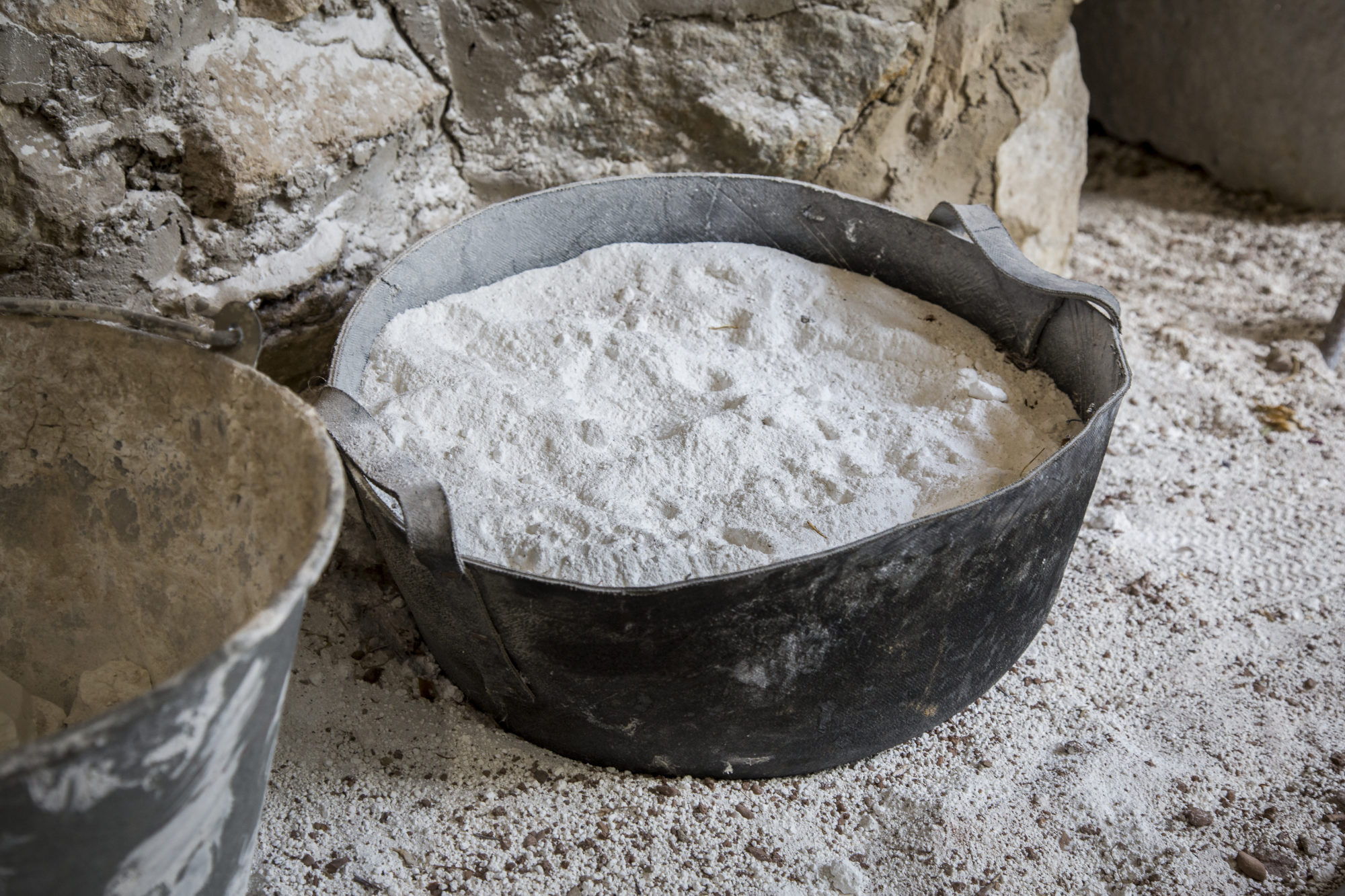
  • It is a sedimentary rock primarily composed of calcium sulfate dihydrate (CaSO4 · 2H2O) and anhydrite (CaSO4).
  • Gypsum is found in both crystal and rock forms. 
  • Occurrence: It commonly occurs in extensive beds alongside evaporite minerals like anhydrite and halite, especially in Permian and Triassic sedimentary formations.
  • It is often found in saline lakes and salt pans and constitutes a significant part of cap rock on salt domes,
  • It generally results from the evaporation of saline water and is one of the more common minerals in sedimentary conditions.
  • Gypsum that occurs in nature is called mineral gypsum.
  • In India, marine gypsum is recovered from salt pans during production of common salt in coastal regions, particularly in Gujarat and Tamil Nadu.

Applications of Gypsum

  • Agricultural use: It works as an agent to remove Saline/Alkaline ingredients in the soil. It acts more or less like manure.
  • Industrial use: It is used in manufacturing lime and in the cement industry and also used in manufacturing Plaster of Paris.

Source: TH

Gypsum FAQs

Q1: Gypsum is a type of?

Ans: Sedimentary rock

Q2: Gypsum is used in which of the following industries?

Ans: Construction, Agriculture and Pharmaceuticals

Carbon-14

What is Carbon-14

Carbon-14 Latest News

Martin Kamen and Samuel Ruben's discovery of the radioactive isotope carbon-14 in 1940 helped usher in a new era of dating artifacts from past civilizations.

About Carbon-14

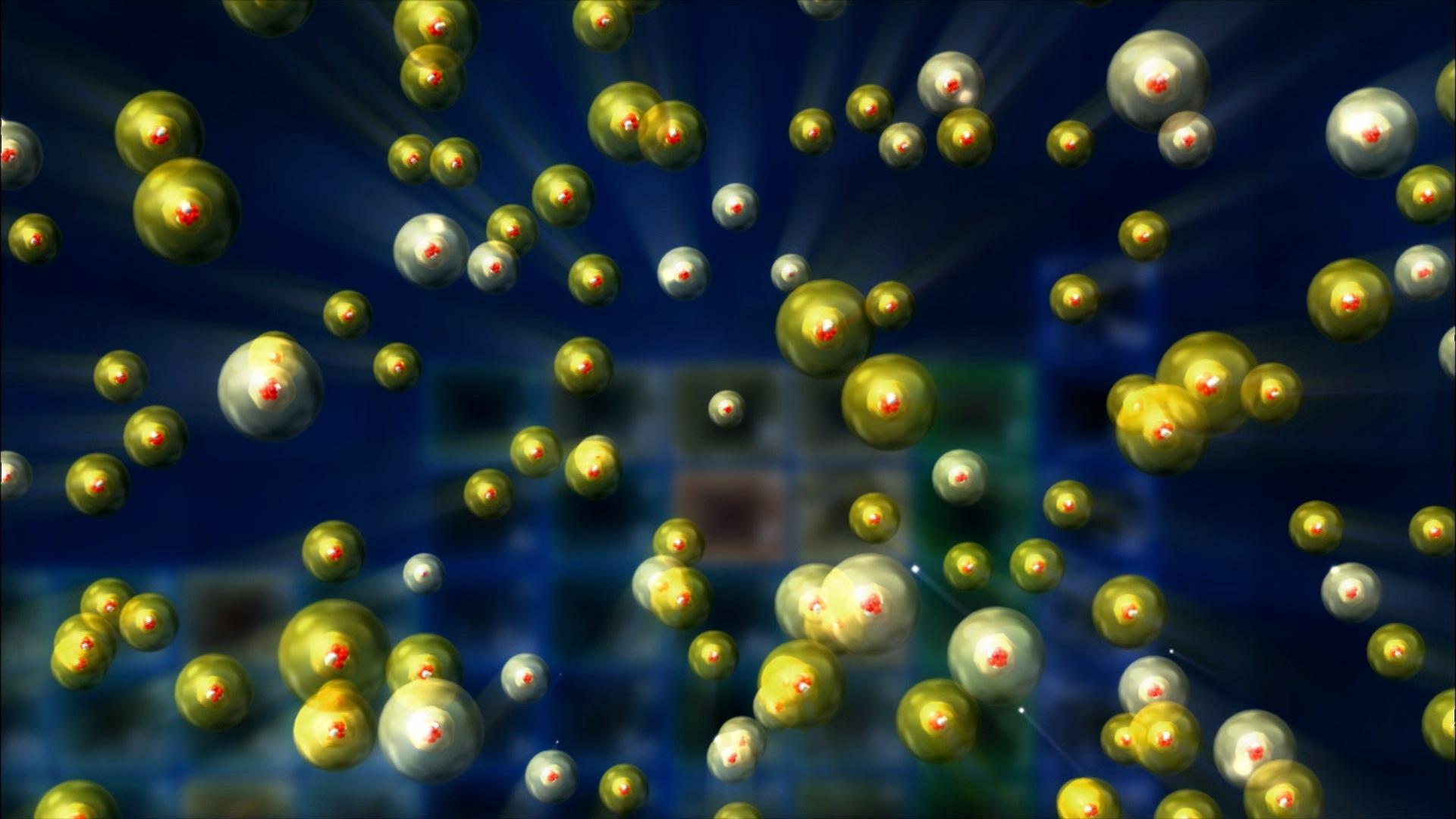
  • Carbon has three main isotopes: carbon-12, carbon-13, and carbon-14. The first two are stable.
  • Carbon-14 is a radioactive isotope of carbon.
  • It is created in the atmosphere through the bombardment of nitrogen by cosmic rays.
  • It has six protons and eight neutrons in its nucleus. 
  • By contrast, most of the carbon in our bodies and in the outside world, known as carbon-12, has six protons and six neutrons. 
  • Crucially, those two extra neutrons make the nucleus of a carbon-14 atom unstable so that it decays radioactively into an atom of nitrogen.
  • It is used in radiocarbon dating to determine the age of organic substances by measuring its decay over time.

What is Radiocarbon Dating, or Carbon-14 Dating?

  • It is a method that provides objective age estimates for carbon-based materials that originated from living organisms.
  • It is based on the fact that living organisms—like trees, plants, people, and animals—absorb carbon-14 into their tissue. 
  • When they die, the carbon-14 starts to change into other atoms over time. 
  • Carbon-14 has a half-life of approximately 5,730 years (i.e., half the amount of the isotope present at any instant will undergo spontaneous disintegration during the succeeding 5,730 years).
  • Because carbon-14 decays at this constant rate, an estimate of the date at which an organism died can be made by measuring the amount of its residual carbon-14. 
  • The technique was developed in the late 1940s at the University of Chicago by a team led by chemistry professor Willard Libby, who would later receive the Nobel Prize for the work.
  • It has proved to be a versatile technique of dating archaeological specimens from 500 to 50,000 years old.
  • Over the years, carbon-14 dating has also found applications in geology, hydrology, geophysics, atmospheric science, oceanography, paleoclimatology, and even biomedicine.

Source: LS


Carbon-14 FAQs

Q1: What is Carbon-14?

Ans: It is a radioactive isotope of carbon.

Q2: How is Carbon-14 formed in the atmosphere?

Ans: It is formed when cosmic rays bombard nitrogen atoms.

Q3: How many protons and neutrons are present in a Carbon-14 atom?

Ans: It has six protons and eight neutrons.

Q4: What is the primary use of Carbon-14?

Ans: It is used in radiocarbon dating to determine the age of organic materials.

Q5: What is the half-life of Carbon-14?

Ans: Approximately 5,730 years.

Sulawesi Island

Sulawesi Island

Sulawesi Island Latest News

In a limestone cave on the Indonesian island of Sulawesi, a hand stencil has been dated to at least 67,800 years ago, making it the oldest known example of rock art currently identified anywhere in the world.

About Sulawesi Island

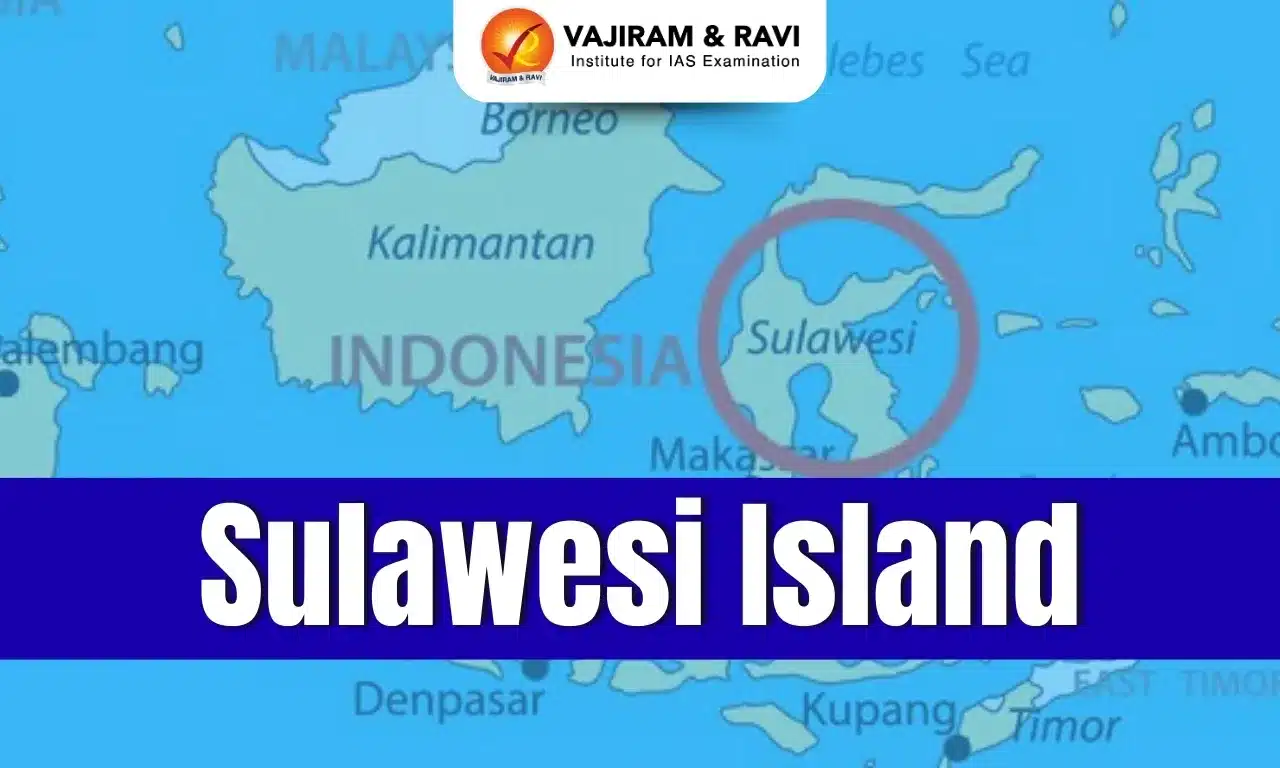
  • Sulawesi, formerly known as Celebes, is a large island in Southeast Asia, in the Indonesian archipelago.
  • It sits centrally within the Indonesian archipelago.
  • It is part of the island chain known as the Greater Sunda Islands. 
  • It is the 11th largest island in the world. It covers an area of 180,680.7 sq. km.
  • The island consists almost entirely of four interconnecting peninsulas. Three large bays, or gulfs, separate these peninsulas.
  • Makassar is the largest city on the island.
  • The island is surrounded on all sides by other big islands: Borneo to the west, the Philippines to the north, the Maluku Islands to the east, and Flores and Timor to the south.
  • The island is highly mountainous, with some active volcanoes.
  • The highest peak on the island of Sulawesi is Mt. Ratenkombola, which is also known simply as Mario.
  • Sulawesi is known for its rainforests, which once covered the entire island until human activity led to mass deforestation.
  • It is home to 127 types of native mammals. A large number, 62% (79 species), are endemic.
  • The island contains thirteen freshwater lakes, including the deepest lake, Matano, in Southeast Asia.
  • It has several remarkable prehistoric cave paintings depicting ancient hunts and animal life. 
  • Seven major ethnic groups inhabit Sulawesi: the Toala, Toraja, Buginese, Makassarese, Minahasan, Mori, and Gorontalese.

Source: TOI


Sulawesi Island FAQs

Q1: Where is Sulawesi Island located?

Ans: Sulawesi is located in Southeast Asia, centrally within the Indonesian archipelago.

Q2: Sulawesi is part of which island group?

Ans: It is part of the Greater Sunda Islands.

Q3: Which is the largest city on Sulawesi?

Ans: Makassar is the largest city.

Q4: What type of terrain dominates Sulawesi?

Ans: The island is highly mountainous and has some active volcanoes.

Porcelain

What is Porcelain

Porcelain Latest News

In the waters off Singapore, a recently uncovered shipwreck with a huge cargo of blue-and-white porcelain is shedding light on the storied Chinese craft produced during the turbulent era of the Mongol Empire.

About Porcelain

  • It is a type of ceramic material that is highly durable and has high-performance characteristics due to its production process.
  • It is made from a combination of natural materials including kaolin (china clay), feldspar, and quartz.
  • Porcelain was first made in China—in a primitive form during the Tang dynasty (618–907 CE) and in the form best known in the West during the Yuan dynasty (1279–1368 CE). 
  • The word porcelain is derived from porcellana, used by Marco Polo to describe the pottery he saw in China.
  • It is often called “china.”
  • There are three major types of porcelain historically used in dinnerware and decorative pieces: hard paste, soft paste, and bone china. 
    • Hard-paste porcelain dates back to antiquity in China and gets its durability from firing at a very high temperature. 
    • The exact composition of porcelain varies depending on its use and the manufacturer, though one common ingredient is kaolin, a soft white clay that is combined with other ingredients like mica, quartz, and feldspar.
    • Soft-paste porcelain was made by Europeans attempting to achieve the durability and translucence of Chinese porcelain.
      • It often incorporated materials like ground glass or soapstone and was fired at a lower temperature.
    • Finally, bone china incorporates up to 50% bone ash in its recipe and was developed during the mid-18th century in England. 
  • Properties of Porcelain:
    • High material density.
    • Smooth, glossy surface, which is particularly translucent and gives porcelain products a refined, elegant character.
    • High resistance to scratches and breakage, making it ideal for everyday use as well as special occasions.

Source: CNN


Porcelain FAQs

Q1: What is porcelain?

Ans: Porcelain is a highly durable ceramic material known for its high-performance characteristics and refined finish.

Q2: Which natural materials are primarily used to make porcelain?

Ans: Porcelain is made from kaolin (china clay), feldspar, and quartz.

Q3: Where was porcelain first produced?

Ans: Porcelain was first produced in China.

Q4: What are the key physical properties of porcelain?

Ans: Porcelain has high density, a smooth glossy and translucent surface, and strong resistance to scratches and breakage.

New Income Tax Slab 2026-27, Rates for FY 2026-27

new income tax slab 2026

The finance minister of India, Nirmala Sitharaman has announced the changes in the New Income Tax Slabs under new tax regime in Budget 2025. This budget contained significant initiatives across multiple sectors, aiming to promote economic growth, support agriculture, enhance infrastructure, and introduce various reforms. Keep reading the article to have a clear understanding about the New Income Tax Slab Rates.

New Income Tax Slab 2026-27

The income tax is a direct tax that follows a progressive slab system, where the tax rate increases as income rises. Under the Income-tax Act, 1961, taxpayers choose between two regimes: the new regime and the old regime. 

In Budget 2025, the Finance Minister announced no income tax will be payable for income up to ₹12 lakh under the new regime, as the rebate has been increased to ₹60,000. The New Income Tax Slab for the new regime for FY 2026-27 has also been announced.

[youtube url="https://www.youtube.com/live/KzlPvOUPrvU" width="560" height="315"]

New Income Tax Slab Features

The New Tax Regime 2026 includes various changes to simplify taxation and provide ease to taxpayers. The New Income Tax Slab Features Includes:

  1. The first ₹3 lakh from the annual income is completely tax-free, offering significant benefits to low-income earners. 
  2. New Income Tax Slab ensures a fair distribution of the tax burden. 
  3. The new regime simplifies tax calculations, making it easier for individuals to understand and comply with the tax system.

New Income Tax Slab Rates

The New Income Tax Slab Rates under the New Tax Regime for FY 2026–27 introduce updated brackets aimed at reducing the tax burden on middle-income earners. Below shared are the simplified revised tax slabs:

New Income Tax Slab Rates

Income Range (₹)

Tax Rate (%)

Up to ₹4,00,000

NIL

₹4,00,000 – ₹8,00,000

5

₹8,00,000 – ₹12,00,000

10

₹12,00,000 – ₹16,00,000

15

₹16,00,000 – ₹20,00,000

20

₹20,00,000- ₹24,00,000

25

Above 24,00,000

30

New Tax Regime vs Old Tax Regime

Below we have shared the comparison between tha New Tax Regime vs Old Tax Regime:

New Tax Regime vs Old Tax Regime

New Tax Regime

Old Tax Regime


Introduction

Introduced in April 2023

Traditional tax regime existing prior to the new regime

Basic Income Exemption Limit

Rs 3 lakh for all taxpayers

Varies depending on taxpayer category and deductions

Tax Rates and Slabs

More income tax slabs with lower rates

Fewer slabs with comparatively higher rates

Standard Deduction

Rs 50,000 from salary/pension income

Available, but limited to specific categories

Employer’s NPS Contribution

Up to 10% of salary (14% for government employees)

Deductions available for employer’s NPS contribution

Deductions Available

Limited to standard deduction and employer’s NPS contribution

Wide range of deductions under various sections (80C, 80D, etc.)

Flexibility vs. Simplicity

Simplified structure with fewer deductions

Offers flexibility with multiple deductions

Tax Planning Strategies

Requires careful planning due to limited deductions

Offers more options for tax planning and optimization

Long-term Financial Goals

May be suitable for individuals seeking simplicity

Beneficial for those prioritizing tax savings through deductions

Considerations

Individual income level, eligibility for deductions

Long-term financial goals, tax planning objectives

New Income Tax Slab FAQs

Q1: What is the new income tax slab for 2026-27?

Ans: Check out the new income tax slab for 2026-27 in the article above.

Q2: Is the new tax regime slab 2026-27?

Ans: No income tax will be payable on annual income of up to 12 Lakhs.

Q3: What is the new tax rebate for 2026 27?

Ans: Incomes of up to Rs 12 lakh are eligible for rebate of up to Rs 60,000 under the new tax regime.

Q4: Is 7 lakh income tax free?

Ans: The Finance Minister increased the no-tax limit from ₹7 lakh to ₹12 lakh.

Q5: How upto 12 lakh is tax-free?

Ans: No income tax will be payable on annual income of up to 12 Lakhs.

Gitchak nakana

What is Gitchak nakana

Gitchak nakana Latest News

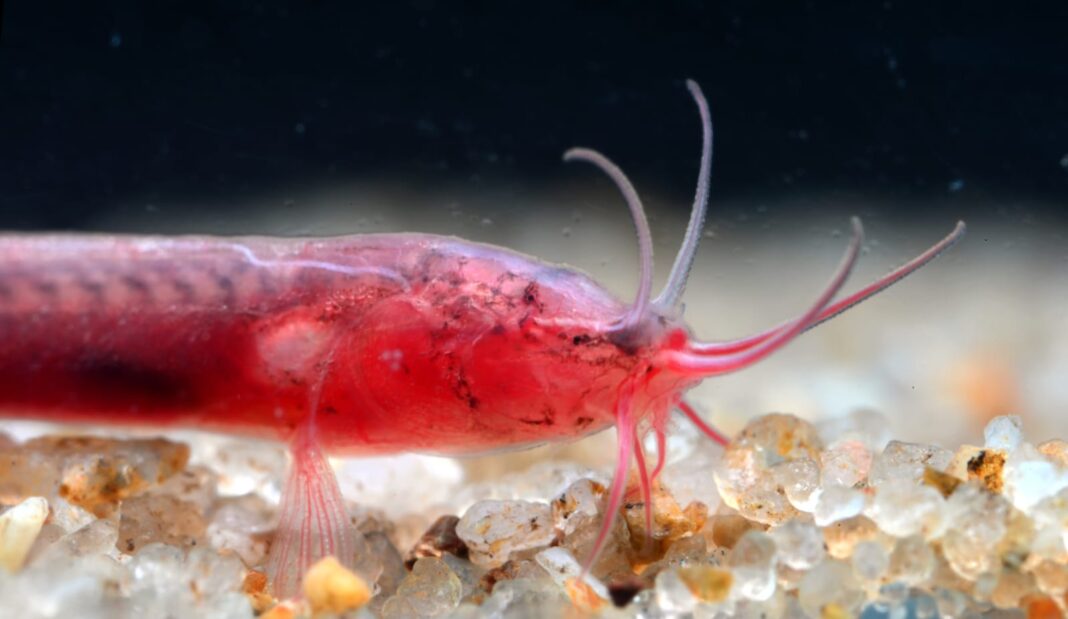
A new groundwater fish species, 'Gitchak Nakana', has been recently discovered in Assam.

About Gitchak nakana

  • It is a new species of groundwater fish.
  • This miniature, blind loach was discovered from a dug-out well in Assam, marking the first aquifer-dwelling (phreatobitic) fish recorded from Northeast India.
  • It belongs to a newly described genus within the family Cobitidae (loaches).
  • Named Gitchak nakana, the species draws from the Garo language, “Gitchak” meaning red, referencing its striking blood-red live colour, and “na-tok” and “kana” referring to a blind fish.
  • It grows to just 2 cm and displays classic subterranean adaptations, or troglomorphies: no externally visible eyes, a translucent, pigmentless body, and extreme miniaturization.
  • It is the most unusual among other groups due to the complete lack of a skull roof, with the brain covered dorsally only by skin.
  • It lives in aquifers, groundwater habitats far more difficult to access. 
    • While more than 300 fish species worldwide are known from subterranean habitats, the vast majority inhabit caves. 
    • Fewer than 10 percent are known from groundwater aquifers, making such discoveries rare.

Source: IT


Gitchak nakana FAQs

Q1: What is Gitchak nakana?

Ans: Gitchak nakana is a newly discovered species of groundwater-dwelling fish.

Q2: Where was Gitchak nakana discovered?

Ans: It was discovered in a dug-out well in Assam.

Q3: Why is the discovery of Gitchak nakana significant for Northeast India?

Ans: It is the first aquifer-dwelling (phreatobitic) fish recorded from the region.

Pax Silica and India – Securing Critical Technology Supply Chains

Pax Silica

Pax Silica Latest News

  • India is likely to be invited to join the U.S.-led Pax Silica initiative aimed at securing global semiconductor, AI, and critical mineral supply chains.

Understanding Pax Silica

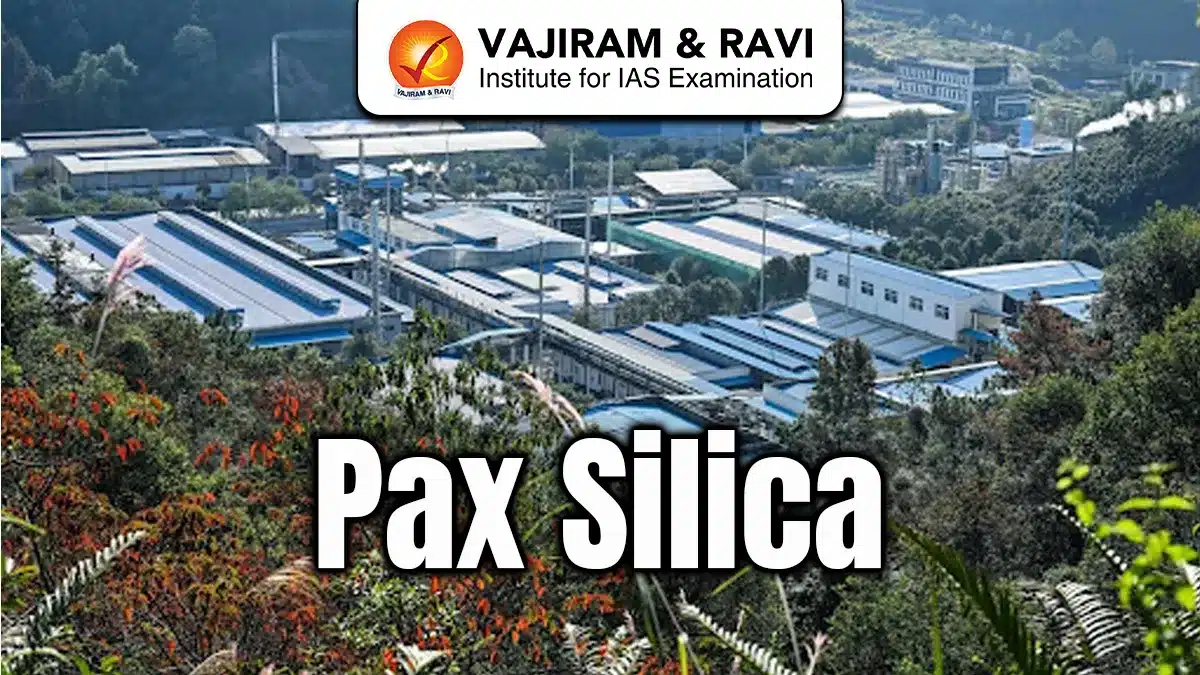
  • Pax Silica is a multilateral initiative launched by the United States in December 2025 to secure supply chains of critical technologies such as semiconductors, artificial intelligence (AI), and rare earth elements (REEs). 
  • The term “Pax” denotes peace, while “Silica” refers to silicon-based semiconductor technologies, symbolising a stable and cooperative global technology order.
  • The Pax Silica Declaration emphasises three core objectives: 
    • Reducing coercive economic dependencies, 
    • Ensuring secure global technology and AI supply chains, and 
    • Building trusted digital infrastructure. 
  • The initiative reflects growing concerns that over-dependence on a single country for critical inputs can expose economies to geopolitical coercion.

Global Context Behind Pax Silica

  • The global economy is witnessing a shift where advanced technologies such as AI, semiconductors, and digital infrastructure are becoming central to economic and strategic power. 
  • At the same time, supply chains for rare earths and critical minerals remain highly concentrated.
  • China currently dominates the global supply of rare earth elements and processing capabilities. 
  • In recent years, it has used export restrictions as a strategic tool, including suspending REE exports following tariff disputes with the U.S. India too faced disruptions in rare-earth magnet supplies, affecting its automobile and electronics industries.
  • The COVID-19 pandemic further exposed vulnerabilities of globally fragmented and concentrated supply chains, prompting countries to pursue diversification and resilience strategies.

Key Members of Pax Silica

  • The Pax Silica grouping brings together technologically advanced and resource-rich countries. 
  • Key participants include the United States and Japan as technology leaders; Australia as a major lithium and rare-earth exporter; the Netherlands for advanced lithography technologies; South Korea for memory chip manufacturing; and Singapore for semiconductor fabrication.
  • Israel contributes expertise in AI software, defence technologies, and cybersecurity, while the United Kingdom hosts one of the world’s largest AI markets. 
  • Gulf countries such as Qatar and the UAE add financial strength through sovereign investment funds. 
  • Canada, the European Union, OECD, and Taiwan currently participate as observers.

India’s Strategic Relevance

  • India is not yet a formal member but is expected to be invited soon. India brings several strengths to Pax Silica. 
  • It has one of the world’s most robust digital public infrastructures, a rapidly growing AI market, and a large pool of skilled technology professionals.
  • The Government of India has also launched the India Semiconductor Mission and national AI initiatives with significant financial support. 
  • Investments by Indian firms such as the Tata Group and foreign companies like Micron indicate growing confidence in India’s semiconductor ecosystem. 
  • Additionally, a steady return of skilled Indian professionals trained abroad could strengthen domestic capabilities.

Existing Supply Chain Initiatives Involving India

  • India has already taken steps to enhance supply chain resilience. In 2021, it joined Australia and Japan in launching the Supply Chain Resilience Initiative
  • India is also part of the Quad’s Critical Minerals Initiative, aimed at securing emerging technology supply chains.
  • Collaborations with Japan, Singapore, and Israel in semiconductor manufacturing further position India as a credible partner in Pax Silica-aligned ecosystems.

Challenges for India in Joining Pax Silica

  • Despite the opportunities, India faces challenges. Pax Silica members are largely high-income U.S. allies, whereas India would be the first developing country and non-ally strategic partner in the grouping. 
  • This may create expectation gaps on policy alignment and strategic responses.
  • India also prioritises strategic autonomy and may resist frameworks that constrain independent foreign or economic policy choices. 
  • Moreover, India may seek to protect its nascent semiconductor and AI industries through subsidies, procurement preferences, and calibrated import controls, policies that may not fully align with the current U.S. policy environment.

Strategic Implications and the Road Ahead

  • The emergence of Pax Silica signals the likelihood of two parallel global technology supply chains, one centred around China and the other around Pax Silica countries. 
  • Given India’s long-standing technological collaboration with Western economies and recent supply disruptions from China, aligning with Pax Silica appears strategically advantageous.
  • However, India is expected to proceed cautiously, engaging in dialogue to ensure that participation strengthens domestic capabilities without compromising strategic autonomy or development priorities.

Source : TH

Pax Silica FAQs

Q1: What is Pax Silica?

Ans: Pax Silica is a U.S.-led initiative aimed at securing global semiconductor, AI, and critical mineral supply chains.

Q2: Why is Pax Silica important for India?

Ans: It can help India reduce dependence on China and strengthen its semiconductor and AI ecosystems.

Q3: Which countries are part of Pax Silica?

Ans: Members include the U.S., Japan, Australia, South Korea, the Netherlands, Singapore, and others.

Q4: What challenges could India face in joining Pax Silica?

Ans: Balancing strategic autonomy, policy flexibility, and expectations of high-income member countries.

Q5: How does Pax Silica impact global geopolitics?

Ans: It signals the emergence of competing technology supply chains led by China and Pax Silica countries.

Disinvestment Policy – Shift from Disinvestment to Asset Monetisation

Disinvestment Policy

Disinvestment Policy Latest News

  • Since the announcement of the revamped Disinvestment Policy (2020) and the Public Sector Enterprises (PSE) Policy (2021), the Union Government initially emphasized privatisation and strategic disinvestment. 
  • However, recent policy developments — including the launch of the National Monetisation Pipeline (NMP) 2.0 — indicate a clear shift from asset sales to value extraction and asset monetisation.
  • The focus is on dividends and leasing of assets instead of outright privatisation.

Evolution of Disinvestment Policy

  • Original privatisation push (2020–21): The Public Sector Enterprises Policy (2021) provides a framework for -
    • Government to exit non-strategic sectors.
    • Minimum presence in strategic sectors.
    • Strategic disinvestment encouraged where private sector capacity exists.
  • Policy rationale: Government should minimise direct business operations. The private sector is seen as more efficient in managing enterprises.

Declining Disinvestment Revenues

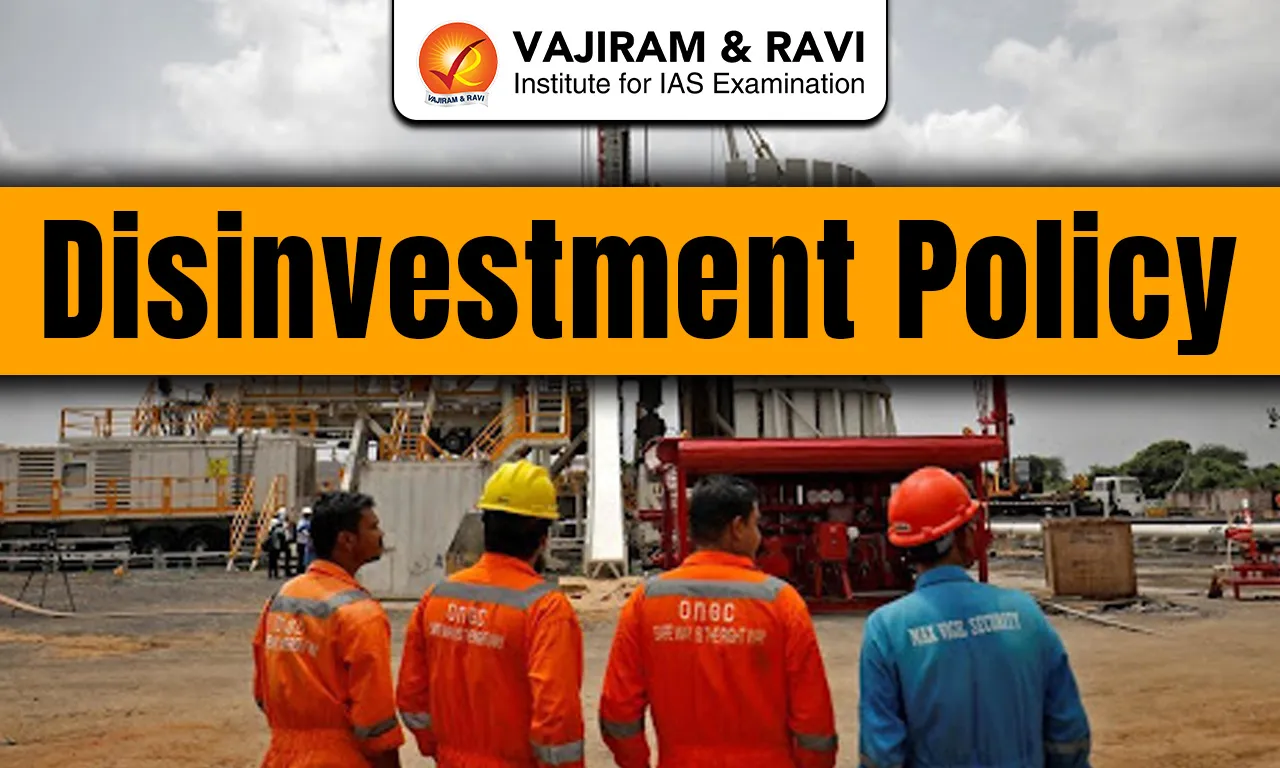
  • Temporary surge: 2022–23 disinvestment revenue (₹35,294 crore), with stake sales in ONGC, LIC, GAIL, and IRCTC, ended a four-year declining trend.
  • Subsequent decline: Disinvestment proceeds fell sharply. For example, from a disinvestment revenue of ₹16,507 crore in 2023-24 to ₹10,163 crore (2024-25) and ₹15,562 crore (till date in 2025–26).
  • Policy signals:
    • Key changes indicate reduced emphasis on privatisation.
    • Removal of separate disinvestment category in Budget documents.
    • Disinvestment receipts merged into “Miscellaneous Capital Receipts.”
    • No annual disinvestment targets.

Reasons for Reduced Privatisation

  • Limited private sector interest: 
    • Key constraints include large employee headcounts, loss-making assets, structural inefficiencies, and political and labour resistance.
    • These factors made many Public Sector Enterprises unattractive to private investors.
  • Increasing focus on dividend income:
    • Consistent Dividend Policy (2020): The Department of Investment and Public Asset Management (DIPAM) advised CPSEs to pay higher dividends, use cash reserves efficiently, and balance capex needs and profitability.
    • Capital Restructuring Guidelines (2024): Revised guidelines emphasized value creation in CPSEs, maximising returns for the government.
    • Rising dividend receipts: From ₹39,750 crore in 2020–21 to ₹74,128 crore (2024-25) and ₹59,730 crore (so far in 2025-26). Dividend income now significantly exceeds disinvestment proceeds.

Asset Monetisation as the New Strategy

  • National Monetisation Pipeline (NMP)
    • Launched in 2021 to monetise brownfield infrastructure assets through leasing arrangements. Key features include -
      • No transfer of ownership
      • Private sector participation
      • Revenue generation from idle or underutilised assets
    • Performance: About 90% of the target [₹6 lakh crore (2021–25)] achieved.
  • National Monetisation Pipeline 2.0 (2025–30):
    • Target: ₹16.72 lakh crore
    • Focus sectors: Transport infrastructure, energy assets, telecom, warehousing, etc.
    • This represents a major expansion of the asset monetisation approach.

Advantages of the New Approach

  • Fiscal benefits: Stable and predictable revenue through dividends. Reduced political resistance compared to privatisation. Avoids one-time asset sales.
  • Economic benefits: Improves utilisation of public assets, encourages private sector efficiency, and retains public ownership.
  • Administrative benefits: Lower complexity compared to strategic disinvestment, and faster implementation.

Challenges and Way Forward

  • Fiscal risks: Dividend extraction may reduce reinvestment capacity of CPSEs. Overdependence on dividends can weaken long-term growth.
    • Strengthen corporate governance: Professional management of CPSEs, reduced political interference.
    • Selective privatisation: Focus on loss-making non-strategic sectors.
  • Structural issues: Persistent inefficiencies in CPSE management. Asset monetisation does not address operational problems.
    • Balanced public sector reform: Combine strategic disinvestment with monetisation  and governance reforms.
  • Market risks: Private sector interest depends on economic conditions. Monetisation revenues may fluctuate.
    • Efficient asset monetisation: Transparent bidding processes, and strong regulatory oversight.
  • Policy inconsistency: Shift from privatisation to monetisation may create uncertainty among investors.
    • Sustainable dividend policy: Avoid excessive dividend extraction, and ensure adequate capital expenditure.

Conclusion

  • India’s public sector reform strategy is undergoing a significant transition from privatisation to asset monetisation and dividend extraction. 
  • While this approach provides steady fiscal returns and political acceptability, long-term success will depend on balancing revenue generation with the financial health and competitiveness of CPSEs. 
  • A calibrated mix of privatisation, monetisation, and governance reforms remains essential for sustainable public sector management.

Source: TH

Disinvestment Policy FAQs

Q1: What is the changing approach of the Government of India in managing Public Sector Enterprises (PSEs)?

Ans: It has shifted from strategic disinvestment to asset monetisation and dividend extraction to generate stable revenues.

Q2: Why has strategic disinvestment in India slowed down in recent years?

Ans: Due to limited private sector interest, labour liabilities, loss-making assets, and valuation challenges.

Q3: How does asset monetisation differ from privatisation in public sector reforms?

Ans: Asset monetisation involves leasing public assets without transfer of ownership, whereas privatisation involves sale of government equity and control.

Q4: What is the fiscal significance of dividend income from CPSEs?

Ans: Rising CPSE dividends provide a stable and recurring source of non-tax revenue.

Q5: What are the long-term implications of relying on CPSE dividends instead of disinvestment?

Ans: Excessive reliance on dividends may weaken CPSE investment capacity and delay structural reforms.

Israel-US Joint Missile Strike in Tehran: Escalation Across the Middle East

Israel-US Joint Missile Strike in Tehran

Israel-US Joint Missile Strike in Tehran Latest News

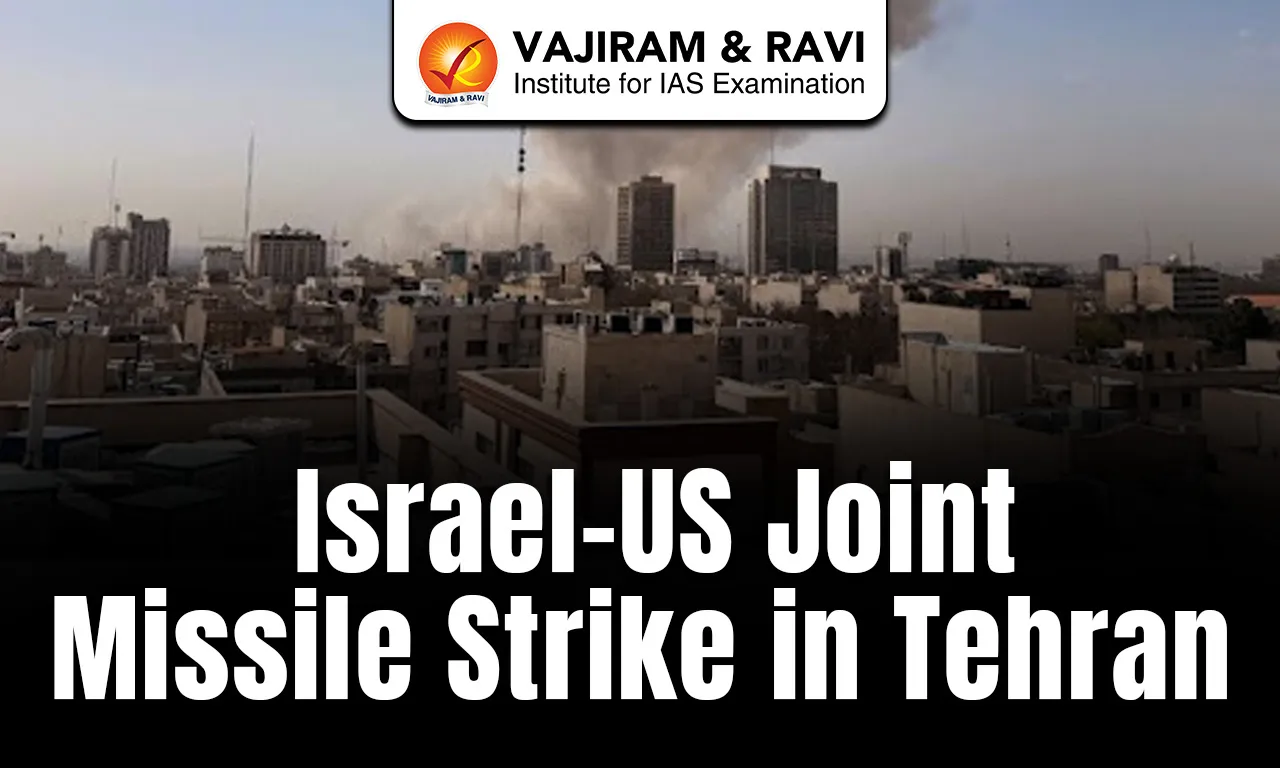
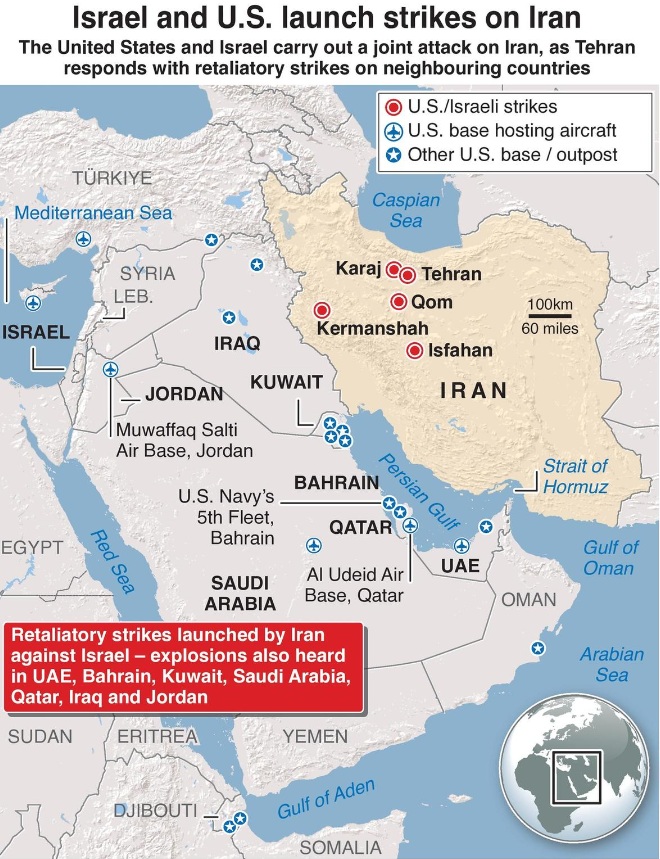
  • On February 28, 2026, Israel carried out a daylight strike on Tehran, calling it a pre-emptive operation. US President Donald Trump confirmed American involvement, stating that major combat operations had begun to stop Iran from developing nuclear weapons.
  • Iran responded with missile and projectile attacks on Israeli territory and subsequently expanded its retaliation by targeting US bases in Qatar, Bahrain, Jordan, Kuwait, and the UAE.
  • The widening scope of strikes has pushed the crisis beyond a bilateral confrontation, placing the entire Middle East under threat of a broader regional war.

What Happened in Iran

Israel US Attack on Iran

  • Explosions were reported in Tehran, with smoke seen rising from several parts of the capital.
  • Israel initially announced missile strikes on Iranian targets. A US official later confirmed the attacks were part of a joint military operation.
  • Trump called the operation “massive and ongoing,” and the US Department of Defense named it Operation Epic Fury.

Iran’s Response

  • Iran retaliated by launching missiles toward northern Israel. Air-raid sirens were activated, and Israeli air defence systems intercepted incoming projectiles.
  • Iran expanded its response by targeting US-linked military facilities across the Middle East, including:
    • Al Udeid Airbase (Qatar)
    • Al-Salem Airbase (Kuwait)
    • Al-Dhafra Airbase (UAE)
    • US Fifth Fleet Headquarters (Bahrain)
  • Reports also indicated explosions in Saudi Arabia and attacks on US bases in Jordan.

Trigger Behind The Attack: Breakdown of Nuclear Talks and Rising Tensions

  • The escalation follows mounting strain over stalled US–Iran nuclear negotiations. A recent round of indirect talks in Geneva, mediated by Oman, failed to produce a breakthrough, though technical discussions are set to continue.
  • Iran insists on its right to enrich uranium for peaceful purposes, while the US demands strict limits on its nuclear programme. 
  • President Trump had expressed dissatisfaction with the pace of talks and repeatedly described Iran as an “imminent threat” and the world’s “number one terror sponsor,” signalling growing impatience ahead of the military action.

India’s Diplomatic Test Amid Israel–Iran Escalation

  • Less than two days after PM Modi’s visit to Israel, India faced a major diplomatic challenge as US–Israel strikes on Iran and Tehran’s retaliation widened the regional conflict. 
  • With deep strategic, economic, and diaspora stakes in West Asia, New Delhi called for restraint, de-escalation, and dialogue.

Diaspora and Evacuation Concerns

  • India has significant diaspora exposure:
    • ~10,000 Indians in Iran
    • Over 41,000 in Israel
    • 8–9 million across the wider Gulf
  • Embassies issued advisories amid airspace closures and flight disruptions. 
  • India’s approach reflects past experience, including the evacuation of over 3,000 nationals during the previous Israel–Iran flare-up.

Strategic and Economic Stakes

  • Beyond citizen safety, India’s energy security is at risk. 
  • Nearly 60% of India’s energy imports come from the region, and threats to close the Strait of Hormuz raise concerns over oil supply disruptions.
  • The US role and President Trump’s explicit stance on Iran further complicate India’s balancing act between strategic partner Israel and longstanding partner Iran.

A Tightrope of Strategic Autonomy

  • India’s response mirrors its approach to the Russia–Ukraine war: maintaining strategic autonomy, avoiding public condemnation, keeping communication channels open, and prioritising national interests.
  • However, as the Middle East conflict expands and US involvement deepens, India’s room for calibrated neutrality may narrow. 
  • The evolving regional dynamics will test New Delhi’s diplomatic agility in preserving its core interests.

Source: IE | IE | TH

Israel-US Joint Missile Strike in Tehran FAQs

Q1: What triggered the Israel-US Joint Missile Strike in Tehran?

Ans: The Israel-US Joint Missile Strike in Tehran followed stalled nuclear talks and mounting US pressure over Iran’s uranium enrichment programme.

Q2: How did Iran respond to the Israel-US Joint Missile Strike in Tehran?

Ans: After the Israel-US Joint Missile Strike in Tehran, Iran launched missiles at Israel and targeted US bases across the Gulf region.

Q3: What is Operation Epic Fury in the Israel-US Joint Missile Strike in Tehran?

Ans: Operation Epic Fury is the US military codename for its involvement in the Israel-US Joint Missile Strike in Tehran.

Q4: How does the Israel-US Joint Missile Strike in Tehran affect India?

Ans: The Israel-US Joint Missile Strike in Tehran threatens energy supplies, diaspora safety, and regional stability affecting India’s strategic interests.

Q5: Why is the Israel-US Joint Missile Strike in Tehran significant globally?

Ans: The Israel-US Joint Missile Strike in Tehran risks widening into a regional war, impacting global oil markets and geopolitical alignments.

India–Brazil Critical Minerals MoU: Securing Strategic Supply Chains

India–Brazil Critical Minerals MoU

India–Brazil Critical Minerals MoU Latest News

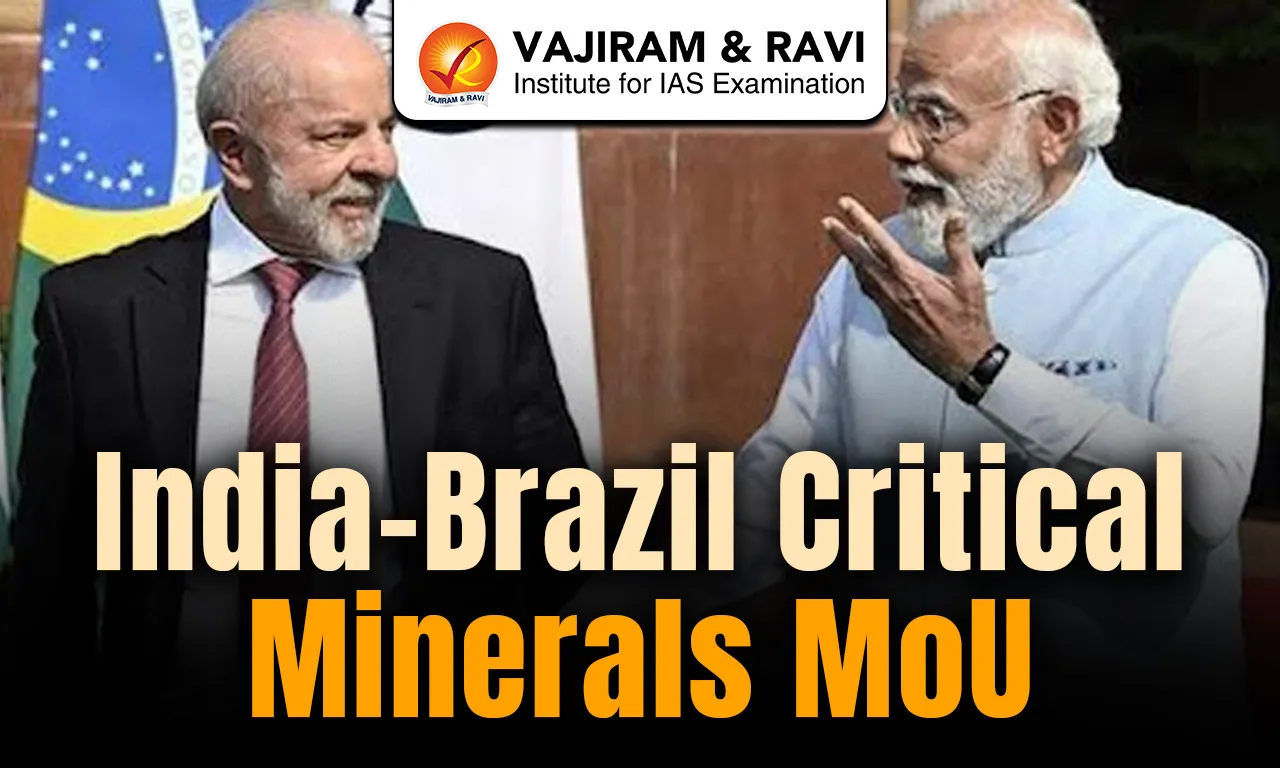
  • India and Brazil signed an MoU on rare earths and critical minerals during President Lula da Silva’s visit to India in February 2026.
  • The agreement aims to deepen cooperation across the entire mineral value chain — including exploration, mining, processing, refining, and recycling. 
  • Both countries seek to strengthen supply chains, enhance competitiveness, and secure reliable access to critical resources essential for strategic and industrial sectors.

India’s Strategy on Critical Minerals

  • India is working to strengthen its capabilities across the entire critical minerals value chain — from exploration and mining to processing, recycling, and recovery.
  • In January 2025, the Union Cabinet approved the National Critical Mineral Mission (2024–25 to 2030–31) to accelerate domestic exploration, beneficiation, processing, and recovery from end-of-life products.

Policy and Regulatory Measures

  • Identification of Critical Minerals - In July 2023, India released a list of 30 critical minerals essential for strategic and industrial sectors.
  • Legal Reforms - The Mines and Minerals (Development and Regulation) Amendment Act, 2023 empowered the Centre to auction blocks for critical and strategic minerals. By September 2025, multiple auction rounds had been conducted.
  • Overseas Partnerships - To reduce reliance on a single country, India is expanding international cooperation. Khanij Bidesh India Ltd. (KABIL) is pursuing overseas acquisitions and exploration agreements in countries such as Argentina and Chile.
  • Trade and Cost Rationalisation - India has reduced customs duties on certain critical minerals and recyclable scrap to lower input costs and improve domestic processing capacity.
  • Boosting Advanced Manufacturing - The government is promoting late-stage manufacturing. India aims to begin domestic production of rare-earth permanent magnets by end-2026 to cut import dependence in sectors like electric vehicles and defence.

What the India–Brazil MoU Means for India

  • Access to Substantial Mineral Reserves - Brazil possesses significant rare earth and critical mineral reserves, of which only about 30% have been explored. The MoU opens avenues for India to partner in exploration and processing, potentially expanding its long-term resource base.
  • Strengthening India’s Bargaining Power - Diversifying supply sources enhances India’s leverage in global markets. With Brazil as an alternative partner, India is less dependent on a limited number of suppliers, improving its negotiating position on pricing and terms.
  • Enhancing Supply Chain Stability - The agreement signals greater supply security to Indian industries. By reducing vulnerability to export controls or geopolitical disruptions, it can encourage higher private-sector investment in downstream manufacturing.
  • Facilitating Standards and Market Access - If India and Brazil harmonise environmental and sourcing standards, Indian manufacturers could more easily access global markets that require transparent and responsible mineral supply chains.

Link Between the India–Brazil MoU and Pax Silica

  • Pax Silica is a U.S.-led initiative aimed at securing the “silicon stack” — from raw materials and manufacturing equipment to advanced computing, data centres, and AI hardware. 
    • India joined the initiative on February 20, 2026.
  • The India–Brazil critical minerals MoU complements Pax Silica’s broader goal of securing supply chains. 
  • By improving access to and processing of key minerals, the MoU could support one component of the secure silicon ecosystem.
  • However, the MoU does not make Brazil a Pax Silica member, nor will cooperation under the MoU operate as a Pax Silica project. 
  • It remains a separate bilateral arrangement aligned with broader supply chain security objectives.

What the India–Brazil MoU Means for Brazil

  • Leveraging Vast Mineral Reserves - Brazil holds substantial reserves of rare earths, bauxite, manganese, and lithium. The MoU provides an opportunity to convert this mineral wealth into greater industrial value rather than merely exporting raw materials.
  • Attracting Investment and Buyers - The agreement can help Brazil draw Indian investment into exploration, mining, and processing projects. Long-term purchase commitments from a large and growing market like India make financing new mines and processing facilities more viable.
  • Moving Up the Value Chain - By covering exploration, mining, refining, recycling, and processing, the MoU aligns with Brazil’s objective to strengthen its domestic value chain and reduce dependence on raw ore exports.
  • Enhancing Strategic Leverage - Partnership with India strengthens Brazil’s bargaining power in global critical mineral markets, diversifies its partnerships, and positions it as a more influential player in supply chain negotiations.

Source: TH

India–Brazil Critical Minerals MoU FAQs

Q1: What is the India–Brazil Critical Minerals MoU about?

Ans: The India–Brazil Critical Minerals MoU promotes cooperation in exploration, mining, processing, refining, and recycling of rare earths and critical minerals.

Q2: How does the India–Brazil Critical Minerals MoU benefit India?

Ans: The India–Brazil Critical Minerals MoU diversifies supply sources, improves bargaining power, and supports India’s strategy to secure critical mineral supply chains.

Q3: What does the India–Brazil Critical Minerals MoU mean for Brazil?

Ans: The India–Brazil Critical Minerals MoU helps Brazil attract Indian investment, move up the value chain, and secure long-term buyers for its mineral resources.

Q4: Does the India–Brazil Critical Minerals MoU link to Pax Silica?

Ans: The India–Brazil Critical Minerals MoU complements Pax Silica’s supply chain goals but remains a separate bilateral agreement.

Q5: Why are critical minerals important in the India–Brazil Critical Minerals MoU?

Ans: Critical minerals are vital for EVs, defence, semiconductors, and clean energy, making the India–Brazil Critical Minerals MoU strategically significant.

Rice Fortification Scheme Suspended – Explained

Rice Fortification

Rice Fortification Latest News

  • The Centre has temporarily discontinued the Rice Fortification Scheme under PMGKAY and allied schemes, citing findings from an IIT Kharagpur study on nutrient stability. 

Background of the Rice Fortification Scheme

  • Rice fortification was introduced as a nutritional intervention to address widespread anaemia and micronutrient deficiencies in India. 
  • Under this initiative, Fortified Rice Kernels (FRK), enriched with iron, folic acid, and vitamin B12, were blended with regular rice and distributed through welfare schemes.
  • The scheme was implemented under the Pradhan Mantri Garib Kalyan Anna Yojana (PMGKAY), as well as through the Public Distribution System (PDS), Integrated Child Development Services (ICDS), and the Mid-Day Meal Scheme.
  • The objective was to provide essential micronutrients to vulnerable populations, particularly women and children, by leveraging the existing foodgrain distribution network.

Government Decision to Suspend Fortification

  • The Union Food Ministry announced that the process of rice fortification would be temporarily discontinued “until a more effective mechanism for delivery of nutrients to beneficiaries is identified.” 
  • The decision followed a review of the implementation of rice fortification under PMGKAY and allied schemes. 
  • The Ministry clarified that this suspension does not reduce foodgrain entitlements and will not affect operations under PDS, ICDS, or the Mid-Day Meal Scheme. 
  • Thus, beneficiaries will continue to receive their allocated foodgrains, albeit without fortification.

Findings of the IIT Kharagpur Study

  • The government had commissioned IIT Kharagpur to assess the shelf life of Fortified Rice Kernels (FRK) and fortified rice under actual storage conditions across diverse agro-climatic zones. 
  • The study concluded that factors such as Moisture content, Storage condition, Temperature, Relative Humidity and Packaging Material critically influence the stability and shelf life of fortified rice. 
  • The report found that FRK and fortified rice are susceptible to micronutrient reduction during prolonged storage and routine handling. 
  • Since rice in the central pool may remain in storage for two to three years, the effective shelf life of fortified rice was found to be shorter than expected, thereby limiting the intended nutritional outcomes. 
  • These findings raised concerns about whether beneficiaries were actually receiving the expected nutritional benefits.

Supply and Storage Context

  • According to official data, against an annual allocation of 372 lakh metric tonnes (LMT) under PMGKAY and other welfare schemes, total availability in the central pool is projected at 674 LMT, including receipts from the Kharif Marketing Season (KMS) 2025-26. 
  • Large procurement volumes and extended storage duration increase the challenges associated with maintaining nutrient stability in fortified rice.
  • The suspension reflects the difficulty of implementing nutrient-sensitive interventions within large-scale foodgrain logistics systems.

Activist and Public Health Perspectives

  • Activists who had challenged the scheme in the Supreme Court welcomed the move. 
  • They argued that fortification is not a scientific method to curb anaemia and that not all anaemia is linked to iron deficiency. 
  • Critics have raised concerns about the safety, cost-effectiveness, and regulatory oversight of large-scale fortification. They argue that addressing anaemia requires a more comprehensive approach that includes dietary diversity, improved public health measures, and targeted supplementation rather than blanket fortification.
  • This debate highlights the tension between population-wide interventions and targeted nutritional strategies.

Broader Policy Implications

  • India continues to face high levels of anaemia, particularly among women and children, as reflected in National Family Health Survey (NFHS) data. 
  • The rice fortification initiative was seen as a scalable solution leveraging the PDS network.
  • However, the IIT study underscores the importance of:
    • Ensuring scientific validation of large-scale interventions
    • Accounting for storage and climatic variations
    • Monitoring nutrient retention over time
    • Aligning food policy with logistical realities
  • The government has stated that fortification will remain suspended until a more robust and effective nutrient delivery mechanism is developed and operationalised. 
  • This suggests a possible redesign rather than complete abandonment of micronutrient strategies.

Source: TH | BS

Rice Fortification FAQs

Q1: Why has the Rice Fortification Scheme been suspended?

Ans: It has been suspended following an IIT Kharagpur study that found reduced micronutrient stability during prolonged storage.

Q2: What is fortified rice?

Ans: Fortified rice is regular rice blended with fortified rice kernels enriched with iron, folic acid, and vitamin B12.

Q3: Will beneficiaries lose foodgrain entitlements?

Ans: No, foodgrain entitlements under PMGKAY, PDS, ICDS, and Mid-Day Meal schemes remain unchanged.

Q4: What major concern did the IIT study highlight?

Ans: It highlighted that storage conditions reduce micronutrient content, limiting intended nutritional outcomes.

Q5: What is the broader objective of rice fortification?

Ans: The objective is to address anaemia and micronutrient deficiencies among vulnerable populations.

AI Impact Summit 2026, Importance, Three Sutras, Seven Chakras

AI Impact Summit 2026

The Ministry of Electronics and Information Technology (MeitY) is hosting AI Impact Summit 2026 on 16-20 February 2026 at Bharat Mandapam, New Delhi. It will be the first global AI summit held in the Global South.The summit aims to promote inclusive and responsible use of AI through global cooperation.

India AI Impact Summit 2026

  • The India-AI Impact Summit 2026, announced by Prime Minister Narendra Modi, will be held on 16-20 February 2026 in New Delhi. It will be the first global AI summit hosted in the Global South.
  • The summit builds on earlier global meetings such as the UK AI Safety Summit, AI Seoul Summit, France AI Action Summit and the Global AI Summit on Africa. Its aim is to move beyond only discussions and focus on practical results, stronger cooperation and real progress in global AI governance.
  • The summit plans to ensure that AI supports inclusive growth, social development and people-centered innovation, while also protecting the environment. It also aims to strengthen the voice of developing countries so that AI benefits are shared equally across the world.
  • At the same time, it recognizes challenges such as job loss, bias in AI systems and rising energy use. Therefore, the summit focuses on taking concrete steps to manage both the opportunities and risks of Artificial Intelligence.

AI Impact Summit 2026 Need

  • Artificial Intelligence (AI) is rapidly transforming society, economy and governance. It offers major opportunities for development, especially for developing countries, by improving access to services through multi-lingual and digital platforms.
  • In recent years, global efforts like the G20 AI Principles, UN resolutions and the Global Partnership on AI (GPAI) have focused on promoting responsible and ethical use of AI.
  • However, a “Global AI Divide” still exists, as AI resources are concentrated in a few developed countries and big corporations. AI also creates challenges such as job loss, bias and high energy consumption.
  • Therefore, there is a need for coordinated global action to ensure AI is inclusive, fair and beneficial for all.

AI Impact Summit 2026 Three Sutras

The India-AI Impact Summit is based on three main guiding principles, called “Sutras.” These Sutras explain how Artificial Intelligence (AI) should be used for the benefit of all through global cooperation.

  1. People
  • The People Sutra focuses on human welfare. It says that AI should respect cultural diversity, protect human dignity and include everyone in its design and use. Technology must remain human-centered and promote safety, trust and equal benefits for society.
  1. Planet
  • The Planet Sutra highlights environmental responsibility. It calls for the responsible use of AI so that it reduces resource use and helps in climate action and environmental protection. AI development should support global sustainability and not harm the planet.
  1. Progress
  • The Progress Sutra aims at inclusive development. It sees AI as a tool for economic growth and social progress. It supports equal access to AI resources and encourages the use of AI in sectors like health, education, agriculture and governance for overall development.

AI Impact Summit 2026 Seven Chakras of the India

Based on the three main Sutras-People, Planet and Progress, the Summit discussions will focus on seven key areas called “Chakras.” These Chakras represent important areas of international cooperation to ensure that AI brings real and practical benefits to society.

  • Human Capital: AI is changing jobs, creating new roles but replacing old ones, risking an “AI divide.” The Human Capital Chakra promotes skills, AI literacy and fair access to AI benefits for all workers.
  • Science: AI is changing scientific research in areas like health, climate and materials. The Science Chakra promotes global collaboration, clear standards and using AI discoveries for real-world benefits.
  • Resilience, Innovation and Efficiency: As AI use grows, it can harm the environment and affect fair development. The Resilience, Innovation & Efficiency Chakra promotes sustainable, efficient AI systems that work well even with limited resources.
  • Inclusion for Social Empowerment: AI can boost social and economic progress if used inclusively. The Inclusion for Social Empowerment Chakra promotes designing AI that meets the needs of all people fairly.
  • Democratizing AI Resources: AI needs large infrastructure like computing power and data systems, which are mostly in a few countries, creating global inequality. The Democratizing AI Resources Chakra aims to make these resources affordable and accessible to all nations, so everyone can benefit from AI progress.
  • Economic Growth and Social Good: AI can boost economic growth and support social development. The Economic Growth and Social Good Chakra aims to use AI to improve services, increase productivity and promote fair and inclusive development.
  • Safe and Trusted AI: Promoting ethical, secure and reliable AI systems that protect privacy and reduce bias.

Earlier AI Summits

  • The AI Safety Summit 2023 was held in England to discuss risks from advanced (frontier) AI. Twenty-eight countries, including the US, China, India and the EU, signed the Bletchley Park Declaration, the first global agreement on AI safety.
  • The declaration recognized both the benefits and risks of AI, especially in cybersecurity and misinformation, and called for international cooperation and regular summits.
  • India supported risk-based and ethical AI regulation and referred to the proposed Digital India Act, 2023 to regulate AI platforms.
  • This was followed by the AI Seoul Summit (2024), where countries discussed innovation, inclusiveness and responsible AI development. The focus expanded from safety to broader governance and global collaboration.
  • In 2025, the AI Action Summit in Paris emphasized practical cooperation, responsible AI deployment and shared global standards. It highlighted the importance of ensuring that AI benefits are distributed fairly among nations. The 2nd India-France AI Policy Roundtable was held on the sidelines of the summit.

[youtube url="https://www.youtube.com/watch?v=m-rJS68k4Q4" width="560" height="315"]

Significance of AI for India

Artificial Intelligence (AI) has become an important tool for India’s economic growth, better governance and improved quality of life. It supports the goals of People, Planet and Progress by promoting inclusive and sustainable development.

AI in Healthcare

  • AI improves healthcare services, especially in rural areas. It supports telemedicine, early disease detection (like TB and cancer), faster diagnosis, and drug discovery. It also helps in predicting disease outbreaks and reducing treatment costs.

AI in Agriculture & Rural Economy

  • AI helps farmers through weather prediction, pest alerts, crop monitoring using drones, and market price forecasting. Mobile-based advisories and regional language tools provide real-time support to farmers.

AI in Education

  • AI enables personalized learning and provides content in regional languages. Platforms like DIKSHA use AI to make education more accessible and inclusive.

AI in Finance

  • AI strengthens digital payments through fraud detection, improves credit access for the unbanked, and provides 24/7 banking support through chatbots.

AI in Governance

  • AI improves public service delivery, smart city management, translation of court judgments, and efficient case management in the judiciary.
  • Recognizing its importance, the Government of India launched initiatives like the IndiaAI Mission to build AI infrastructure, promote indigenous AI models, and develop skilled manpower.

AI Impact Summit 2026 Key Highlights

  • The AI Impact Expo at Bharat Mandapam would be inaugurated by the Prime Minister, showcasing newly developed Indian AI language models, including sovereign AI models by Sarvam AI and BharatGen.
  • More than 840 exhibitors, including national delegations, tech companies, AI startups and research labs, showcased their AI products and innovations.
  • The Bharat-VISTAAR (Virtually Integrated System to Access Agricultural Resources) tool would be launched in Jaipur. It is an AI-based multilingual platform to help farmers with crop planning, pest control, weather updates and government schemes through a 24/7 AI assistant named Bharati. It initially supports Hindi and English and will later expand to regional languages.
  • The tool also allows stakeholder collaboration and feedback to improve agricultural policies and research.
  • The India AI Readiness Assessment Methodology (RAM) Report, prepared by UNESCO in partnership with the IndiaAI Mission and Ikigai Law, would be released. It will assess India’s preparedness for ethical and responsible AI and give policy recommendations.
  • AI4Bharat (IIT Madras) announced a new benchmark to evaluate speech recognition systems across 15 Indian languages.

AI Impact Summit 2026 FAQs

Q1: What is the AI Impact Summit 2026?

Ans: It is a global AI governance summit hosted by India in February 2026, focusing on inclusive and responsible AI. It is the first such summit held in the Global South.

Q2: Why is the summit needed?

Ans: AI is growing fast but benefits are unequal and risks like job loss and bias exist. The summit aims to ensure fair and coordinated global AI development.

Q3: What are the Three Sutras?

Ans: People (human-centered AI), Planet (environment-friendly AI), and Progress (inclusive economic growth through AI).

Q4: What are the Seven Chakras?

Ans: They focus on Human Capital, science, Resilience, Innovation and Efficiency, inclusion, Democratizing AI Resources, AI for economic and social good and Safe and Trusted AI.

Q5: How is it linked to earlier AI summits?

Ans: It builds on earlier global AI meetings in the UK, Seoul and Paris, moving from safety discussions to practical outcomes and Global South leadership.

Enquire Now