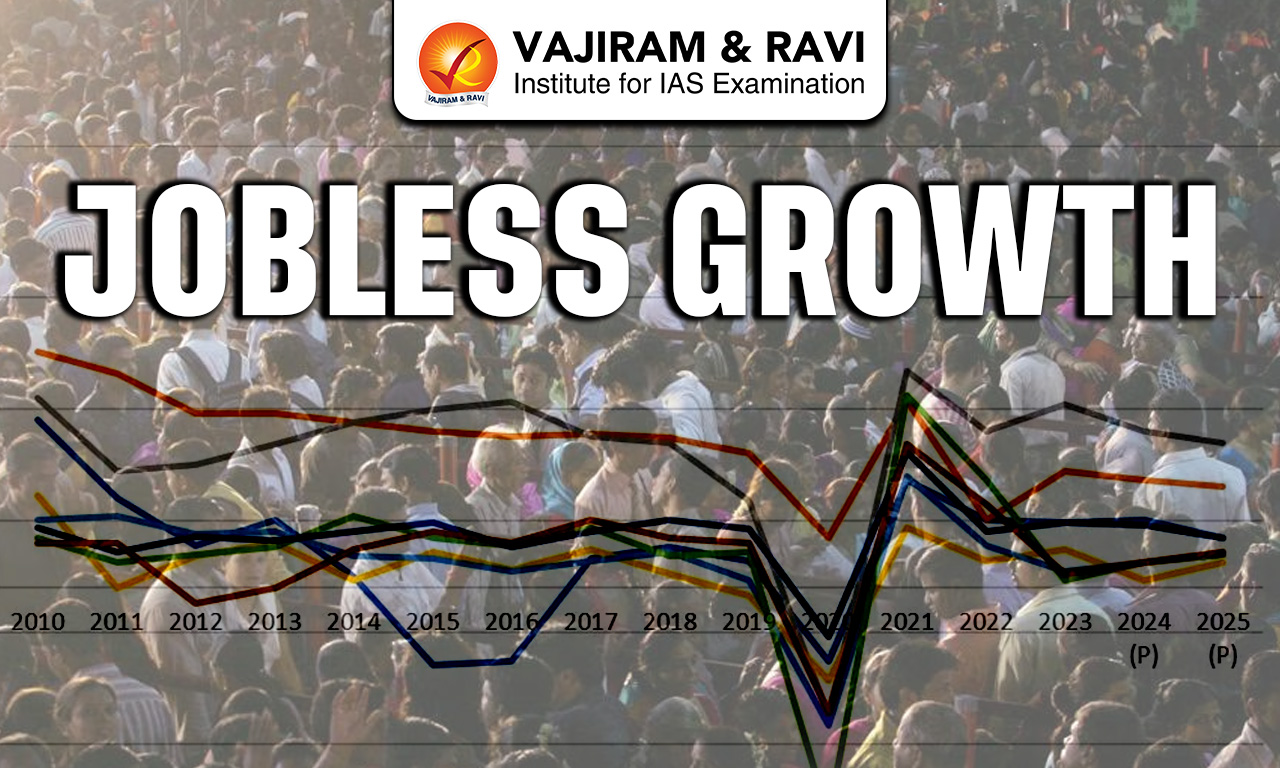
According to the World Economic Forum Jobless growth refers to a situation where economic growth does not lead to job creation.
It reflects growth without inclusivity, where the benefits of economic development are concentrated in capital-intensive sectors rather than labour-intensive ones.
Jobless Growth in India
India’s GDP has grown at an average of 6-7% per year over the past decade, yet unemployment rates, particularly among the youth and educated segments, remain high.
- According to the Economic Survey, India needs 20 million new jobs annually, but current job creation is only about 4 million per year.
- Employment elasticity (the responsiveness of employment to GDP growth) declined from 0.26 (2000–2012) to 0.001 by 2019.
- According to the State of Working India 2026 report by Azim Premji University, less than 7% of male Indian graduates secure a permanent salaried job within a year of graduation, and only 3.7% manage to obtain a white-collar position.
Causes of Jobless Growth in India
Main causes of jobless growth in India are:
Capital-Intensive Growth and Higher Labour Productivity
- India’s GDP growth has largely been driven by capital deepening and technological adoption, which increases output per worker.
- While this raises overall economic performance, it reduces the number of jobs created per unit of GDP, contributing to jobless growth.
Premature De-Industrialisation
- The manufacturing sector’s share in GDP has remained around 14-17%, while its share of employment is only 12%, showing stagnation since 1991. This limits the sector’s capacity to absorb the growing workforce.
Preference for Capital-Intensive Industries
Industries with high automation and mechanisation are favoured over labour-intensive sectors.
- Push Factors: Complex labour regulations and low skill levels among workers make labour-intensive production less attractive.
- Pull Factors: Government schemes and historical focus on heavy and basic industries during Five-Year Plans made capital-intensive investments easier and more profitable.
Dwarf Firms
- Many MSMEs operate at a very small scale due to the nature of government incentives, limiting their capacity to expand production and generate employment.
Service Sector Dominance
- The service sector contributes around 55% of GDP but employs only about 30% of the workforce, reflecting low labour intensity and a mismatch between growth and job creation.
Rigid Labour Market and Regulatory Burden
- India has 44 central labour laws, leading to regulatory complexity and compliance costs. Lack of flexibility in hiring and firing, enforced by the Industrial Disputes Act, discourages labour-intensive investment.
Skill Deficit
- Only about 4% of the workforce has received formal training, compared with 96% in South Korea, limiting employability in modern, high-productivity sectors.
Implications of Jobless Growth
Jobless growth in India has far-reaching implications:
- Inability to Reap Demographic Dividend: India’s large working-age population is underutilised.
- Lack of Inclusive Growth: Economic gains remain concentrated in capital-intensive sectors.
- Low Savings and Investment: Unemployed or underemployed households cannot save or invest, limiting domestic capital formation.
- Stagnation in GDP in the Long Run: Low employment dampens consumption demand.
- Middle-Income Trap: Without mass employment, India risks being trapped in a growth model that benefits only a few.
Strategies to Address Jobless Growth
- Promote Secondary Agriculture (Dalwai Panel): Encourage rural small-scale enterprises providing agricultural inputs (SHGs, machinery, seeds) and processing outputs (food processing units).
- Focus on Labour-Intensive Industries: Textiles, leather, and other low-skill sectors can generate large employment, as seen in Bangladesh.
- Incentivise Infant Firms: Limit government incentives to initial 5–7 years to encourage growth rather than sustaining small-scale “dwarf” firms.
- Assemble in India for the World: Integrating assembly-focused manufacturing into Make in India could create up to 8 crore jobs by 2030.
- Reorient SEZs as Economic and Employment Enclaves (EEE): As recommended by the Baba Kalyani Committee, SEZs can be leveraged to generate both economic output and employment.
- Infrastructure-Led Employment: Higher public expenditure in infrastructure creates direct and indirect jobs across sectors.
- Effective Implementation of Labour Codes: Promote fixed-term employment and simplify labour laws to encourage hiring.
- Skill Development: Strengthen vocational training, apprenticeship schemes, and align skill development with industry needs to bridge the demand-supply gap.
Way Forward
India’s ability to reap its demographic dividend and achieve the vision of a $7 trillion economy is intricately linked to improving employment elasticity. The government must:
- Boost labour-intensive production,
- Expand skill development and vocational training,
- Incentivise firms that generate significant employment, and
- Ensure effective implementation of employment-linked schemes.
Without these measures, GDP growth risks remaining jobless, undermining inclusive development, social stability, and long-term economic prosperity.
Jobless Growth FAQs
Q1: What is Jobless Growth in India?
Ans: Jobless Growth in India refers to a situation where the economy grows steadily, but employment does not increase proportionally, resulting in GDP expansion without adequate job creation.
Q2: Why is India experiencing Jobless Growth?
Ans: Factors include capital-intensive growth, stagnant manufacturing, dominance of dwarf MSMEs, rigid labour laws, service sector bias, and low skill levels among the workforce.
Q3: How serious is Jobless Growth in India?
Ans: India needs 20 million new jobs annually, yet only about 4 million are created. Employment elasticity fell from 0.26 (2000–2012) to 0.001 by 2019, showing minimal job creation despite high GDP growth.
Q4: What are the implications of Jobless Growth in India?
Ans: It limits the demographic dividend, restricts inclusive growth, reduces savings and investment, risks long-term GDP stagnation, and may trap the economy in a middle-income scenario.
Q5: How can India address Jobless Growth?
Ans: Promote labour-intensive industries, incentivise expanding MSMEs, strengthen rural and small-scale enterprises, implement skill development programs, reform labour laws, and invest in infrastructure-led employment.