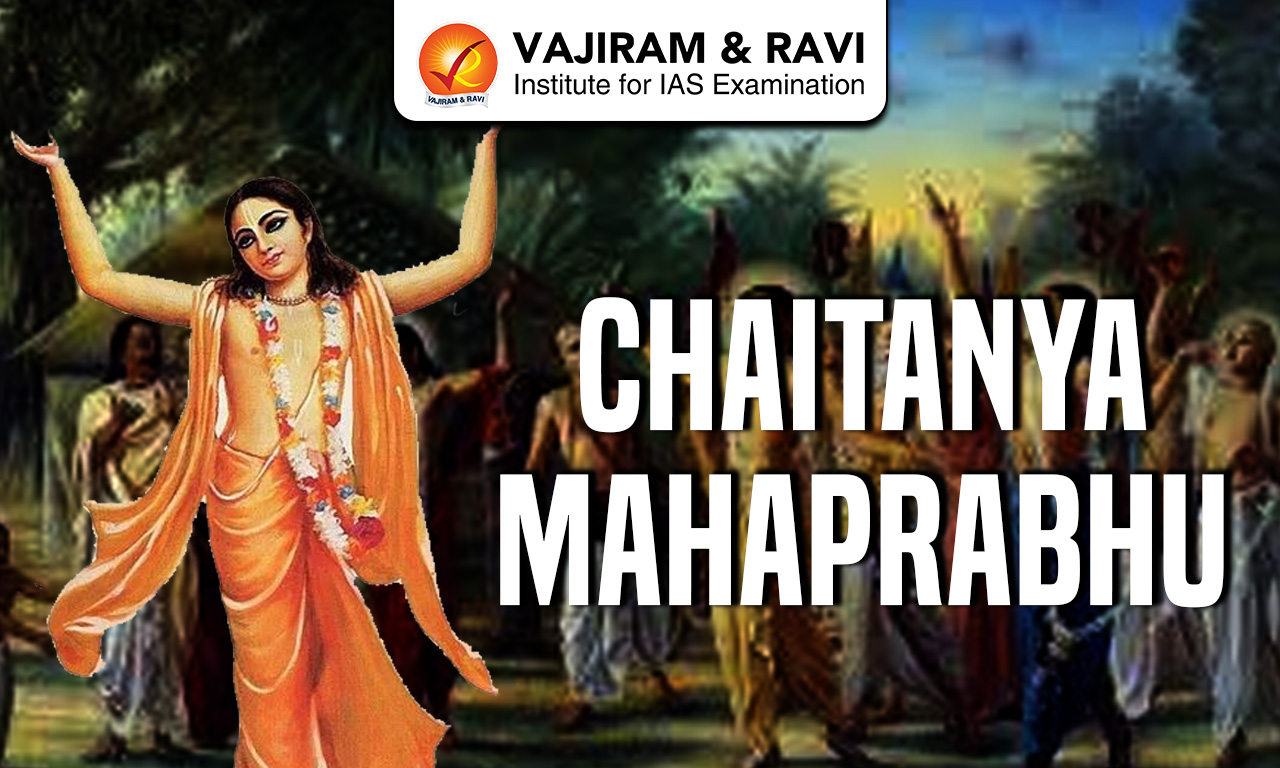
Chaitanya Mahaprabhu, Early Life, Philosophy, Teachings

Chaitanya Mahaprabhu

Chaitanya Mahaprabhu was a great saint and spiritual teacher who is remembered for spreading love and devotion towards Lord Krishna. He believed that true happiness comes from chanting God’s name and having a pure heart. Through his simple teachings and emotional devotion, he connected with people from all sections of society. His life inspired many to follow the path of bhakti (devotion), kindness, and unity.

About Chaitanya Mahaprabhu

  • Birth and Early Life: Chaitanya Mahaprabhu was born in 1486 on the occasion of Phalguni Purnima at Nabadwip (Mayapur) in Bengal, and he was originally named Vishwambhar, later known as Nimai Pandit due to his scholarly nature, before becoming famous as Chaitanya Mahaprabhu after adopting a spiritual life.
  • Names and Identity: He was also popularly known as Gauranga because of his fair complexion and Vishwambhar, and his different names reflect various phases of his life from a learned scholar to a devoted spiritual leader.
  • Spiritual Guru and Influence: He became a disciple of Keshav Bharati, under whom he accepted sannyasa (renunciation), which marked a turning point in his life as he fully devoted himself to spiritual preaching.
  • Role in Bhakti Movement: Chaitanya Mahaprabhu was one of the most important Bhakti reformers from Bengal, and he played a major role in spreading the message of devotion (bhakti), love, and equality among people, especially in eastern India.
  • Devotion to Krishna: He was a great devotee of Lord Krishna and encouraged people to develop a personal connection with God through love and faith, treating devotion as the simplest path to spiritual fulfillment.
  • Spread of Vaishnavism: He actively preached Vaishnavism in regions like Bengal and Odisha, and his teachings gave rise to a new tradition known as Gaudiya Vaishnavism, which focused on devotion to Radha and Krishna.
  • Centre of Activities: Puri in Odisha became the main centre of his activities, where he spent a large part of his life spreading his teachings and engaging in devotional practices.
  • Introduction of Kirtan Tradition: He popularized the practice of singing devotional songs (kirtans) as a form of worship, making spirituality more accessible and emotional, and encouraging collective participation in devotion.
  • Popular Chanting Tradition: He widely promoted the chanting of “Hare Rama, Hare Krishna” as a simple and powerful way to connect with God, especially in the age of Kali Yuga.
  • Philosophy of Achintya Bheda-Abheda: He taught the philosophy of Achintya Bheda-Abheda, which means the relationship between God and the world is both different and non-different at the same time, a concept that tries to balance unity and diversity in spiritual understanding.
  • Nature of His Philosophy: His ideas were influenced by earlier traditions like those of Madhvacharya and Ramanuja but developed into a unique system that combined elements of dualism and qualified non-dualism.
  • Teachings and Message: His teachings emphasized love for God (prema), devotion through chanting, equality among people, and the idea that the ultimate goal of life is to achieve divine love and spiritual realization.
  • Siksastakam and Literary Contribution: Although he did not write many texts himself, his teachings were preserved in the form of eight verses called Siksastakam, which explain the core ideas of devotion and are considered very important in his tradition.
  • Role of Disciples: His followers, especially the Six Goswamis of Vrindavan, later organized and spread his teachings in a systematic way through various texts and practices.
  • Universal Religion Idea: He believed in a universal path of religion where people from all backgrounds could come together by chanting the name of God, promoting unity and reducing conflicts in society.
  • Belief in Divine Incarnation: Followers of Gaudiya Vaishnavism consider him to be an incarnation of Lord Krishna who appeared in human form to show the path of devotion in the Kali Yuga.
  • Cultural and Religious Impact: His influence spread widely across eastern India, and his devotional practices, especially kirtans and bhajans, continue to be an important part of religious life even today.
  • Legacy and Importance: Chaitanya Mahaprabhu is remembered as a great spiritual reformer who simplified religion, emphasized love and devotion, and brought people together through faith, music, and collective worship.

Chaitanya Mahaprabhu FAQs

Q1: Who was Chaitanya Mahaprabhu?

Ans: Chaitanya Mahaprabhu was a 15th-16th century Bhakti saint and reformer from Bengal who spread devotion to Lord Krishna through love, faith, and simple practices like chanting.

Q2: Where and when Chaitanya Mahaprabhu was born?

Ans: Chaitanya Mahaprabhu was born in 1486 at Nabadwip (Mayapur) in Bengal on the occasion of Phalguni Purnima.

Q3: What was his main contribution to the Bhakti Movement?

Ans: Chaitanya Mahaprabhu popularized emotional devotion to Krishna and made bhakti accessible to all through singing, chanting, and collective worship.

Q4: What is the philosophy of Achintya Bheda-Abheda?

Ans: It is the idea that God and the world are both different and not different at the same time, showing a balance between unity and diversity in spiritual thought.

Q5: What role did kirtans play in his teachings?

Ans: He introduced and popularized kirtans (devotional songs) as a simple and powerful way to worship God and bring people together.

Glove Puppetry, Features, State Puppets, Global Recognition

Glove Puppetry

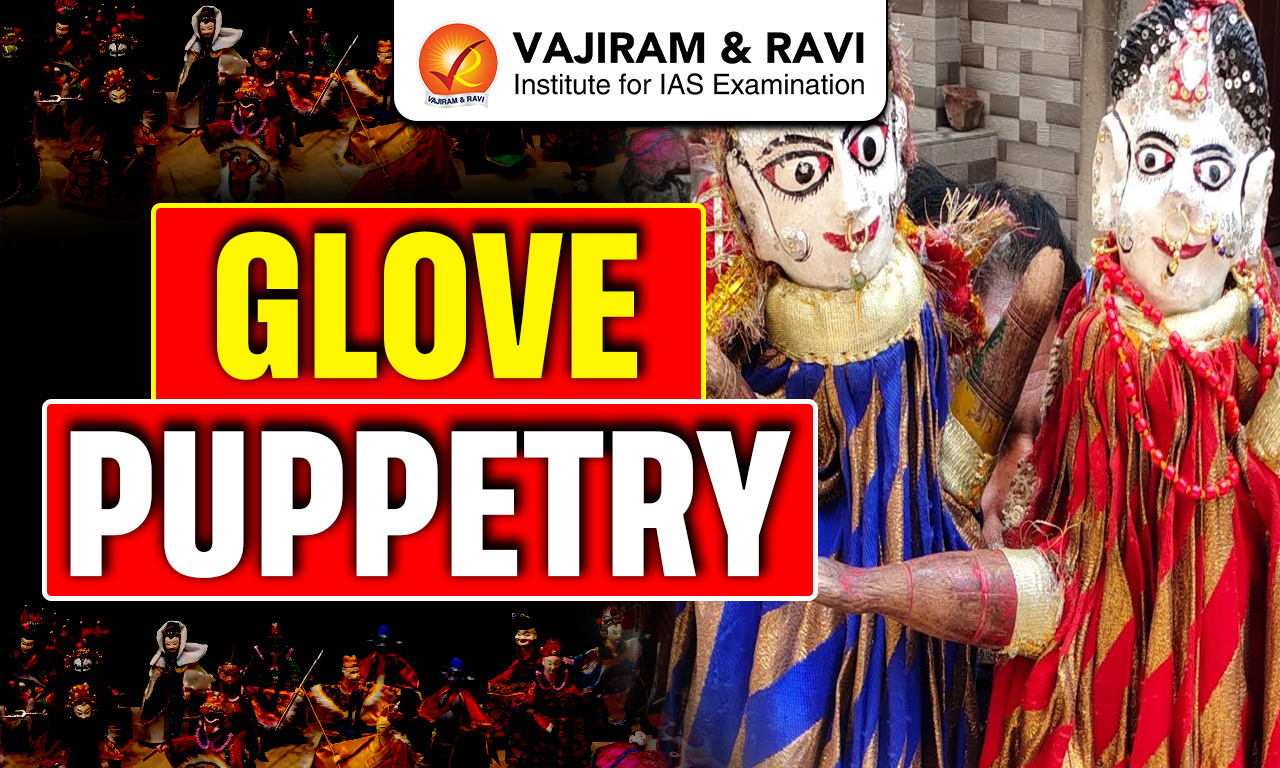
Glove Puppetry is a traditional performing art in which Puppets are controlled by hand movements, making them appear lively and expressive. It originated in the 17th century Fujian province of China, particularly in Quanzhou and Zhangzhou regions and later spread to Taiwan and other parts of Asia. In India, it evolved into diverse regional forms across states like Uttar Pradesh, Odisha, Kerala and West Bengal, reflecting strong cultural, religious and social narratives.

Glove Puppetry Features

Glove Puppetry involves simple hand controlled techniques and cloth based Puppets that allow expressive storytelling across cultures and regions.

  • Structure and Material: Puppets have hollow wooden heads with cloth bodies, while hands and feet are wooden, enabling durability and flexibility in performance movements.
  • Manipulation Technique: The Puppeteer inserts fingers inside the Puppet, using the index finger for the head and thumb and middle finger for arms, creating lifelike gestures.
  • Costume Design: Puppets resemble cloth sacks with flowing skirts, giving the name “cloth bag opera” in Chinese tradition and allowing easy concealment of hand movements.
  • Performance Style: Shows are divided into two parts, including demonstration and storytelling with orchestra, emphasizing dexterity, narration and coordinated movements.
  • Themes and Narratives: Performances generally avoid vocal singing and focus on narration, poetry and instrumental music to convey mythological and social themes effectively.

Also Read: Rod Puppetry

This regional form reflects social narratives and humor through simple storytelling techniques using Glove Puppets controlled by skilled artists.

  • Gulabo Sitabo Tradition: This form represents two co-wives married to the same man, highlighting domestic conflicts, humor and social satire through semi improvised performances.
  • Material Evolution: Earlier Puppets used wooden heads, but modern versions use papier mache, making them lighter and easier to handle during performances.
  • Performance Style: Puppeteers often use acapella narration, incorporating local songs, jokes and audience interaction to make performances engaging and relatable.
  • Cultural Context: Shows are often performed during fairs and festivals, especially in Lucknow region, reflecting everyday social issues and community life.

Glove Puppetry of Odisha

Odisha’s Glove Puppetry is deeply connected with devotional themes and traditional storytelling rooted in Krishna legends.

  • Sakhi Kundhei Nata: This popular form is practiced in regions like Bhubaneswar and Cuttack, focusing mainly on stories of Radha and Krishna.
  • Puppeteer Technique: Artists operate Puppets using both hands while simultaneously playing musical instruments like dhol, showcasing multitasking skills.
  • Narrative Themes: Stories are derived from Puranas and medieval poetry, emphasizing devotional love and divine adventures of Krishna.
  • Performance Groups: Puppeteers travel in groups across villages, presenting shows with musical accompaniment and narration, maintaining a strong community tradition.

Also Read: Shadow Puppetry

Glove Puppetry of Kerala

Kerala’s Glove Puppetry shows strong influence of classical dance traditions and elaborate visual aesthetics.

  • Pavakoothu Tradition: Developed under the influence of Kathakali, it incorporates elaborate costumes, facial designs and dramatic storytelling elements.
  • Puppet Design: Puppets are decorated with paints, peacock feathers and metallic ornaments, resembling Kathakali performers in miniature form.
  • Musical Accompaniment: Instruments like chenda, chengila, cymbals and conch shells are used, requiring at least six performers for a complete show.
  • Themes and Stories: Narratives are mainly drawn from epics like Mahabharata and Ramayana, focusing on heroic and moral episodes.

Glove Puppetry of West Bengal

West Bengal’s Glove Puppetry combines artistic craftsmanship with social and historical significance.

  • Beni Putul Form: The name refers to braided hair structure, symbolizing the Puppet’s three part construction of head, arms and flowing skirt.
  • Material Composition: Puppets have terracotta or wooden heads, wooden arms and cloth skirts, making them durable and visually appealing.
  • Historical Role: It was used as a medium of resistance against British oppression, reflecting socio-political awareness among performers.
  • Performance Themes: Stories include Krishna Radha legends and domestic narratives like Madan Puti, often depicting everyday conflicts humorously.

Glove Puppetry of Karnataka

Karnataka presents a unique folk adaptation of Glove Puppetry rooted in tribal and street performance traditions.

  • Chinni Patti Form: Named after small wooden dolls, this form uses simple Puppets made from wood and rice straw for storytelling.
  • Performer Background: Traditionally practiced by marginalized communities, including beggars, who perform on streets using minimal resources.
  • Themes of Narration: Stories focus on daily life situations such as trickery, social humor and moral lessons involving common people.
  • Cultural Roots: The tradition is linked to tribal rituals and early social practices, reflecting indigenous cultural expressions.

Glove Puppetry of Tamil Nadu

Tamil Nadu’s Glove Puppetry is associated with ritual performances and mythological storytelling during festivals.

  • Pava Koothu Tradition: This form is performed mainly during festivals and religious occasions, emphasizing ritualistic significance.
  • Puppet Design: Puppets are small in size and made using rice straw and paper, making them lightweight and easy to manipulate.
  • Narrative Focus: Stories highlight divine victories, especially goddess Lakshmi’s triumph over demons, symbolizing good over evil.
  • Revival Efforts: The art form had declined but has recently been revived by cultural scholars and local communities.

Glove Puppetry Across Globe

Glove Puppetry exists in multiple forms worldwide, adapting to different cultural contexts and technological advancements.

  • Chinese Glove Puppetry: Originated in Fujian province during the 17th century, it spread across Min Nan speaking regions and became popular in Taiwan.
  • Taiwanese Glove Puppetry: Yunlin County is a major center, with modern adaptations like Pili productions integrating computer animation and global collaborations.
  • Indonesian Glove Puppetry: Known as Wayang Potehi, it evolved through Chinese-Javanese cultural interaction and is preserved in Java regions like Semarang and Jombang.
  • Global Variants: Other forms include Black Light Puppets using UV light, Bunraku in Japan, Carnival Puppets in USA and South Africa and Object Puppets made from everyday materials.

Glove Puppetry Significance

Glove Puppetry holds cultural, educational and artistic significance across regions, despite facing challenges in modern times.

  • Cultural Importance: It represents traditional storytelling, reflecting religious beliefs, folklore and social values across different societies.
  • Educational Value: Puppetry enhances language skills, creativity, emotional development and listening abilities, especially among children.
  • Decline Factors: Competition from electronic media, lack of patronage and outdated stage techniques have reduced its popularity in recent decades.
  • Revival Efforts: Institutional support, cultural initiatives and modern adaptations like television integration have helped preserve and promote this art globally. 

Glove Puppetry FAQs

Q1: What is Glove Puppetry?

Ans: Glove Puppetry is a form of puppet performance where puppets are controlled by the hand using fingers to move the head and arms, creating lifelike actions.

Q2: What are Glove Puppets made of?

Ans: Glove Puppets typically have wooden or papier mache heads, wooden hands and a cloth body resembling a flowing costume.

Q3: Which Indian states are famous for Glove Puppetry?

Ans: Glove Puppetry is popular in Uttar Pradesh, Odisha, Kerala and West Bengal, each having its own regional style and themes.

Q4: What are the main themes in Glove Puppetry performances?

Ans: Themes mainly include mythological stories like Ramayana and Mahabharata, Krishna legends and social issues reflecting everyday life.

Q5: What is Pavakoothu in Kerala Glove Puppetry?

Ans: Pavakoothu is a Glove Puppetry form influenced by Kathakali, featuring richly decorated puppets and performances based on epics like the Mahabharata and Ramayana.

Difference Between OPEC and OPEC+, Members, Formation

Difference Between OPEC and OPEC+

The Organization of the Petroleum Exporting Countries (OPEC) is a formal group of oil-exporting countries formed in 1960 to manage oil supply and stabilize prices. In contrast, OPEC+ is a broader alliance created in 2016 that includes OPEC members along with non-OPEC producers. OPEC mainly focuses on setting production quotas for its members, while OPEC+ works through wider cooperation to influence global oil markets. Due to the inclusion of major producers like Russia, OPEC+ has greater control and impact on global oil prices.

Difference Between OPEC and OPEC+

The difference between Organization of the Petroleum Exporting Countries (OPEC) and OPEC+ (OPEC Plus) lies mainly in their membership and scope of cooperation in regulating global oil production.

Difference Between OPEC and OPEC+

Feature

OPEC

OPEC+

Main Purpose

Regulate oil supply and stabilize prices

Expand control by including non-OPEC producers

Formation

Founded in 1960 in Baghdad by Iraq, Iran, Kuwait, Saudi Arabia, and Venezuela

Formed in 2016 through cooperation between OPEC and 10 non-OPEC countries

Nature

Formal intergovernmental organization

Informal alliance/coalition

Objective

Coordinate petroleum policies among member nations

Strengthen global oil market management through wider cooperation

Members

Around 12-13 countries including Saudi Arabia, Iran, Iraq, UAE, Venezuela

OPEC members + countries like Russia, Kazakhstan, Mexico, Oman, etc.

Leadership

Dominated by Saudi Arabia

Joint leadership of Saudi Arabia and Russia

Oil Market Share

Produces ~30–40% of global crude oil and holds ~80% reserves

Produces ~40–50% of global oil, giving higher influence

Decision-Making

Internal quota system among members

Collective decisions with both OPEC & non-OPEC partners

Influence on Prices

Adjusts production to manage price stability

Stronger price influence due to wider participation

Response to Market Changes

Changes output based on demand-supply conditions

Implements larger coordinated production cuts or increases

Headquarters

Vienna, Austria

No separate HQ; follows OPEC framework

About Organization of Petroleum Exporting Countries

  • Organization of the Petroleum Exporting Countries is an intergovernmental organization established in 1960 to coordinate petroleum policies among member countries.
  • Its primary objective is to stabilize global oil markets and ensure fair prices for producers along with a steady supply for consumers.
  • OPEC was founded in Baghdad, Iraq, by five countries: Iran, Iraq, Kuwait, Saudi Arabia, and Venezuela.
  • The headquarters of OPEC is located in Vienna, Austria, since 1965.
  • The organization mainly includes oil-producing countries from the Middle East, Africa, and South America.
  • OPEC has 12 member countries: Algeria, Congo, Equatorial Guinea, Gabon, Iran, Iraq, Kuwait, Libya, Nigeria, Saudi Arabia, United Arab Emirates, and Venezuela.
  • Congo joined OPEC in 2018, Equatorial Guinea in 2017, and Gabon rejoined in 2016.
  • Iran, Iraq, Kuwait, Saudi Arabia, and Venezuela are founding members of OPEC.
  • OPEC members collectively hold more than 75–80% of the world’s proven crude oil reserves.
  • The organization produces around 35–40% of the world’s total crude oil supply.
  • OPEC plays a crucial role in influencing global oil prices by adjusting production levels.
  • Member countries meet regularly to decide production quotas based on global demand and supply conditions.
  • Saudi Arabia is considered the most influential member due to its large oil production capacity.
  • Angola withdrew from OPEC in January 2024, reducing the total number of members.
  • Qatar (2019), Indonesia (2016), and Ecuador (2020) have left or suspended their memberships in recent years.

About OPEC+

  • It is the alliance of major oil-exporting nations. 
  • It is an extension of the Organization of the Petroleum Exporting Countries formed in 2016.
  • It consists of 22 oil-exporting countries which meet regularly to decide how much crude oil to sell on the world market.
  • Members of OPEC+: It comprises 12 OPEC countries plus Azerbaijan, Bahrain, Brunei, Kazakhstan, Russia, Mexico, Malaysia, South Sudan, Sudan, and Oman.
  • These nations aim to work together on adjusting crude oil production to bring stability to the oil market.

Difference Between OPEC and OPEC+ FAQs

Q1: What is the main difference between Organization of the Petroleum Exporting Countries and OPEC+?

Ans: OPEC is a formal organization of oil-exporting countries, while OPEC+ is a broader alliance that includes OPEC members along with major non-OPEC producers to strengthen global oil control.

Q2: When were OPEC and OPEC+ formed?

Ans: OPEC was established in 1960 in Baghdad, whereas OPEC+ was formed in 2016 to enhance cooperation between oil-producing nations.

Q3: Why was OPEC+ created?

Ans: OPEC+ was created to include large oil producers like Russia and improve coordination in stabilizing global oil markets and prices.

Q4: Which countries are part of OPEC+?

Ans: OPEC+ includes all OPEC members along with non-OPEC countries such as Kazakhstan, Mexico, and others.

Q5: Which has more influence on global oil prices, OPEC or OPEC+?

Ans: OPEC+ has greater influence because it includes additional major oil producers, increasing its share in global oil supply.

Rod Puppetry, Features, Kathi Kandhe, Yampuri, Putul Nach

Rod Puppetry

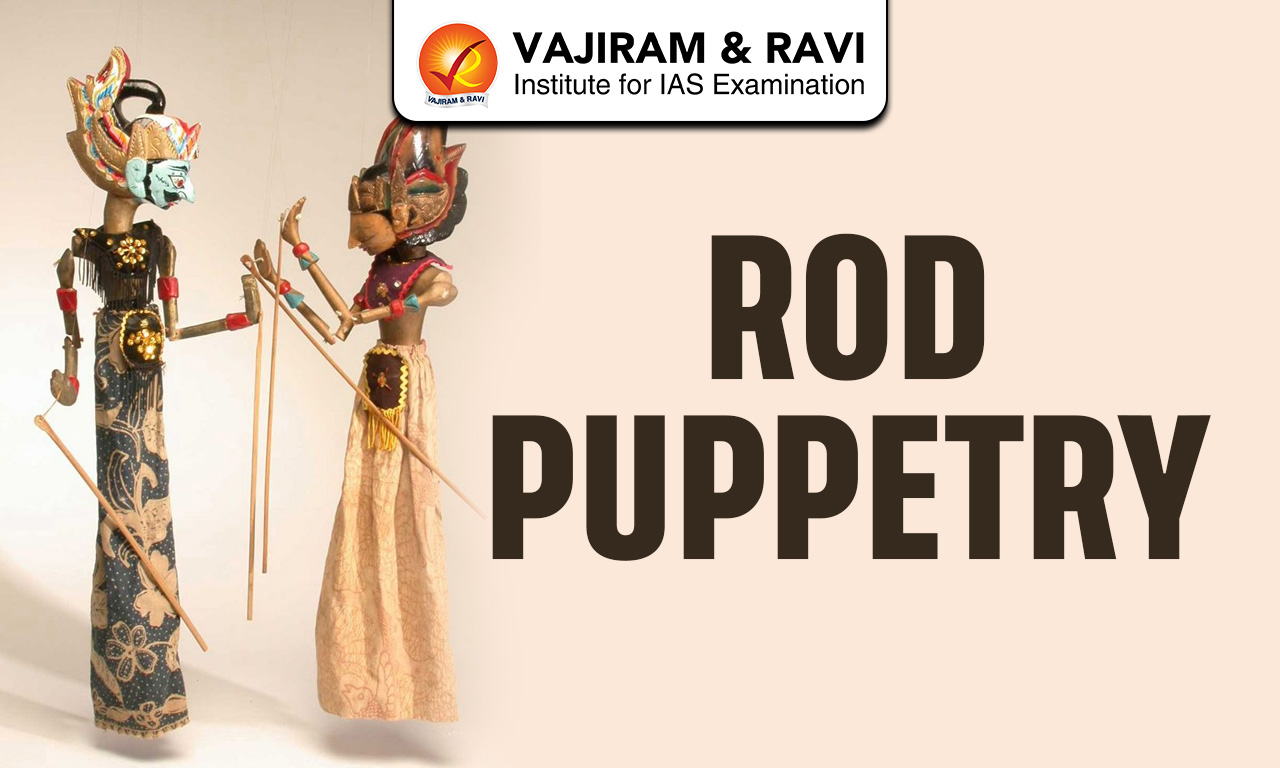
Rod Puppetry is a traditional form of Indian Puppetry that evolved as an advanced version of glove Puppetry, distinguished by the use of rods for manipulation. These Puppets are larger in size and are controlled from below using one or more sticks of varying lengths. It is practiced mainly in West Bengal, Odisha and Bihar. It combines craftsmanship, storytelling and performance, making it an important medium of folk expression rooted in mythology, social themes and local traditions.

Rod Puppetry Features

Rod Puppetry is a developed form of glove Puppetry, characterized by rod based manipulation, larger Puppet size and distinct structural composition.

  • Structure and Joints: Rod Puppets generally consist of three joints where the head is fixed to the main rod at the neck, while both hands are attached to separate rods at the shoulders, enabling controlled movement.
  • Material Composition: The body and hands of these Puppets are made using bamboo, rice husk and hay, which are mixed and moulded into desired shapes, ensuring durability and lightweight handling.
  • Costume and Appearance: Puppets are dressed in traditional attire such as dhotis and saris based on character roles and the main rod remains hidden beneath the costume to maintain visual realism during performance.
  • Manipulation Technique: The Puppeteer operates the Puppet from below using rods, especially controlling the hands through action rods, creating expressive gestures and lifelike movements in performances.
  • Regional Presence: This form is predominantly found in West Bengal and Odisha, where it has developed into structured theatrical traditions with defined performance styles and storytelling formats.

Rod Puppetry of Odisha

Rod Puppetry in Odisha, known as Kathi Kandhe, is a smaller sized and culturally rich form, deeply linked with religious and social storytelling traditions.

  • Local Name: In Odisha, Rod Puppetry is called Kathi Kandhe.
  • Size: The Puppets are comparatively smaller than those in West Bengal, usually measuring around 12 to 18 inches in height.
  • Performance Style: Puppeteers manipulate the Puppets while squatting behind a screen, creating a concealed performance style that focuses audience attention entirely on the Puppet movements.
  • Thematic Content: The stories performed are mainly derived from epics like Ramayana, Puranas and also include social issues, making the performances both entertaining and informative.
  • Musical Elements: The performance begins with a ritual orchestral prelude called Stuti, followed by the main play, integrating structured musical traditions into the theatrical presentation.
  • Song Traditions: Medieval songs such as Bhajan, Champu, Koili and Chautisha are sung during performances, often adapted in style to appeal to contemporary audiences while retaining classical roots.

Also Read: Shadow Puppetry

Rod Puppetry of Bihar

Rod Puppetry in Bihar, known as Yampuri, is unique for its wooden structure and absence of joints, requiring high skill from Puppeteers.

  • Traditional Form: Yampuri is the traditional Rod Puppetry of Bihar, recognized for its distinct style and use of solid wooden Puppets crafted from a single piece.
  • No Joint Structure: Unlike other regions, Yampuri Puppets do not have joints, which limits flexibility in movement and demands greater dexterity and expertise from Puppeteers.
  • Craftsmanship: These Puppets are carved from a single block of wood, then painted and decorated with vibrant colours, reflecting strong local artistic traditions.
  • Performance Setup: The shows are performed on a raised platform of about three feet height, with curtains used as backdrops and musicians positioned nearby to enhance the presentation.
  • Cultural Challenges: Yampuri is facing decline due to limited patronage and exclusivity to specific communities, highlighting the need for revival efforts to preserve this traditional art form.

Rod Puppetry of West Bengal

Rod Puppetry in West Bengal, known as Putul Nach, is one of the most elaborate forms, characterized by large Puppets and dynamic performance styles.

  • Local Identity: In West Bengal, Rod Puppetry is called Putul Nach, meaning “dancing dolls,” and is widely practised as a traditional theatrical form in the region.
  • Puppet Dimensions: These Puppets are large, often reaching heights of 1.5 metres and weighing up to 10 kilograms, built on bamboo sticks measuring around 2.5 metres.
  • Costume and Design: Puppets are decorated in local painting styles and dressed like Jatra theatre characters, enhancing their visual appeal and cultural authenticity.
  • Performance Elements: The performances include a musical troupe of three to four artists playing harmonium, cymbals and tabla, creating a vibrant and engaging stage environment.
  • Themes and Adaptation: Traditional themes include Ramayana and Satee Behula, while modern performances increasingly incorporate movie plots, reflecting adaptation to changing audience preferences.

Rod Puppetry Significance

Rod Puppetry holds cultural significance as one of the oldest forms of Puppetry in India, representing a blend of art, storytelling and traditional knowledge systems.

  • Cultural Heritage: Rod Puppetry is an important part of India’s intangible cultural heritage, preserving regional traditions, folklore and mythological narratives through visual storytelling.
  • Artistic Value: The art form showcases intricate craftsmanship using natural materials like bamboo and wood, combined with performance skills that bring inanimate figures to life.
  • Regional Diversity: Each state, including West Bengal, Odisha and Bihar, has developed its own distinct style, reflecting local customs, themes and performance techniques.
  • Educational Importance: Puppetry plays a role in communication and social awareness by presenting moral lessons, cultural values and social issues in an engaging format.
  • Need for Preservation: With declining popularity due to modern entertainment media, there is a growing need for institutional support and innovation to sustain and revive this traditional art form. 

Rod Puppetry FAQs

Q1: What is Rod Puppetry?

Ans: Rod Puppetry is a traditional Puppetry form where Puppets are controlled from below using rods, making them larger and more expressive than glove Puppets.

Q2: Which states are famous for Rod Puppetry?

Ans: Rod Puppetry is mainly practised in West Bengal, Odisha and Bihar, each having its own distinct style such as Putul Nach, Kathi Kandhe and Yampuri.

Q3: What materials are used to make Rod Puppets?

Ans: Rod Puppets are made using bamboo, rice husk, hay and wood, which are moulded into shape and then dressed in traditional costumes like dhoti or sari.

Q4: What makes Yampuri Puppets unique?

Ans: Yampuri Puppets of Bihar are unique because they are made from a single piece of wood and do not have joints, requiring high skill for movement.

Q5: What themes are shown in Rod Puppetry performances?

Ans: Rod Puppetry performances mainly depict stories from Ramayana, Puranas and folklore, along with some social themes and modern adaptations.

Royal Bengal Tigers, Characteristics, Conservation Efforts

Royal Bengal Tigers

The Royal Bengal Tiger (scientific name: Panthera tigris tigris) is one of the most magnificent and powerful big cats in the world. It is the national animal of India and Bangladesh, symbolizing strength, courage, and grace. Found mainly in the Indian subcontinent, this tiger plays a crucial role in maintaining ecological balance as an apex predator.

Scientific Classification and Status

The Royal Bengal Tiger belongs to the family of big cats and is classified as:

  • Scientific Name: Panthera tigris tigris
  • Conservation Status: Endangered (IUCN Red List)
  • Legal Protection: Schedule I under Wildlife Protection Act, 1972
  • CITES Status: Appendix I 

Royal Bengal Tiger Physical Characteristics

The Royal Bengal Tiger is known for its powerful build, striking appearance, and unique stripe patterns that make it one of the most recognizable big cats in the world. Its physical features are specially adapted for hunting, camouflage, and survival in diverse habitats.

  • Body Size and Length: Adult males can reach up to 3–3.2 meters (including tail), while females are slightly smaller, making them one of the largest tiger subspecies.
  • Weight: Males typically weigh between 200–300 kg, whereas females range from 100–180 kg, showing clear sexual dimorphism.
  • Coat and Coloration: The body has a bright orange or reddish-yellow coat with dark black stripes, which helps in camouflage within forest vegetation.
  • Stripe Pattern: Each tiger has a unique stripe pattern, similar to human fingerprints, used for individual identification.
  • Eyes and Vision: Tigers have large eyes with excellent night vision, enabling them to hunt effectively in low light conditions.
  • Limbs and Strength: Strong muscular legs allow them to leap long distances (up to 8–10 meters) and overpower large prey.
  • Tail: The long tail helps in maintaining balance while running and turning during hunting.
  • The gestation period of the Royal Bengal Tiger is approximately 93–112 days (about 3.5 months).

Conservation Efforts

The conservation of the Royal Bengal Tiger has been a major priority in India and globally, leading to significant recovery in its population over the past few decades.

  • Project Tiger (1973): Launched by the Government of India to protect tigers through the creation of dedicated tiger reserves with strict monitoring.
  • National Tiger Conservation Authority (NTCA): A statutory body that oversees tiger conservation, implements policies, and ensures proper management of tiger reserves.
  • Tiger Reserves Network: India has established over 50 tiger reserves with core and buffer zones to ensure safe breeding and habitat protection.
  • Anti-Poaching Measures: Special Tiger Protection Forces and advanced surveillance techniques like drones and camera traps are used to curb illegal hunting.
  • Legal Protection: Tigers are protected under the Wildlife Protection Act, 1972 (Schedule I), providing the highest level of legal safeguard.
  • Habitat Conservation: Efforts are made to preserve forests, maintain ecological corridors, and reduce habitat fragmentation.
  • Community Participation: Local communities are involved through eco-development programs, awareness campaigns, and alternative livelihood options.
  • International Initiatives: Programs like the TX2 goal and the Global Tiger Forum aim to double the global tiger population and promote cooperation among countries.

Royal Bengal Tigers FAQs

Q1: What is the scientific name of the Royal Bengal Tiger?

Ans: The scientific name of the Royal Bengal Tiger is Panthera tigris tigris.

Q2: What is the conservation status of the Royal Bengal Tiger?

Ans: It is classified as Endangered by the International Union for Conservation of Nature (IUCN).

Q3: Where is the Royal Bengal Tiger mainly found?

Ans: It is primarily found in countries like India, Bangladesh, Nepal, and Bhutan.

Q4: Why is it called the Royal Bengal Tiger?

Ans: It is called “Royal” due to its historical association with royal hunting traditions in the Bengal region during ancient and colonial times.

Q5: Why are tigers important for the ecosystem?

Ans: Tigers are apex predators that help maintain ecological balance by controlling herbivore populations and supporting healthy forests.

Horticulture Sector in India, Segments, State-wise Distribution

Horticulture Sector in India

The horticulture sector in India is one of the fastest-growing segments of agriculture. It includes the cultivation of fruits, vegetables, flowers, spices, plantation crops, and medicinal plants. Over the years, horticulture has become a key driver of agricultural diversification, income generation, and nutritional security in the country.

What is Horticulture?

Horticulture refers to the science and practice of growing fruits, vegetables, flowers, and other crops for human consumption and commercial use. It is more intensive, high-value, and profit-oriented compared to traditional farming.

Horticulture Sector in India Features

The horticulture sector in India is a high-value and rapidly growing segment of agriculture that focuses on fruits, vegetables, flowers, and other crops. It plays a key role in increasing farmers’ income, improving nutrition, and supporting economic development.

  • High-Value Crops: Horticulture focuses on crops like fruits, vegetables, and flowers that provide higher returns compared to traditional food grains.
  • Crop Diversification: It encourages farmers to shift from cereals to a variety of crops, reducing risk and improving farm sustainability.
  • Intensive Farming Practice: Requires careful management, better inputs, and scientific techniques to achieve higher productivity from limited land.
  • Year-Round Production: Different crops are grown in different seasons, ensuring continuous production and stable income for farmers.
  • Employment Generation
    Creates large employment opportunities in cultivation, harvesting, processing, packaging, and marketing activities.
  • Nutritional Security: Provides essential vitamins, minerals, and fiber through fruits and vegetables, improving public health.
  • Export Potential: India exports many horticulture products like spices, fruits, and flowers, contributing to foreign exchange earnings.
  • Support to Food Processing Industry: Supplies raw materials for industries producing juices, jams, pickles, and other processed foods.
  • Suitable for Small Farmers: Even small and marginal farmers can earn good income due to high productivity and profitability.
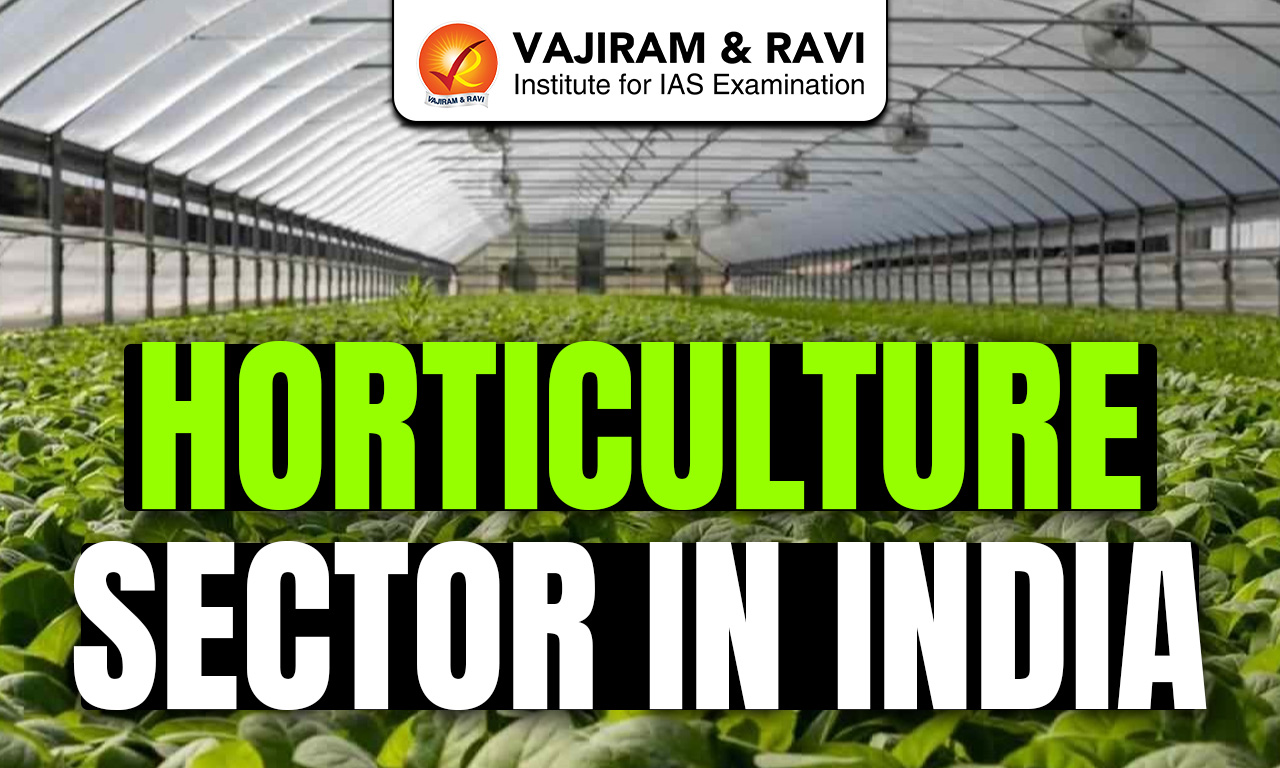
  • Use of Modern Technology: Adoption of drip irrigation, greenhouse farming, and improved seeds enhances efficiency and output.
  • Regional Specialization: Different regions grow specific crops based on climate and soil conditions, increasing productivity and quality.
  • Perishable Nature: Most horticulture produce is perishable, requiring proper storage, cold chains, and transportation facilities.
  • Contribution to Agricultural Growth: The sector contributes significantly to agricultural GDP and has surpassed foodgrain production in volume.

Major Segments of Horticulture in India

Horticulture in India is broadly divided into several major segments based on the type of crops cultivated. These segments together contribute over 370 million tonnes of production annually, with fruits and vegetables dominating the sector.

1. Fruits

Fruits are one of the most important segments of horticulture, contributing significantly to nutrition and exports. India is the second-largest producer of fruits in the world.

  • Total fruit production: 114.51 million tonnes (2024-25)
  • Major fruits: mango, banana, apple, citrus, grapes, guava
  • India is the largest producer of banana, mango, and papaya globally
  • Key producing states: Andhra Pradesh, Maharashtra, Uttar Pradesh, Gujarat

2. Vegetables

Vegetables form the largest share of horticulture production in India and are the backbone of the sector.

  • Total production: 219.67 million tonnes (2024-25)
  • Share: Vegetables dominate overall horticulture output (largest segment)
  • Major vegetables: potato, onion, tomato, cabbage, cauliflower
  • India ranks 2nd globally in vegetable production
  • Leading states: Uttar Pradesh, West Bengal, Madhya Pradesh, Bihar

3. Plantation Crops

These are long-duration commercial crops grown mainly in tropical regions and are important for export earnings.

  • Major crops: tea, coffee, rubber, coconut, arecanut
  • India ranks 1st in coconut and arecanut production globally
  • Key regions: Kerala, Karnataka, Tamil Nadu, Assam

4. Spices

India is known as the “Spice Bowl of the World” and is a global leader in spice production, consumption, and export.

  • Major spices: turmeric, pepper, cardamom, ginger, cumin
  • India is the largest producer, consumer, and exporter of spices
  • Contributes significantly to agricultural exports

5. Floriculture (Flowers)

Floriculture includes the cultivation of flowers for decorative, cultural, and export purposes.

  • Major flowers: rose, marigold, jasmine, orchid
  • Demand driven by festivals, weddings, and export markets
  • Rapid growth due to urbanization and lifestyle changes 

6. Medicinal and Aromatic Plants

This segment includes plants used in pharmaceuticals, cosmetics, and traditional medicine systems like Ayurveda.

  • Examples: tulsi, aloe vera, ashwagandha, lemongrass
  • Growing demand due to herbal and organic product trends
  • Increasing importance in export and health industries

7. Nuts and Dry Fruits

Though smaller in share, this segment is gaining importance due to rising demand.

  • Major crops: cashew, almond, walnut
  • India is a major producer and exporter of cashew
  • Key regions: Kerala, Goa, Maharashtra, Jammu & Kashmir

State-wise Contribution

Horticulture production in India is unevenly distributed, with states like Uttar Pradesh, Maharashtra, and West Bengal contributing the highest shares. Different crops are grown in specific regions based on climate, soil, and agro-ecological suitability.

1. Mango (Fruit Crop)

Mango (Fruit Crop)

Aspect

Details

Top Producing States

Uttar Pradesh, Andhra Pradesh, Karnataka, Bihar, Gujarat

Production Facts

India is the largest producer globally, contributing ~40–50% of world production (~20–22 million tonnes annually)

Major Varieties

Alphonso (Maharashtra), Dasheri (UP), Banganapalli (AP), Kesar (Gujarat)

Climate Required

Tropical & sub-tropical climate; temperature 24–30°C, rainfall 75–250 cm, dry weather during flowering

Soil Type

Well-drained loamy/alluvial soil (pH 5.5–7.5)

Special Note

Cannot tolerate frost; requires dry season for good fruiting

2. Banana (Fruit Crop)

Banana (Fruit Crop)

Aspect

Details

Top Producing States

Andhra Pradesh, Tamil Nadu, Maharashtra, Gujarat, Karnataka

Production Facts

India is the largest producer of banana in the world

Climate Required

Tropical climate; temperature 25–35°C, high humidity

Soil Type

Deep, fertile, well-drained loamy soil

Special Note

Requires continuous water supply and is highly sensitive to frost and drought

3. Apple (Temperate Fruit)

Apple (Temperate Fruit)

Aspect

Details

Top Producing States

Jammu & Kashmir, Himachal Pradesh, Uttarakhand

Production Facts

India is a major apple producer in Asia (mainly hill regions)

Climate Required

Temperate climate with chilling requirement (1000–1500 hours)

Soil Type

Well-drained loamy soil

Special Note

Requires cold winters and mild summers

4. Potato (Vegetable Crop)

Potato (Vegetable Crop)

Aspect

Details

Top Producing States

Uttar Pradesh, West Bengal, Bihar, Gujarat

Production Facts

One of the largest vegetable crops in India

Climate Required

Cool climate; temperature 15–20°C

Soil Type

Sandy loam soil with good drainage

Special Note

Sensitive to high temperature and waterlogging

5. Onion (Vegetable Crop)

Onion (Vegetable Crop)

Aspect

Details

Top Producing States

Maharashtra, Madhya Pradesh, Karnataka, Gujarat

Production Facts

India is the second-largest producer of onion globally

Climate Required

Mild climate; temperature 13–25°C

Soil Type

Well-drained loamy soil

Special Note

Requires dry weather during harvesting

6. Coconut (Plantation Crop)

Coconut (Plantation Crop)

Aspect

Details

Top Producing States

Kerala, Tamil Nadu, Karnataka, Andhra Pradesh

Production Facts

India is one of the largest producers of coconut

Climate Required

Tropical climate; temperature 27°C, high humidity

Soil Type

Coastal sandy and alluvial soil

Special Note

Requires high rainfall and coastal conditions

7. Tea (Plantation Crop)

Tea (Plantation Crop)

Aspect

Details

Top Producing States

Assam, West Bengal (Darjeeling), Tamil Nadu

Production Facts

India is among the largest tea producers and exporters

Climate Required

Warm, humid climate with heavy rainfall (150–300 cm)

Soil Type

Acidic soil (pH 4.5–5.5)

Special Note

Grows well in hilly slopes and high humidity areas

8. Turmeric (Spice Crop)

Turmeric (Spice Crop)

Aspect

Details

Top Producing States

Telangana, Andhra Pradesh, Maharashtra, Tamil Nadu

Production Facts

India is the largest producer and exporter of turmeric

Climate Required

Warm and humid climate

Soil Type

Well-drained sandy loam soil

Special Note

Requires good rainfall and irrigation

Government Initiatives for Horticulture Development

The Government of India has launched several schemes and missions to promote the growth of the horticulture sector through better infrastructure, technology, and financial support.

1. Mission for Integrated Development of Horticulture (MIDH)

  • Centrally sponsored umbrella scheme covering fruits, vegetables, spices, flowers, and plantation crops
  • Focuses on holistic development from production to post-harvest management
  • Provides financial assistance for nurseries, irrigation, and protected cultivation
  • Promotes organic farming and integrated pest management
  • Sub-schemes include NHM, HMNEH, and NBM

2. National Horticulture Mission (NHM)

  • Launched to promote area expansion and productivity improvement
  • Supports plantation of new orchards and rejuvenation of old ones
  • Encourages use of high-quality planting material
  • Provides assistance for infrastructure like storage and marketing
  • Focuses on states with high horticulture potential

3. Horticulture Mission for North East & Himalayan States (HMNEH)

  • Special scheme for North Eastern and Himalayan regions
  • Promotes region-specific crops like spices, fruits, and flowers
  • Supports organic horticulture and export-oriented production
  • Focuses on infrastructure development and market access
  • Encourages sustainable and eco-friendly farming

4. National Horticulture Board (NHB)

  • Provides financial assistance for commercial horticulture projects
  • Supports cold storage, warehouses, and post-harvest infrastructure
  • Promotes hi-tech horticulture and modern practices
  • Offers credit-linked subsidies to farmers and entrepreneurs
  • Helps in improving market linkages and value chains

5. PM Formalization of Micro Food Processing Enterprises (PMFME)

  • Aims to promote food processing and value addition
  • Supports small units with credit, training, and branding assistance
  • Encourages “One District One Product (ODOP)” approach
  • Helps reduce wastage of horticulture produce
  • Strengthens local supply chains and rural economy

6. Pradhan Mantri Krishi Sinchai Yojana (PMKSY) – Micro Irrigation

  • Promotes efficient water use through drip and sprinkler irrigation
  • Per Drop More Crop” component focuses on horticulture crops
  • Reduces water wastage and improves crop productivity
  • Provides subsidies for installation of irrigation systems
  • Especially useful for water-intensive crops like fruits and vegetables

7. Operation Greens

  • Initially launched for TOP crops (Tomato, Onion, Potato)
  • Expanded to include more fruits and vegetables
  • Aims to stabilize prices and reduce volatility
  • Supports storage, transportation, and processing facilities
  • Helps farmers get better prices and reduces consumer price fluctuations

8. Agricultural and Processed Food Products Export Development Authority (APEDA)

  • Promotes export of horticulture products
  • Provides assistance for quality certification and packaging
  • Supports development of export infrastructure
  • Helps farmers connect with international markets
  • Encourages branding of Indian horticulture produce

9. National Bamboo Mission (NBM)

  • Focuses on development of the bamboo sector
  • Promotes cultivation, processing, and marketing of bamboo
  • Provides support for plantation and value addition
  • Enhances income of farmers in forest and tribal areas
  • Boosts eco-friendly and sustainable resources

10. Sub-Mission on Seeds and Planting Material (SMSP)

  • Ensures availability of quality seeds and planting materials
  • Supports development of nurseries and seed infrastructure
  • Promotes use of certified and disease-free plants
  • Improves productivity and crop quality
  • Strengthens the foundation of horticulture production 

Challenges in Horticulture Sector

 The horticulture sector in India has achieved significant growth, but it continues to face several serious challenges related to infrastructure, markets, and climate.

  • India loses about 15–30% of horticulture produce annually, which is nearly 15 million tonnes, due to poor post-harvest management and lack of storage facilities.
  • The country has around 8,000–9,000 cold storage units with ~40 million tonnes capacity, which is insufficient and unevenly distributed, especially lacking in rural areas.
  • Price fluctuations are very common, with examples like tomato prices falling to ₹2–₹6 per kg, causing heavy losses to farmers during surplus production.
  • Only about 10% of fruits and vegetables are processed in India, which is very low compared to developed countries, leading to limited value addition.
  • More than 85% of farmers are small and marginal, making it difficult to adopt modern technologies and achieve large-scale production.
  • Horticulture crops are highly sensitive to climate change, and events like heatwaves, unseasonal rains, and droughts frequently damage crops and reduce yields.
  • Pest and disease attacks are more common in horticulture crops, leading to reduced quality and increased cost of cultivation.
  • Farmers often receive a lower share of the final price due to multiple intermediaries and weak market linkages.
  • Poor transportation and lack of cold chain logistics cause spoilage during transit, especially for perishable fruits and vegetables.
  • Storage losses in crops like onion can reach up to 30-40% due to spoilage and improper storage conditions.
  • Export potential is limited due to issues like lack of quality standards, certification, and proper packaging infrastructure.
  • Inefficient irrigation practices lead to water wastage, affecting productivity, especially in water-scarce regions.

Way Forward

  • Strengthen cold storage and supply chain infrastructure to reduce post-harvest losses, which currently range between 15–30% of total produce.
  • Promote food processing and value addition to increase the processing level beyond the current ~10%, creating better income opportunities.
  • Encourage formation of Farmer Producer Organizations (FPOs) to help small farmers achieve economies of scale and improve bargaining power.
  • Improve market linkages and direct marketing platforms like e-NAM to reduce dependence on middlemen and ensure better price realization.
  • Expand micro-irrigation techniques such as drip and sprinkler systems under “Per Drop More Crop” to improve water use efficiency.
  • Promote protected cultivation (greenhouses, polyhouses) to protect crops from climate risks and increase productivity.
  • Invest in research and development (R&D) for high-yielding, disease-resistant, and climate-resilient crop varieties.
  • Strengthen extension services and farmer training to increase awareness about modern horticulture practices and technologies.
  • Develop export infrastructure and quality certification systems to boost India’s share in global horticulture markets.

Horticulture Sector in India FAQs

Q1: What is the horticulture sector in India?

Ans: The horticulture sector in India includes the cultivation of fruits, vegetables, flowers, spices, plantation crops, and medicinal plants. It focuses on high-value crops that provide better income compared to traditional farming.

Q2: Why is the horticulture sector important in India?

Ans: It is important because it increases farmers’ income, provides nutritious food, generates employment, and contributes significantly to agricultural growth and exports.

Q3: What is the current production of horticulture crops in India?

Ans: India produces more than 370 million tonnes of horticulture crops annually, making it one of the largest producers in the world.

Q4: Which are the major horticulture crops grown in India?

Ans: Major crops include fruits (mango, banana), vegetables (potato, tomato), spices (turmeric, pepper), plantation crops (tea, coffee), and flowers (rose, marigold).

Q5: Which state is the largest producer of horticulture crops in India?

Ans: Uttar Pradesh is one of the largest producers, followed by states like Maharashtra, West Bengal, and Andhra Pradesh.

Mirabai, Early Life, Struggles, Major Works, Legacy

Mirabai

Mirabai was a well-known saint and poet who is remembered for her deep love and devotion to Lord Krishna. She lived a simple life and expressed her feelings through beautiful songs and poems filled with emotion and faith. Despite facing many challenges, she remained strong in her beliefs and chose the path of devotion over worldly life. Her life and teachings continue to inspire people to follow love, devotion, and inner strength.

About Mirabai

  • Birth and Early Life: Mirabai was born around 1498 in Kudki, located in present-day Rajasthan, into a Rajput royal family, and she spent much of her early life in Merta, where she developed a deep spiritual inclination from a very young age, especially towards Lord Krishna.
  • Royal Background and Marriage: She was married to Bhoj Raj, the crown prince of Mewar, but despite her royal position, she remained deeply devoted to Krishna, which created tensions within her marital family as she prioritized spiritual devotion over royal responsibilities.
  • Deep Devotion to Krishna: Mirabai considered Lord Krishna as her eternal husband and dedicated her entire life to his worship, expressing intense love, surrender, and devotion, which became the central theme of her life and teachings.
  • Association with Bhakti Movement: She emerged as one of the most prominent figures of the Bhakti movement, which emphasized personal devotion to God, equality, and rejection of rigid social norms, thereby making spirituality accessible to all sections of society.
  • Struggles and Social Opposition: Mirabai faced strong opposition and criticism from her in-laws and society due to her unconventional lifestyle, as she openly mingled with saints and common people and rejected traditional expectations of a royal woman.
  • Literary Contributions and Poetry: She composed numerous devotional songs and poems, mainly in the form of bhajans and padas, written in simple languages like Rajasthani and Braj Bhasha, which conveyed deep spiritual emotions and devotion toward Krishna.
  • Authenticity of Works: Although Mirabai is traditionally credited with a large number of hymns, scholars believe that only a limited number can be authentically attributed to her, as many compositions were passed down orally and later written by her followers.
  • Major works: Some of Mirabai’s notable compositions include Raag Govind, Govind Tika, Raag Soratha, Meera Ki Malhar, Mira Padavali, and Narsi Ji Ka Mayara.
  • Themes of Her Poetry: Her poetry reflects themes of divine love, longing, surrender, and detachment from worldly life, and it often portrays a personal and emotional relationship with God rather than ritualistic worship.
  • Cultural and Religious Influence: Mirabai’s songs became widely popular across India and continue to be sung as devotional bhajans, inspiring people with values of faith, courage, devotion, and inner strength.
  • Mention in Historical Texts: By the late 16th century, she had gained significant recognition, as evidenced by her mention in texts like Bhaktamal, indicating her importance in the Bhakti tradition.
  • Language and Style: Her compositions are lyrical and simple, making them easily understandable, and they reflect a blend of regional languages, which helped in spreading her message among the masses.
  • Association with Sikh Tradition: Some of her verses are believed to have been included in later compilations like Prem Ambodh Pothi, showing her influence beyond regional and religious boundaries.
  • Festivals and Commemoration: Her legacy is celebrated through events like Meera Mahotsav, organized annually in Rajasthan, where music, dance, and devotional performances highlight her contributions to Indian culture.
  • Legacy and Importance: Mirabai is remembered as a symbol of devotion, courage, and spiritual independence, who challenged social norms and inspired generations through her unwavering faith and poetic expression.

Also Read: Classical Music of India

Mirabai FAQs

Q1: Who was Mirabai?

Ans: Mirabai was a 16th-century saint-poet of the Bhakti movement, known for her deep devotion to Lord Krishna and her emotionally rich devotional songs.

Q2: Where and when was Mirabai born?

Ans: Mirabai was born around 1498 in Kudki, Rajasthan, into a Rajput royal family and was brought up in Merta.

Q3: What was the nature of Mirabai’s devotion?

Ans: Mirabai considered Krishna as her eternal husband and dedicated her life to his worship, expressing complete love, surrender, and spiritual attachment.

Q4: What challenges did Mirabai face in her life?

Ans: Mirabai faced opposition from her royal family and society due to her devotion to Krishna and her disregard for traditional social norms.

Q5: What are the main features of Mirabai’s poetry?

Ans: Her poetry consists of bhajans and padas in simple languages like Rajasthani and Braj, focusing on love for God, devotion, and detachment from worldly life.

UPSC Daily Quiz 11 April 2026

UPSC Daily Quiz

[WpProQuiz 134]

UPSC Daily Quiz FAQs

Q1: What is the Daily UPSC Quiz?

Ans: The Daily UPSC Quiz is a set of practice questions based on current affairs, static subjects, and PYQs that help aspirants enhance retention and test conceptual clarity regularly.

Q2: How is the Daily Quiz useful for UPSC preparation?

Ans: Daily quizzes support learning, help in revision, improve time management, and boost accuracy for both UPSC Prelims and Mains through consistent practice.

Q3: Are the quiz questions based on the UPSC syllabus?

Ans: Yes, all questions are aligned with the UPSC Syllabus 2025, covering key areas like Polity, Economy, Environment, History, Geography, and Current Affairs.

Q4: Are solutions and explanations provided with the quiz?

Ans: Yes, each quiz includes detailed explanations and source references to enhance conceptual understanding and enable self-assessment.

Q5: Is the Daily UPSC Quiz suitable for both Prelims and Mains?

Ans: Primarily focused on Prelims (MCQ format), but it also indirectly helps in Mains by strengthening subject knowledge and factual clarity.

Islam, Beliefs, Quran, Five Pillars, Sufism and Spread in India

Islam

Islam is one of the major religions of the world. It teaches belief in one God, called Allah, and emphasizes living a life of peace, honesty, and kindness. The followers of Islam are known as Muslims, who follow the teachings of the holy book, the Quran. Islam encourages people to help others, respect all human beings, and live with discipline and faith. It is practiced by millions of people around the world.

About Islam

  • Belief in One God and Prophets: Islam teaches that there is only one God, called Allah, who created the entire universe and guides humanity, and Muslims believe that God sent many prophets such as Abraham, Moses, and Jesus to show people the right path, with Muhammad being the final prophet who delivered God’s last message.
  • Origin and Emergence of Islam: Islam began in the 7th century in Arabia, and an important event in its history is the migration (Hijra) of Prophet Muhammad from Mecca to Medina, while Muslims believe that the words of God were revealed to him over time through the Angel Gabriel, which later became the foundation of Islamic teachings.
  • Holy Book and Sources of Guidance: The main religious text of Islam is the Quran, which Muslims believe contains the direct words of God, and along with it, the Sunnah (teachings and actions of Prophet Muhammad) acts as a guide for daily life, helping Muslims understand how to live according to God’s will.
  • Basic Beliefs of Islam: Islam teaches belief in one God, belief in Prophet Muhammad as the final messenger, and belief in the Day of Judgment, where every person will be judged based on their actions, as life on earth is considered a test that prepares individuals for life after death.
  • Main Religious Duties (Five Pillars of Islam): Muslims are required to follow certain important duties such as offering five daily prayers (Namaz), performing the weekly Friday prayer (Juma), fasting during the month of Ramzan from dawn to dusk, giving charity (Zakat) to help the poor, and undertaking the pilgrimage (Hajj) to Mecca at least once in their lifetime if they are able, which together build discipline, faith, and a sense of responsibility.
  • Sects in Islam: Islam is mainly divided into two sects, Sunni and Shia, and although both follow the Quran and basic teachings, they differ mainly in their historical views regarding the leadership after Prophet Muhammad’s death, with most Muslims in India belonging to the Sunni sect.
  • Spread of Islam in India: Islam came to India through Arab traders who settled on the western coast for trade, and over time it spread further across the country through the influence of rulers, cultural interactions, and social acceptance, eventually becoming one of the major religions practiced in India today.

About Sufisim

  • Meaning of Sufism: Sufism, also known as Tasawwuf, is the mystical and spiritual aspect of Islam that focuses on developing a deep and personal connection with God through love, devotion, and purity of heart, and the term “Sufi” is believed to come from the Arabic word suf (wool), referring to the simple woolen clothes worn by early Sufis as a symbol of a modest and detached lifestyle.
  • Origin and Spread in India: Sufism came to India during the medieval period with Muslim saints, traders, and scholars from regions like Central Asia and Persia, and it gradually spread across the country because Sufi saints preached in a peaceful and simple manner, attracting people through love, equality, and compassion rather than force or strict rules.
  • Beliefs and Influences: Sufi teachings are based on the Quran and the teachings of Prophet Muhammad, but they are explained in a more spiritual and symbolic way, and Sufis also adopted some practices from other religions such as the guru-disciple tradition, which helped them connect better with local cultures and people.
  • Main Objectives of Sufism: The main aims of Sufism are the spiritual development of a person and the service of humanity, and Sufis believe that by showing kindness, helping others, and living a pure and honest life, a person can come closer to God and achieve inner peace.
  • Spiritual Path and Way of Life: Sufism teaches that a person must go through different stages of spiritual growth such as repentance, self-control, patience, gratitude, hope, and complete surrender to God’s will, and it also encourages people to avoid a materialistic lifestyle and instead focus on inner purity and devotion.
  • Importance of Music and Devotion: Music plays an important role in Sufi practices, as devotional singing like qawwali and the remembrance of God (zikr) help create a spiritual environment and allow followers to express their love and devotion to God in a deeper and emotional way.
  • Sufi Orders (Silsilahs): Sufis are organized into different groups called silsilahs, each having its own teachings and methods of practice, and some important Sufi orders include the Chishti, Suhrawardi, Qadri, Shattari, Firdausi, and Naqshbandi orders, which played a major role in spreading Sufism in different regions.

Development of Islam in India

  • Early Trade Contacts and Peaceful Entry: Islam first came to India through peaceful means via Arab traders who had been visiting the western coast, especially the Malabar region, since the 7th century CE, leading to early cultural exchanges and the gradual establishment of Muslim communities that lived in harmony with local populations.
  • Growth of Early Muslim Settlements: The spread of Islam in coastal regions was voluntary and non-political, supported by trade relations, intermarriages, and the tolerant policies of local rulers, as reflected in early institutions like Cheraman Juma Mosque, which symbolized the acceptance of Islam in Indian society.
  • Arab Conquest of Sindh: A major turning point came in 712 CE when Muhammad bin Qasim conquered Sindh, marking the first political expansion of Islam into India, although its influence remained largely limited to north-western regions and did not spread deeply into the subcontinent.
  • Turkish Invasions and Foundation of Muslim Rule: The real expansion of Islam began with Turkish invasions led by Mahmud of Ghazni and later Muhammad Ghori, whose military successes laid the groundwork for permanent Muslim rule in North India.
  • Establishment of the Delhi Sultanate: The formation of the Delhi Sultanate marked a decisive phase in the institutionalization of Islam, leading to the creation of administrative systems, urban centers, mosques, and madrasas that facilitated the spread of Islamic culture and governance.
  • Role of Migration and Cultural Exchange: The spread of Islam during this period was also aided by the migration of scholars, traders, artisans, and soldiers from Central Asia and Persia, which enriched Indian society with new ideas, technologies, and cultural practices.
  • Policies of Delhi Sultanate Rulers: The approach of rulers varied, with some like Alauddin Khalji focusing mainly on administrative efficiency rather than religious expansion, while others like Firoz Shah Tughlaq promoted Islamic practices more actively, reflecting diversity in governance.
  • Rise and Influence of Sufism: One of the most significant factors in the spread of Islam was Sufism, which emphasized love, devotion, equality, and a direct relationship with God, making it more accessible and appealing to the common people, especially marginalized sections.
  • Contribution of Sufi Saints: Influential Sufi saints such as Khwaja Moinuddin Chishti, Nizamuddin Auliya, and Baba Farid spread Islamic teachings through peaceful methods, establishing khanqahs that became centers of spiritual guidance and social service.
  • Appeal of Sufi Teachings to Masses: Sufi ideology attracted a large number of followers because it rejected rigid orthodoxy and emphasized universal brotherhood and equality, which appealed particularly to lower castes seeking relief from the hierarchical social order.
  • Interaction with Bhakti Movement: The interaction between Sufism and the Bhakti movement promoted shared values such as devotion, equality, and rejection of rituals, as reflected in the teachings of Kabir and Guru Nanak, contributing to the development of a syncretic culture.
  • Mughal Period and Consolidation: The Mughal Empire marked a period of consolidation where Islam became deeply embedded in Indian society through cultural developments in architecture, language, literature, and art.
  • Religious Policies of Mughal Rulers: The policies of Mughal rulers significantly influenced the development of Islam, with Akbar promoting tolerance and Sulh-i-kul to ensure harmony, while Aurangzeb adopted a more orthodox approach, reflecting variations within Islamic governance.
  • Spread in Deccan and South India: Regional Sultanates like the Bahmani kingdom and Deccan Sultanates played an important role in spreading Islam in South India, where it blended with local traditions and gave rise to unique cultural forms such as Dakhini language and Indo-Islamic art.
  • Factors Responsible for Spread of Islam: The spread of Islam in India was influenced by social mobility for lower castes, economic opportunities under Muslim rule, the simplicity and egalitarian nature of Islamic teachings, and the missionary efforts of Sufi saints, making it a multi-dimensional process.
  • Emergence of Composite Culture: Islam in India evolved through continuous interaction with indigenous traditions, leading to a pluralistic and syncretic culture often described as the Ganga-Jamuni Tehzeeb, which reflects harmony between different religious communities.

Islam FAQs

Q1: What are the core beliefs of Islam?

Ans: Islam is based on belief in one God (Allah), belief in prophets (with Muhammad as the final prophet), and belief in the Day of Judgment, where every individual is held accountable for their actions.

Q2: What are the Five Pillars of Islam?

Ans: The Five Pillars include daily prayers (Namaz), fasting during Ramzan, giving charity (Zakat), performing pilgrimage (Hajj), and declaration of faith, which together guide a Muslim’s religious and moral life.

Q3: How did Islam first come to India?

Ans: Islam came to India peacefully through Arab traders on the western coast in the 7th century CE, leading to early settlements and cultural interactions, especially in regions like Kerala.

Q4: What was the significance of the conquest of Sindh?

Ans: The conquest of Sindh in 712 CE by Muhammad bin Qasim marked the first political entry of Islam into India, though its influence remained regionally limited.

Q5: What role did the Delhi Sultanate play in the spread of Islam?

Ans: The Delhi Sultanate helped institutionalize Islam through administration, establishment of mosques and madrasas, and expansion of urban centers.

Modern Theatre, Evolution, Features, Exponents, Recognitions

Modern Theatre

Modern Theatre in India represents a dynamic synthesis of indigenous traditions and Western dramatic practices that emerged during the colonial period. It evolved through the interaction of Sanskrit theatre, rich folk traditions and dominant Western proscenium styles introduced by the British. Over time, it became a powerful medium reflecting social change, political consciousness and cultural transformation, while adapting to modern themes, structures and performance techniques across regions.

Modern Theatre Historical Evolution

Modern Theatre evolved during colonial rule, influenced strongly by Western stagecraft and urban cultural growth across major cities.

  • Origin under British Influence: Modern theatre began after British arrival, with centres like Calcutta, Bombay, Madras developing theatre culture. Europeans established theatres for entertainment, introducing proscenium stage, dramatic structure and Western dramaturgy to Indian audiences.
  • Early Bengali Theatre Initiatives: Gerasim Lebedev established Bengali Theatre and staged plays like Disguise and Love is the Best Doctor in 1765. This marked the beginning of organized modern theatre performances in Indian languages.
  • Rise of Private and Commercial Theatre: Wealthy Indians began hosting plays in homes and gardens. Gradually, theatre became commercialized, leading to formation of professional theatrical companies and ticket based performances for wider audiences.
  • Growth of Parsi Theatre Companies: The first Parsi Theatre “Pārsī Nāṭak Maṇḍali” staged Roostum Zabooli and Sohrab in 1853. By 1860, over 20 Parsi groups existed in Mumbai, touring across India and popularizing theatre.
  • Nationalism and Social Reform in Theatre: Plays like Neel Darpan by Dinabandhu Mitra highlighted indigo exploitation, reflecting emerging nationalism. Theatre also criticized social evils like caste, dowry and superstition.
  • Post Independence Transformation: After independence, theatre reflected effects of World War II and Partition. New themes included economic disparity, urban alienation and social conflicts, with experimentation in structure and staging techniques.

Modern Theatre Types

Indian Modern Theatre developed into diverse regional and thematic forms, combining local traditions with modern dramatic elements.

  • Parsi Theatre: Popular between 1850s-1920s, it used Gujarati and Marathi languages. Known for music, melodrama and elaborate stage effects, it played a major role in spreading theatre across India.
  • Bengali Theatre: Emerged as a pioneer modern theatre form with playwrights like Rabindranath Tagore and Dinabandhu Mitra. It blended nationalism, spirituality and social issues with Western dramatic techniques.
  • Regional Theatres: Marathi, Tamil, Kannada, Assamese and other regional theatres flourished, developing unique styles. They addressed local issues while incorporating national themes and modern dramaturgy.
  • Musical and Dance Theatre: Forms like opera and ballet influenced Indian theatre. Traditional dance drama elements were integrated into modern productions, especially in southern India.

Modern Theatre Features

Modern Theatre reflects structural, thematic and stylistic changes shaped by Western influence and Indian socio-cultural developments.

  • Western Dramatic Influence: Modern Theatre adopted Western concepts like tragic endings, realism and proscenium stage, replacing the traditional preference for happy endings in Sanskrit theatre.
  • Thematic Evolution: Initially focused on mythological and historical themes, later expanded to include social, political and economic issues such as inequality, gender concerns and class conflict.
  • Integration of Traditions: Combined elements of Sanskrit theatre and folk performances with Western techniques. Parsi theatre emphasized music, dance and spectacle inspired by folk traditions.
  • Structural Changes in Plays: Earlier five act structures with multiple scenes were reduced to three or one act formats, improving continuity and enhancing audience engagement.
  • Influence of Foreign Playwrights: Exposure to global dramatists like Bertolt Brecht, Anton Chekhov and Jean-Paul Sartre influenced Indian playwrights in narrative style and experimental theatre practices.

Modern Theatre Significance

Modern Theatre played a crucial role in shaping cultural identity, social awareness and artistic innovation in India.

  • Medium of Social Reform: Theatre addressed issues like caste discrimination, dowry, untouchability and gender inequality, spreading awareness and encouraging societal change through impactful storytelling.
  • Platform for Nationalism: Plays highlighted colonial exploitation and promoted national consciousness. Works like Neel Darpan became symbols of resistance against British rule.
  • Cultural Synthesis: It blended Indian traditions with Western methods, creating a unique theatrical identity that balanced heritage with modernity.
  • Reflection of Social Change: Theatre mirrored transformations caused by industrialization, urbanization and changing value systems, making it a record of evolving Indian society.
  • Artistic Experimentation: Encouraged innovation in staging, acting and storytelling, leading to new theatrical forms and experimental productions in post independence India.

Modern Theatre Exponents

Modern Indian theatre was shaped by influential playwrights, directors and actors who introduced innovation and depth to theatrical practices.

  • Rabindranath Tagore: A major figure who wrote plays like Valmiki Pratibha, integrating music, dance and symbolism, while addressing nationalism, spirituality and social issues through experimental theatre.
  • Dinabandhu Mitra: Known for Neel Darpan, which exposed indigo exploitation, marking a significant step in nationalist theatre and social awareness through dramatic expression.
  • Bharatendu Harishchandra: Wrote nationalist satires such as Bharat Durdasha and Andher Nagri, highlighting social evils and colonial exploitation in Hindi theatre.
  • Girish Karnad: Introduced historical reinterpretation in plays like Tughlaq, combining tradition with modern themes and innovative dramaturgy.
  • Vijay Tendulkar and Badal Sarkar: Known for experimental theatre, addressing contemporary social issues with new narrative forms and minimalistic staging.
  • Ibrahim Alkazi and Utpal Dutt: Played crucial roles in modern theatre training and politically engaged performances, influencing generations of theatre practitioners.

Modern Theatre Recognitions

Institutional support and organized efforts strengthened Modern Theatre and ensured its continued development in India.

  • Indian People’s Theatre Association (IPTA): Founded in 1943, it promoted socially relevant plays on issues like Bengal famine. It had strong political and cultural influence despite being dissolved in 1947.
  • Sangeet Natak Akademi: Established in 1952 to promote theatre, music and dance, providing recognition, funding and support to artists and institutions.
  • National School of Drama: Under Ibrahim Alkazi, it trained major theatre personalities and contributed significantly to professional theatre development.
  • Prithvi Theatre: Founded by Prithviraj Kapoor, it popularized travelling theatre and contributed to realistic Hindi drama performances.
  • Bharatiya Natya Sangh: Established in 1949, affiliated with UNESCO’s International Theatre Institute, promoting theatre through festivals, seminars and collaboration. 

Modern Theatre FAQs

Q1: What is Modern Theatre in India?

Ans: Modern Theatre in India is a form of theatrical expression that developed during the colonial period by combining Sanskrit traditions, folk elements and Western proscenium theatre techniques.

Q2: When did Modern Indian Theatre begin?

Ans: Modern Indian Theatre began in the late 18th century after the arrival of the British, with early performances in cities like Calcutta, Bombay and Madras.

Q3: What role did Parsi Theatre play in Modern Theatre?

Ans: Parsi Theatre popularized modern theatre by touring across India, using regional languages and introducing music, dance and melodrama to attract mass audiences.

Q4: How did Modern Theatre contribute to social reform?

Ans: Modern plays highlighted issues like caste discrimination, dowry and colonial exploitation, helping spread awareness and encouraging societal and political change.

Q5: Name some important personalities of Modern Theatre.

Ans: Key figures include Rabindranath Tagore, Girish Karnad, Vijay Tendulkar and Badal Sarkar.

ALH MK-III Helicopter

ALH MK-III Helicopter

ALH MK-III Helicopter Latest News

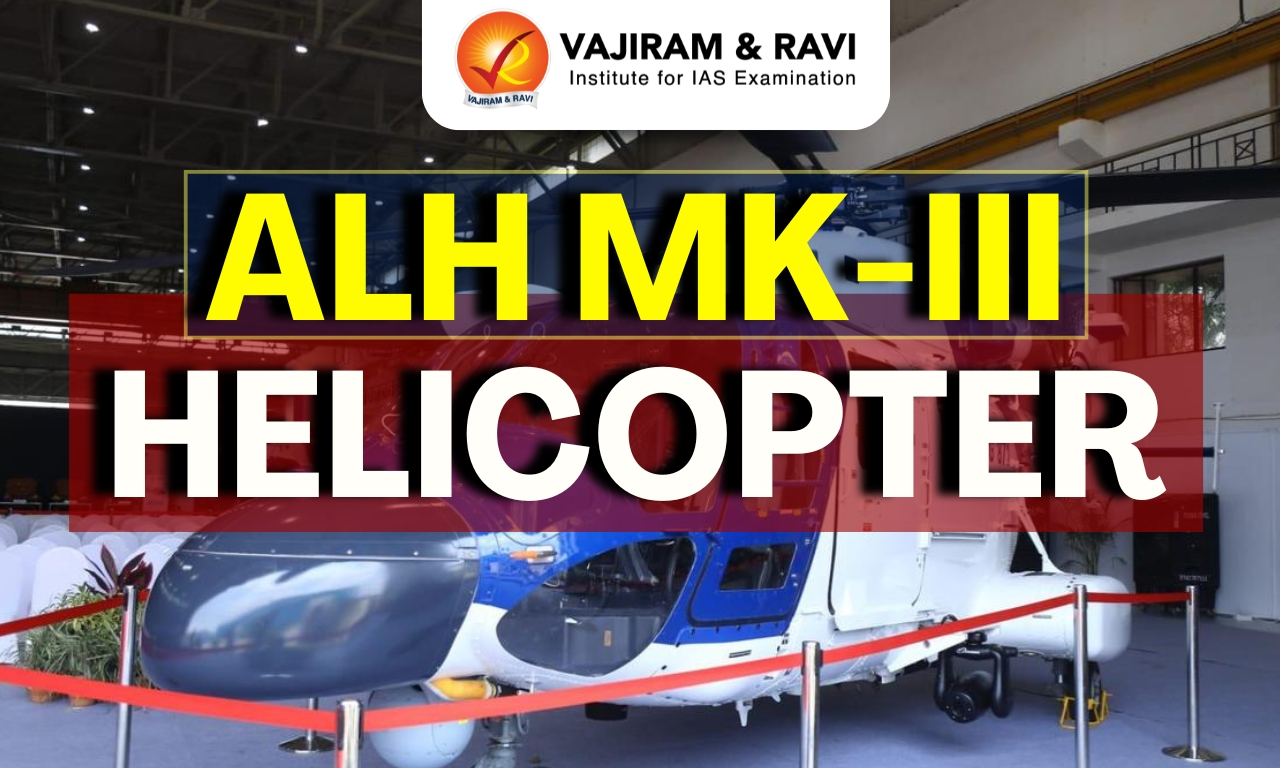
Recently, the Hindustan Aeronautics Limited (HAL) handed over four Advanced Light Helicopter (ALH) Mk III Maritime Role (MR) helicopters to the Indian Coast Guard.

About ALH MK-III Helicopter

  • It is the maritime variant of the indigenous Dhruv Advanced Helicopter.
  • These have been indigenously manufactured by Hindustan Aeronautics Limited (HAL).
  • Features of ALH MK-III Helicopter
    • It is a multi-role twin-engine helicopter equipped for demanding maritime operations.
    • It is equipped with advanced avionics, a modern glass cockpit, and night operation capability.
  • Uses: It is used for maritime surveillance, search and rescue, casualty evacuation, coastal security, law enforcement, VIP travel, troop transport, logistics, and anti-piracy.
  • Significance: The ALH Mk III (MR) significantly strengthens the Indian Coast Guard’s operational readiness across diverse maritime scenarios.

Key Facts about Indian Coast Guard

  • It is a maritime armed force operating under the Ministry of Defence, Government of India. 
  • It was raised on February 1, 1977.
  • It was formally established in 1978 by the Coast Guard Act, 1978 as an independent armed force of India.
  • Functions: The ICG was envisioned to address emerging maritime challenges and safeguard India’s expanding marine interests.
  • The Headquarters of the ICG is located in New Delhi, and is under the command of the Director General Indian Coast Guard.
  • Moto: “VAYAM RAKSHAMAH” – WE PROTECT.

Source: TH

ALH MK-III Helicopter FAQs

Q1: What is the primary role of the ALH MK-III helicopter?

Ans: Maritime reconnaissance and search and rescue

Q2: What is the engine type used in ALH MK-III helicopters?

Ans: Shakti-1H turboshaft engines

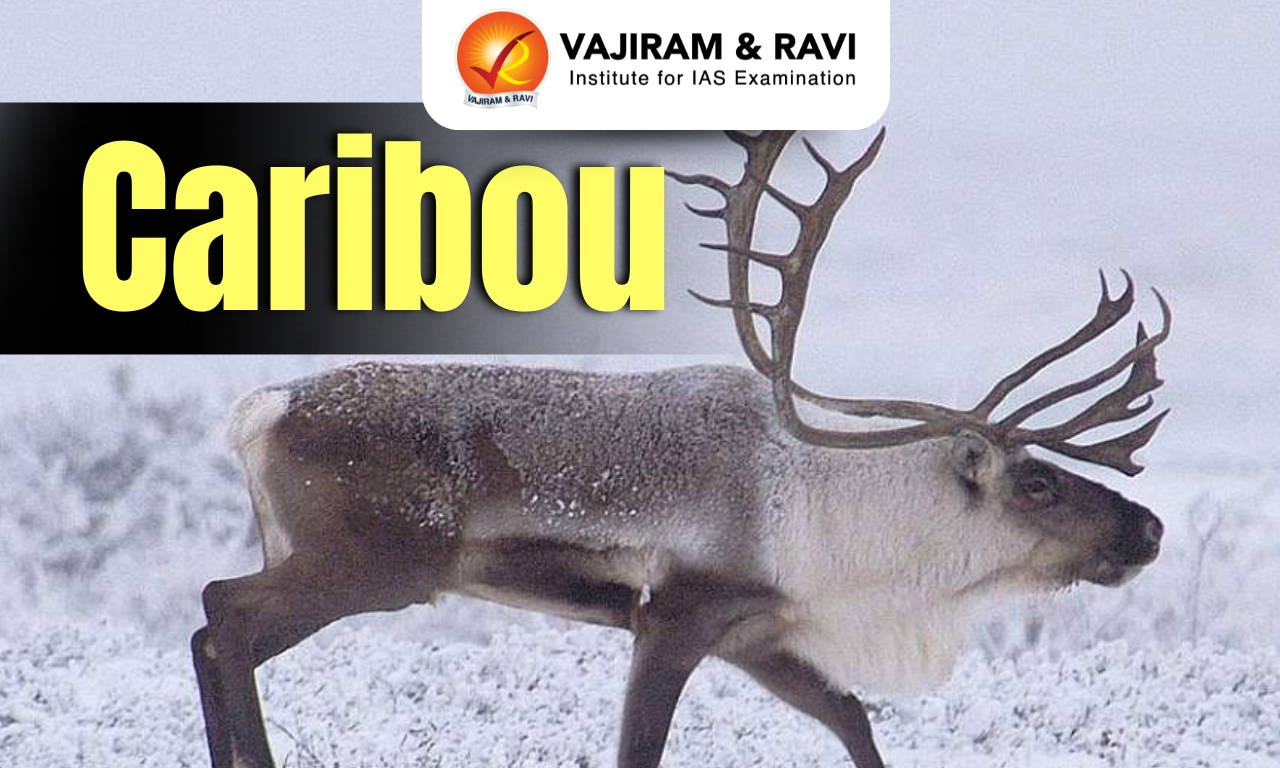
Caribou

Caribou

Caribou Latest News

According to a study by researchers Lichen continues to decline across the Arctic and caribou populations could struggle to survive the winter.

About Caribou

  • It is a species of cervidae or deer family. 
  • Scientific Name: Rangifer tarandus
  • Habitat: It survives in Arctic, subarctic, tundra, boreal, and mountainous regions.
  • Distribution: It is found in Greenland, Scandinavia, Russia, Alaska, and Canada. 
  • Features
    • Physical adoption: They have nasal turbinate bones which serve to increase the surface area in their nostrils. Cold air can thus be warmed up by their body heat prior to entering their lungs.
    • Both male and female caribou grow antlers, which they shed and regrow every year.
    • Diet: Caribou (called reindeer in Eurasia) are one of the few animals that can eat and digest lichen
    • Caribou dig through snow in a behavior known as 'cratering'
    • Migration: They travel distances that are greater than those traveled by any other terrestrial mammal.
    • They have the ability to see ultraviolet light – helps them to recognize predators in time and find food.

Conservation Status of Caribou

  • IUCN Red List: Vulnerable
  • Threats: Habitat destruction and Climate change

Source: DTE

Caribou FAQs

Q1: What do Caribou primarily eat?

Ans: Lichens and mosses

Q2: Where are Caribou primarily found?

Ans: It is found in Greenland, Scandinavia, Russia, Alaska, and Canada. 

Shree Chamundeshwari Temple

Shree Chamundeshwari Temple

Shree Chamundeshwari Temple Latest News

The Karnataka High Court has taken strong exception to the State defying judicial orders prohibiting construction activities in Sree Chamudeshwari Temple, Mysuru.

About Shree Chamundeshwari Temple

  • It is a Hindu temple located on the top of Chamundi Hills, about 13 km from the palace city of Mysuru in the state of Karnataka.
  • It is dedicated to Goddess Chamundeshwari, who is an avatar of Durga.
  • The original shrine is considered to be built by the Hoysala rulers from the 12th century and later by the Vijayanagara Empire in the 17th century.
  • Notable though are the 1000-odd, stone stairway steps that lead to the temple carved sometime in mid-17th CE by Maharaja Dodda Devaraja of Mysuru.
  • It is considered as Shakti Peetha and is one among the 18 Maha Shakti Peethas.

Shree Chamundeshwari Temple Architecture

  • The temple is of a quadrangular structure. 
  • Built in Dravidian style, it consists of the main doorway, entrance, Navaranga Hall, Antharala Mantapa, Sanctum Sanctorum, and Prakara.
  • There is a beautiful seven-tier Gopura, or pyramidal tower, at the entrance and a ‘Vimana’ (small tower) atop the sanctum sanctorum. 
  • The gopuram, adorned with colourful sculptures of gods, goddesses, and mythical figures, is visible from miles away.
  • The tower at the entrance has a small image of Lord Ganesha on the doorway.
  • The doorway is silver-plated and has the images of the Goddess in different forms.

Source: LL

Shree Chamundeshwari Temple FAQs

Q1: Where is the Shree Chamundeshwari Temple located?

Ans: It is located on the top of Chamundi Hills, about 13 km from the palace city of Mysuru in the state of Karnataka.

Q2: Who originally built the shrine of the Shree Chamundeshwari Temple?

Ans: The original shrine is considered to be built by the Hoysala rulers from the 12th century.

Q3: Who built the stone stairway leading to the Shree Chamundeshwari Temple?

Ans: The stairway was built by Dodda Devaraja Wodeyar.

Q4: What is the prominent feature at the entrance of the Shree Chamundeshwari Temple?

Ans: A seven-tier gopuram (pyramidal tower).

Canary Islands

Canary Islands

Canary Islands Latest News

A man has died and 27 others were injured after a bus carrying British tourists veered off a mountain road and crashed into a ravine in Spain’s Canary Islands.

About Canary Islands

  • The Canary Islands are an archipelago located off the northwest coast of Africa in the Macaronesia region of the North Atlantic Ocean.
  • Geographically, the archipelago is part of continental Africa, but politically and economically it is part of Europe.
  • The archipelago is a Spanish territory and is its southernmost autonomous community. 
  • It is approximately 100 km from Morocco and southwest of Spain.
  • It is Macaronesia’s largest and most populated archipelago. 
  • Some of the largest islands in the archipelago are Lanzarote, Fuerteventura, Gran Canaria, and Tenerife.
  • Tenerife is the largest island, spanning 2,034 sq.km. It is the second-largest island in Spain and also Spain’s most populated island.
  • The Canary Islands’ capital, Santa Cruz de Tenerife, is located on the island. Tenerife also hosts Teide, Spain’s highest point.
  • The Canary Islands formed millions of years ago through volcanic eruption, and some of the volcanoes are still active. 
  • The archipelago is the only Spanish region where a volcanic eruption has taken place in the modern era.
  • Most beaches along the Canaries have black sand due to their volcanic composition.
  • Climate: Desertic and tropical, moderated by trade winds and the surrounding sea.
  • The islands’ location in the Atlantic Ocean and their proximity to four continents (Africa, Europe, and the Americas) make them a popular tourist destination.

Source: TOI

Canary Islands FAQs

Q1: What are the Canary Islands?

Ans: They are an archipelago located off the northwest coast of Africa in the North Atlantic Ocean.

Q2: Politically, the Canary Islands belong to which country?

Ans: They are a territory of Spain.

Q3: Which is the largest island in the Canary Islands?

Ans: Tenerife is the largest island.

Q4: What is the capital of the Canary Islands?

Ans: Santa Cruz de Tenerife is one of the capitals.

Woolly-Necked Stork

Woolly-Necked Stork

Woolly-Necked Stork Latest News

Rare sightings of the woolly-necked stork are being reported from the paddy fields near Thanjavur, Tamil Nadu.

About Woolly-Necked Stork

  • Woolly-Necked Stork,  also known as the White-necked Stork or Bishop Stork,  is a large wading bird belonging to the stork family, Ciconiidae.
  • Scientific Name: Ciconia episcopus

Woolly-Necked Stork Habitat and Distribution

  • It is a widespread tropical species, which breeds in Africa and in Asia from India to Indonesia.
  • In India, it is most commonly found in the northern states.
  • It typically inhabits open grasslands, paddy fields, riverbanks, ponds, and other wetland areas.

Woolly-Necked Stork Features

  • It is a broad-winged soaring bird, which relies on moving between thermals of hot air for sustained long-distance flight.
  • It is all black except for the woolly white neck and white lower belly. 
  • The upperparts are glossed dark green, and the breast and belly have a purple hue. 
  • Juvenile birds are duller versions of the adult. 
  • It breeds singly or in small loose colonies. 
  • It is predominantly carnivorous, its diet consisting of fish, frogs, toads, snakes, lizards, large insects and larvae, crabs, molluscs, and marine invertebrates. 
  • It forages by slowly walking through water or vegetation, stabbing at prey.

Woolly-Necked Stork Conservation Status

It is classified as 'Near Threatened' under the IUCN Red List.

Source: TOI

Woolly-Necked Stork FAQs

Q1: What is the Woolly-Necked Stork?

Ans: It is a large wading bird belonging to the stork family Ciconiidae.

Q2: Where is the Woolly-Necked Stork distributed?

Ans: It is found in Africa and Asia from India to Indonesia.

Q3: What type of habitats does the Woolly-Necked Stork prefer?

Ans: It inhabits open grasslands, paddy fields, riverbanks, ponds, and wetlands.

Q4: What is the distinctive feature of the Woolly-Necked Stork’s appearance?

Ans: It has an all-black body with a woolly white neck and white lower belly.

Q5: What is the conservation status of the Woolly-Necked Stork?

Ans: It is listed as IUCN Red List: Near Threatened.

Hwasong-11Ga

Hwasong-11Ga

Hwasong-11Ga Latest News

North Korea recently conducted a series of weapons tests including the launch of a Hwasong-11ga fitted with a cluster munition warhead.

About Hwasong-11Ga

  • The Hwasong-11Ga, known as the KN-23 in the West, is a short-range ballistic missile.
  • It was developed by North Korea.

Hwasong-11Ga Features

  • It is a single-stage, solid-fuel missile fitted with a cluster munition warhead.
  • It is approximately 7.3 meters long with a diameter of 0.9 meters. 
  • It can carry a nuclear, chemical, or conventional warhead weighing around 500 kg. 
  • With a range of 600-700 km and a circular error probable (CEP) of 5 to 30 meters, the missile is notably accurate. 

What Makes Cluster Bombs the ‘devil’s weapon’?

  • Cluster munitions are widely considered among the most controversial weapons in modern warfare. 
  • A single missile or bomb releases dozens to hundreds of smaller submunitions in mid-air, dispersing them across a wide target area.
  • This characteristic has earned them the nickname “devil’s weapon” due to their indiscriminate nature. 
  • Unlike conventional precision strikes, cluster bombs do not distinguish between military and civilian targets.
  • Many submunitions also fail to explode on impact, remaining on the ground as unexploded ordnance, posing long-term threats to civilians.

Source: TOI

Hwasong-11Ga FAQs

Q1: What is the Hwasong-11Ga?

Ans: It is a short-range ballistic missile (SRBM).

Q2: Which country developed the Hwasong-11Ga missile?

Ans: It was developed by North Korea.

Q3: What type of warhead is fitted on the Hwasong-11Ga?

Ans: It is fitted with a cluster munition warhead.

Q4: What is the range of the Hwasong-11Ga missile?

Ans: Its range is about 600–700 km.

Morchella Mushroom

Morchella Mushroom

Morchella Mushroom Latest News

Recently, the Sheri Kashmir University of Agriculture and Sciences (SKUAST) in Srinagar has cultivated the Morchella mushroom for the first time in controlled condition.

About Morchella Mushroom

  • It is an edible mushroom from the Ascomycota group.
  • Morels or Morchella is locally known as Kangaech or Gucchi mushroom.
  • It grows naturally in specific high elevation forest ecosystems during a narrow rainy season.
  • It traditionally belongs to the family morchellaceae of the Ascomycota.
  • Properties: It is a highly valued gourmet mushroom known for its intense and distinct flavour, superior nutritional profile and medicinal properties.
  • Appearance: They are pale yellow in colour with large pits and ridges on the surface of the cap, raised on a large white stem.
  • Climatic conditions for Growth: Ideal weather conditions for the great morel are daytime temperature is between 15 and 20 Celsius and night-time temperatures are in the five to nine.
  • Distribution: They grow in conifer forests across temperature regions, and the foothills in Himachal Pradesh, Uttaranchal, and Jammu and Kashmir. 
  • These mushrooms usually grow in clusters on logs of decaying wood, leaves or humus soil.
  • They may or may not grow in the same spot the next season, which only makes the process of collection more tedious.
  • It is known to be one of the most expensive mushrooms.

Source: IE

Morchella Mushroom FAQs

Q1: What is another name for Morchella mushroom?

Ans: Morel

Q2: What is unique about Morchella mushroom's appearance?

Ans: Its honeycomb-like cap

Methanol

Methanol

Methanol Latest News

Recently, the Deendayal Port Authority (Kandla Port) has advanced its methanol bunkering capabilities, positioning itself as a key player in India’s energy transition efforts and global green shipping corridors. 

About Methanol

  • It is also known as wood alcohol is the simplest alcohol (CH3OH).
  • Production
    • This fuel is generally produced by steam-reforming natural gas to create a synthesis gas. Feeding this synthesis gas into a reactor with a catalyst produces methanol and water vapor.
  • Properties
    • It appears as a colorless fairly volatile liquid with a faintly sweet pungent odor like that of ethyl alcohol.
    • It can completely mix with water.
    • It has a high-octane, clean-burning fuel that is a potentially important substitute for gasoline in automotive vehicles.
  • Applications: Used to make chemicals, to remove water from automotive and aviation fuels, as a solvent for paints and plastics, and as an ingredient in a wide variety of products.

Benefits of Methanol

  • Methanol can be an alternative to conventional transportation fuels.
  • Lower production cost: Methanol is cheap to produce relative to other alternative fuels.
  • Improved safety: Methanol has a lower risk of flammability compared to gasoline.
  • Increased energy security: Methanol can be manufactured from a variety of domestic carbon-based feedstocks, such as biomass, natural gas, and coal.

Source: PIB

Methanol FAQs

Q1: What is the primary method of methanol production?

Ans: Synthesis from syngas

Q2: What is methanol commonly used as?

Ans: Fuel and solvent

PACE Satellite

PACE Satellite

PACE Satellite Latest News

Researchers recently found that NASA’s PACE satellite can now detect nitrogen dioxide pollution at a fine enough scale to isolate emissions from individual factories and highway corridors.

About PACE Satellite

  • The Plankton, Aerosol, Cloud, and ocean Ecosystem (PACE) is a NASA satellite mission that studies global ocean biology, aerosols, and clouds. 
  • It was launched in February 2024 into a Sun-synchronous orbit.
  • It provides the world’s first and only hyperspectral coverage of the globe every 1-2 days.
  • PACE's primary instrument is the Ocean Color Instrument (OCI), a highly advanced optical spectrometer to measure the ocean’s colour across a spectrum from ultraviolet to shortwave infrared.
    • It enables continuous measurement of light at finer wavelength resolution than previous NASA satellite instruments, extending key system ocean color data records for climate studies.
  • It also features two polarimeters – the Spectro-polarimeter for Planetary Exploration (SPEXone) and the Hyper Angular Research Polarimeter (HARP2).
    • These are used to measure how the oscillation of sunlight within a geometric plane - known as its polarization - is changed by passing through clouds, aerosols, and the ocean.
  • The data from PACE allows researchers to study microscopic life in the ocean and particles in the air, advancing the understanding of issues including fisheries health, harmful algal blooms, air pollution, and wildfire smoke.
  • With PACE, scientists also can investigate how the ocean and atmosphere interact with each other and are affected by a changing climate.

Source: EARTH

PACE Satellite FAQs

Q1: Which organization launched the PACE satellite?

Ans: The PACE satellite was launched by NASA.

Q2: What is the primary objective of the PACE mission?

Ans: To study global ocean biology, aerosols, and clouds.

Q3: What is the primary instrument onboard PACE?

Ans: The primary instrument is the Ocean Color Instrument (OCI).

Q4: When was the PACE satellite launched?

Ans: It was launched in February 2024.

Mauritius

Key Facts about Mauritius

Mauritius Latest News

India and Mauritius concluded agreements to implement projects under a $680 million economic assistance package provided by New Delhi.

About Mauritius

  • Location: It is an island country located off the southeast coast of Africa in the Indian Ocean.
  • It is a member of the Common Market for Eastern and Southern Africa (COMESA) and the Southern African Development Community (SADC).
  • Both the Indian Ocean Rim Association and the Indian Ocean Commission have their headquarters in Mauritius.
  • Capital City: Port Louis

Geographical Features of Mauritius

  • Terrain: It is made up of the main island of Mauritius and several outlying islands, like Ambre Island, Est Island, Cerfs Island, Benitiers Island, etc.
  • The island of Mauritius is a volcanic island formed by volcanic activity around 8 million years ago. 
  • Climate: The climate is maritime subtropical, with fairly uniform temperatures throughout the year.
  • Highest peak: Mount Piton, is located in the southwest of the plateau.
  • Lakes: Lake Vacoas, which is a main water source.
  • Major Rivers: Grand River South East and the Black River.

Source: HT

Mauritius FAQs

Q1: What is the capital of Mauritius?

Ans: Port Louis

Q2: Where is Mauritius located?

Ans: Indian Ocean, east of Madagascar

India Climate Decision: Why India Climate Policy Rejected COP33 Hosting

COP33

COP33 Latest News

  • India had offered to host the 2028 COP climate meeting during COP28 (December 2023) in Dubai, signalling its intent to take a leadership role in global climate governance, especially after the successful G20 summit. 
  • However, changing global and domestic circumstances led to a reassessment. India realised that hosting the summit would require it to advocate positions that might conflict with its evolving climate stance and national interests. 
  • Consequently, India has decided not to pursue hosting COP33 in 2028.

India’s Evolving Climate Stance: Prioritising National Interest

  • Context of Policy Shift - India’s decision to reconsider hosting a future climate summit reflects a broader shift in its climate positioning, shaped by changing global negotiations and a reassessment of national priorities.
  • Concerns with the Global Climate Framework - India has increasingly argued that the Paris Agreement remains skewed against developing countries, especially those like India that require greater carbon space for economic growth.
  • Development-First Approach - India has moved towards a development-first strategy, emphasising that economic growth and improved living standards are essential for building long-term resilience against climate change.
  • Questioning Temperature Targets and Mitigation Focus - India has challenged the focus on fixed temperature targets (1.5°C/2°C) and the mitigation-centric approach, arguing that adaptation needs equal or greater priority for developing nations.
  • Divergence from Global Climate Narrative - This stance contrasts with the dominant global view that prioritises climate action above all else. India instead advocates a balanced approach, similar to development-led models followed by countries like China.
  • Assertive Position on Climate Finance - India has taken a strong stand on climate finance, pushing for the implementation of Article 9.1 of the Paris Agreement, which obligates developed nations to provide financial resources to developing countries.
  • Resistance to Fossil Fuel Transition Pressures - India’s position has also hardened on proposals for an early transition away from fossil fuels, resisting pressure from developed countries and emphasising its developmental needs.
  • Increasingly Vocal Climate Diplomacy - In recent years, India has become more assertive and vocal in global climate negotiations, reflecting its recalibrated priorities and willingness to challenge prevailing international frameworks.

Global Climate Leadership vs National Interest: India’s COP33 Dilemma

  • Conflict Between Leadership Role and National Position - India’s evolving climate stance made it difficult to lead COP33, as the host is expected to champion the Paris Agreement, whereas India has been questioning key aspects of the framework.
  • Pressure to Deliver Higher Climate Ambition - COP33 would include the second Global Stocktake (GST), requiring stronger global commitments on emission cuts. As host, India would have been responsible for pushing ambitious outcomes despite its own reservations.
  • Increased Scrutiny on India’s Policies - Hosting COP33 would have placed India under greater international scrutiny, especially as the third-largest emitter, potentially pressuring it to align with global expectations over domestic priorities.
  • Limited Impact Without Global Consensus - With the United States stepping away from the Paris Agreement, India recognised that increased ambition by other countries alone may not significantly impact the climate crisis, reducing the effectiveness of leadership efforts.
  • Deepening Global Divisions - Post-COP29, trust between developed and developing countries has declined, making consensus-building increasingly difficult. This challenge was evident at COP30 and would have been even more complex during a GST year.
  • Strategic Decision to Avoid Role Conflict - Given these challenges, India chose not to pursue hosting COP33, avoiding a situation where it would have to prioritise global climate expectations over national interests.

IPCC AR7 and India’s Strategic Calculus on COP33

  • AR7 Timeline and Link to Global Stocktake - The seventh assessment report (AR7) of the IPCC, expected in 2029, may be advanced to 2028 to inform the Global Stocktake, increasing its relevance for COP33 negotiations.
  • Likely Findings and Implications - AR7 is expected to present a worsening climate scenario, with rising temperatures and insufficient global action, potentially triggering renewed pressure on countries to enhance climate commitments.
  • India’s Opposition to Early Publication - India, along with countries like China, has opposed early release, citing limited capacity of developing nations to adequately review the report and concerns over imbalanced scientific representation.
  • Concerns Over Increased Pressure - India’s resistance is also driven by fears that an early AR7 would intensify pressure on developing countries to raise climate ambition, constraining their policy flexibility.
  • Host Nation Constraints at COP33 - As host of COP33, India would have been expected to support early publication and stronger climate action, making it difficult to oppose measures that conflict with its national interests.
  • Preserving Policy Space and Energy Security - India aims to avoid binding international commitments under pressure, especially amid geopolitical uncertainties affecting energy security and supply chains.
  • Balancing Leadership and Strategic Interests - Although stepping back may appear as a loss of leadership opportunity and a setback to Global South advocacy, India prioritised avoiding being cornered on critical climate issues.
  • Decision to Opt Out - Weighing these challenges, India chose not to host COP33, opting to safeguard its strategic and developmental priorities over the demands of global climate leadership.

Source: IE

COP33 FAQs

Q1: Why did India refuse to host COP33?

Ans: India climate decision was driven by concerns that hosting COP33 would force India climate policy to prioritise global commitments over national development and energy security interests.

Q2: How has India climate policy evolved recently?

Ans: India climate policy now emphasises development-first strategy, adaptation focus, and equitable climate responsibility, challenging the mitigation-centric approach of global climate frameworks.

Q3: What role does the IPCC AR7 report play?

Ans: India climate concerns include early IPCC AR7 publication, which could increase pressure on developing countries to raise climate ambition and limit policy flexibility.

Q4: What is the Global Stocktake (GST)?

Ans: India climate negotiations include GST, a periodic review of global progress under the Paris Agreement, requiring countries to enhance commitments and accelerate emission reductions.

Q5: What challenges would India face as COP33 host?

Ans: India climate leadership at COP33 would involve balancing national interest with global expectations, managing geopolitical divisions, and pushing consensus on ambitious climate targets.

NBFC-UL Identification: RBI’s Proposed Overhaul Towards Simplicity and Regulatory Neutrality

NBFC-UL Identification

NBFC-UL Identification Latest News

  • The Reserve Bank of India (RBI) has released draft amendment directions to revise the methodology for identifying Non-Banking Financial Companies – Upper Layer (NBFC-UL) under the Scale Based Regulatory (SBR) Framework
  • The move aims to enhance transparency, simplicity, and regulatory parity, while also inviting public consultation.

NBFCs and Their Identification

  • NBFCs:
    • NBFCs are financial institutions providing banking-like services (loans, investments) without holding a full banking license, regulated by the RBI. 
    • Under the SBR framework, they are categorized into four layers based on size and risk -
      • Base Layer (NBFC-BL): Small, non-deposit-taking NBFCs with fewer systemic risks.
      • Middle Layer (NBFC-ML): All deposit-taking NBFCs (NBFC-ND-SI) and non-deposit taking ones above a certain threshold.
      • Upper Layer (NBFC-UL): Systemically significant, high-risk NBFCs.
      • Top Layer (NBFC-TL): A "blank" layer meant for specific Upper Layer entities that the RBI identifies as posing extreme risk. 
    • NBFC-UL: These comprises entities that pose significant systemic risks due to their size, complexity, and interconnectedness. 
  • Key aspects of NBFC-UL include: 
    • Identification: Includes the top ten NBFCs by asset size and others identified through a scoring methodology.
    • Examples: Major players like Bajaj Finance, Shriram Finance, Tata Capital, Aditya Birla Finance, and LIC Housing Finance.
    • Regulation: Subject to enhanced regulatory provisions, including mandatory listing within 3 years, stricter governance (e.g., higher capital buffers, liquidity ratios), and intensive supervision.
    • Duration: Once classified as UL, they must comply with these norms for at least five years, even if their parameters dip. 

Existing Framework - Two-Pronged Approach

  • Under the current SBR Framework, NBFC-UL entities are identified using -
    • Top 10 NBFCs by asset size, and
    • Parametric scoring methodology (based on risk factors such as leverage, interconnectedness, etc.)
  • This approach has been criticized for being complex and less transparent.

Proposed Changes in Draft Directions

  • Shift to asset size-based criteria:
    • RBI proposes a single, objective threshold - NBFCs with asset size ≥ ₹1,00,000 crore will qualify as NBFC-UL. This replaces the dual methodology with a clear and absolute benchmark.
    • Significance: Enhances predictability, reduces ambiguity, and improves ease of compliance.
  • Inclusion of government-owned NBFCs:
    • Currently, Government-owned NBFCs are placed in Base Layer (NBFC-BL) or Middle Layer (NBFC-ML).
    • Proposed reforms include Government-owned NBFCs in the Upper Layer based on size.
    • Principle: Ownership-neutral regulation — treating public and private entities equally.
  • State government guarantees as credit risk transfer tool:
    • NBFC-UL entities may now use State government guarantees as a credit risk transfer instrument without any cap, subject to conditions.
    • Implication: Greater flexibility in risk management and credit expansion.

Corporate Dimension and Expert Opinion

  • Tata Sons episode:
    • Tata Sons was earlier identified among NBFC-UL entities. To avoid mandatory listing requirements, it surrendered its NBFC licence.
  • Internal tussle:
    • Shapoorji Pallonji Group (18% stake) - supports listing to unlock value
    • Tata Trusts (66% stake) - opposes listing
    • Revised norms may clarify such regulatory ambiguities in future.
  • Expert opinion - ICRA Ltd highlights:
    • Asset-size criterion will improve clarity and transparency.
    • Inclusion of Government NBFCs will create a harmonised regulatory framework.
    • Likely increase in number of NBFC-UL entities beyond the current 15.

Key Challenges

  • Regulatory burden: More entities entering NBFC-UL means stricter regulations (capital adequacy, governance norms), and increased compliance costs.
  • Threshold rigidity: Sole reliance on asset size may ignore risk heterogeneity, and overlook qualitative factors like interconnectedness.
  • Impact on government NBFCs: Inclusion may limit operational flexibility, increase compliance pressure on public sector entities.
  • Corporate governance conflicts: Cases like Tata Sons highlight ownership conflicts, regulatory implications on corporate restructuring.

Way Forward

  • Balanced criteria: Combine asset size with risk-based indicators to avoid oversimplification.
  • Phased implementation: Gradual transition for newly included NBFC-UL entities, especially Government-owned ones.
  • Strengthening supervision: Enhance RBI’s supervisory capacity to monitor a larger pool of systemically important NBFCs.
  • Clear guidelines on listing requirements: Avoid regulatory arbitrage (e.g., surrendering NBFC licence to bypass listing norms).
  • Stakeholder consultation: Incorporate feedback from industry, experts, and public before final notification.

Conclusion

  • The RBI’s proposed reforms mark a significant shift towards simplification, transparency, and regulatory neutrality in NBFC supervision. 
  • While the move strengthens the macroprudential framework and aligns with evolving financial sector dynamics, careful calibration is needed to balance ease of regulation with risk sensitivity. 
  • If implemented prudently, it can enhance the stability and resilience of India’s shadow banking sector, a critical pillar of financial intermediation.

Source: TH

NBFC-UL Identification FAQs

Q1: What is the significance of the proposed shift to an asset size-based criterion for identifying NBFC-UL by the RBI?

Ans: It enhances transparency, predictability, and simplicity by replacing complex parametric scoring with a clear asset threshold.

Q2: What is the rationale behind including Government-owned NBFCs in the Upper Layer under RBI’s revised framework?

Ans: It reflects the principle of ownership-neutral regulation, ensuring equal treatment of public and private NBFCs.

Q3: What are the potential implications of allowing NBFC-ULs to use State Government guarantees as credit risk transfer instruments?

Ans: It provides greater flexibility in risk management and credit expansion, strengthening financial intermediation.

Q4: What are the key challenges associated with the proposed NBFC-UL identification reforms?

Ans: Major challenges include increased regulatory burden, threshold rigidity, and compliance pressure on government NBFCs.

Q5: How does the Tata Sons episode reflect regulatory and corporate governance issues in NBFC regulation?

Ans: It highlights regulatory arbitrage and ownership conflicts arising from listing requirements linked to NBFC-UL classification.

Jyotirao Phule: Legacy of Jyotirao Phule in Social Reform and Education

Jyotirao Phule

Jyotirao Phule Latest News

  • PM Modi paid tribute to Jyotirao Phule on his birth anniversary (April 11), marking the beginning of his 200th birth anniversary celebrations and highlighting his enduring legacy in social reform.

Jyotirao Phule (1827–1890)

  • Jyotirao Phule is a central figure in Indian social reform history. 
  • He is widely regarded as one of the earliest and most radical voices against caste oppression and patriarchy in 19th-century India.

Early Life and Background

  • Born on 11 April 1827 in Pune, Maharashtra, into the Mali (gardener) caste — a lower-caste community — Phule experienced caste discrimination firsthand from an early age. 
  • Despite initial obstacles, he pursued education and was deeply influenced by the egalitarian ideals of Thomas Paine's The Rights of Man and the American anti-slavery movement. 
  • His exposure to these ideas shaped his lifelong crusade against Brahminical social order.

Key Areas of Work

  • Education for the Marginalised - In 1848, he opened the first school for girls in Pune at Bhide Wada — a radical act in 19th-century India. He subsequently opened schools for lower-caste children and untouchables. His wife, Savitribai Phule, became India's first female teacher and was his closest partner in this mission.
  • Women's Empowerment - In 1863, he established a home for the care of upper-caste widows and their newborns, challenging the social stigma attached to widow remarriage and pregnancy outside wedlock.
  • Fight Against Caste System - He rejected the authority of the Vedas and Manusmriti as instruments of upper-caste domination. He was among the first reformers to draw a direct link between caste oppression and economic exploitation of the peasantry and labouring classes.

Satyashodhak Samaj (1873)

  • Phule founded the Satyashodhak Samaj (Society of Truth Seekers) in 1873 — one of the most significant social reform organisations of 19th-century India. 
  • Its core objectives were to liberate untouchables, promote rational thinking, and establish direct communion with God without priestly intermediaries. 
  • The Samaj conducted marriages without Brahmin priests, a practice known as Satyashodhak marriages.

Books and Literary Works

  • Tritiya Ratna (1855)
  • Gulamgiri (Slavery) — 1873
  • Shetkaryaca Asud (Cultivator's Whipcord) — 1883
  • Sarvajanik Satyadharma Pustak (1889)

Legacy and Recognition

  • In 1888, Phule was conferred the title "Mahatma" by a public gathering in Pune — decades before Gandhi received the same title.
  • He is regarded as a forerunner of B.R. Ambedkar, who acknowledged Phule as one of his three greatest influences (alongside the Buddha and Kabir).
  • The Government of India has honoured him as one of the makers of modern India.

Key Highlights of the Speech by PM Modi

  • Phule as a Catalyst for Social Change - PM Modi described Phule as a reformer who believed that societal change must emerge from within, inspiring generations through thought, action, and commitment to justice.
  • Central Role of Education in Reform - Education was at the heart of Phule’s vision. He pioneered schools for girls and marginalised communities, emphasising that knowledge is a shared resource and a tool for equality and empowerment.
  • Champion of Equality and Social Justice - Phule worked tirelessly for the poor, farmers, and marginalised, advocating dignity, equal rights, and social harmony. His founding of the Satyashodhak Samaj institutionalised these ideals.
  • Contribution of Savitribai Phule - PM Modi also honoured Savitribai Phule, a pioneer in women’s education, who carried forward Phule’s mission and sacrificed her life while serving plague victims.
  • Contemporary Relevance and Policy Inspiration - The Prime Minister linked Phule’s ideas to present-day initiatives focused on education, innovation, and youth empowerment, highlighting their continued relevance in nation-building.
  • Call for Renewal of Social Commitment - The bicentenary is seen as an opportunity to renew commitment to education, justice, and social reform, reinforcing the belief that society can transform itself through collective effort.

Source: IE

Jyotirao Phule FAQs

Q1: Who was Jyotirao Phule?

Ans: Jyotirao Phule was a pioneering social reformer who fought caste oppression, promoted education for girls and marginalised communities, and laid foundations for modern social justice movements.

Q2: What were Jyotirao Phule’s key contributions?

Ans: Jyotirao Phule established schools for girls, worked for women’s rights, opposed caste hierarchy, and founded Satyashodhak Samaj to promote equality and rational thinking.

Q3: What is Satyashodhak Samaj?

Ans: Jyotirao Phule founded Satyashodhak Samaj in 1873 to fight caste discrimination, promote social equality, and encourage direct connection with God without priestly intermediaries.

Q4: How did Jyotirao Phule contribute to women’s education?

Ans: Jyotirao Phule, along with Savitribai Phule, pioneered girls’ education in India, opening schools and challenging social norms that denied education to women.

Q5: Why is Jyotirao Phule relevant today?

Ans: Jyotirao Phule’s ideas on equality, education, and social justice continue to inspire policies and movements aimed at inclusive growth and empowerment in modern India.

Daily Editorial Analysis 11 April 2026

Daily-Editorial-Analysis

An Alternative Proposal on Viksit Bharat Shiksha Adhisthan Bill

Context

  • The proposed Viksit Bharat Shiksha Adhisthan (VBSA) Bill seeks to institutionalise the implementation of the National Education Policy (NEP) 2020.
  • While it is presented as a reformative framework for higher education, the Bill has raised significant concerns regarding constitutional validity, centralisation of power, erosion of institutional autonomy, and weakening of social justice commitments.
  • A close analysis reveals that the Bill, in its current form, represents a shift away from democratic and federal principles toward bureaucratic and centralised governance.

The Core of the Criticism: Constitutional Overreach and Centralisation of Power

  • Under the Indian constitutional framework, Parliament’s authority over higher education is limited to the coordination and determination of standards, as specified in Entry 66 of the Union List.
  • However, the Bill expands this scope by granting extensive discretionary powers to Union government-controlled councils.
  • These bodies are empowered not only to determine standards but also to conduct inspections and exercise wide-ranging regulatory authority.
  • This expansion effectively sidelines State governments, undermining the federal structure of governance.

Major Concerns Surrounding the Viksit Bharat Shiksha Adhisthan (VBSA) Bill

  • Erosion of Institutional Autonomy and Participatory Governance
    • The Bill reduces the role of higher education institutions (HEIs) in decision-making processes and replaces consultative mechanisms with bureaucratic control.
    • For instance, it dilutes provisions of the University Grants Commission (UGC) Act, which mandates consultation with universities before inspections.
    • Under the VBSA framework, prestigious institutions such as IITs, IIMs, and Inter-University Centres risk losing their governing autonomy.
    • Bureaucrats are positioned as central actors in transforming higher education, which raises concerns about the marginalisation of academic voices.
    • The absence of participation from faculty, students, and institutional bodies like senates and academic councils further weakens democratic governance within universities.
  • Ideological and Structural Concerns
    • Critics argue that this approach risks privileging a narrow cultural perspective, potentially undermining India’s pluralistic and multicultural intellectual traditions.
    • Additionally, the emphasis on global rankings and output-based metrics, such as patents and publications, reflects a shift toward market-driven, corporate-oriented education
    • This orientation may neglect broader educational goals such as social justice, national innovation, and self-reliance.
    • The Bill’s silence on affirmative action and reservation policies for marginalised communities further exacerbates concerns about equity and inclusion.
  • Flaws in Regulatory and Accreditation Mechanisms
    • The proposed regulatory architecture introduces multiple councils for governance, accreditation, and standards.
    • However, these bodies are heavily centralised and lack adequate representation from States and academic communities.
    • The Regulatory Council is granted sweeping powers, including the authority to recognise or close institutions, often without requiring State consent.
    • Similarly, the Accreditation Council’s plan to outsource evaluation to third-party agencies risks undermining transparency and deliberative processes.
    • Technology-driven assessments and output-based evaluation metrics fail to capture the broader societal impact of education.
    • The Standards Council, operating from a centralised location, is unlikely to effectively address the diverse needs of different regions, disciplines, and sectors.

The Path Forward to Address These Concerns

  • Need for Democratisation and Federal Balance
    • A key recommendation is the inclusion of State Higher Education Councils (SHECs) in decision-making processes.
    • Ensuring equal representation, such as a 50% weightage for both State and Union bodies, would help restore federal balance and promote cooperative governance.
    • The Bill should also institutionalise the participation of students, teachers, and non-teaching staff in governance.
    • Decision-making processes must be deliberative, inclusive, and context-sensitive, rather than prescriptive and centralised.
    • Regional councils could further help accommodate local priorities, including ecological sustainability, cultural diversity, and economic development.
  • Reimagining Funding and Public Responsibility
    • A significant structural reform proposed is the creation of a Higher Education Grants Council (HEGC) to manage funding.
    • This body should ensure equitable distribution of resources, particularly to State universities that have historically been underfunded.
    • Public funding must remain central to higher education, reinforcing its role as a public good rather than a market commodity.
    • The Bill should explicitly articulate the public purposes of higher education, including social justice, inter-regional equity, and national development.
    • Adequate funding mechanisms, along with clear accountability structures, are essential for achieving these objectives.

Conclusion

  • While the VBSA Bill aims to reform and modernise higher education in India, its current framework raises serious constitutional, institutional, and social concerns.
  • The centralisation of power, erosion of autonomy, and neglect of equity threaten to undermine the foundational principles of India’s education system.
  • Meaningful reform requires a shift toward democratic governance, federal cooperation, and a renewed commitment to education as a public good.
  • Only through inclusive and balanced policymaking can the transformative potential of higher education be fully realised.

An Alternative Proposal on Viksit Bharat Shiksha Adhisthan Bill FAQs

Q1. Why is the VBSA Bill considered a constitutional overreach?
Ans. The VBSA Bill is considered a constitutional overreach because it expands the Union government’s powers beyond coordinating standards to exercising broad control over higher education.

Q2. How does the Bill affect institutional autonomy?
Ans.  The Bill reduces institutional autonomy by limiting the role of universities in decision-making and increasing bureaucratic control.

Q3. What concern is raised about the Bill’s approach to “Bhartiya Knowledge”?
Ans. The Bill’s approach to “Bhartiya Knowledge” is criticised for potentially undermining India’s multicultural and pluralistic traditions.

Q4. What is the issue with the Bill’s regulatory framework?
Ans. The Bill’s regulatory framework is seen as overly centralised and lacking adequate participation from States and academic communities.

Q5. What key reform is suggested regarding funding?
Ans. It is suggested that a Higher Education Grants Council should be created to ensure equitable and adequate public funding for institutions.

Source: The Hindu


Bolstering Deterrence Through Submarine Dominance

Context

  • Defence Minister Rajnath Singh's cryptic post on X mentioning the word 'Aridhaman' recently sparked widespread speculation about the quiet commissioning of INS Aridhaman — India's third nuclear ballistic missile submarine (SSBN) in the Indian Navy's programme.
  • This follows the commissioning of INS Arihant in 2016 and INS Arighat in 2024.
  • This article highlights the strategic significance of INS Aridhaman in strengthening India’s nuclear triad, enhancing sea-based deterrence, advancing defence self-reliance, and responding to the evolving dynamics of multi-domain warfare.

About INS Aridhaman

  • Evolution of India’s SSBN Programme
    • India’s SSBN programme began with INS Arihant (2016), followed by INS Arighat (2024), and now INS Aridhaman, marking steady progress in strengthening sea-based nuclear capabilities.
    • Another submarine in the Arihant class is expected soon.
  • Key Specifications and Upgrade
    • INS Aridhaman represents a significant upgrade over its predecessors.
    • It is a larger 7,000-tonne vessel capable of carrying up to 24 K-15 Sagarika missiles and up to eight nuclear-tipped K-4 or K-5 missiles — nearly double the capacity of INS Arihant and INS Arighat, which could each carry twelve K-15 and four K-4 missiles.

Strategic Significance

  • Completing the Nuclear Triad
    • The commissioning of INS Aridhaman further consolidates India's nuclear triad — the ability to launch nuclear weapons from land, sea, and air.
    • Notably, apart from India, only the P5 nations (USA, Russia, China, France, UK) possess full nuclear triad capabilities.
    • India's nuclear doctrine remains anchored on its No First Use (NFU) policy.
  • Strengthening Sea-Based Deterrence
    • Sea-based deterrence has emerged as a critical priority in India's nuclear strategy, particularly given the rapidly worsening strategic environment in the Indian Ocean.
    • China's growing presence through research and survey vessels — which possess dual-use technologies and risk being used for intelligence gathering — has made robust maritime deterrence essential.
    • INS Aridhaman directly addresses this imperative against both China and Pakistan.
  • Boost to Indigenous Defence Production
    • The SSBN programme has significantly advanced India's goal of self-reliance in defence production.
    • With active global conflicts straining international defence supply chains, and the Russia-Ukraine war highlighting the risks of over-dependence on traditional partners like Moscow, indigenisation has become a strategic necessity for India.

Evolving Nature of Modern Warfare

  • Modern warfare no longer operates in isolated silos. The West Asia conflict, which began as air campaigns but quickly acquired a maritime character with the Strait of Hormuz emerging as the epicentre, is a stark illustration.
  • Similarly, Operation Sindoor — India's counter-terror response against Pakistan — demonstrated that a naval dimension to such operations remains a real possibility.
  • This complexity of multi-domain warfare makes nuclear triad capabilities and cross-domain deterrence indispensable for India's national security.

Key Challenges

  • The primary challenges ahead include efficiently balancing resource allocation between upgrading existing submarines and inducting new ones, and integrating emerging technologies such as Artificial Intelligence and Autonomous Systems into submarine design and production.
  • Keeping pace with China's rapidly expanding naval roster will remain a defining benchmark for the Indian Navy going forward.

Road Ahead

  • A fourth vessel of the Arihant class is expected to be inducted soon.
  • Additionally, India aims to commission its first fully indigenously designed nuclear attack submarine (SSN) by 2036, followed by a second by 2038 — signalling that submarine dominance is fast becoming central to India's deterrence strategy.

Conclusion

  • INS Aridhaman marks a crucial step in India’s deterrence strategy, but sustaining submarine dominance will require technological innovation, resource optimisation, and sustained focus on indigenous capabilities.

Bolstering Deterrence Through Submarine Dominance FAQs

Q1. What is the significance of INS Aridhaman for India?

Ans. INS Aridhaman strengthens India’s nuclear triad and enhances sea-based deterrence, making India more capable of responding to strategic threats across multiple domains.

Q2. How is INS Aridhaman different from earlier submarines?

Ans. It is a larger, more advanced submarine with nearly double missile capacity, carrying up to 24 K-15 or 8 K-4/K-5 missiles, improving strike capability.

Q3. Why is sea-based deterrence important for India?

Ans. Sea-based deterrence ensures survivable second-strike capability and counters threats from adversaries like China and Pakistan in the Indian Ocean region.

Q4. How does INS Aridhaman support self-reliance in defence?

Ans. The SSBN programme promotes indigenous defence production, reducing dependence on foreign suppliers amid global supply disruptions and enhancing strategic autonomy.

Q5. What are the future plans for India’s submarine programme?

Ans. India plans to induct more Arihant-class submarines and develop indigenous nuclear attack submarines (SSNs) by 2036 and 2038 to strengthen naval capabilities.

Source: TH


Broader and Hidden Implications of West Asia Conflict for India

Context

  • The ongoing conflict in West Asia has disrupted LPG supply chains to India, triggering a domestic fuel crisis.
  • This has led to rising LPG prices, panic buying, black-marketing, and economic distress in small industries.
  • The situation has broader implications, extending beyond energy security to food security and nutrition

Immediate Impacts of LPG Supply Disruption

  • Rising household expenditure:
    • According to the Household Consumption Expenditure Survey (HCES) 2023-24, fuel and light account for 6.1% (rural) and 5.6% (urban) of monthly per capita expenditure.
    • Increase in LPG prices directly raises the cost of cooking meals, comparable to spending on health and education.
  • Economic ripple effects:
    • Reduced LPG availability affects small-scale industries reliant on LPG, urban informal workforce, leading to reverse migration (similar to COVID-19 trends).
    • Government response: Prioritisation of domestic consumption over commercial use, and diversification of import sources.

Indirect Effects on Food Systems

  • Rising cost of agricultural production:
    • India’s dependence on fertiliser imports makes it vulnerable to global disruptions.
    • Increased costs of fertilisers, mechanisation, and transportation - likely to trigger food inflation.
  • Supply chain disruptions:
    • Higher logistics costs impact availability and affordability of food items, especially perishables.

Impact on Nutritional Security

  • Cost of a Healthy Diet (CoHD):
    • Based on ICMR dietary guidelines, average CoHD (non-vegetarian diet) was ₹73.1/person/day (2023-24).
    • This indicates that 25–49% of the population are already unable to afford a healthy diet.
  • Role of cooking fuel costs:
    • Meal preparation adds ₹9.5 extra, including ₹6.5 from fuel costs alone. This raises unaffordability to 32–62% of the population.
  • Post-crisis scenario:
    • Rising LPG prices and food inflation may further result in declining dietary diversity and nutrition intake. This will create a disproportionate impact on poor and vulnerable households.

Key Challenges

  • Structural issues: High import dependence (LPG and fertilisers), and weak resilience of food supply chains.
  • Affordability crisis: Rising cost of living affecting both food and fuel, increasing nutrition inequality.
  • Social dimensions: Exclusion of migrant populations from welfare schemes. Intra-household dynamics affecting food distribution and access.
  • Policy gaps: Food policies often ignore cooking fuel as a determinant of nutrition. Limited focus on dietary diversity.

Way Forward

  • Short-term measures:
    • Expand social safety nets, for example, subsidise nutritious foods (pulses, vegetables, eggs, meat, nuts).
    • Strengthen schemes like PMUY (Pradhan Mantri Ujjwala Yojana) to ensure continued LPG affordability, and including migrant workers temporarily.
    • Price stabilisation through buffer stocks and market intervention.
  • Medium-term interventions:
    • Improve public distribution system (PDS) to include nutrient-rich foods, strengthen last-mile delivery mechanisms, and enhance urban food security frameworks.
  • Long-term structural reforms:
    • Promote domestic fertiliser production and reduce import dependency, and encourage nutrition-sensitive agriculture.
    • Adopt a food systems approach integrating production, distribution, consumption, and energy access.

Conclusion

  • The LPG crisis triggered by geopolitical instability highlights the deep interlinkages between energy security, food systems, and nutrition security.
  • In a country already grappling with high levels of malnutrition, such shocks can exacerbate vulnerabilities.
  • A shift towards a holistic food systems approach, backed by inclusive welfare policies and resilient supply chains, is essential to safeguard India’s nutritional well-being in times of global uncertainty.

Hidden Implications of West Asia Conflict FAQs

Q1. What is the impact of rising LPG prices on nutritional security in India?

Ans. Rising LPG prices increase cooking costs, reducing affordability of healthy diets and worsening nutritional insecurity.

Q2. How does disruption in global energy supply chains affect India’s food inflation?

Ans. Energy disruptions raise fertiliser, transport, and production costs, leading to increased food prices and inflation.

Q3. What is the concept of Cost of a Healthy Diet (CoHD)?

Ans. It reflects the minimum cost of nutritionally adequate diets, highlighting affordability gaps and guiding targeted nutrition interventions.

Q4. Why is a ‘food systems approach’ essential for ensuring nutrition security in India?

Ans. Because it integrates production, distribution, consumption, and energy access.

Q5. What is the role of social safety nets in mitigating the impact of food and fuel crises?

Ans. Food subsidies and LPG schemes buffer vulnerable populations against price shocks and protect nutrition outcomes.

Source: IE

Daily Editorial Analysis 11 April 2026 FAQs

Q1: What is editorial analysis?

Ans: Editorial analysis is the critical examination and interpretation of newspaper editorials to extract key insights, arguments, and perspectives relevant to UPSC preparation.

Q2: What is an editorial analyst?

Ans: An editorial analyst is someone who studies and breaks down editorials to highlight their relevance, structure, and usefulness for competitive exams like the UPSC.

Q3: What is an editorial for UPSC?

Ans: For UPSC, an editorial refers to opinion-based articles in reputed newspapers that provide analysis on current affairs, governance, policy, and socio-economic issues.

Q4: What are the sources of UPSC Editorial Analysis?

Ans: Key sources include editorials from The Hindu and Indian Express.

Q5: Can Editorial Analysis help in Mains Answer Writing?

Ans: Yes, editorial analysis enhances content quality, analytical depth, and structure in Mains answer writing.

Enquire Now