Information Sharing and Transparency in Government

Information Sharing and Transparency in Government

In today’s information age, governance is no longer judged merely by decisions taken but also by how openly those decisions are communicated. Information sharing and transparency transform governance from a closed system into a participative process where citizens become informed stakeholders rather than passive recipients. They strengthen accountability, build trust, and promote ethical governance.

“Information is the currency of democracy.” — Thomas Jefferson

Information Sharing Meaning

Information sharing refers to the timely, accurate, and meaningful exchange of information among government institutions, citizens, civil society, and other stakeholders.

It is much more than merely providing data. It ensures that citizens understand government actions, public officials make informed decisions, and different institutions work in coordination.

Significance of Information Sharing in Governance

Information is the lifeblood of good governance, as it transforms power into accountability and citizens into informed participants.

  • Promotes Informed Governance: Accurate and timely information enables evidence-based policymaking and better public service delivery. Example: Data-driven vaccination strategies during the COVID-19 pandemic.
  • Strengthens Citizen Sovereignty: Access to information empowers citizens to participate meaningfully in democratic processes and governance.
  • Enhances Accountability: Information acts as a tool of public oversight by enabling citizens to scrutinize government actions and decisions.
  • Builds Trust and Credibility: Transparent sharing of information reduces suspicion and strengthens trust between government and society.
  • Facilitates Responsive Governance: Continuous flow of information helps governments understand public needs and respond effectively to emerging challenges.
  • Reduces Information Asymmetry: It bridges the knowledge gap between the state and citizens, making governance more equitable and inclusive.
  • Supports Constitutional Morality: Information sharing promotes transparency, openness, and accountability, which are essential democratic values.
  • Encourages Public Participation: Informed citizens are more likely to engage constructively in policy discussions, public consultations, and community initiatives.
  • Promotes Ethical Governance: Openness in information sharing discourages corruption, arbitrariness, and misuse of public authority.
  • Creates Public Value: Information enables governments to align policies with citizens’ needs and welfare, thereby advancing the common good.
  • Strengthens Social Trust: A transparent information ecosystem fosters cooperation, legitimacy, and long-term confidence in public institutions.
  • Improves Inter-Agency Coordination: Effective information exchange among government departments enhances administrative efficiency and policy implementation.

Transparency in Governance Meaning

Transparency refers to openness in government functioning, decision-making, and utilization of public resources. It ensures that citizens know:

  • What decisions are being taken.
  • Why are they being taken?
  • How public money is being spent.
  • Who is accountable for outcomes.

Significance of Transparency in Governance

Transparency turns the government from a black box into a glass house.

  • Strengthens Accountability: Transparency enables citizens to hold public officials answerable for their actions, decisions, and use of public resources.
  • Promotes Probity in Governance: Openness in administration discourages corruption, arbitrariness, and misuse of authority, fostering integrity in public life.
  • Builds Public Trust: Transparent institutions inspire confidence among citizens and strengthen the legitimacy of democratic governance.
  • Citizen Sovereignty: In a democracy, citizens are the ultimate stakeholders; transparency empowers them with the information necessary for informed participation.
  • Facilitates Responsive Governance: Public scrutiny encourages governments to remain sensitive and responsive to the needs and aspirations of people.
  • Supports Ethical Decision-Making: Transparency promotes fairness, objectivity, and evidence-based policymaking by exposing decisions to public evaluation.
  • Enabler of Social Justice: Access to information empowers marginalized groups to claim their rights and entitlements.

Challenges to Information Sharing and Transparency

  • Culture of Secrecy: Traditional bureaucratic mindsets often prioritize confidentiality over openness, limiting the free flow of information.
  • Weak Information Infrastructure: Poor record management, inadequate digitization, and technological gaps hinder timely dissemination of information.
  • Privacy and Data Protection Concerns: Balancing citizens’ right to know with the right to privacy remains a significant ethical challenge.
  • Lack of Awareness Among Citizens: Many people are unaware of their information rights and available transparency mechanisms such as RTI.
  • Political and Administrative Resistance: Transparency may be resisted when it exposes inefficiency, corruption, or misuse of authority.
  • Information Overload and Poor Communication: Mere disclosure of large volumes of raw data without proper interpretation can create confusion rather than transparency.
  • Coordination and Capacity Deficits: Weak inter-departmental coordination and lack of trained personnel often obstruct effective information sharing.
  • National Security and Confidentiality Issues: Governments must balance transparency with legitimate concerns relating to security, diplomacy, and sensitive information.

The challenge is not merely to make information available, but to make it accessible, understandable, and useful while safeguarding legitimate confidentiality.

Tools for Promoting Information Sharing and Transparency

  • Right to Information (RTI) Act, 2005: Empowers citizens to access government information and strengthens accountability in public administration.
  • Proactive Disclosure: Government departments voluntarily place important information in the public domain, reducing information asymmetry.
  • E-Governance Platforms: Digital initiatives such as DigiLocker, UMANG, and government portals improve accessibility, efficiency, and transparency.
  • Citizen Charters: Clearly define service standards, responsibilities, and timelines, making public institutions more accountable.
  • Social Audits: Enable citizens and communities to verify the implementation of public programmes and expenditure.
  • Open Government Data (OGD): Public access to government datasets promotes informed participation, innovation, and evidence-based scrutiny.
  • Whistleblower Protection Mechanisms: Encourage ethical disclosure of corruption, misconduct, and abuse of authority in the public interest.
  • Public Consultations and Stakeholder Engagement: Involving citizens in policymaking improves transparency and participative governance.
  • Annual Reports and Performance Dashboards: Regular disclosure of achievements, targets, and outcomes strengthens institutional accountability.
  • Independent Oversight Institutions: Bodies such as the CAG, Central Information Commission, Lokpal, and Vigilance Commissions act as guardians of transparency and public trust.

Conclusion

In the digital age, good governance is no longer defined merely by what governments do, but also by how openly they communicate and how effectively they share information with the people.

“Transparency converts authority into accountability, information into empowerment, and governance into public trust.”

Information Sharing and Transparency in Government FAQs

Q1: What do you understand about Information Sharing in governance?

Ans: Information sharing is the timely and meaningful exchange of information among government institutions, citizens, and stakeholders to facilitate informed decision-making, coordination, and accountability.

Q2: How is transparency different from information sharing?

Ans: Information sharing is the process of providing information, whereas transparency is the outcome achieved when information is shared openly, accurately, and accessibly.

Q3: Why is transparency considered a cornerstone of good governance?

Ans: Transparency promotes accountability, reduces corruption, builds public trust, and enables citizens to participate effectively in governance.

Q4: How does information sharing strengthen democratic governance?

Ans: It empowers citizens with knowledge, enhances participation in public affairs, and enables informed scrutiny of government actions and decisions.

Q5: What are the major challenges in ensuring transparency in governance?

Ans: Key challenges include bureaucratic secrecy, privacy concerns, weak institutional capacity, information overload, political resistance, and national security considerations.


Igneous Rocks, Types, Formation, Classification, Significance

Igneous Rocks

Igneous Rocks are one of the main types of rocks found on Earth. They are formed when hot molten material called magma (below the Earth’s surface) or lava (on the surface) cools and hardens. These rocks are often considered the “original” rocks because they are the first to form in the rock cycle, and other rocks can be made from them over time. 

Igneous Rocks

  • Rocks formed from the solidification of magma (molten rock below the surface) and lava (molten rock above the surface) are called Igneous Rocks or primary rocks.
  • The term igneous is derived from a Latin word meaning “fire.”
  • Magma refers to molten rock inside the Earth, while lava refers to molten rock that comes out onto the surface.
  • Igneous Rocks are formed under high-temperature conditions and are unfossiliferous.
  • Molten rock usually forms deep inside the Earth, especially near plate boundaries or hot spots, and then gradually moves upward.
  • Based on the place and time taken for cooling, Igneous Rocks are of two types: plutonic rocks and volcanic rocks.
  • Based on the presence of silicon (acid-forming radical), rocks are classified into acidic rocks and basic rocks.
  • Examples of Igneous Rocks include granite, gabbro, and basalt.

Also Read : Types of Rocks

Classification of Igneous Rocks Based on Place of Cooling

The classification of Igneous Rocks based on the place of cooling explains how the location where magma or lava solidifies influences the type of rock formed. Based on this variation in place of cooling, Igneous Rocks are broadly categorized into types discussed below. 

Intrusive Igneous Rocks (Plutonic Rocks)

  • These rocks are formed when magma gets trapped deep inside the Earth and does not reach the surface.
  • The trapped magma cools very slowly, sometimes taking thousands or even millions of years to solidify.
  • Because of this slow cooling, mineral crystals get enough time to grow, making them large and clearly visible.
  • These rocks have a coarse-grained texture, meaning you can easily see the grains with the naked eye.
  • Intrusive rocks are also known as plutonic rocks.
  • Common examples include granite, diorite, gabbro, and peridotite.
  • A special type called pegmatite can have extremely large crystals, sometimes even bigger than a human hand.

Extrusive Igneous Rocks (Volcanic Rocks)

  • These rocks form when magma comes out onto the Earth’s surface as lava and cools there.
  • This usually happens during volcanic eruptions or through cracks (fissures) in the Earth’s crust.
  • Since the lava is exposed to the cool air or water, it cools very quickly.
  • Due to rapid cooling, crystals do not get much time to grow, so they remain very small or even invisible.
  • These rocks have a fine-grained or glassy texture.
  • Sometimes, gas bubbles get trapped in the lava, creating a bubbly (vesicular) texture.
  • Common examples include basalt, rhyolite, andesite, and obsidian.
  • Obsidian forms when lava cools almost instantly, giving it a glassy appearance with no crystals.

Also Read : Sedimentary Rock

Cooling and Texture of Igneous Rocks

  • The speed at which magma or lava cools plays a very important role in deciding the texture, crystal size, and overall appearance of Igneous Rocks.
  • When cooling happens slowly deep inside the Earth, minerals get enough time to grow into large, well-formed crystals, resulting in a coarse-grained texture, also known as phaneritic texture.
  • These crystals are usually clearly visible to the naked eye, making such rocks look rough and grainy.
  • When cooling happens quickly on or near the Earth’s surface, crystals do not get enough time to grow, so they remain very small or may not form at all.
  • This leads to a fine-grained texture, called aphanitic texture, where individual crystals are too small to be seen without a microscope.
  • In cases of extremely rapid cooling, such as when lava cools almost instantly, the rock may form a glassy texture with no crystals, like in obsidian.
  • Sometimes, gases trapped in quickly cooling lava create small holes or bubbles, giving the rock a vesicular texture (for example, pumice).

Igneous Rocks Formation and Composition

  • All Igneous Rocks begin as magma formed deep inside the Earth, mainly in the lower crust or upper mantle, where temperatures and pressure are extremely high.
  • This magma forms due to processes like melting of rocks, movement of tectonic plates, or presence of hot spots.
  • The composition of Igneous Rocks depends on the minerals present in the magma, which can vary in terms of silica content, temperature, and chemical makeup.
  • Because of these differences, Igneous Rocks can range from light-colored (rich in silica) to dark-colored (rich in iron and magnesium).
  • Even if two rocks originate from the same magma, they can look very different depending on how and where they cool.
  • For example, slow cooling inside the Earth forms granite with large crystals, while rapid cooling on the surface forms rhyolite with very fine crystals.
  • The environment of formation (inside or outside Earth) and rate of cooling together influence not only texture but also structure and mineral arrangement.

Igneous Rocks Chemical Components

  • Most Igneous Rocks are mainly made up of silicate minerals, which are formed from silicon (Si) and oxygen (O). These two elements are the basic building blocks of most rocks in the Earth’s crust.
  • In rare cases, Igneous Rocks can be rich in carbonates, but such examples are very uncommon. Therefore, most studies focus on silicate-based Igneous Rocks.
  • Role of Silica in Rock Composition
    • The amount of silica (SiO₂) present in magma is very important because it controls the chemical nature and appearance of the rock.
    • Rocks with low silica content usually contain higher amounts of iron and magnesium, which makes them darker, heavier, and denser.
    • These rocks generally have less sodium and potassium.
    • Rocks with high silica content contain more sodium and potassium and less iron and magnesium, which makes them lighter in color.
    • Other components like calcium oxide and alumina also change with silica content. Calcium is usually higher in rocks with moderate silica but decreases as silica increases further.
  • Classification Based on Silica Content
    • Igneous Rocks are commonly classified into different groups based on their silica percentage.
    • Felsic (or silicic) rocks contain more than 66 percent silica and are usually light in color.
    • Intermediate rocks contain about 55 to 66 percent silica and show a balance of light and dark minerals.
    • Mafic rocks contain about 45 to 55 percent silica and are rich in iron and magnesium, giving them a darker appearance.
    • Ultramafic rocks contain less than 45 percent silica and have very high amounts of iron and magnesium.
    • The terms felsic and mafic are widely used to describe the chemical character of Igneous Rocks.

Classification of Igneous Rocks Based on Chemical Composition

Igneous Rocks can be broadly divided into acidic and basic rocks depending on the amount of silica and other elements present in them.

Acidic Igneous Rocks

  • Acidic rocks contain a high proportion of silica, often up to about 70-80 percent, mainly in the form of minerals like quartz and feldspar. Other elements such as aluminium, alkalis, iron, and magnesium are present in smaller amounts. Because they lack heavy elements like iron and magnesium, these rocks are lighter in colour and less dense.
  • The high silica content makes the magma thick and sticky, so it cools relatively quickly and does not flow very far. As a result, the lava tends to pile up near the source, leading to the formation of steep and high landforms like mountains and domes.
  • These rocks are generally hard, compact, and massive in structure, which makes them resistant to weathering and erosion. Because of this strength, they often form the core of continental crust (sial region) and contribute to stable landforms.
  • Common examples include granite, rhyolite, microgranite, and quartz-rich rocks, which mainly contain minerals such as quartz, feldspar, and biotite.

Basic Igneous Rocks

  • Basic rocks contain a lower amount of silica, usually around 40-50 percent, and are rich in magnesium and iron, along with other elements like lime and aluminium. Due to the presence of these heavy elements, they are denser and darker in colour, often appearing black or dark grey.
  • The low silica content makes the magma more fluid, allowing it to flow easily over long distances before cooling. This widespread flow of lava results in the formation of large flat landforms such as plateaus, like volcanic plateaus.
  • These rocks are generally less hard compared to acidic rocks and are therefore more prone to weathering over time, which contributes to soil formation.
  • Common examples include basalt, gabbro, and dolerite, which contain minerals like olivine, pyroxene, and feldspar. Because of their composition, they are also referred to as mafic rocks.

Igneous Rocks Significance

  • Igneous Rocks are very important economically because they are a major source of valuable minerals and metals. Since they are formed from magma, many important ores are directly linked to these rocks and are mined for industrial use.
  • Several useful minerals are found in Igneous Rocks, including iron, nickel, copper, lead, zinc, manganese, chromite, gold, platinum, and even diamonds. These minerals are widely used in industries like construction, manufacturing, electronics, and jewellery.
  • Some Igneous Rocks contain special structures called amygdales, which are small, almond-shaped cavities formed by gas bubbles. Over time, these spaces get filled with useful minerals like quartz, calcite, and zeolites, increasing their economic value.
  • The ancient rocks of the Indian Peninsula are especially rich in mineral resources, and many important mining areas are located in these regions. These deposits play a key role in the country’s mineral-based industries and economy.
  • Igneous Rocks like granite are widely used as building materials because they are strong, durable, and available in attractive colours and textures. They are commonly used in construction, monuments, flooring, and decorative purposes.
  • Basalt, another important igneous rock, is used in road construction and as railway ballast due to its hardness and resistance to weathering. This makes it useful for infrastructure development.
  • Igneous Rocks also help in the formation of gemstones and precious stones, which are highly valuable in the jewellery industry and contribute to trade and exports.
  • These rocks play a role in scientific and geological studies, helping in understanding the Earth’s interior and guiding the exploration of mineral resources.

Igneous Rocks FAQs

Q1: What are Igneous Rocks and how are they formed?

Ans: Igneous Rocks are formed when molten material called magma (inside the Earth) or lava (on the surface) cools and solidifies. They are considered the primary rocks in the rock cycle because all other rocks are ultimately derived from them.

Q2: What is the difference between intrusive and extrusive Igneous Rocks?

Ans: Intrusive rocks form below the Earth’s surface and cool slowly, resulting in large crystals, while extrusive rocks form on the surface and cool quickly, leading to very small or no visible crystals.

Q3: How does cooling rate affect the texture of Igneous Rocks?

Ans: Slow cooling produces coarse-grained rocks with large crystals, whereas rapid cooling forms fine-grained or glassy rocks with very small or no crystals. Extremely fast cooling can also create vesicular textures with gas bubbles.

Q4: What are felsic, mafic, intermediate, and ultramafic rocks?

Ans: These are categories based on silica content. Felsic rocks are rich in silica and light-colored, mafic rocks have less silica and are dark, intermediate rocks fall in between, and ultramafic rocks have very low silica with high iron and magnesium content.

Q5: What is the difference between acidic and basic Igneous Rocks?

Ans: Acidic rocks contain high silica (70-80%) and are lighter and less dense, while basic rocks have lower silica (40-50%), are darker, denser, and more fluid when molten.

UPSC Daily Quiz 24 June 2026

UPSC Daily Quiz

[WpProQuiz 193]

UPSC Daily Quiz FAQs

Q1: What is the Daily UPSC Quiz?

Ans: The Daily UPSC Quiz is a set of practice questions based on current affairs, static subjects, and PYQs that help aspirants enhance retention and test conceptual clarity regularly.

Q2: How is the Daily Quiz useful for UPSC preparation?

Ans: Daily quizzes support learning, help in revision, improve time management, and boost accuracy for both UPSC Prelims and Mains through consistent practice.

Q3: Are the quiz questions based on the UPSC syllabus?

Ans: Yes, all questions are aligned with the UPSC Syllabus 2025, covering key areas like Polity, Economy, Environment, History, Geography, and Current Affairs.

Q4: Are solutions and explanations provided with the quiz?

Ans: Yes, each quiz includes detailed explanations and source references to enhance conceptual understanding and enable self-assessment.

Q5: Is the Daily UPSC Quiz suitable for both Prelims and Mains?

Ans: Primarily focused on Prelims (MCQ format), but it also indirectly helps in Mains by strengthening subject knowledge and factual clarity.

Concept of Public Service, Meaning, Values, Ethics, Significance

Concept of Public Service

Service to others has been regarded as one of the highest human virtues across civilizations. A society becomes truly civilized when its institutions and individuals work not merely for personal gain but for the welfare of others. Public service embodies this ideal by placing citizens and the common good at the centre of governance.

“The best way to find yourself is to lose yourself in the service of others.” — Mahatma Gandhi

Public Service Meaning 

Public service refers to activities undertaken for the welfare of people and the promotion of collective well-being. It transforms authority into responsibility and power into welfare, acting as a bridge between the state and the people.

Traditionally, it was associated mainly with government functions and officials. However, in contemporary society, public service extends beyond government and includes contributions by civil society organisations, media, private institutions, philanthropists, and individual citizens.

Public Service Meaning in the Western Context

In the Western tradition, public service is generally viewed as the performance of duties for which an individual receives remuneration. It is often associated with public institutions, government agencies, and officials who work to implement laws and policies.

  • Social Contract Perspective: Thinkers such as Thomas Hobbes argued that public service is essential for enforcing the social contract between the state and citizens. Public servants therefore ensure order, security, and welfare in society.
  • Administrative Perspective: Max Weber described public servants as professionally recruited officials selected through merit-based processes to implement government policies. They are expected to remain politically neutral, efficient, and accountable.
  • Institutional Perspective: The United Nations’ Code of Conduct for Public Officials views public servants as individuals who act on behalf of elected representatives and discharge public responsibilities.

This perspective primarily emphasizes duty, professionalism, accountability, and institutional responsibility.

Public Service Meaning in the Indian Context

The Indian understanding of public service goes beyond employment and administration. It is deeply rooted in ethics, spirituality, and social responsibility.

  • Service as a Sacred Duty: Indian thought views service not merely as work but as a moral obligation towards society. Service is often associated with selflessness, compassion, and personal growth.
  • Seva Bhava: Swami Vivekananda emphasized that service to humanity is service to God. His message, “Jiva is Shiva”, highlights that serving people is the highest form of worship.
  • Lokasangraha: The Bhagavad Gita advocates Lokasangraha, meaning working for the welfare and stability of society. It encourages individuals to rise above narrow self-interest and contribute to collective well-being.
  • Inner Motivation: Unlike the Western emphasis on external accountability, the Indian tradition places greater importance on conscience, self-discipline, and inner satisfaction. Public service is performed not merely for rewards but for self-realisation and social good.

Thus, public service in India is both a professional responsibility and a moral calling.

Spirit of Public Service

The spirit of service refers to complete dedication towards one’s duties and a genuine concern for the welfare of others. It involves performing responsibilities efficiently, ethically, and with compassion.

Anthropologist Margaret Mead once remarked that the first sign of civilization was a healed femur bone. A person with a broken leg could survive only because someone cared for and supported them. Her observation highlights an important truth: civilization begins when people start helping one another.

The spirit of service is important because:

  • Promotes Compassion: It develops empathy and sensitivity towards the needs of others.
  • Builds Character: Service encourages humility, responsibility, and emotional maturity.
  • Strengthens Society: Communities become stronger when individuals contribute to the welfare of others.
  • Creates Inner Satisfaction: Selfless service often brings a sense of fulfilment and purpose beyond material rewards.
  • Supports Nation Building: Dedicated public service contributes directly to social harmony and national development.

The lives of Armstrong Pame, Kiran Bedi, and many social reformers demonstrate how the spirit of service can transform communities and inspire others.

Key Attributes of Public Service

  • Citizen-Centric: Public service exists to serve citizens and respond to their needs, rights, and aspirations. Citizens are not merely beneficiaries but the central stakeholders of governance.
  • Collective in Nature: Public services are designed for the welfare of society as a whole. Public health, law and order, environmental protection, and sanitation benefit entire communities.
  • Based on Equality: Public service seeks to provide equal opportunities and fair treatment to all citizens regardless of social or economic background.
  • Value-Oriented: Public service is guided by values such as honesty, integrity, compassion, fairness, and responsibility.
  • Government-Led: Although various stakeholders contribute, governments remain the primary providers because they possess constitutional authority and public resources.
  • Essential for Human Development: Education, healthcare, justice, and social security enable individuals to lead dignified and productive lives.
  • Linked to Sovereignty: Functions such as defence, taxation, administration, and maintenance of law and order are closely associated with the sovereign authority of the state.

Difference between Public Servants and Civil Servants

A public servant is any individual or institution working for public welfare. This broad category includes judges, police personnel, government employees, social workers, and various public functionaries.

Civil servants form a specific category within public servants. They are professionally recruited officials who assist the government in policy implementation and administration.

Every civil servant is a public servant, but every public servant is not a civil servant.

Civil servants are expected to uphold neutrality, professionalism, objectivity, accountability, and efficiency while serving the public interest.

Significance of Public Service

Public service is not merely an administrative function; it is the practical expression of a society’s commitment to justice, welfare, and human dignity.

“Where markets seek profits, public service seeks human welfare; where authority seeks compliance, public service seeks public trust.”

  • Instrument of Constitutional Morality: Public service translates constitutional values such as justice, equality, liberty, and fraternity into reality through policies and service delivery.
  • Vehicle of Antyodaya: It ensures that governance reaches the last and most vulnerable citizen, reflecting Gandhiji’s talisman of remembering the poorest person while making decisions.
  • Embodiment of Lokasangraha: Public service promotes collective welfare and social harmony by placing community interests above narrow individual interests.
  • Bridge Between State and Citizens: Public servants connect government policies with people’s aspirations, making governance more responsive and participatory.
  • Compassionate Governance: Welfare schemes such as Ayushman Bharat and PM Poshan reflect the state’s concern for the dignity and well-being of vulnerable groups.
  • Promotion of Human Dignity: Public services in healthcare, education, sanitation, and social security enable individuals to live with dignity rather than mere survival.
  • Institutionalization of Ethics of Care: Public service encourages sensitivity towards the elderly, women, children, persons with disabilities, and other vulnerable groups.
  • Catalyst for Social Transformation: Effective public service not only delivers services but also challenges social evils such as poverty, illiteracy, discrimination, and exclusion.
  • Builder of Social Capital: Fair and efficient public service strengthens trust between citizens and institutions, which is essential for social cohesion and democratic stability.
  • Guardian of Public Trust: Public servants act as trustees of public resources and authority. Hence, integrity and probity become essential for maintaining citizens’ confidence.
  • Promoter of Inclusive Development: Public service ensures that the benefits of growth are distributed across regions, communities, and social groups.
  • Strengthening Democratic Legitimacy: Citizens often judge governments by the quality of public services they receive. Efficient service delivery enhances the legitimacy of democratic institutions.
  • Enabler of Public Value Creation: Modern public service goes beyond administration and seeks to create lasting social value through innovation, transparency, and citizen engagement.
  • Cultivator of Duty Consciousness: Public service reinforces the idea that rights and welfare must be accompanied by responsibility, commitment, and ethical conduct.
  • Nation-Building: By maintaining order, promoting development, and fostering social justice, public service contributes directly to national integration and progress.

Difference Between Public Service and Private Jobs

Public service and private jobs differ in their objectives, accountability, and approach to work.

Basis

Public Service

Private Jobs

Primary Purpose

Public welfare, social justice, and collective well-being

Profit maximization and business growth

Beneficiaries

Citizens and society at large

Customers, shareholders, and owners

Nature of Services

Essential services such as law and order, healthcare, education, and justice

Goods and services driven by consumer demand

Accountability

Accountable to citizens, Constitution, laws, and democratic institutions

Accountable to owners, management, and shareholders

Source of Funds

Public resources such as taxes, fees, and government revenues

Private investment and business revenue

Approach

Focus on equity, inclusiveness, and social responsibility

Focus on efficiency, competitiveness, and profitability

Decision-Making

Guided by laws, rules, constitutional values, and public interest

Guided by business objectives and market conditions

Competition

Often operates in areas with limited or no competition, especially essential services

Operates in a competitive market environment

Service Orientation

Citizen-centric and welfare-oriented

Customer-centric and market-oriented

Discrimination

Must provide services impartially and without discrimination

May differentiate based on market considerations and customer segments

Performance Measure

Public welfare, service delivery, and social impact

Profit, market share, and customer satisfaction

Ethical Expectation

High standards of integrity, probity, neutrality, and public trust

Professional ethics and corporate responsibility

In essence, while private jobs focus on creating economic value, public service focuses on creating public value by balancing efficiency with equity, accountability, and citizen welfare.

Ethical Foundations of Public Service

The legitimacy of public service rests on ethical conduct.

  • Selflessness: Public interest must be placed above personal interest.
  • Integrity: Honesty and consistency in actions build public trust.
  • Accountability: Public officials must remain answerable for their decisions.
  • Transparency: Openness strengthens trust and reduces corruption.
  • Compassion: Sensitivity towards vulnerable groups gives governance a human face.
  • Objectivity: Decisions should be based on facts, fairness, and public interest.
  • Leadership: Public servants should inspire confidence through ethical conduct and responsible behaviour.

These values closely align with the Nolan Principles of Public Life: Selflessness, Integrity, Objectivity, Accountability, Openness, Honesty, and Leadership.

Ethical Challenges in Public Service

Despite its noble purpose, public service often faces several ethical challenges that can affect public trust and the quality of governance.

  • Corruption: Misuse of public office for personal gain undermines integrity and public confidence in institutions.
  • Conflict of Interest: Personal, political, or financial interests may influence official decisions, compromising impartiality.
  • Lack of Transparency: Opaque decision-making reduces accountability and creates opportunities for misconduct.
  • Abuse of Authority: Excessive or arbitrary use of power can violate citizens’ rights and weaken democratic values.
  • Political Pressure: Public servants may face pressure to act in favour of political interests rather than public interest.
  • Weak Accountability: Inadequate monitoring and oversight can lead to inefficiency, negligence, and irresponsible behaviour.
  • Red Tapism: Excessive procedural delays and rigid adherence to rules often hinder effective service delivery.
  • Discrimination and Bias: Prejudice based on caste, gender, religion, region, or socio-economic status can affect fairness in administration.
  • Misuse of Public Resources: Diversion or wastage of public funds and resources reduces the effectiveness of welfare programmes.
  • Lack of Empathy: Insensitive behaviour towards citizens, particularly vulnerable groups, can weaken the spirit of public service.
  • Resistance to Change: Reluctance to adopt reforms, innovation, and technology may affect administrative efficiency and responsiveness.
  • Balancing Law and Compassion: Public servants often face ethical dilemmas where strict legal provisions may conflict with humanitarian concerns.

Addressing these challenges requires strong institutions, ethical leadership, technology-driven governance, and active citizen participation.

Concept of Public Service FAQs

Q1: What is public service?

Ans: Public service refers to activities undertaken for the welfare of society and the promotion of the common good. It aims to serve citizens and advance public interest rather than private profit.

Q2: What are the core values of public service?

Ans: Public service is guided by values such as integrity, honesty, accountability, transparency, compassion, objectivity, and commitment to public welfare.

Q3: How is public service different from a private job?

Ans: While private jobs primarily focus on profit and business objectives, public service focuses on citizen welfare, social justice, and the effective delivery of essential services.

Q4: What is meant by the spirit of public service?

Ans: The spirit of public service refers to selfless dedication, compassion, integrity, and commitment towards serving people and fulfilling public responsibilities ethically and efficiently.

Q5: Why is ethics important in public service?

Ans: Ethics ensures that public power and resources are used fairly, honestly, and responsibly. It helps build public trust, improve service delivery, and strengthen democratic governance.

Lohagarh Fort, History, Architecture, Other Features & Significance

Lohagarh Fort

Lohagarh Fort is a historic fort known for its strength and unique construction. Built in the city of Bharatpur, it stands out from other forts because it was designed more for defense than decoration. Instead of grand architecture, it focuses on solid walls, deep moats, and strong protection systems, which made it extremely difficult for enemies to capture. 

About Lohagarh Fort

  • Lohagarh Fort is one of the strongest and most unique forts in India, located in Bharatpur, and is especially known for its defensive strength rather than decorative beauty.
  • Unlike many forts of Rajasthan that focus on royal luxury and artistic design, this fort was built with a clear aim of protecting the kingdom from repeated invasions.
  • The name “Lohagarh” or “Iron Fort” reflects its unbreakable nature, as even strong enemies failed to capture it.
  • The fort gives a strong impression of practical architecture, where every structure has a purpose related to safety and survival.

Also Read : Daulatabad Fort

Lohagarh Fort Historical Background

  • Rajasthan has always been an entry route for foreign invaders, which made it highly exposed to attacks, destruction, and political conflicts in the past.
  • Invaders often looted wealth, destroyed settlements, and tried to capture important cities, creating a need for strong defensive systems.
  • To deal with such threats, rulers began constructing forts that could act as protective barriers and ensure the safety of their people.
  • Lohagarh Fort represents this defensive approach, showing how rulers focused on long-term protection rather than temporary solutions.
  • It also reflects the political instability of that time, when kingdoms had to constantly prepare for external threats.

Lohagarh Fort Construction and Architectural Features

  • The fort was built in 1732 by Maharaja Suraj Mal, who was known for his strong leadership and focus on building secure infrastructure.
  • It was constructed on an artificial island, which naturally made it difficult for enemies to approach and attack directly.
  • The fort has a massive rectangular layout with strong boundary walls supported by around 34 bastions, which were used for surveillance and defense.
  • A unique feature is the use of mud inside the walls, which helped absorb cannon fire instead of cracking like stone, making the fort more resistant during battles.
  • The surrounding deep and wide moat filled with water acted as a major obstacle for enemies trying to enter the fort.
  • The construction required huge manpower, time, and financial resources, showing the importance given to security.
  • The overall design reflects a perfect combination of engineering skills and military strategy.

Important Structures Inside the Lohargarh Fort

  • The fort complex includes a variety of structures such as palaces, administrative buildings, temples, and residential areas, reflecting a complete living space.
  • Jawahar Burj is one of the most important structures, built to celebrate victory and symbolize the pride of the rulers.
  • Other buildings like Kishori Mahal, Moti Mahal, Kothi Khas, and palace complexes show the lifestyle and architectural style of the royal family.
  • The fort also houses a museum, where visitors can see weapons, armours, artefacts, and other historical objects from earlier times.
  • Religious places like the Ganga Temple and Laxman Mandir highlight the spiritual beliefs and cultural practices of the people.
  • There are also watchtowers and cannon points, which were used during battles for defense and surveillance.
  • The structures inside the fort show a mix of military use and daily life, making it a self-sufficient complex.

Lohagarh Fort Historical Significance

  • Lohagarh Fort is widely known for its ability to withstand powerful attacks, including those by British forces led by Lord Lake in 1805.
  • Even after a long siege lasting several weeks, the British were unable to capture the fort, which proved its exceptional strength.
  • This made the fort a symbol of resistance and courage, especially for the Jat rulers of Bharatpur.
  • It also showed how strategic planning and smart construction could defeat even powerful armies.
  • The fort played an important role in maintaining the independence and security of the region during difficult times.
  • Today, the fort is preserved and maintained by the Archaeological Survey of India, which works to restore and protect its historical structures. 
  • Lohagarh Fort stands as a powerful symbol of strength, resilience, and intelligent design, showing how architecture was used for protection.
  • Its simple yet highly effective construction makes it different from many other forts that focus mainly on beauty.
  • The fort reflects the courage and determination of the Jat rulers, who successfully defended their kingdom.
  • Visiting this fort helps in understanding the history, culture, and military strategies of ancient India.

Also Read : Maratha Military Landscapes

Lohagarh Fort FAQs

Q1: What is Lohagarh Fort famous for?

Ans: Lohagarh Fort is famous for its extraordinary strength and defensive design, which made it almost impossible for enemies to capture, even during repeated attacks.

Q2: Where is Lohagarh Fort located?

Ans: Lohagarh Fort is located in Bharatpur, a historically important region known for both cultural heritage and natural attractions.

Q3: Who built Lohagarh Fort and when?

Ans: The fort was built in 1732 by Maharaja Suraj Mal, a powerful Jat ruler known for his strong military planning and architectural vision.

Q4: Why is Lohagarh Fort called the Iron Fort?

Ans: It is called the “Iron Fort” because of its strong structure and ability to withstand powerful attacks, including a long British siege, without being conquered.

Q5: What are the main architectural features of Lohagarh Fort?

Ans: The fort includes thick walls, deep water-filled moats, bastions, and strong gates, along with a unique use of mud inside walls to absorb cannon fire.

PRIs Reforms and Innovations (2014–2026), Governance, Issues

PRIs Reforms and Innovations

Over the last decade, India has witnessed a significant transformation in Panchayat governance through capacity building, digitalisation, fiscal empowerment, technological innovation, and greater participation of women, tribal communities, and youth. These reforms have strengthened democratic decentralisation and positioned Panchayats as key drivers of rural development and inclusive growth.

About Panchayati Raj Institutions (PRIs)

Panchayati Raj Institutions (PRIs) are the backbone of grassroots democracy in India. Established through the 73rd Constitutional Amendment Act, 1992, they were envisioned as institutions of self-government capable of planning and implementing development according to local needs. 

By bringing governance closer to citizens, PRIs promote democratic participation, local accountability, and inclusive rural development.

Over time, however, challenges such as limited administrative capacity, inadequate financial resources, weak planning mechanisms, and uneven devolution of powers constrained their effectiveness. Recognising these gaps, the Government undertook a series of reforms between 2014 and 2026 aimed at strengthening institutional capacity, improving digital governance, enhancing fiscal autonomy, and making Panchayats more participatory, transparent, and citizen-centric.

Strengthening Institutional Capacity

Rashtriya Gram Swaraj Abhiyan (RGSA): A major challenge before Panchayats has been the lack of institutional and administrative capacity. To address this, the Government launched the Rashtriya Gram Swaraj Abhiyan (RGSA) in 2018-19, which was further revamped from 2022-23.

  • More than 4.10 crore elected representatives and Panchayat functionaries across over 2.70 lakh Panchayati Raj Institutions have been trained.
  • Special emphasis has been placed on strengthening the leadership of women representatives, with more than 33.55 lakh women elected representatives receiving training between 2022-23 and 2025-26.

Investments in governance infrastructure: More than 25,100 Gram Panchayat buildings and over 61,000 computers have been provided, enabling Panchayats to function more effectively and deliver public services efficiently.

Deepening Participatory Planning

Gram Panchayat Development Plan (GPDP): Effective local governance requires local participation. Recognising this principle, the Government institutionalised the Gram Panchayat Development Plan (GPDP) as the primary instrument for participatory village planning.

  • Today, more than 2.55 lakh Gram Panchayats prepare development plans through consultations with local communities. 
  • This has strengthened bottom-up planning and ensured that development priorities reflect local needs rather than top-down administrative decisions.

The integration of GPDPs with digital platforms has further improved transparency and accessibility, making local planning more accountable and evidence-based.

Digital Transformation of Panchayats

One of the most remarkable changes in Panchayat governance has been the adoption of digital technologies.

e-GramSwaraj platform: The e-GramSwaraj platform has transformed the functioning of Panchayats by digitising planning, budgeting, accounting, and financial management. 

  • More than 2.59 lakh Panchayats are now part of the e-Panchayat ecosystem. 
  • Integration with the Public Financial Management System (PFMS) enables real-time monitoring of expenditures and online payments.
  • As of June 2026, online transactions worth more than ₹3.16 lakh crore have been processed through the integrated platform. 
  • This has significantly enhanced transparency, reduced delays, and improved accountability in Panchayat finances.

Meri Panchayat App: Citizen participation has also been strengthened through the Meri Panchayat App, which provides information on Panchayat meetings, development projects, and public assets. 

  • With over one crore downloads, the application has emerged as an important tool for citizen-centric governance.

SVAMITVA and Rural Property Reforms

Among the most transformative rural governance reforms has been the SVAMITVA (Survey of Villages and Mapping with Improvised Technology in Village Areas) Scheme, launched in 2020.

  • The scheme uses drone technology to survey inhabited rural areas and provide legal ownership records through property cards. 
  • As of June 2026, around 3.18 crore property cards have been distributed across 1.92 lakh villages.
  • The initiative has reduced property disputes, improved access to institutional credit, strengthened land records, and enhanced the revenue-generating capacity of Panchayats. 
  • By providing formal recognition of property ownership, the scheme has significantly contributed to rural economic security.

Fiscal Empowerment of Local Governments

Political decentralisation cannot succeed without financial decentralisation. Recognising this, successive Finance Commissions have increased support to Rural Local Bodies.

  • During the Fifteenth Finance Commission period (2020–26), grants amounting to ₹2.82 lakh crore were released to Rural Local Bodies, representing nearly 95 percent of the total allocation. This is the highest release percentage under any Finance Commission cycle.
  • Building on this momentum, the Sixteenth Finance Commission (2026–31) has recommended ₹4.35 lakh crore for Rural Local Bodies, an increase of nearly 84 percent over the previous cycle.

The focus has not only been on grants but also on promoting financial self-reliance. Initiatives such as the SAMARTH Panchayat Portal and the Atmanirbhar Panchayat Programme aim to strengthen Panchayats’ Own Source Revenue (OSR) through better assessment, collection, and management of local revenues.

Technology and Artificial Intelligence in Governance

The recent phase of Panchayat reforms has been characterised by the adoption of data analytics and Artificial Intelligence.

Panchayat Advancement Index (PAI): In 2025, the Government introduced the Panchayat Advancement Index (PAI) to measure Panchayat performance across the nine themes of Localised Sustainable Development Goals (LSDGs). 

  • Covering more than 2.59 lakh Gram Panchayats, the Index enables performance benchmarking, evidence-based planning, and informed decision-making.

SabhaSaar: The Ministry also launched SabhaSaar, an AI-enabled platform that automatically generates Gram Sabha minutes in 23 Indian languages. 

  • More than 1.35 lakh Panchayats have used the platform, generating over three lakh meeting records. This has improved transparency while making local governance more accessible and inclusive.

Another innovative step was the launch of India’s first Gram Panchayat-level weather forecasting initiative in collaboration with the India Meteorological Department (IMD)

  • Panchayat-level forecasts help farmers and rural communities make informed decisions and improve resilience to weather-related risks.

Strengthening Tribal Self-Governance

Special attention has been given to the implementation of the Panchayats (Extension to Scheduled Areas) Act, 1996 (PESA).

  • The Government has developed specialised training manuals in tribal languages, launched a dedicated PESA-GPDP Portal, established a Centre of Excellence for PESA, and introduced India’s first PESA Ranking Framework.

These initiatives have strengthened tribal participation in governance and improved implementation of self-governance provisions in Scheduled Areas.

Advancing Women-Led Development

Women’s participation in Panchayat governance has expanded significantly over the years. The focus has now shifted from representation to leadership.

Sashakt Panchayat-Netri Abhiyan: The Sashakt Panchayat-Netri Abhiyan, launched in 2025, seeks to enhance governance, communication, and leadership skills among elected women representatives.

744 Model Women-Friendly Gram Panchayats: Additionally, 744 Model Women-Friendly Gram Panchayats have been identified across the country.

Nirbhay Raho Campaign: promotes women’s safety, leadership, and participation in local governance.

These initiatives reflect a broader shift towards women-led development at the grassroots level.

Engaging Youth in Democracy

The Ministry has also focused on engaging young citizens with local democracy.

Model Youth Gram Sabha (MYGS): The Model Youth Gram Sabha (MYGS) initiative introduces students to democratic decision-making through simulated Gram Sabha proceedings. Covering Jawahar Navodaya Vidyalayas, Eklavya Model Residential Schools, and government schools, the initiative engaged more than 29,000 students in 2025.

This effort aligns with the objectives of the National Education Policy (NEP), 2020 by promoting civic awareness, leadership, and democratic values among youth.

PRIs Reforms and Innovations FAQs

Q1: How did the 73rd Constitutional Amendment strengthen grassroots democracy in India?

Ans: It granted constitutional status to Panchayati Raj Institutions, mandated regular elections, reservation for women and weaker sections, State Finance Commissions, and Gram Sabhas, thereby institutionalising democratic decentralisation.

Q2: Examine the role of Panchayati Raj Institutions in achieving the vision of Viksit Bharat.

Ans: PRIs promote participatory governance, strengthen service delivery, improve local planning, empower communities, and ensure inclusive development by bringing decision-making closer to citizens.

Q3: What are the major challenges faced by Panchayati Raj Institutions in India?

Ans: Inadequate devolution of functions, funds and functionaries (3Fs), weak financial autonomy, limited administrative capacity, bureaucratic interference, and uneven implementation across states.

Q4: How has digitalisation transformed Panchayat governance in India?

Ans: Platforms such as e-GramSwaraj, PFMS integration, Meri Panchayat App, and SabhaSaar have improved transparency, accountability, citizen participation, and real-time monitoring of Panchayat activities and finances.

Q5: Examine the role of Artificial Intelligence and data analytics in strengthening Panchayat governance.

Ans: AI-based initiatives such as SabhaSaar and data-driven tools like PAI improve decision-making, performance assessment, record management, transparency, and evidence-based planning at the grassroots level.

Antaram idukki

Antaram idukki

Antaram idukki Latest News

A team of researchers has discovered a new genus and species of tiger moth from the southern Western Ghats and named it as Antaram idukki. 

About Antaram idukki

  • It belongs to the tiger moth subfamily Arctiinae (Erebidae).
  • It was discovered in Kerala’s Idukki district.
  • It is currently known only from Idukki and is distinguished from related genera by a unique combination of external and genital morphological characters.
    • Tiger moths play a crucial ecological role as pollinators, particularly for plants that bloom at night.
    • They also serve as an important food source for birds, bats and other wildlife, while acting as biological indicators of environmental change.

What are Moths?

  • These are insects that belong to the order Lepidoptera, which they share with butterflies.
  • Characteristics
    • Highly adapted, they live in all but polar habitats. 
    • They often have duller colors compared to butterflies, which helps with camouflage. Some, like the luna moth or atlas moth, are vividly colored.
    • Moth antennae are often feathery, unlike the thin and clubbed antennae of butterflies.
    • Most moths are active at night, but some are diurnal.
    • The larvae and adults of most moth species are plant eaters. Larvae in particular do considerable damage to ornamental trees and shrubs and to many other plants of economic importance.

Source: TH

Antaram idukki FAQs

Q1: What is Antaram idukki?

Ans: New genus & species of Tiger Moth

Q2: Which subfamily does Antaram idukki belong to?

Ans: Arctiinae, family Erebidae

Vitamin B3

Vitamin B3

Vitamin B3 Latest News

A clinical trial is exploring whether high doses of vitamin B3 could give patients with glioblastoma a better chance against aggressive brain cancer.

About Vitamin B3

  • Vitamin B3, or Niacin, is a water-soluble vitamin.
  • Water-soluble vitamins dissolve in water. Leftover amounts of the vitamin leave the body through the urine. 
  • The body keeps a small reserve of these vitamins, but they have to be taken on a regular basis to maintain the reserve. 
  • It is naturally present in many foods, added to some food products, and available as a dietary supplement.
  • Your body gets niacin through food, but it also makes small amounts from the amino acid tryptophan, which can be found in protein sources like turkey and other animal foods.
  • The two most common forms of niacin in food and supplements are nicotinic acid and nicotinamide. 
  • Functions:
    • Niacin works in the body as a coenzyme, with more than 400 enzymes dependent on it for various reactions. 
    • Niacin helps to convert nutrients into energy, create cholesterol and fats, create and repair DNA, and exert antioxidant effects. 
    • Due to Niacin's positive effects on cholesterol levels, it may help prevent heart disease. 
    • Additionally, it may reduce oxidative stress and inflammation, which are associated with atherosclerosis, or the hardening of the arteries. 
  • Food Sources: It is found in many foods, both from animals and plants.
    • Red meat: beef, beef liver, pork
    • Poultry
    • Fish
    • Brown rice
    • Fortified cereals and breads
    • Nuts, seeds
    • Legumes
    • Bananas 
  • Deficiency:
    • A severe niacin deficiency leads to pellagra, a condition that causes a dark, sometimes scaly rash to develop on skin areas exposed to sunlight; bright redness of the tongue; and constipation/diarrhea.
    • Other signs of severe niacin deficiency include:
      • Depression
      • Headache
      • Fatigue
      • Memory loss
      • Hallucinations.

News: SD

Vitamin B3 FAQs

Q1: What is another name for Vitamin B3?

Ans: Niacin.

Q2: Is Vitamin B3 a water-soluble or fat-soluble vitamin?

Ans: It is a water-soluble vitamin.

Q3: What are the two most common forms of niacin found in foods and supplements?

Ans: Nicotinic acid and nicotinamide.

Q4: What role does niacin play in the body?

Ans: It acts as a coenzyme in numerous biochemical reactions.

Q5: How does niacin help in energy production?

Ans: It helps convert nutrients into energy.

Pradhan Mantri Rashtriya Bal Puraskar

Pradhan Mantri Rashtriya Bal Puraskar

Pradhan Mantri Rashtriya Bal Puraskar Latest News

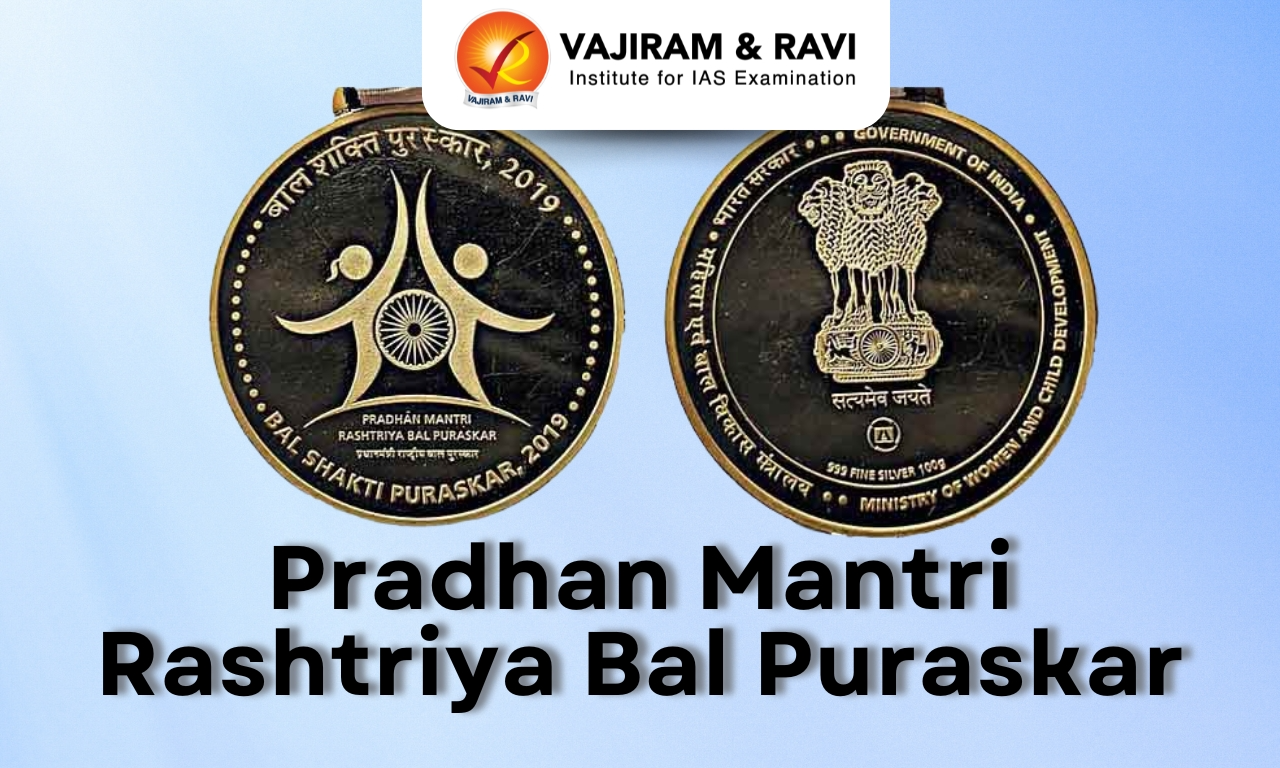
The Ministry of Women and Child Development has invited nominations for the Pradhan Mantri Rashtriya Bal Puraskar (PMRBP) 2026. 

About Pradhan Mantri Rashtriya Bal Puraskar

  • It is the nation's highest civilian honour for children.
  • It is presented annually by the President of India on Veer Bal Diwas.
    • Veer Bal Diwas is observed annually on December 26 in memory of Sahibzada Zorawar Singh and Sahibzada Fateh Singh.
  • It recognises exceptional achievements in six distinct categories namely: Bravery, Social Service, Environment, Sports, Art and Culture, Science and Technology.
  • Selection Committee: The awardees are selected by a committee constituted by the Union Minister for Women and Child Development and headed by the Secretary of the Ministry.

Eligibility for Pradhan Mantri Rashtriya Bal Puraskar

  • Citizenship: A child should be an Indian Citizen.
  • Age: A child above the age of 5 years and not exceeding 18 years (as of 31st July of respective year).
  • The act/incident/achievement should have been within 2 years of the last date of receipt of application/nomination for the year of consideration.
  • The number of awards will be 25, however, any relaxation to this maximum number may be permitted at the discretion of the National Selection Committee.
  • A child may be nominated in more than one category, although the committee reserves the right to consider only one application.
  • Any individual or institution can nominate a child. Children may also apply through self-nomination.
  • Recommendations are also invited from certain government entities and offices. 
  • Each awardee is given a medal, a cash prize of Rs. 1 Lakh and certificate.

Source: DD News

Pradhan Mantri Rashtriya Bal Puraskar FAQs

Q1: What is Pradhan Mantri Rashtriya Bal Puraskar?

Ans: Highest civilian honour for children – given by MoWCD for exceptional achievement; age 5-18 years

Q2: How many categories are there in PMRBP?

Ans: 6 categories – Innovation, Social Service, Scholastic, Sports, Art & Culture, Bravery

International Maritime Organisation

International Maritime Organisation

International Maritime Organisation Latest News

Recently, the International Maritime Organisation (IMO) Secretary-General  has announced a plan to evacuate all the ships — and the 11,000 seafarers on them — stranded in the Persian Gulf due to the war in West Asia. 

About International Maritime Organisation

  • It is a specialized agency of the United Nations which is responsible for measures to improve the safety and security of international shipping and to prevent pollution from ships.
  • It is the global standard-setting authority for the safety, security and environmental performance of international shipping.
  • Mandate: Its main role is to create a regulatory framework for the shipping industry that is fair and effective, universally adopted and universally implemented.
  • Background: It was established as the Inter-Governmental Maritime Consultative Organization (IMCO) in 1948, became a specialized agency of the United Nations in 1959 and was renamed International Maritime Organization in 1982.
  • Governance of the organisation
    • Assembly: It is the highest Governing Body of the IMO. It consists of all Member States, and it meets once every two years in regular sessions. The Assembly is responsible for approving the work program, voting the budget and electing the Council.
    • Council: It is the Executive Organ of the IMO and and consists of 40 elected members, is responsible, under the Assembly, for supervising the work of the Organization.
    • Committees: The five policy-making committees are responsible for the development, review, updating, and approval of the organization’s guidelines and regulations.
  • Funding: Funding for the organization comes from contributions by member states, as well as voluntary donations and commercial activities.
  • Members: It currently has 176 Member States. (India has been a member since 1959) 
  • Headquarters: London.

Source: TH

International Maritime Organisation FAQs

Q1: How many member states are in IMO?

Ans: 176 member states

Q2: What is the International Maritime Organisation?

Ans: UN specialized agency – for safe, secure, environmentally sound shipping

FCRA Rules 2025 – Tighter Oversight of Foreign-Funded NGOs

Foreign Contribution Regulation Act

FCRA Latest News

  • The Union Home Ministry has amended the Rules under the Foreign Contribution (Regulation) Act (FCRA), 2010, introducing stricter compliance requirements for NGOs receiving foreign funds. 
  • The amendments aim to make registrations purpose-specific, enhance transparency, tighten monitoring of foreign contributions, and strengthen accountability mechanisms.

FCRA 2010

  • Objectives:
    • It regulates acceptance and utilisation of foreign contributions.
    • Prevent foreign funding from adversely affecting sovereignty, integrity, security, public interest, electoral politics and communal harmony.
    • Ensure transparency and accountability in foreign-funded activities.
  • Constitutional linkages:
    • Article 19(1)(c): Freedom to form associations.
    • Reasonable restrictions under Article 19(4) in the interests of sovereignty, integrity and public order.

Key Changes in FCRA Rules

  • Purpose-specific registration:
    • Earlier, NGOs seeking foreign funding only had to register under one of five broad categories: Social, Economic, Educational, Cultural, and Religious.
    • The amended rules now prescribe specific activity lists under each category. NGOs must select activities only from the approved schedule while applying for registration or prior permission.
  • Geographical restrictions:
    • Registration certificates will now explicitly mention approved purpose(s), and States/Union Territories of operation.
    • Existing FCRA-registered organisations must, within one year, indicate the purposes and geographical areas they intend to retain through the revised Form FC-6F.

Enhanced Disclosure Requirements

  • NGOs must now provide additional information, including:
    • Website details.
    • Social media accounts.
    • Detailed activity reports.
    • Publications issued by the organisation or its key functionaries.
    • Information regarding ultimate donors when funds are routed through donor-advised funds or intermediary channels.
  • The government argues that these changes will improve uniformity and prevent duplication in FCRA filings.

Religious Activities - Explicit Bar on Proselytisation

  • One of the most significant amendments concerns the religious category.
  • Permitted activities include:
    • Construction, renovation and maintenance of places of worship.
    • Preservation of scriptures and religious heritage.
    • Running dharamshalas, langars and related facilities.
    • Religious education and spiritual programmes.
  • However, several activities now carry an explicit condition of “excluding proselytisation”, including:
    • Religious education and moral instruction.
    • Documentation and preservation of religious philosophy and history.
    • Revival of indigenous and tribal faith practices.
    • Satsangs, discourses and meditation retreats.
  • This marks a clear attempt by the government to distinguish religious and cultural activities from conversion-related activities.

Expansion of “Key Functionary” Definition

  • The amended rules broaden the scope of key functionaries beyond office-bearers and directors to include: 
    • Trustees, Partners, Members of governing bodies, Directors of companies,
    • Karta or head of a Hindu Undivided Family (HUF), and 
    • Any person exercising control or management over the organisation.
  • This widens accountability and scrutiny over individuals managing foreign-funded entities.

Stricter Conditions

  • Restrictions on foreign nationals:
    • Associations having foreign nationals (other than Persons of Indian Origin) as key functionaries will ordinarily not be eligible for:
      • FCRA registration
      • Prior permission for foreign contributions
    • However, the Central Government may grant exemptions through specific orders.
  • Utilisation of foreign funds:
    • Minimum activity requirement:
      • An organisation will be considered to have undertaken “reasonable activity” only if it has utilised at least ₹10 lakh of foreign contribution during the previous two financial years. 
      • This criterion will be relevant for renewal and cancellation decisions.
    • Prior permission cases: For organisations receiving foreign funds through prior permission, subsequent instalments will be released only after -
      • 75% of the previous instalment has been utilised, and
      • Utilisation is verified through field inquiry.
    • Revised penalty framework: The Home Ministry has also strengthened compounding penalties for FCRA violations for -
      • Administrative expenses: If administrative expenditure exceeds the prescribed 20% ceiling, penalty of ₹1 lakh or 5% of the excess amount, whichever is higher, will be imposed.
      • Speculative investments: For investing foreign contributions in speculative ventures:
        • Penalty: ₹1 lakh or 30% of the invested amount, whichever is higher.
        • Recovery of 100% of returns earned from such investments.
      • Diversion of funds:
        • For using foreign contributions for purposes other than approved objectives, penalty of ₹1 lakh or 30% of the misused amount, whichever is higher.
        • Any violation under the revised framework attracts a minimum penalty of ₹1 lakh.

Significance of the Amendments

  • Potential benefits: 
    • Greater transparency and accountability in foreign-funded activities. 
    • Improved monitoring of fund utilisation.
    • Better alignment between approved objectives and actual activities.
    • Enhanced safeguards against misuse, diversion, or opaque funding channels.
    • Stronger oversight of activities affecting national security and public order.
  • Concerns raised:
    • Increased compliance burden for NGOs.
    • Higher registration and operational costs due to category- and geography-specific approvals.
    • Possibility of reduced flexibility in programme implementation.
    • Concerns over shrinking operational space for civil society organisations dependent on foreign funding.

Conclusion

  • The latest FCRA amendments represent a significant shift from broad-based regulation to activity-specific, geography-specific and compliance-intensive oversight of foreign-funded NGOs. 
  • Their implementation will determine whether a balance can be maintained between regulatory control and the legitimate functioning of civil society organisations.

Source: TH | IE

FCRA

Q1: How do the 2025 FCRA amendments strengthen regulatory oversight of NGOs?

Ans: They introduce purpose-specific registrations, enhanced disclosures, geographical restrictions, etc.

Q2: Why is the explicit exclusion of proselytisation significant in the amended FCRA Rules?

Ans: It seeks to distinguish religious and cultural activities from conversion-related activities.

Q3: What is the significance of expanding the definition of “key functionary” under the FCRA Rules?

Ans: It broadens accountability by bringing trustees, partners, HUF Kartas, governing body members, under regulatory scrutiny.

Q4: How do the amended FCRA Rules promote transparency in foreign funding?

Ans: They mandate disclosure of social media accounts, publications, activity reports, and ultimate donors.

Q5: What constitutional debate is likely to arise from stricter FCRA regulations on NGOs?

Ans: The amendments raise questions about balancing national security concerns with the freedom of association [Article 19(1)(c)].

Burevestnik Missile

Burevestnik Missile

Burevestnik Missile Latest News

Russia’s mysterious Burevestnik cruise missile, known to NATO as SSC-X-9 Skyfall, recently returned to the spotlight after new research suggested the weapon may leave a trail of radioactive material in its wake as it flies.

About Burevestnik Missile

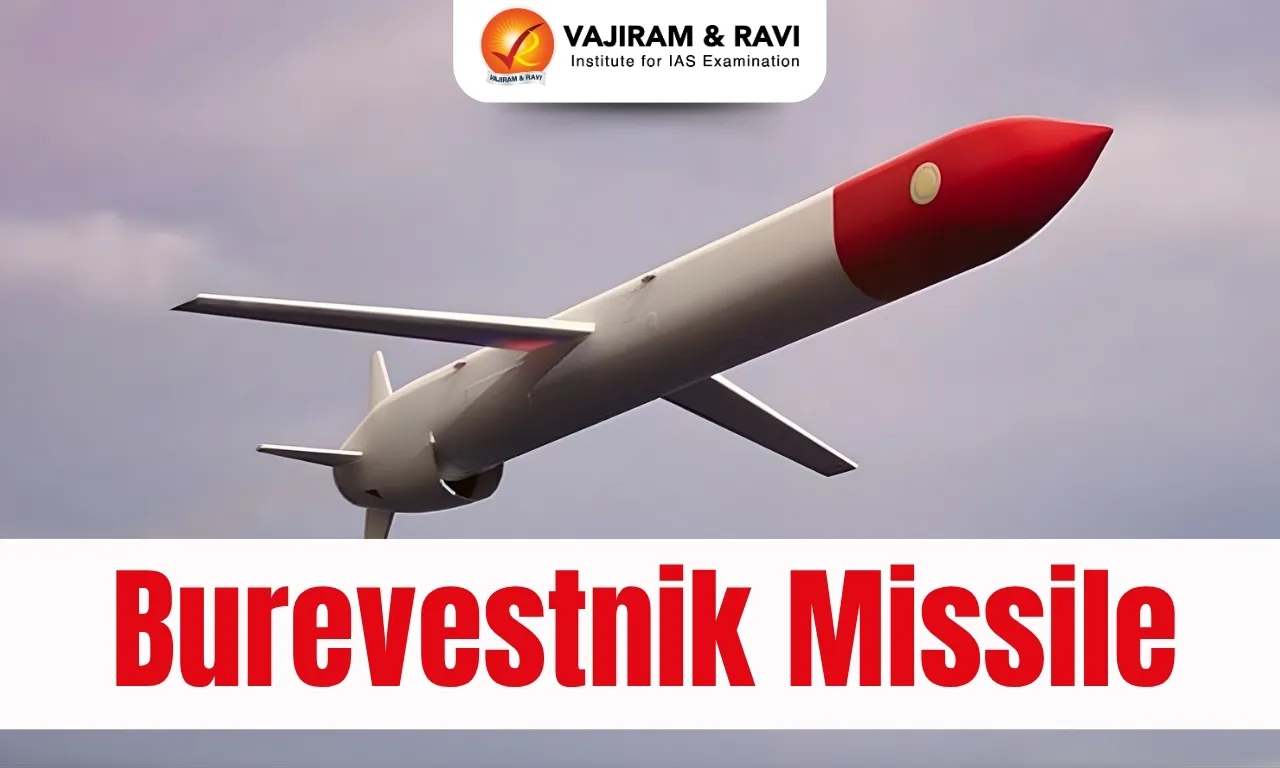
  • The Burevestnik, whose name translates as “storm petrel“, is a ground-launched, low-flying nuclear-powered, nuclear-armed cruise missile.
  • It was developed by Russia.
  • It is the world's first nuclear-powered cruise missile.
  • It is one of six strategic weapons that the Russian President introduced in a 2018 speech.
  • NATO refers to it as the SSC-X-9 Skyfall. 

Burevestnik Missile Features

  • It is powered by a small nuclear reactor, which heats up air to propel the missile forward.
  • Its nuclear propulsion gives the missile much longer range than traditional turbojet or turbofan engines that are limited by how much fuel they can carry.
  • That propulsion gives it virtually unlimited range, allowing it to loiter for days, circling the enemy’s air defenses and attacking from an unexpected direction.
  • The missile is also designed to fly at low altitudes, much lower than a conventionally powered cruise missile, which would make it harder for air-defence radar to detect.

News: IE

Burevestnik Missile FAQs

Q1: What is the Burevestnik missile?

Ans: It is a ground-launched, low-flying, nuclear-powered, nuclear-armed cruise missile.

Q2: Which country developed the Burevestnik missile?

Ans: Russia.

Q3: Why is the Burevestnik missile considered unique?

Ans: It is the world's first nuclear-powered cruise missile.

Q4: What is the NATO designation for the Burevestnik missile?

Ans: SSC-X-9 Skyfall.

Fibre-Optic Drones and the Future of Asymmetric Warfare

Asymmetric Warfare

Asymmetric Warfare Latest News

  • The recent conflict in southern Lebanon has highlighted the growing use of fibre-optic drones, which have proven difficult to counter despite advanced electronic warfare systems deployed by modern militaries.

Asymmetric Warfare

  • Asymmetric warfare refers to a conflict in which opposing sides possess significantly different military capabilities, resources, or technologies. 
  • In such situations, the weaker side often relies on unconventional tactics and relatively inexpensive weapons to offset the advantages of a stronger adversary.
  • Common features of asymmetric warfare include:
    • Use of guerrilla tactics and irregular forces. 
    • Reliance on low-cost technologies. 
    • Exploitation of vulnerabilities in conventional military systems. 
    • Emphasis on mobility, surprise, and adaptability. 
  • In recent years, drones have become one of the most important tools of asymmetric warfare because they can inflict significant damage at a fraction of the cost of traditional military platforms.

Drone Warfare and Its Evolution

  • The increasing availability of commercial drone technology has transformed modern battlefields. Initially, drones were primarily used for:
    • Surveillance and reconnaissance
    • Target acquisition
    • Intelligence gathering 
  • Over time, they evolved into offensive platforms capable of carrying explosives, conducting precision strikes, and functioning as loitering munitions.
  • The Russia-Ukraine conflict demonstrated how inexpensive drones could challenge tanks, artillery systems, and even advanced air defence networks. This has accelerated innovation in drone technology worldwide.

About Fibre-Optic Drones

  • Fibre-optic drones are unmanned aerial vehicles connected directly to their operators through a fibre-optic cable rather than relying on radio-frequency (RF) communication or satellite navigation systems.
  • The drone carries a spool containing a thin fibre-optic cable that unwinds during flight. Through this cable, data and control signals are exchanged between the drone and its operator in real time.
  • Key characteristics include:
    • High-speed data transmission
    • Real-time video and operational feedback 
    • Reduced dependence on GPS and radio communications 
    • Ability to operate over distances reportedly ranging from 5 km to 30 km 
  • Since communication occurs through a physical cable, these drones emit virtually no radio signals, making them significantly harder to detect.

Advantages of Fibre-Optic Drones

  • The growing popularity of fibre-optic drones stems from their ability to overcome many vulnerabilities associated with conventional drones.
  • Resistance to Electronic Warfare
    • Traditional drones depend on radio signals and GPS navigation. These signals can be:
      • Jammed
      • Spoofed 
      • Detected and tracked 
    • Fibre-optic drones avoid these vulnerabilities because communication occurs through the cable rather than radio transmissions.
    • As a result, they are often described as "invisible drones" in electronic warfare environments.
  • Real-Time Control
    • The fibre-optic link enables operators to receive continuous visual feedback and adjust the drone's flight path with precision.
    • This improves targeting accuracy and situational awareness during combat operations.
  • Cost-Effectiveness
    • Compared to advanced missile systems or sophisticated military aircraft, fibre-optic drones are relatively inexpensive while retaining significant offensive capabilities.
    • This makes them attractive tools for non-state actors and smaller military forces engaged in asymmetric warfare.

Role in Recent Conflicts

  • Russia-Ukraine War
    • The Russia-Ukraine conflict has emerged as a major testing ground for drone warfare innovation.
    • As both sides developed increasingly sophisticated electronic warfare systems, conventional drones became more vulnerable to jamming and interception. Fibre-optic drones emerged as a response to these challenges by providing a communication method that could not be disrupted through traditional electronic countermeasures.
  • Southern Lebanon Conflict
    • Recent fighting between Hezbollah and the Israel Defence Forces (IDF) has demonstrated the operational effectiveness of fibre-optic drones.
    • Reports indicate that despite Israel's advanced electronic warfare capabilities, these drones have successfully targeted military assets, including armoured vehicles and personnel.
    • The conflict has highlighted the limitations of existing counter-drone systems when confronting drones that do not emit detectable radio signals.

Challenges in Detecting and Neutralising Fibre-Optic Drones

  • The primary challenge arises from their limited electronic signature.
  • Unlike conventional drones, fibre-optic drones cannot easily be detected through radio-frequency monitoring. Detection therefore, depends largely on:
    • Radar systems
    • Electro-optical sensors 
    • Infrared tracking systems 
  • However, identifying small, slow-moving, low-flying drones remains technically difficult.
  • Counter-Drone Measures
    • Advanced radar networks
    • Directed-energy weapons 
    • Electromagnetic capture systems 
    • Kinetic interception systems ("hit-to-kill" technologies) 
    • Physical barriers such as protective nets and cages 
  • These solutions are often expensive and require multiple sensors and interception layers.

Limitations of Fibre-Optic Drones

  • Strong winds and adverse weather conditions
  • Heavy rainfall
  • Physical obstacles such as trees, buildings, and terrain features
  • Breakage of the fibre-optic cable during flight
  • A snapped cable can immediately disrupt communication and render the drone ineffective

Implications for India

  • India's conflict with Pakistan in the aftermath of the Pahalgam terror attack highlighted the increasing role of drone swarms and loitering munitions in regional security challenges.
  • The emergence of fibre-optic drones presents new operational concerns because traditional electronic jamming may prove ineffective against them.
  • Experts suggest that India should focus on:
    • Developing advanced radar and sensor systems
    • Strengthening hard-kill counter-drone capabilities 
    • Integrating AI-enabled detection systems 
    • Enhancing mobile air defence networks 
    • Utilising platforms such as the Light Combat Helicopter (LCH) and Light Combat Aircraft (LCA) for counter-drone operations 
  • As drone technology continues to evolve, adapting defence strategies will become increasingly important for maintaining battlefield superiority.

Source: IE

Asymmetric Warfare FAQs

Q1: What are fibre-optic drones?

Ans: Fibre-optic drones are unmanned aerial vehicles controlled through a fibre-optic cable rather than radio signals.

Q2: Why are fibre-optic drones difficult to detect?

Ans: They emit minimal radio-frequency signals, making them resistant to traditional electronic detection methods.

Q3: What is asymmetric warfare?

Ans: It is a form of conflict where opposing sides possess unequal military capabilities and rely on unconventional tactics.

Q4: In which recent conflicts have fibre-optic drones gained prominence?

Ans: They have gained prominence in the Russia-Ukraine war and the conflict between Hezbollah and Israel in southern Lebanon.

Q5: Why are conventional jamming systems less effective against fibre-optic drones?

Ans: Because communication occurs through a physical fibre-optic cable rather than radio-frequency signals.

Reproductive Autonomy of Women with Intellectual Disabilities: Law, Consent and Court Decisions

Reproductive Autonomy of Women with Intellectual Disabilities

Reproductive Autonomy of Women with Intellectual Disabilities Latest News

  • The Karnataka High Court recently permitted a total abdominal hysterectomy — surgical removal of the uterus — for a 23-year-old woman with severe intellectual and developmental disabilities. 
  • Her parents had approached the court arguing that their daughter's cognitive impairments made her incapable of understanding or managing menstrual hygiene, causing recurring infections and medical complications. 
  • A multidisciplinary medical board confirmed she lacked the capacity for informed consent and recommended the surgery. The court allowed the procedure.
  • This judgment is part of a larger pattern of courts navigating the deeply sensitive intersection of law, medicine, and human rights for women with intellectual disabilities.

The Core Legal Problem: Consent and Intellectual Disability

  • Informed consent is the cornerstone of medical ethics and law. Before any significant medical procedure, a patient must understand its nature, risks, and consequences — and agree to it voluntarily.
  • A difficult situation arises when a person's intellectual disability is so severe that she cannot understand or give informed consent. 
  • Neither caregivers nor doctors can then take a unilateral decision. The law requires court intervention.
  • In such cases, courts invoke the doctrine of parens patriae — a Latin term meaning "parent of the nation." 
  • Under this doctrine, the court steps into the role of a guardian for individuals who cannot care for themselves. 
  • The court does not simply impose its own judgment. It conducts an inquiry to determine what is in the "best interests" of the person — prioritising their health, dignity, and bodily integrity.

The Legal Framework Protecting Disabled Persons

  • Section 10 of the Rights of Persons with Disabilities Act, 2016 (RPwD Act 2016), is the key provision here. 
  • It explicitly prohibits subjecting any person with disability to a medical procedure leading to infertility without their free and informed consent. 
  • This was enacted precisely because women with intellectual disabilities have historically been vulnerable to forced sterilisations — often justified by caregivers as a matter of convenience or as protection from the consequences of sexual abuse.
  • The law thus creates a strong presumption in favour of the disabled person's autonomy. Any deviation requires judicial scrutiny.

Supreme Court Guidelines on Hysterectomies (2023)

  • In Dr Narendra Gupta v. Union of India (2023), a PIL brought to the Supreme Court highlighted that unnecessary hysterectomies were being performed on women — particularly from marginalised communities — under government health insurance schemes, often in private hospitals, without informed consent or disclosure of side-effects.
  • The Supreme Court held this to be a serious violation of the fundamental right to health under Article 21. 
  • It directed all states and Union Territories to strictly implement the Union Health Ministry's 2022 Guidelines to Prevent Unnecessary Hysterectomies. 
  • It also mandated the formation of hysterectomy monitoring committees at national, state, and district levels, and directed the blacklisting of hospitals performing such procedures without medical necessity or consent.

The Abortion Dilemma: A Separate and Complicated Legal Terrain

  • Most judicial decisions involving women with intellectual disabilities in India arise not from hysterectomy cases, but from pregnancies resulting from sexual assault. 
  • The Medical Termination of Pregnancy Act, 1971 (MTP Act) allows termination of pregnancy with the written consent of a guardian if the pregnant woman has a mental illness. 
  • However, this guardian-consent provision does not extend to women with intellectual disabilities. 
  • For them, their own consent remains an absolute legal requirement for abortion — regardless of their cognitive capacity. This creates a significant legal gap that courts have repeatedly had to navigate.

Landmark Cases: Reproductive Rights of Intellectually Disabled Women

  • Suchita Srivastava v. Chandigarh Administration (2009) - A rape survivor with mild intellectual disability wished to keep her child. The Supreme Court upheld her choice, ruling reproductive decisions are protected under Article 21. Key distinction established: intellectual disability ≠ mental illness.
  • Z v. State of Bihar (2017) - A disabled HIV-positive rape survivor sought abortion, but hospital demanded third-party consent — illegally. The pregnancy crossed the legal limit. The Supreme Court condemned this as negligence and awarded compensation.
  • Orissa High Court (2020) - Termination of a 24-week pregnancy was denied on medical safety grounds. The court ordered state compensation and postnatal care instead.
  • Gujarat High Court (2024) - A 28-week abortion was permitted for a 15-year-old tribal girl with intellectual disability, based on medical board findings of physical and psychological harm from continuing the pregnancy.

The Recurring Tension: Autonomy vs. Best Interests

  • These cases reveal a fundamental tension in law and ethics — between two principles that are both important but can point in opposite directions.
  • Reproductive autonomy holds that every woman — including one with a disability — has the right to make decisions about her own body. 
  • This principle is grounded in Article 21 and supported by international human rights law, including the UN Convention on the Rights of Persons with Disabilities (UNCRPD), to which India is a signatory.
  • Best interests, on the other hand, is the principle courts apply when a person lacks the capacity to decide for themselves. It requires the court to act as a guardian and determine what would best serve the person's health, dignity, and welfare.
  • The courts have tried to balance both — giving maximum weight to the woman's own expressed wishes where possible, and resorting to the best interests standard only when she truly cannot communicate a decision.

Source: IE

Reproductive Autonomy of Women with Intellectual Disabilities FAQs

Q1: Why is Reproductive Autonomy of Women with Intellectual Disabilities a complex legal issue?

Ans: Reproductive Autonomy of Women with Intellectual Disabilities involves balancing bodily autonomy, informed consent, medical necessity and protection of vulnerable individuals.

Q2: How does Indian law protect Reproductive Autonomy of Women with Intellectual Disabilities?

Ans: The Rights of Persons with Disabilities Act safeguards Reproductive Autonomy of Women with Intellectual Disabilities by restricting procedures affecting fertility without consent.

Q3: What role do courts play in Reproductive Autonomy of Women with Intellectual Disabilities?

Ans: Courts intervene in Reproductive Autonomy of Women with Intellectual Disabilities cases when individuals lack decision-making capacity and judicial oversight becomes necessary.

Q4: Why is informed consent central to Reproductive Autonomy of Women with Intellectual Disabilities?

Ans: Reproductive Autonomy of Women with Intellectual Disabilities depends on informed consent because medical procedures directly affect bodily integrity, dignity and personal rights.

Q5: How have landmark judgments shaped Reproductive Autonomy of Women with Intellectual Disabilities?

Ans: Landmark judgments have strengthened Reproductive Autonomy of Women with Intellectual Disabilities by recognising reproductive choices as part of Article 21 protections.

Meta-CRED Deal: What the Meta-CRED Deal Means for India’s Digital Economy

Meta-CRED Deal

Meta-CRED Deal Latest News

  • Meta Platforms — the parent company of WhatsApp, Facebook, and Instagram — has announced a $900 million (approximately ₹8,550 crore) investment in CRED, a Bengaluru-based fintech company. 
  • Simultaneously, CRED's founder Kunal Shah has been appointed as the global CEO of WhatsApp, succeeding Will Cathcart. 
  • Meta will acquire a roughly 20% minority stake in CRED, valuing the company at approximately $4.5 billion (₹38,000 crore).

What Is CRED

  • CRED was founded in 2018 and originally targeted India's creditworthy consumers — rewarding them for paying credit card bills on time. 
  • Over the years, it expanded into lending, UPI payments, rent payments, bill payments, and wealth management services.
  • Key numbers: CRED has 1.7 crore (17 million) members and controls over 40% of India's credit-card bill payments. 
  • This makes it one of the most valuable financial data platforms in the country.

Why Has Meta Invested in CRED

  • India is WhatsApp's largest market globally, with over 500 million active users. It is also one of the world's fastest-growing digital payments markets. 
  • Meta has been expanding aggressively in India for years. In 2020, it invested ₹43,500 crore ($5.7 billion) in Jio Platforms. The CRED deal is the next step in deepening that presence.

WhatsApp's Ambition: Beyond Messaging

  • WhatsApp crossed 3 billion monthly active users globally in 2025. But Meta sees it as far more than a messaging app. 
  • The company wants to transform WhatsApp into a platform for business messaging, digital commerce, and payments. 
  • India — with its massive UPI ecosystem and mobile-first consumers — is the ideal testing ground for this vision.
  • CRED's user base is particularly attractive. Its members are financially active, credit-aware, and high-value consumers — exactly the segment Meta wants to engage through WhatsApp Pay and future commerce features.

Payments + Messaging + AI: The Convergence Play

  • The deal brings together three dominant themes in the global technology industry: messaging, payments, and artificial intelligence. 
  • Meta is betting that integrating CRED's fintech expertise with WhatsApp's massive reach could create a powerful super-app ecosystem in India — combining customer communication, shopping, financial services, and AI-powered experiences on a single platform.

Structure of the Deal

  • Meta acquires a minority stake (~20%) in CRED. CRED has clarified that Meta will not receive access to customer data as part of this arrangement, and Meta will not take a board seat. 
  • Kunal Shah will step away from his day-to-day operational role at CRED and relocate to Meta's headquarters in Menlo Park, California, to lead WhatsApp globally.

Impact on India's Digital Payments Landscape

  • India's UPI-based digital payments market is large but already concentrated and foreign dominated
  • PhonePe — backed by Walmart — and Google Pay together account for the lion's share of UPI transactions. Other players include Paytm, Amazon Pay, WhatsApp Pay, and CRED. 
  • The Meta-CRED deal further consolidates foreign ownership in this space. The pattern is striking. 
  • India's digital payments ecosystem — built on public infrastructure like Aadhaar, UPI, and India Stack — is increasingly dominated by platforms linked to American corporations: Walmart (PhonePe), Google (Google Pay), and now Meta (WhatsApp Pay + CRED).
  • Some analysts believe the combined strength of Meta's global reach and CRED's high-value user base could challenge PhonePe and Google Pay's dominance. 
  • However, gaining meaningful market share in UPI transactions takes time, and no specific product integration between CRED and WhatsApp Pay has yet been announced. The competitive outcome remains to be seen.

Concerns: Data Sovereignty and Foreign Control

Concern 1 — Creeping Foreign Control Over Indian Fintech

  • The CRED investment would further entrench foreign technology giants in a sector that was built on Indian public digital infrastructure — paid for by Indian taxpayers and Indian policy choices.

Concern 2 — Indian Startups as Acquisition Targets, Not Champions

  • Experts have pointed to a troubling pattern: many Indian fintech startups appear to be building companies not for long-term domestic ownership, but for eventual sale to foreign buyers. 
  • The CRED deal fits this pattern — a high-profile Indian startup founded on Indian public infrastructure, now partially owned by a US technology giant. 
  • India risks becoming a market for foreign digital companies rather than a producer of globally owned digital platforms.

Concern 3 — Future Data Access Risk

  • CRED has stated that Meta will not access customer data today. 
  • However, over time, CRED's rich financial data — covering credit card behaviour, spending patterns, and financial profiles of 1.7 crore users — could directly or indirectly become accessible to Meta, which could potentially use it to train AI models or monetise it through targeted advertising. 
  • Financial data is among the most sensitive categories of personal data. Its linkage with a global advertising-and-AI platform raises legitimate regulatory questions.

Regulatory and Governance Dimensions

  • Data Protection: India's Digital Personal Data Protection Act, 2023 governs the handling of personal data. Cross-border data flows, especially involving financial information, require careful regulatory oversight. The CRED-Meta arrangement will be closely watched to ensure compliance.
  • FDI in Fintech: Foreign direct investment in the fintech sector is regulated by RBI and SEBI guidelines. A 20% stake acquisition by a foreign entity in a company handling large-scale credit card data raises questions about sectoral caps, beneficial ownership norms, and data localisation requirements.
  • Competition Law: The Competition Commission of India (CCI) would need to assess whether the deal creates anti-competitive advantages through the combination of WhatsApp's messaging dominance and CRED's payments position.
  • India Stack and Public Infrastructure: UPI, Aadhaar, and the broader India Stack were built as public goods using public investment. The question of who ultimately benefits from the commercial value generated on top of this infrastructure is a live policy debate.

Source: IE | FE

Meta-CRED Deal FAQs

Q1: Why is the Meta-CRED Deal significant for India's digital economy?

Ans: The Meta-CRED Deal combines Meta's massive user base with CRED's fintech ecosystem, potentially reshaping digital payments, commerce and financial services.

Q2: How does the Meta-CRED Deal strengthen Meta's presence in India?

Ans: The Meta-CRED Deal expands Meta's influence in India's digital payments market by connecting WhatsApp's reach with CRED's high-value customer base.

Q3: What concerns have been raised regarding the Meta-CRED Deal?

Ans: The Meta-CRED Deal has sparked concerns about data sovereignty, foreign ownership of fintech platforms and possible future access to sensitive financial data.

Q4: How could the Meta-CRED Deal affect India's UPI ecosystem?

Ans: The Meta-CRED Deal may intensify competition in the UPI market and challenge existing leaders through integration of payments, messaging and digital commerce.

Q5: Why are regulators closely monitoring the Meta-CRED Deal?

Ans: The Meta-CRED Deal involves issues related to data protection, competition law, foreign investment regulations and governance of India's digital public infrastructure.

Sahariya Tribe

Sahariya Tribe

Sahariya Tribe Latest News

The President recently interacted with Cheetah Mitras and members of the Sahariya tribe at Kuno National Park in Madhya Pradesh’s Sheopur district.

About Sahariya Tribe

  • It is one of the Particularly Vulnerable Tribal Groups (PVTG).
  • They are also called by the names Seher, Sair, Savar, Saonar, Sahra, etc.
  • They live on the margins — in the forests and villages of Madhya Pradesh and Rajasthan.
  • They mostly live in a distinct settlement called ‘Seharana’ which is generally a cluster of houses.
    • The houses are made of some stone boulders, and the roofing is also made of stone slabs – locally called Patore. 
  • In some villages, mud structures are also constructed.
  • Language: While the Sahariyas have lost their original language, they speak the local dialects of the regions they inhabit.
  • Religion: They practice Hinduism infused with veneration of local deities like Bhavani, Gond Devta, and Bijasur, alongside animistic elements tied to their jungle-dwelling heritage 
  • The Saharia are divided into five sub-tribes: the Jati, Arsi, Muli, Kindal, and Kumbi. 
    • This classification is based primarily on occupation. 
    • The Jati are farmers; the Arsi are weavers; the Muli are iron workers; the Kindal are basket makers; and the Kumbi are potters.  
  • They are known for their dance, the Saharia Swang, which is performed during the month of Holi.
    • The dance is performed to the beats of the dhol, nagari, and matki.
    • It features a male dressed in female attire who dances around the male performers.
  • Livelihood
    • They are predominantly forest dwellers and make their living from forest produce, additionally cultivating small plots of land and work as landless labourers. 
    • They are particularly skilled in making catechu from khair trees.

News: NOA

Sahariya Tribe FAQ's

Q1: The Sahariya tribe is mainly found in which two Indian states?

Ans: Madhya Pradesh and Rajasthan.

Q2: By what other names are the Sahariya people known?

Ans: Seher, Sair, Savar, Saonar, and Sahra.

Q3: What are the traditional houses of the Sahariya tribe made of?

Ans: Stone boulders with roofs made of stone slabs called Patore.

Q4: What is the famous traditional dance of the Sahariya tribe?

Ans: Saharia Swang.

Daily Editorial Analysis 24 June 2026

Daily-Editorial-Analysis

Reconnect Public Health with People’s Needs 

Context

  • Public health policy plays a vital role in improving population health, reducing inequalities, and enabling a country to harness its demographic dividend.
  • In recent years, India has sought to advance Universal Health Coverage (UHC) through initiatives such as the Ayushman Bharat Health and Wellness Centres (HWCs) and the Ayushman Bharat Digital Health Mission (ABDHM).
  • While these reforms aim to strengthen healthcare delivery, concerns remain regarding their ability to address the fundamental challenges of healthcare access, affordability, and quality.
  • The growing emphasis on wellness and digital health infrastructure has often overshadowed the need to strengthen the country’s healthcare delivery system.

Background: Evolution of the Wellness Approach

  • The concept of wellness emerged as an expansion of traditional definitions of health.
  • Initially associated with the absence of disease, it later evolved to include mentalsocialspiritual, and environmental dimensions of well-being.
  • This holistic perspective influenced modern healthcare thinking and encouraged attention to lifestyle and behavioural factors.
  • However, public health traditionally focuses on health promotion, which recognises the role of social determinants of health such as income, education, housing, nutrition, sanitation, and environmental conditions.
  • Unlike wellness, health promotion is more measurable and better suited to evaluating outcomes at the population level.

Key Concerns in Contemporary Public Health Policy

  • Shift from Population Health to Individual Well-being

    • The transformation of existing healthcare institutions into Health and Wellness Centres reflects a broader policy shift from measurable population health outcomes to individual well-being.
    • Earlier assessments of health focused on access to preventive, promotive, curative, and rehabilitative services, including maternal and child healthcare, nutrition, safe drinking water, and chronic disease management.
    • The increasing focus on wellness may divert attention from these essential healthcare needs.
    • Since well-being is subjective and varies across individuals, it becomes difficult to measure and evaluate systematically.
  • Individualisation of Health Responsibility

    • A significant consequence of the wellness narrative is the individualisation of health.
    • Health is increasingly portrayed as a result of personal choices and lifestyle decisions, leading to the rise of health coaches, wellness campaigns, and social media-driven health advice.
    • Such an approach risks overlooking structural barriers that influence health outcomes.
    • Factors such as poverty, inadequate healthcare infrastructure, poor living conditions, and unequal access to services cannot be addressed solely through individual behavioural changes.

Challenges in Measuring Wellness

  • An important principle of governance is that effective policy requires measurable outcomes.
  • While indicators exist for disease burden, healthcare utilisation, nutrition, and mortality, there are no universally accepted measures of wellness at the population level.
  • Excessive reliance on an inherently subjective concept may weaken the ability of policymakers to identify unmet healthcare needs and evaluate the effectiveness of health interventions.

Critical Analysis of the Digital Health Mission

  • The Ayushman Bharat Digital Health Mission (ABDHM) seeks to establish a comprehensive digital health ecosystem through ABHA cards, electronic health records, and registries of healthcare facilities and professionals.
  • These initiatives can improve data management, coordination, and health system planning.
  • However, digitalisation alone cannot resolve the problem of inadequate healthcare access.
  • The existence of health records does not guarantee the availability of hospitals, doctors, medicines, or emergency services.
  • Information systems are valuable tools, but they cannot substitute for a robust healthcare delivery mechanism.
  • The effectiveness of digital health initiatives ultimately depends on the strength of healthcare institutions and service provisioning.

Structural Causes of Inadequate Healthcare Access

  • India’s healthcare challenges are rooted primarily in the unaffordability of private healthcare and the inadequate quality of many public health facilities.
  • Large sections of the population continue to face difficulties in obtaining timely and affordable treatment.
  • Strengthening Sub-Centres (SCs)Primary Health Centres (PHCs), and Community Health Centres (CHCs) remains essential for improving healthcare access.
  • These institutions constitute the backbone of the country's three-tier healthcare system and are critical for delivering preventive, promotive, curative, and rehabilitative care.

The Way Forward

  • A more balanced public health strategy should:
    • Prioritise accessibleaffordable, and quality healthcare.
    • Strengthen public healthcare infrastructure and human resources.
    • Improve the functioning of SCs, PHCs, and CHCs.
    • Integrate digital health initiatives with service delivery reforms.
    • Address social determinants of health through inter-sectoral policies.
    • Focus on measurable health outcomes alongside broader well-being objectives.
    • Enhance accountability through evidence-based policy evaluation.

Conclusion

  • The pursuit of Universal Health Coverage requires more than wellness-oriented narratives and digital databases.
  • Sustainable improvements in health outcomes depend on strong public institutions, effective service delivery, and equitable access to care.
  • While wellness and digitalisation can complement healthcare reforms, they cannot replace investments in healthcare infrastructure and population health measures.
  • A public health system that prioritises accessibility, affordability, and quality remains the most effective pathway toward achieving better health outcomes for all citizens.

Reconnect Public Health with People’s Needs FAQs

Q1. What is the main objective of Universal Health Coverage (UHC)?

Ans. Universal Health Coverage aims to ensure that all individuals have access to necessary health services without facing financial hardship.

Q2. Why is the wellness approach criticised in public health policy?

Ans. The wellness approach is criticised because it is subjective, difficult to measure, and often overlooks the social determinants of health.

Q3. What is the primary purpose of the Ayushman Bharat Digital Health Mission (ABDHM)?

Ans. The primary purpose of ABDHM is to create a digital health ecosystem through ABHA cards, health records, and healthcare registries.

Q4. Why cannot digital health records alone improve healthcare access?

Ans. Digital health records alone cannot improve healthcare access because they do not provide hospitals, doctors, medicines, or healthcare infrastructure.

Q5. What is the most important requirement for improving healthcare access in India?

Ans. The most important requirement for improving healthcare access in India is strengthening public healthcare institutions and infrastructure at all levels.

Source: The Hindu


India’s Patchy Industrial Climate Strategy 

Context

  • India's ambitions of Make-in-IndiaViksit Bharat 2047, and net-zero emissions by 2070 require a careful balance between industrial growth and environmental sustainability.
  • As manufacturing expands, energy demand and greenhouse gas emissions rise significantly.
  • Since the industrial sector contributes a major share of national emissions, industrial decarbonisation has become central to India's long-term climate strategy.
  • However, achieving meaningful emission reductions requires addressing important gaps in the current policy framework.

Industrial Emissions and Economic Growth

  • Industrial development remains a key driver of economic progress, employment generation, and infrastructure expansion.
  • At the same time, it increases dependence on energy-intensive processes. According to India's Biennial Transparency Report (BTR1), more than 20% of national emissions originate from industry.
  • Of this, manufacturing industries and construction account for 13% through fuel consumption, while industrial processes and product use contribute another 9%.
  • These figures highlight the significant role of industry in shaping India's overall carbon footprint. Consequently, reducing emissions from this sector is essential for meeting both development and climate objectives.

Existing Mitigation Policies

  • India has adopted several market-based mechanisms to improve energy efficiency and reduce industrial emissions.
  • The Perform, Achieve and Trade (PAT) scheme targets energy-intensive sectors by encouraging efficient energy use.
  • It is gradually transitioning into the Carbon Credit Trading Scheme (CCTS), which focuses on reducing emission intensity in sectors such as aluminium, cement, fertilizers, iron and steel, petrochemicals, petroleum refining, pulp and paper, textiles, and chlor-alkali.
  • These mechanisms establish benchmarks, create incentives for cleaner production, and support the transition toward a low-carbon economy. However, their effectiveness is limited by the sectors they cover.

The Policy Gap: Non-Specific Industries

  • A major challenge lies in the large share of emissions classified under non-specific industries.
  • Emissions data from manufacturing and construction indicate that identified industrial sectors account for slightly more than 55% of sectoral emissions, while over 40% fall under this broad and undefined category.
  • The absence of clear sub-sectoral classification creates an administrative and regulatory blind spot.
  • While sectors such as cement, steel, chemicals, and textiles are covered by PAT and CCTS, industries grouped under non-specific industries remain largely outside these frameworks.
  • As a result, a substantial portion of India's industrial emissions is not subject to the same emission-reduction targets, monitoring mechanisms, or efficiency standards.
  • This gap weakens the effectiveness of India's broader climate strategy and slows the country's green transition.

The Path Forward

  • Need to Identify Industries

    • Achieving sustainable industrial growth requires greater transparency, detailed emissions data, and improved sectoral classification.
    • Breaking down the non-specific industries category is essential for identifying the exact sub-sectors responsible for emissions, understanding their energy consumption patterns, and locating emission-intensive stages within production chains.
    • Such information would enable policymakers to design targeted interventions, strengthen regulatory mechanisms, and expand mitigation measures to currently overlooked industries.
    • Accurate classification would also improve monitoring and facilitate more effective implementation of climate policies.
  • Transparency as a Policy Tool

    • Transparency is not merely an international reporting requirement. It is a vital instrument for effective domestic policymaking.
    • Detailed and reliable data help governments evaluate policy outcomes, identify shortcomings, and make necessary corrections.
    • Without clear knowledge of emission sources, efforts to reduce industrial emissions remain incomplete.
    • Effective climate reporting provides the foundation for evidence-based decisions and long-term planning.

Conclusion

  • While initiatives such as PAT and CCTS have strengthened emission management in major industries, a large share of emissions continues to originate from poorly defined non-specific industries.
  • Bringing these sectors within the scope of mitigation policies through better data, transparency, and classification is essential for achieving net-zero, supporting sustainable development, and building a resilient low-carbon economy.
  • A comprehensive and inclusive approach will ensure that industrial expansion and environmental responsibility progress together.

India’s Patchy Industrial Climate Strategy FAQs

Q1. Why is industrial decarbonisation important for India?
Ans. Industrial decarbonisation is important because it helps India achieve its climate goals while sustaining economic growth.

Q2. What percentage of India's total emissions comes from the industrial sector?
Ans. More than 20% of India's total emissions come from the industrial sector.

Q3. What are the two major mechanisms used to reduce industrial emissions?
Ans. The PAT scheme and the Carbon Credit Trading Scheme (CCTS) are the two major mechanisms used to reduce industrial emissions.

Q4. What is the main concern regarding non-specific industries?
Ans. Non-specific industries account for over 40% of industrial emissions but are not adequately covered by existing mitigation policies.

Q5. Why is transparency important in climate policymaking?
Ans. Transparency is important because it helps policymakers identify emission sources and design effective climate interventions.

Source: The Hindu

Daily Editorial Analysis 2026 FAQs

Q1: What is editorial analysis?

Ans: Editorial analysis is the critical examination and interpretation of newspaper editorials to extract key insights, arguments, and perspectives relevant to UPSC preparation.

Q2: What is an editorial analyst?

Ans: An editorial analyst is someone who studies and breaks down editorials to highlight their relevance, structure, and usefulness for competitive exams like the UPSC.

Q3: What is an editorial for UPSC?

Ans: For UPSC, an editorial refers to opinion-based articles in reputed newspapers that provide analysis on current affairs, governance, policy, and socio-economic issues.

Q4: What are the sources of UPSC Editorial Analysis?

Ans: Key sources include editorials from The Hindu and Indian Express.

Q5: Can Editorial Analysis help in Mains Answer Writing?

Ans: Yes, editorial analysis enhances content quality, analytical depth, and structure in Mains answer writing.

Volcan de Fuego

Fuego Volcano

Volcan de Fuego Latest News

Tourists on Guatemala's Volcan de Fuego were caught off guard when the volcano erupted recently, and burning rocks began to rain down, forcing them to scramble down the slopes.

About Volcan de Fuego

  • Volcan de Fuego, which translates to “Volcano of Fire” in Spanish, is an active volcano located in Guatemala.
  • It is a relatively young basaltic stratovolcano. 
  • It is one of three large stratovolcanoes overlooking Guatemala’s former capital, Antigua.
  • Nestled between the neighboring volcanoes of Acatenango and Agua, it rises dramatically to an altitude of 3,763 meters (12,346 feet) above sea level.
  • It forms part of the Central American Volcanic Arc, a chain of volcanoes stretching from Guatemala to Panama. 
  • Guatemala lies on the Pacific “Ring of Fire and experiences frequent seismic and volcanic activity.
  • It lies on the boundary between the Cocos Plate and the Caribbean Plate. 
  • Fuego has what scientists call an “open-vent system.” 
    • This means the volcano keeps a clear pathway for gas and magma to escape.
    • Because of this open vent, it releases pressure through smaller, more frequent eruptions.  
    • The Fuego is known for its vulcanian activity, occasionally accompanied by pyroclastic flows. 
  • It is one of the most active volcanoes in Central America and has erupted more than 60 times in the last 500 years.  
  • A deadly eruption in 2018 claimed 194 lives and left 234 people missing.
  • Since then Volcan Fuego has continued to be active, but to a lesser extent, with small eruptions several times a day.
  • Typical activity is characterized by ashfall, pyroclastic flows, lava flows, and lahars.

News: NDTV

Volcan de Fuego FAQs

Q1: In which country is Volcán de Fuego located?

Ans: Guatemala.

Q2: What type of volcano is Volcán de Fuego?

Ans: It is an active basaltic stratovolcano.

Q3: Is Volcán de Fuego an active or dormant volcano?

Ans: It is one of the most active volcanoes in Central America.

Q4: Between which two volcanoes is Volcán de Fuego situated?

Ans: Acatenango and Agua.

Indian National Centre for Ocean Information Services

Indian National Centre for Ocean Information Services (INCOIS)

Indian National Centre for Ocean Information Services Latest News

Indian National Centre for Ocean Information Services (INCOIS) started releasing Specialized El Nino Bulletins to highlight the possible impacts of the ongoing El Nino on the Maritime Sectors. 

About Indian National Centre for Ocean Information Services

  • It was established as an autonomous body in 1999 under the Ministry of Earth Sciences (MoES) and is a unit of the Earth System Science Organisation (ESSO).
  • Mandate: It is mandated to provide ocean information and advisory services to society, industry, government agencies and the scientific community through sustained ocean observations and constant improvements through systematic and focussed research.
  • It is a permanent member of UNESCO’s Intergovernmental Oceanographic Commission (IOC).
  • It established the Indian Tsunami Early Warning Centre (ITEWC) which provides tsunami alerts within 10 minutes, serving India and 28 Indian Ocean countries.
  • Headquarter: It is located in Hyderabad, Telangana.
  • Initiatives of INCOIS
    • Search and Rescue Aided Tool (SARAT): It is to assist the Indian Coast Guard, Navy and Coastal Security Police, in locating individuals or objects lost at sea.
    • SynOPS visualization Platform: It integrates real-time data to strengthen response coordination during extreme events.

Source: PIB

Indian National Centre for Ocean Information Services FAQs

Q1: What is INCOIS?

Ans: Autonomous body under the Ministry of Earth Sciences (MoES)

Q2: Which early warning service of INCOIS is globally recognized?

Ans: Indian Tsunami Early Warning Centre (ITEWC)

Interstellar Comet 3I/ATLAS

Interstellar Comet 3I/ATLAS

Interstellar Comet 3I/ATLAS Latest News

Scientists studying the comet 3I/ATLAS have determined that this interstellar visitor is remarkably ancient – formed an estimated 10 to 12 billion years ago in a primordial planetary system. 

About Interstellar Comet 3I/ATLAS

  • It is the third known interstellar object from outside our solar system after 1I/ʻOumuamua(2017) and 2I/Borisov (2019). 
  • It was first observed by a NASA-supported telescope in Rio Hurtado, Chile, which is part of the ATLAS (Asteroid Terrestrial-impact Last Alert System) survey.
  • It will exit the solar system permanently after a brief interaction with the Sun.
  • Physical Characteristics of Interstellar  Comet 3I/ATLAS
    • It is confirmed to be an active comet, with a visible coma, a cloud of ice particles and dust surrounding the nucleus.
    • Trajectory: It has hyperbolic orbit and travels at 57–68 km/s speed relative to the Sun.
    • As it nears the Sun, it is expected to develop a tail, a characteristic cemetery feature formed by solar heating.
    • Photometric analysis shows a reddish hue suggests the surface may be rich in complex organic compounds or water ice.

What are Interstellar Objects?

  • These are celestial bodies that originate outside the solar system, and travel through it. These objects are not gravitationally bound to a star.
  • They can come from other solar systems and be thrown into interstellar space (the area between the stars) due to collisions or be slingshotted by a planet’s or star’s gravity.
  • The trajectory of these objects is basically open-ended hyperbolic orbit, where there is a perihelion point (closest to the Sun) but no aphelion.

Source: IT

Interstellar Comet 3I/ATLAS FAQs

Q1: What does “3I” in 3I/ATLAS signify?

Ans: 3rd Interstellar object – “I” = interstellar; after 1I/ʻOumuamua 2017 & 2I/Borisov 2019

Q2: What is 3I/ATLAS?

Ans: Third confirmed interstellar object

Ranthambhore Tiger Reserve

Ranthambhore Tiger Reserve

Ranthambhore Tiger Reserve Latest News

A captive-bred Indian vulture released in Maharashtra’s Melghat in January this year has covered an astonishing 3,334 km, soaring across states before reaching the Ranthambhore Tiger Reserve in Rajasthan.

About Ranthambhore Tiger Reserve

  • It is located in the Sawai Madhopur district of southeastern Rajasthan
  • It derives its name from the Ranthambore Fort (a World Heritage Site) situated within its precincts. 
  • It is located at the junction (great boundary fault) of the Aravalis and Vindhyan ranges. 
  • The area was once a royal hunting ground for the Maharajas of Jaipur. 
  • It is one of the largest tiger reserves in northern India. It spans an area of roughly 1,411 sq.km.
  • It boasts a spectacular landscape filled with boulder-strewn highland plateaus, lakes, and rivers dotted with old forts and abandoned mosques.
  • Rivers: It is bounded to the north by the Banas River and to the south by the Chambal River. 
  • There are several lakes in the park known as Padam Talab, Raj Bagh Talab, and Malik Talab.
  • Vegetation: It is dry deciduous forests and open grassy meadow.
  • Flora: Pure sands of Dhok tree (Anogeissus pendula) interspersed with grasslands at the plateaus, and other species like Acacia, Capparis, Zizyphus, Prosopis, etc are found here.
  • Fauna
    • It consists of leopard, caracal, jungle cat, sambar, chital, chinkara, and wild boar.
    • Peacocks, partridges, green pigeons, parakeets, sparrows, prinias, warblers, etc. are examples of avifauna. 

News: TP

Ranthambhore Tiger Reserve FAQs

Q1: Where is the Ranthambhore Tiger Reserve located?

Ans: In the Sawai Madhopur district of southeastern Rajasthan.

Q2: At the junction of which two mountain ranges is the Ranthambhore Tiger Reserve situated?

Ans: The Aravalli and Vindhyan ranges.

Q3: Which river forms the northern boundary of the Ranthambhore Tiger Reserve?

Ans: The Banas River.

Q4: Which river forms the southern boundary of the Ranthambhore Tiger Reserve?

Ans: The Chambal River.

Q5: What type of vegetation is found in the Ranthambhore Tiger Reserve?

Ans: Dry deciduous forests and open grassy meadows.

Enquire Now