International Waters Rules Latest News
- The incident marks a sharp escalation in tensions in the Strait of Hormuz, where Iran attacked three ships and detained two within its territorial waters. This action is seen as retaliation for U.S. seizures of Iranian-linked vessels on the high seas, including a major crude carrier intercepted between Sri Lanka and Indonesia.
- Overall, the developments highlight a cycle of tit-for-tat maritime actions between Iran and the United States, further destabilising a critical global energy route.
Strait of Hormuz During the War: Restricted Transit and Strategic Control
- At the onset of the conflict on February 28, vessel movement through the Strait of Hormuz dropped sharply from around 100 ships daily to only a few.
- Iran introduced a system regulating passage based on geopolitical considerations, reportedly charging high tolls, though India maintained it did not pay any fee and exercised its right to free navigation under international law.
- Despite restrictions, several Indian-linked and Iranian vessels were allowed transit, reflecting a selective and strategic control of this critical maritime route.


U.S. Actions in the Strait of Hormuz Conflict: Escalation and Maritime Control
- Breakdown of Negotiations with Iran – During talks, Iran sought the right to regulate ship movement and impose tolls in the Strait of Hormuz. After negotiations collapsed on April 12, tensions escalated sharply.
- Declaration of a Strategic Blockade – Donald Trump announced a blockade of Iranian ships, not through physical naval barriers but via control measures like radio warnings, aiming to restrict Iran’s influence over maritime traffic.
Interception and Seizure of Iranian-Linked Vessels
- U.S. forces intensified action by:
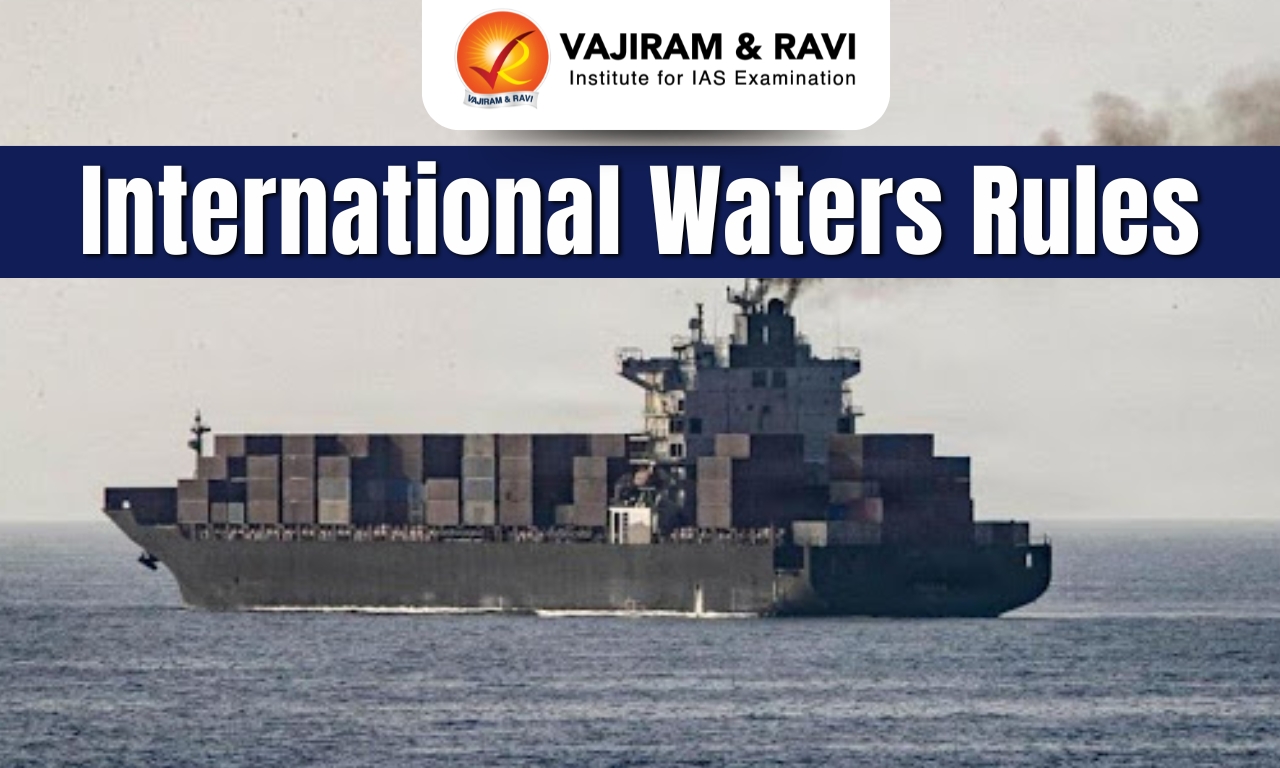
- Boarding and seizing the container ship Touska, suspected of carrying military-use cargo
- Intercepting the crude carrier Tifani in international waters, allegedly linked to Iran’s oil trade
- Both vessels are now under U.S. custody.
- These measures are part of a broader U.S. strategy to disrupt Iran’s oil exports and revenue streams, weaken its control over the strait, and deter its maritime activities.
Legal Framework for Interceptions at Sea: UNCLOS and Key Principles
- Strategic straits have historically been flashpoints in conflicts, leading to treaties governing navigation in regions like Turkey and Egypt.
- These agreements laid the groundwork for a broader global legal framework.
- The United Nations Convention on the Law of the Sea established that the oceans are a shared global commons.
- Its core principle is the freedom of navigation, especially for merchant ships, with minimal restrictions.
High Seas: Freedom with Limited Exceptions
- On the high seas, which lie beyond national jurisdiction, ships enjoy unrestricted navigation rights. Interception is allowed only under specific conditions:
- Hot pursuit of vessels involved in crimes
- Authorisation by the United Nations Security Council
- Ships without nationality
- Consent from the ship’s flag state
- Within a country’s territorial waters, ships retain the right of “innocent passage”, meaning transit is allowed as long as it does not threaten the coastal state’s security.
U.S. Sanctions vs International Law
- The United States often uses sanctions and ship interceptions as tools of economic pressure.
- However, these actions are based on domestic law rather than international law, and are not necessarily backed by UN authorisation.
Iran’s Rights in the Strait of Hormuz Under International Law
- The Strait of Hormuz is classified as an international strait, where the territorial waters of Iran and Oman overlap, leaving no high seas zone.
- Under the United Nations Convention on the Law of the Sea, the principle of “transit passage” applies—ensuring free and uninterrupted movement of ships.
- This means Iran cannot block, regulate, or deny passage to merchant vessels.
- However, it can enforce limited conditions: ships must move continuously without delay, follow designated routes, use the strait only for transit, and avoid violating local laws such as illegal loading or unloading.
What Lies Ahead: IMO’s Role and Possible Resolution
- The International Maritime Organization is expected to play a key role in de-escalating tensions in the Strait of Hormuz.
- It is working with Iran to facilitate safe passage and evacuation of ships while upholding freedom of navigation.
- The IMO has opposed tolls and permit-based restrictions, and has formally condemned Iran’s actions against commercial vessels, though it has not similarly criticised U.S. measures.
- Overall, diplomatic engagement through the IMO may shape the next phase of resolution.
Source: TH

 Last updated on August, 2026
→ UPSC Mains 2026 commenced on 21st August 2026 and will continue through 30th August 2026, as per the official examination schedule.
→ UPSC Mains Question Paper 2026 is out now for Essay & GS Paper 1, 2, 3 & 4.
→ UPSC Mains GS Paper 1 2026 is out now.
→ UPSC Mains GS Paper 2 2026 is out now.
→ UPSC Mains GS Paper 3 2026 is out now.
→ UPSC Mains GS Paper 4 2026 is out now.
→ UPSC Mains Indian Language Paper & English Compulsory Paper are out now.
→ Check out the latest UPSC Syllabus 2026 here.
→ UPSC Mains Admit Card 2026 is now out.
→ Enroll in Vajiram & Ravi’s UPSC Mains Test Series 2027 for structured answer writing practice, expert evaluation, and exam-oriented feedback.
→ Join Vajiram & Ravi’s UPSC Mentorship Program 2027 for personalized guidance, strategy planning, and one-to-one support from experienced mentors.
→ Go through the UPSC Mains Previous Year Papers to enhance your preparation.
→ Download UPSC Mains Essay Paper 2025, UPSC Mains GS Paper-I 2025, UPSC Mains GS Paper-II 2025, UPSC Mains GS Paper-III 2025, UPSC Mains GS Paper-IV 2025, UPSC Mains English (Compulsory) Paper 2025, UPSC Mains Hindi (Qualifying) Paper 2025 here.
→ UPSC has released UPSC Toppers List 2025 with the Civil Services final result on its official website.
→ UPSC Calendar 2027 has been released.
→ Also check Best UPSC Coaching in India
International Waters Rules FAQs
Q1. What are international waters rules?+
Q2. What does UNCLOS say about international waters rules?+
Q3. When can ships be intercepted under international waters rules?+
Q4. What rights does Iran have under international waters rules in the Strait of Hormuz?+
Q5. What role does IMO play in international waters rules?+
Tags: International waters rules mains articles upsc current affairs upsc mains current affairs