India is highly vulnerable to extreme weather events such as cyclones, floods, heatwaves, droughts, and landslides due to its diverse geography, long coastline, and monsoon-dependent climate.
According to the India Meteorological Department and the Ministry of Earth Sciences, India experiences hundreds of extreme weather events every year, with floods affecting nearly 40 million hectares of land and heatwaves becoming more frequent in recent decades. Over 75 percent of India’s districts are exposed to multiple climate hazards, while cyclones and floods account for a large share of disaster-related losses, according to the Council on Energy, Environment and Water. In this context, Early Warning Systems have become a critical tool for disaster risk reduction and climate resilience in India.
About Early Warning Systems
An Early Warning System (EWS) is a system that helps in detecting a possible hazard in advance, predicting its impact, and informing people in time so that they can take protective action before the disaster occurs.
The United Nations Office for Disaster Risk Reduction defines Early Warning Systems as a set of capacities and procedures for generating and disseminating timely and meaningful warning information to allow people exposed to a hazard to prepare and act appropriately.
Components of an Early Warning Systems
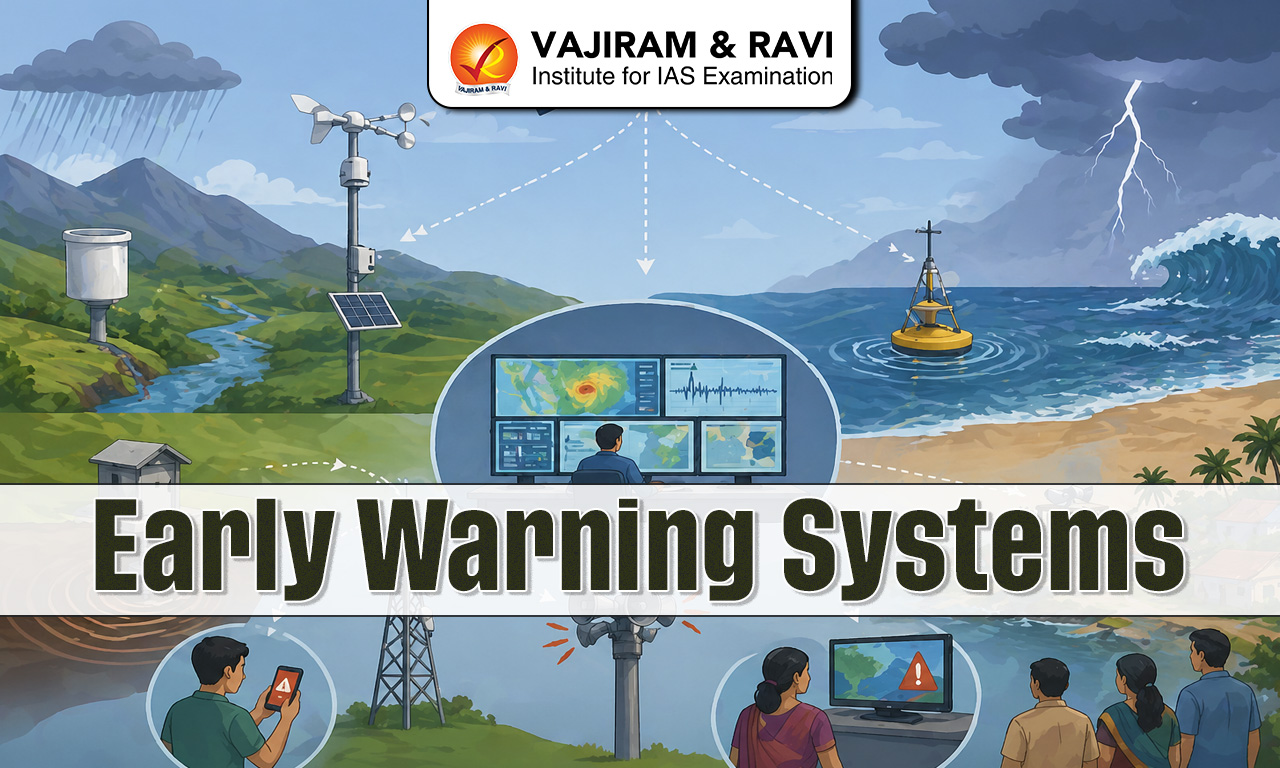
An Early Warning System (EWS) is not a single tool or technology. It is a chain of interconnected processes that work together to ensure that a hazard is detected early and people respond in time. According to the widely accepted framework used by the United Nations and disaster management agencies, an effective Early Warning System has four essential components.
- Risk Knowledge: It refers to systematic understanding of hazards, exposure, and vulnerability in a region.
- For example, coastal Odisha and Andhra Pradesh are identified as high cyclone-risk zones, while Bihar and Assam are mapped as flood-prone regions due to recurring river flooding.
- Monitoring and Forecasting: It is the continuous scientific observation of environmental and geophysical conditions using tools such as satellites, radars, and sensors to detect hazards early and predict their likely intensity, location, and timing.
- Warning Communication and Dissemination: It involves transmitting risk information in a timely and understandable form to authorities and the public through channels like mobile alerts, media, sirens, and local administration so that people receive actionable warnings.
- Response Capability: It is the ability of institutions and communities to act on warnings through preparedness measures such as evacuation, emergency planning, and coordinated disaster response to reduce actual loss and damage.


Early Warning Systems Types
Early Warning Systems can be classified in different ways depending on the nature of hazard, scale of operation, approach, and technology used.
- Based on hazard type: Hydrometeorological systems cover cyclones, floods, heatwaves, and droughts; geological systems cover earthquakes, tsunamis, and landslides; biological systems cover disease outbreaks; and environmental systems cover forest fires and air pollution.
- Based on scale: Global systems operate across regions or countries, national systems function within a country like India Meteorological Department alerts, and local systems operate at community or village level.
- Based on approach: Single-hazard systems deal with one disaster type, while multi-hazard systems integrate multiple hazards in one platform.
- Based on technology: Systems range from traditional observation-based methods to satellite and radar-based systems, and now to AI-based predictive systems.
Early Warning System Benefits
Early Warning Systems play a crucial role in reducing disaster impacts by enabling timely preparedness and response.
- Saving lives: Early alerts allow timely evacuation and significantly reduce mortality during disasters such as cyclones and floods.
- Reducing economic losses: Advance warnings help protect crops, infrastructure, and property from large-scale damage.
- Improving disaster preparedness: Governments and communities can plan evacuation, resource deployment, and emergency response in advance.
- Supporting climate adaptation: Early warnings help societies adjust to increasing frequency and intensity of extreme weather events.
- Strengthening governance: They improve coordination between central, state, and local authorities during emergencies.
- Empowering communities: Timely and understandable alerts enable people to take informed and immediate protective action.
Status of Early Warning Systems in India
India has developed one of the most advanced Early Warning System frameworks among developing countries, particularly for cyclones, floods, heatwaves, droughts, and tsunamis. Over time, the system has evolved from fragmented and sector-specific forecasting to an integrated, technology-driven, and increasingly impact-based warning system, improving disaster preparedness and reducing losses.
Institutional Framework
India’s Early Warning System is supported by a strong multi-agency setup:
- India Meteorological Department (IMD): Issues forecasts and warnings for cyclones, rainfall, heatwaves, and extreme weather events.
- Central Water Commission (CWC): Provides flood forecasting and river-level monitoring.
- Indian National Centre for Ocean Information Services (INCOIS): Manages tsunami early warning and ocean-state forecasting.
- National Disaster Management Authority (NDMA): Coordinates disaster preparedness and national alert systems.
- Indian Space Research Organisation (ISRO): Provides satellite-based observation and forecasting support.
Technological Advancements
India has significantly strengthened its warning systems through modern technologies.
- Multi-Hazard Integrated Systems: India is developing platforms that combine cyclone, flood, heatwave, and rainfall forecasts into a single decision-support system for faster and coordinated action.
- Impact-Based Forecasting: The focus has shifted from only predicting weather to assessing who will be affected, what damage may occur, and which areas need evacuation, enabling targeted response.
- Satellite and Radar Expansion: A wider Doppler radar network, satellite systems, and ocean buoys have improved real-time tracking of cyclones, rainfall, and ocean conditions.
- Digital Alert Systems: Mobile SMS alerts, the NDMA “Sachet” application, and media-based warnings ensure faster dissemination of alerts in multiple languages.
- Advanced Flood and Urban Systems: Seven-day flood forecasts, 72-hour city-level rainfall alerts, and AI-based monitoring for glacial lake outburst floods in the Himalayas have strengthened regional preparedness.
- Financial and Institutional Investment: The Government has invested significantly in strengthening forecasting infrastructure, with over ₹2,300 crore spent on Early Warning Systems since 2014, indicating sustained capacity building in disaster prediction technologies.
Key Implementation Challenges
Despite significant technological and institutional progress, India’s Early Warning System continues to face several structural and operational challenges that limit its full effectiveness.
- Last-Mile Communication Gaps: Reaching remote, tribal, and hilly regions remains difficult due to weak digital connectivity and infrastructure constraints.
- Uneven Community Preparedness: Awareness levels and disaster response capacity vary widely across regions, limiting effective action even when warnings are issued.
- Institutional Coordination Issues: Delays and overlaps in coordination between central, state, and district-level agencies sometimes affect timely response.
- Urban Vulnerability in Informal Settlements: High-density informal urban areas often lack preparedness systems, evacuation planning, and structured communication channels.
- Data Integration and Standardisation Issues: Despite technological progress, integration of real-time data across multiple agencies and platforms remains inconsistent.

 Last updated on Sep, 2026
→ UPSC Mains Question Paper 2026 is out now for Essay & GS Paper 1, 2, 3 & 4.
→ UPSC Mains GS Paper 1 2026 is out now.
→ UPSC Mains GS Paper 2 2026 is out now.
→ UPSC Mains GS Paper 3 2026 is out now.
→ UPSC Mains GS Paper 4 2026 is out now.
→ UPSC Mains Indian Language Paper & English Compulsory Paper are out now.
→ Check out the latest UPSC Syllabus 2026 here.
→ UPSC Mains Admit Card 2026 is now out.
→ Enroll in Vajiram & Ravi’s UPSC Mains Test Series 2027 for structured answer writing practice, expert evaluation, and exam-oriented feedback.
→ Join Vajiram & Ravi’s UPSC Mentorship Program 2027 for personalized guidance, strategy planning, and one-to-one support from experienced mentors.
→ Go through the UPSC Mains Previous Year Papers to enhance your preparation.
→ Download UPSC Mains Essay Paper 2025, UPSC Mains GS Paper-I 2025, UPSC Mains GS Paper-II 2025, UPSC Mains GS Paper-III 2025, UPSC Mains GS Paper-IV 2025, UPSC Mains English (Compulsory) Paper 2025, UPSC Mains Hindi (Qualifying) Paper 2025 here.
→ UPSC has released UPSC Toppers List 2025 with the Civil Services final result on its official website.
→ UPSC Calendar 2027 has been released.
→ Also check Best UPSC Coaching in India
Early Warning Systems FAQs
Q1. What is an Early Warning System?+
Q2. What is the main objective of an Early Warning System?+
Q3. What are the four components of an Early Warning System?+
Q4. Which organisation issues cyclone warnings in India?+
Q5. Why is the Early Warning System important for India?+
Tags: early warning systems