The Modhweth Festival is a unique and culturally rich celebration observed by the Toda tribe of the Nilgiri Hills in Tamil Nadu. This article provides detailed insights on Modhweth Festival and its significance.
Modhweth Festival
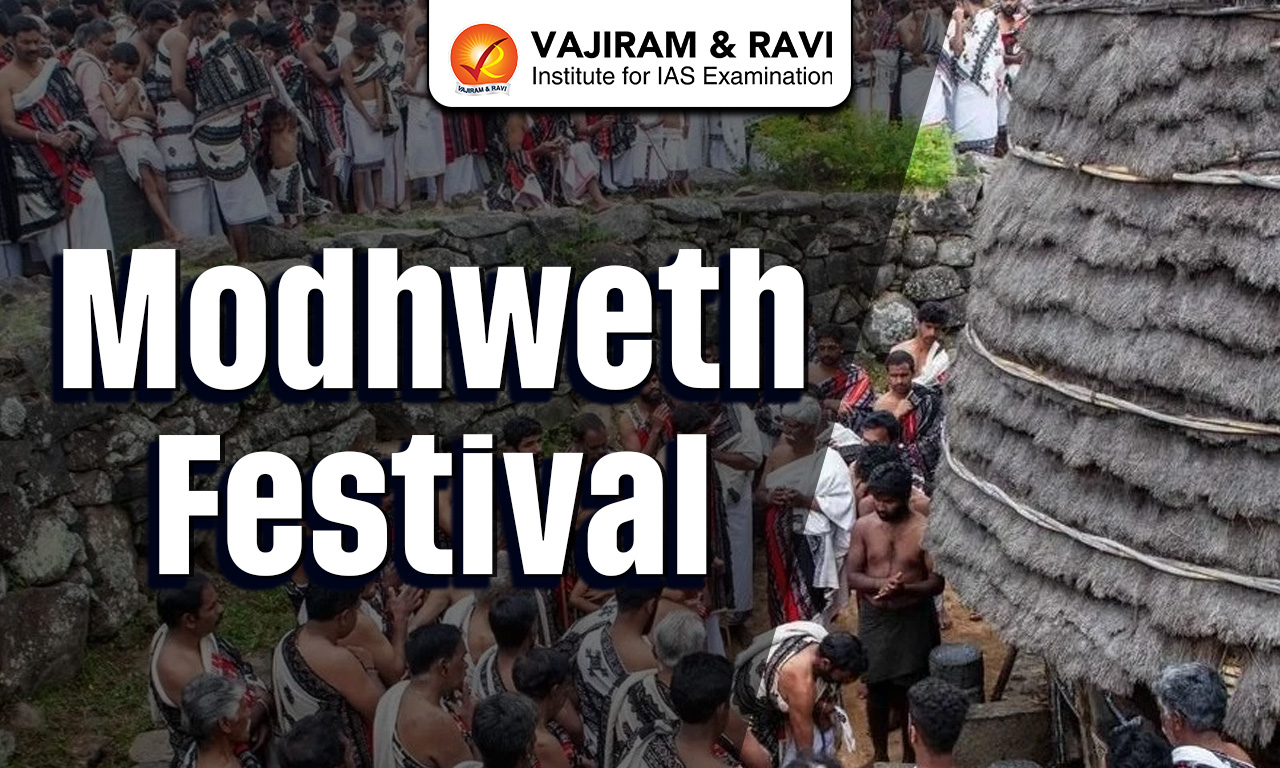
The Modhweth Festival is the traditional New Year celebration of the Toda tribe in the Nilgiri Hills of Tamil Nadu, reflecting their deep-rooted cultural and pastoral traditions. It is marked by sacred rituals, prayers for prosperity, and unique customs that highlight the tribe’s social identity and connection with nature.
- Celebrated annually on the last Sunday of December or the first Sunday of January by the Toda community.
- Held at the Moonpo Temple in Muthanadu Mund village in the Nilgiri district of Tamil Nadu.
- The temple has a distinctive structure with a vertical spire, thatched roof, and flat stone top, representing traditional Toda architecture.
- Devotees offer prayers to Thenkish Amman seeking good health, rainfall, and a prosperous harvest.
- Traditional dances are performed outside the temple as part of communal celebrations.
- Toda youth participate in a strength test by attempting to lift a greased boulder weighing around 80 kg.
- The ritual of lifting the stone symbolizes masculinity, courage, and social recognition among men.
- Women traditionally do not participate in the festival rituals as per customary practices.
- The festival reflects the pastoral lifestyle of the Toda tribe and their dependence on nature.
- It also reinforces community bonding, cultural continuity, and preservation of indigenous traditions.
About Toda Tribe
- The Toda tribe inhabits the Nilgiri Hills in southern India.
- They are classified as a Particularly Vulnerable Tribal Group (PVTG) in Tamil Nadu due to their small population and socio-economic vulnerability.
- Traditionally, they are a pastoral community, primarily dependent on buffalo herding and dairy activities.
- The Toda language belongs to the Dravidian family but is highly distinct and different from other Dravidian languages.
- Their settlements, called “munds,” consist of a small cluster of houses with unique barrel-shaped huts.
- The tribe is famous for its Toda embroidery, a distinctive red and black geometric pattern on white cloth.
- Religion is centered around nature and sacred buffaloes, with important deities like Tökisy (goddess) and Ön (underworld god).
- Dairy temples hold great religious significance, and priests perform rituals associated with milk and buffaloes.
- Social customs are traditional, and certain rituals restrict the participation of women.
- Their habitat lies within the Nilgiri Biosphere Reserve, highlighting their ecological importance.
- The Toda community has played a role in conserving biodiversity through sustainable living practices.


About Nilgiri Hills
- Nilgiri Hills is located at the junction of Tamil Nadu, Karnataka, and Kerala, forming a key part of the Western Ghats.
- The name “Nilgiri” means “Blue Mountains”, derived from the seasonal blooming of Neelakurinji flowers.
- Home to the famous hill stations like Ooty (Udhagamandalam), Coonoor, and Kotagiri.
- The region forms a major part of the Nilgiri Biosphere Reserve, India’s first biosphere reserve.
- Recognized under UNESCO for its ecological importance.
- Known for high biodiversity, including endemic species like the Nilgiri tahr and Nilgiri langur.
- Vegetation includes tropical rainforests, montane forests, grasslands, and shola ecosystems.
- The hills act as an important watershed region, feeding rivers like the Bhavani, Moyar, and Kabini.
- Inhabited by indigenous tribes such as the Toda, Kota, Kurumba, and Irula communities.
- Climate is cool and pleasant, making it a major tourist destination in South India.
- Contains several protected areas like Mudumalai, Mukurthi, and Silent Valley National Parks.

 Last updated on Oct, 2026
→ UPSC 2027 Notification will be released on 13 January 2027 at upsconline.nic.in.
→ Check Nobel Prize 2026 Winners List here.
→ Download PIB PRiSM Monthly Magazine 2026 here.
→ Check UPSC Monthly Current Affairs Magazine The Recitals here.
→ Check out the latest UPSC Syllabus here.
→ Download UPSC Model Answers for Mains 2026
→ UPSC Mains Question Paper 2026 is out now for Essay & GS Paper 1, 2, 3 & 4.
→ UPSC Calendar 2027 has been released.
→ Enroll in Vajiram & Ravi’s UPSC Mains Test Series 2027 for structured answer writing practice, expert evaluation, and exam-oriented feedback.
→ Join Vajiram & Ravi’s UPSC Mentorship Program 2027 for personalized guidance, strategy planning, and one-to-one support from experienced mentors.
→ Go through the UPSC Mains Previous Year Papers to enhance your preparation.
→ UPSC has released UPSC Toppers List 2025 with the Civil Services final result on its official website.
→ Also check Best UPSC Coaching in India
Modhweth Festival FAQs
Q1. What is the Modhweth Festival?+
Q2. When is the Modhweth Festival celebrated?+
Q3. Where is the Modhweth Festival held?+
Q4. Which tribe celebrates the Modhweth Festival?+
Q5. Which deity is worshipped during the festival?+
Tags: indian art and culture modhweth festival