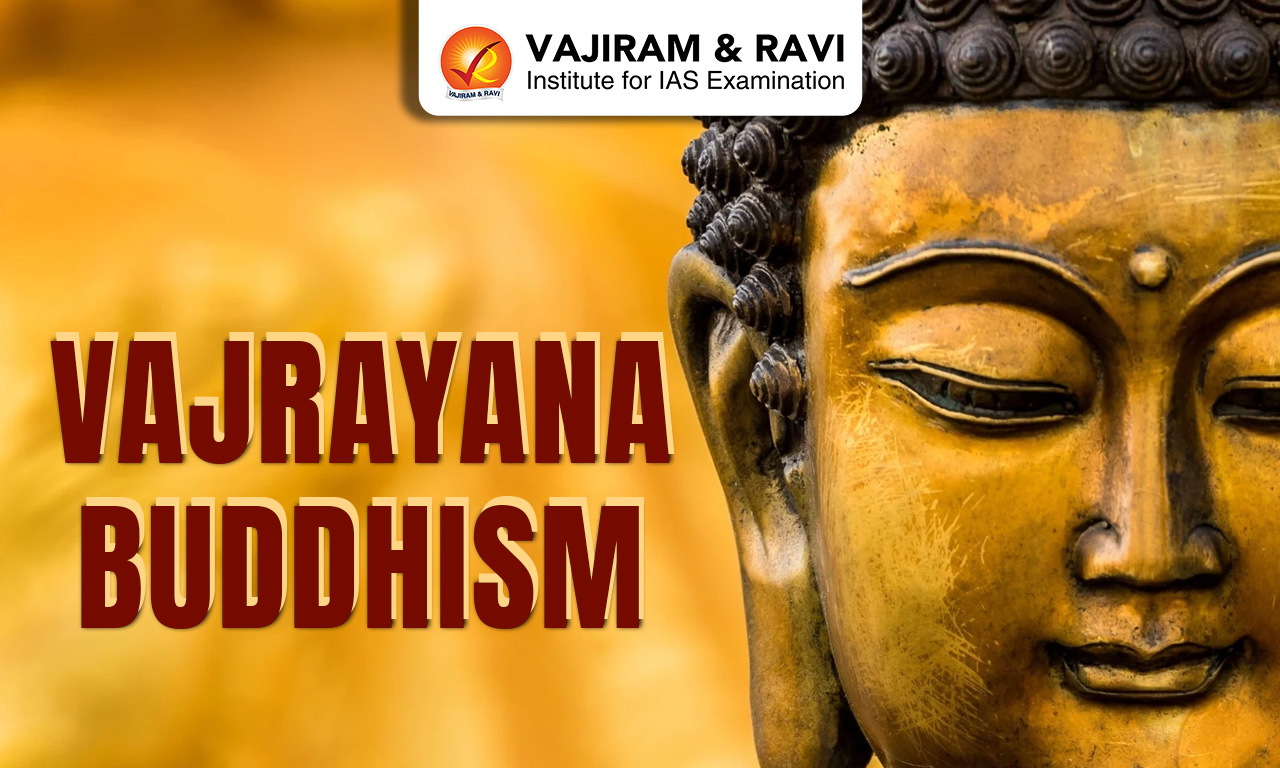
Vajrayana Buddhism is a later form of Buddhism that focuses on reaching enlightenment in a faster and more direct way. It combines basic Buddhist teachings with special practices like meditation, mantras, and rituals. With the guidance of a teacher, it aims to help people develop wisdom and inner peace by transforming their thoughts and actions. Vajrayana Buddhism’s origin, Key Beliefs and other Features are discussed in detail in this article.
About Vajrayana Buddhism
- Vajrayana Buddhism is a later development of Buddhism and is often called Tantric Buddhism or the Diamond Vehicle. The term “Vajra” means thunderbolt or diamond, symbolizing strength and clarity, while “Yana” refers to the spiritual path toward enlightenment.
- Origin and Spread: Vajrayana developed in India around the early medieval period (around 6th-9th century CE) and later spread to regions like Tibet, Bhutan, Mongolia, and parts of Central Asia. In India, it flourished mainly in Bengal, Bihar, Ladakh, and Sikkim. It is closely associated with Tibetan Buddhism.
- Connection with Mahayana Buddhism: This tradition is based on Mahayana Buddhism but introduces additional practices and beliefs. It combines philosophical ideas with practical rituals to make the path to enlightenment more direct.
- Key Practices: Vajrayana emphasizes the use of tantras (sacred texts), mantras (chanting), and yantras (spiritual diagrams). These are believed to be powerful tools that help control the mind and achieve spiritual growth more quickly and are powerful methods for achieving liberation, as they involve advanced and meaningful spiritual practices.
- Role of Guru (Teacher): A spiritual teacher or guru plays a very important role in Vajrayana Buddhism. Followers receive guidance and teachings directly from the guru to properly understand and practice the rituals.
- Belief in Faster Enlightenment: One of the main ideas of Vajrayana is that it offers a quicker path to enlightenment compared to other Buddhist schools. It teaches that even ordinary life experiences can be transformed into steps toward spiritual awakening.
- Importance of Female Deities: Vajrayana gives special importance to feminine energy. Deities like Tara are highly respected and seen as symbols of compassion and protection. She is often worshipped as a female Buddha and meditation deity.
- Philosophical Ideas: Vajrayana teaches that wisdom and compassion must go together. It also explains that opposite ideas, such as emptiness and existence, are connected and must be understood as one for true enlightenment.
- Cultural and Religious Influence: This tradition shows the influence of earlier Indian practices and rituals, blending them with Buddhist teachings. It includes symbolic language, meditation techniques, and sacred art like mandalas.
Also Read: Sects of Buddhism


 Last updated on Sep, 2026
→ UPSC Mains Question Paper 2026 is out now for Essay & GS Paper 1, 2, 3 & 4.
→ UPSC Mains GS Paper 1 2026 is out now.
→ UPSC Mains GS Paper 2 2026 is out now.
→ UPSC Mains GS Paper 3 2026 is out now.
→ UPSC Mains GS Paper 4 2026 is out now.
→ UPSC Mains Indian Language Paper & English Compulsory Paper are out now.
→ Check out the latest UPSC Syllabus 2026 here.
→ UPSC Mains Admit Card 2026 is now out.
→ Enroll in Vajiram & Ravi’s UPSC Mains Test Series 2027 for structured answer writing practice, expert evaluation, and exam-oriented feedback.
→ Join Vajiram & Ravi’s UPSC Mentorship Program 2027 for personalized guidance, strategy planning, and one-to-one support from experienced mentors.
→ Go through the UPSC Mains Previous Year Papers to enhance your preparation.
→ Download UPSC Mains Essay Paper 2025, UPSC Mains GS Paper-I 2025, UPSC Mains GS Paper-II 2025, UPSC Mains GS Paper-III 2025, UPSC Mains GS Paper-IV 2025, UPSC Mains English (Compulsory) Paper 2025, UPSC Mains Hindi (Qualifying) Paper 2025 here.
→ UPSC has released UPSC Toppers List 2025 with the Civil Services final result on its official website.
→ UPSC Calendar 2027 has been released.
→ Also check Best UPSC Coaching in India
Vajrayana Buddhism FAQs
Q1. What is Vajrayana Buddhism?+
Q2. What does Vajrayana mean?+
Q3. Where did Vajrayana Buddhism originate and spread?+
Q4. How is Vajrayana Buddhism different from Mahayana Buddhism?+
Q5. What are the key practices of Vajrayana Buddhism?+
Tags: art and culture art and culture notes vajrayana buddhism