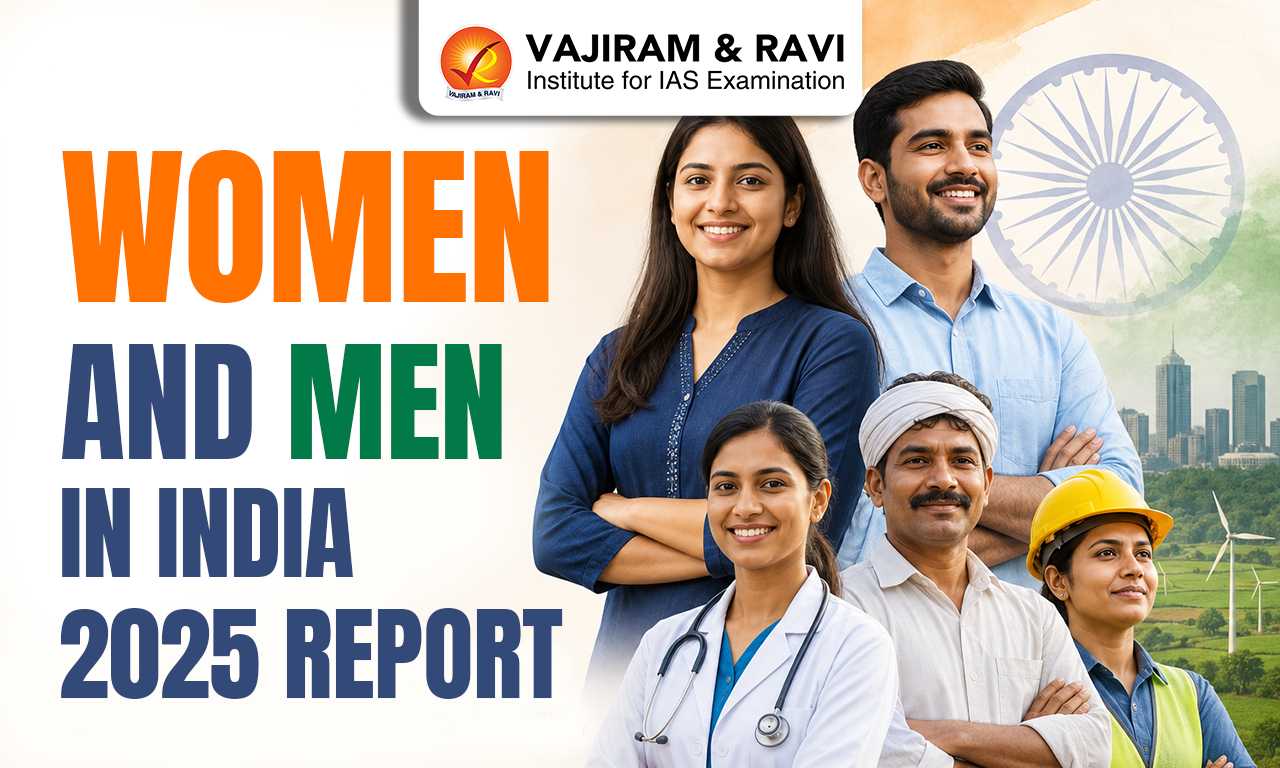
Ministry of Statistics and Programme Implementation (MoSPI) has released the 27th edition of its publication titled “Women and Men in India 2025: Selected Indicators and Data” at the National Deliberative Summit on “Data for Development”, on 29th April 2026 at Bhubaneswar, Odisha.
Key Findings of the Women and Men in India 2025 Report
The Women and Men in India 2025 Report provides a comprehensive, evidence-based overview of gender-related trends across population, health, education, employment, and decision-making. It compiles gender-disaggregated data from multiple ministries, departments, and organisations.
Population:
- The average annual exponential population growth rate in India follows an inverted U- shaped trajectory, implying that population growth accelerated in the decades after independence, reached its peak during the 1971–1981 decade, steadily declining thereafter.
- The slowing growth rate signals the onset of a demographic dividend phase, which over time, may lead towards population ageing.
- The sex ratio at birth has increased at the all-India level, indicating improved survival of women and girls reaching from 904 in 2017-19 to 917 in 2021-23.
- As of 2023, highest sex ratio is in northeastern states of Arunachal Pradesh, where women outnumber men with a sex ratio of 1085, followed by Nagaland (1007), followed by Goa (973). The worst performing are Jharkhand (899) and Bihar (900).
Health:
- The Total Fertility Rate in urban areas has shown a decline between 2019 to 2023.
- Maternal Mortality Ratio has shown a steady and significant decline over the years, with the maternal mortality ratio reducing from 254 to 88 from 2004-06 to 2021-23
- Infant mortality rates have declined consistently for both girls and boys between 2008 and 2023.
- Across rural and urban areas, the mean age at marriage for women has shown a steady increase from 2021 onwards.
- Female sterilization emerges as the most commonly adopted method of family planning among currently married women aged 15-49, accounting for 37.9 percent of total usage.
- Mizoram emerges as the most affected state with respect to HIV infections for both male and female together, recording a prevalence rate of 1.02 and 0.77 respectively, whereas Kerala report the lowest prevalence, at 0.01 for males and 0.01 for females.
- Tuberculosis cases are observed to be more prevalent among the male population compared to females.
Education:
- Literacy rates have improved for both genders across urban and rural areas.
- Gross Enrolment Ratio (GER) at Higher Education has improved from 28.5 to 30.2 for females and 28.3 to 28.9 for males between 2021-22 and 2022-23.
- Gender parity has been achieved across all levels of school education from Primary to Higher Secondary level.
- The dropout rates for both girls and boys have decreased from the year 2022-23 to 2024-25 under NEP Structure.
- As of 2022-23, the Mean Year of Schooling (MYS) in formal education, in India is 8.4 for 15 years and above, while the female MYS is 7.4, making it 1.9 years lesser than male MYS.
- Thirty out of Thirty-six States/Union Territories have Gender Parity Index of 1.00 and above.
- More females study Arts, Sciences, Social Sciences and Medical Sciences as compared to males. Whereas, more males study Engineering & Technology, IT & Computers, Management and Law as compared to females.
Participation in Economy:
- Rural females have seen the highest increase in Labour Force Participation Rate (LFPR), going from 37.5 to 45.9 during the period 2022 to 2025.
- In year 2025, the Worker Population Ratio (WPR) for ages 15 and above is 76.6 for males and 38.8 for females. For both genders, the WPR is higher in rural areas compared to urban areas.
- As of 2025, there is a greater concentration of women workers in agriculture in rural areas, with nearly three-fourths (72.7 per cent) of rural female workers engaged in this sector. In contrast, in urban areas, women workers are more concentrated in manufacturing activities.
- Unemployment remains most pronounced among the youth population aged 15–29 years, with its severity being particularly high in urban areas.
- Average time spent in a day by males on unpaid activities has increased between 2019 and 2024, whereas average time spent in a day by female on paid activities increased in the same period.
- The average time spent by men on unpaid domestic services is 88 minutes while women spent 289 minutes.
Participation in Decision Making:
- As of 2025, women constitute 13.65 per cent of Members of Parliament, and 9.86 per cent hold ministerial portfolios.
- Women account for 49.75 per cent of elected Panchayat representatives where 16 States report more than 50 per cent women’s representation in Panchayati Raj Institutions.
- Representation of women in PRIs is the highest in Assam (60.1%), followed by Dadar & Nagar Haveli and Daman & Diu (56.93%), and Chhattisgarh (56.5%)
- The gender gap in percentage of Male and Female Electors Voting has progressively narrowed, with female turnout surpassing male turnout in the 2019 and 2024 General Election.
- Of the 1,122 approved judicial positions, only 118 are held by women, accounting for just 14.30% of the judiciary. In the Supreme Court, women constitute merely 3.03% of the permanent strength of 33 judges
- The defence sector, including the army and navy, has seen a rise in the number of women serving from 2020 and 2025.
- There has been a 73.80% increase in Men engaged in managerial positions between 2017 and 2025, whereas there has been a 102.54% increase in Women engaged in managerial positions during the same time period
- Women’s participation in household decision-making has seen a marked improvement, as, at least 16 out of 28 States and 6 out of 8 Union Territories report more than 90 per cent of women participating in household decision-making as of 2019-21.
Violence against Women and other challenges:
- Crimes Against Women constitute 7.18% of total crimes committed in year 2023.
- West Bengal reported the highest share (19.24 %), of reported Crimes Against Women to total crimes within state.
- Cybercrime against women has expanded rapidly with the growth of ICTs and digital platforms. Registered cases increased from 4,242 in 2017 to 19,510 in 2023, with cyber pornography and cyber stalking/bullying most frequently reported; Karnataka (7,002) recorded the highest number of cases, followed by Maharashtra (2,502) and Uttarakhand (1,463).
- A noted decline is observed between 2015-16 to 2019-21 in Child Marriage.
- The number of suicides has increased for men, women, and transgender persons from 2018 to 2023.
Key Challenges
- Persistent son preference affecting sex ratio at birth
- Low female workforce participation in urban areas
- Dominance of informal and unpaid work among women
- Gender wage gap and limited asset ownership
- Underrepresentation in top political and corporate leadership
- Heavy burden of unpaid care work


Way Forward
- Strengthen enforcement of laws against gender discrimination and sex-selective practices
- Promote creation of quality and formal employment opportunities for women
- Enhance skill development, digital inclusion, and access to entrepreneurship
- Provide institutional support systems such as childcare and social security
- Encourage greater representation of women in leadership and governance roles
- Improve collection and utilisation of gender-disaggregated data for targeted policy design

 Last updated on Sep, 2026
→ UPSC Mains Question Paper 2026 is out now for Essay & GS Paper 1, 2, 3 & 4.
→ UPSC Mains GS Paper 1 2026 is out now.
→ UPSC Mains GS Paper 2 2026 is out now.
→ UPSC Mains GS Paper 3 2026 is out now.
→ UPSC Mains GS Paper 4 2026 is out now.
→ UPSC Mains Indian Language Paper & English Compulsory Paper are out now.
→ Check out the latest UPSC Syllabus 2026 here.
→ UPSC Mains Admit Card 2026 is now out.
→ Enroll in Vajiram & Ravi’s UPSC Mains Test Series 2027 for structured answer writing practice, expert evaluation, and exam-oriented feedback.
→ Join Vajiram & Ravi’s UPSC Mentorship Program 2027 for personalized guidance, strategy planning, and one-to-one support from experienced mentors.
→ Go through the UPSC Mains Previous Year Papers to enhance your preparation.
→ Download UPSC Mains Essay Paper 2025, UPSC Mains GS Paper-I 2025, UPSC Mains GS Paper-II 2025, UPSC Mains GS Paper-III 2025, UPSC Mains GS Paper-IV 2025, UPSC Mains English (Compulsory) Paper 2025, UPSC Mains Hindi (Qualifying) Paper 2025 here.
→ UPSC has released UPSC Toppers List 2025 with the Civil Services final result on its official website.
→ UPSC Calendar 2027 has been released.
→ Also check Best UPSC Coaching in India
Women and Men in India 2025 Report FAQs
Q1. Who released the Women and Men in India 2025 Report?+
Q2. When and where was the Women and Men in India 2025 Report released?+
Q3. What is the objective of the Women and Men in India 2025 Report?+
Q4. What does the Women and Men in India 2025 Report indicate about infant mortality rates?+
Q5. What are the findings of the Women and Men in India 2025 Report on education?+
Q6. What does the Women and Men in India 2025 Report say about employment trends?+
Tags: women and men in india 2025 report