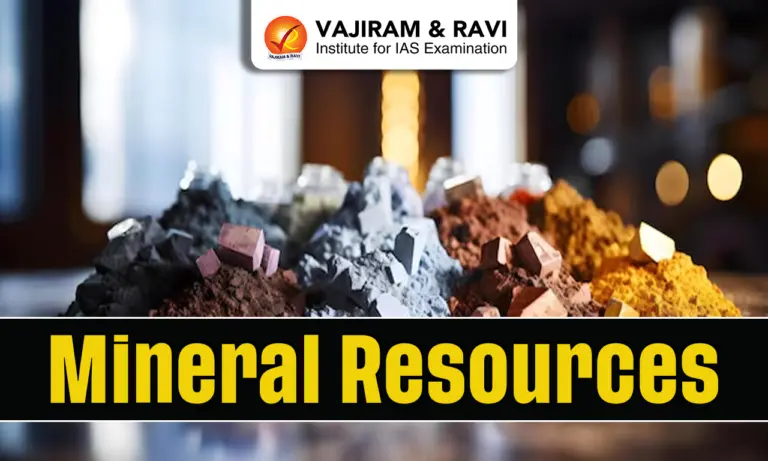
Mineral resources are naturally occurring substances found in the earth’s crust that have economic value. These include metals like iron, copper, and gold, as well as non-metals like mica and limestone. They are essential for industrial development, infrastructure, and daily human activities. Minerals are exhaustible resources, meaning they take millions of years to form and cannot be replaced quickly once used.
Types of Minerals
Minerals are broadly classified based on their properties and usage:
1. Metallic Minerals
Metallic minerals are those minerals that contain metals in their raw form. These metals can be extracted through mining and processing and are widely used in industries like construction, transport, and manufacturing.
Types of Metallic Minerals
1. Ferrous Minerals
- These minerals contain iron as the main element.
- They are mainly used in the production of steel and alloys, which are essential for infrastructure and heavy industries.
- Examples: Iron ore, manganese, chromite
2. Non-Ferrous Minerals
- These minerals do not contain iron.
- They are important for industries like electronics, aerospace, electrical, and construction because they are lightweight and resistant to corrosion.
- Examples: Copper, bauxite (aluminium), lead, zinc, gold, silver
2. Non-Metallic Minerals
Non-metallic minerals do not contain metals but are equally important for various industries like construction, chemicals, and manufacturing.
Types of Non-Metallic Minerals
1. Industrial Minerals
-
- Used directly in industries without converting into metals.
- Examples: Limestone, mica, graphite
2. Building Materials
-
- Used in construction and infrastructure development.
- Examples: Sand, clay, gypsum, marble
3. Gemstones and Precious Stones
-
- Used in jewellery and decorative items.
- Examples: Diamond, ruby, emerald
Characteristics of Minerals
Minerals have distinct physical and chemical properties that help in their identification, classification, and use in various industries. These characteristics are formed due to their internal structure, composition, and geological processes.
- Natural Occurrence: Minerals are naturally occurring inorganic substances formed over millions of years through geological processes like heat, pressure, and chemical reactions.
- Occurrence in Deposits: Minerals are found in rocks, veins, and beds, and when present in large quantities, they form economically valuable deposits.
- Definite Chemical Composition: Each mineral has a fixed or limited chemical formula that determines its properties and behavior.
- Crystal Structure: Minerals have an orderly internal arrangement of atoms, which gives them a definite shape and crystal system such as cubic or hexagonal.
- Hardness: It is the resistance of a mineral to scratching, measured on the Mohs scale from 1 (softest) to 10 (hardest).
- Cleavage: The property of a mineral to break along smooth and flat surfaces due to its internal structure.
- Fracture: The irregular breaking pattern of a mineral when cleavage is absent, often producing rough or curved surfaces.
- Toughness: The ability of a mineral to resist breaking, bending, or deforming under stress.
- Brittleness: The tendency of a mineral to break or shatter easily when force is applied.
- Color: The visible appearance of a mineral, which may vary due to impurities and is not always reliable for identification.
- Streak: The color of a mineral in powdered form, which is more reliable than its surface color.
- Luster: The way a mineral reflects light, which can be metallic or non-metallic such as glassy or dull.
- Transparency (Diaphaneity): The ability of a mineral to allow light to pass through it, classified as transparent, translucent, or opaque.


Distribution of Mineral Resources in India
The distribution of minerals in India is highly uneven and closely linked to the country’s geological structure. Most minerals are concentrated in the Peninsular Plateau region, especially in areas formed by ancient crystalline rocks. States like Odisha, Jharkhand, Chhattisgarh, Karnataka, and Rajasthan are rich in mineral resources, while the Northern Plains have very limited deposits.
Major Mineral Belts in India
India’s mineral wealth is concentrated in a few important belts, each known for specific types of minerals:
- North-Eastern Plateau Belt: Covers Jharkhand, Odisha, West Bengal, and parts of Chhattisgarh. It is the richest mineral belt in India with large deposits of iron ore, coal, manganese, and mica. The Chota Nagpur Plateau lies in this region and is often called the “storehouse of minerals.”
- Central Belt: Extends across Madhya Pradesh and Chhattisgarh. This belt is known for coal, bauxite, limestone, and diamonds. The region supports cement and power industries.
- Southern Belt: Includes Karnataka, Andhra Pradesh, and Tamil Nadu. It is rich in iron ore, gold, bauxite, and mica. The Dharwar region in Karnataka is famous for gold deposits.
- Western Belt: Covers Rajasthan and Gujarat. It is known for copper, zinc, lead, gypsum, and petroleum. Rajasthan is particularly important for non-ferrous minerals.
- North-Western Himalayan Belt: Includes Jammu & Kashmir ansd Himachal Pradesh. This belt has deposits of copper, lead, zinc, and limestone, though mining is limited due to difficult terrain.
State-wise Distribution of Major Mineral Resources
State-wise Distribution of Major Minerals has been highlighted below, along with major mines and their significance.
| State-wise Distribution of Major Mineral Resources | |||
|
Mineral |
Top Producing States |
Major Mines / Areas |
Significance / Uses |
|
Iron Ore |
Odisha, Chhattisgarh, Jharkhand, Karnataka, Goa |
Barbil-Joda (Odisha), Bailadila (Chhattisgarh), Noamundi (Jharkhand), Bellary (Karnataka) |
Backbone of steel industry, infrastructure, railways |
|
Coal |
Jharkhand, Chhattisgarh, Odisha, West Bengal, MP |
Jharia, Raniganj, Bokaro, Talcher, Korba |
Thermal power generation, major energy source |
|
Bauxite |
Odisha, Gujarat, Maharashtra, Jharkhand, MP |
Panchpatmali, Koraput, Amarkantak |
Raw material for aluminium production |
|
Aluminium |
Odisha, Chhattisgarh, Jharkhand |
Angul, Korba |
Used in aircraft, transport, packaging, electrical |
|
Copper |
Rajasthan, MP, Jharkhand |
Khetri, Malanjkhand, Singhbhum |
Electrical wires, electronics, alloys |
|
Zinc |
Rajasthan (dominant), Gujarat |
Rampura Agucha, Zawar |
Galvanization, corrosion protection |
|
Lead |
Rajasthan |
Zawar, Rajpura-Dariba |
Batteries, chemicals, radiation shielding |
|
Gold |
Karnataka, Andhra Pradesh |
Kolar Gold Fields, Hutti, Ramagiri |
Jewellery, electronics, financial reserves |
|
Silver |
Rajasthan, Gujarat |
By-product of zinc mines (Udaipur belt) |
Jewellery, solar panels, electronics |
|
Nickel |
Odisha |
Sukinda Valley |
Stainless steel, batteries, alloys |
|
Manganese |
Odisha, Maharashtra, MP, Karnataka |
Nagpur, Balaghat, Keonjhar |
Steel making, alloy production |
|
Chromite |
Odisha (largest), Karnataka |
Sukinda Valley |
Stainless steel, refractory material |
|
Limestone |
MP, Rajasthan, Andhra Pradesh, Gujarat, Chhattisgarh |
Satna, Jaisalmer, Kadapa |
Cement industry, construction |
|
Dolomite |
Chhattisgarh, Odisha, MP |
Bilaspur, Durg |
Flux in iron & steel industry |
|
Gypsum |
Rajasthan (largest), J&K |
Bikaner, Barmer |
Fertilizers, cement, plaster |
|
Mica |
Jharkhand, Bihar, Andhra Pradesh, Rajasthan |
Koderma, Gaya belt, Nellore |
Electrical insulation, cosmetics |
|
Graphite |
Jharkhand, Odisha, Tamil Nadu, Kerala |
Palamu, Koraput |
Lubricants, batteries, pencils |
|
Diamond |
MP, Andhra Pradesh, Chhattisgarh |
Panna, Krishna River basin |
Jewellery, cutting tools |
|
Petroleum (Oil) |
Assam, Gujarat, Maharashtra (offshore), Rajasthan |
Digboi, Ankleshwar, Mumbai High, Barmer |
Fuel, petrochemicals, transport |
|
Natural Gas |
Assam, Tripura, Gujarat, Maharashtra |
Krishna-Godavari Basin, Hazira |
Power generation, fertilizer industry |
|
Uranium |
Jharkhand, Andhra Pradesh, Telangana |
Jaduguda, Tummalapalle |
Nuclear energy production |
|
Thorium |
Kerala, Tamil Nadu, Odisha |
Monazite sands (coastal) |
Future nuclear fuel |
|
Salt |
Gujarat (largest), Rajasthan, Tamil Nadu |
Rann of Kutch, Sambhar Lake |
Food, chemicals, preservation |
Mineral Distribution in World
The global distribution of minerals is uneven and depends on geological history, with major concentrations found in regions rich in ancient rocks, tectonic activity, and sedimentary basins.
| Distribution of Minerals in the World | |||
|
Mineral |
Major Producing Countries |
Key Regions / Mines |
Significance / Uses |
|
Iron Ore |
Australia, Brazil, China, India, Russia |
Pilbara (Australia), Carajás (Brazil) |
Steel production, infrastructure |
|
Coal |
China, India, USA, Australia, Indonesia |
Shanxi (China), Jharia (India), Appalachia (USA) |
Power generation, fuel |
|
Bauxite |
Australia, Guinea, China, Brazil, India |
Weipa (Australia), Boké (Guinea) |
Aluminium production |
|
Copper |
Chile, Peru, China, USA, DR Congo |
Chuquicamata (Chile), Escondida (Chile) |
Electrical industry, wiring |
|
Gold |
China, Australia, Russia, USA, Canada |
Witwatersrand (South Africa), Nevada (USA) |
Jewellery, finance |
|
Silver |
Mexico, China, Peru, Australia, Russia |
Zacatecas (Mexico), Andes (Peru) |
Jewellery, electronics |
|
Zinc |
China, Peru, Australia, India, Mexico |
Mount Isa (Australia), Rampura Agucha (India) |
Galvanization, alloys |
|
Nickel |
Indonesia, Philippines, Russia, Canada, Australia |
Sudbury (Canada), Norilsk (Russia) |
Stainless steel, batteries |
|
Manganese |
South Africa, Australia, Gabon, Brazil, India |
Kalahari (South Africa) |
Steel making |
|
Chromium (Chromite) |
South Africa, Kazakhstan, India, Turkey |
Bushveld Complex (South Africa) |
Stainless steel |
|
Petroleum (Oil) |
USA, Saudi Arabia, Russia, Canada, Iraq |
Middle East, Texas, Siberia |
Fuel, petrochemicals |
|
Natural Gas |
USA, Russia, Iran, Qatar, China |
Siberia, Persian Gulf |
Energy, fertilizers |
|
Uranium |
Kazakhstan, Canada, Australia, Namibia, Niger |
Athabasca Basin (Canada) |
Nuclear energy |
|
Diamond |
Russia, Botswana, Canada, DR Congo, Australia |
Yakutia (Russia), Kimberley (South Africa) |
Jewellery, cutting tools |
|
Limestone |
China, USA, India, Russia |
Widely distributed |
Cement industry |
|
Phosphate |
Morocco, China, USA, Russia, Jordan |
Western Sahara (Morocco) |
Fertilizers |
|
Gypsum |
China, USA, Iran, Spain, Thailand |
Global deposits |
Cement, plaster |
|
Tin |
China, Indonesia, Myanmar, Peru, Bolivia |
Southeast Asia belt |
Electronics, alloys |
Mineral Resources Significance
Mineral resources are essential for economic development as they provide raw materials for industries, support infrastructure growth, and contribute to energy and technological advancement.
- Industrial Development: Provide basic raw materials for industries like iron & steel, cement, and manufacturing.
- Economic Growth: Contribute significantly to GDP, exports, and government revenue.
- Employment Generation: Create jobs in mining, processing, and related sectors.
- Infrastructure Development: Used in construction of roads, buildings, railways, and urban development.
- Energy Security: Minerals like coal, petroleum, and uranium are key sources of energy.
- Technological Advancement: Essential for electronics, communication, and modern technologies.
- Strategic Importance: Critical minerals are vital for defense, aerospace, and national security.
- Regional Development: Promotes development of mineral-rich but backward areas.
- Foreign Exchange Earnings: Export of minerals adds to national income.
- Support to Agriculture: Minerals like gypsum and phosphate are used in fertilizers.

 Last updated on Sep, 2026
→ UPSC Mains Question Paper 2026 is out now for Essay & GS Paper 1, 2, 3 & 4.
→ UPSC Mains GS Paper 1 2026 is out now.
→ UPSC Mains GS Paper 2 2026 is out now.
→ UPSC Mains GS Paper 3 2026 is out now.
→ UPSC Mains GS Paper 4 2026 is out now.
→ UPSC Mains Indian Language Paper & English Compulsory Paper are out now.
→ Check out the latest UPSC Syllabus 2026 here.
→ UPSC Mains Admit Card 2026 is now out.
→ Enroll in Vajiram & Ravi’s UPSC Mains Test Series 2027 for structured answer writing practice, expert evaluation, and exam-oriented feedback.
→ Join Vajiram & Ravi’s UPSC Mentorship Program 2027 for personalized guidance, strategy planning, and one-to-one support from experienced mentors.
→ Go through the UPSC Mains Previous Year Papers to enhance your preparation.
→ Download UPSC Mains Essay Paper 2025, UPSC Mains GS Paper-I 2025, UPSC Mains GS Paper-II 2025, UPSC Mains GS Paper-III 2025, UPSC Mains GS Paper-IV 2025, UPSC Mains English (Compulsory) Paper 2025, UPSC Mains Hindi (Qualifying) Paper 2025 here.
→ UPSC has released UPSC Toppers List 2025 with the Civil Services final result on its official website.
→ UPSC Calendar 2027 has been released.
→ Also check Best UPSC Coaching in India
Mineral Resources FAQs
Q1. What are mineral resources?+
Q2. Are mineral resources renewable or non-renewable?+
Q3. What are the main types of minerals?+
Q4. Why are minerals unevenly distributed in India?+
Q5. Which region in India is richest in minerals?+
Tags: geography geography notes mineral resources