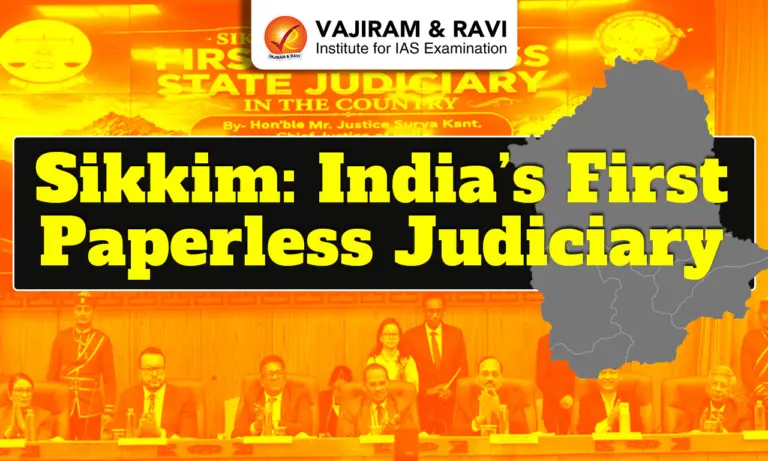
On May 1, 2026, the Chief Justice of India, Justice Surya Kant, declared Sikkim as the first fully paperless state judiciary in India. The announcement was made during the National Conclave on Technology and Judicial Education held at Gangtok, coinciding with Sikkim’s 50th Statehood Anniversary.
What is a Paperless Judiciary?
A paperless judiciary is a system where all court processes are conducted digitally. This includes:
- E-filing of cases and documents
- Virtual hearings through video conferencing
- Digital case records instead of physical files
- Online case tracking with real-time updates
- Automated workflows for faster case management
Key Features of Sikkim’s Paperless Judiciary
Sikkim’s model demonstrates a comprehensive integration of technology:
- End-to-End Digitisation: From filing petitions to delivering judgments, all processes are conducted electronically.
- Virtual Connectivity: Litigants can access courts without physical presence, reducing geographical barriers.
- Real-Time Case Tracking: Judicial data systems enable transparency and monitoring of case progress.
- Integration of AI Tools: Use of tools like SUPACE and SUVAS for research, translation, and case management.
- Expansion of e-Seva Kendras: Facilitating access for citizens with limited digital literacy.


India’s First Paperless Judiciary Background
Sikkim’s transition to a paperless judiciary is not an isolated reform; it is part of a nationwide digital transformation under the e-Courts Mission Mode Project, implemented by the judiciary with support from the Government of India.
What is the e-Courts Project?
The e-Courts Mission Mode Project aims to modernise the Indian judiciary using Information and Communication Technology (ICT). Its core objective is to make courts more:
- Accessible (easy for citizens to reach)
- Efficient (faster case disposal)
- Transparent (open and trackable processes)
It is implemented under the guidance of the Supreme Court’s e-Committee.
Evolution of the e-Courts Project: The project has been rolled out in three phases.
Phase I (2007–2015)
- Basic computerisation of district and subordinate courts
- Installation of hardware and internet connectivity
- Creation of a foundational digital infrastructure
Phase II (2015–2023)
- Introduction of e-filing, e-payment, and National Judicial Data Grid (NJDG)
- Development of virtual courts and video conferencing facilities
- Online access to case status, orders, and judgments
Phase III (2023 onwards): Approved in 2023 with an outlay of ₹7,210 crore, Phase III focuses on creating a completely digital, paperless, and integrated judicial system. Key features of Phase III are:
- Digitisation of Legacy Records
- Around thousands of crores of pages of old case records are being digitised
- Converts physical files into searchable digital documents
- Ensures long-term preservation and easy retrieval
- Universal e-Filing System
- Enables lawyers and litigants to file cases online from anywhere
- Reduces dependency on physical presence in courts
- Promotes ease of doing litigation
- Cloud-Based Infrastructure
- Courts will shift from local servers to secure cloud systems
- Allows real-time data access across courts
- Improves scalability, storage, and disaster recovery
- e-Seva Kendras
- Physical help centres set up in court complexes
- Assist citizens who lack digital literacy or internet access
- Act as a bridge between technology and common people
- Integration of AI and Machine Learning
- Use of AI tools like SUPACE (legal research assistance)
- Use of SUVAS (translation of judgments into regional languages)
- Helps in faster research, reducing judicial workload and improving consistency in decisions.
Sikkim represents a practical implementation of the objectives of Phase III of the e-Courts Mission Mode Project. The state has adopted digital filing, electronic records, and virtual court access, thereby reducing reliance on physical processes.
Significance of Sikkim’s Paperless Judiciary
Significance of Sikkim’s Paperless Judiciary
The transition of Sikkim to a paperless judiciary marks an important step in modernising India’s justice delivery system.
- It significantly improves access to justice, especially in a hilly state where physical travel to courts was time-consuming and difficult. By enabling digital filing and virtual hearings, it brings courts closer to citizens.
- The initiative also enhances efficiency and reduces delays by streamlining procedures and minimising paperwork, thereby helping in faster case disposal.
- Further, it promotes transparency and accountability, as litigants can track case progress online in real time.
- From a policy perspective, Sikkim serves as a model for replication, demonstrating that complete judicial digitalisation is achievable within the existing framework of reforms.
- Additionally, it has environmental benefits by reducing paper usage and supports sustainable governance
Challenges and Concerns
Despite its transformative potential, certain structural challenges remain:
- Digital Divide: Limited digital literacy and infrastructure may exclude vulnerable sections.
- Cybersecurity Risks: Protection of sensitive judicial data is critical.
- Standardisation Issues: Need for uniform implementation across states through systems like the National Court Case Information System (NCCIS).
- Ethical Concerns in AI Use: Risk of algorithmic bias affecting judicial fairness.

 Last updated on Sep, 2026
→ UPSC 2027 Notification will be released on 13 January 2027 at upsconline.nic.in.
→ UPSC Mains Question Paper 2026 is out now for Essay & GS Paper 1, 2, 3 & 4.
→ UPSC Mains GS Paper 1 2026 is out now.
→ UPSC Mains GS Paper 2 2026 is out now.
→ UPSC Mains GS Paper 3 2026 is out now.
→ UPSC Mains GS Paper 4 2026 is out now.
→ UPSC Mains Indian Language Paper & English Compulsory Paper are out now.
→ Check out the latest UPSC Syllabus 2026 here.
→ UPSC Mains Admit Card 2026 is now out.
→ Enroll in Vajiram & Ravi’s UPSC Mains Test Series 2027 for structured answer writing practice, expert evaluation, and exam-oriented feedback.
→ Join Vajiram & Ravi’s UPSC Mentorship Program 2027 for personalized guidance, strategy planning, and one-to-one support from experienced mentors.
→ Go through the UPSC Mains Previous Year Papers to enhance your preparation.
→ Download UPSC Mains Essay Paper 2025, UPSC Mains GS Paper-I 2025, UPSC Mains GS Paper-II 2025, UPSC Mains GS Paper-III 2025, UPSC Mains GS Paper-IV 2025, UPSC Mains English (Compulsory) Paper 2025, UPSC Mains Hindi (Qualifying) Paper 2025 here.
→ UPSC has released UPSC Toppers List 2025 with the Civil Services final result on its official website.
→ UPSC Calendar 2027 has been released.
→ Also check Best UPSC Coaching in India
Sikkim: India’s First Paperless Judiciary FAQs
Q1. What is meant by a paperless judiciary?+
Q2. Which state has been declared India’s first paperless judiciary?+
Q3. Why is Sikkim significant in India’s judicial reforms?+
Q4. How does a paperless judiciary improve access to justice?+
Q5. What is the e-Courts Mission Mode Project?+
Q6. What are the key features of Phase III of the e-Courts Project?+
Tags: indian polity and governance sikkim india’s first paperless judiciary