Ecocide International Law Debate Latest News
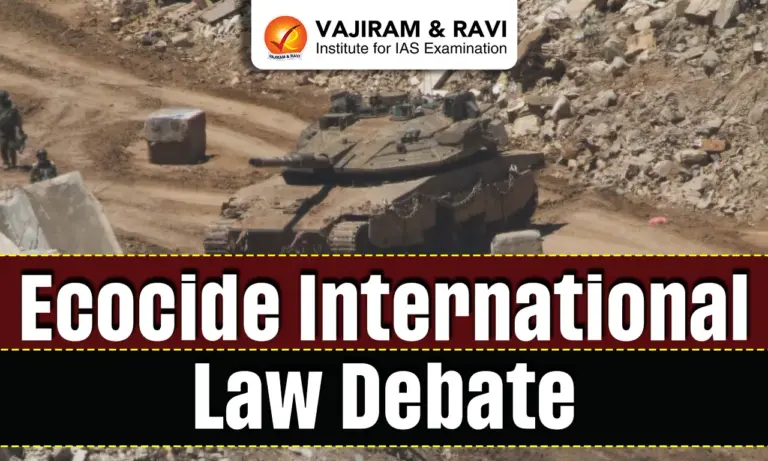
- The term “ecocide” has gained renewed attention amid recent conflicts in West Asia, with Lebanon and Iran accusing Israel of causing severe environmental destruction during military operations.
- Although international law already addresses severe environmental damage in armed conflict, activists and legal experts are pushing for ecocide to be recognised as a separate international crime under the International Criminal Court framework.
- They argue that a distinct legal category would strengthen accountability, broaden the scope of protection, and place greater emphasis on environmental destruction as a serious global crime.
Ecocide: Meaning, Origin and Global Recognition
- Ecocide refers to severe and large-scale environmental destruction caused by human activities, often resulting in widespread or long-term ecological harm.
- It is commonly associated with industrial disasters, war-related damage, or actions that devastate ecosystems.
- Legal Recognition in National Laws – Vietnam became the first country to include ecocide in domestic law in 1990. Since then, several countries such as Russia, Ukraine, France, Belgium, and Chile have incorporated similar provisions into their legal systems.
- Proposed International Definition – In 2021, experts proposed defining ecocide as unlawful or reckless acts committed with awareness that they could cause severe, widespread, or long-term environmental damage.
- Lack of International Recognition – Despite growing attention and national-level recognition, ecocide is still not formally recognised as an international crime under global law.


Ecocide vs Existing International Law: Key Differences
- International law already contains provisions addressing severe environmental destruction, even though the term “ecocide” is not formally recognised.
- The International Criminal Court’s Rome Statute classifies attacks causing “widespread, long-term and severe” environmental damage as war crimes when they directly affect human beings.
- Similarly, the Geneva Conventions prohibit warfare methods causing major environmental harm, while the Environmental Modification Convention (ENMOD) bans deliberate manipulation of natural processes with severe consequences.
- Environmental harm can also be challenged through principles of state sovereignty and cross-border responsibility.
- Under traditional international law, actions such as polluting rivers flowing into another country can constitute violations of legal obligations between states.
How Ecocide Differs
- The major difference lies in the focus of protection.
- Existing international laws are largely anthropocentric, meaning they treat environmental destruction mainly as a crime because it harms human beings.
- Ecocide, however, seeks to recognise the environment itself as a victim deserving independent legal protection.
- Supporters of ecocide argue that recognising it as a separate international crime would move global law beyond human-centred harm and establish accountability for large-scale ecological destruction, even where immediate human suffering may not be directly visible.
Limitations of Current International Law on Ecocide
- Current international legal frameworks provide only partial protection against environmental destruction.
- Under the International Criminal Court’s Rome Statute, severe environmental damage is treated mainly as a war crime, meaning the provisions apply primarily during armed conflict rather than in peacetime ecological disasters.
- Another major hurdle is jurisdiction. Countries like Iran and Lebanon are not parties to the ICC, making prosecution difficult unless the matter is referred by the UN Security Council or accepted through special arrangements.
- Most international environmental agreements do not impose direct international criminal liability for large-scale ecological destruction. As a result, many acts causing severe environmental harm may escape effective punishment under existing laws.
- Adding ecocide to the Rome Statute would require a formal amendment proposed by a State Party and approval by a two-thirds majority of member states.
- Even after approval, additional legal conditions would need to be fulfilled before the amendment becomes effective internationally.
Major Obstacle: Enforcement
- Despite evolving legal frameworks, no direct prosecution has yet occurred for environmental destruction caused by war.
- This raises doubts about whether formally recognising ecocide under international criminal law would automatically improve accountability.
- Experts argue that international law ultimately depends on political will and compliance by powerful states.
- Without enforcement by influential actors, international law often functions more as a moral and diplomatic restraint rather than a coercive mechanism.
Significance of Recognition
- Even with limited enforcement, recognising ecocide can still serve an important role by establishing legal and ethical standards, discouraging impunity, and preventing states from claiming legitimacy for environmentally destructive actions.
Growing International Recognition
- Although ecocide is not yet recognised under the Rome Statute, international frameworks are gradually acknowledging the concept.
- The International Union for Conservation of Nature (IUCN) has passed motions recognising ecocide as a crime.
- In 2025, the Council of Europe adopted the Convention on the Protection of the Environment through Criminal Law — the first binding international treaty criminalising severe and large-scale environmental destruction.
- The treaty allows European domestic courts to prosecute such crimes even if committed outside Europe.
Source: IE

 Last updated on August, 2026
→ UPSC Mains Question Paper 2026 is out now for Essay & GS Paper 1, 2, 3 & 4.
→ UPSC Mains GS Paper 1 2026 is out now.
→ UPSC Mains GS Paper 2 2026 is out now.
→ UPSC Mains GS Paper 3 2026 is out now.
→ UPSC Mains GS Paper 4 2026 is out now.
→ UPSC Mains Indian Language Paper & English Compulsory Paper are out now.
→ Check out the latest UPSC Syllabus 2026 here.
→ UPSC Mains Admit Card 2026 is now out.
→ Enroll in Vajiram & Ravi’s UPSC Mains Test Series 2027 for structured answer writing practice, expert evaluation, and exam-oriented feedback.
→ Join Vajiram & Ravi’s UPSC Mentorship Program 2027 for personalized guidance, strategy planning, and one-to-one support from experienced mentors.
→ Go through the UPSC Mains Previous Year Papers to enhance your preparation.
→ Download UPSC Mains Essay Paper 2025, UPSC Mains GS Paper-I 2025, UPSC Mains GS Paper-II 2025, UPSC Mains GS Paper-III 2025, UPSC Mains GS Paper-IV 2025, UPSC Mains English (Compulsory) Paper 2025, UPSC Mains Hindi (Qualifying) Paper 2025 here.
→ UPSC has released UPSC Toppers List 2025 with the Civil Services final result on its official website.
→ UPSC Calendar 2027 has been released.
→ Also check Best UPSC Coaching in India
Ecocide International Law Debate FAQs
Q1. What is ecocide international law debate?+
Q2. Why is ecocide international law debate important?+
Q3. How does ecocide international law debate relate to the ICC?+
Q4. What are the challenges in ecocide international law debate?+
Q5. Which countries support ecocide international law debate?+
Tags: Ecocide international law debate mains articles upsc current affairs upsc mains current affairs