Chief Minister Refuse to Resign Latest News
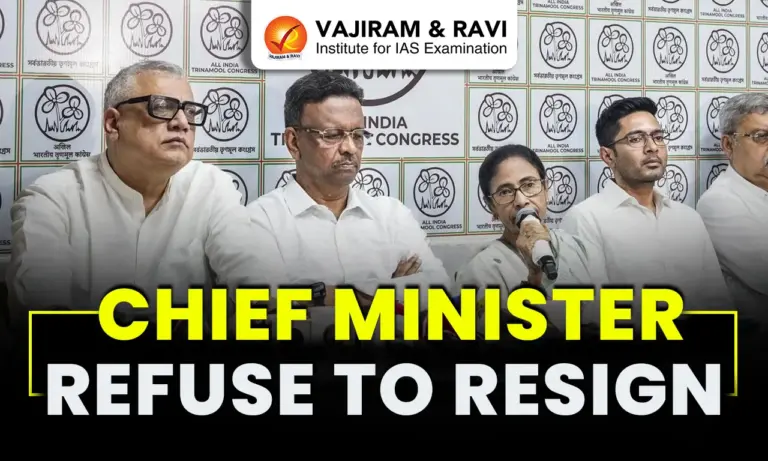
- A day after the All India Trinamool Congress lost the West Bengal Assembly elections, Mamata Banerjee announced that she would not resign as Chief Minister, alleging that the election outcome resulted from a “conspiracy” rather than the people’s mandate.
- She accused the winning party of misusing central forces to capture booths and manipulate the electoral process, and stated that her party would legally challenge the results while continuing its political struggle.
Can a Governor Remove a Chief Minister
- Article 164(1) of the Constitution states that the Chief Minister is appointed by the Governor and holds office “during the pleasure of the Governor.”
- On a literal reading, this appears to give the Governor the power to remove a Chief Minister.
Concerns in the Constituent Assembly
- During debates in the Constituent Assembly, members expressed concern that such wording could enable arbitrary use of gubernatorial powers.
- Mohammad Ismail Khan proposed replacing the phrase “during the pleasure” with a provision making ministers hold office only as long as they enjoyed the confidence of the Legislative Assembly.
- However, B. R. Ambedkar clarified that in a parliamentary system, the Council of Ministers survives only while it enjoys majority support in the Assembly, even if not explicitly stated in the Constitution.
Supreme Court’s Interpretation
- Over time, the Supreme Court of India has interpreted the Governor’s powers as largely bound by the “aid and advice” of the Council of Ministers.
- In A.G. Perarivalan v. State Through Superintendent of Police, the Court observed that the Governor generally acts as a constitutional head rather than exercising independent executive authority.
- In practice, a Governor cannot arbitrarily dismiss a Chief Minister who continues to enjoy the confidence of the Legislative Assembly.
- The real test of legitimacy remains majority support in the House.


Floor Test: Determining Majority Support in the Assembly
- A floor test becomes necessary when there is doubt about whether the Chief Minister still enjoys the confidence of the Legislative Assembly, especially if the Governor asks the Chief Minister to resign and considers inviting another leader to form the government.
- The floor test is a constitutional mechanism to verify majority support in the House. The Chief Minister must demonstrate the backing of more than half of the sitting MLAs.
- If the Chief Minister fails to secure majority support during the floor test, resignation becomes necessary.
- If no party or coalition can prove a stable majority after the floor test, the state may come under President’s Rule under Article 356 as a last resort.
What Happens After the Assembly’s Tenure Ends
- Constitutional Provision – Article 172 of the Constitution states that a State Legislative Assembly normally continues for five years from the date of its first meeting, unless dissolved earlier. After five years, the Assembly automatically stands dissolved.
- Expiry of the West Bengal Assembly – According to the Election Commission, the present West Bengal Assembly began its term on May 8, 2021, and its tenure is scheduled to end on May 7.
- Formation of a New Government – After the Assembly’s tenure ends, the Governor initiates the process of constituting a new Assembly. Newly elected MLAs take oath, following which a new government is formed based on majority support in the House.
What Happens Next After Electoral Defeat
- According to the experts, resignation after losing an Assembly election is largely a constitutional convention rather than a strict legal requirement.
- Even if a Chief Minister does not resign, the office automatically ceases once the Assembly’s tenure ends and the House stands dissolved.
Possibility of Election Petitions
- The election results can still be legally challenged through an election petition filed before the High Court within 45 days of the declaration of results.
- Under the Representation of the People Act, 1951, grounds for challenge include corrupt practices and procedural violations during the conduct of elections.
Scope for Writ Petitions
- Apart from election petitions, writ petitions may also be filed if the integrity of the electoral process itself is questioned.
- Allegations such as arbitrary deletion of voters from electoral rolls can be challenged as violations of fundamental rights.
- Legal experts argue that large-scale irregularities affecting voter participation could invite judicial scrutiny, especially where constitutional rights and fairness of the democratic process are involved.
Source: TH

 Last updated on Sep, 2026
→ UPSC 2027 Notification will be released on 13 January 2027 at upsconline.nic.in.
→ Check out the latest UPSC Syllabus here.
→ Download UPSC Model Answers for Mains 2026
→ UPSC Mains Question Paper 2026 is out now for Essay & GS Paper 1, 2, 3 & 4.
→ UPSC Calendar 2027 has been released.
→ Enroll in Vajiram & Ravi’s UPSC Mains Test Series 2027 for structured answer writing practice, expert evaluation, and exam-oriented feedback.
→ Join Vajiram & Ravi’s UPSC Mentorship Program 2027 for personalized guidance, strategy planning, and one-to-one support from experienced mentors.
→ Go through the UPSC Mains Previous Year Papers to enhance your preparation.
→ UPSC has released UPSC Toppers List 2025 with the Civil Services final result on its official website.
→ Also check Best UPSC Coaching in India
Chief Minister Refuse to Resign FAQs
Q1. Can a Chief Minister refuse to resign after losing a state assembly election?+
Q2. What constitutional provision governs the appointment and removal of a Chief Minister?+
Q3. What is a floor test and when is it required after a Chief Minister refuses to resign?+
Q4. Can the Governor dismiss a Chief Minister who refuses to step down?+
Q5. What legal options exist to challenge election results when a Chief Minister refuses to resign?+
Tags: Chief Minister refuse to resign mains articles upsc current affairs upsc mains current affairs