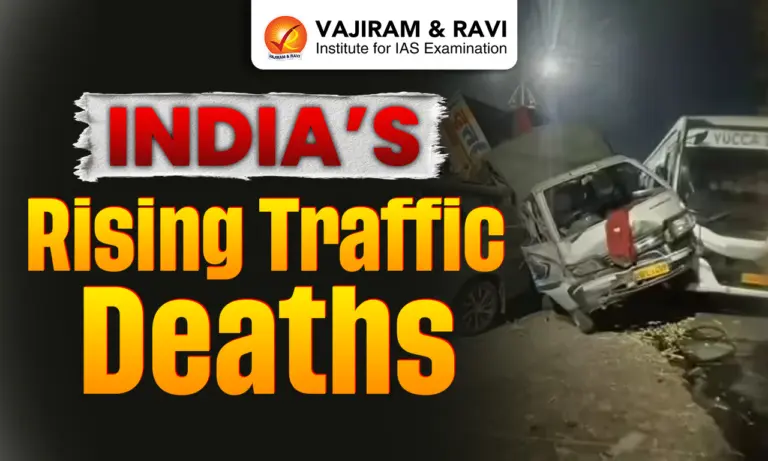
Traffic accidents have emerged as one of the biggest causes of accidental deaths in India. According to the National Crime Records Bureau (NCRB), nearly 1.99 lakh people died in traffic-related accidents in 2024, averaging around 546 deaths every day. Traffic accidents include road accidents, railway accidents, railway crossing incidents, and accidents occurring on railway tracks and premises.
Key NCRB Findings
Rising Traffic Deaths:
- The NCRB reported 1.99 lakh traffic-related deaths in 2024 compared to 1.98 lakh deaths in 2023.
- Traffic accident cases increased from 4.91 lakh to 4.95 lakh during the same period, while around 4.52 lakh people suffered injuries.
Largest Share in Accidental Deaths
- Traffic accidents accounted for 42.6 percent of all accidental deaths in India during 2024, making them the largest contributor to accidental mortality.
- Most traffic-related deaths are preventable and arise from systemic governance failures rather than unavoidable causes.
- Other major causes included sudden deaths (16.2 percent), drowning (8.6 percent), falls (5.7 percent), poisoning (4.6 percent), and electrocution (3.4 percent).
Road Accidents Dominate
- Out of the total 1.99 lakh traffic-related deaths, nearly 1.75 lakh deaths or around 88 percent occurred due to road accidents alone.
- Additionally, 17,029 people died after falling from trains or colliding on railway tracks, 5,384 deaths occurred on railway premises, and 1,888 deaths were recorded at railway crossings.
Worst-Affected States
- Uttar Pradesh recorded the highest traffic fatalities at 27,071 deaths, followed by Tamil Nadu with 20,390 deaths and Maharashtra with 19,475 deaths.
- Together, these three states accounted for 33.6 percent of all traffic-related deaths in India during 2024.
Two-Wheeler Vulnerability
- Two-wheelers accounted for the highest number of road fatalities with 84,599 deaths. Pedestrian deaths stood at 25,769, while cars accounted for 23,739 deaths.
- Tamil Nadu reported the highest number of two-wheeler deaths at 11,786, followed by Uttar Pradesh with 8,575 fatalities.
Overspeeding as the Biggest Cause
- Overspeeding accounted for 58 percent of road deaths in India during 2024, making it the single largest cause of traffic fatalities.
- Dangerous and careless driving contributed 26.3 percent of deaths, while weather conditions caused 2.9 percent and drunk or drug-influenced driving caused 1.9 percent of fatalities.
Peak Accident Hours
- Most road accidents occurred between 6 PM and 9 PM, accounting for 20.8 percent of total accidents.
Highway Accident Burden
- Although national highways constitute only 2.1 percent of India’s total road network, they accounted for 29.8 percent of all road accidents in 2024.
- State highways accounted for 22 percent of accidents, while other roads contributed 48.2 percent of total accidents.
Railway Safety Concerns
- Maharashtra accounted for 28.9 percent of deaths caused by falls from trains or collisions on railway tracks.
- Most such incidents occur in overcrowded suburban railway networks where passengers travel on footboards or attempt to board moving trains.
- October recorded the highest share of such accidents at 8.8 percent, mainly due to increased festive-season travel.
Major Causes of Rising Traffic Deaths
The rising number of traffic fatalities in India is driven by a combination of behavioural, infrastructural, administrative, and systemic factors that continue to weaken overall road safety and transport management.
- Overspeeding and Reckless Driving: High-speed driving, aggressive driving behaviour, and frequent violation of traffic rules remain the primary causes of road fatalities.
- Weak Traffic Law Enforcement: Poor monitoring systems, inadequate policing, corruption, and low conviction rates reduce deterrence against traffic violations.
- Poor Road Engineering: Unsafe road design, black spots, poor signage, inadequate lighting, and lack of pedestrian infrastructure significantly increase accident risks.
- Rapid Motorisation: Rapid growth in vehicle ownership, especially two-wheelers, has increased pressure on already stressed transport infrastructure.
- Unsafe Public Transport: Overcrowded suburban rail systems and inadequate public transport facilities contribute to unsafe commuting practices.
- Weak Emergency Response: Delays in ambulance services, trauma care, and emergency medical response increase mortality after accidents.


Impact of Traffic Fatalities
Rising traffic deaths have far-reaching consequences on individuals, families, the economy, and public health systems, making road safety a critical developmental and governance issue in India.
- Human and Social Impact: Traffic accidents result in death, disability, psychological trauma, and long-term financial hardship for affected families.
- Economic Losses: Road crashes impose losses worth nearly 3.14 percent of GDP through healthcare costs, productivity losses, and economic disruption.
- Public Health Burden: The growing number of injuries and fatalities places additional pressure on hospitals, trauma centres, and emergency healthcare systems.
Government Initiatives and Road Safety Reforms
The Government of India has introduced legislative, technological, infrastructural, and awareness-based measures to reduce traffic fatalities, improve road safety standards, and strengthen enforcement mechanisms across the country.
- Motor Vehicles (Amendment) Act, 2019: The Motor Vehicles (Amendment) Act, 2019 introduced stricter penalties for overspeeding, dangerous driving, drunk driving, and other traffic violations to improve road discipline.
- iRAD and eDAR Systems: The Integrated Road Accident Database (iRAD) and electronic Detailed Accident Report (eDAR) systems digitise real-time accident reporting, identify accident black spots, improve ambulance deployment, and streamline insurance and legal processes.
- Electronic Monitoring and Enforcement Rules: The government has introduced rules mandating installation of electronic enforcement devices on high-risk corridors, highways, and major urban junctions to improve compliance with traffic laws.
- Bharat NCAP Programme: The Bharat New Car Assessment Programme (BNCAP) introduces vehicle safety ratings for passenger cars to encourage safer automobile manufacturing and informed consumer choices.
- iRASTE AI-Based Project: The Intelligent Solutions for Road Safety through Technology and Engineering (iRASTE) project uses artificial intelligence, sensors, and mobility analytics to identify risky driving behaviour and prevent accidents.
- Vehicle Scrapping Policy: The Vehicle Scrapping Policy aims to phase out old and unfit vehicles through automated fitness testing and incentives for scrapping polluting vehicles.
- Technology-Based Enforcement: The government has expanded e-challan systems, CCTV surveillance, intelligent traffic systems, and digital monitoring mechanisms to improve traffic enforcement.
- Black Spot Removal Programme: Accident-prone road stretches are being scientifically identified and redesigned to reduce accident risks and fatalities.
- Road Safety Awareness Campaigns: National campaigns promote helmet use, seat-belt compliance, safe driving practices, and public awareness regarding traffic safety.
- International Commitments: India is a signatory to the Brasilia Declaration on Road Safety and is committed to the UN Decade of Action for Road Safety 2021–2030, which aims to reduce road traffic deaths by 50 percent by 2030 under SDG Target 3.6.
Way Forward
- Strengthen Traffic Enforcement: Strict enforcement of speed limits, helmet rules, seat-belt laws, and drunk-driving provisions is essential to reduce fatalities.
- Adopt National Road Safety Plan 2025–2030: India needs a comprehensive Road Safety Action Plan with measurable targets, annual monitoring, and alignment with the UN goal of reducing fatalities by 50 percent by 2030.
- Improve Road Engineering: Scientific road design, better lighting, pedestrian infrastructure, and removal of black spots must be prioritised.
- Expand AI-Based Safety Systems: Projects such as iRASTE should be expanded nationally for predictive accident prevention and intelligent traffic management.
- Strengthen Public Transport and Railway Safety: Reducing overcrowding in suburban trains, improving railway crossing safety, and expanding reliable public transport systems are necessary.
- Improve Trauma Care Systems: Efficient ambulance services, trauma centres, and emergency response systems can significantly reduce accident-related mortality.
- Ensure Rear Seat-Belt Compliance: Mandatory rear seat-belt reminder systems for vehicles manufactured after April 2025 should be strictly enforced to improve passenger safety.
- Promote Behavioural Change: Long-term road safety education and awareness campaigns are necessary to improve traffic discipline and responsible driving behaviour.

 Last updated on Sep, 2026
→ UPSC 2027 Notification will be released on 13 January 2027 at upsconline.nic.in.
→ Check out the latest UPSC Syllabus here.
→ Download UPSC Model Answers for Mains 2026
→ UPSC Mains Question Paper 2026 is out now for Essay & GS Paper 1, 2, 3 & 4.
→ UPSC Calendar 2027 has been released.
→ Enroll in Vajiram & Ravi’s UPSC Mains Test Series 2027 for structured answer writing practice, expert evaluation, and exam-oriented feedback.
→ Join Vajiram & Ravi’s UPSC Mentorship Program 2027 for personalized guidance, strategy planning, and one-to-one support from experienced mentors.
→ Go through the UPSC Mains Previous Year Papers to enhance your preparation.
→ UPSC has released UPSC Toppers List 2025 with the Civil Services final result on its official website.
→ Also check Best UPSC Coaching in India
India’s Rising Traffic Deaths FAQs
Q1. What are the major findings of the NCRB Traffic Accident Report 2024?+
Q2. Which states recorded the highest number of traffic deaths in 2024?+
Q3. What proportion of traffic deaths in India are caused by road accidents?+
Q4. What is the biggest cause of road fatalities in India according to the NCRB report?+
Q5. Why are national highways considered high-risk accident zones?+
Tags: indias rising traffic deaths