Governor Role Latest News
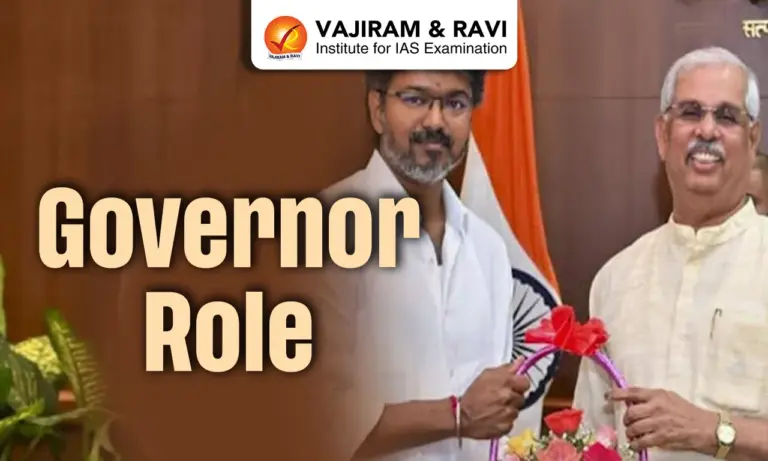
- After the Tamilaga Vettri Kazhagam (TVK) emerged as the single largest party in the 2026 Tamil Nadu Assembly elections, Governor Rajendra Arlekar delayed inviting party president C. Joseph Vijay to form the government.
- The Governor asked Vijay to demonstrate majority support by submitting physical letters from at least 118 MLAs in the 234-member Tamil Nadu Legislative Assembly before taking oath as Chief Minister.
Governor’s Role in a Hung Assembly
- Under Article 164 of the Constitution, the Governor appoints the Chief Minister.
- However, the Constitution does not prescribe a fixed procedure for selecting a Chief Minister in the event of a hung Assembly.
- The Governor’s primary responsibility is to ensure the formation of a stable and responsible government while preserving constitutional governance in the State.
- Recommendations of the Sarkaria Commission and various Supreme Court judgments emphasise that Governors must act impartially and constitutionally rather than on personal discretion.
Exploring Government Formation
- The Governor is expected to explore all reasonable possibilities for government formation by consulting political parties, alliances, and independent MLAs within a reasonable timeframe.
- While some time may be allowed to establish majority support, the Governor cannot delay indefinitely, as prolonged uncertainty may encourage political defections and horse-trading.
Power to Dissolve the Assembly
- The Supreme Court of India, in cases such as B. R. Kapur case and Rameshwar Prasad case, recognised that the Governor may recommend dissolution of the Assembly under Article 174(2)(b) if no party is able to form a stable government.
- If all possibilities of forming a government fail, the Governor may recommend President’s Rule under Article 356 as a last constitutional option.


Order of Preference for Inviting a Party to Form Government
- First Preference: Pre-Poll Alliance with Majority – The Sarkaria Commission recommended that the Governor should first invite a pre-poll alliance that has secured a clear majority in the Assembly. This principle has also received judicial support.
- Second Preference: Single Largest Party – If no alliance has a majority, the Governor may invite the single largest party, provided it can demonstrate majority support through alliances or backing from other legislators.
- Supreme Court’s View on Minority Governments – In the S. R. Bommai case, the Supreme Court of India clarified that the Constitution does not require the ruling party to independently hold a majority. What matters is whether the government enjoys the confidence of the Legislative Assembly.
- Third Preference: Post-Poll Alliances – The next option is a post-election alliance formed after results are declared. Such coalitions are constitutionally valid if they can demonstrate majority support in the House.
- Rise of Coalition Politics – The Court recognised that post-poll alliances among ideologically compatible parties have become common in India’s coalition-era politics and are legitimate means of forming governments.
- Recent debates have focused on concerns that Governors may misuse discretionary powers, including recommendations for President’s Rule, to advance the political interests of the ruling party at the Centre.
Floor Test as a Measure of Majority
- Critics have argued that Governor Rajendra Arlekar’s insistence on physical letters of support has delayed government formation.
- A petition before the Supreme Court contends that the Governor is constitutionally bound to invite C. Joseph Vijay to form the government and then require him to prove majority through a floor test in the Assembly.
Supreme Court’s Evolving Position
- Although the S. R. Bommai case initially suggested that floor tests were mainly for testing whether an incumbent government had lost majority support.
- Later, Supreme Court judgments increasingly treated floor tests as the most objective and transparent method of determining legislative confidence.
- Successive rulings have stressed that the people’s electoral mandate should not depend solely on the Governor’s personal discretion and that majority claims should ideally be tested on the Assembly floor.
Instances Where Floor Tests Protected Constitutional Governance
- Over the years, the Supreme Court of India has increasingly treated the floor test as the most reliable method for determining majority support and ensuring stable government formation in States.
Goa Political Crisis (2017)
- In 2017, the Court allowed Manohar Parrikar of the Bharatiya Janata Party to be sworn in as Chief Minister despite the Congress being the single largest party.
- However, the Court reduced the time given to prove majority from 15 days to 48 hours and ordered an immediate floor test, which Parrikar successfully won.
Karnataka Political Crisis (2018)
- In 2018, the Governor invited B. S. Yediyurappa to form the government and granted him 15 days to prove majority.
- After a challenge by the Congress–JD(S) alliance, the Supreme Court shortened the deadline to 24 hours and directed that the floor test be conducted openly under live television coverage rather than through a secret ballot.
- Yediyurappa resigned before the trust vote.
Assembly Floor Over Governor’s Discretion
- The Supreme Court has repeatedly emphasised that legislative majority must be tested in the Assembly and not determined solely by the Governor’s subjective assessment.
- According to the Court, the Legislative House — not the Raj Bhavan — is where democratic legitimacy must ultimately be established.
Source: TH

 Last updated on Sep, 2026
→ UPSC 2027 Notification will be released on 13 January 2027 at upsconline.nic.in.
→ Check out the latest UPSC Syllabus here.
→ Download UPSC Model Answers for Mains 2026
→ UPSC Mains Question Paper 2026 is out now for Essay & GS Paper 1, 2, 3 & 4.
→ UPSC Calendar 2027 has been released.
→ Enroll in Vajiram & Ravi’s UPSC Mains Test Series 2027 for structured answer writing practice, expert evaluation, and exam-oriented feedback.
→ Join Vajiram & Ravi’s UPSC Mentorship Program 2027 for personalized guidance, strategy planning, and one-to-one support from experienced mentors.
→ Go through the UPSC Mains Previous Year Papers to enhance your preparation.
→ UPSC has released UPSC Toppers List 2025 with the Civil Services final result on its official website.
→ Also check Best UPSC Coaching in India
Governor Role FAQs
Q1. What is the Governor role in hung Assembly situations?+
Q2. Which party gets first preference in a hung Assembly?+
Q3. Why is a floor test important in a hung Assembly?+
Q4. Can the Governor recommend President’s Rule in a hung Assembly?+
Q5. What has the Supreme Court said about hung Assembly disputes?+
Tags: Governor role mains articles upsc current affairs upsc mains current affairs