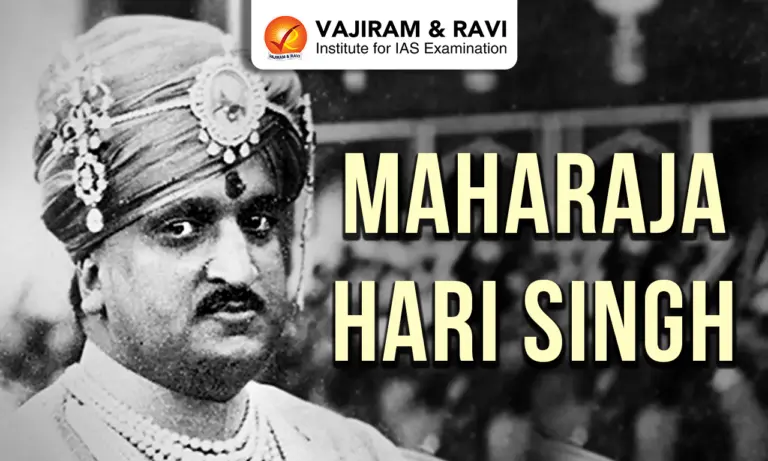
Maharaja Hari Singh was born in 1895 and belonged to the Dogra dynasty that ruled Jammu and Kashmir. He became the ruler of the princely state in 1925 after the death of Maharaja Pratap Singh. During his reign, he introduced several reforms in administration, education, and governance.
He is remembered mainly for his role during the partition era and the accession of Jammu and Kashmir to India in 1947. His decisions shaped the political future of the region and continue to influence India-Pakistan relations even today.
Maharaja Hari Singh Early Life
Maharaja Hari Singh was born on September 23, 1895, into the Dogra royal family. He received his education at Mayo College, Ajmer, and later underwent military training. From an early age, he was known for his administrative abilities and interest in modern governance.
After ascending the throne in 1925, he attempted to modernize the princely state through administrative reforms and better governance practices.
Maharaja Hari Singh’s Reign and Reforms
Maharaja Hari Singh ruled the princely state of Jammu and Kashmir from 1925 to 1947 and is remembered for introducing several administrative and social reforms. His reign focused on modernization, better governance, public participation, and improving the overall administration of the state.
- Maharaja Hari Singh ascended the throne of Jammu and Kashmir in 1925 after the death of Maharaja Pratap Singh.
- He aimed to modernize the administration of the princely state by introducing reforms in governance, law, and public services.
- One of his most important reforms was the establishment of the Praja Sabha in 1934, which served as the legislative assembly of Jammu and Kashmir.
- The Praja Sabha allowed limited representation of the people in governance and marked the beginning of constitutional reforms in the state.
- He worked toward improving the judicial system by promoting fair legal procedures and strengthening administrative accountability.
- Maharaja Hari Singh introduced reforms in the revenue system to improve tax collection and administrative efficiency.
- He encouraged the expansion of education in Jammu and Kashmir and supported the establishment of educational institutions.
- Social reforms during his reign included measures against discrimination and efforts to improve the condition of weaker sections of society.
- He promoted infrastructure development, including roads, communication systems, and public services, to strengthen connectivity within the state.
- His administration focused on reducing corruption and improving the efficiency of government officials.
- Maharaja Hari Singh also encouraged economic development through trade and administrative modernization.
- Despite his reformist approach, political unrest and growing demands for democratic governance increased during the later years of his rule.
- His reign became historically significant due to the political developments surrounding the partition of India in 1947 and the accession of Jammu and Kashmir to India.
Also Read: Kargil War


Instrument of Accession 1947
- The Instrument of Accession was signed by Maharaja Hari Singh on October 26, 1947.
- It legally integrated Jammu and Kashmir with India during the partition period.
- Maharaja Hari Singh initially wanted Jammu and Kashmir to remain independent.
- The accession was signed after a tribal invasion supported by Pakistan threatened the state.
- India agreed to provide military assistance only after the signing of the accession document.
- Under the agreement, India received control over defense, external affairs, and communications.
- The accession was accepted by Lord Mountbatten on October 27, 1947.
- The Instrument of Accession became the legal basis for Jammu and Kashmir’s merger with India and led to the Indo-Pak War of 1947–48.

 Last updated on Sep, 2026
→ UPSC 2027 Notification will be released on 13 January 2027 at upsconline.nic.in.
→ Check out the latest UPSC Syllabus here.
→ Download UPSC Model Answers for Mains 2026
→ UPSC Mains Question Paper 2026 is out now for Essay & GS Paper 1, 2, 3 & 4.
→ UPSC Calendar 2027 has been released.
→ Enroll in Vajiram & Ravi’s UPSC Mains Test Series 2027 for structured answer writing practice, expert evaluation, and exam-oriented feedback.
→ Join Vajiram & Ravi’s UPSC Mentorship Program 2027 for personalized guidance, strategy planning, and one-to-one support from experienced mentors.
→ Go through the UPSC Mains Previous Year Papers to enhance your preparation.
→ UPSC has released UPSC Toppers List 2025 with the Civil Services final result on its official website.
→ Also check Best UPSC Coaching in India
Maharaja Hari Singh FAQs
Q1. Who was Maharaja Hari Singh?+
Q2. Why is Maharaja Hari Singh important in Indian history?+
Q3. When did Maharaja Hari Singh sign the Instrument of Accession?+
Q4. Why did Maharaja Hari Singh accede to India?+
Q5. What was the Standstill Agreement?+
Tags: history maharaja hari singh political science