Russia–China Proximity Latest News
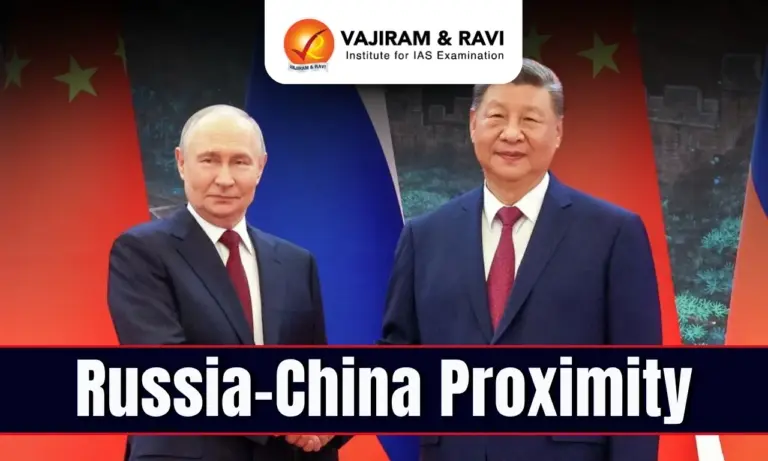
- Russian President Vladimir Putin’s visit to Beijing, coming just days after US President Donald Trump’s trip, highlights China’s growing role as a central hub of global diplomacy.
- While the US seeks to stabilise strained relations with China, Russia is looking to secure continued economic support from Beijing and maintain its strategic relevance amid global geopolitical shifts.
- Given that the US, China, and Russia are key systemic powers, the nature of their interactions will significantly shape the future global order.
- Putin’s visit is therefore important not just for bilateral ties, but for regional and global strategic stability, raising questions about whether the deepening Russia–China partnership could eventually evolve into a formal military alliance.
History of Russia-China Relations
- Russia-China relations have evolved through three phases—imperial, Soviet, and post-Soviet.
- Despite a long 4,300-km border, ties were mostly stable, though China remembers 19th-century territorial losses to Russia as part of its “century of humiliation.”
- Relations strengthened after China’s Communist revolution, culminating in the 1950 Treaty of Friendship, but ideological and strategic differences triggered the Sino-Soviet split and 1969 armed clashes.
- This enabled US-China rapprochement in the 1970s, affecting India’s security.
- After the Soviet collapse, ties revived with the 1992 Strategic Partnership Treaty, reaching new heights under Putin and Xi, who declared a “no-limits” partnership in 2022.


Deepening Russia–China Strategic Partnership
- Russia and China have developed strong political and economic interdependence, driven by complementary strengths.
- While China provides markets, technology, and capital, Russia supplies energy and defence products.
- Western sanctions after the Ukraine war significantly increased Russia’s dependence on China, which now accounts for about 32% of Russia’s total trade ($228 billion out of $700 billion in 2025).
- Chinese firms have filled the vacuum left by Western companies in automobiles, telecom, and electronics, while Russia increasingly relies on Chinese semiconductors and industrial technology.
- Energy ties have deepened through the Power of Siberia gas pipelines.
- Politically, frequent leadership interactions reflect strategic closeness, while bilateral trade in yuan and ruble signals growing de-dollarisation of economic ties.
Key Outcomes of the Putin–Xi Summit
- Expanded Bilateral Cooperation – The Putin–Xi summit was seen as more productive than the earlier Trump–Xi meeting, resulting in a joint statement and over 40 agreements covering: Energy, Technology, Investment etc. However, no concrete agreement was reached on the Power of Siberia-2 gas pipeline.
- Strategic Objective – The summit reflected the shared goal of building strong bilateral ties resilient to global uncertainty and Western pressure, especially in the backdrop of geopolitical tensions.
- Common Geopolitical Stand – Without directly naming the United States, both leaders criticised unilateralism and hegemonic policies and reiterated support for: A multipolar world order; Democratisation of global institutions.
- Core Message – The summit underscored Russia and China’s determination to deepen strategic cooperation, protect shared interests, and collectively counter Western dominance in global affairs.
Are Russia and China Moving Towards a Military Alliance
- Russia and China are drawing closer due to changing global geopolitics, particularly their shared perception of the United States as a structural rival.
- However, they are not natural allies in terms of culture, ideology, political systems, or historical affinity.
- A military alliance involves a formal commitment to defend each other against external threats. Despite growing cooperation, both countries are cautious about the risks associated with such alliances.
- China does not want to be dragged into Russia’s confrontation with the West, especially over Ukraine. Russia, likewise, is reluctant to become entangled in China’s tensions with the US over Taiwan.
- While strategic and military cooperation between Russia and China is expected to deepen, a formal military alliance appears unlikely in the near future, as both seek flexibility rather than binding security commitments.
- Recent US-China diplomatic engagement has further reduced the likelihood of such an alliance in the short term.
Implications for India’s Security
- Russia’s growing dependence on China poses a significant strategic challenge for India. For the past two decades, India has maintained a balancing strategy by deepening security ties with the United States while preserving strong relations with Russia.
- However, this diplomatic space is shrinking as both Washington and Moscow seek closer engagement with Beijing.
- As a result, India may need to recalibrate its strategic approach, as reliance on the US for continental security balancing appears increasingly uncertain, particularly under the current geopolitical circumstances.
Source: IE

 Last updated on Oct, 2026
→ UPSC 2027 Notification will be released on 13 January 2027 at upsconline.nic.in.
→ Check Nobel Prize 2026 Winners List here.
→ Download PIB PRiSM Monthly Magazine 2026 here.
→ Check UPSC Monthly Current Affairs Magazine The Recitals here.
→ Check out the latest UPSC Syllabus here.
→ Download UPSC Model Answers for Mains 2026
→ UPSC Mains Question Paper 2026 is out now for Essay & GS Paper 1, 2, 3 & 4.
→ UPSC Calendar 2027 has been released.
→ Enroll in Vajiram & Ravi’s UPSC Mains Test Series 2027 for structured answer writing practice, expert evaluation, and exam-oriented feedback.
→ Join Vajiram & Ravi’s UPSC Mentorship Program 2027 for personalized guidance, strategy planning, and one-to-one support from experienced mentors.
→ Go through the UPSC Mains Previous Year Papers to enhance your preparation.
→ UPSC has released UPSC Toppers List 2025 with the Civil Services final result on its official website.
→ Also check Best UPSC Coaching in India
Russia–China Proximity FAQs
Q1. Why is Russia–China Proximity becoming a strategic concern for India?+
Q2. How has the Ukraine war accelerated Russia–China Proximity?+
Q3. Can Russia–China Proximity evolve into a military alliance?+
Q4. How does Russia–China Proximity affect India’s foreign policy options?+
Q5. What does Russia–China Proximity mean for India’s long-term security strategy?+
Tags: mains articles russia–china proximity upsc current affairs upsc mains current affairs