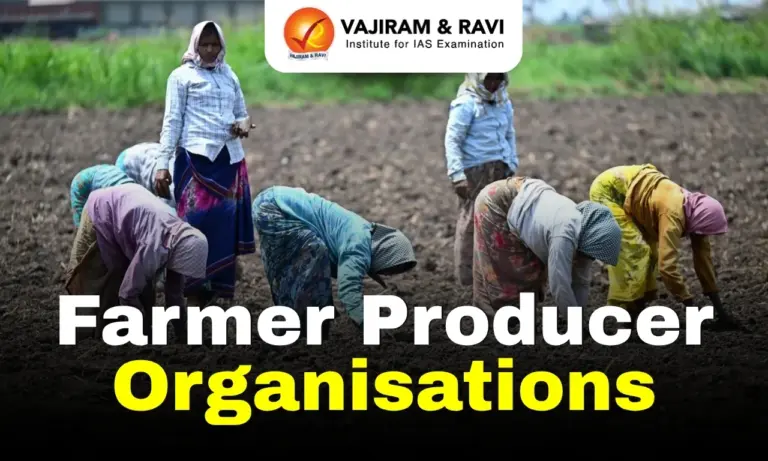
Farmer Producer Organisation Latest News
- With the southwest monsoon expected to be weak due to El Niño conditions, the Union Ministry of Agriculture is leveraging the network of 10,000 Farmer Producer Organisations to promote drought-resistant crops and climate-resilient farming practices.
About Farmer Producer Organisations (FPOs)
- A Farmer Producer Organisation is a collective body of primary producers, primarily small and marginal farmers, formed to enhance productivity, profitability, and bargaining power through collective action.
- FPOs are registered either under the Companies Act (as Producer Companies) or under the Cooperative Societies Act of respective states.
- Concept and Structure
- FPOs combine the strengths of two organisational forms:
- The professional management of companies.
- The member-driven democratic governance of cooperatives.
- This hybrid structure enables farmers to pool resources, access institutional credit, procure quality inputs, and market their produce collectively, thereby capturing greater value from the agricultural value chain.
- Objectives of FPOs
- Aggregating produce of small farmers for better market access.
- Improving bargaining power of farmers in input and output markets.
- Reducing transaction costs through collective action.
- Providing technical support and capacity building.
- Facilitating access to credit, insurance, and government schemes.
- Promoting value addition and processing of agricultural produce.
- Adopting modern technology and climate-resilient practices.


Government Initiatives for FPOs
- Formation and Promotion of 10,000 FPOs Scheme
- Launched in 2020 with an outlay of Rs. 6,865 crore, this Central Sector Scheme aims to form and promote 10,000 new FPOs across the country by 2027-28.
- Key features include:
- Financial support of up to Rs. 18 lakh per FPO over three years.
- Equity grant of up to Rs. 15 lakh per FPO.
- Credit guarantee facility up to Rs. 2 crore.
- Cluster-based business organisations approach.
- Implementation through Implementing Agencies (IAs) such as NABARD, NCDC, SFAC, and state agencies.
- Other Supporting Initiatives
- NABARD’s Producer Organisation Development Fund (PODF) for credit support.
- Small Farmers’ Agribusiness Consortium (SFAC) providing equity grants and credit guarantees.
- Agricultural Infrastructure Fund (AIF) with Rs. 1 lakh crore for farm-gate infrastructure.
- Mission for Integrated Development of Horticulture (MIDH) support.
Significance of FPOs
- FPOs play a transformative role in Indian agriculture:
- Economic empowerment of small and marginal farmers who constitute 86% of India’s farmers.
- Access to markets including e-NAM and direct procurement.
- Reduced dependence on middlemen, improving farmer incomes.
- Adoption of best practices in cultivation and post-harvest management.
- Channel for government schemes and subsidies.
- Platform for climate-resilient agriculture and sustainable practices.
Current Status
- Over 10,000 FPOs have been formed under the scheme.
- They represent more than 63 lakh farmer members across India.
- FPOs are active across all major agricultural states.
- They cover diverse activities including crop cultivation, horticulture, dairy, fisheries, and beekeeping.
News Summary
- The India Meteorological Department (IMD) has projected that the southwest monsoon (June-September) 2026 is likely to be at 90% of the Long Period Average (LPA), with a model error of ±4%. The LPA, based on data from 1971 to 2020, is 87 cm for the country as a whole.
- More concerning is the projection for the monsoon core zone, where rainfall is expected to be below normal (less than 94% of LPA).
- The monsoon core zone covers most of India’s rain-fed agriculture areas, including Maharashtra, Gujarat, Rajasthan, Madhya Pradesh, Chhattisgarh, Jharkhand, Karnataka, Telangana and Odisha.
Ministry’s Strategic Response
- The Union Ministry of Agriculture is stepping up preparations to tackle the challenges of a weak monsoon by leveraging the vast network of FPOs:
- Prepared a list of 10,000 FPOs that have adopted climate-resilient farming practices.
- Identified FPOs cultivating drought-resistant crops like millets.
- Promoting mulching for moisture conservation, drip irrigation, and mixed cropping systems.
- Hosting daily webinars to promote natural farming, one state at a time.
- Planning a series of webinars to promote climate-resilient farm practices.
Climate-Resilient Practices Being Promoted
- Mulching for Moisture Conservation
- Officials describe mulching as one of the simplest and most effective ways to conserve soil moisture:
- Covering soil surface with crop residues or organic materials.
- Reduces evaporation losses significantly.
- Suppresses weeds and improves soil health.
- Low-cost intervention accessible to small farmers.
- Officials describe mulching as one of the simplest and most effective ways to conserve soil moisture:
- Drought-Resistant Crops
- The Ministry is encouraging cultivation of:
- Millets (ragi, jowar, bajra) – naturally drought-resistant.
- Pulses (moong, urad, kulthi/horse gram) – require less water.
- Mixed cropping to spread risk.
- These crops are naturally resilient, require less water, and perform well in marginal environments.
- The Ministry is encouraging cultivation of:
Success Stories from Jharkhand
- Two FPOs from Jharkhand have emerged as torchbearers:
- Torpa Mahila Krishi Bagwani Swavlambi Sahkari Samiti Limited
- Located in Khunti district, Jharkhand.
- Has about 4,000 farmer members.
- Adopting natural mulching using straw and gunny bags.
- Planning to shift from paddy to pulses and millets like ragi in kharif 2026.
- Encouraging other farmers to plant water-efficient crops.
- The director of this FPO mentioned that the shift is significant; most farmers traditionally grew paddy in the kharif season, but with weak monsoon projections, they are now switching to crops that require less water.
- Senem Nirem Farmer Producer Company Limited
- Also adopting natural mulching techniques.
- Low-cost interventions helping retain moisture in soil for longer periods.
- Enabling crops to withstand dry spells more effectively.

 Last updated on Oct, 2026
→ UPSC 2027 Notification will be released on 13 January 2027 at upsconline.nic.in.
→ Asian Games 2026 are being held in Aichi-Nagoya, Japan, from 19 September to 4 October.
→ Check Nobel Prize 2026 Winners List here.
→ Download PIB PRiSM Monthly Magazine 2026 here.
→ Check UPSC Monthly Current Affairs Magazine The Recitals here.
→ Check out the latest UPSC Syllabus here.
→ Download UPSC Model Answers for Mains 2026
→ UPSC Mains Question Paper 2026 is out now for Essay & GS Paper 1, 2, 3 & 4.
→ UPSC Calendar 2027 has been released.
→ Enroll in Vajiram & Ravi’s UPSC Mains Test Series 2027 for structured answer writing practice, expert evaluation, and exam-oriented feedback.
→ Join Vajiram & Ravi’s UPSC Mentorship Program 2027 for personalized guidance, strategy planning, and one-to-one support from experienced mentors.
→ Go through the UPSC Mains Previous Year Papers to enhance your preparation.
→ UPSC has released UPSC Toppers List 2025 with the Civil Services final result on its official website.
→ Also check Best UPSC Coaching in India
Farmer Producer Organisations FAQs
Q1. What is a Farmer Producer Organisation (FPO)?+
Q2. What is the government's scheme for promoting FPOs?+
Q3. What is the IMD's monsoon forecast for 2026?+
Q4. What climate-resilient practices are FPOs promoting?+
Q5. How many farmers are members of FPOs in India?+
Tags: farmer producer organisations mains articles upsc current affairs upsc mains current affairs