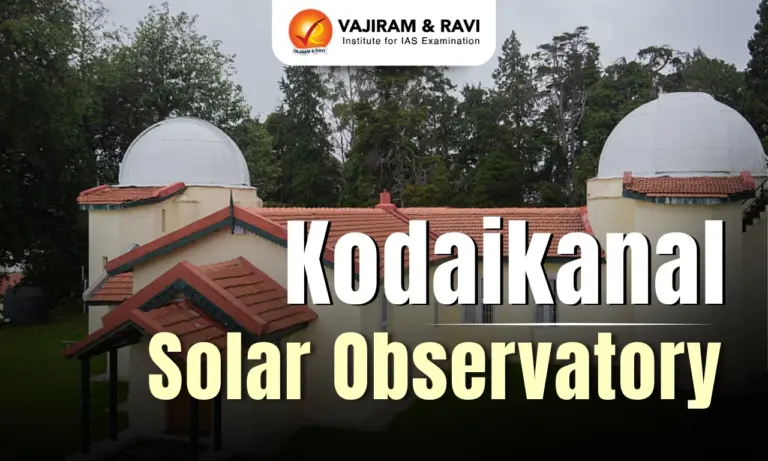
The Kodaikanal Solar Observatory remains one of the world’s most important centres for long-term solar observations, with its century-old solar data continuing to support modern research on solar cycles, space weather, and climate studies.
About Kodaikanal Solar Observatory
The Kodaikanal Solar Observatory (KoSO) is India’s oldest dedicated solar observatory established for the systematic study of the Sun and its influence on Earth.
- It was established in 1899 and is currently operated by the Indian Institute of Astrophysics.
- It is located at Kodaikanal on the southern tip of the Palani Hills at an altitude of over 2,000 metres.
- It was established primarily to study solar activity and its possible relationship with monsoon in India patterns and weather systems.
- It possesses one of the world’s longest continuous records of solar observations spanning more than a century.
- It remains a globally significant centre for solar physics and space weather research.
Kodaikanal Solar Observatory Historical Background
The origins of the Kodaikanal Solar Observatory can be traced to the devastating Great Drought of 1875-1878, one of the worst climatic disasters of the nineteenth century.
- During this period, repeated monsoon failures caused widespread famine in India and contributed to a global famine that claimed nearly 50 million lives.
- The disaster led scientists and policymakers to explore the possible relationship between solar activity and Indian rainfall patterns.
- Acting on the recommendation of the Famine Commission, the Government decided to establish a dedicated solar observatory for systematic study of the Sun and its influence on Indian meteorology.
- Charles Michie Smith was assigned the task of identifying a suitable location for the observatory through extensive surveys across India.
- Northern hill stations such as Leh, Mussoorie, and Shimla were rejected due to cloudiness, dust, and unstable atmospheric conditions.
- Kodaikanal in the Palani Hills was ultimately selected because of its clear skies, low humidity, minimal fog, and excellent atmospheric stability, making it ideal for astronomical observations.
- The Government of India sanctioned the Solar Physics Observatory in 1893, and its foundation stone was laid in 1895, leading to the establishment of the Kodaikanal Solar Observatory in 1899.


Kodaikanal Solar Observatory Major Scientific Contributions
Over the past century, the Kodaikanal Solar Observatory (KoSO) has made several landmark contributions to solar physics and astronomical research through continuous observations of the Sun.
Discovery of the Evershed Effect
- Historic Scientific Discovery: The observatory achieved global recognition when John Evershed discovered the Evershed Effect in January 1909 from observations of sunspots made at KoSO.
- Understanding Sunspots: The Evershed Effect refers to the apparent radial outward flow of gases in the penumbra, or outer region, of sunspots on the Sun.
- Major Contribution to Solar Physics: The discovery remains one of the most significant scientific achievements associated with the observatory.
Long-Term Solar Observations
- Continuous Monitoring of the Sun: KoSO has been imaging and observing the Sun for more than a century, creating a rich repository of solar data.
- Valuable Historical Archive: The observatory’s long-term records help scientists reconstruct the historic behaviour of the Sun and study changes in solar activity over time.
- Space Weather Research: These datasets support efforts to better understand and predict future solar activity and its impact on Earth’s atmosphere and space weather.
Early Solar Physics Research
- Study of Sunspots and Faculae: Early observations focused on examining the Sun’s disc for sunspots and faculae, which are bright regions associated with magnetic activity.
- Observation of Chromospheric Features: Scientists traced bright spectral lines originating from the Sun’s chromosphere and prominences.
- Spectroscopic Analysis of Sunspots: Detailed visual and photographic observations were conducted on spectral lines broadened within sunspots.
- Measurement of Solar Radiation: Regular measurements of solar radiation were carried out during clear-sky conditions.
- Monochromatic Solar Photography: Direct photographs of the Sun were taken using monochromatic light in calcium and hydrogen wavelengths.
Expansion of Research Activities
- Broadening of Scientific Scope: Until the end of the World War 2, KoSO remained primarily a solar physics observatory, after which its research activities expanded significantly.
- New Areas of Research: The observatory began conducting studies in cosmic rays, radio astronomy, ionospheric physics, stellar physics, and related fields.
- Pioneering Solar Radio Observations: Continuous recording of solar radio noise flux commenced in 1952 and is regarded as the earliest systematic solar radio observation programme in India.
Why is Kodaikanal Solar Observatory Important Today?
The Kodaikanal Solar Observatory continues to play a vital role in solar research by providing long-term observational data that supports space weather forecasting, solar physics, and climate studies.
- Space Weather Monitoring: Continuous observations of solar flares, sunspots, and other solar phenomena help scientists understand and predict space weather events that can disrupt satellites, communication networks, navigation systems, and power grids.
- Understanding Solar Cycles: The observatory’s century-long solar records enable researchers to analyse periodic variations in solar activity, improve understanding of the Sun’s magnetic cycles, and validate modern solar observations using historical datasets.
- Supporting Modern Solar Missions: The rich archival data generated by KoSO complements observations from Aditya-L1 and supports national as well as international solar research programmes.
- Climate and Monsoon Research: Long-term solar datasets continue to assist scientists in studying possible links between solar variability, climatic changes, and rainfall patterns, which was the original objective behind the establishment of the observatory.
- Preserving a Unique Solar Archive: More than a century of uninterrupted solar observations has created one of the world’s most valuable solar databases, helping reconstruct the Sun’s past behaviour and improve predictions about its future activity and impact on Earth.

 Last updated on Oct, 2026
→ UPSC 2027 Notification will be released on 13 January 2027 at upsconline.nic.in.
→ Asian Games 2026 are being held in Aichi-Nagoya, Japan, from 19 September to 4 October.
→ Check Nobel Prize 2026 Winners List here.
→ Download PIB PRiSM Monthly Magazine 2026 here.
→ Check UPSC Monthly Current Affairs Magazine The Recitals here.
→ Check out the latest UPSC Syllabus here.
→ Download UPSC Model Answers for Mains 2026
→ UPSC Mains Question Paper 2026 is out now for Essay & GS Paper 1, 2, 3 & 4.
→ UPSC Calendar 2027 has been released.
→ Enroll in Vajiram & Ravi’s UPSC Mains Test Series 2027 for structured answer writing practice, expert evaluation, and exam-oriented feedback.
→ Join Vajiram & Ravi’s UPSC Mentorship Program 2027 for personalized guidance, strategy planning, and one-to-one support from experienced mentors.
→ Go through the UPSC Mains Previous Year Papers to enhance your preparation.
→ UPSC has released UPSC Toppers List 2025 with the Civil Services final result on its official website.
→ Also check Best UPSC Coaching in India
Kodaikanal Solar Observatory FAQs
Q1. Where is the Kodaikanal Solar Observatory located?+
Q2. When was the Kodaikanal Solar Observatory established?+
Q3. Which institution currently operates the Kodaikanal Solar Observatory?+
Q4. Why was the Kodaikanal Solar Observatory established?+
Q5. Why was Kodaikanal chosen as the site for the observatory?+
Q6. How does KoSO contribute to modern solar research?+
Q7. Why is the Kodaikanal Solar Observatory important today?+
Tags: kodaikanal solar observatory