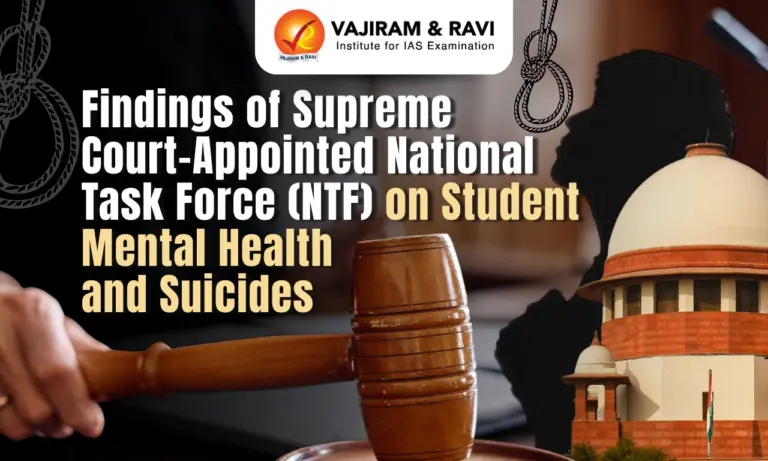
Student suicides have emerged as a serious social, educational, and public health challenge in India. Recognising the growing severity of the problem, the Supreme Court constituted a National Task Force (NTF) under former Supreme Court Judge Justice S. Ravindra Bhat to examine student mental health concerns and recommend measures for suicide prevention in Higher Educational Institutions (HEIs).
Magnitude of Student Suicides in India
Student suicides have steadily increased over the past decade, making them a major concern for policymakers and educational institutions. The National Task Force (NTF) surveyed over 2.43 lakh students and 2,119 higher educational institutions across the country and found that :
- More than 13,000 students died by suicide in India in 2022, accounting for about 7.6% of all suicides in the country. Student suicides exceeded the number of farmer suicides recorded during the same year.
- Student suicides have been reported across both premier institutions and ordinary colleges, indicating a systemic challenge.
- Of the institutions surveyed, 56 reported one or more student suicides between April 2020 and March 2025.
- The Supreme Court described the rising trend as “highly disturbing” while hearing a case related to the deaths of two students at IIT Delhi.
About National Task Force on Student Mental Health
Recognising the growing seriousness of the issue, the Supreme Court constituted the National Task Force (NTF) in March 2025 to examine student mental health concerns and recommend measures for suicide prevention in higher educational institutions.
Composition of the National Task Force: Headed by former Supreme Court Judge Justice S. Ravindra Bhat and includes mental health experts, psychologists, education specialists, and social scientists.
Mandate of task force:
- Examine the causes of student suicides and mental health challenges in HEIs.
- Assess the adequacy of counselling, grievance redressal, and student support mechanisms.
- Recommend a comprehensive framework for suicide prevention and student well-being.
Methodology of the task force:
- Conducted surveys covering 2.43 lakh students and 2,119 institutions.
- Undertook field visits across 10 states, including institutions such as IIT Delhi, AIIMS Delhi, JNU, and Jamia Millia Islamia.
- Consulted students, parents, faculty members, administrators, and experts.
- Submitted an interim report in November 2025 and has been granted time till October 2026 to submit its final report.
The Task Force adopted a multidisciplinary approach and concluded that student suicides are driven by a combination of psychological, academic, social, economic, and institutional factors rather than mental health concerns alone.


Major Findings of the Supreme Court-Appointed National Task Force (NTF)
The interim report of the National Task Force (NTF) reveals deep institutional, psychological, social, and governance-related challenges that contribute to student distress and suicide.
Absence of a Dedicated Suicide Prevention Framework: India lacks a specific statutory, regulatory, or institutional framework for preventing student suicides in higher educational institutions.
- Existing interventions remain fragmented, generic, and largely reactive rather than preventive.
- The National Suicide Prevention Strategy (2022) provides broad guidance but does not prescribe institution-specific implementation mechanisms.
- No uniform national standards exist for early identification, counselling, crisis intervention, or post-crisis response.
- Institutions often respond only after a suicide occurs rather than building preventive support systems.
Severe Deficit in Mental Health Services: The report highlights a widespread absence of professional mental health support across higher educational institutions.
- Around 65% of surveyed institutions do not provide access to mental health service providers.
- Only 35% of institutions reported offering professional mental health services.
- Approximately 73% of institutions lack a full-time mental health professional.
- Many institutions depend on occasional counselling sessions rather than continuous support mechanisms.
- Mental health services remain particularly weak in smaller institutions and non-metropolitan regions.
Lack of Suicide Risk Assessment and Crisis Management Systems: The Task Force identified serious shortcomings in institutional preparedness for suicide prevention.
- Fewer than 4% of surveyed institutions have formal suicide-risk management protocols.
- There are no standard procedures for risk assessment, referral, intervention, and follow-up support.
- Institutions generally do not maintain databases relating to student mental health vulnerabilities
- Crisis response mechanisms remain poorly developed across campuses.
Disturbing Mental Health Indicators Among Students: The student survey reveals widespread psychological distress among young people.
- Around 15% of students reported prolonged periods of anxiety, depression, distress, or low mood during the previous six months.
- Approximately 9% reported experiencing suicidal thoughts often or very often during the previous year
- Feelings of loneliness, alienation, and lack of belonging were common across institutions.
Academic Pressure and Performance Anxiety: The report identifies academic stress as a major contributor to student distress.
- Intense competition for grades, placements, scholarships, and career opportunities creates continuous pressure.
- Competitive examinations and demanding academic schedules contribute to anxiety and burnout.
- Fear of failure often generates chronic stress and low self-esteem
- Students frequently experience pressure arising from parental expectations and societal aspirations.
- Rigid and unyielding attendance policies further aggravate academic stress.
Financial Stress and Scholarship-Related Challenges: Economic insecurity emerged as an important factor affecting student mental health.
- Students reported delays, inconsistencies, and uncertainties in scholarship disbursement.
- Delayed reimbursements often created financial hardships for economically vulnerable students.
- Some institutions deducted expected scholarship amounts from fees and later demanded payment when government reimbursements were delayed
- Financial pressures often intensified academic and emotional stress.
- Students from disadvantaged backgrounds faced greater uncertainty regarding continuation of education.
Social Isolation and Lack of Belonging: Nearly 34% of surveyed students reported feeling like outsiders on their campuses.
- Students from different linguistic, cultural, and regional backgrounds often struggle to integrate into campus life.
- Only 56% of students expressed confidence that their institutions would address serious concerns fairly and effectively.
- First-generation learners face additional challenges in adapting to institutional environments.
- Social disconnectedness frequently contributes to anxiety, depression, and withdrawal.
Caste-Based Discrimination and Social Exclusion: The report draws attention to the continuing influence of social hierarchies within higher education institutions.
- Students from SC, ST, and OBC communities often hesitate to discuss experiences of discrimination.
- Fear of being labelled or marked discourages many students from reporting grievances.
- Negative perceptions regarding reservation policies continue to shape campus interaction. Students from socially advantaged groups frequently expressed resentment regarding reservation policies.
- Experiences of exclusion, prejudice, and stereotyping adversely affect mental well-being.
Sexual Harassment and Gender-Related Concerns: Students reported the prevalence of sexual harassment and dissatisfaction with institutional responses.
- Cases of complaint suppression, delayed action, and biased proceedings were highlighted.
- Internal Complaints Committees (ICCs) often failed to inspire confidence among students.
- Fear of social stigma discouraged reporting of sensitive issues.
Committees Existing Only on Paper: The Task Force found a large gap between regulatory compliance and actual implementation.
- Anti-ragging cells, counselling committees, and grievance bodies often existed only to satisfy formal requirements.
- Committee members were frequently unaware of their mandated responsibilities.
- Student-support structures lacked visibility, accessibility, and effectiveness.
- Compliance was often procedural rather than outcome-oriented.
Weak Grievance Redressal Mechanisms: The survey revealed widespread dissatisfaction with complaint-resolution systems.
- Grievance redressal mechanisms were frequently non-functional or minimally operational.
- Students often perceived complaint systems as ineffective and inaccessible.
- Transparency and accountability remained weak.
- Delayed resolution reduced confidence in institutional processes
- Fear of retaliation discouraged students from reporting concerns.
Lack of Institutional Empathy and Supportive Culture: The Task Force observed a serious absence of institutional empathy towards distressed students.
- Institutions where suicides occurred often displayed denial of responsibility rather than introspection.
- Student protests following suicides were sometimes discouraged, suppressed, or met with punitive actions.
Deep-Rooted Structural and Systemic Challenges: The Task Force emphasised that student suicides cannot be viewed solely as mental health issues.
- Academic pressure, discrimination, financial stress, social isolation, harassment, and institutional failures interact in complex ways.
- The diversity of Indian society requires tailored support mechanisms rather than a one-size-fits-all approach.
- Significant gaps exist in data collection, monitoring, and evidence-based policymaking.
Existing Government Initiatives Related to Student Mental Health
- National Suicide Prevention Strategy (2022): India’s first national suicide prevention framework aims to reduce suicide mortality through early identification of vulnerable individuals, strengthening mental health services, responsible media reporting, crisis intervention mechanisms, and awareness campaigns; however, it does not provide a dedicated operational framework for higher educational institutions.
- National Mental Health Programme (NMHP): Seeks to improve access to affordable mental healthcare through capacity building, treatment facilities, community outreach, and integration of mental health services into the general healthcare system, though its direct linkage with university campuses remains limited.
- District Mental Health Programme (DMHP): Operational under NMHP, it provides counselling, psychiatric treatment, awareness generation, and community-based mental healthcare at the district level, helping expand mental health service delivery beyond major urban centres.
- Tele-MANAS (Tele Mental Health Assistance and Networking Across States): Launched under the National Tele Mental Health Programme, it offers free 24×7 tele-counselling and psychological support through trained professionals, enabling wider access to mental health services, particularly for youth and students.
- MANODARPAN Initiative: Introduced by the Ministry of Education to provide psychosocial support, counselling services, stress management resources, and mental health awareness programmes for students, teachers, and families through digital platforms and helplines.
- UGC Guidelines on Student Mental Health and Well-being: Require universities and colleges to establish counselling centres, wellness centres, anti-ragging committees, Internal Complaints Committees (ICCs), Equal Opportunity Cells, and grievance redressal mechanisms to address student concerns and promote a supportive campus environment.
- UGC Guidelines for Promotion of Physical Fitness, Emotional Well-being and Mental Health of Students: Encourage institutions to organise regular counselling sessions, peer-support programmes, mental health awareness activities, stress-management workshops, and wellness initiatives.
- Anti-Ragging Framework of UGC: Mandates anti-ragging committees, anti-ragging squads, online affidavits, and complaint mechanisms to prevent harassment and psychological trauma among students.
- National Education Policy (NEP) 2020: Promotes holistic and multidisciplinary education, reduction of excessive academic pressure, flexibility in learning pathways, student-centric pedagogy, and the creation of inclusive and supportive educational ecosystems.
- KIRAN Mental Health Rehabilitation Helpline: Provides a 24×7 toll-free national helpline offering psychological support, emotional counselling, crisis intervention, and referrals to mental health professionals for individuals facing mental health challenges.
- Institutional Counselling and Wellness Centres: Several centrally funded institutions such as IITs, IIMs, AIIMS, and Central Universities have established wellness centres, student support cells, and professional counselling services to address academic stress, anxiety, depression, and emotional well-being.
- NIMHANS-led Mental Health Capacity Building Programmes: The National Institute of Mental Health and Neurosciences supports training, research, awareness generation, and capacity building for mental health professionals, educators, and institutions across the country.
Gaps in Existing Initiatives
Despite multiple initiatives, substantial shortcomings remain.
- No dedicated legal framework exists specifically for student suicide prevention.
- Most initiatives focus on awareness rather than institutional accountability.
- Mental health professionals remain unavailable in most institutions.
- Existing guidelines lack effective monitoring and enforcement mechanisms.
- Counselling services remain unevenly distributed across institutions.
- Campus-specific risk management systems are largely absent.
- Social and structural determinants of distress receive insufficient attention.
Way Forward
A comprehensive and preventive approach is required to address student suicides effectively.
- Enact a dedicated national framework for student mental health and suicide prevention in higher educational institutions.
- Mandate full-time psychologists, counsellors, and mental health professionals in all universities and colleges.
- Establish standardised suicide-risk assessment, crisis intervention, and referral protocols across institutions.
- Strengthen grievance redressal systems with transparency, independence, and student participation.
- Ensure timely scholarship disbursement and expand financial support mechanisms for vulnerable students.
- Promote inclusive campuses through anti-discrimination measures and sensitivity training.
- Introduce flexible academic policies that balance excellence with student well-being.
- Develop peer-support networks, mentorship programmes, and community-building initiatives.
- Strengthen monitoring of UGC guidelines through periodic audits and accountability mechanisms.
- Integrate mental health services into the broader framework of educational governance and student welfare.

 Last updated on Sep, 2026
→ UPSC 2027 Notification will be released on 13 January 2027 at upsconline.nic.in.
→ UPSC Mains Question Paper 2026 is out now for Essay & GS Paper 1, 2, 3 & 4.
→ UPSC Mains GS Paper 1 2026 is out now.
→ UPSC Mains GS Paper 2 2026 is out now.
→ UPSC Mains GS Paper 3 2026 is out now.
→ UPSC Mains GS Paper 4 2026 is out now.
→ UPSC Mains Indian Language Paper & English Compulsory Paper are out now.
→ Check out the latest UPSC Syllabus 2026 here.
→ UPSC Mains Admit Card 2026 is now out.
→ Enroll in Vajiram & Ravi’s UPSC Mains Test Series 2027 for structured answer writing practice, expert evaluation, and exam-oriented feedback.
→ Join Vajiram & Ravi’s UPSC Mentorship Program 2027 for personalized guidance, strategy planning, and one-to-one support from experienced mentors.
→ Go through the UPSC Mains Previous Year Papers to enhance your preparation.
→ Download UPSC Mains Essay Paper 2025, UPSC Mains GS Paper-I 2025, UPSC Mains GS Paper-II 2025, UPSC Mains GS Paper-III 2025, UPSC Mains GS Paper-IV 2025, UPSC Mains English (Compulsory) Paper 2025, UPSC Mains Hindi (Qualifying) Paper 2025 here.
→ UPSC has released UPSC Toppers List 2025 with the Civil Services final result on its official website.
→ UPSC Calendar 2027 has been released.
→ Also check Best UPSC Coaching in India
Findings of Supreme Court-Appointed National Task Force (NTF) on Student Mental Health and Suicides FAQs
Q1. Why was the National Task Force (NTF) constituted by the Supreme Court?+
Q2. What is the most significant finding of the NTF?+
Q3. What percentage of students reported suicidal thoughts according to the NTF?+
Q4. What are the major causes of student distress identified by the NTF?+
Q5. What key reform has been recommended by the NTF?+